PHARMACOLOGICAL PERSPECTIVES
  IN NURSE’S CONTEXTUALITIES
FIVE RIGHTS IN DRUG
                 ADMINISTRATION
 RIGHT DOSE
    The nurse
       Minimizes any forms of errors
       Checks the supply – UNIT DOSE or STOCK SUPPLY
       Requires two nurses to verify the medicine being administered

 RIGHT DRUG
    The nurse
       Compares the medicine card or unit dose recording form with
        the physician’s order
       Compares the label three times
       Administers one has prepared
FIVE RIGHTS IN DRUG ADMINISTRATION

 RIGHT CLIENT
   The nurse
      Identifies the patient correctly
 RIGHT ROUTE
   Oral (Buccal or Sublingual)
   Parenteral
FIVE RIGHTS IN DRUG ADMINISTRATION

 RIGHT TIME
   The nurse must know why a medicine is ordered
    for certain times of the day & whether the time can
    be altered
      EXAMPLE: q8h and TID
      The q8h (every 8 hour) is intended for around the clock
      TID (three times a day) is given during waking hours (8 – 1 – 6)
      QID (8 – 12 – 4 – 6)
      Physician orders (stat, prn, single dose, standing)
FIVE RIGHTS IN DRUG ADMINISTRATION

 RIGHT ASSESSMENT
 RIGHT APPROACH
 RIGHT DOCUMENTATION
 RIGHT EVALUATION
 RIGHT TO CONSIDER THE CLIENT’S
  REFUSAL TO TREATMENT OR
  MEDICATION
ORAL MEDICATION

• Assessment – client’s knowledge, diet status, oral
  cavity, ability to swallow
• Enteric coated not be crushed only the scored tablet
• Time release capsule contents may be mixed with
  food
• SOLID MEDICATIONS
   – All solid medications can be placed in one container unless
     if one needs further assessment before administering
   – Unit dose in original individual package
   – Reduce chance of contamination – medicines into cap of
     container, top side down, transfer to medicine cap and
     replace lid and container
ORAL MEDICATION
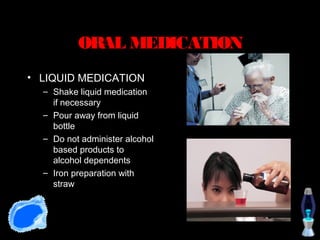
• LIQUID MEDICATION
  – Shake liquid medication
    if necessary
  – Pour away from liquid
    bottle
  – Do not administer alcohol
    based products to
    alcohol dependents
  – Iron preparation with
    straw
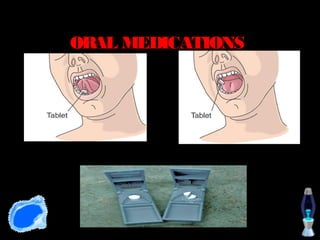
ORAL MEDICATIONS
ORAL MEDICATIONS
• Absorption is reduced by the presence of
  food
• Dilute or dissolve irritating drugs to reduce
  gastric irritation
ORAL MEDICATIONS
• INFANTS
  – Use calibrated dropper, nipple or syringe
  – Keep infant 45 degrees
  – Not to use medicine as child’s favorite food or
    punishment
  – If using NGT, check for patency
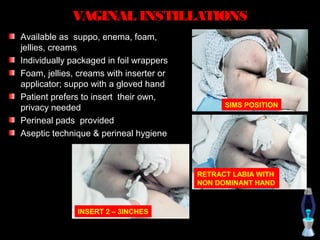
VAGINAL INSTILLATIONS
Available as suppo, enema, foam,
jellies, creams
Individually packaged in foil wrappers
Foam, jellies, creams with inserter or
applicator; suppo with a gloved hand
Patient prefers to insert their own,
privacy needed                                 SIMS POSITION

Perineal pads provided
Aseptic technique & perineal hygiene


                                         RETRACT LABIA WITH
                                         NON DOMINANT HAND


              INSERT 2 – 3INCHES
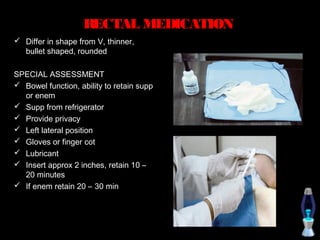
RECTAL MEDICATION
 Differ in shape from V, thinner,
  bullet shaped, rounded

SPECIAL ASSESSMENT
 Bowel function, ability to retain supp
  or enem
 Supp from refrigerator
 Provide privacy
 Left lateral position
 Gloves or finger cot
 Lubricant
 Insert approx 2 inches, retain 10 –
  20 minutes
 If enem retain 20 – 30 min
OTIC INSTILLATIONS

         Internal ear structures

High sensitivity with extreme temperatures

    Causes vertigo (severe dizziness)
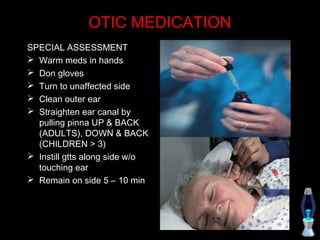
OTIC MEDICATION
SPECIAL ASSESSMENT
 Warm meds in hands
 Don gloves
 Turn to unaffected side
 Clean outer ear
 Straighten ear canal by
  pulling pinna UP & BACK
  (ADULTS), DOWN & BACK
  (CHILDREN > 3)
 Instill gtts along side w/o
  touching ear
 Remain on side 5 – 10 min
OPTHALMIC APPLICATION

Eye drops, ointment, OTC artificial tears, vasoconstrictors

                           PRINCIPLES

Cornea is supplied with pain fibers
Risk of transmitting infection
Used only for affected eye
Never allows a person to use another’s eye medication
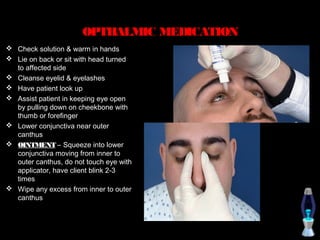
OPTHALMIC MEDICATION
 Check solution & warm in hands
 Lie on back or sit with head turned
  to affected side
 Cleanse eyelid & eyelashes
 Have patient look up
 Assist patient in keeping eye open
  by pulling down on cheekbone with
  thumb or forefinger
 Lower conjunctiva near outer
  canthus
 OINTMENT – Squeeze into lower
  conjunctiva moving from inner to
  outer canthus, do not touch eye with
  applicator, have client blink 2-3
  times
 Wipe any excess from inner to outer
  canthus
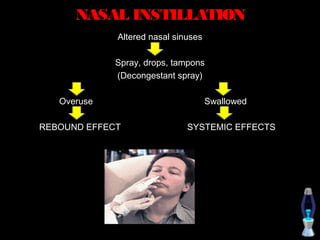
NASAL INSTILLATION
             Altered nasal sinuses

             Spray, drops, tampons
             (Decongestant spray)

   Overuse                           Swallowed

REBOUND EFFECT                SYSTEMIC EFFECTS
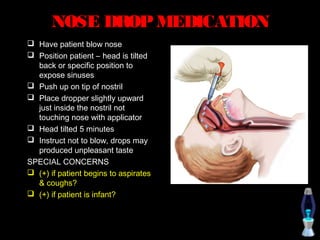
NOSE DROP MEDICATION
 Have patient blow nose
 Position patient – head is tilted
  back or specific position to
  expose sinuses
 Push up on tip of nostril
 Place dropper slightly upward
  just inside the nostril not
  touching nose with applicator
 Head tilted 5 minutes
 Instruct not to blow, drops may
  produced unpleasant taste
SPECIAL CONCERNS
 (+) if patient begins to aspirates
  & coughs?
 (+) if patient is infant?
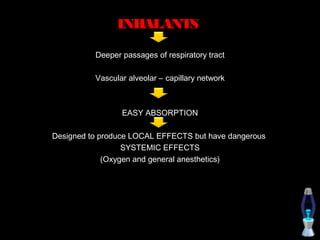
INHALANTS

          Deeper passages of respiratory tract

          Vascular alveolar – capillary network


                 EASY ABSORPTION

Designed to produce LOCAL EFFECTS but have dangerous
                  SYSTEMIC EFFECTS
             (Oxygen and general anesthetics)
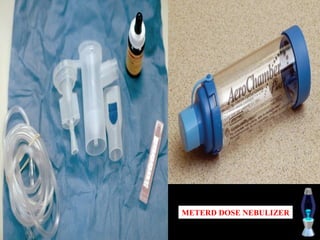
METERD DOSE NEBULIZER
ORAL INHALER
METERED DOSE
 INHALER
IRRIGATION
• Medications may be used to irrigate or wash
  out body cavity & delivered thru a stream of
  solution (sterile water, NSS, antiseptic)
• Eye, ear, throat, vagina & urinary tract
• Avoid further injury to the tissue
• Prevent transmission of infection
• Maintain patient’s comfort
PARENTERAL DRUG ADMINISTRATION


ADVANTAGES                   DISADVANTAGES
• More rapid absorption      • Penetrates the first line of
  and effect                   defense, the skin
• Effects are more           • Danger of damaging
  predictable                  nerves and blood vessels
• Desirable for patients     • Pain might be present
  who are irrational,        • Possibility of abscess
  unconscious on having GI     formation
  disturbances
PARENTERAL DR ADMINISTRATION
                       UG
              SPECIAL CONSIDERATION
The size and type are determined by     Know the volume of the drug
the type of medication and amount
to be injected                          Characteristics
The size of the needle is determined    Viscosity
by the route of administration, size,   Anatomical structures or
age                                     landmarks
Surgical asepsis
                                        Position of comfort
No way of protecting unused
medication
                                        Ice application prior
Rotate sites                            Divert client attention
Do not mixed
Assess if you need assistance –
restraining or turning
Countercheck
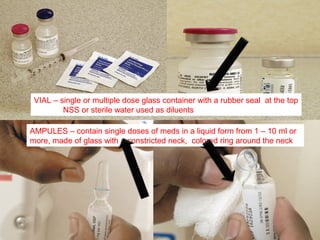
VIAL – single or multiple dose glass container with a rubber seal at the top
         NSS or sterile water used as diluents

AMPULES – contain single doses of meds in a liquid form from 1 – 10 ml or
more, made of glass with a constricted neck, colored ring around the neck
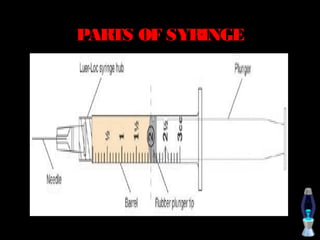
PARTS OF SYRINGE
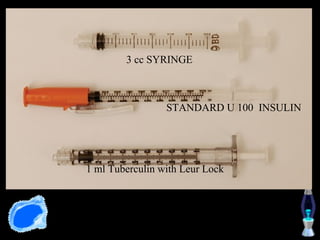
3 cc SYRINGE


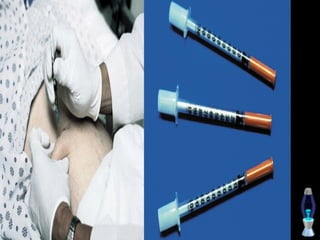
                 STANDARD U 100 INSULIN


1 ml Tuberculin with Leur Lock
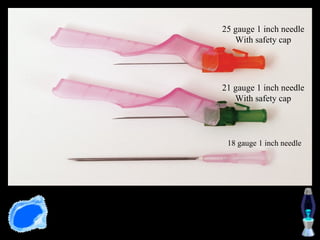
25 gauge 1 inch needle
   With safety cap


21 gauge 1 inch needle
   With safety cap


 18 gauge 1 inch needle
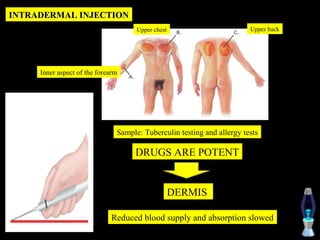
INTRADERMAL INJECTION
                                     Upper chest                        Upper back


     Inner aspect of the forearm


                               Sample: Tuberculin testing and allergy tests

                                    DRUGS ARE POTENT


                                                   DERMIS

                             Reduced blood supply and absorption slowed
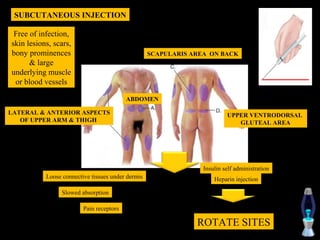
SUBCUTANEOUS INJECTION

 Free of infection,
skin lesions, scars,
bony prominences                                   SCAPULARIS AREA ON BACK
      & large
underlying muscle
 or blood vessels

                                          ABDOMEN

LATERAL & ANTERIOR ASPECTS                                                UPPER VENTRODORSAL
   OF UPPER ARM & THIGH                                                      GLUTEAL AREA


                                                                 Insulin self administration
           Loose connective tissues under dermis                     Heparin injection

                 Slowed absorption

                         Pain receptors

                                                               ROTATE SITES
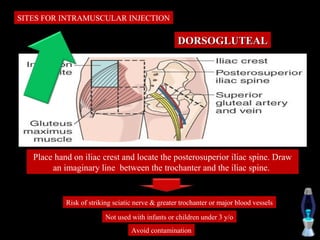
SITES FOR INTRAMUSCULAR INJECTION

                                                   DORSOGLUTEAL


   Place hand on iliac crest and locate the posterosuperior iliac spine. Draw
        an imaginary line between the trochanter and the iliac spine.


            Risk of striking sciatic nerve & greater trochanter or major blood vessels

                          Not used with infants or children under 3 y/o
                                   Avoid contamination
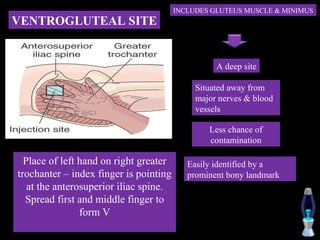
INCLUDES GLUTEUS MUSCLE & MINIMUS
VENTROGLUTEAL SITE


                                                  A deep site

                                             Situated away from
                                             major nerves & blood
                                             vessels

                                                Less chance of
                                                contamination

  Place of left hand on right greater      Easily identified by a
trochanter – index finger is pointing      prominent bony landmark
   at the anterosuperior iliac spine.
  Spread first and middle finger to
                form V
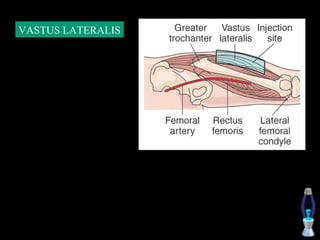
VASTUS LATERALIS
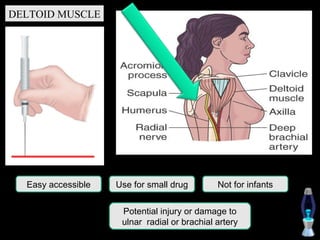
DELTOID MUSCLE


  Easy accessible   Use for small drug        Not for infants


                     Potential injury or damage to
                     ulnar radial or brachial artery
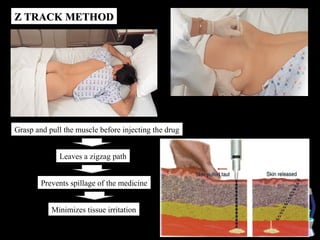
Z TRACK METHOD


Grasp and pull the muscle before injecting the drug


             Leaves a zigzag path


        Prevents spillage of the medicine


           Minimizes tissue irritation
MAJOR LONG EXAMINATION


      APRIL 14, 2008
        MONDAY

Medications

  • 1.
    PHARMACOLOGICAL PERSPECTIVES IN NURSE’S CONTEXTUALITIES
  • 2.
    FIVE RIGHTS INDRUG ADMINISTRATION  RIGHT DOSE  The nurse  Minimizes any forms of errors  Checks the supply – UNIT DOSE or STOCK SUPPLY  Requires two nurses to verify the medicine being administered  RIGHT DRUG  The nurse  Compares the medicine card or unit dose recording form with the physician’s order  Compares the label three times  Administers one has prepared
  • 3.
    FIVE RIGHTS INDRUG ADMINISTRATION  RIGHT CLIENT  The nurse  Identifies the patient correctly  RIGHT ROUTE  Oral (Buccal or Sublingual)  Parenteral
  • 4.
    FIVE RIGHTS INDRUG ADMINISTRATION  RIGHT TIME  The nurse must know why a medicine is ordered for certain times of the day & whether the time can be altered  EXAMPLE: q8h and TID  The q8h (every 8 hour) is intended for around the clock  TID (three times a day) is given during waking hours (8 – 1 – 6)  QID (8 – 12 – 4 – 6)  Physician orders (stat, prn, single dose, standing)
  • 5.
    FIVE RIGHTS INDRUG ADMINISTRATION  RIGHT ASSESSMENT  RIGHT APPROACH  RIGHT DOCUMENTATION  RIGHT EVALUATION  RIGHT TO CONSIDER THE CLIENT’S REFUSAL TO TREATMENT OR MEDICATION
  • 6.
    ORAL MEDICATION • Assessment– client’s knowledge, diet status, oral cavity, ability to swallow • Enteric coated not be crushed only the scored tablet • Time release capsule contents may be mixed with food • SOLID MEDICATIONS – All solid medications can be placed in one container unless if one needs further assessment before administering – Unit dose in original individual package – Reduce chance of contamination – medicines into cap of container, top side down, transfer to medicine cap and replace lid and container
  • 7.
    ORAL MEDICATION • LIQUIDMEDICATION – Shake liquid medication if necessary – Pour away from liquid bottle – Do not administer alcohol based products to alcohol dependents – Iron preparation with straw
  • 8.
  • 9.
    ORAL MEDICATIONS • Absorptionis reduced by the presence of food • Dilute or dissolve irritating drugs to reduce gastric irritation
  • 10.
    ORAL MEDICATIONS • INFANTS – Use calibrated dropper, nipple or syringe – Keep infant 45 degrees – Not to use medicine as child’s favorite food or punishment – If using NGT, check for patency
  • 11.
    VAGINAL INSTILLATIONS Available assuppo, enema, foam, jellies, creams Individually packaged in foil wrappers Foam, jellies, creams with inserter or applicator; suppo with a gloved hand Patient prefers to insert their own, privacy needed SIMS POSITION Perineal pads provided Aseptic technique & perineal hygiene RETRACT LABIA WITH NON DOMINANT HAND INSERT 2 – 3INCHES
  • 12.
    RECTAL MEDICATION  Differin shape from V, thinner, bullet shaped, rounded SPECIAL ASSESSMENT  Bowel function, ability to retain supp or enem  Supp from refrigerator  Provide privacy  Left lateral position  Gloves or finger cot  Lubricant  Insert approx 2 inches, retain 10 – 20 minutes  If enem retain 20 – 30 min
  • 13.
    OTIC INSTILLATIONS Internal ear structures High sensitivity with extreme temperatures Causes vertigo (severe dizziness)
  • 14.
    OTIC MEDICATION SPECIAL ASSESSMENT Warm meds in hands  Don gloves  Turn to unaffected side  Clean outer ear  Straighten ear canal by pulling pinna UP & BACK (ADULTS), DOWN & BACK (CHILDREN > 3)  Instill gtts along side w/o touching ear  Remain on side 5 – 10 min
  • 15.
    OPTHALMIC APPLICATION Eye drops,ointment, OTC artificial tears, vasoconstrictors PRINCIPLES Cornea is supplied with pain fibers Risk of transmitting infection Used only for affected eye Never allows a person to use another’s eye medication
  • 16.
    OPTHALMIC MEDICATION  Checksolution & warm in hands  Lie on back or sit with head turned to affected side  Cleanse eyelid & eyelashes  Have patient look up  Assist patient in keeping eye open by pulling down on cheekbone with thumb or forefinger  Lower conjunctiva near outer canthus  OINTMENT – Squeeze into lower conjunctiva moving from inner to outer canthus, do not touch eye with applicator, have client blink 2-3 times  Wipe any excess from inner to outer canthus
  • 17.
    NASAL INSTILLATION Altered nasal sinuses Spray, drops, tampons (Decongestant spray) Overuse Swallowed REBOUND EFFECT SYSTEMIC EFFECTS
  • 18.
    NOSE DROP MEDICATION Have patient blow nose  Position patient – head is tilted back or specific position to expose sinuses  Push up on tip of nostril  Place dropper slightly upward just inside the nostril not touching nose with applicator  Head tilted 5 minutes  Instruct not to blow, drops may produced unpleasant taste SPECIAL CONCERNS  (+) if patient begins to aspirates & coughs?  (+) if patient is infant?
  • 19.
    INHALANTS Deeper passages of respiratory tract Vascular alveolar – capillary network EASY ABSORPTION Designed to produce LOCAL EFFECTS but have dangerous SYSTEMIC EFFECTS (Oxygen and general anesthetics)
  • 20.
  • 21.
  • 22.
    IRRIGATION • Medications maybe used to irrigate or wash out body cavity & delivered thru a stream of solution (sterile water, NSS, antiseptic) • Eye, ear, throat, vagina & urinary tract • Avoid further injury to the tissue • Prevent transmission of infection • Maintain patient’s comfort
  • 23.
    PARENTERAL DRUG ADMINISTRATION ADVANTAGES DISADVANTAGES • More rapid absorption • Penetrates the first line of and effect defense, the skin • Effects are more • Danger of damaging predictable nerves and blood vessels • Desirable for patients • Pain might be present who are irrational, • Possibility of abscess unconscious on having GI formation disturbances
  • 24.
    PARENTERAL DR ADMINISTRATION UG SPECIAL CONSIDERATION The size and type are determined by Know the volume of the drug the type of medication and amount to be injected Characteristics The size of the needle is determined Viscosity by the route of administration, size, Anatomical structures or age landmarks Surgical asepsis Position of comfort No way of protecting unused medication Ice application prior Rotate sites Divert client attention Do not mixed Assess if you need assistance – restraining or turning Countercheck
  • 25.
    VIAL – singleor multiple dose glass container with a rubber seal at the top NSS or sterile water used as diluents AMPULES – contain single doses of meds in a liquid form from 1 – 10 ml or more, made of glass with a constricted neck, colored ring around the neck
  • 26.
  • 27.
    3 cc SYRINGE STANDARD U 100 INSULIN 1 ml Tuberculin with Leur Lock
  • 28.
    25 gauge 1inch needle With safety cap 21 gauge 1 inch needle With safety cap 18 gauge 1 inch needle
  • 29.
    INTRADERMAL INJECTION Upper chest Upper back Inner aspect of the forearm Sample: Tuberculin testing and allergy tests DRUGS ARE POTENT DERMIS Reduced blood supply and absorption slowed
  • 31.
    SUBCUTANEOUS INJECTION Freeof infection, skin lesions, scars, bony prominences SCAPULARIS AREA ON BACK & large underlying muscle or blood vessels ABDOMEN LATERAL & ANTERIOR ASPECTS UPPER VENTRODORSAL OF UPPER ARM & THIGH GLUTEAL AREA Insulin self administration Loose connective tissues under dermis Heparin injection Slowed absorption Pain receptors ROTATE SITES
  • 33.
    SITES FOR INTRAMUSCULARINJECTION DORSOGLUTEAL Place hand on iliac crest and locate the posterosuperior iliac spine. Draw an imaginary line between the trochanter and the iliac spine. Risk of striking sciatic nerve & greater trochanter or major blood vessels Not used with infants or children under 3 y/o Avoid contamination
  • 34.
    INCLUDES GLUTEUS MUSCLE& MINIMUS VENTROGLUTEAL SITE A deep site Situated away from major nerves & blood vessels Less chance of contamination Place of left hand on right greater Easily identified by a trochanter – index finger is pointing prominent bony landmark at the anterosuperior iliac spine. Spread first and middle finger to form V
  • 35.
  • 36.
    DELTOID MUSCLE Easy accessible Use for small drug Not for infants Potential injury or damage to ulnar radial or brachial artery
  • 38.
    Z TRACK METHOD Graspand pull the muscle before injecting the drug Leaves a zigzag path Prevents spillage of the medicine Minimizes tissue irritation
  • 42.
    MAJOR LONG EXAMINATION APRIL 14, 2008 MONDAY