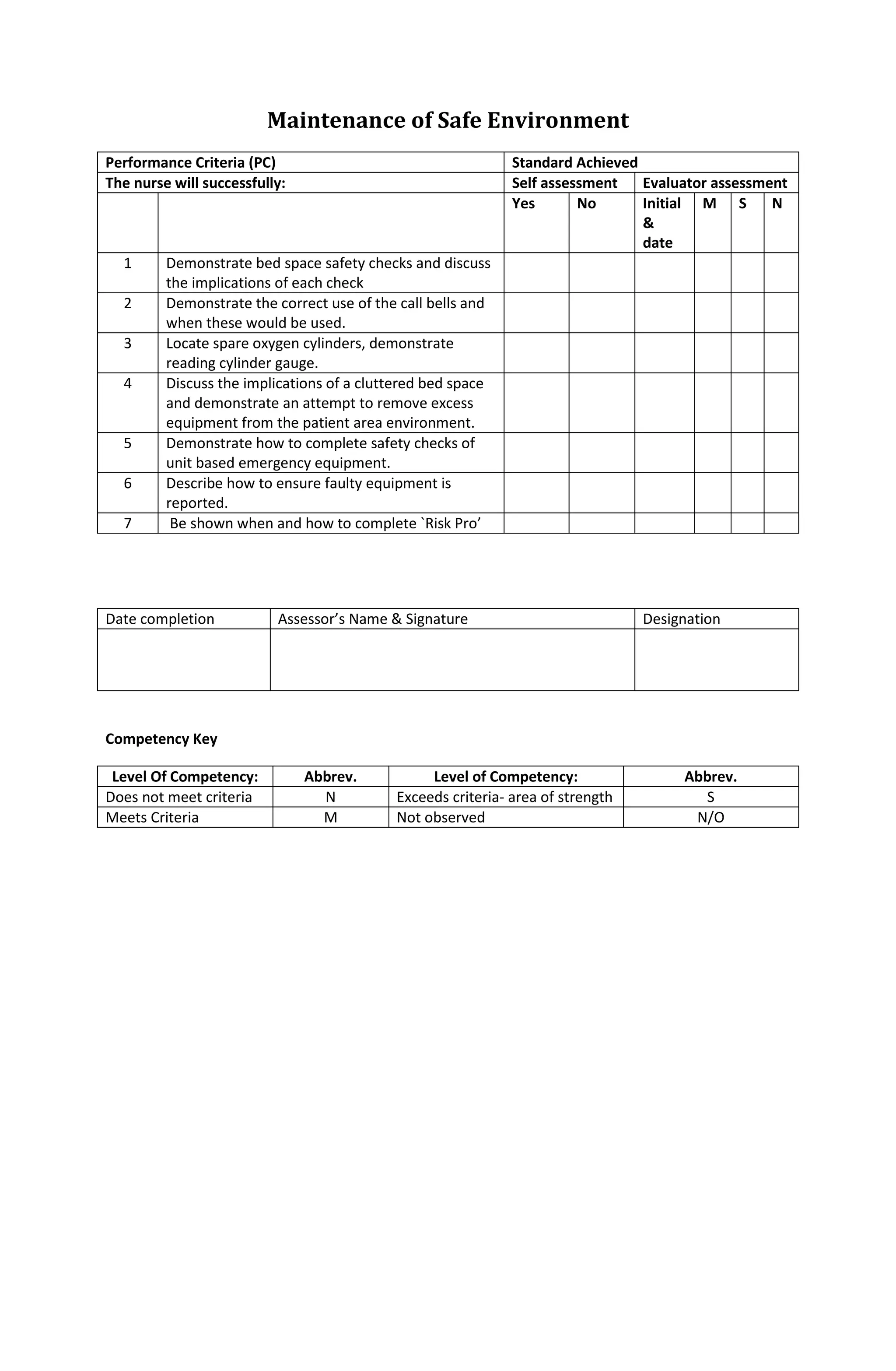
Maintenance of Safe Environment
Performance Criteria (PC) Standard Achieved
The nurse will successfully: Self assessment Evaluator assessment
Yes No Initial
&
date
M S N
1 Demonstrate bed space safety checks and discuss
the implications of each check
2 Demonstrate the correct use of the call bells and
when these would be used.
3 Locate spare oxygen cylinders, demonstrate
reading cylinder gauge.
4 Discuss the implications of a cluttered bed space
and demonstrate an attempt to remove excess
equipment from the patient area environment.
5 Demonstrate how to complete safety checks of
unit based emergency equipment.
6 Describe how to ensure faulty equipment is
reported.
7 Be shown when and how to complete `Risk Pro’
Date completion Assessor’s Name & Signature Designation
Competency Key
Level Of Competency: Abbrev. Level of Competency: Abbrev.
Does not meet criteria N Exceeds criteria- area of strength S
Meets Criteria M Not observed N/O
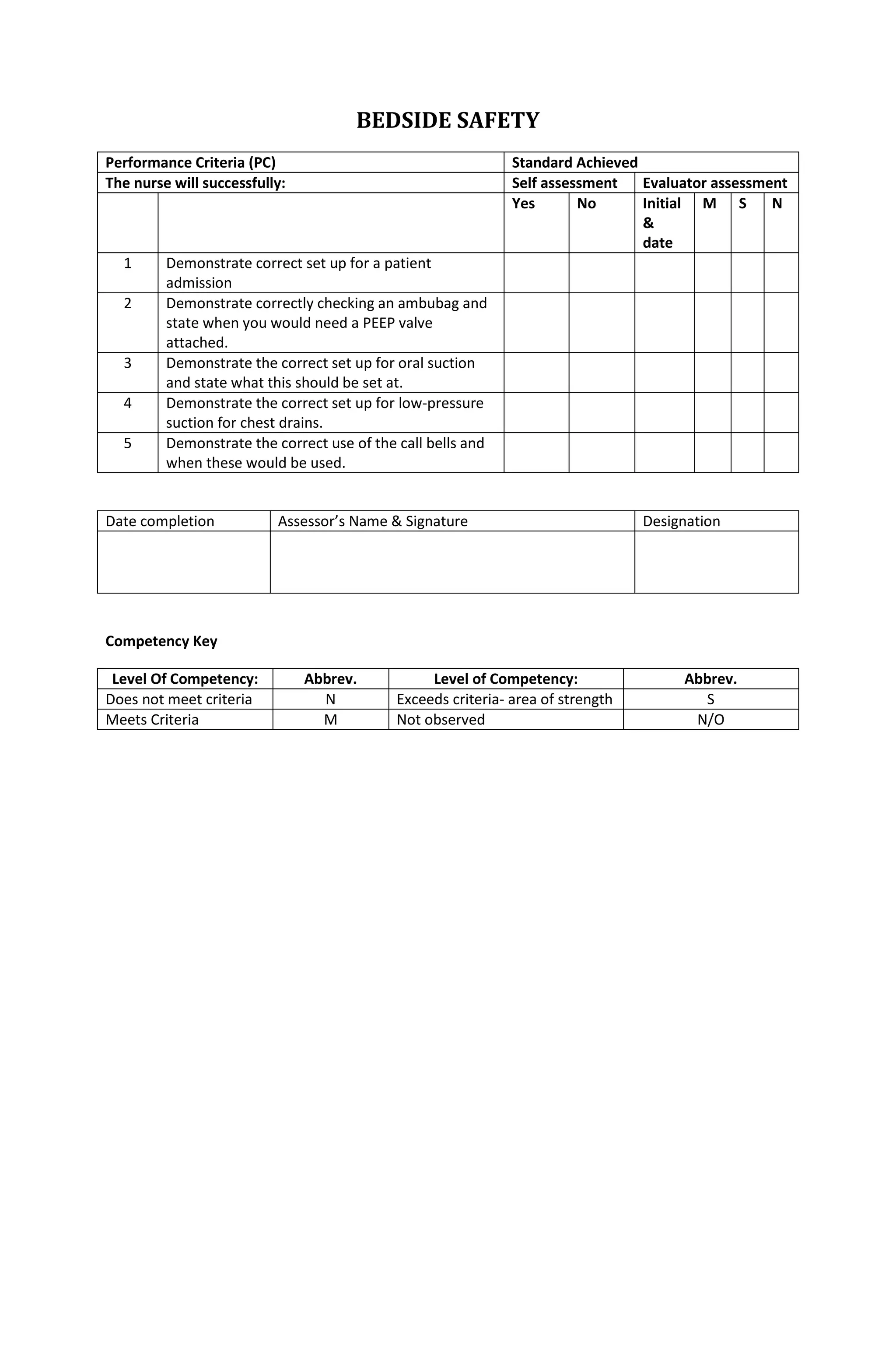
BEDSIDE SAFETY
Performance Criteria (PC) Standard Achieved
The nurse will successfully: Self assessment Evaluator assessment
Yes No Initial
&
date
M S N
1 Demonstrate correct set up for a patient
admission
2 Demonstrate correctly checking an ambubag and
state when you would need a PEEP valve
attached.
3 Demonstrate the correct set up for oral suction
and state what this should be set at.
4 Demonstrate the correct set up for low-pressure
suction for chest drains.
5 Demonstrate the correct use of the call bells and
when these would be used.
Date completion Assessor’s Name & Signature Designation
Competency Key
Level Of Competency: Abbrev. Level of Competency: Abbrev.
Does not meet criteria N Exceeds criteria- area of strength S
Meets Criteria M Not observed N/O
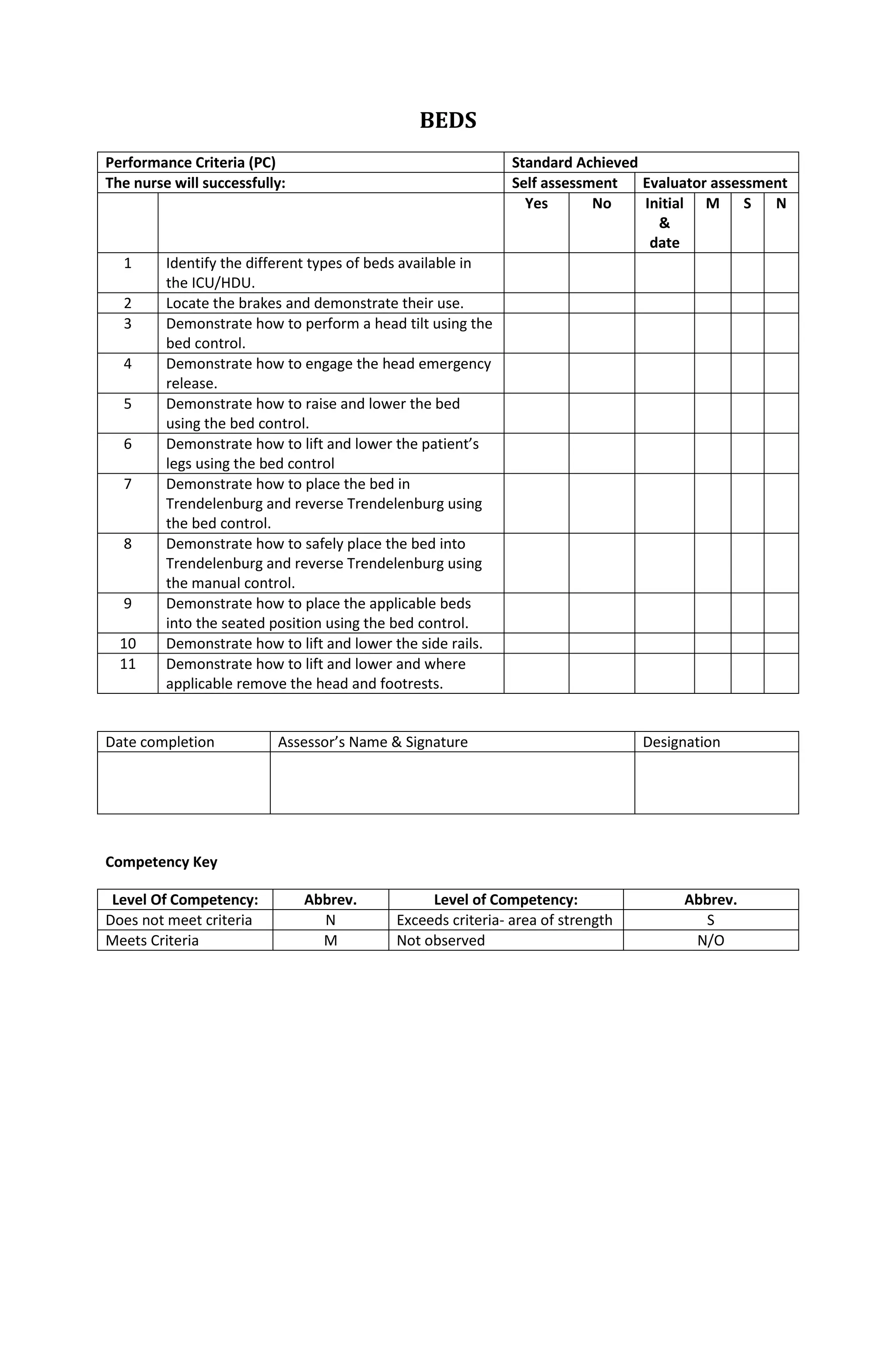
BEDS
Performance Criteria (PC) Standard Achieved
The nurse will successfully: Self assessment Evaluator assessment
Yes No Initial
&
date
M S N
1 Identify the different types of beds available in
the ICU/HDU.
2 Locate the brakes and demonstrate their use.
3 Demonstrate how to perform a head tilt using the
bed control.
4 Demonstrate how to engage the head emergency
release.
5 Demonstrate how to raise and lower the bed
using the bed control.
6 Demonstrate how to lift and lower the patient’s
legs using the bed control
7 Demonstrate how to place the bed in
Trendelenburg and reverse Trendelenburg using
the bed control.
8 Demonstrate how to safely place the bed into
Trendelenburg and reverse Trendelenburg using
the manual control.
9 Demonstrate how to place the applicable beds
into the seated position using the bed control.
10 Demonstrate how to lift and lower the side rails.
11 Demonstrate how to lift and lower and where
applicable remove the head and footrests.
Date completion Assessor’s Name & Signature Designation
Competency Key
Level Of Competency: Abbrev. Level of Competency: Abbrev.
Does not meet criteria N Exceeds criteria- area of strength S
Meets Criteria M Not observed N/O
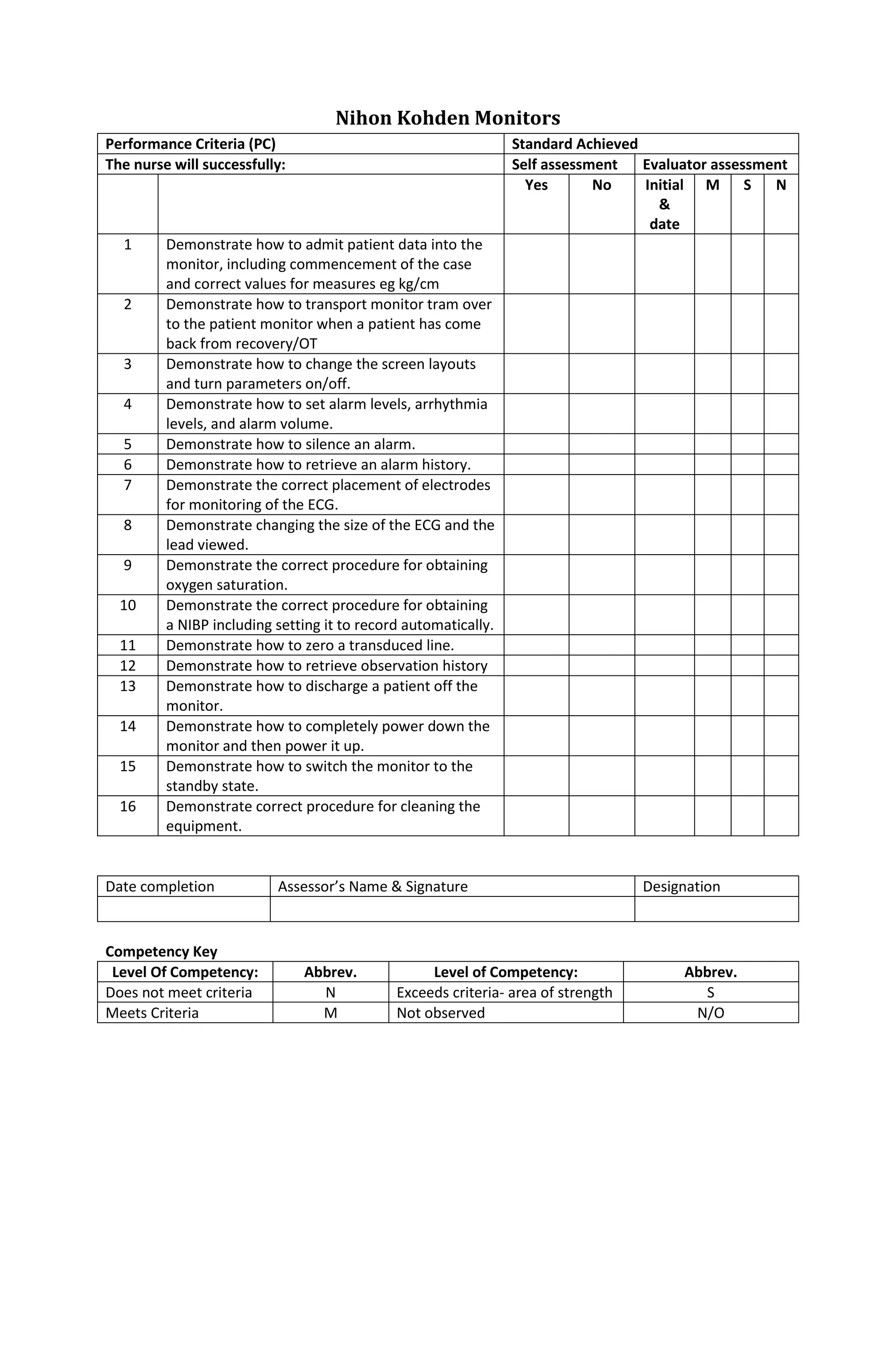
Nihon Kohden Monitors
Performance Criteria (PC) Standard Achieved
The nurse will successfully: Self assessment Evaluator assessment
Yes No Initial
&
date
M S N
1 Demonstrate how to admit patient data into the
monitor, including commencement of the case
and correct values for measures eg kg/cm
2 Demonstrate how to transport monitor tram over
to the patient monitor when a patient has come
back from recovery/OT
3 Demonstrate how to change the screen layouts
and turn parameters on/off.
4 Demonstrate how to set alarm levels, arrhythmia
levels, and alarm volume.
5 Demonstrate how to silence an alarm.
6 Demonstrate how to retrieve an alarm history.
7 Demonstrate the correct placement of electrodes
for monitoring of the ECG.
8 Demonstrate changing the size of the ECG and the
lead viewed.
9 Demonstrate the correct procedure for obtaining
oxygen saturation.
10 Demonstrate the correct procedure for obtaining
a NIBP including setting it to record automatically.
11 Demonstrate how to zero a transduced line.
12 Demonstrate how to retrieve observation history
13 Demonstrate how to discharge a patient off the
monitor.
14 Demonstrate how to completely power down the
monitor and then power it up.
15 Demonstrate how to switch the monitor to the
standby state.
16 Demonstrate correct procedure for cleaning the
equipment.
Date completion Assessor’s Name & Signature Designation
Competency Key
Level Of Competency: Abbrev. Level of Competency: Abbrev.
Does not meet criteria N Exceeds criteria- area of strength S
Meets Criteria M Not observed N/O
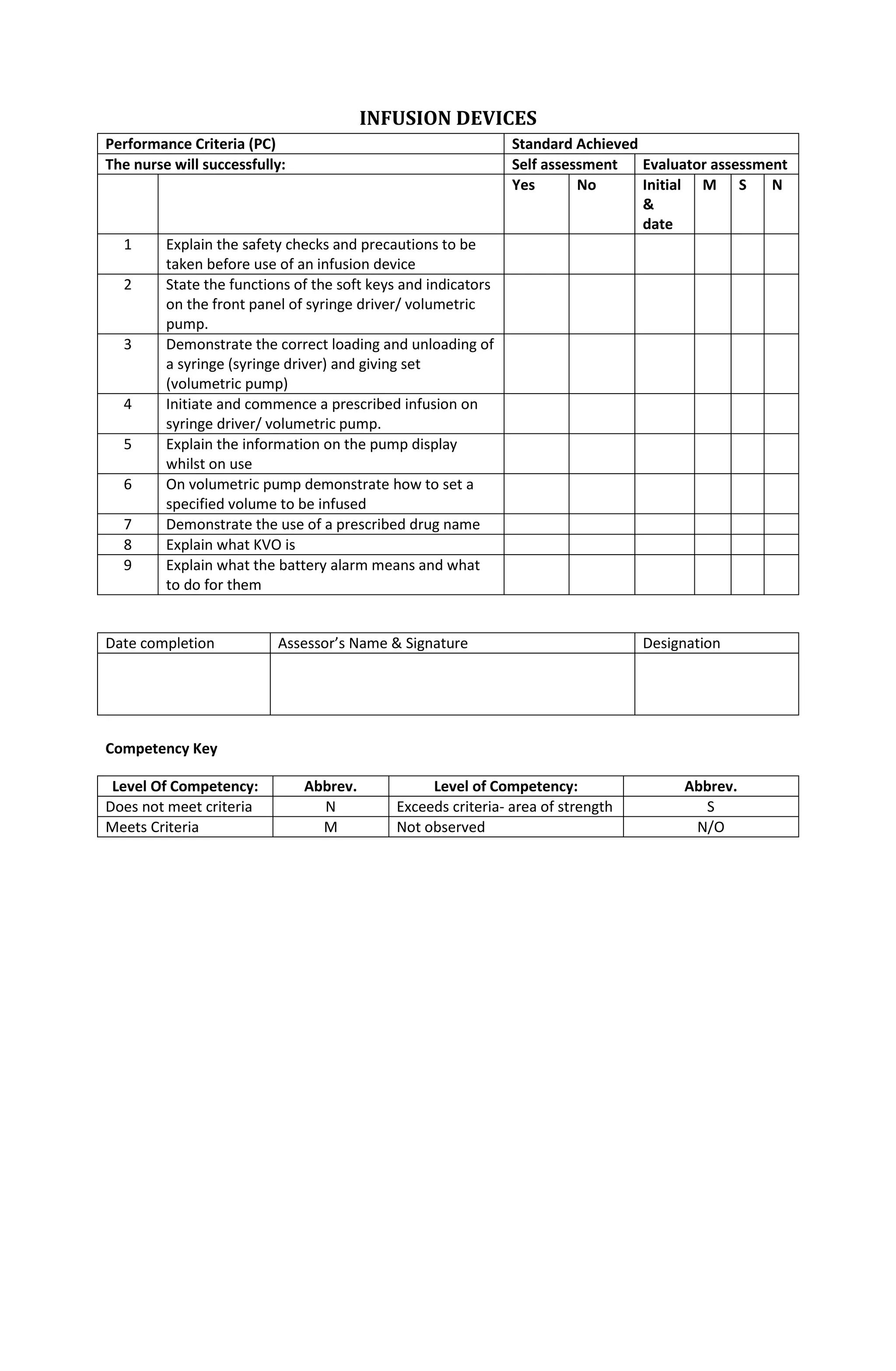
INFUSION DEVICES
Performance Criteria (PC) Standard Achieved
The nurse will successfully: Self assessment Evaluator assessment
Yes No Initial
&
date
M S N
1 Explain the safety checks and precautions to be
taken before use of an infusion device
2 State the functions of the soft keys and indicators
on the front panel of syringe driver/ volumetric
pump.
3 Demonstrate the correct loading and unloading of
a syringe (syringe driver) and giving set
(volumetric pump)
4 Initiate and commence a prescribed infusion on
syringe driver/ volumetric pump.
5 Explain the information on the pump display
whilst on use
6 On volumetric pump demonstrate how to set a
specified volume to be infused
7 Demonstrate the use of a prescribed drug name
8 Explain what KVO is
9 Explain what the battery alarm means and what
to do for them
Date completion Assessor’s Name & Signature Designation
Competency Key
Level Of Competency: Abbrev. Level of Competency: Abbrev.
Does not meet criteria N Exceeds criteria- area of strength S
Meets Criteria M Not observed N/O
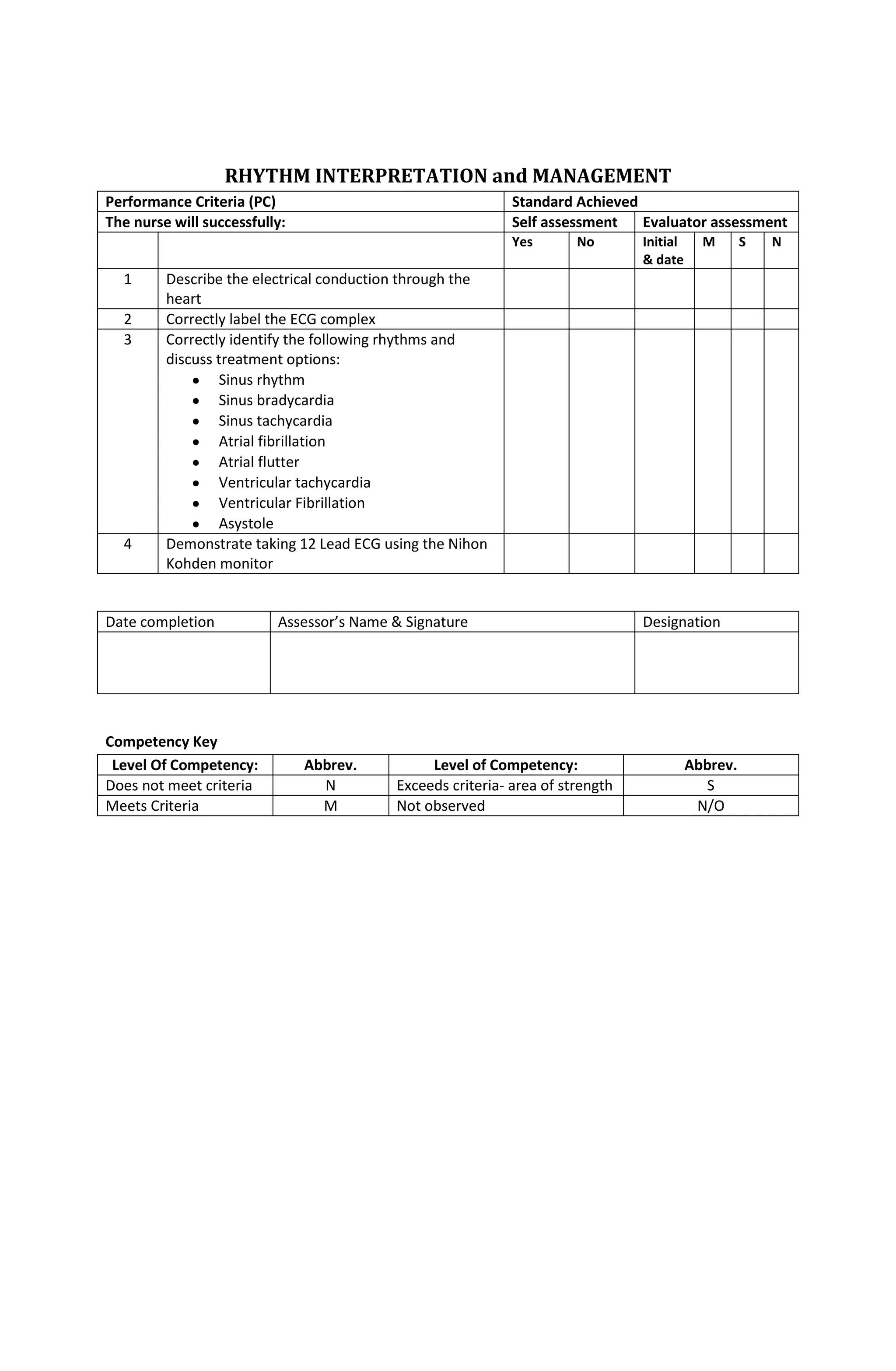
RHYTHM INTERPRETATION and MANAGEMENT
Performance Criteria (PC) Standard Achieved
The nurse will successfully: Self assessment Evaluator assessment
Yes No Initial
& date
M S N
1 Describe the electrical conduction through the
heart
2 Correctly label the ECG complex
3 Correctly identify the following rhythms and
discuss treatment options:
Sinus rhythm
Sinus bradycardia
Sinus tachycardia
Atrial fibrillation
Atrial flutter
Ventricular tachycardia
Ventricular Fibrillation
Asystole
4 Demonstrate taking 12 Lead ECG using the Nihon
Kohden monitor
Date completion Assessor’s Name & Signature Designation
Competency Key
Level Of Competency: Abbrev. Level of Competency: Abbrev.
Does not meet criteria N Exceeds criteria- area of strength S
Meets Criteria M Not observed N/O
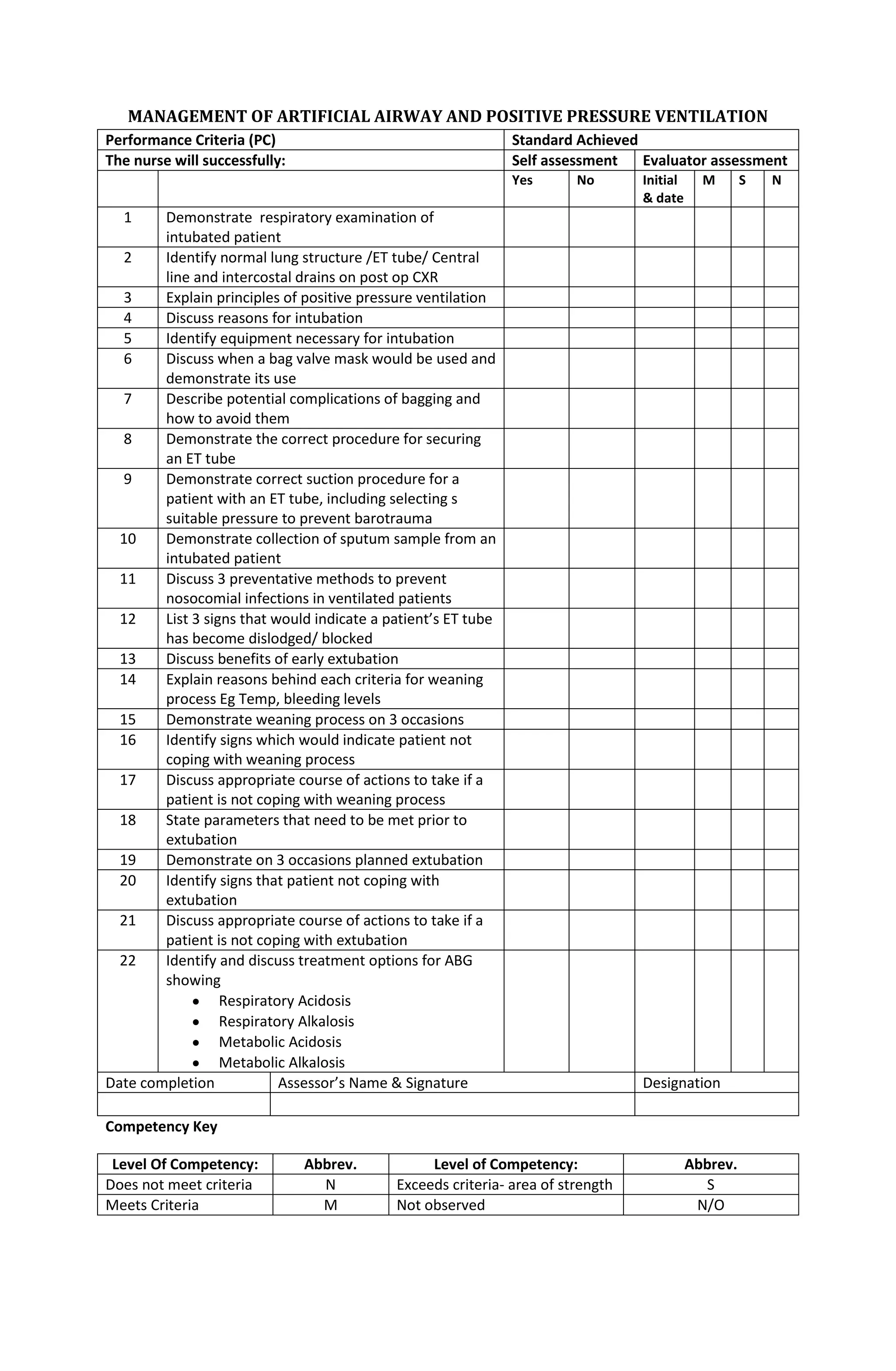
MANAGEMENT OF ARTIFICIAL AIRWAY AND POSITIVE PRESSURE VENTILATION
Performance Criteria (PC) Standard Achieved
The nurse will successfully: Self assessment Evaluator assessment
Yes No Initial
& date
M S N
1 Demonstrate respiratory examination of
intubated patient
2 Identify normal lung structure /ET tube/ Central
line and intercostal drains on post op CXR
3 Explain principles of positive pressure ventilation
4 Discuss reasons for intubation
5 Identify equipment necessary for intubation
6 Discuss when a bag valve mask would be used and
demonstrate its use
7 Describe potential complications of bagging and
how to avoid them
8 Demonstrate the correct procedure for securing
an ET tube
9 Demonstrate correct suction procedure for a
patient with an ET tube, including selecting s
suitable pressure to prevent barotrauma
10 Demonstrate collection of sputum sample from an
intubated patient
11 Discuss 3 preventative methods to prevent
nosocomial infections in ventilated patients
12 List 3 signs that would indicate a patient’s ET tube
has become dislodged/ blocked
13 Discuss benefits of early extubation
14 Explain reasons behind each criteria for weaning
process Eg Temp, bleeding levels
15 Demonstrate weaning process on 3 occasions
16 Identify signs which would indicate patient not
coping with weaning process
17 Discuss appropriate course of actions to take if a
patient is not coping with weaning process
18 State parameters that need to be met prior to
extubation
19 Demonstrate on 3 occasions planned extubation
20 Identify signs that patient not coping with
extubation
21 Discuss appropriate course of actions to take if a
patient is not coping with extubation
22 Identify and discuss treatment options for ABG
showing
Respiratory Acidosis
Respiratory Alkalosis
Metabolic Acidosis
Metabolic Alkalosis
Date completion Assessor’s Name & Signature Designation
Competency Key
Level Of Competency: Abbrev. Level of Competency: Abbrev.
Does not meet criteria N Exceeds criteria- area of strength S
Meets Criteria M Not observed N/O
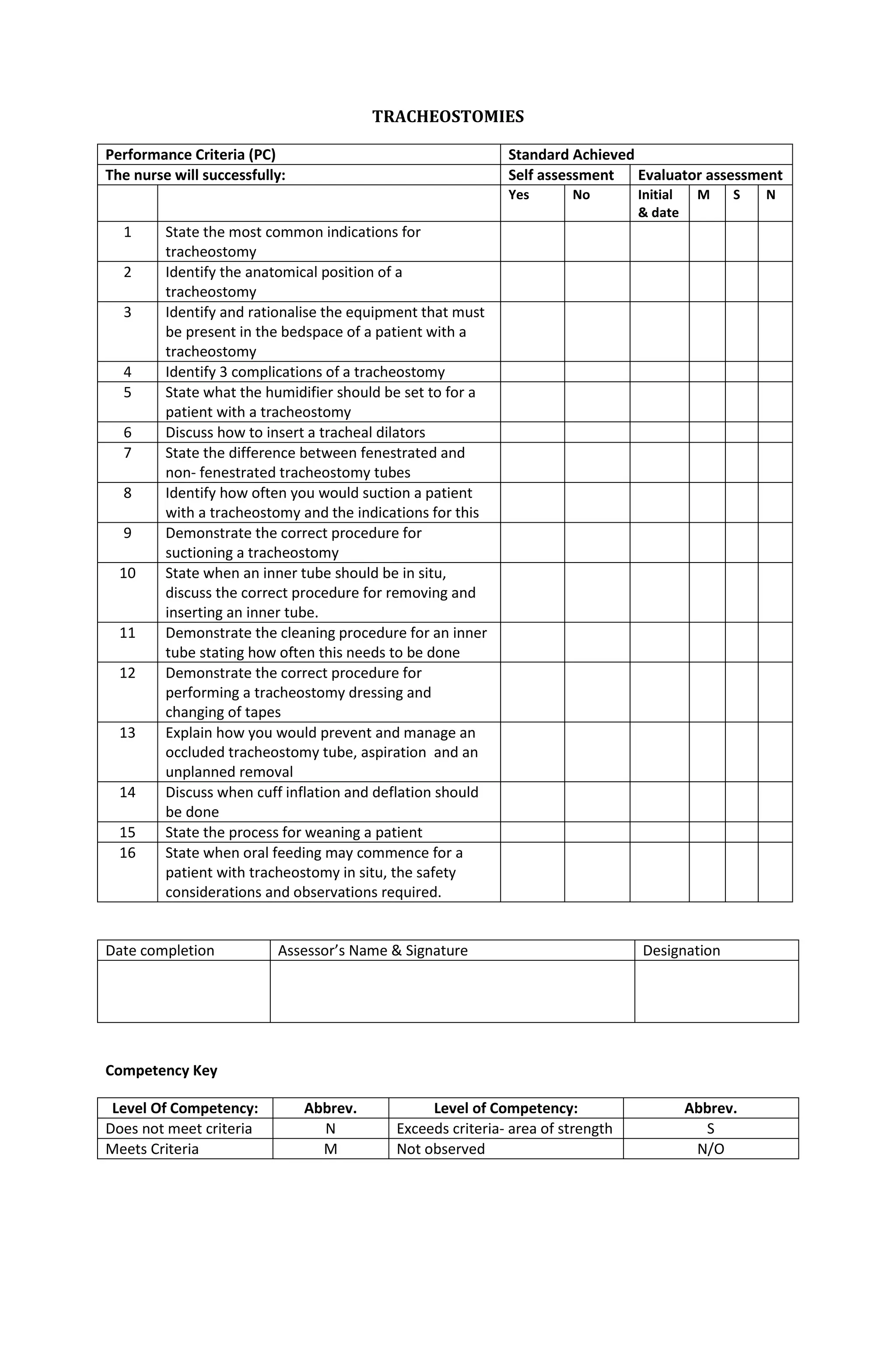
TRACHEOSTOMIES
Performance Criteria (PC) Standard Achieved
The nurse will successfully: Self assessment Evaluator assessment
Yes No Initial
& date
M S N
1 State the most common indications for
tracheostomy
2 Identify the anatomical position of a
tracheostomy
3 Identify and rationalise the equipment that must
be present in the bedspace of a patient with a
tracheostomy
4 Identify 3 complications of a tracheostomy
5 State what the humidifier should be set to for a
patient with a tracheostomy
6 Discuss how to insert a tracheal dilators
7 State the difference between fenestrated and
non- fenestrated tracheostomy tubes
8 Identify how often you would suction a patient
with a tracheostomy and the indications for this
9 Demonstrate the correct procedure for
suctioning a tracheostomy
10 State when an inner tube should be in situ,
discuss the correct procedure for removing and
inserting an inner tube.
11 Demonstrate the cleaning procedure for an inner
tube stating how often this needs to be done
12 Demonstrate the correct procedure for
performing a tracheostomy dressing and
changing of tapes
13 Explain how you would prevent and manage an
occluded tracheostomy tube, aspiration and an
unplanned removal
14 Discuss when cuff inflation and deflation should
be done
15 State the process for weaning a patient
16 State when oral feeding may commence for a
patient with tracheostomy in situ, the safety
considerations and observations required.
Date completion Assessor’s Name & Signature Designation
Competency Key
Level Of Competency: Abbrev. Level of Competency: Abbrev.
Does not meet criteria N Exceeds criteria- area of strength S
Meets Criteria M Not observed N/O
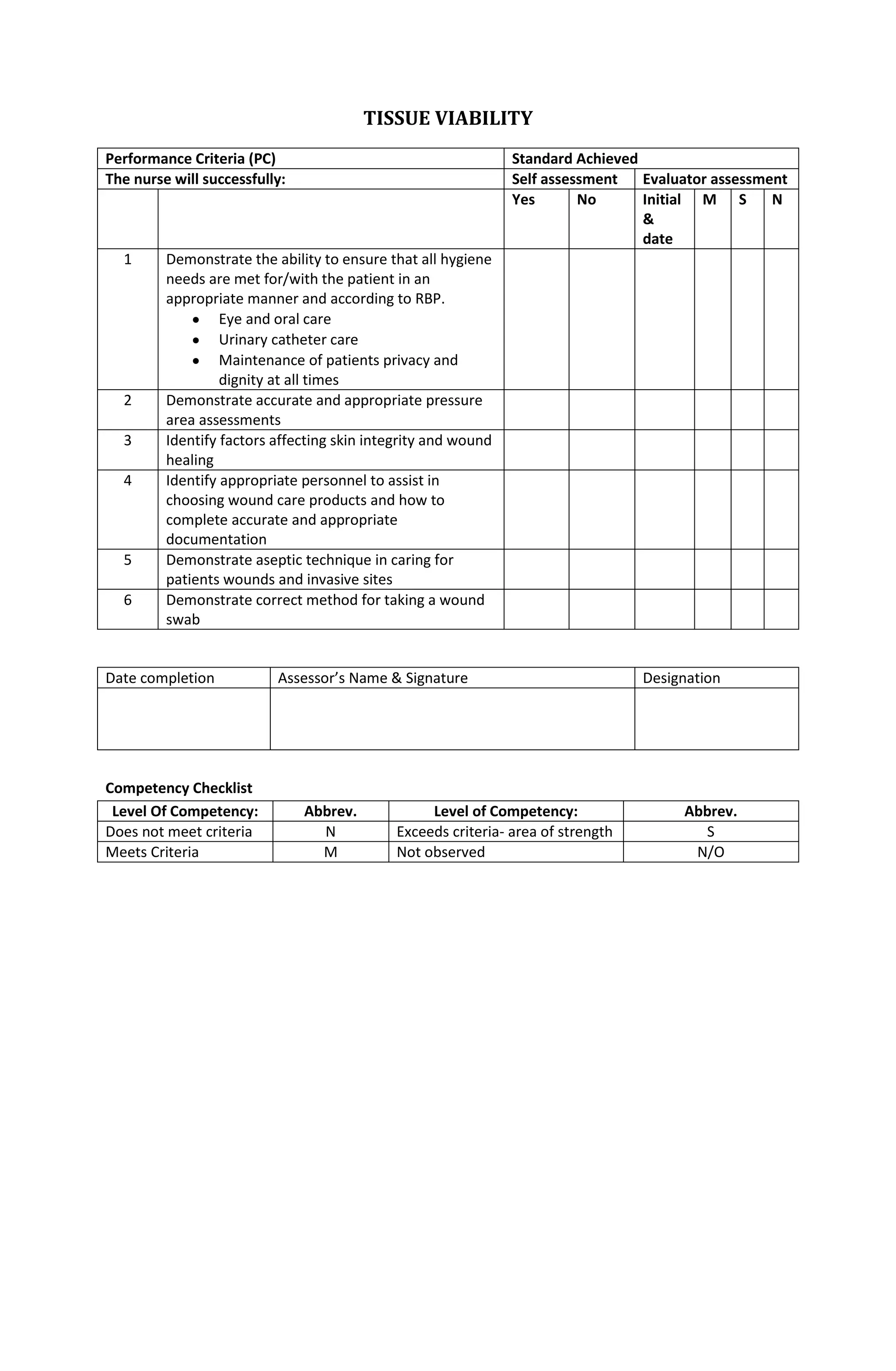
TISSUE VIABILITY
Performance Criteria (PC) Standard Achieved
The nurse will successfully: Self assessment Evaluator assessment
Yes No Initial
&
date
M S N
1 Demonstrate the ability to ensure that all hygiene
needs are met for/with the patient in an
appropriate manner and according to RBP.
Eye and oral care
Urinary catheter care
Maintenance of patients privacy and
dignity at all times
2 Demonstrate accurate and appropriate pressure
area assessments
3 Identify factors affecting skin integrity and wound
healing
4 Identify appropriate personnel to assist in
choosing wound care products and how to
complete accurate and appropriate
documentation
5 Demonstrate aseptic technique in caring for
patients wounds and invasive sites
6 Demonstrate correct method for taking a wound
swab
Date completion Assessor’s Name & Signature Designation
Competency Checklist
Level Of Competency: Abbrev. Level of Competency: Abbrev.
Does not meet criteria N Exceeds criteria- area of strength S
Meets Criteria M Not observed N/O
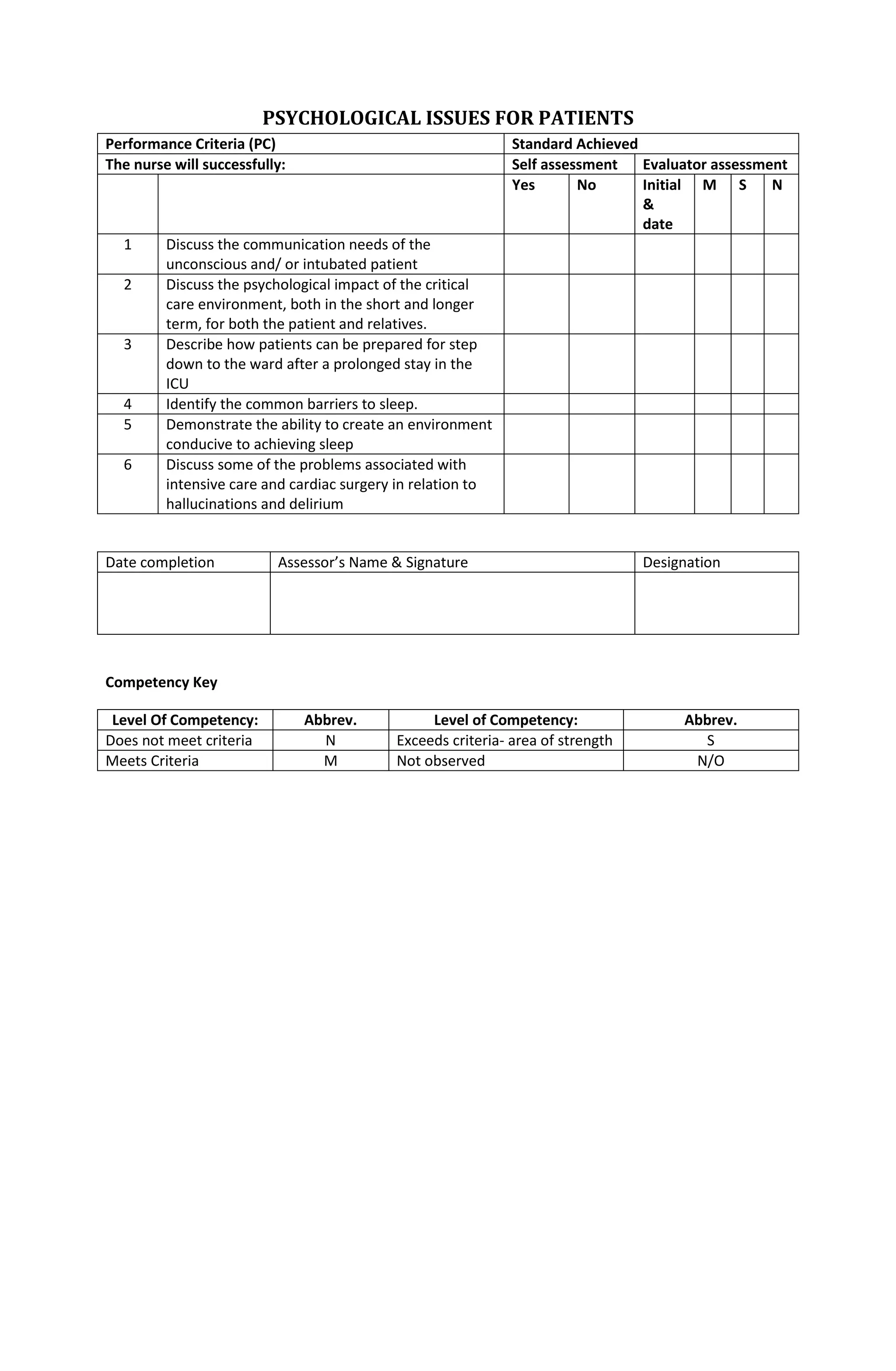
PSYCHOLOGICAL ISSUES FOR PATIENTS
Performance Criteria (PC) Standard Achieved
The nurse will successfully: Self assessment Evaluator assessment
Yes No Initial
&
date
M S N
1 Discuss the communication needs of the
unconscious and/ or intubated patient
2 Discuss the psychological impact of the critical
care environment, both in the short and longer
term, for both the patient and relatives.
3 Describe how patients can be prepared for step
down to the ward after a prolonged stay in the
ICU
4 Identify the common barriers to sleep.
5 Demonstrate the ability to create an environment
conducive to achieving sleep
6 Discuss some of the problems associated with
intensive care and cardiac surgery in relation to
hallucinations and delirium
Date completion Assessor’s Name & Signature Designation
Competency Key
Level Of Competency: Abbrev. Level of Competency: Abbrev.
Does not meet criteria N Exceeds criteria- area of strength S
Meets Criteria M Not observed N/O
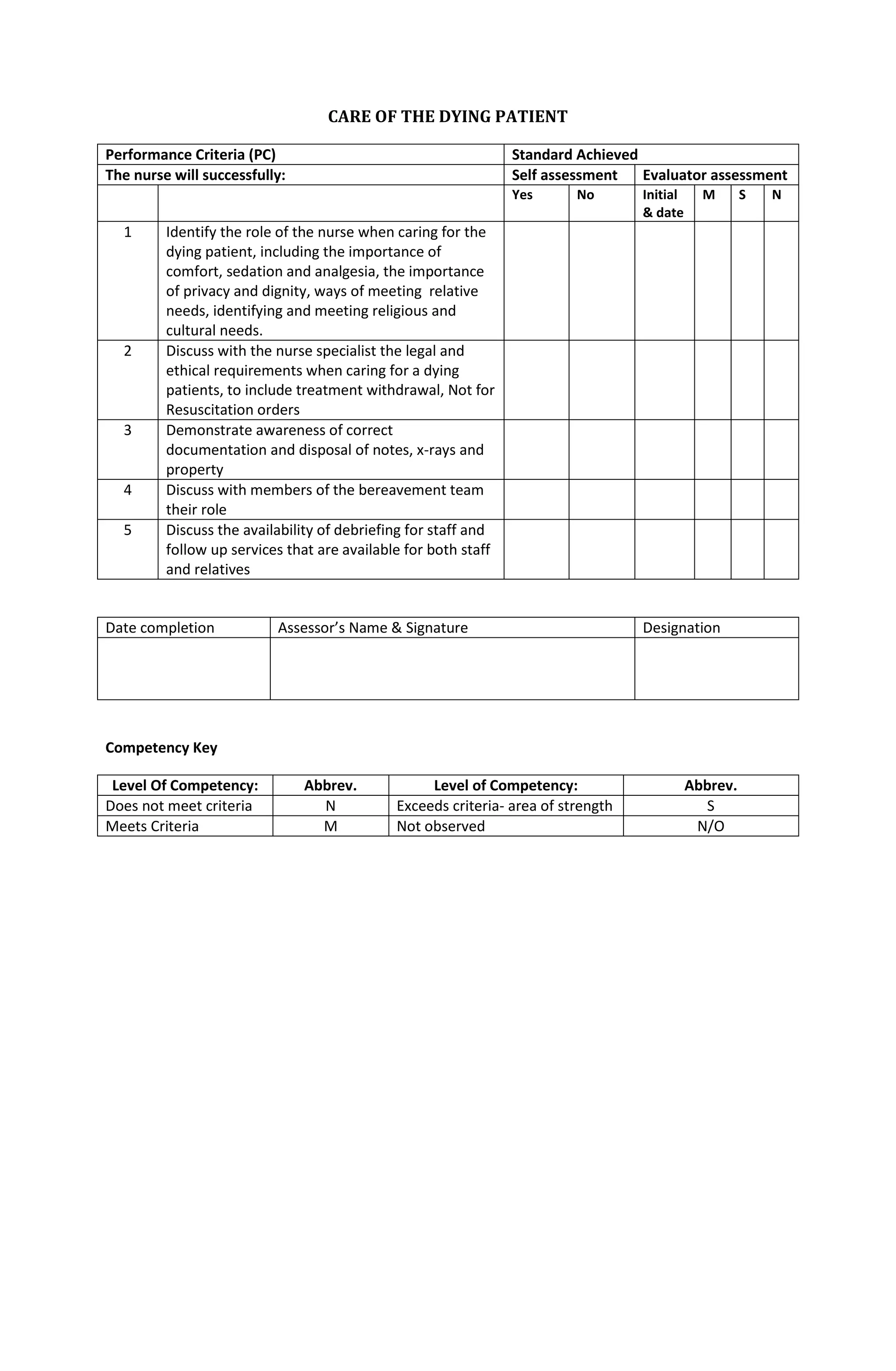
CARE OF THE DYING PATIENT
Performance Criteria (PC) Standard Achieved
The nurse will successfully: Self assessment Evaluator assessment
Yes No Initial
& date
M S N
1 Identify the role of the nurse when caring for the
dying patient, including the importance of
comfort, sedation and analgesia, the importance
of privacy and dignity, ways of meeting relative
needs, identifying and meeting religious and
cultural needs.
2 Discuss with the nurse specialist the legal and
ethical requirements when caring for a dying
patients, to include treatment withdrawal, Not for
Resuscitation orders
3 Demonstrate awareness of correct
documentation and disposal of notes, x-rays and
property
4 Discuss with members of the bereavement team
their role
5 Discuss the availability of debriefing for staff and
follow up services that are available for both staff
and relatives
Date completion Assessor’s Name & Signature Designation
Competency Key
Level Of Competency: Abbrev. Level of Competency: Abbrev.
Does not meet criteria N Exceeds criteria- area of strength S
Meets Criteria M Not observed N/O
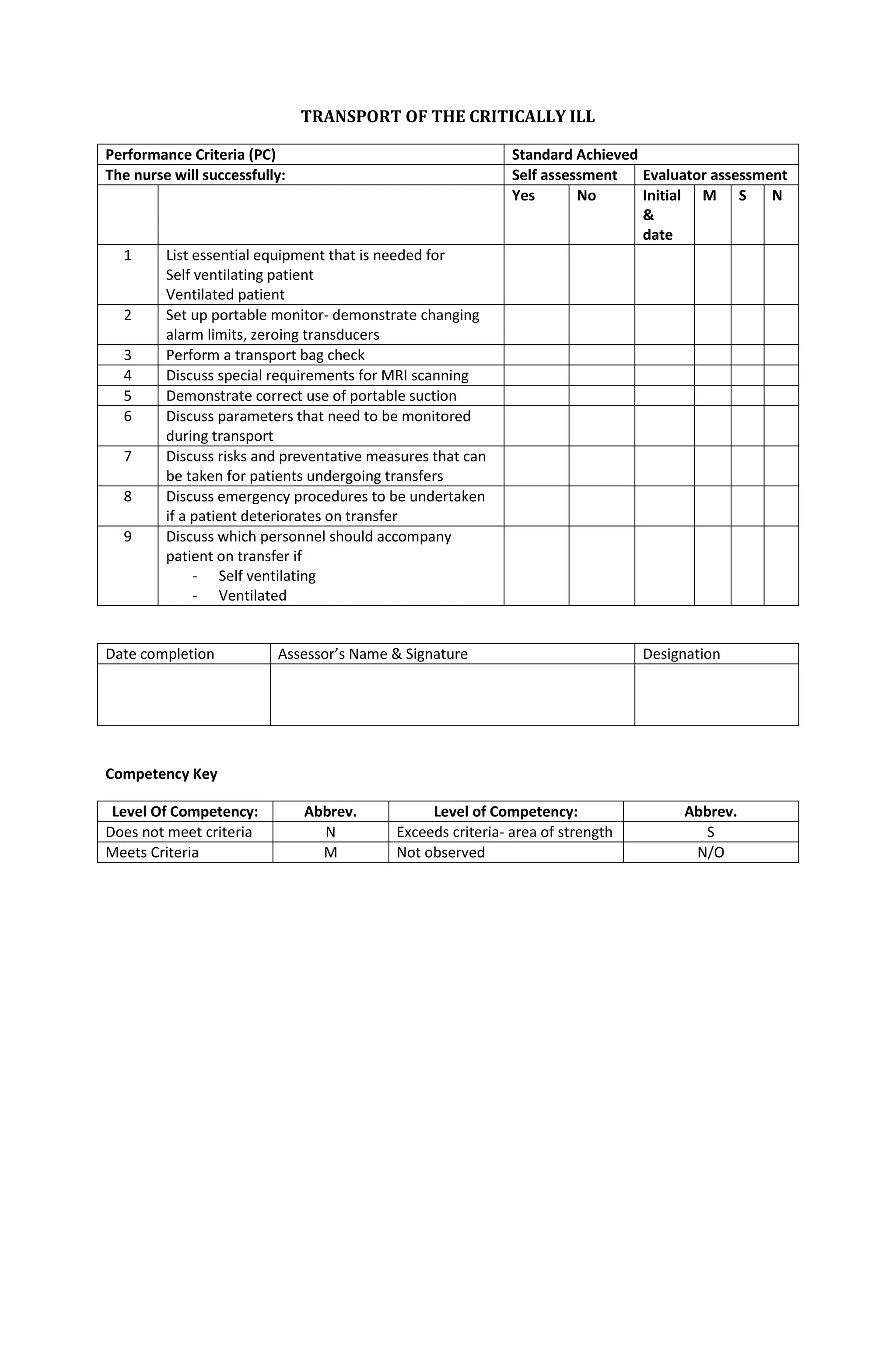
TRANSPORT OF THE CRITICALLY ILL
Performance Criteria (PC) Standard Achieved
The nurse will successfully: Self assessment Evaluator assessment
Yes No Initial
&
date
M S N
1 List essential equipment that is needed for
Self ventilating patient
Ventilated patient
2 Set up portable monitor- demonstrate changing
alarm limits, zeroing transducers
3 Perform a transport bag check
4 Discuss special requirements for MRI scanning
5 Demonstrate correct use of portable suction
6 Discuss parameters that need to be monitored
during transport
7 Discuss risks and preventative measures that can
be taken for patients undergoing transfers
8 Discuss emergency procedures to be undertaken
if a patient deteriorates on transfer
9 Discuss which personnel should accompany
patient on transfer if
- Self ventilating
- Ventilated
Date completion Assessor’s Name & Signature Designation
Competency Key
Level Of Competency: Abbrev. Level of Competency: Abbrev.
Does not meet criteria N Exceeds criteria- area of strength S
Meets Criteria M Not observed N/O
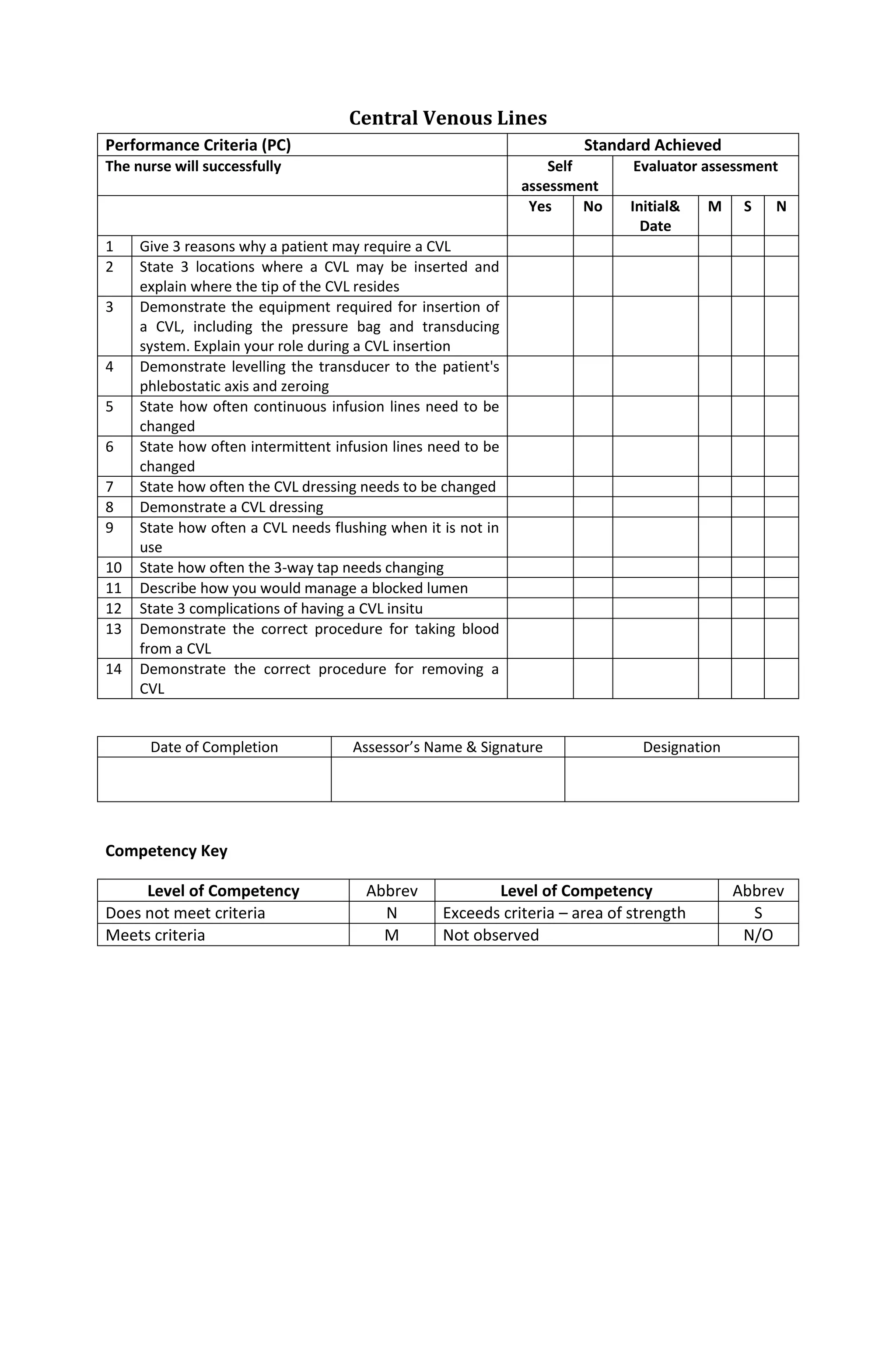
Central Venous Lines
Performance Criteria (PC) Standard Achieved
The nurse will successfully Self
assessment
Evaluator assessment
Yes No Initial&
Date
M S N
1 Give 3 reasons why a patient may require a CVL
2 State 3 locations where a CVL may be inserted and
explain where the tip of the CVL resides
3 Demonstrate the equipment required for insertion of
a CVL, including the pressure bag and transducing
system. Explain your role during a CVL insertion
4 Demonstrate levelling the transducer to the patient's
phlebostatic axis and zeroing
5 State how often continuous infusion lines need to be
changed
6 State how often intermittent infusion lines need to be
changed
7 State how often the CVL dressing needs to be changed
8 Demonstrate a CVL dressing
9 State how often a CVL needs flushing when it is not in
use
10 State how often the 3-way tap needs changing
11 Describe how you would manage a blocked lumen
12 State 3 complications of having a CVL insitu
13 Demonstrate the correct procedure for taking blood
from a CVL
14 Demonstrate the correct procedure for removing a
CVL
Date of Completion Assessor’s Name & Signature Designation
Competency Key
Level of Competency Abbrev Level of Competency Abbrev
Does not meet criteria N Exceeds criteria – area of strength S
Meets criteria M Not observed N/O
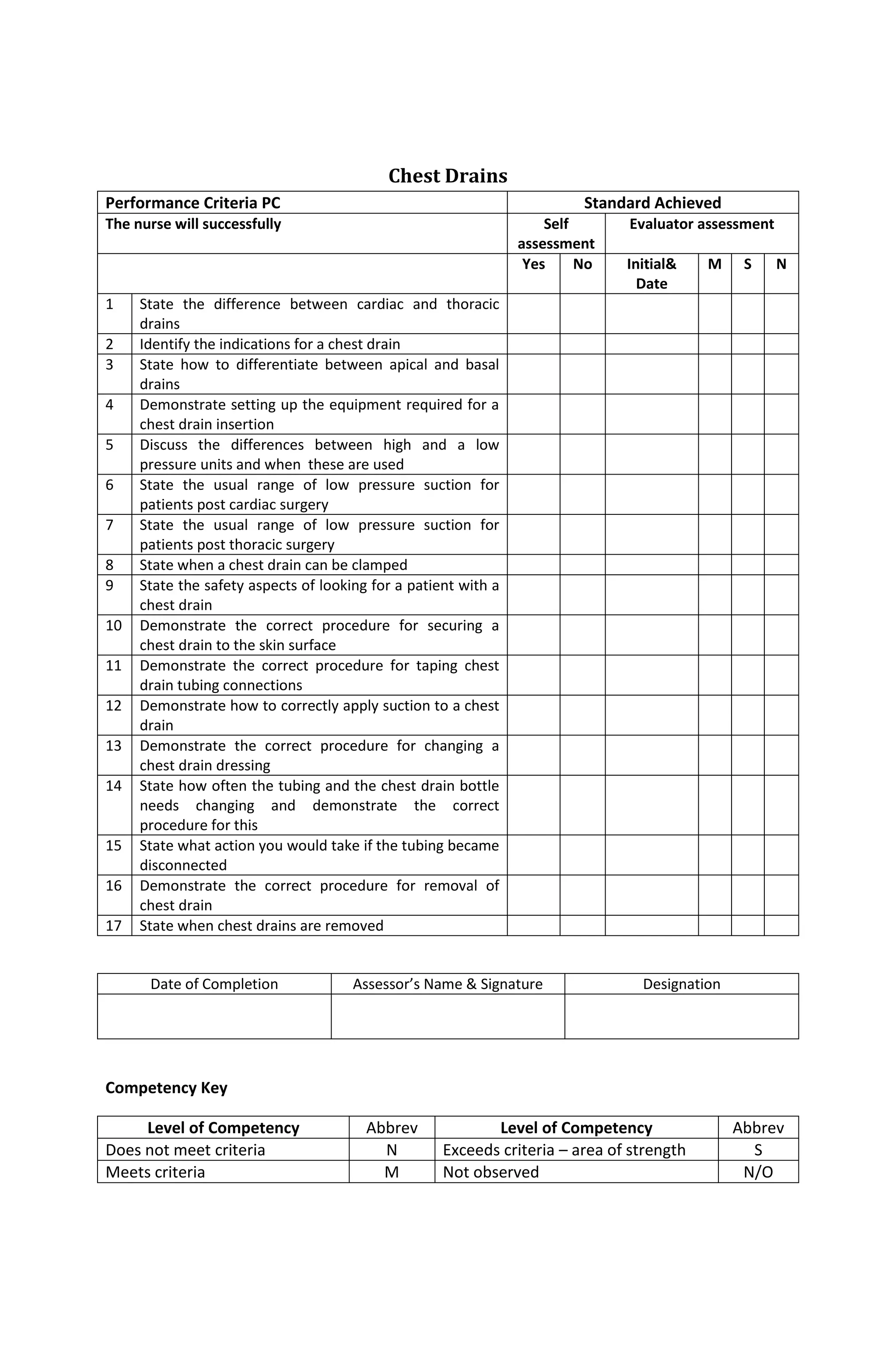
Chest Drains
Performance Criteria PC Standard Achieved
The nurse will successfully Self
assessment
Evaluator assessment
Yes No Initial&
Date
M S N
1 State the difference between cardiac and thoracic
drains
2 Identify the indications for a chest drain
3 State how to differentiate between apical and basal
drains
4 Demonstrate setting up the equipment required for a
chest drain insertion
5 Discuss the differences between high and a low
pressure units and when these are used
6 State the usual range of low pressure suction for
patients post cardiac surgery
7 State the usual range of low pressure suction for
patients post thoracic surgery
8 State when a chest drain can be clamped
9 State the safety aspects of looking for a patient with a
chest drain
10 Demonstrate the correct procedure for securing a
chest drain to the skin surface
11 Demonstrate the correct procedure for taping chest
drain tubing connections
12 Demonstrate how to correctly apply suction to a chest
drain
13 Demonstrate the correct procedure for changing a
chest drain dressing
14 State how often the tubing and the chest drain bottle
needs changing and demonstrate the correct
procedure for this
15 State what action you would take if the tubing became
disconnected
16 Demonstrate the correct procedure for removal of
chest drain
17 State when chest drains are removed
Date of Completion Assessor’s Name & Signature Designation
Competency Key
Level of Competency Abbrev Level of Competency Abbrev
Does not meet criteria N Exceeds criteria – area of strength S
Meets criteria M Not observed N/O
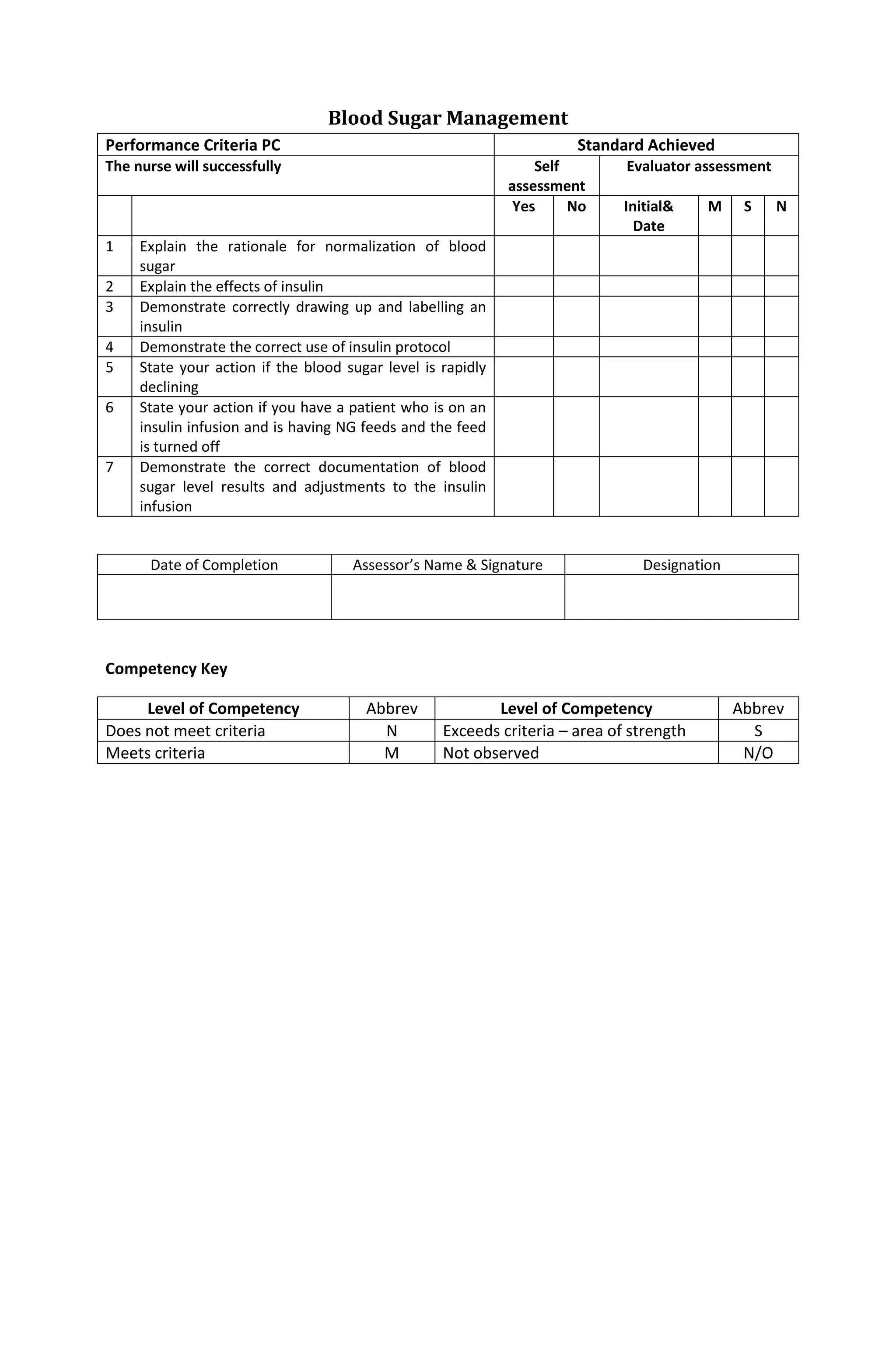
Blood Sugar Management
Performance Criteria PC Standard Achieved
The nurse will successfully Self
assessment
Evaluator assessment
Yes No Initial&
Date
M S N
1 Explain the rationale for normalization of blood
sugar
2 Explain the effects of insulin
3 Demonstrate correctly drawing up and labelling an
insulin
4 Demonstrate the correct use of insulin protocol
5 State your action if the blood sugar level is rapidly
declining
6 State your action if you have a patient who is on an
insulin infusion and is having NG feeds and the feed
is turned off
7 Demonstrate the correct documentation of blood
sugar level results and adjustments to the insulin
infusion
Date of Completion Assessor’s Name & Signature Designation
Competency Key
Level of Competency Abbrev Level of Competency Abbrev
Does not meet criteria N Exceeds criteria – area of strength S
Meets criteria M Not observed N/O
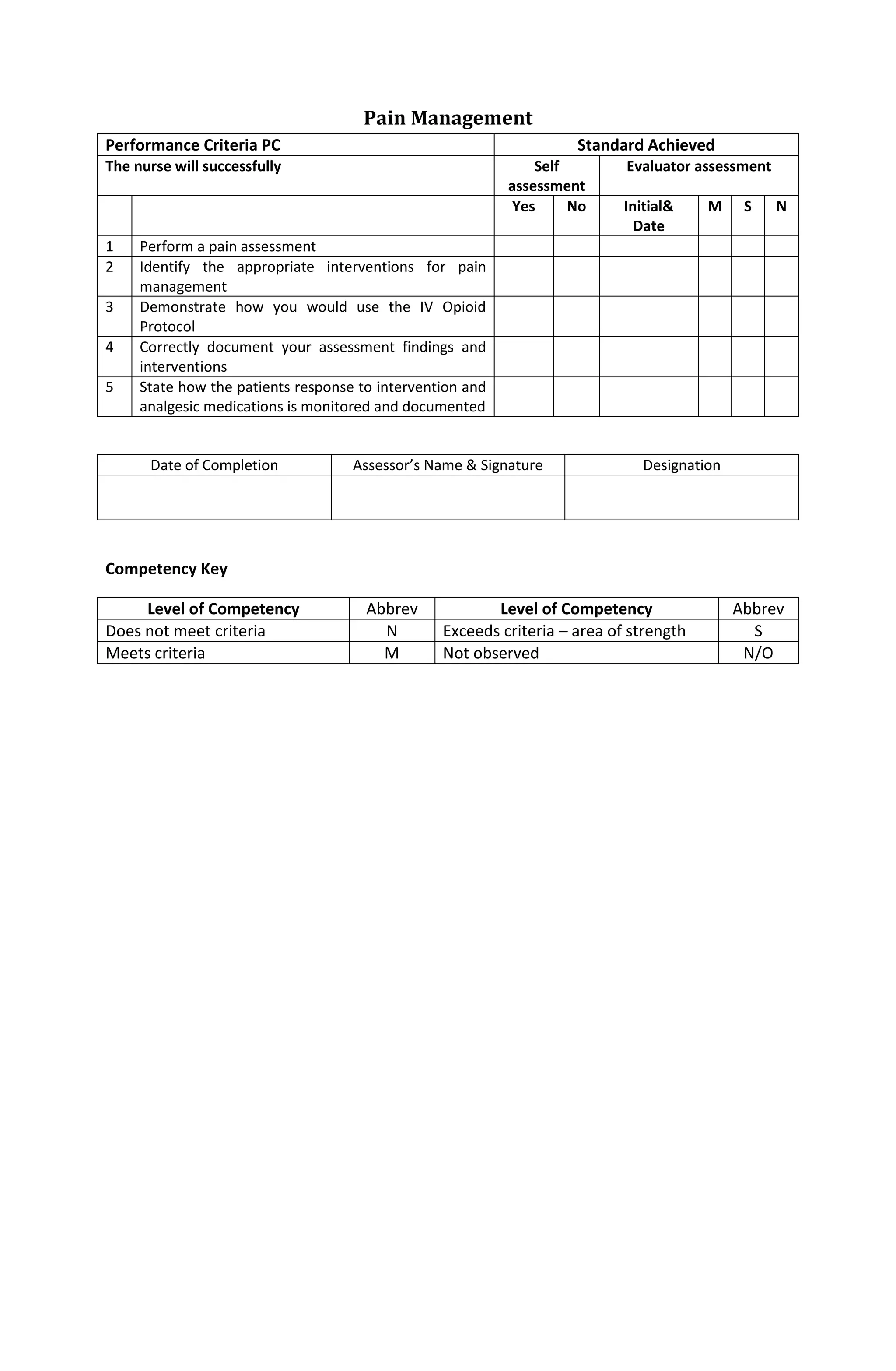
Pain Management
Performance Criteria PC Standard Achieved
The nurse will successfully Self
assessment
Evaluator assessment
Yes No Initial&
Date
M S N
1 Perform a pain assessment
2 Identify the appropriate interventions for pain
management
3 Demonstrate how you would use the IV Opioid
Protocol
4 Correctly document your assessment findings and
interventions
5 State how the patients response to intervention and
analgesic medications is monitored and documented
Date of Completion Assessor’s Name & Signature Designation
Competency Key
Level of Competency Abbrev Level of Competency Abbrev
Does not meet criteria N Exceeds criteria – area of strength S
Meets criteria M Not observed N/O
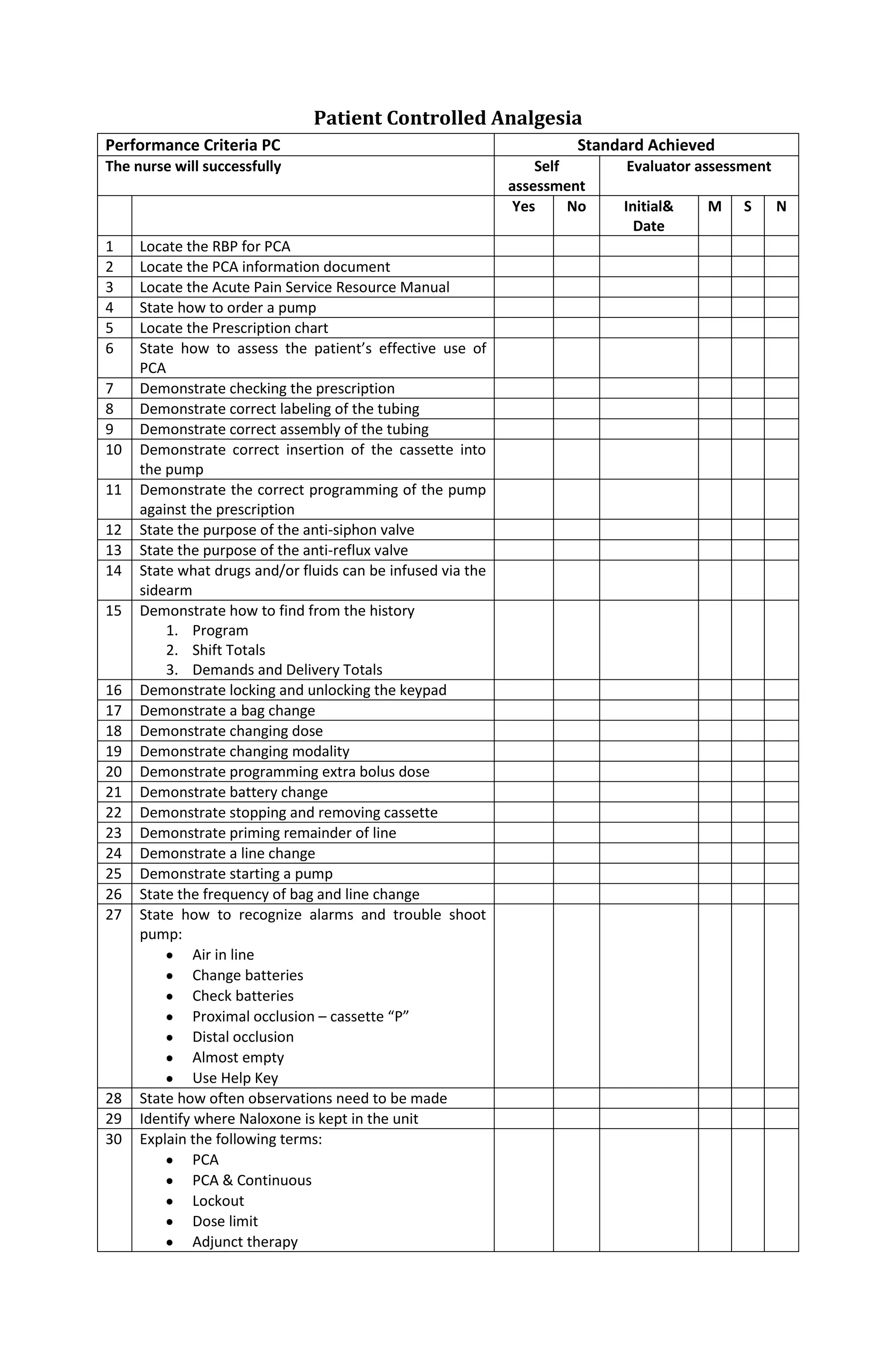
Patient Controlled Analgesia
Performance Criteria PC Standard Achieved
The nurse will successfully Self
assessment
Evaluator assessment
Yes No Initial&
Date
M S N
1 Locate the RBP for PCA
2 Locate the PCA information document
3 Locate the Acute Pain Service Resource Manual
4 State how to order a pump
5 Locate the Prescription chart
6 State how to assess the patient’s effective use of
PCA
7 Demonstrate checking the prescription
8 Demonstrate correct labeling of the tubing
9 Demonstrate correct assembly of the tubing
10 Demonstrate correct insertion of the cassette into
the pump
11 Demonstrate the correct programming of the pump
against the prescription
12 State the purpose of the anti-siphon valve
13 State the purpose of the anti-reflux valve
14 State what drugs and/or fluids can be infused via the
sidearm
15 Demonstrate how to find from the history
1. Program
2. Shift Totals
3. Demands and Delivery Totals
16 Demonstrate locking and unlocking the keypad
17 Demonstrate a bag change
18 Demonstrate changing dose
19 Demonstrate changing modality
20 Demonstrate programming extra bolus dose
21 Demonstrate battery change
22 Demonstrate stopping and removing cassette
23 Demonstrate priming remainder of line
24 Demonstrate a line change
25 Demonstrate starting a pump
26 State the frequency of bag and line change
27 State how to recognize alarms and trouble shoot
pump:
Air in line
Change batteries
Check batteries
Proximal occlusion – cassette “P”
Distal occlusion
Almost empty
Use Help Key
28 State how often observations need to be made
29 Identify where Naloxone is kept in the unit
30 Explain the following terms:
PCA
PCA & Continuous
Lockout
Dose limit
Adjunct therapy
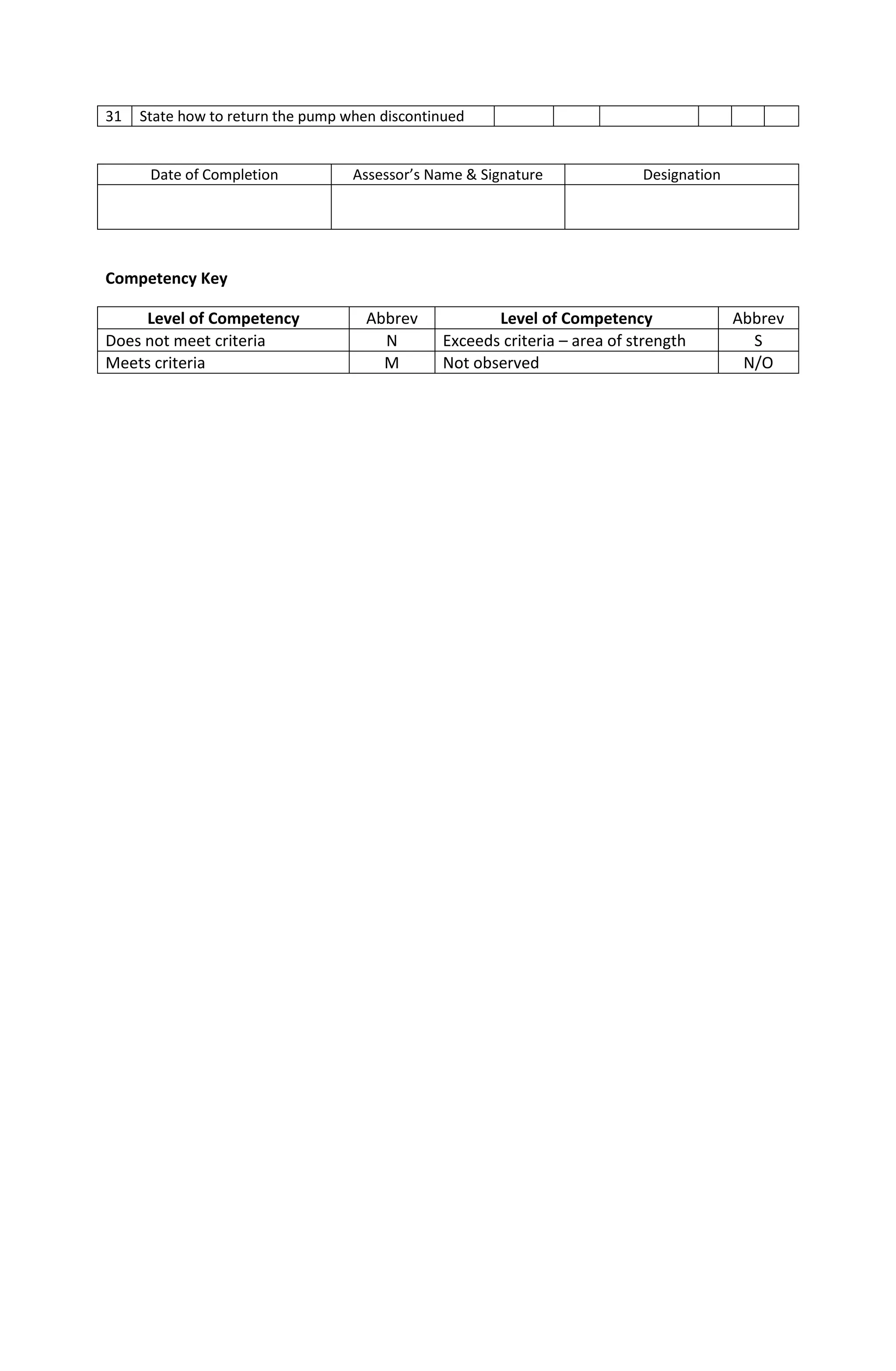
31 State how to return the pump when discontinued
Date of Completion Assessor’s Name & Signature Designation
Competency Key
Level of Competency Abbrev Level of Competency Abbrev
Does not meet criteria N Exceeds criteria – area of strength S
Meets criteria M Not observed N/O
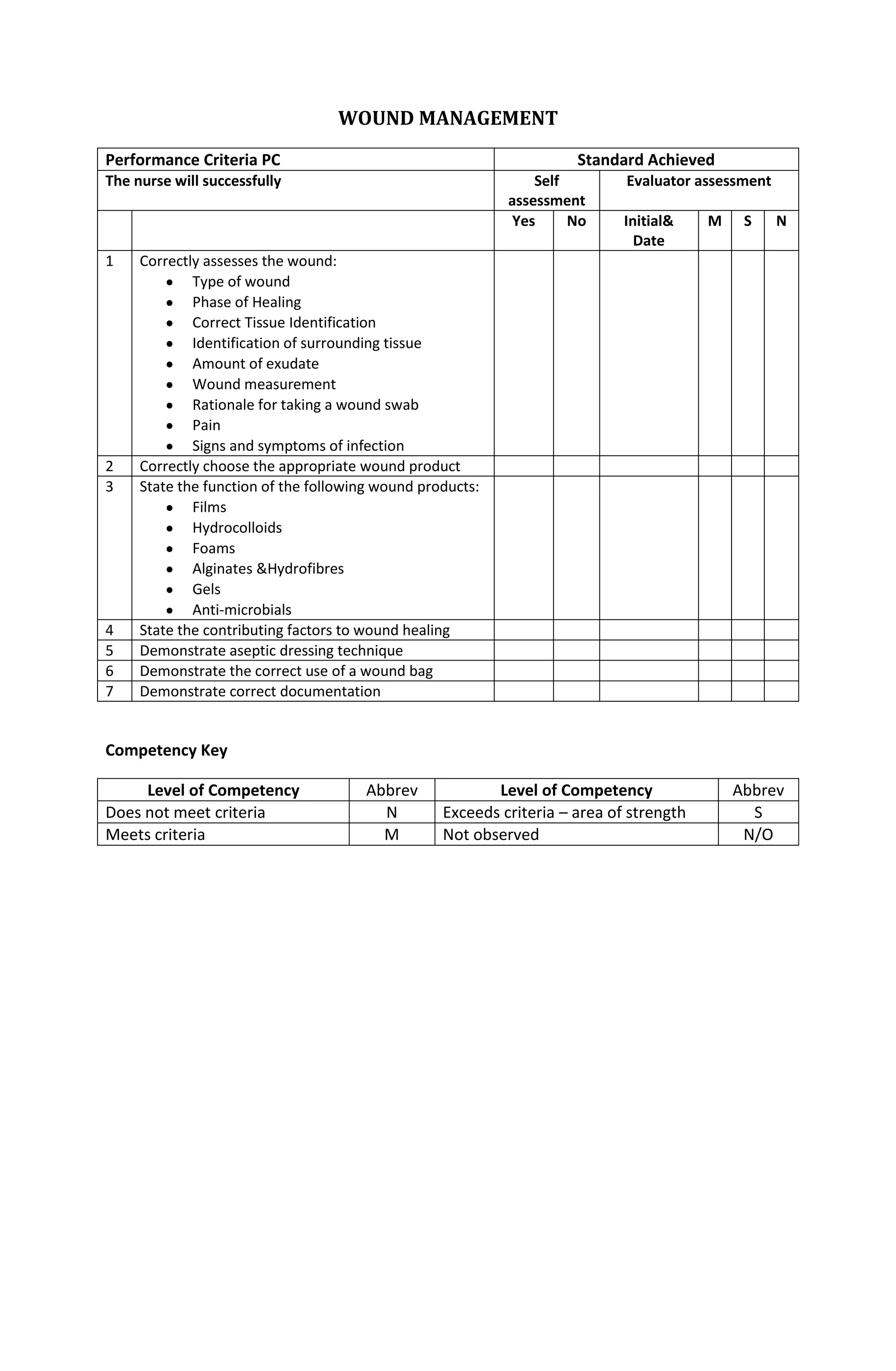
WOUND MANAGEMENT
Performance Criteria PC Standard Achieved
The nurse will successfully Self
assessment
Evaluator assessment
Yes No Initial&
Date
M S N
1 Correctly assesses the wound:
Type of wound
Phase of Healing
Correct Tissue Identification
Identification of surrounding tissue
Amount of exudate
Wound measurement
Rationale for taking a wound swab
Pain
Signs and symptoms of infection
2 Correctly choose the appropriate wound product
3 State the function of the following wound products:
Films
Hydrocolloids
Foams
Alginates &Hydrofibres
Gels
Anti-microbials
4 State the contributing factors to wound healing
5 Demonstrate aseptic dressing technique
6 Demonstrate the correct use of a wound bag
7 Demonstrate correct documentation
Competency Key
Level of Competency Abbrev Level of Competency Abbrev
Does not meet criteria N Exceeds criteria – area of strength S
Meets criteria M Not observed N/O
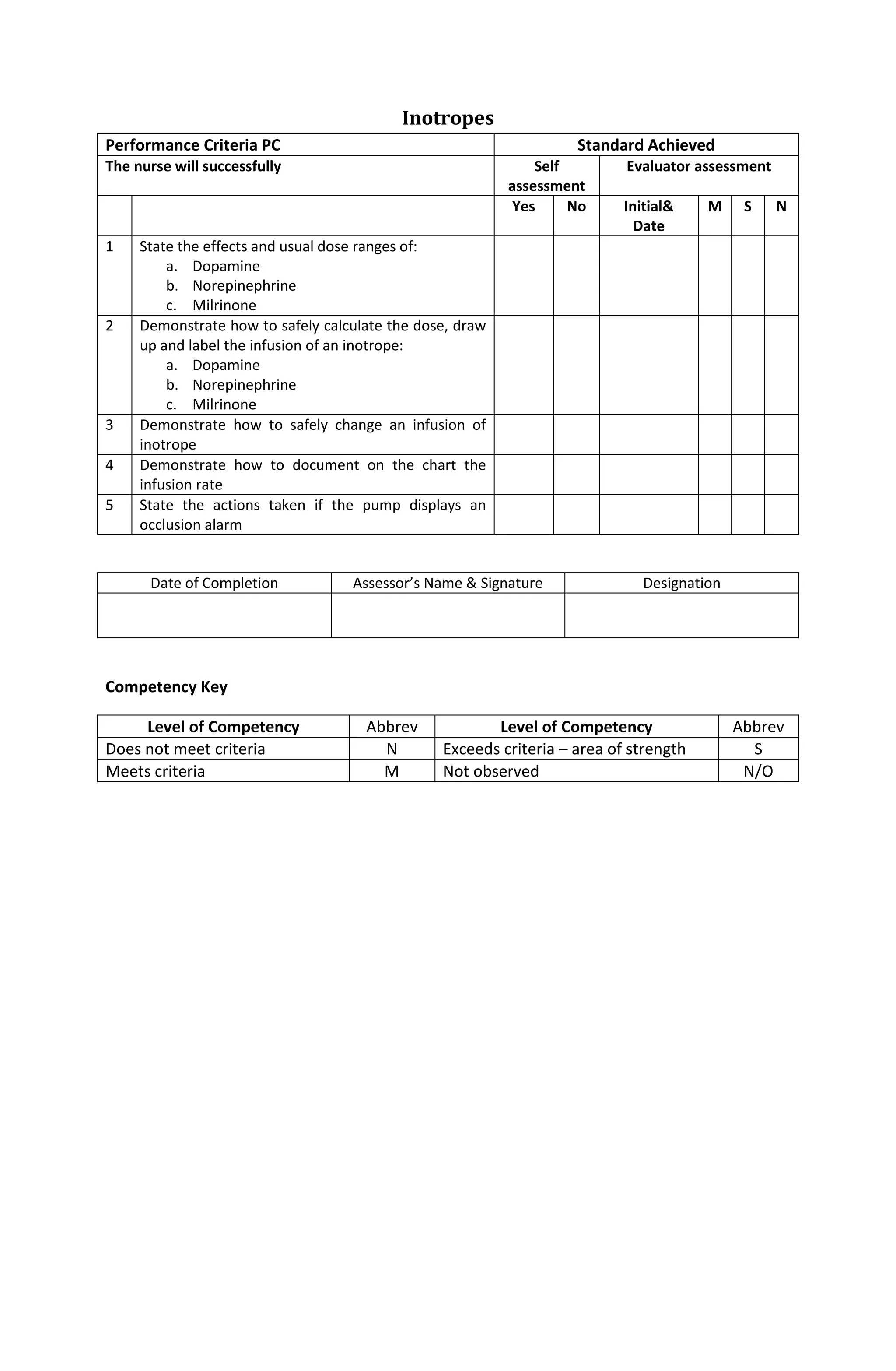
Inotropes
Performance Criteria PC Standard Achieved
The nurse will successfully Self
assessment
Evaluator assessment
Yes No Initial&
Date
M S N
1 State the effects and usual dose ranges of:
a. Dopamine
b. Norepinephrine
c. Milrinone
2 Demonstrate how to safely calculate the dose, draw
up and label the infusion of an inotrope:
a. Dopamine
b. Norepinephrine
c. Milrinone
3 Demonstrate how to safely change an infusion of
inotrope
4 Demonstrate how to document on the chart the
infusion rate
5 State the actions taken if the pump displays an
occlusion alarm
Date of Completion Assessor’s Name & Signature Designation
Competency Key
Level of Competency Abbrev Level of Competency Abbrev
Does not meet criteria N Exceeds criteria – area of strength S
Meets criteria M Not observed N/O

Competency checklist addl

  • 1.
    Maintenance of SafeEnvironment Performance Criteria (PC) Standard Achieved The nurse will successfully: Self assessment Evaluator assessment Yes No Initial & date M S N 1 Demonstrate bed space safety checks and discuss the implications of each check 2 Demonstrate the correct use of the call bells and when these would be used. 3 Locate spare oxygen cylinders, demonstrate reading cylinder gauge. 4 Discuss the implications of a cluttered bed space and demonstrate an attempt to remove excess equipment from the patient area environment. 5 Demonstrate how to complete safety checks of unit based emergency equipment. 6 Describe how to ensure faulty equipment is reported. 7 Be shown when and how to complete `Risk Pro’ Date completion Assessor’s Name & Signature Designation Competency Key Level Of Competency: Abbrev. Level of Competency: Abbrev. Does not meet criteria N Exceeds criteria- area of strength S Meets Criteria M Not observed N/O
  • 2.
    BEDSIDE SAFETY Performance Criteria(PC) Standard Achieved The nurse will successfully: Self assessment Evaluator assessment Yes No Initial & date M S N 1 Demonstrate correct set up for a patient admission 2 Demonstrate correctly checking an ambubag and state when you would need a PEEP valve attached. 3 Demonstrate the correct set up for oral suction and state what this should be set at. 4 Demonstrate the correct set up for low-pressure suction for chest drains. 5 Demonstrate the correct use of the call bells and when these would be used. Date completion Assessor’s Name & Signature Designation Competency Key Level Of Competency: Abbrev. Level of Competency: Abbrev. Does not meet criteria N Exceeds criteria- area of strength S Meets Criteria M Not observed N/O
  • 3.
    BEDS Performance Criteria (PC)Standard Achieved The nurse will successfully: Self assessment Evaluator assessment Yes No Initial & date M S N 1 Identify the different types of beds available in the ICU/HDU. 2 Locate the brakes and demonstrate their use. 3 Demonstrate how to perform a head tilt using the bed control. 4 Demonstrate how to engage the head emergency release. 5 Demonstrate how to raise and lower the bed using the bed control. 6 Demonstrate how to lift and lower the patient’s legs using the bed control 7 Demonstrate how to place the bed in Trendelenburg and reverse Trendelenburg using the bed control. 8 Demonstrate how to safely place the bed into Trendelenburg and reverse Trendelenburg using the manual control. 9 Demonstrate how to place the applicable beds into the seated position using the bed control. 10 Demonstrate how to lift and lower the side rails. 11 Demonstrate how to lift and lower and where applicable remove the head and footrests. Date completion Assessor’s Name & Signature Designation Competency Key Level Of Competency: Abbrev. Level of Competency: Abbrev. Does not meet criteria N Exceeds criteria- area of strength S Meets Criteria M Not observed N/O
  • 4.
    Nihon Kohden Monitors PerformanceCriteria (PC) Standard Achieved The nurse will successfully: Self assessment Evaluator assessment Yes No Initial & date M S N 1 Demonstrate how to admit patient data into the monitor, including commencement of the case and correct values for measures eg kg/cm 2 Demonstrate how to transport monitor tram over to the patient monitor when a patient has come back from recovery/OT 3 Demonstrate how to change the screen layouts and turn parameters on/off. 4 Demonstrate how to set alarm levels, arrhythmia levels, and alarm volume. 5 Demonstrate how to silence an alarm. 6 Demonstrate how to retrieve an alarm history. 7 Demonstrate the correct placement of electrodes for monitoring of the ECG. 8 Demonstrate changing the size of the ECG and the lead viewed. 9 Demonstrate the correct procedure for obtaining oxygen saturation. 10 Demonstrate the correct procedure for obtaining a NIBP including setting it to record automatically. 11 Demonstrate how to zero a transduced line. 12 Demonstrate how to retrieve observation history 13 Demonstrate how to discharge a patient off the monitor. 14 Demonstrate how to completely power down the monitor and then power it up. 15 Demonstrate how to switch the monitor to the standby state. 16 Demonstrate correct procedure for cleaning the equipment. Date completion Assessor’s Name & Signature Designation Competency Key Level Of Competency: Abbrev. Level of Competency: Abbrev. Does not meet criteria N Exceeds criteria- area of strength S Meets Criteria M Not observed N/O
  • 5.
    INFUSION DEVICES Performance Criteria(PC) Standard Achieved The nurse will successfully: Self assessment Evaluator assessment Yes No Initial & date M S N 1 Explain the safety checks and precautions to be taken before use of an infusion device 2 State the functions of the soft keys and indicators on the front panel of syringe driver/ volumetric pump. 3 Demonstrate the correct loading and unloading of a syringe (syringe driver) and giving set (volumetric pump) 4 Initiate and commence a prescribed infusion on syringe driver/ volumetric pump. 5 Explain the information on the pump display whilst on use 6 On volumetric pump demonstrate how to set a specified volume to be infused 7 Demonstrate the use of a prescribed drug name 8 Explain what KVO is 9 Explain what the battery alarm means and what to do for them Date completion Assessor’s Name & Signature Designation Competency Key Level Of Competency: Abbrev. Level of Competency: Abbrev. Does not meet criteria N Exceeds criteria- area of strength S Meets Criteria M Not observed N/O
  • 6.
    RHYTHM INTERPRETATION andMANAGEMENT Performance Criteria (PC) Standard Achieved The nurse will successfully: Self assessment Evaluator assessment Yes No Initial & date M S N 1 Describe the electrical conduction through the heart 2 Correctly label the ECG complex 3 Correctly identify the following rhythms and discuss treatment options: Sinus rhythm Sinus bradycardia Sinus tachycardia Atrial fibrillation Atrial flutter Ventricular tachycardia Ventricular Fibrillation Asystole 4 Demonstrate taking 12 Lead ECG using the Nihon Kohden monitor Date completion Assessor’s Name & Signature Designation Competency Key Level Of Competency: Abbrev. Level of Competency: Abbrev. Does not meet criteria N Exceeds criteria- area of strength S Meets Criteria M Not observed N/O
  • 7.
    MANAGEMENT OF ARTIFICIALAIRWAY AND POSITIVE PRESSURE VENTILATION Performance Criteria (PC) Standard Achieved The nurse will successfully: Self assessment Evaluator assessment Yes No Initial & date M S N 1 Demonstrate respiratory examination of intubated patient 2 Identify normal lung structure /ET tube/ Central line and intercostal drains on post op CXR 3 Explain principles of positive pressure ventilation 4 Discuss reasons for intubation 5 Identify equipment necessary for intubation 6 Discuss when a bag valve mask would be used and demonstrate its use 7 Describe potential complications of bagging and how to avoid them 8 Demonstrate the correct procedure for securing an ET tube 9 Demonstrate correct suction procedure for a patient with an ET tube, including selecting s suitable pressure to prevent barotrauma 10 Demonstrate collection of sputum sample from an intubated patient 11 Discuss 3 preventative methods to prevent nosocomial infections in ventilated patients 12 List 3 signs that would indicate a patient’s ET tube has become dislodged/ blocked 13 Discuss benefits of early extubation 14 Explain reasons behind each criteria for weaning process Eg Temp, bleeding levels 15 Demonstrate weaning process on 3 occasions 16 Identify signs which would indicate patient not coping with weaning process 17 Discuss appropriate course of actions to take if a patient is not coping with weaning process 18 State parameters that need to be met prior to extubation 19 Demonstrate on 3 occasions planned extubation 20 Identify signs that patient not coping with extubation 21 Discuss appropriate course of actions to take if a patient is not coping with extubation 22 Identify and discuss treatment options for ABG showing Respiratory Acidosis Respiratory Alkalosis Metabolic Acidosis Metabolic Alkalosis Date completion Assessor’s Name & Signature Designation Competency Key Level Of Competency: Abbrev. Level of Competency: Abbrev. Does not meet criteria N Exceeds criteria- area of strength S Meets Criteria M Not observed N/O
  • 8.
    TRACHEOSTOMIES Performance Criteria (PC)Standard Achieved The nurse will successfully: Self assessment Evaluator assessment Yes No Initial & date M S N 1 State the most common indications for tracheostomy 2 Identify the anatomical position of a tracheostomy 3 Identify and rationalise the equipment that must be present in the bedspace of a patient with a tracheostomy 4 Identify 3 complications of a tracheostomy 5 State what the humidifier should be set to for a patient with a tracheostomy 6 Discuss how to insert a tracheal dilators 7 State the difference between fenestrated and non- fenestrated tracheostomy tubes 8 Identify how often you would suction a patient with a tracheostomy and the indications for this 9 Demonstrate the correct procedure for suctioning a tracheostomy 10 State when an inner tube should be in situ, discuss the correct procedure for removing and inserting an inner tube. 11 Demonstrate the cleaning procedure for an inner tube stating how often this needs to be done 12 Demonstrate the correct procedure for performing a tracheostomy dressing and changing of tapes 13 Explain how you would prevent and manage an occluded tracheostomy tube, aspiration and an unplanned removal 14 Discuss when cuff inflation and deflation should be done 15 State the process for weaning a patient 16 State when oral feeding may commence for a patient with tracheostomy in situ, the safety considerations and observations required. Date completion Assessor’s Name & Signature Designation Competency Key Level Of Competency: Abbrev. Level of Competency: Abbrev. Does not meet criteria N Exceeds criteria- area of strength S Meets Criteria M Not observed N/O
  • 9.
    TISSUE VIABILITY Performance Criteria(PC) Standard Achieved The nurse will successfully: Self assessment Evaluator assessment Yes No Initial & date M S N 1 Demonstrate the ability to ensure that all hygiene needs are met for/with the patient in an appropriate manner and according to RBP. Eye and oral care Urinary catheter care Maintenance of patients privacy and dignity at all times 2 Demonstrate accurate and appropriate pressure area assessments 3 Identify factors affecting skin integrity and wound healing 4 Identify appropriate personnel to assist in choosing wound care products and how to complete accurate and appropriate documentation 5 Demonstrate aseptic technique in caring for patients wounds and invasive sites 6 Demonstrate correct method for taking a wound swab Date completion Assessor’s Name & Signature Designation Competency Checklist Level Of Competency: Abbrev. Level of Competency: Abbrev. Does not meet criteria N Exceeds criteria- area of strength S Meets Criteria M Not observed N/O
  • 10.
    PSYCHOLOGICAL ISSUES FORPATIENTS Performance Criteria (PC) Standard Achieved The nurse will successfully: Self assessment Evaluator assessment Yes No Initial & date M S N 1 Discuss the communication needs of the unconscious and/ or intubated patient 2 Discuss the psychological impact of the critical care environment, both in the short and longer term, for both the patient and relatives. 3 Describe how patients can be prepared for step down to the ward after a prolonged stay in the ICU 4 Identify the common barriers to sleep. 5 Demonstrate the ability to create an environment conducive to achieving sleep 6 Discuss some of the problems associated with intensive care and cardiac surgery in relation to hallucinations and delirium Date completion Assessor’s Name & Signature Designation Competency Key Level Of Competency: Abbrev. Level of Competency: Abbrev. Does not meet criteria N Exceeds criteria- area of strength S Meets Criteria M Not observed N/O
  • 11.
    CARE OF THEDYING PATIENT Performance Criteria (PC) Standard Achieved The nurse will successfully: Self assessment Evaluator assessment Yes No Initial & date M S N 1 Identify the role of the nurse when caring for the dying patient, including the importance of comfort, sedation and analgesia, the importance of privacy and dignity, ways of meeting relative needs, identifying and meeting religious and cultural needs. 2 Discuss with the nurse specialist the legal and ethical requirements when caring for a dying patients, to include treatment withdrawal, Not for Resuscitation orders 3 Demonstrate awareness of correct documentation and disposal of notes, x-rays and property 4 Discuss with members of the bereavement team their role 5 Discuss the availability of debriefing for staff and follow up services that are available for both staff and relatives Date completion Assessor’s Name & Signature Designation Competency Key Level Of Competency: Abbrev. Level of Competency: Abbrev. Does not meet criteria N Exceeds criteria- area of strength S Meets Criteria M Not observed N/O
  • 12.
    TRANSPORT OF THECRITICALLY ILL Performance Criteria (PC) Standard Achieved The nurse will successfully: Self assessment Evaluator assessment Yes No Initial & date M S N 1 List essential equipment that is needed for Self ventilating patient Ventilated patient 2 Set up portable monitor- demonstrate changing alarm limits, zeroing transducers 3 Perform a transport bag check 4 Discuss special requirements for MRI scanning 5 Demonstrate correct use of portable suction 6 Discuss parameters that need to be monitored during transport 7 Discuss risks and preventative measures that can be taken for patients undergoing transfers 8 Discuss emergency procedures to be undertaken if a patient deteriorates on transfer 9 Discuss which personnel should accompany patient on transfer if - Self ventilating - Ventilated Date completion Assessor’s Name & Signature Designation Competency Key Level Of Competency: Abbrev. Level of Competency: Abbrev. Does not meet criteria N Exceeds criteria- area of strength S Meets Criteria M Not observed N/O
  • 13.
    Central Venous Lines PerformanceCriteria (PC) Standard Achieved The nurse will successfully Self assessment Evaluator assessment Yes No Initial& Date M S N 1 Give 3 reasons why a patient may require a CVL 2 State 3 locations where a CVL may be inserted and explain where the tip of the CVL resides 3 Demonstrate the equipment required for insertion of a CVL, including the pressure bag and transducing system. Explain your role during a CVL insertion 4 Demonstrate levelling the transducer to the patient's phlebostatic axis and zeroing 5 State how often continuous infusion lines need to be changed 6 State how often intermittent infusion lines need to be changed 7 State how often the CVL dressing needs to be changed 8 Demonstrate a CVL dressing 9 State how often a CVL needs flushing when it is not in use 10 State how often the 3-way tap needs changing 11 Describe how you would manage a blocked lumen 12 State 3 complications of having a CVL insitu 13 Demonstrate the correct procedure for taking blood from a CVL 14 Demonstrate the correct procedure for removing a CVL Date of Completion Assessor’s Name & Signature Designation Competency Key Level of Competency Abbrev Level of Competency Abbrev Does not meet criteria N Exceeds criteria – area of strength S Meets criteria M Not observed N/O
  • 14.
    Chest Drains Performance CriteriaPC Standard Achieved The nurse will successfully Self assessment Evaluator assessment Yes No Initial& Date M S N 1 State the difference between cardiac and thoracic drains 2 Identify the indications for a chest drain 3 State how to differentiate between apical and basal drains 4 Demonstrate setting up the equipment required for a chest drain insertion 5 Discuss the differences between high and a low pressure units and when these are used 6 State the usual range of low pressure suction for patients post cardiac surgery 7 State the usual range of low pressure suction for patients post thoracic surgery 8 State when a chest drain can be clamped 9 State the safety aspects of looking for a patient with a chest drain 10 Demonstrate the correct procedure for securing a chest drain to the skin surface 11 Demonstrate the correct procedure for taping chest drain tubing connections 12 Demonstrate how to correctly apply suction to a chest drain 13 Demonstrate the correct procedure for changing a chest drain dressing 14 State how often the tubing and the chest drain bottle needs changing and demonstrate the correct procedure for this 15 State what action you would take if the tubing became disconnected 16 Demonstrate the correct procedure for removal of chest drain 17 State when chest drains are removed Date of Completion Assessor’s Name & Signature Designation Competency Key Level of Competency Abbrev Level of Competency Abbrev Does not meet criteria N Exceeds criteria – area of strength S Meets criteria M Not observed N/O
  • 15.
    Blood Sugar Management PerformanceCriteria PC Standard Achieved The nurse will successfully Self assessment Evaluator assessment Yes No Initial& Date M S N 1 Explain the rationale for normalization of blood sugar 2 Explain the effects of insulin 3 Demonstrate correctly drawing up and labelling an insulin 4 Demonstrate the correct use of insulin protocol 5 State your action if the blood sugar level is rapidly declining 6 State your action if you have a patient who is on an insulin infusion and is having NG feeds and the feed is turned off 7 Demonstrate the correct documentation of blood sugar level results and adjustments to the insulin infusion Date of Completion Assessor’s Name & Signature Designation Competency Key Level of Competency Abbrev Level of Competency Abbrev Does not meet criteria N Exceeds criteria – area of strength S Meets criteria M Not observed N/O
  • 16.
    Pain Management Performance CriteriaPC Standard Achieved The nurse will successfully Self assessment Evaluator assessment Yes No Initial& Date M S N 1 Perform a pain assessment 2 Identify the appropriate interventions for pain management 3 Demonstrate how you would use the IV Opioid Protocol 4 Correctly document your assessment findings and interventions 5 State how the patients response to intervention and analgesic medications is monitored and documented Date of Completion Assessor’s Name & Signature Designation Competency Key Level of Competency Abbrev Level of Competency Abbrev Does not meet criteria N Exceeds criteria – area of strength S Meets criteria M Not observed N/O
  • 17.
    Patient Controlled Analgesia PerformanceCriteria PC Standard Achieved The nurse will successfully Self assessment Evaluator assessment Yes No Initial& Date M S N 1 Locate the RBP for PCA 2 Locate the PCA information document 3 Locate the Acute Pain Service Resource Manual 4 State how to order a pump 5 Locate the Prescription chart 6 State how to assess the patient’s effective use of PCA 7 Demonstrate checking the prescription 8 Demonstrate correct labeling of the tubing 9 Demonstrate correct assembly of the tubing 10 Demonstrate correct insertion of the cassette into the pump 11 Demonstrate the correct programming of the pump against the prescription 12 State the purpose of the anti-siphon valve 13 State the purpose of the anti-reflux valve 14 State what drugs and/or fluids can be infused via the sidearm 15 Demonstrate how to find from the history 1. Program 2. Shift Totals 3. Demands and Delivery Totals 16 Demonstrate locking and unlocking the keypad 17 Demonstrate a bag change 18 Demonstrate changing dose 19 Demonstrate changing modality 20 Demonstrate programming extra bolus dose 21 Demonstrate battery change 22 Demonstrate stopping and removing cassette 23 Demonstrate priming remainder of line 24 Demonstrate a line change 25 Demonstrate starting a pump 26 State the frequency of bag and line change 27 State how to recognize alarms and trouble shoot pump: Air in line Change batteries Check batteries Proximal occlusion – cassette “P” Distal occlusion Almost empty Use Help Key 28 State how often observations need to be made 29 Identify where Naloxone is kept in the unit 30 Explain the following terms: PCA PCA & Continuous Lockout Dose limit Adjunct therapy
  • 18.
    31 State howto return the pump when discontinued Date of Completion Assessor’s Name & Signature Designation Competency Key Level of Competency Abbrev Level of Competency Abbrev Does not meet criteria N Exceeds criteria – area of strength S Meets criteria M Not observed N/O
  • 19.
    WOUND MANAGEMENT Performance CriteriaPC Standard Achieved The nurse will successfully Self assessment Evaluator assessment Yes No Initial& Date M S N 1 Correctly assesses the wound: Type of wound Phase of Healing Correct Tissue Identification Identification of surrounding tissue Amount of exudate Wound measurement Rationale for taking a wound swab Pain Signs and symptoms of infection 2 Correctly choose the appropriate wound product 3 State the function of the following wound products: Films Hydrocolloids Foams Alginates &Hydrofibres Gels Anti-microbials 4 State the contributing factors to wound healing 5 Demonstrate aseptic dressing technique 6 Demonstrate the correct use of a wound bag 7 Demonstrate correct documentation Competency Key Level of Competency Abbrev Level of Competency Abbrev Does not meet criteria N Exceeds criteria – area of strength S Meets criteria M Not observed N/O
  • 20.
    Inotropes Performance Criteria PCStandard Achieved The nurse will successfully Self assessment Evaluator assessment Yes No Initial& Date M S N 1 State the effects and usual dose ranges of: a. Dopamine b. Norepinephrine c. Milrinone 2 Demonstrate how to safely calculate the dose, draw up and label the infusion of an inotrope: a. Dopamine b. Norepinephrine c. Milrinone 3 Demonstrate how to safely change an infusion of inotrope 4 Demonstrate how to document on the chart the infusion rate 5 State the actions taken if the pump displays an occlusion alarm Date of Completion Assessor’s Name & Signature Designation Competency Key Level of Competency Abbrev Level of Competency Abbrev Does not meet criteria N Exceeds criteria – area of strength S Meets criteria M Not observed N/O