ACTIVITY
&
EXERCISE PATTERN
Fundamentals of nursing BScN
Nursing Instructor: Sir Jerry
8/21/2021 1
Objectives
At the end of this lecture, the learners will
be able to:
•Define terms mobility, joint mobility,
body alignments, and body mechanics.
•Discuss the benefits of exercise and
activity.
•Identify the principles of gravity that
effect balance.
•Discuss factors effecting mobility
•Discuss the effect of immobility on human
body.
Nursing Instructor: Sir Jerry
8/21/2021 2
Objectives
•Review A/P of muscular skeletal system
and characteristics of normal movements.
•Describe the impact of immobility on
physiologic and psychological functioning.
•Apply nursing process while planning for
the client with altered muscular skeletal
system.
Nursing Instructor: Sir Jerry
8/21/2021 3
An activity –exercise pattern:
Nursing Instructor: Sir Jerry
8/21/2021 4
Refers to a person's routine of
exercise, activity, leisure, and
recreation: it includes
Activities of daily living (ADLs) that
require energy expenditure such as
hygiene, cooking, shopping, eating,
working, and home maintenance.
The type, quality, and quantity of
exercise, including sports.
Mobility and Immobility
Nursing Instructor: Sir Jerry
8/21/2021 5
Mobility refers to the ability to engage in
activity, and free movement which includes
walking, running, sitting, standing, lifting,
pushing, pulling and performing daily living
activities
Immobility refers to the inability to move
about freely.
Body mechanics
Good body mechanics is the
efficient, coordinated, and safe use of the body
to produce motion and maintain balance during
activity.
Three basic elements of body mechanics:
BODY ALIGNMENT (POSTURE), BALANCE
(STABILITY), and COORDINATED BODY
MOVEMENT.
Nursing Instructor: Sir Jerry
8/21/2021 6
Normal movement
Body Alignment: the geometric
arrangement of body parts in relation to
each other.
Joint mobility
Balance: a state of equipoise
(equilibrium) in which opposing forces
counteract each other
Coordinated Body Movement: Integrated
functioning of the musculoskeletal and
nervous system as well as joint mobility
Nursing Instructor: Sir Jerry
8/21/2021 7
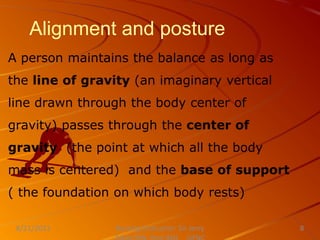
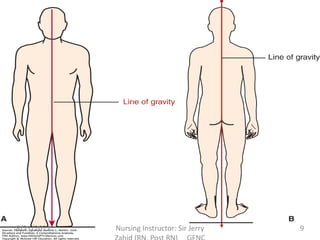
Alignment and posture
A person maintains the balance as long as
the line of gravity (an imaginary vertical
line drawn through the body center of
gravity) passes through the center of
gravity (the point at which all the body
mass is centered) and the base of support
( the foundation on which body rests)
Nursing Instructor: Sir Jerry
8/21/2021 8
Nursing Instructor: Sir Jerry
8/21/2021 9
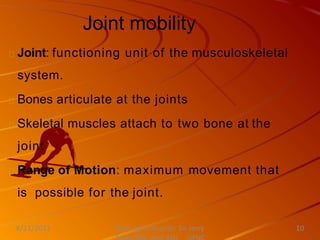
Joint mobility
Joint: functioning unit of the musculoskeletal
system.
Bones articulate at the joints
Skeletal muscles attach to two bone at the
joint
Range of Motion: maximum movement that
is possible for the joint.
Nursing Instructor: Sir Jerry
8/21/2021 10
Joint mobility
Joints are functional units of
musculoskeletal system. The bones of
skeletal articulates at the joints, most of
the skeletal muscles attach to the two
bones at joint . These muscles are
categorized according to the type of joint
movement they produce on contraction.
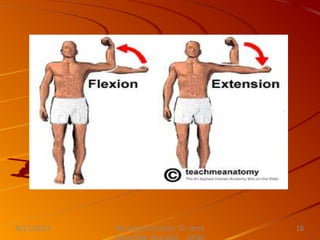
Muscles are therefore called flexors,
extensors, internal rotators, and so on
Nursing Instructor: Sir Jerry
8/21/2021 11
Balance
The mehanism involved in maintaing balance
and posture are complex and involve
informational inputs from labyrinth , from vision
( vestibulo occular input), from stretch
receptors of muscles and tendons( vestibulo
spinal input).
Labyrinth (inner ear )
Cochlea – hearing
Vestibule – equilibrium-receptors
Semicircular canal – equilibrium- receptors.
These equlibrium receptors collectively called
vestibulae appratus
Nursing Instructor: Sir Jerry
8/21/2021 12
proprioception
Is the term used to describe awareness of
posture, movements, and changes in
equilibrium and the knowledge of position,
weight and resistance of objects in
relation to the body.
Nursing Instructor: Sir Jerry
8/21/2021 13
Coordinated movements
Balanced, smooth, and purposeful
movements is the result of proper
functioning of cerebral cotex , cerebellum,
and basal ganglia .
Cerebral cortex – voluntary motor activity
Cerebellum – muscles involved in motor
activity
Basal ganglia – maintain posture
Nursing Instructor: Sir Jerry
8/21/2021 14
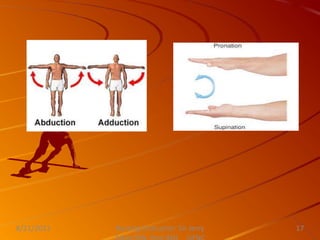
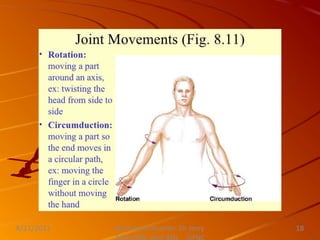
Types of joint
movements
Nursing Instructor: Sir Jerry
8/21/2021 15
Nursing Instructor: Sir Jerry
8/21/2021 16
Nursing Instructor: Sir Jerry
8/21/2021 17
Nursing Instructor: Sir Jerry
8/21/2021 18
Exercise
Nursing Instructor: Sir Jerry
8/21/2021 19
Physical activity is "bodily movement
produced by skeletal muscles that
requires energy expenditure and
produces progressive health benefits."
Exercise is "a type of physical activity
defined as a planned, structured, and
repetitive bodily movement done to
improve or maintain one or more
components of physical fitness."
Activity tolerance is the type and
amount of exercise or daily living
activities an individual is able to perform
without experiencing adverse effects.
Type of exercise:
Nursing Instructor: Sir Jerry
8/21/2021 20
Exercise involves the active contraction
and relaxation of muscles.
Exercise can be classified according to the
type of muscle contraction
(isotonic, isometric, or isokinetic)
and according to the source of energy
(aerobic or anaerobic).
Isotonic (dynamic) exercises:
Nursing Instructor: Sir Jerry
8/21/2021 21
Muscle shortens to produce contraction and
active movement .e.g. running, walking,
swimming, cycling)
* Advantages:
1 Increase muscle tone, mass, strength.
2 Maintain joint flexibility and circulation.
Isometric (static or setting)
exercises:
Nursing Instructor: Sir Jerry
8/21/2021 22
There is muscle contraction without moving
the joint
*useful for strengthening abdominal, gluteal
muscles
* No change in muscle length
* No joint movement
*Maintaining strength in immobilized muscle
Isokinetic (resistive) exercises:
Nursing Instructor: Sir Jerry
8/21/2021 23
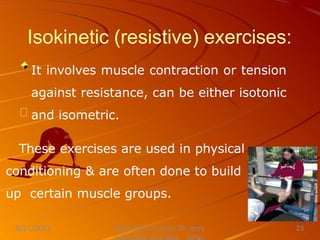
It involves muscle contraction or tension
against resistance, can be either isotonic
and isometric.
These exercises are used in physical
conditioning & are often done to build
up certain muscle groups.
Aerobic exercise:
 It is an activity during which the amount of
oxygen taken in the body is greater than that
used to perform the activity.
 These exercises use the large groups of
muscle, are performed continuously, & are
rhythmic in nature. E.g: walking, running,
dancing, aerobic exercise improve
cardiovascular conditioning & physical fitness.
Nursing Instructor: Sir Jerry
8/21/2021 24
Anaerobic exercise:
involves activity in which the muscles cannot
draw out enough oxygen from the
bloodstream.
And anaerobic pathways are used to
provide additional energy for the short
time. this type of exercise is used in
endurance training for athletes.
Nursing Instructor: Sir Jerry
8/21/2021 25
Factors effecting body alignment
and mobility
 Growth and
Development
 Physical Health
 Mental Health
 Nutrition
 Lifestyle
 Personal Values
 Fatigue and Stress
 External Factors
 Prescribed
limitations
Nursing Instructor: Sir Jerry
8/21/2021 26
Benefits of exercise on body system
Nursing Instructor: Sir Jerry
8/21/2021 27
Musculoskeletal System:
*Increase and maintain muscle tone, size,
shape
* Increase joint mobility, flexibility, and
range of motion.
*Maintain bone density & strength.
Cardiovascular System:
*Improve cardiovascular function, by increasing
cardiac output and strength of heart muscle
contraction.
Benefits of exercise on body
system
Respiratory System:
*Improves gas exchange by increasing the
ventilation & oxygenation.
GI tract System:
*Improve appetite, digestion and elimination.
Metabolic System:
*Increase metabolic rate, thus increase the
production of body heat and calorie use.
Nursing Instructor: Sir Jerry
8/21/2021 28
Benefits of exercise on body
system
Nursing Instructor: Sir Jerry
8/21/2021 29
Urinary System:
*Improve excretion of body waste through the kidneys.
Psycho- neurologic System:
*Enhance sense of well-being and help to relieve stress.
* Improves the quality of sleep.
*Improve self concept and self esteem by decreasing
depression.
Intugumentary System:
* Maintain skin integrity
COGNITIVE FUNCTION:
Current research supports the positive effects of
exercise on cognitive functioning, in particular
decision-making & problem-solving
processes, planning, and paying attention.
Physical exertion induces cells in the brain to
strengthen and build neuronal connections
Nursing Instructor: Sir Jerry
8/21/2021 30
SPIRITUAL HEALTH:
Yoga-style exercise improves the mind–body–
spirit connection, relationship with God, and
physical well-being by establishing balance
in the internal and external environment.
The RELAXATION RESPONSE (RR), first described
by Dr. Herbert Benson, is beneficial for
counteracting some of the harmful effects of stress
on the body and mind. The RR is a healthful
physiological relaxation that can be elicited through
recitation of a word or phrase or prayer while sitting
quietly and relaxing your muscles.
(Varvogli & Darviri, 2011).
Nursing Instructor: Sir Jerry
Zahid (RN, Post RN) GFNC
8/21/2021 31
Effects of immobility
Mobility and activity tolerence are effected by any
disorder that impairs the ability of the nervous system,
musculoskeletal system, cardiovascular system, vestibular
apparatus . Congenital problems such as hip dysplasia,
spinal bifida, cerebral palsy, and muscular dystrophies
effect motor functioning.
Head and spinal cord injuries can leave muscle group
weakened paralyzed, spastic, or flaccid.
Nursing Instructor: Sir Jerry
8/21/2021 32
Effects of immobility & exercise on body
 Problem Related to
Immobility:
 Disuse osteoporosis
 Disuse atrophy
 Contractures
 Stiffness and pain in
joints
 Cardiovascular System
 Problems related to
Immobility:
 Diminished cardiac
reserve; Orthostatic
hypotension, venous
vasodilatation and
stasis, dependent
edema , thrombus
formation.
Nursing Instructor: Sir Jerry
8/21/2021 33
Nursing Instructor: Sir Jerry
8/21/2021 34
Respiratory System:
 Problems related to
Immobility:
 Decreased
respiratory movement;
 Pooling of respiratory
excretions;
 Atelectasis;
 hypostatic pneumonia
 Metabolic System:
 Problems related to
Immobility
 Decreased metabolic
rate
 Anorexia
 Negative calcium
balance
 Negative nitrogen
balance
Nursing Instructor: Sir Jerry
8/21/2021 35
Urinary System:
◦ Problems related to Immobility:
Urinary stasis;
renal calculi
Urinary retention;
Urinary Infection
Gastrointestinal System:
◦ Problems related to Immobility: Constipation;
decreased peristalsis and colon motility
Nursing Instructor: Sir Jerry
8/21/2021 36
Effects…..
Intugumentary System:
 Problems related to Immobility: Reduced
skin turgor; skin breakdown
 Effects of exercise: improved blood
circulation (peripheral) and promoted
delivery of nutrients and oxygen.
Nursing Instructor: Sir Jerry
8/21/2021 37
Effects……
Psycho neurologic System
◦ Problems related to Immobility: Increased
dependence; lower self-esteem; Exaggerated
emotional reactions; lack of intellectual
stimulation
◦ Effects of exercise: improves tolerance to
stress; sense of relaxation; improvement of
body image; improves sleep
Nursing Instructor: Sir Jerry
8/21/2021 38
Assessment
 Nursing history
 Physical examination
Body alignment
 Gait
 Appearance
 Movement of joints
 Capabilities and
limitations of joints
 Muscle mass and
strength
 Activity tolerance
Nursing Instructor: Sir Jerry
8/21/2021 39
Nursing Diagnoses
Nursing Instructor: Sir Jerry
8/21/2021 40
Activity Intolerance
Impaired Physical Mobility
Self-Care Deficits
Altered Health Maintenance
Risks for Falls
Planning
The client will have;
•Increased tolerance for physical activity
•Restored or improved capabilities to ambulate or
participate in ADLs
•Absence of injury from falling
•Enhanced physical fitness
•Absence of any complication associated with
immobility
•Improved social , emotional, intellectual wellbeing
Nursing Instructor: Sir Jerry
8/21/2021 41
Nursing intervention
Maintaining good posture
Positioning Clients
◦ Fowler’s Position
◦ Orthopneic Position
◦ Dorsal Recumbent Position
◦ Prone Position
◦ Lateral Position
◦ Sim’s Position
Nursing Instructor: Sir Jerry
8/21/2021 42
Nursing interventions
Nursing strategies to maintain or promote body
alignment and mobility involve
•Positioning client appropriately
•Moving and turning clients in bed
•Transferring clients
•Providing ROM exercises
•Ambulating clients with or without mechanical
aids
•Prevent the complications of immobility
Nursing Instructor: Sir Jerry
8/21/2021 43
Nursing intervention
Moving and Turning Clients in Bed
◦ Moving a client up in bed
◦ Moving a client to the side of the bed in segments
Transferring Clients
◦ Transferring a client between a Bed and a
Wheelchair
◦ Transferring a Client between a Bed and a Stretcher
◦ Moving a Client Using a Hydraulic Lift
Exercise
Nursing Instructor: Sir Jerry
8/21/2021 44
Nursing interventions
Ambulating Clients
◦ Ambulation: act of walking; function that most
people take for granted
Perambulatory Exercises
Assisting Clients to Ambulate
Nursing Instructor: Sir Jerry
8/21/2021 45
Evaluation
The goals established during planning
phase are evaluated according to specified
desired outcome.
Nursing Instructor: Sir Jerry
8/21/2021 46
References
Nursing Instructor: Sir Jerry
8/21/2021 47
Kozier, Barbara, et al. (2004) Assessing,
Fundamentals of Nursing: concepts,
process and practice, 2nd ed .
THANKS FOR THE
ATTENTION
Nursing Instructor: Sir Jerry
8/21/2021 48
Nursing Instructor: Sir Jerry
8/21/2021 49

Activityexercisepattern

  • 1.
    ACTIVITY & EXERCISE PATTERN Fundamentals ofnursing BScN Nursing Instructor: Sir Jerry 8/21/2021 1
  • 2.
    Objectives At the endof this lecture, the learners will be able to: •Define terms mobility, joint mobility, body alignments, and body mechanics. •Discuss the benefits of exercise and activity. •Identify the principles of gravity that effect balance. •Discuss factors effecting mobility •Discuss the effect of immobility on human body. Nursing Instructor: Sir Jerry 8/21/2021 2
  • 3.
    Objectives •Review A/P ofmuscular skeletal system and characteristics of normal movements. •Describe the impact of immobility on physiologic and psychological functioning. •Apply nursing process while planning for the client with altered muscular skeletal system. Nursing Instructor: Sir Jerry 8/21/2021 3
  • 4.
    An activity –exercisepattern: Nursing Instructor: Sir Jerry 8/21/2021 4 Refers to a person's routine of exercise, activity, leisure, and recreation: it includes Activities of daily living (ADLs) that require energy expenditure such as hygiene, cooking, shopping, eating, working, and home maintenance. The type, quality, and quantity of exercise, including sports.
  • 5.
    Mobility and Immobility NursingInstructor: Sir Jerry 8/21/2021 5 Mobility refers to the ability to engage in activity, and free movement which includes walking, running, sitting, standing, lifting, pushing, pulling and performing daily living activities Immobility refers to the inability to move about freely.
  • 6.
    Body mechanics Good bodymechanics is the efficient, coordinated, and safe use of the body to produce motion and maintain balance during activity. Three basic elements of body mechanics: BODY ALIGNMENT (POSTURE), BALANCE (STABILITY), and COORDINATED BODY MOVEMENT. Nursing Instructor: Sir Jerry 8/21/2021 6
  • 7.
    Normal movement Body Alignment:the geometric arrangement of body parts in relation to each other. Joint mobility Balance: a state of equipoise (equilibrium) in which opposing forces counteract each other Coordinated Body Movement: Integrated functioning of the musculoskeletal and nervous system as well as joint mobility Nursing Instructor: Sir Jerry 8/21/2021 7
  • 8.
    Alignment and posture Aperson maintains the balance as long as the line of gravity (an imaginary vertical line drawn through the body center of gravity) passes through the center of gravity (the point at which all the body mass is centered) and the base of support ( the foundation on which body rests) Nursing Instructor: Sir Jerry 8/21/2021 8
  • 9.
    Nursing Instructor: SirJerry 8/21/2021 9
  • 10.
    Joint mobility Joint: functioningunit of the musculoskeletal system. Bones articulate at the joints Skeletal muscles attach to two bone at the joint Range of Motion: maximum movement that is possible for the joint. Nursing Instructor: Sir Jerry 8/21/2021 10
  • 11.
    Joint mobility Joints arefunctional units of musculoskeletal system. The bones of skeletal articulates at the joints, most of the skeletal muscles attach to the two bones at joint . These muscles are categorized according to the type of joint movement they produce on contraction. Muscles are therefore called flexors, extensors, internal rotators, and so on Nursing Instructor: Sir Jerry 8/21/2021 11
  • 12.
    Balance The mehanism involvedin maintaing balance and posture are complex and involve informational inputs from labyrinth , from vision ( vestibulo occular input), from stretch receptors of muscles and tendons( vestibulo spinal input). Labyrinth (inner ear ) Cochlea – hearing Vestibule – equilibrium-receptors Semicircular canal – equilibrium- receptors. These equlibrium receptors collectively called vestibulae appratus Nursing Instructor: Sir Jerry 8/21/2021 12
  • 13.
    proprioception Is the termused to describe awareness of posture, movements, and changes in equilibrium and the knowledge of position, weight and resistance of objects in relation to the body. Nursing Instructor: Sir Jerry 8/21/2021 13
  • 14.
    Coordinated movements Balanced, smooth,and purposeful movements is the result of proper functioning of cerebral cotex , cerebellum, and basal ganglia . Cerebral cortex – voluntary motor activity Cerebellum – muscles involved in motor activity Basal ganglia – maintain posture Nursing Instructor: Sir Jerry 8/21/2021 14
  • 15.
    Types of joint movements NursingInstructor: Sir Jerry 8/21/2021 15
  • 16.
    Nursing Instructor: SirJerry 8/21/2021 16
  • 17.
    Nursing Instructor: SirJerry 8/21/2021 17
  • 18.
    Nursing Instructor: SirJerry 8/21/2021 18
  • 19.
    Exercise Nursing Instructor: SirJerry 8/21/2021 19 Physical activity is "bodily movement produced by skeletal muscles that requires energy expenditure and produces progressive health benefits." Exercise is "a type of physical activity defined as a planned, structured, and repetitive bodily movement done to improve or maintain one or more components of physical fitness." Activity tolerance is the type and amount of exercise or daily living activities an individual is able to perform without experiencing adverse effects.
  • 20.
    Type of exercise: NursingInstructor: Sir Jerry 8/21/2021 20 Exercise involves the active contraction and relaxation of muscles. Exercise can be classified according to the type of muscle contraction (isotonic, isometric, or isokinetic) and according to the source of energy (aerobic or anaerobic).
  • 21.
    Isotonic (dynamic) exercises: NursingInstructor: Sir Jerry 8/21/2021 21 Muscle shortens to produce contraction and active movement .e.g. running, walking, swimming, cycling) * Advantages: 1 Increase muscle tone, mass, strength. 2 Maintain joint flexibility and circulation.
  • 22.
    Isometric (static orsetting) exercises: Nursing Instructor: Sir Jerry 8/21/2021 22 There is muscle contraction without moving the joint *useful for strengthening abdominal, gluteal muscles * No change in muscle length * No joint movement *Maintaining strength in immobilized muscle
  • 23.
    Isokinetic (resistive) exercises: NursingInstructor: Sir Jerry 8/21/2021 23 It involves muscle contraction or tension against resistance, can be either isotonic and isometric. These exercises are used in physical conditioning & are often done to build up certain muscle groups.
  • 24.
    Aerobic exercise:  Itis an activity during which the amount of oxygen taken in the body is greater than that used to perform the activity.  These exercises use the large groups of muscle, are performed continuously, & are rhythmic in nature. E.g: walking, running, dancing, aerobic exercise improve cardiovascular conditioning & physical fitness. Nursing Instructor: Sir Jerry 8/21/2021 24
  • 25.
    Anaerobic exercise: involves activityin which the muscles cannot draw out enough oxygen from the bloodstream. And anaerobic pathways are used to provide additional energy for the short time. this type of exercise is used in endurance training for athletes. Nursing Instructor: Sir Jerry 8/21/2021 25
  • 26.
    Factors effecting bodyalignment and mobility  Growth and Development  Physical Health  Mental Health  Nutrition  Lifestyle  Personal Values  Fatigue and Stress  External Factors  Prescribed limitations Nursing Instructor: Sir Jerry 8/21/2021 26
  • 27.
    Benefits of exerciseon body system Nursing Instructor: Sir Jerry 8/21/2021 27 Musculoskeletal System: *Increase and maintain muscle tone, size, shape * Increase joint mobility, flexibility, and range of motion. *Maintain bone density & strength. Cardiovascular System: *Improve cardiovascular function, by increasing cardiac output and strength of heart muscle contraction.
  • 28.
    Benefits of exerciseon body system Respiratory System: *Improves gas exchange by increasing the ventilation & oxygenation. GI tract System: *Improve appetite, digestion and elimination. Metabolic System: *Increase metabolic rate, thus increase the production of body heat and calorie use. Nursing Instructor: Sir Jerry 8/21/2021 28
  • 29.
    Benefits of exerciseon body system Nursing Instructor: Sir Jerry 8/21/2021 29 Urinary System: *Improve excretion of body waste through the kidneys. Psycho- neurologic System: *Enhance sense of well-being and help to relieve stress. * Improves the quality of sleep. *Improve self concept and self esteem by decreasing depression.
  • 30.
    Intugumentary System: * Maintainskin integrity COGNITIVE FUNCTION: Current research supports the positive effects of exercise on cognitive functioning, in particular decision-making & problem-solving processes, planning, and paying attention. Physical exertion induces cells in the brain to strengthen and build neuronal connections Nursing Instructor: Sir Jerry 8/21/2021 30
  • 31.
    SPIRITUAL HEALTH: Yoga-style exerciseimproves the mind–body– spirit connection, relationship with God, and physical well-being by establishing balance in the internal and external environment. The RELAXATION RESPONSE (RR), first described by Dr. Herbert Benson, is beneficial for counteracting some of the harmful effects of stress on the body and mind. The RR is a healthful physiological relaxation that can be elicited through recitation of a word or phrase or prayer while sitting quietly and relaxing your muscles. (Varvogli & Darviri, 2011). Nursing Instructor: Sir Jerry Zahid (RN, Post RN) GFNC 8/21/2021 31
  • 32.
    Effects of immobility Mobilityand activity tolerence are effected by any disorder that impairs the ability of the nervous system, musculoskeletal system, cardiovascular system, vestibular apparatus . Congenital problems such as hip dysplasia, spinal bifida, cerebral palsy, and muscular dystrophies effect motor functioning. Head and spinal cord injuries can leave muscle group weakened paralyzed, spastic, or flaccid. Nursing Instructor: Sir Jerry 8/21/2021 32
  • 33.
    Effects of immobility& exercise on body  Problem Related to Immobility:  Disuse osteoporosis  Disuse atrophy  Contractures  Stiffness and pain in joints  Cardiovascular System  Problems related to Immobility:  Diminished cardiac reserve; Orthostatic hypotension, venous vasodilatation and stasis, dependent edema , thrombus formation. Nursing Instructor: Sir Jerry 8/21/2021 33
  • 34.
    Nursing Instructor: SirJerry 8/21/2021 34
  • 35.
    Respiratory System:  Problemsrelated to Immobility:  Decreased respiratory movement;  Pooling of respiratory excretions;  Atelectasis;  hypostatic pneumonia  Metabolic System:  Problems related to Immobility  Decreased metabolic rate  Anorexia  Negative calcium balance  Negative nitrogen balance Nursing Instructor: Sir Jerry 8/21/2021 35
  • 36.
    Urinary System: ◦ Problemsrelated to Immobility: Urinary stasis; renal calculi Urinary retention; Urinary Infection Gastrointestinal System: ◦ Problems related to Immobility: Constipation; decreased peristalsis and colon motility Nursing Instructor: Sir Jerry 8/21/2021 36
  • 37.
    Effects….. Intugumentary System:  Problemsrelated to Immobility: Reduced skin turgor; skin breakdown  Effects of exercise: improved blood circulation (peripheral) and promoted delivery of nutrients and oxygen. Nursing Instructor: Sir Jerry 8/21/2021 37
  • 38.
    Effects…… Psycho neurologic System ◦Problems related to Immobility: Increased dependence; lower self-esteem; Exaggerated emotional reactions; lack of intellectual stimulation ◦ Effects of exercise: improves tolerance to stress; sense of relaxation; improvement of body image; improves sleep Nursing Instructor: Sir Jerry 8/21/2021 38
  • 39.
    Assessment  Nursing history Physical examination Body alignment  Gait  Appearance  Movement of joints  Capabilities and limitations of joints  Muscle mass and strength  Activity tolerance Nursing Instructor: Sir Jerry 8/21/2021 39
  • 40.
    Nursing Diagnoses Nursing Instructor:Sir Jerry 8/21/2021 40 Activity Intolerance Impaired Physical Mobility Self-Care Deficits Altered Health Maintenance Risks for Falls
  • 41.
    Planning The client willhave; •Increased tolerance for physical activity •Restored or improved capabilities to ambulate or participate in ADLs •Absence of injury from falling •Enhanced physical fitness •Absence of any complication associated with immobility •Improved social , emotional, intellectual wellbeing Nursing Instructor: Sir Jerry 8/21/2021 41
  • 42.
    Nursing intervention Maintaining goodposture Positioning Clients ◦ Fowler’s Position ◦ Orthopneic Position ◦ Dorsal Recumbent Position ◦ Prone Position ◦ Lateral Position ◦ Sim’s Position Nursing Instructor: Sir Jerry 8/21/2021 42
  • 43.
    Nursing interventions Nursing strategiesto maintain or promote body alignment and mobility involve •Positioning client appropriately •Moving and turning clients in bed •Transferring clients •Providing ROM exercises •Ambulating clients with or without mechanical aids •Prevent the complications of immobility Nursing Instructor: Sir Jerry 8/21/2021 43
  • 44.
    Nursing intervention Moving andTurning Clients in Bed ◦ Moving a client up in bed ◦ Moving a client to the side of the bed in segments Transferring Clients ◦ Transferring a client between a Bed and a Wheelchair ◦ Transferring a Client between a Bed and a Stretcher ◦ Moving a Client Using a Hydraulic Lift Exercise Nursing Instructor: Sir Jerry 8/21/2021 44
  • 45.
    Nursing interventions Ambulating Clients ◦Ambulation: act of walking; function that most people take for granted Perambulatory Exercises Assisting Clients to Ambulate Nursing Instructor: Sir Jerry 8/21/2021 45
  • 46.
    Evaluation The goals establishedduring planning phase are evaluated according to specified desired outcome. Nursing Instructor: Sir Jerry 8/21/2021 46
  • 47.
    References Nursing Instructor: SirJerry 8/21/2021 47 Kozier, Barbara, et al. (2004) Assessing, Fundamentals of Nursing: concepts, process and practice, 2nd ed .
  • 48.
    THANKS FOR THE ATTENTION NursingInstructor: Sir Jerry 8/21/2021 48
  • 49.
    Nursing Instructor: SirJerry 8/21/2021 49

Editor's Notes

  • #32 Its done until here on 31-08-2021