Body Mechanics and
Positioning
HEALTH ASSESSMENT’ (NCM 101) SKILLS
Mr. JHONEE F. BALMEO
Body mechanics is the term used to describe
the efficient, coordinated, and safe use of
the body to move objects and carry out the
ADLs.
Until recently, nurses believed that “correct” body mechanics
would facilitate the safe and efficient use of appropriate muscle
groups to maintain balance, reduce the energy required, reduce
fatigue, and decrease the risk of injury for both nurses and clients,
How about Ergonomics?
In reality, more than 30years of evidence
show that:
 Educating nurses in body mechanics alone will not prevent job-
related injuries.
 Back belts have not been shown to be effective in reducing back
injury.
 Nurses who are physically fit
are at no less risk of injury.
 The formerly widely accepted National Institute for Occupational
Safety and Health (NIOSH) “lifting equation,” which
recommended that workers observe a limit of 51 pounds of
lifting, cannot be safely applied to nursing practice.
 The long-term benefits of using the proper
equipment (e.g., mechanical lifts) far
outweigh the costs related to injuries.
 Staff will use equipment when they have participated in the
decision-making process for purchasing the equipment
(AmericanNursesAssociation[ANA], HandlewithCare,n.d.).
Body Mechanics
 Body mechanics is the safe use of the body using the correct
posture, bodily alignment, balance and bodily movements to
safely bend, carry, lift and move objects and people.
In addition to getting the assistance of another or using a mechanical life,
nurses should follow these:
 Take the time to do a little bit of muscular warmup and stretching
before you attempt to lift or transfer a person or object.
 Think about and plan your approach before you attempt to do it.
 Explain what you will be doing and how you will perform the lift or
transfer to the client. Instruct the patient about what you and they will
be doing.
 Remain as close to the person or the object, such as a large box, when
you are about to lift it and while you are lifting.
 Face the person or object that you are about to lift.
 Keep your spine, neck and back straight and aligned throughout the lift
or transfer. Do not twist
 Maintain a wide and secure base of support by keeping your feet apart.
 Pivot on your feet in the direction of the move and not against it.
 Get a secure and good grip on the object or person that you
are about to lift.
 Use the long and strong muscles of your arms and legs to lift. Do NOT
use back muscles.
 Use slow, smooth and non-jerky movements.
Principles of Body Mechanics
 Principles underlying proper body mechanics involve three
major factors: center of gravity, base of support, and line
of gravity.
Center of Gravity
 A person’s center of gravity is located
in the pelvic area.
 When lifting an object, bend at the
knees and hips and keep the back
straight. By doing so, the center of
gravity remains over the feet, giving
extra stability. It is thus easier to
maintain balance
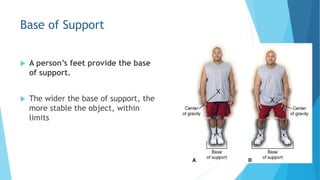
Base of Support
 A person’s feet provide the base
of support.
 The wider the base of support, the
more stable the object, within
limits
Basic Principles of Body Mechanics
 1. It is easier to pull, push, or roll an object than it is to
lift it. The movement should be smooth and continuous,
rather than jerky.
 2. Often less energy or force is required to keep an
object moving than it is to start and stop it.
Basic Principles of Body Mechanics
 3. It takes less effort to lift an object if the nurse works as close to it
as possible. Use the strong leg and arm muscles as much as possible.
Use back muscles, which are not as strong, as little as possible. Avoid
reaching.
 4. The nurse rocks backward or forward on the feet and with his or
her body as a force for pulling or pushing.
Line of Gravity
 Draw an imaginary vertical (up and
down) line through the top of the
head, the center of gravity, and the
base of support.
 For highest efficiency, this line should
be straight from the top of the head to
the base of support, with equal weight
on each side.
Body Alignment
 When lifting, walking, or
performing any body activity,
proper body alignment is essential
to maintain balance.
 When a person is in proper
alignment, an imaginary straight
line can be drawn connecting the
person’s nose, breastbone
(sternum), and pubic bone.
?
?
 To increase stability during client
transfer, the nurse increases the base
of support by performing which
action?
1. Leaning slightly backward
2. Spacing the feet farther apart.
3. Tensing the abdominal muscles
4. Bending the knees
?
 A client weighs 250 pounds and needs to be
transferred from the bed to a chair. Which
instruction by the nurse to the unlicensed
assistive personnel (UAP) is most appropriate?
 1. “Using proper body mechanics will prevent
you from injuring yourself.”
 2. “You are physically fit and at lesser risk for
injury when transferring the client.”
 3. “Use the mechanical lift and another person
to transfer the client from the bed to the
chair.”.
 4. “Use the back belt to avoid hurting your
back.”
Lifting
 It is important to remember that nurses should not lift
more than 35 pounds without assistance from proper
equipment and/or other persons.
There are a number of assistive devices that can
be used to safely lift and transfer patients.
 Mechanical lifts
are used mostly for patients who
are obese and cannot be safely
moved or transferred by two
people, and are paralyzed.
 A gait or transfer belt
is also used to assist with transfers and lifting.
 Slide boards
are particularly useful to move a patient from one flat surface to another.
Pulling and Pushing
 When pulling or pushing an
object, a person maintains
balance with least effort when
the base of support is increased
in the direction in which the
movement is to be produced or
opposed
Pivoting
 Pivoting is a technique in which the
body is turned in a way that avoids
twisting of the spine
POSITIONING THE CLIENT
 Encouraging clients to move in
bed, get out of bed, or walk serves
several positive purposes. Clients may
be reluctant to move or may stay in bed
unnecessarily.
This immobility can contribute to a number of disorders,
among which are;
 pressure ulcers,
 blood clots,
 constipation,
 muscle weakness and atrophy,
 pneumonia,
 joint deformities, and
 mental disorders
?
 The nurse is performing an
assessment of an immobilized
client. Which assessment causes
the nurse to take action?
 1. Heart rate 86
 2. Reddened area on sacrum.
 3. Nonproductive cough
 4. Urine output of 50 mL/hour
Moving and Positioning Clients
 There are many reasons to change the client’s position,
including promoting comfort, restoring body function,
preventing deformities, relieving pressure, preventing
muscle strain, stimulating proper respiration and
circulation, providing diversion, and giving nursing
treatments.
!!!Any position, correct or incorrect, can be detrimental if
maintained for a prolonged period.
Positioning for Examinations and Treatments
 The client is sometimes helped into a special
position as part of a treatment or
examination. Many different positions are used
for physical examinations, nursing treatments
and tests, and to obtain specimens.
 Because nurses assist clients into some of
these positions and will see other positions
used, it is important to know how to assist the
client and how to place the necessary drapes.
IN PRACTICE :NURSING CARE GUIDELINES
 POSITIONING THE CLIENT FOR COMFORT
 • Maintain functional client body alignment. (Alignment
is similar whether the client is standing or in bed.)
 • Maintain client safety.
 • Reassure the client, to promote comfort and
cooperation.
 • Properly handle the client’s body, to prevent pain or
injury
 • Follow proper body mechanics, to protect yourself and
the client.
 • Obtain assistance, if needed, to move heavy or
immobile clients.
 • Follow specific provider’s orders.
 • Remember that a specific order is needed for a client
to be out of bed.
 • Do not use special devices (eg, splints, traction) unless
ordered and trained to use this equipment.
 • Make sure the client is comfortable and has the nurse
signal cord available after positioning.
 • A urine specimen is collected, as ordered.
 • The client is encouraged to defecate before most
examinations, particularly a rectal examination.
 • The client is provided with an examination gown
and/or bath towel to cover the chest and perineal area.
 • A bath blanket or sheet is provided for warmth and
privacy. In some cases, a small pillow is provided.
 • The examination procedure is explained to the client.
 • The body is draped appropriately for client privacy
and examiner’s access.
 • Appropriate lighting is provided for the examiner.
 • Needed equipment and supplies are prepared before
the examination begins.
 • The nurse stays with the client during the
examination.
 • Examiner and nurse wash or sanitize their hands
before and after any examination.
 • Gloves are worn in many cases.
 • Other personal protective equipment is worn when
needed.
 • A signed release is obtained from the client when
needed.
 • The nurse observes, in order to document the
procedure and to maintain client safety and
confidentiality.
 • After the examination, the nurse assists in disposing of
equipment and supplies and readying the examination
room for the next examination.
 • The nurse needs to know why the examination is being
done so the client’s questions can be answered and to
anticipate problems that might arise.
?
 The client is ambulating for the first time
after surgery. The client tells the nurse,
“I feel faint.” Which is the best action by
the nurse?
 1. Find another nurse for help.
 2. Return the client to her room as
quickly as possible.
 3. Tell the client to take rapid, shallow
breaths.
 4. Assist the client to a nearby chair..
Client Positions
Supine (Dorsal Recumbent)
 General examination;
examination of chest,
abdomen, pelvic area.
 Back-lying, legs
extended or slightly
bent. Arms up or down.
Small pillow allowed.
May be uncomfortable
for client with back
problem
Prone
 Examination of spine, back. (Long time in this position
may cause neck strain and/or headache.)
 On abdomen, head to side. Arms above head or beside
body.
 (Small pillow or folded towel may be placed under
shoulder toward which head is turned. Difficult for
pregnant woman, obese client, or client with abdominal
incision or breathing problem
Lateral (Side Lying)
 Client positioned for extended rest periods.
 Side-lying, bottom arm behind or in front of client, not as
extreme as Sims’. Pillow placed under top leg for support.
Comfortable for longer time than prone
 Sims’ (Semi Prone)
 Rectal examination;
procedures such as
colonoscopy or enema
 Side-lying (usually left side),
upper knee flexed sharply,
bottom arm behind body.
Small pillow allowed under
head. Pillow may be placed
under top leg. Difficult for
client with arthritis or leg
injuries
 Fowler’s
 Promotes drainage; assists
with breathing; preparation
for dangling or walking
 Semi-Fowler’s position is
when the head and trunk are
raised 15 to 45 degrees.
 In high Fowler’s position, the
head and trunk are raised 60–
90 degrees
Orthopneic position
 Facilitates breathing in client
with severe cardiac or
respiratory disorders. Can be
used for an extended length
of time
 High Fowler’s, leaning on
overbed table, arms
outstretched, head held up or
turned to side on pillows.
knee-Chest (Genupectoral)
Rectal or vaginal examination;
treatment to bring retroflexed
uterus into normal position
Client on knees with chest resting
on bed. Arms above head or to
the side; head turned to side.
Thighs straight up and down;
lower legs flat on bed. Client may
become dizzy; do not leave alone
Lithotomy (Dorsal Lithotomy)
 Pelvic or perineal
examination.
 Supine, with legs separated,
knees acutely flexed, hips at
end of examination table,
and feet in stirrups
Modified Standing
 Prostate examination.
 Standing, with chest, head, and
arms on table.
Trendelenburg’s Position
(Head Down Position)
 Treatment of shock,
simulated using drainage,
promoting venous return.
 Head lower than feet.
(May be simulated using
pillows under feet in
emergency.) Place pillow
between client’s head and
headboard of bed
Reverse Trendelenburg’s Position
(Head Elevated)
 To facilitate tube feedings,
emergency treatment in severe
bleeding, head injury
 Head higher than feet.
 Place pillow between client’s feet
and footboard of bed.
Support Devices
Pillows.
 Different sizes are available. Used for support or elevation of an arm or leg.
Mattresses.
 There are two types of mattresses: ones that fit on the bed frame and
mattresses that fit on the standard bed mattress. Mattresses should be
evenly supportive.
Suspension or heel guard boot.
 These are made of a variety of substances. They usually have a firm exterior
and padding of foam to protect the skin.
Footboard.
 A flat panel often made of plastic or wood. It keeps the feet in
dorsiflexion to prevent plantar flexion.
Hand roll.
 Can be made by rolling a washcloth. Purpose is to keep hand in a
functional position and prevent finger contractures.
Abduction pillow.
 A triangular-shaped foam pillow that maintains hip abduction to prevent
hip dislocation following total hip replacement
?
 What type of patient would benefit from
an elevated head of the bed position?
A. Patient with burns of the face and head .
B. Patient with a broken femur
C. Patient who had a hemorroidectomy
D. Patient who had a lumbar puncture
?
A patient is supine and the head of the
bed is elevated to 45 to 60 degrees.
What position is this called?
 A. Semi-Fowler's Position
 B. High Fowler's Position
 C. Sim's Position
 D. Fowler's Position.
?
 Your patient is getting prepped for a
lumbar puncture. What position do you
assist the patient in?
 A. Lateral Side-lying Position.
 B. Prone
 C. Head of the bed at 45 degrees
 D. None of the above
?
 Which of the following statements
made by the patient is true regarding
positioning after cataracts surgery?
 A. I will sleep on the unaffected side. .
 B. I will sleep on the affected side to
help decrease drainage.
 C. I know I can't lay on my back and be
on my side for at least a week.
 D. I will sleep on my stomach to help
keep pressure on my eye while I sleep
References:
 Audrey Berman . . . [et al.]. – 9th ed. (2012)
KOZIER & ERB’S Fundamentals of NURSING
Concepts, Process, and Practice.
DEMONSTRATION 

01 pres bodymechanics

  • 1.
    Body Mechanics and Positioning HEALTHASSESSMENT’ (NCM 101) SKILLS Mr. JHONEE F. BALMEO
  • 2.
    Body mechanics isthe term used to describe the efficient, coordinated, and safe use of the body to move objects and carry out the ADLs. Until recently, nurses believed that “correct” body mechanics would facilitate the safe and efficient use of appropriate muscle groups to maintain balance, reduce the energy required, reduce fatigue, and decrease the risk of injury for both nurses and clients, How about Ergonomics?
  • 3.
    In reality, morethan 30years of evidence show that:  Educating nurses in body mechanics alone will not prevent job- related injuries.
  • 4.
     Back beltshave not been shown to be effective in reducing back injury.  Nurses who are physically fit are at no less risk of injury.
  • 5.
     The formerlywidely accepted National Institute for Occupational Safety and Health (NIOSH) “lifting equation,” which recommended that workers observe a limit of 51 pounds of lifting, cannot be safely applied to nursing practice.  The long-term benefits of using the proper equipment (e.g., mechanical lifts) far outweigh the costs related to injuries.
  • 6.
     Staff willuse equipment when they have participated in the decision-making process for purchasing the equipment (AmericanNursesAssociation[ANA], HandlewithCare,n.d.).
  • 7.
    Body Mechanics  Bodymechanics is the safe use of the body using the correct posture, bodily alignment, balance and bodily movements to safely bend, carry, lift and move objects and people.
  • 8.
    In addition togetting the assistance of another or using a mechanical life, nurses should follow these:  Take the time to do a little bit of muscular warmup and stretching before you attempt to lift or transfer a person or object.  Think about and plan your approach before you attempt to do it.
  • 9.
     Explain whatyou will be doing and how you will perform the lift or transfer to the client. Instruct the patient about what you and they will be doing.  Remain as close to the person or the object, such as a large box, when you are about to lift it and while you are lifting.
  • 10.
     Face theperson or object that you are about to lift.  Keep your spine, neck and back straight and aligned throughout the lift or transfer. Do not twist
  • 11.
     Maintain awide and secure base of support by keeping your feet apart.  Pivot on your feet in the direction of the move and not against it.  Get a secure and good grip on the object or person that you are about to lift.
  • 12.
     Use thelong and strong muscles of your arms and legs to lift. Do NOT use back muscles.  Use slow, smooth and non-jerky movements.
  • 13.
    Principles of BodyMechanics  Principles underlying proper body mechanics involve three major factors: center of gravity, base of support, and line of gravity.
  • 14.
    Center of Gravity A person’s center of gravity is located in the pelvic area.  When lifting an object, bend at the knees and hips and keep the back straight. By doing so, the center of gravity remains over the feet, giving extra stability. It is thus easier to maintain balance
  • 15.
    Base of Support A person’s feet provide the base of support.  The wider the base of support, the more stable the object, within limits
  • 16.
    Basic Principles ofBody Mechanics  1. It is easier to pull, push, or roll an object than it is to lift it. The movement should be smooth and continuous, rather than jerky.  2. Often less energy or force is required to keep an object moving than it is to start and stop it.
  • 17.
    Basic Principles ofBody Mechanics  3. It takes less effort to lift an object if the nurse works as close to it as possible. Use the strong leg and arm muscles as much as possible. Use back muscles, which are not as strong, as little as possible. Avoid reaching.  4. The nurse rocks backward or forward on the feet and with his or her body as a force for pulling or pushing.
  • 18.
    Line of Gravity Draw an imaginary vertical (up and down) line through the top of the head, the center of gravity, and the base of support.  For highest efficiency, this line should be straight from the top of the head to the base of support, with equal weight on each side.
  • 19.
    Body Alignment  Whenlifting, walking, or performing any body activity, proper body alignment is essential to maintain balance.  When a person is in proper alignment, an imaginary straight line can be drawn connecting the person’s nose, breastbone (sternum), and pubic bone.
  • 20.
  • 21.
    ?  To increasestability during client transfer, the nurse increases the base of support by performing which action? 1. Leaning slightly backward 2. Spacing the feet farther apart. 3. Tensing the abdominal muscles 4. Bending the knees
  • 22.
    ?  A clientweighs 250 pounds and needs to be transferred from the bed to a chair. Which instruction by the nurse to the unlicensed assistive personnel (UAP) is most appropriate?  1. “Using proper body mechanics will prevent you from injuring yourself.”  2. “You are physically fit and at lesser risk for injury when transferring the client.”  3. “Use the mechanical lift and another person to transfer the client from the bed to the chair.”.  4. “Use the back belt to avoid hurting your back.”
  • 23.
    Lifting  It isimportant to remember that nurses should not lift more than 35 pounds without assistance from proper equipment and/or other persons.
  • 24.
    There are anumber of assistive devices that can be used to safely lift and transfer patients.  Mechanical lifts are used mostly for patients who are obese and cannot be safely moved or transferred by two people, and are paralyzed.
  • 26.
     A gaitor transfer belt is also used to assist with transfers and lifting.
  • 27.
     Slide boards areparticularly useful to move a patient from one flat surface to another.
  • 28.
    Pulling and Pushing When pulling or pushing an object, a person maintains balance with least effort when the base of support is increased in the direction in which the movement is to be produced or opposed
  • 29.
    Pivoting  Pivoting isa technique in which the body is turned in a way that avoids twisting of the spine
  • 31.
    POSITIONING THE CLIENT Encouraging clients to move in bed, get out of bed, or walk serves several positive purposes. Clients may be reluctant to move or may stay in bed unnecessarily.
  • 32.
    This immobility cancontribute to a number of disorders, among which are;  pressure ulcers,  blood clots,  constipation,  muscle weakness and atrophy,  pneumonia,  joint deformities, and  mental disorders
  • 34.
    ?  The nurseis performing an assessment of an immobilized client. Which assessment causes the nurse to take action?  1. Heart rate 86  2. Reddened area on sacrum.  3. Nonproductive cough  4. Urine output of 50 mL/hour
  • 35.
    Moving and PositioningClients  There are many reasons to change the client’s position, including promoting comfort, restoring body function, preventing deformities, relieving pressure, preventing muscle strain, stimulating proper respiration and circulation, providing diversion, and giving nursing treatments. !!!Any position, correct or incorrect, can be detrimental if maintained for a prolonged period.
  • 36.
    Positioning for Examinationsand Treatments  The client is sometimes helped into a special position as part of a treatment or examination. Many different positions are used for physical examinations, nursing treatments and tests, and to obtain specimens.  Because nurses assist clients into some of these positions and will see other positions used, it is important to know how to assist the client and how to place the necessary drapes.
  • 37.
    IN PRACTICE :NURSINGCARE GUIDELINES  POSITIONING THE CLIENT FOR COMFORT  • Maintain functional client body alignment. (Alignment is similar whether the client is standing or in bed.)  • Maintain client safety.  • Reassure the client, to promote comfort and cooperation.
  • 38.
     • Properlyhandle the client’s body, to prevent pain or injury  • Follow proper body mechanics, to protect yourself and the client.  • Obtain assistance, if needed, to move heavy or immobile clients.  • Follow specific provider’s orders.  • Remember that a specific order is needed for a client to be out of bed.
  • 39.
     • Donot use special devices (eg, splints, traction) unless ordered and trained to use this equipment.  • Make sure the client is comfortable and has the nurse signal cord available after positioning.  • A urine specimen is collected, as ordered.  • The client is encouraged to defecate before most examinations, particularly a rectal examination.  • The client is provided with an examination gown and/or bath towel to cover the chest and perineal area.
  • 40.
     • Abath blanket or sheet is provided for warmth and privacy. In some cases, a small pillow is provided.  • The examination procedure is explained to the client.  • The body is draped appropriately for client privacy and examiner’s access.  • Appropriate lighting is provided for the examiner.  • Needed equipment and supplies are prepared before the examination begins.
  • 41.
     • Thenurse stays with the client during the examination.  • Examiner and nurse wash or sanitize their hands before and after any examination.  • Gloves are worn in many cases.  • Other personal protective equipment is worn when needed.  • A signed release is obtained from the client when needed.
  • 42.
     • Thenurse observes, in order to document the procedure and to maintain client safety and confidentiality.  • After the examination, the nurse assists in disposing of equipment and supplies and readying the examination room for the next examination.  • The nurse needs to know why the examination is being done so the client’s questions can be answered and to anticipate problems that might arise.
  • 43.
    ?  The clientis ambulating for the first time after surgery. The client tells the nurse, “I feel faint.” Which is the best action by the nurse?  1. Find another nurse for help.  2. Return the client to her room as quickly as possible.  3. Tell the client to take rapid, shallow breaths.  4. Assist the client to a nearby chair..
  • 44.
    Client Positions Supine (DorsalRecumbent)  General examination; examination of chest, abdomen, pelvic area.  Back-lying, legs extended or slightly bent. Arms up or down. Small pillow allowed. May be uncomfortable for client with back problem
  • 45.
    Prone  Examination ofspine, back. (Long time in this position may cause neck strain and/or headache.)  On abdomen, head to side. Arms above head or beside body.  (Small pillow or folded towel may be placed under shoulder toward which head is turned. Difficult for pregnant woman, obese client, or client with abdominal incision or breathing problem
  • 46.
    Lateral (Side Lying) Client positioned for extended rest periods.  Side-lying, bottom arm behind or in front of client, not as extreme as Sims’. Pillow placed under top leg for support. Comfortable for longer time than prone
  • 47.
     Sims’ (SemiProne)  Rectal examination; procedures such as colonoscopy or enema  Side-lying (usually left side), upper knee flexed sharply, bottom arm behind body. Small pillow allowed under head. Pillow may be placed under top leg. Difficult for client with arthritis or leg injuries
  • 49.
     Fowler’s  Promotesdrainage; assists with breathing; preparation for dangling or walking  Semi-Fowler’s position is when the head and trunk are raised 15 to 45 degrees.  In high Fowler’s position, the head and trunk are raised 60– 90 degrees
  • 51.
    Orthopneic position  Facilitatesbreathing in client with severe cardiac or respiratory disorders. Can be used for an extended length of time  High Fowler’s, leaning on overbed table, arms outstretched, head held up or turned to side on pillows.
  • 52.
    knee-Chest (Genupectoral) Rectal orvaginal examination; treatment to bring retroflexed uterus into normal position Client on knees with chest resting on bed. Arms above head or to the side; head turned to side. Thighs straight up and down; lower legs flat on bed. Client may become dizzy; do not leave alone
  • 53.
    Lithotomy (Dorsal Lithotomy) Pelvic or perineal examination.  Supine, with legs separated, knees acutely flexed, hips at end of examination table, and feet in stirrups
  • 54.
    Modified Standing  Prostateexamination.  Standing, with chest, head, and arms on table.
  • 55.
    Trendelenburg’s Position (Head DownPosition)  Treatment of shock, simulated using drainage, promoting venous return.  Head lower than feet. (May be simulated using pillows under feet in emergency.) Place pillow between client’s head and headboard of bed
  • 56.
    Reverse Trendelenburg’s Position (HeadElevated)  To facilitate tube feedings, emergency treatment in severe bleeding, head injury  Head higher than feet.  Place pillow between client’s feet and footboard of bed.
  • 57.
    Support Devices Pillows.  Differentsizes are available. Used for support or elevation of an arm or leg. Mattresses.  There are two types of mattresses: ones that fit on the bed frame and mattresses that fit on the standard bed mattress. Mattresses should be evenly supportive. Suspension or heel guard boot.  These are made of a variety of substances. They usually have a firm exterior and padding of foam to protect the skin.
  • 58.
    Footboard.  A flatpanel often made of plastic or wood. It keeps the feet in dorsiflexion to prevent plantar flexion. Hand roll.  Can be made by rolling a washcloth. Purpose is to keep hand in a functional position and prevent finger contractures. Abduction pillow.  A triangular-shaped foam pillow that maintains hip abduction to prevent hip dislocation following total hip replacement
  • 60.
    ?  What typeof patient would benefit from an elevated head of the bed position? A. Patient with burns of the face and head . B. Patient with a broken femur C. Patient who had a hemorroidectomy D. Patient who had a lumbar puncture
  • 61.
    ? A patient issupine and the head of the bed is elevated to 45 to 60 degrees. What position is this called?  A. Semi-Fowler's Position  B. High Fowler's Position  C. Sim's Position  D. Fowler's Position.
  • 62.
    ?  Your patientis getting prepped for a lumbar puncture. What position do you assist the patient in?  A. Lateral Side-lying Position.  B. Prone  C. Head of the bed at 45 degrees  D. None of the above
  • 63.
    ?  Which ofthe following statements made by the patient is true regarding positioning after cataracts surgery?  A. I will sleep on the unaffected side. .  B. I will sleep on the affected side to help decrease drainage.  C. I know I can't lay on my back and be on my side for at least a week.  D. I will sleep on my stomach to help keep pressure on my eye while I sleep
  • 65.
    References:  Audrey Berman. . . [et al.]. – 9th ed. (2012) KOZIER & ERB’S Fundamentals of NURSING Concepts, Process, and Practice.
  • 66.

Editor's Notes

  • #3 ABC in Body mechanics: Alignment, Balance, Coordination of the body/ the body movement Ergonomics is a scientific discipline that addresses the human being in the environment to facilitate human wellbeing. especially during transferring, lifting, and repositioning.
  • #6 If the weight to be lifted exceeds 35pounds, assistive devices should be used (Waters, 2007) These devices include floor-based and ceiling lifts, slings, mechanical lateral standing lifts, sliding boards, and standing assist aids.
  • #8 Nurses are encouraged to support “no manual lift” and “no solo lift” policies in their workplaces body mechanics protect the patient and they also protect the nurse
  • #10 For example, tell the patient to bend their knees and press their feet into the mattress and, then on the count of three, tell the patient that they should push up to the top of the bed as you assist them.
  • #15 This means that approximately half the body weight is distributed above this area, half below it, when thinking of the body divided horizontally.
  • #16 The feet must not be too wide apart, as this would cause instability (It is important not to twist the body.)
  • #19 This becomes the line of gravity, or the gravital plane When the body is held in proper alignment, the back is in a "neutral” position, with the curve of the lower spine intact.
  • #20 When a person’s body is in correct alignment, all the muscles work together for the safest and most efficient movement, without muscle strain.
  • #25 EZ Lift is a mobile electric lift that functions to lift clients from bed, chair, toilet, and floor
  • #26 A ceiling-mounted lift A sit-to-stand power lift.
  • #28  These boards reduce friction and, therefore, make the move easier and less irritating to the patient's skin The Slipp® Patient Mover is a client-moving device that reduces the nurse’s exposure to back injuries and maximizes client comfort But, what if these devices or equipment aren’t available? Here comes the use of our own body. Applying the proper safe use body mechanics, lifting, and moving
  • #29 For example, when pushing an object, a person can enlarge the base of support by moving the front foot forward.
  • #30 To pivot, place one foot ahead of the other, raise the heels very slightly, and put the body weight on the balls of the feet. The foot that was forward will now be behind.
  • #33 By assisting clients to maintain or regain mobility, you promote self-care practices and help to prevent these complications
  • #36 changing the position regularly (every 2 hours)
  • #50 Fowler’s position is the position of choice for people who have difficulty breathing and for some people with heart problems
  • #51 In this position, gravity pulls the diaphragm downward, allowing greater chest expansion and lung ventilation trochanter roll: prevent outward rotation of the legs and hips
  • #52 In the orthopneic position, the client sits either in bed or on the side of the bed with an overbed table across the lap
  • #58 eggcrate mattres