USED IN OPHTHALMOLOGY
Indra P Sharma
Master of Clinical Optometry (Year I)
Amity Medical School
FLUORESCEIN STAIN
Objective
 To understand the biochemical
properties, indication and
contraindication of fluorescein stain
ophthalmology.
Sharma IP
Contents
1. An overview- Introduction
2. Properties of sodium fluorescein
3. Indication of use
4. Contraindication, side effects and
comtamination
5. Conculsion
6. Reference
Sharma IP
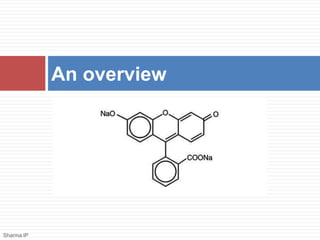
An overview
Sharma IP
Introduction –Sodium
Fluorescein
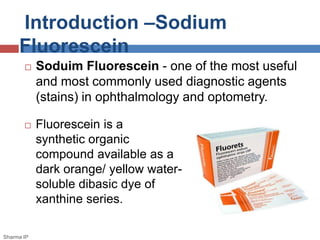
 Fluorescein is a
synthetic organic
compound available as a
dark orange/ yellow water-
soluble dibasic dye of
xanthine series.
Sharma IP
 Soduim Fluorescein - one of the most useful
and most commonly used diagnostic agents
(stains) in ophthalmology and optometry.
Fluorescein – Historical
Perspective
 Baeyer(1871): First fluorescein dye was
made.
 M Straub (1888) : First used fluorescein for
vital staining of the eye.
 Burk (1910): First used fluorescein to detect
retinal disease
Sharma IP
Properties of fluorescein
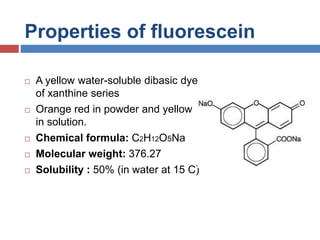
 A yellow water-soluble dibasic dye
of xanthine series
 Orange red in powder and yellow
in solution.
 Chemical formula: C2H12O5Na
 Molecular weight: 376.27
 Solubility : 50% (in water at 15 C)
Optimum condition for
observation of fluorescein
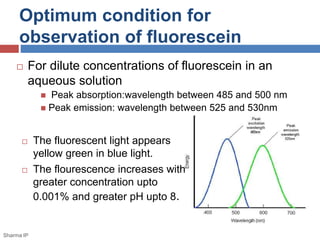
 For dilute concentrations of fluorescein in an
aqueous solution
 Peak absorption:wavelength between 485 and 500 nm
 Peak emission: wavelength between 525 and 530nm
Sharma IP
 The fluorescent light appears
yellow green in blue light.
 The flourescence increases with
greater concentration upto
0.001% and greater pH upto 8.
Important clinical
characterstics
 Stains epithelial defects bright green
 Diffuses into intercellular space
 Will not stain devitalized
 Tear film appears yellow orange
 Can exhibit pseudoflare, Fischer Schweitzer mosaic
 Promotes growth of pseudomonas aeruginosa in
solution
 Will stain soft contact lens
Sharma IP
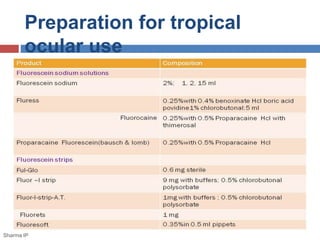
Preparation for tropical
ocular use
Sharma IP
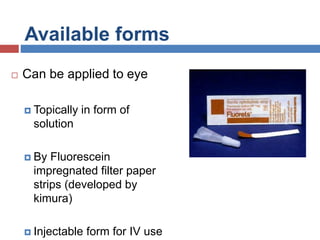
Available forms
 Can be applied to eye
 Topically in form of
solution
 By Fluorescein
impregnated filter paper
strips (developed by
kimura)
 Injectable form for IV use
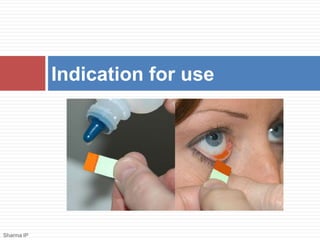
Indication for use
Sharma IP
A. Topical Indication
 Assessment of ocular surface integrity -
Detection of defects in corneal epithelium
 Fitting assessment of rigid contact lens.
 Applanation tonometry - Goldmann
tonometer/Perkins hand-held tonometry
 Seidel's test- Detection of site of perforation/bleb
 Lacrimal testing ( Tear flim breakup time
(TBUT), Jone dye test, Fluorescein dye
disappreance test(FDDT)
Sharma IP
1.Assessment of ocular surface
integrity
 Frequently used to detect lesions of ocular
surface owing to its high degree of ionization,
it neither penetrates the intact corneal
epithelium nor forms a firm bond with any vital
tissue.
 Instillation of dye in cul-de-sac allows
determination of corneal & conjunctival lesions
such as abrasions ulcers& edema & aids in
detection of foreign bodies.
 Epithelial defect appears as vivid green
fluorescence
Sharma IP
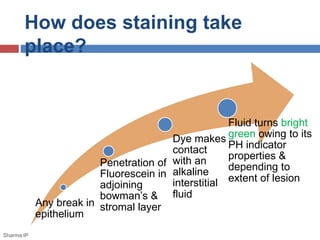
How does staining take
place?
Any break in
epithelium
Penetration of
Fluorescein in
adjoining
bowman’s &
stromal layer
Dye makes
contact
with an
alkaline
interstitial
fluid
Fluid turns bright
green owing to its
PH indicator
properties &
depending to
extent of lesion
Sharma IP
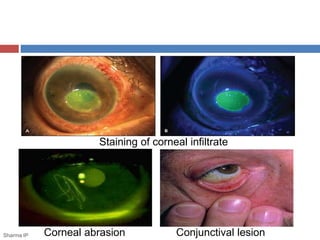
Staining of corneal infiltrate
Corneal abrasionSharma IP Conjunctival lesion
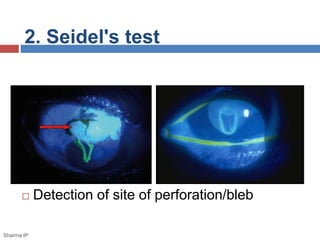
2. Seidel's test
 Detection of site of perforation/bleb
Sharma IP
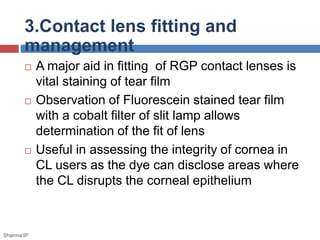
 A major aid in fitting of RGP contact lenses is
vital staining of tear film
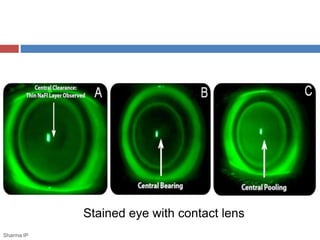
 Observation of Fluorescein stained tear film
with a cobalt filter of slit lamp allows
determination of the fit of lens
 Useful in assessing the integrity of cornea in
CL users as the dye can disclose areas where
the CL disrupts the corneal epithelium
3.Contact lens fitting and
management
Sharma IP
Stained eye with contact lens
Sharma IP
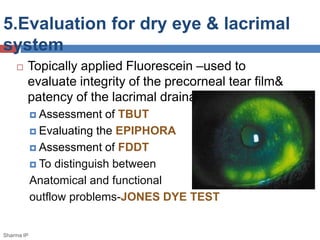
5.Evaluation for dry eye & lacrimal
system
 Topically applied Fluorescein –used to
evaluate integrity of the precorneal tear film&
patency of the lacrimal drainage system
 Assessment of TBUT
 Evaluating the EPIPHORA
 Assessment of FDDT
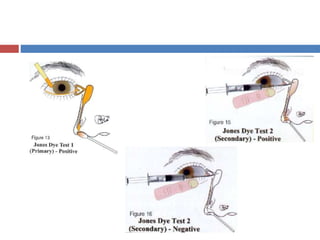
 To distinguish between
Anatomical and functional
outflow problems-JONES DYE TEST
Sharma IP
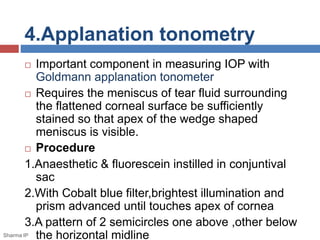
4.Applanation tonometry
 Important component in measuring IOP with
Goldmann applanation tonometer
 Requires the meniscus of tear fluid surrounding
the flattened corneal surface be sufficiently
stained so that apex of the wedge shaped
meniscus is visible.
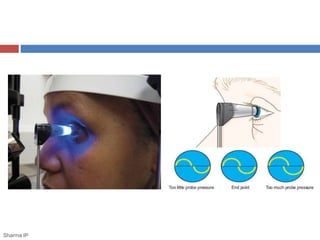
 Procedure
1.Anaesthetic & fluorescein instilled in conjuntival
sac
2.With Cobalt blue filter,brightest illumination and
prism advanced until touches apex of cornea
3.A pattern of 2 semicircles one above ,other below
the horizontal midlineSharma IP
Sharma IP
B. Intravenous indication
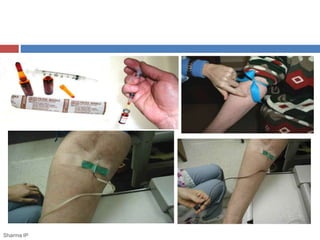
1. Fluorescein angiography
 About 10 ml of a 5% solution injected in
antecubital vein
 The dye normally appears in central retinal artery
in 10– 15 sec
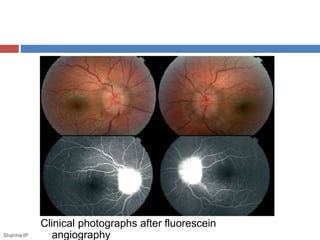
 Shows retinal blood vessels in high contrast
 Non vascularised, pigmented retinal & subretinal
lesions appear as dark areas against the green
fluorescing background
 Proven helpful in diagnosis of a variety of
pathological conditions of fundus ,various macular
lesions , choroidopathy, diabetic retinopathy etc.
Sharma IP
Sharma IP
Clinical photographs after fluorescein
angiographySharma IP
2.Iris Angiography
 IV inj. Dye first appears in radial vessels
at betn 9-20 secs
 Amount of iris pigmentation and the pattern of
its distribution compared with normal iris
angiogram
Sharma IP
Ophthalmic Research
 Intraocular dynamic studies [fluorometry]
 Tear film drainage studies
 Penetration to anterior segment structures
Sharma IP
Side effects
 Topical - unconsciousness & hypertensive
reactions
 Rare side effects.
 IV inj. – with increased concentration adverse
effects in about 10% of patients receiving IV
inj.
 Less frequently – respiratory effects like
laryngeal or pulmonary edema
 Cardiovascular toxicity in form of severe
hypotension and shock
Sharma IP
Contraindication
 Hypersensitivity to active ingredents or any
other components
 Family and personal allergic history
 Not used over soft contact lens.
SCL – avoided for few hrs. of fluorescein
instillation
Sharma IP
Contamination of fluorescein
 Contamination of fluorescein eyedrops is a serious
risk
-even greater than that encountered with the majority
of other eyedrops.
 As these individual drops are liable to become
infected with bacteria and, at the same time, are
frequently used on damaged tissue that is prone to
infection, very great care must be taken in their use.
 Pseudomonas aeruginosa – most dangerous
microorganism with which fluorescein eyedrops are
inclined to become invaded.
Sharma IP
Contd...
 Phenylmercuric acetate or nitrate in
0.002%
-Best bactericide for preserving
fluorescein drops, and this is effective
against Pseudomonas, given adequate
contact time.
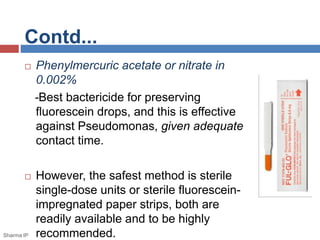
 However, the safest method is sterile
single-dose units or sterile fluorescein-
impregnated paper strips, both are
readily available and to be highly
recommended.Sharma IP
Conclusion
 Fluorescein stain is a very useful diagnostic
agents in ophthalmic clinical practise and has
many applications.
 The use of diagnostic dyes represents one of the
most efficient, objective, non-invasive, and directly
visible means we have of identifying and tracking
ocular structures at the cellular level.
 Every optometrist must understand the proper use
of its clinical application, contraindication and side
effects in clinical use.
Sharma IP
Reference
Books
 Donald S. Fong,Drugs in Ophthalmology,,2006, Springer-
Verlag Berlin Heidelberg
 Graham Hopkins and Richard Pearson, Ophthalmic Drugs,
2007, Butterworth Heineman Elsevier. 5th Ed10:149-154
 Brain Duvall, Ophthalmic medication and Pharmacology,
SLACK incorporated 2nd Ed.
 P.H.O’Connor Davies, The Action and Uses of Ophthalmic
Drugs,1994, Jaypee Brothers. 3rd Ed. 9:148-153
Websites
 www.emedicine.medscape.com
 www.rootatlas.com
 en.wikipedia.org
 www.google.com/imghp
Sharma IP
Tashi Delek
Sharma IP

Fluorescein Stain

  • 1.
    USED IN OPHTHALMOLOGY IndraP Sharma Master of Clinical Optometry (Year I) Amity Medical School FLUORESCEIN STAIN
  • 2.
    Objective  To understandthe biochemical properties, indication and contraindication of fluorescein stain ophthalmology. Sharma IP
  • 3.
    Contents 1. An overview-Introduction 2. Properties of sodium fluorescein 3. Indication of use 4. Contraindication, side effects and comtamination 5. Conculsion 6. Reference Sharma IP
  • 4.
  • 5.
    Introduction –Sodium Fluorescein  Fluoresceinis a synthetic organic compound available as a dark orange/ yellow water- soluble dibasic dye of xanthine series. Sharma IP  Soduim Fluorescein - one of the most useful and most commonly used diagnostic agents (stains) in ophthalmology and optometry.
  • 6.
    Fluorescein – Historical Perspective Baeyer(1871): First fluorescein dye was made.  M Straub (1888) : First used fluorescein for vital staining of the eye.  Burk (1910): First used fluorescein to detect retinal disease Sharma IP
  • 7.
    Properties of fluorescein A yellow water-soluble dibasic dye of xanthine series  Orange red in powder and yellow in solution.  Chemical formula: C2H12O5Na  Molecular weight: 376.27  Solubility : 50% (in water at 15 C)
  • 8.
    Optimum condition for observationof fluorescein  For dilute concentrations of fluorescein in an aqueous solution  Peak absorption:wavelength between 485 and 500 nm  Peak emission: wavelength between 525 and 530nm Sharma IP  The fluorescent light appears yellow green in blue light.  The flourescence increases with greater concentration upto 0.001% and greater pH upto 8.
  • 9.
    Important clinical characterstics  Stainsepithelial defects bright green  Diffuses into intercellular space  Will not stain devitalized  Tear film appears yellow orange  Can exhibit pseudoflare, Fischer Schweitzer mosaic  Promotes growth of pseudomonas aeruginosa in solution  Will stain soft contact lens Sharma IP
  • 10.
  • 11.
    Available forms  Canbe applied to eye  Topically in form of solution  By Fluorescein impregnated filter paper strips (developed by kimura)  Injectable form for IV use
  • 12.
  • 13.
    A. Topical Indication Assessment of ocular surface integrity - Detection of defects in corneal epithelium  Fitting assessment of rigid contact lens.  Applanation tonometry - Goldmann tonometer/Perkins hand-held tonometry  Seidel's test- Detection of site of perforation/bleb  Lacrimal testing ( Tear flim breakup time (TBUT), Jone dye test, Fluorescein dye disappreance test(FDDT) Sharma IP
  • 14.
    1.Assessment of ocularsurface integrity  Frequently used to detect lesions of ocular surface owing to its high degree of ionization, it neither penetrates the intact corneal epithelium nor forms a firm bond with any vital tissue.  Instillation of dye in cul-de-sac allows determination of corneal & conjunctival lesions such as abrasions ulcers& edema & aids in detection of foreign bodies.  Epithelial defect appears as vivid green fluorescence Sharma IP
  • 15.
    How does stainingtake place? Any break in epithelium Penetration of Fluorescein in adjoining bowman’s & stromal layer Dye makes contact with an alkaline interstitial fluid Fluid turns bright green owing to its PH indicator properties & depending to extent of lesion Sharma IP
  • 16.
    Staining of cornealinfiltrate Corneal abrasionSharma IP Conjunctival lesion
  • 17.
    2. Seidel's test Detection of site of perforation/bleb Sharma IP
  • 18.
     A majoraid in fitting of RGP contact lenses is vital staining of tear film  Observation of Fluorescein stained tear film with a cobalt filter of slit lamp allows determination of the fit of lens  Useful in assessing the integrity of cornea in CL users as the dye can disclose areas where the CL disrupts the corneal epithelium 3.Contact lens fitting and management Sharma IP
  • 19.
    Stained eye withcontact lens Sharma IP
  • 20.
    5.Evaluation for dryeye & lacrimal system  Topically applied Fluorescein –used to evaluate integrity of the precorneal tear film& patency of the lacrimal drainage system  Assessment of TBUT  Evaluating the EPIPHORA  Assessment of FDDT  To distinguish between Anatomical and functional outflow problems-JONES DYE TEST Sharma IP
  • 22.
    4.Applanation tonometry  Importantcomponent in measuring IOP with Goldmann applanation tonometer  Requires the meniscus of tear fluid surrounding the flattened corneal surface be sufficiently stained so that apex of the wedge shaped meniscus is visible.  Procedure 1.Anaesthetic & fluorescein instilled in conjuntival sac 2.With Cobalt blue filter,brightest illumination and prism advanced until touches apex of cornea 3.A pattern of 2 semicircles one above ,other below the horizontal midlineSharma IP
  • 23.
  • 24.
    B. Intravenous indication 1.Fluorescein angiography  About 10 ml of a 5% solution injected in antecubital vein  The dye normally appears in central retinal artery in 10– 15 sec  Shows retinal blood vessels in high contrast  Non vascularised, pigmented retinal & subretinal lesions appear as dark areas against the green fluorescing background  Proven helpful in diagnosis of a variety of pathological conditions of fundus ,various macular lesions , choroidopathy, diabetic retinopathy etc. Sharma IP
  • 25.
  • 26.
    Clinical photographs afterfluorescein angiographySharma IP
  • 27.
    2.Iris Angiography  IVinj. Dye first appears in radial vessels at betn 9-20 secs  Amount of iris pigmentation and the pattern of its distribution compared with normal iris angiogram Sharma IP
  • 28.
    Ophthalmic Research  Intraoculardynamic studies [fluorometry]  Tear film drainage studies  Penetration to anterior segment structures Sharma IP
  • 29.
    Side effects  Topical- unconsciousness & hypertensive reactions  Rare side effects.  IV inj. – with increased concentration adverse effects in about 10% of patients receiving IV inj.  Less frequently – respiratory effects like laryngeal or pulmonary edema  Cardiovascular toxicity in form of severe hypotension and shock Sharma IP
  • 30.
    Contraindication  Hypersensitivity toactive ingredents or any other components  Family and personal allergic history  Not used over soft contact lens. SCL – avoided for few hrs. of fluorescein instillation Sharma IP
  • 31.
    Contamination of fluorescein Contamination of fluorescein eyedrops is a serious risk -even greater than that encountered with the majority of other eyedrops.  As these individual drops are liable to become infected with bacteria and, at the same time, are frequently used on damaged tissue that is prone to infection, very great care must be taken in their use.  Pseudomonas aeruginosa – most dangerous microorganism with which fluorescein eyedrops are inclined to become invaded. Sharma IP
  • 32.
    Contd...  Phenylmercuric acetateor nitrate in 0.002% -Best bactericide for preserving fluorescein drops, and this is effective against Pseudomonas, given adequate contact time.  However, the safest method is sterile single-dose units or sterile fluorescein- impregnated paper strips, both are readily available and to be highly recommended.Sharma IP
  • 33.
    Conclusion  Fluorescein stainis a very useful diagnostic agents in ophthalmic clinical practise and has many applications.  The use of diagnostic dyes represents one of the most efficient, objective, non-invasive, and directly visible means we have of identifying and tracking ocular structures at the cellular level.  Every optometrist must understand the proper use of its clinical application, contraindication and side effects in clinical use. Sharma IP
  • 34.
    Reference Books  Donald S.Fong,Drugs in Ophthalmology,,2006, Springer- Verlag Berlin Heidelberg  Graham Hopkins and Richard Pearson, Ophthalmic Drugs, 2007, Butterworth Heineman Elsevier. 5th Ed10:149-154  Brain Duvall, Ophthalmic medication and Pharmacology, SLACK incorporated 2nd Ed.  P.H.O’Connor Davies, The Action and Uses of Ophthalmic Drugs,1994, Jaypee Brothers. 3rd Ed. 9:148-153 Websites  www.emedicine.medscape.com  www.rootatlas.com  en.wikipedia.org  www.google.com/imghp Sharma IP
  • 35.

Editor's Notes

  • #31 Frequency Ectopia lentis is a rare condition. Incidence in the general population is unknown. The most common cause of ectopia lentis is trauma. Mortality/Morbidity Ectopia lentis may cause marked visual disturbance, depending the degree of lens displacement and the underlying etiologic abnormality. Sex Males appear more prone to ocular trauma than females; therefore, a male preponderance has been reported. Male and female frequency varies with the etiology of the lens displacement. Age Ectopia lentis can occur at any age. It may be present at birth, or it may manifest late in life.