3
INFORMATION SYSTEMS &INFORMATION SYSTEMS &
ORGANIZATIONAL SYSTEMORGANIZATIONAL SYSTEM
UniversityofEducation,Okara
Campus
1
Inam ul Haq
Lecturer in Computer Science
UE, Okara Campus
inam@ue.edu.pk inam.bth@gmail.com
© 2002 by Prentice Hall
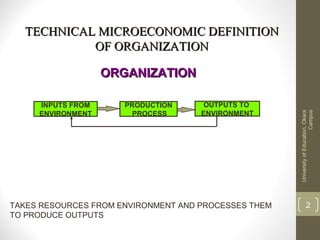
TECHNICAL MICROECONOMIC DEFINITIONTECHNICAL MICROECONOMIC DEFINITION
OF ORGANIZATIONOF ORGANIZATION
OUTPUTS TO
ENVIRONMENT
ORGANIZATIONORGANIZATION
PRODUCTION
PROCESS
INPUTS FROM
ENVIRONMENT
UniversityofEducation,Okara
Campus
2TAKES RESOURCES FROM ENVIRONMENT AND PROCESSES THEM
TO PRODUCE OUTPUTS
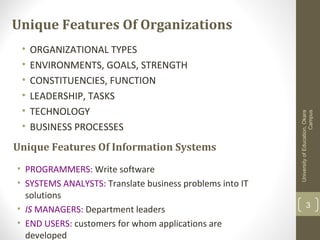
Unique Features Of Organizations
• ORGANIZATIONAL TYPES
• ENVIRONMENTS, GOALS, STRENGTH
• CONSTITUENCIES, FUNCTION
• LEADERSHIP, TASKS
• TECHNOLOGY
• BUSINESS PROCESSES
UniversityofEducation,Okara
Campus
3
Unique Features Of Information Systems
• PROGRAMMERS: Write software
• SYSTEMS ANALYSTS: Translate business problems into IT
solutions
• IS MANAGERS: Department leaders
• END USERS: customers for whom applications are
developed
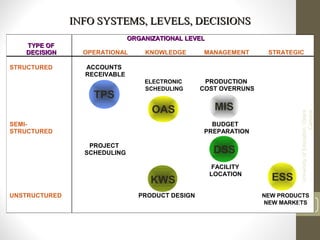
INFO SYSTEMS, LEVELS, DECISIONSINFO SYSTEMS, LEVELS, DECISIONS
TPS
OAS MIS
KWS
DSS
ESS
ORGANIZATIONAL LEVELORGANIZATIONAL LEVEL
TYPE OFTYPE OF
DECISIONDECISION OPERATIONAL KNOWLEDGE MANAGEMENT STRATEGIC
STRUCTURED ACCOUNTS
RECEIVABLE
ELECTRONIC PRODUCTION
SCHEDULING COST OVERRUNS
SEMI- BUDGET
STRUCTURED PREPARATION
PROJECT
SCHEDULING
FACILITY
LOCATION
UNSTRUCTURED PRODUCT DESIGN NEW PRODUCTS
NEW MARKETS
UniversityofEducation,Okara
Campus
4
5
UniversityofEducation,Okara
Campus
Basic Components of IS
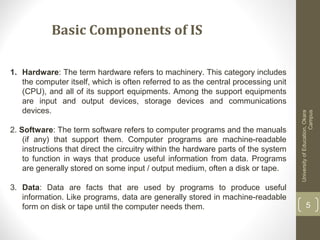
1. Hardware: The term hardware refers to machinery. This category includes
the computer itself, which is often referred to as the central processing unit
(CPU), and all of its support equipments. Among the support equipments
are input and output devices, storage devices and communications
devices.
2. Software: The term software refers to computer programs and the manuals
(if any) that support them. Computer programs are machine-readable
instructions that direct the circuitry within the hardware parts of the system
to function in ways that produce useful information from data. Programs
are generally stored on some input / output medium, often a disk or tape.
3. Data: Data are facts that are used by programs to produce useful
information. Like programs, data are generally stored in machine-readable
form on disk or tape until the computer needs them.
6
UniversityofEducation,Okara
Campus
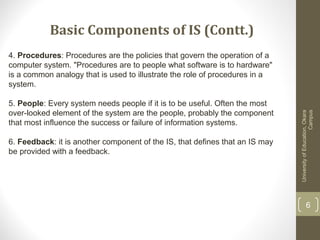
4. Procedures: Procedures are the policies that govern the operation of a
computer system. "Procedures are to people what software is to hardware"
is a common analogy that is used to illustrate the role of procedures in a
system.
5. People: Every system needs people if it is to be useful. Often the most
over-looked element of the system are the people, probably the component
that most influence the success or failure of information systems.
6. Feedback: it is another component of the IS, that defines that an IS may
be provided with a feedback.
Basic Components of IS (Contt.)
7
UniversityofEducation,Okara
Campus
References:
•http://en.wikipedia.org/wiki/Information_system#Components
[2.3.2015]
•http://en.wikipedia.org/wiki/Information_system [2.3.2015]
•http://www.businessdictionary.com/definition/information-
system.html [2.3.2015]

Information System & Organizational System

  • 1.
    3 INFORMATION SYSTEMS &INFORMATIONSYSTEMS & ORGANIZATIONAL SYSTEMORGANIZATIONAL SYSTEM UniversityofEducation,Okara Campus 1 Inam ul Haq Lecturer in Computer Science UE, Okara Campus inam@ue.edu.pk inam.bth@gmail.com © 2002 by Prentice Hall
  • 2.
    TECHNICAL MICROECONOMIC DEFINITIONTECHNICALMICROECONOMIC DEFINITION OF ORGANIZATIONOF ORGANIZATION OUTPUTS TO ENVIRONMENT ORGANIZATIONORGANIZATION PRODUCTION PROCESS INPUTS FROM ENVIRONMENT UniversityofEducation,Okara Campus 2TAKES RESOURCES FROM ENVIRONMENT AND PROCESSES THEM TO PRODUCE OUTPUTS
  • 3.
    Unique Features OfOrganizations • ORGANIZATIONAL TYPES • ENVIRONMENTS, GOALS, STRENGTH • CONSTITUENCIES, FUNCTION • LEADERSHIP, TASKS • TECHNOLOGY • BUSINESS PROCESSES UniversityofEducation,Okara Campus 3 Unique Features Of Information Systems • PROGRAMMERS: Write software • SYSTEMS ANALYSTS: Translate business problems into IT solutions • IS MANAGERS: Department leaders • END USERS: customers for whom applications are developed
  • 4.
    INFO SYSTEMS, LEVELS,DECISIONSINFO SYSTEMS, LEVELS, DECISIONS TPS OAS MIS KWS DSS ESS ORGANIZATIONAL LEVELORGANIZATIONAL LEVEL TYPE OFTYPE OF DECISIONDECISION OPERATIONAL KNOWLEDGE MANAGEMENT STRATEGIC STRUCTURED ACCOUNTS RECEIVABLE ELECTRONIC PRODUCTION SCHEDULING COST OVERRUNS SEMI- BUDGET STRUCTURED PREPARATION PROJECT SCHEDULING FACILITY LOCATION UNSTRUCTURED PRODUCT DESIGN NEW PRODUCTS NEW MARKETS UniversityofEducation,Okara Campus 4
  • 5.
    5 UniversityofEducation,Okara Campus Basic Components ofIS 1. Hardware: The term hardware refers to machinery. This category includes the computer itself, which is often referred to as the central processing unit (CPU), and all of its support equipments. Among the support equipments are input and output devices, storage devices and communications devices. 2. Software: The term software refers to computer programs and the manuals (if any) that support them. Computer programs are machine-readable instructions that direct the circuitry within the hardware parts of the system to function in ways that produce useful information from data. Programs are generally stored on some input / output medium, often a disk or tape. 3. Data: Data are facts that are used by programs to produce useful information. Like programs, data are generally stored in machine-readable form on disk or tape until the computer needs them.
  • 6.
    6 UniversityofEducation,Okara Campus 4. Procedures: Proceduresare the policies that govern the operation of a computer system. "Procedures are to people what software is to hardware" is a common analogy that is used to illustrate the role of procedures in a system. 5. People: Every system needs people if it is to be useful. Often the most over-looked element of the system are the people, probably the component that most influence the success or failure of information systems. 6. Feedback: it is another component of the IS, that defines that an IS may be provided with a feedback. Basic Components of IS (Contt.)
  • 7.