Introduction To Java
Programming
You will learn about the process of creating Java programs and
constructs for input, output, branching, looping, as well some of
the history behind Java’s development.
1
Inam Ul-Haq
Lecturer in Computer Science
MS Computer Science (Sweden)
University of Education, Okara Campus
Inam.bth@gmail.com, organizer@dfd-charity.com
inam@acm.org, inam@ue.edu.pk , inkh10@student.bth.se
Lecture 2, Part 1
UniversityofEducation,Okara
Campus
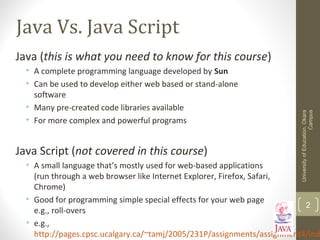
Java Vs. Java Script
Java (this is what you need to know for this course)
• A complete programming language developed by Sun
• Can be used to develop either web based or stand-alone
software
• Many pre-created code libraries available
• For more complex and powerful programs
Java Script (not covered in this course)
• A small language that’s mostly used for web-based applications
(run through a web browser like Internet Explorer, Firefox, Safari,
Chrome)
• Good for programming simple special effects for your web page
e.g., roll-overs
• e.g.,
http://pages.cpsc.ucalgary.ca/~tamj/2005/231P/assignments/assignment4/ind
2
UniversityofEducation,Okara
Campus
Java: History (1)
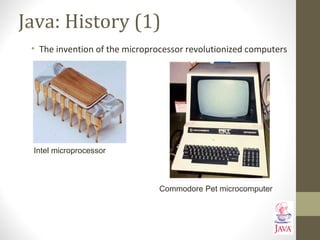
• The invention of the microprocessor revolutionized computers
Intel microprocessor
Commodore Pet microcomputer
Java: History (2)
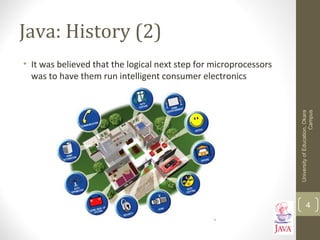
• It was believed that the logical next step for microprocessors
was to have them run intelligent consumer electronics
4
UniversityofEducation,Okara
Campus
Java History (3)
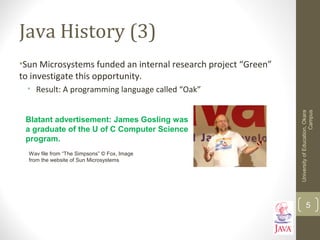
•Sun Microsystems funded an internal research project “Green”
to investigate this opportunity.
• Result: A programming language called “Oak”
Blatant advertisement: James Gosling was
a graduate of the U of C Computer Science
program.
Wav file from “The Simpsons” © Fox, Image
from the website of Sun Microsystems
5
UniversityofEducation,Okara
Campus
Java History (4)
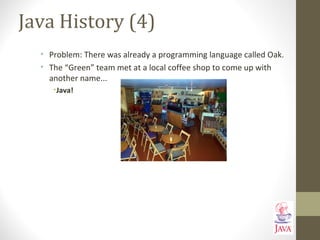
• Problem: There was already a programming language called Oak.
• The “Green” team met at a local coffee shop to come up with
another name...
•Java!
Java: History (5)
•The popularity of the Internet resulted in Sun’s re-focusing of Java
on computers.
•Prior to the advent of Java, web pages allowed you to download
only text and images.
Your computer at home running a web browser
User clicks on a link
Images and text get
downloaded
Server containing a web page
7
Top 20 websites developed in java? [google]
UniversityofEducation,Okara
Campus
Your computer at
home running a
web browser
Server containing
a web page
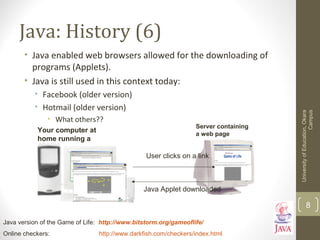
Java: History (6)
• Java enabled web browsers allowed for the downloading of
programs (Applets).
• Java is still used in this context today:
• Facebook (older version)
• Hotmail (older version)
• What others??
User clicks on a link
Java Applet downloaded
Java version of the Game of Life: http://www.bitstorm.org/gameoflife/
Online checkers: http://www.darkfish.com/checkers/index.html
8
UniversityofEducation,Okara
Campus
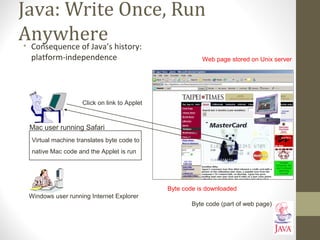
Java: Write Once, Run
Anywhere• Consequence of Java’s history:
platform-independence
Mac user running Safari
Windows user running Internet Explorer
Web page stored on Unix server
Click on link to Applet
Byte code is downloaded
Virtual machine translates byte code to
native Mac code and the Applet is run
Byte code (part of web page)
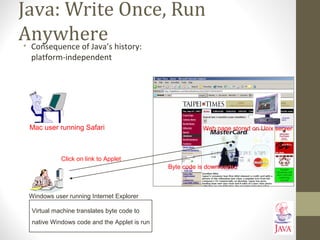
Java: Write Once, Run
Anywhere• Consequence of Java’s history:
platform-independent
Mac user running Safari
Windows user running Internet Explorer
Web page stored on Unix server
Click on link to Applet
Byte code is downloaded
Virtual machine translates byte code to
native Windows code and the Applet is run
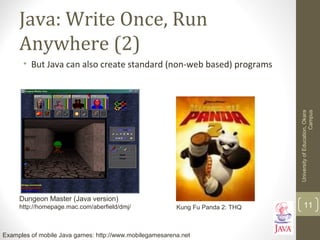
Java: Write Once, Run
Anywhere (2)
• But Java can also create standard (non-web based) programs
Dungeon Master (Java version)
http://homepage.mac.com/aberfield/dmj/
Examples of mobile Java games: http://www.mobilegamesarena.net
Kung Fu Panda 2: THQ 11
UniversityofEducation,Okara
Campus
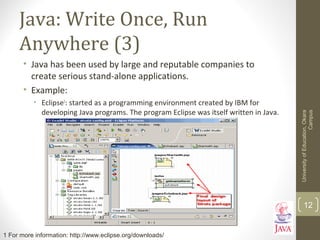
Java: Write Once, Run
Anywhere (3)
• Java has been used by large and reputable companies to
create serious stand-alone applications.
• Example:
• Eclipse1
: started as a programming environment created by IBM for
developing Java programs. The program Eclipse was itself written in Java.
1 For more information: http://www.eclipse.org/downloads/
12
UniversityofEducation,Okara
Campus
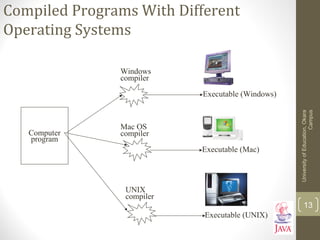
Compiled Programs With Different
Operating Systems
Windows
compiler
Executable (Windows)
UNIX
compiler
Executable (UNIX)
Mac OS
compiler
Executable (Mac)
Computer
program
13
UniversityofEducation,Okara
Campus
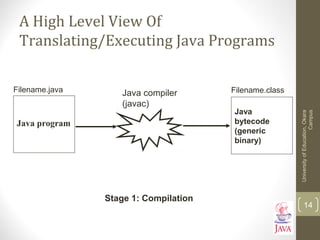
A High Level View Of
Translating/Executing Java Programs
Java compiler
(javac)
Java program
Filename.java
Java
bytecode
(generic
binary)
Filename.class
Stage 1: Compilation
14
UniversityofEducation,Okara
Campus
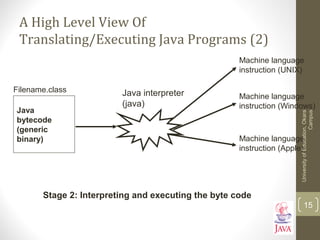
A High Level View Of
Translating/Executing Java Programs (2)
Java interpreter
(java)
Java
bytecode
(generic
binary)
Filename.class
Machine language
instruction (UNIX)
Machine language
instruction (Windows)
Machine language
instruction (Apple)
Stage 2: Interpreting and executing the byte code
15
UniversityofEducation,Okara
Campus
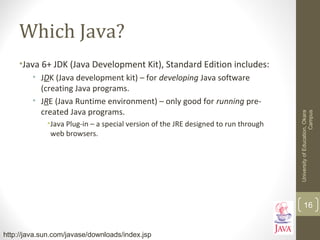
Which Java?
•Java 6+ JDK (Java Development Kit), Standard Edition includes:
• JDK (Java development kit) – for developing Java software
(creating Java programs.
• JRE (Java Runtime environment) – only good for running pre-
created Java programs.
•Java Plug-in – a special version of the JRE designed to run through
web browsers.
http://java.sun.com/javase/downloads/index.jsp
16
UniversityofEducation,Okara
Campus
Smallest Executable Java Program
The name of the example is: Smallest.java (Important note: file name matches
the word after the keyword ‘class’)
public class Smallest
{
public static void main (String[] args)
{
System.out.println(“Hello World!”);
}
}
17
Hint: write syso, then ctrl+space to autocomplete output instruction
Ctrl+space = for any help anywhere
UniversityofEducation,Okara
Campus
Compiling The Smallest Java Program
public class Smallest
{
public static void main (String[] args)
{
}
}
Smallest.java
javac
(Java byte code)
10000100000001000
00100100000001001
: :
Smallest.class
Type “javac
Smallest.java”
18
UniversityofEducation,Okara
Campus
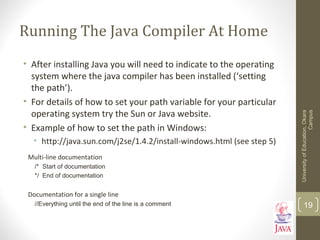
Running The Java Compiler At Home
• After installing Java you will need to indicate to the operating
system where the java compiler has been installed (‘setting
the path’).
• For details of how to set your path variable for your particular
operating system try the Sun or Java website.
• Example of how to set the path in Windows:
• http://java.sun.com/j2se/1.4.2/install-windows.html (see step 5)
19
Multi-line documentation
/* Start of documentation
*/ End of documentation
Documentation for a single line
//Everything until the end of the line is a comment
UniversityofEducation,Okara
Campus
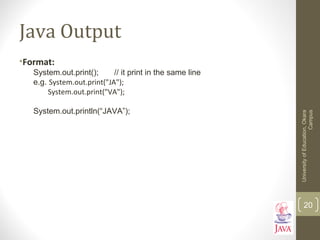
Java Output
•Format:
System.out.print(); // it print in the same line
e.g. System.out.print("JA");
System.out.print("VA");
System.out.println(“JAVA”);
20
UniversityofEducation,Okara
Campus
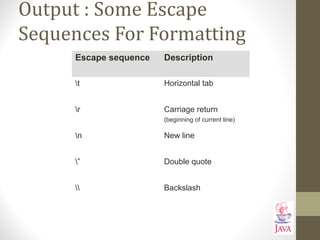
Output : Some Escape
Sequences For Formatting
Escape sequence Description
t Horizontal tab
r Carriage return
(beginning of current line)
n New line
” Double quote
 Backslash
Example Formatting Codes
• Name of the online example: FormattingExample.java
public class FormattingExample
{
public static void main (String [] args)
{
System.out.print(“UE Okaratn");
System.out.println("hellorworld");
System.out.println(""Geek" talk slash () com");
}
}
22
UniversityofEducation,Okara
Campus
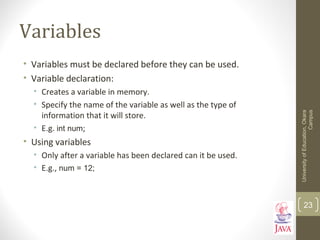
Variables
• Variables must be declared before they can be used.
• Variable declaration:
• Creates a variable in memory.
• Specify the name of the variable as well as the type of
information that it will store.
• E.g. int num;
• Using variables
• Only after a variable has been declared can it be used.
• E.g., num = 12;
23
UniversityofEducation,Okara
Campus
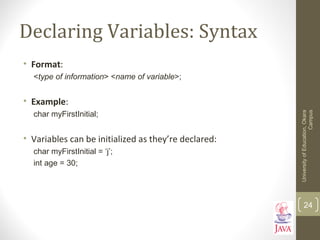
Declaring Variables: Syntax
• Format:
<type of information> <name of variable>;
• Example:
char myFirstInitial;
• Variables can be initialized as they’re declared:
char myFirstInitial = ‘j’;
int age = 30;
24
UniversityofEducation,Okara
Campus
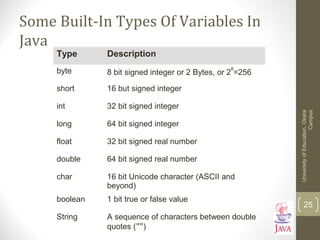
Some Built-In Types Of Variables In
Java
Type Description
byte 8 bit signed integer or 2 Bytes, or 2
8
=256
short 16 but signed integer
int 32 bit signed integer
long 64 bit signed integer
float 32 bit signed real number
double 64 bit signed real number
char 16 bit Unicode character (ASCII and
beyond)
boolean 1 bit true or false value
String A sequence of characters between double
quotes ("")
25
UniversityofEducation,Okara
Campus
Location Of Variable
Declarations
public class <name of class>
{
public static void main (String[] args)
{
// Local variable declarations occur here
<< Program statements >>
: :
}
}
26
UniversityofEducation,Okara
Campus
Style Hint: Initializing
Variables
• Always initialize your variables prior to using them!
• Do this whether it is syntactically required or not.
• Example how not to approach:
public class OutputExample1
{
public static void main (String [] args)
{
int num;
System.out.print(num);
}
} OutputExample1.java:7: error: variable
num might not have been initialized
System.out.print(num);
^
27
UniversityofEducation,Okara
Campus
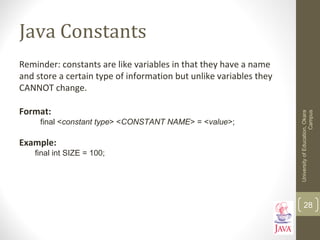
Java Constants
Reminder: constants are like variables in that they have a name
and store a certain type of information but unlike variables they
CANNOT change.
Format:
final <constant type> <CONSTANT NAME> = <value>;
Example:
final int SIZE = 100;
28
UniversityofEducation,Okara
Campus
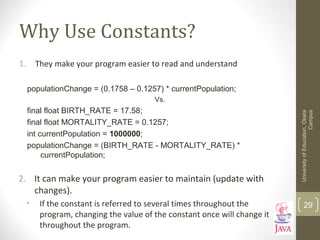
Why Use Constants?
1. They make your program easier to read and understand
populationChange = (0.1758 – 0.1257) * currentPopulation;
Vs.
final float BIRTH_RATE = 17.58;
final float MORTALITY_RATE = 0.1257;
int currentPopulation = 1000000;
populationChange = (BIRTH_RATE - MORTALITY_RATE) *
currentPopulation;
29
2. It can make your program easier to maintain (update with
changes).
• If the constant is referred to several times throughout the
program, changing the value of the constant once will change it
throughout the program.
UniversityofEducation,Okara
Campus
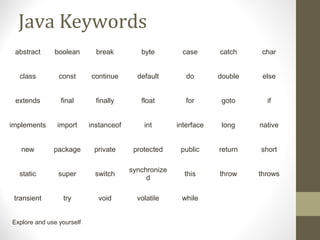
Java Keywords
abstract boolean break byte case catch char
class const continue default do double else
extends final finally float for goto if
implements import instanceof int interface long native
new package private protected public return short
static super switch
synchronize
d
this throw throws
transient try void volatile while
Explore and use yourself

Introduction to java programming part 1

  • 1.
    Introduction To Java Programming Youwill learn about the process of creating Java programs and constructs for input, output, branching, looping, as well some of the history behind Java’s development. 1 Inam Ul-Haq Lecturer in Computer Science MS Computer Science (Sweden) University of Education, Okara Campus Inam.bth@gmail.com, organizer@dfd-charity.com inam@acm.org, inam@ue.edu.pk , inkh10@student.bth.se Lecture 2, Part 1 UniversityofEducation,Okara Campus
  • 2.
    Java Vs. JavaScript Java (this is what you need to know for this course) • A complete programming language developed by Sun • Can be used to develop either web based or stand-alone software • Many pre-created code libraries available • For more complex and powerful programs Java Script (not covered in this course) • A small language that’s mostly used for web-based applications (run through a web browser like Internet Explorer, Firefox, Safari, Chrome) • Good for programming simple special effects for your web page e.g., roll-overs • e.g., http://pages.cpsc.ucalgary.ca/~tamj/2005/231P/assignments/assignment4/ind 2 UniversityofEducation,Okara Campus
  • 3.
    Java: History (1) •The invention of the microprocessor revolutionized computers Intel microprocessor Commodore Pet microcomputer
  • 4.
    Java: History (2) •It was believed that the logical next step for microprocessors was to have them run intelligent consumer electronics 4 UniversityofEducation,Okara Campus
  • 5.
    Java History (3) •SunMicrosystems funded an internal research project “Green” to investigate this opportunity. • Result: A programming language called “Oak” Blatant advertisement: James Gosling was a graduate of the U of C Computer Science program. Wav file from “The Simpsons” © Fox, Image from the website of Sun Microsystems 5 UniversityofEducation,Okara Campus
  • 6.
    Java History (4) •Problem: There was already a programming language called Oak. • The “Green” team met at a local coffee shop to come up with another name... •Java!
  • 7.
    Java: History (5) •Thepopularity of the Internet resulted in Sun’s re-focusing of Java on computers. •Prior to the advent of Java, web pages allowed you to download only text and images. Your computer at home running a web browser User clicks on a link Images and text get downloaded Server containing a web page 7 Top 20 websites developed in java? [google] UniversityofEducation,Okara Campus
  • 8.
    Your computer at homerunning a web browser Server containing a web page Java: History (6) • Java enabled web browsers allowed for the downloading of programs (Applets). • Java is still used in this context today: • Facebook (older version) • Hotmail (older version) • What others?? User clicks on a link Java Applet downloaded Java version of the Game of Life: http://www.bitstorm.org/gameoflife/ Online checkers: http://www.darkfish.com/checkers/index.html 8 UniversityofEducation,Okara Campus
  • 9.
    Java: Write Once,Run Anywhere• Consequence of Java’s history: platform-independence Mac user running Safari Windows user running Internet Explorer Web page stored on Unix server Click on link to Applet Byte code is downloaded Virtual machine translates byte code to native Mac code and the Applet is run Byte code (part of web page)
  • 10.
    Java: Write Once,Run Anywhere• Consequence of Java’s history: platform-independent Mac user running Safari Windows user running Internet Explorer Web page stored on Unix server Click on link to Applet Byte code is downloaded Virtual machine translates byte code to native Windows code and the Applet is run
  • 11.
    Java: Write Once,Run Anywhere (2) • But Java can also create standard (non-web based) programs Dungeon Master (Java version) http://homepage.mac.com/aberfield/dmj/ Examples of mobile Java games: http://www.mobilegamesarena.net Kung Fu Panda 2: THQ 11 UniversityofEducation,Okara Campus
  • 12.
    Java: Write Once,Run Anywhere (3) • Java has been used by large and reputable companies to create serious stand-alone applications. • Example: • Eclipse1 : started as a programming environment created by IBM for developing Java programs. The program Eclipse was itself written in Java. 1 For more information: http://www.eclipse.org/downloads/ 12 UniversityofEducation,Okara Campus
  • 13.
    Compiled Programs WithDifferent Operating Systems Windows compiler Executable (Windows) UNIX compiler Executable (UNIX) Mac OS compiler Executable (Mac) Computer program 13 UniversityofEducation,Okara Campus
  • 14.
    A High LevelView Of Translating/Executing Java Programs Java compiler (javac) Java program Filename.java Java bytecode (generic binary) Filename.class Stage 1: Compilation 14 UniversityofEducation,Okara Campus
  • 15.
    A High LevelView Of Translating/Executing Java Programs (2) Java interpreter (java) Java bytecode (generic binary) Filename.class Machine language instruction (UNIX) Machine language instruction (Windows) Machine language instruction (Apple) Stage 2: Interpreting and executing the byte code 15 UniversityofEducation,Okara Campus
  • 16.
    Which Java? •Java 6+JDK (Java Development Kit), Standard Edition includes: • JDK (Java development kit) – for developing Java software (creating Java programs. • JRE (Java Runtime environment) – only good for running pre- created Java programs. •Java Plug-in – a special version of the JRE designed to run through web browsers. http://java.sun.com/javase/downloads/index.jsp 16 UniversityofEducation,Okara Campus
  • 17.
    Smallest Executable JavaProgram The name of the example is: Smallest.java (Important note: file name matches the word after the keyword ‘class’) public class Smallest { public static void main (String[] args) { System.out.println(“Hello World!”); } } 17 Hint: write syso, then ctrl+space to autocomplete output instruction Ctrl+space = for any help anywhere UniversityofEducation,Okara Campus
  • 18.
    Compiling The SmallestJava Program public class Smallest { public static void main (String[] args) { } } Smallest.java javac (Java byte code) 10000100000001000 00100100000001001 : : Smallest.class Type “javac Smallest.java” 18 UniversityofEducation,Okara Campus
  • 19.
    Running The JavaCompiler At Home • After installing Java you will need to indicate to the operating system where the java compiler has been installed (‘setting the path’). • For details of how to set your path variable for your particular operating system try the Sun or Java website. • Example of how to set the path in Windows: • http://java.sun.com/j2se/1.4.2/install-windows.html (see step 5) 19 Multi-line documentation /* Start of documentation */ End of documentation Documentation for a single line //Everything until the end of the line is a comment UniversityofEducation,Okara Campus
  • 20.
    Java Output •Format: System.out.print(); //it print in the same line e.g. System.out.print("JA"); System.out.print("VA"); System.out.println(“JAVA”); 20 UniversityofEducation,Okara Campus
  • 21.
    Output : SomeEscape Sequences For Formatting Escape sequence Description t Horizontal tab r Carriage return (beginning of current line) n New line ” Double quote Backslash
  • 22.
    Example Formatting Codes •Name of the online example: FormattingExample.java public class FormattingExample { public static void main (String [] args) { System.out.print(“UE Okaratn"); System.out.println("hellorworld"); System.out.println(""Geek" talk slash () com"); } } 22 UniversityofEducation,Okara Campus
  • 23.
    Variables • Variables mustbe declared before they can be used. • Variable declaration: • Creates a variable in memory. • Specify the name of the variable as well as the type of information that it will store. • E.g. int num; • Using variables • Only after a variable has been declared can it be used. • E.g., num = 12; 23 UniversityofEducation,Okara Campus
  • 24.
    Declaring Variables: Syntax •Format: <type of information> <name of variable>; • Example: char myFirstInitial; • Variables can be initialized as they’re declared: char myFirstInitial = ‘j’; int age = 30; 24 UniversityofEducation,Okara Campus
  • 25.
    Some Built-In TypesOf Variables In Java Type Description byte 8 bit signed integer or 2 Bytes, or 2 8 =256 short 16 but signed integer int 32 bit signed integer long 64 bit signed integer float 32 bit signed real number double 64 bit signed real number char 16 bit Unicode character (ASCII and beyond) boolean 1 bit true or false value String A sequence of characters between double quotes ("") 25 UniversityofEducation,Okara Campus
  • 26.
    Location Of Variable Declarations publicclass <name of class> { public static void main (String[] args) { // Local variable declarations occur here << Program statements >> : : } } 26 UniversityofEducation,Okara Campus
  • 27.
    Style Hint: Initializing Variables •Always initialize your variables prior to using them! • Do this whether it is syntactically required or not. • Example how not to approach: public class OutputExample1 { public static void main (String [] args) { int num; System.out.print(num); } } OutputExample1.java:7: error: variable num might not have been initialized System.out.print(num); ^ 27 UniversityofEducation,Okara Campus
  • 28.
    Java Constants Reminder: constantsare like variables in that they have a name and store a certain type of information but unlike variables they CANNOT change. Format: final <constant type> <CONSTANT NAME> = <value>; Example: final int SIZE = 100; 28 UniversityofEducation,Okara Campus
  • 29.
    Why Use Constants? 1.They make your program easier to read and understand populationChange = (0.1758 – 0.1257) * currentPopulation; Vs. final float BIRTH_RATE = 17.58; final float MORTALITY_RATE = 0.1257; int currentPopulation = 1000000; populationChange = (BIRTH_RATE - MORTALITY_RATE) * currentPopulation; 29 2. It can make your program easier to maintain (update with changes). • If the constant is referred to several times throughout the program, changing the value of the constant once will change it throughout the program. UniversityofEducation,Okara Campus
  • 30.
    Java Keywords abstract booleanbreak byte case catch char class const continue default do double else extends final finally float for goto if implements import instanceof int interface long native new package private protected public return short static super switch synchronize d this throw throws transient try void volatile while Explore and use yourself