DNA and Genes
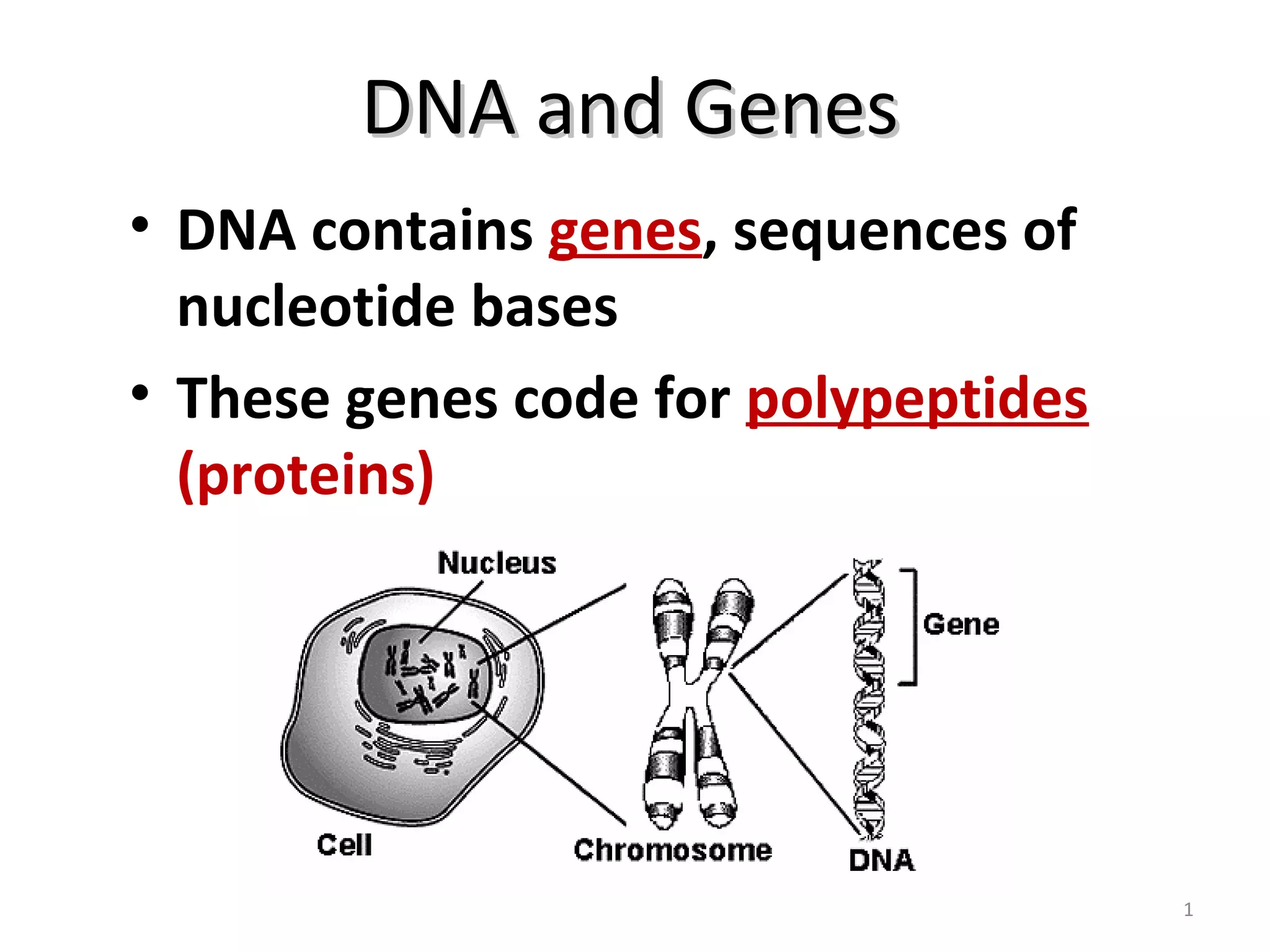
• DNA contains genes, sequences of
  nucleotide bases
• These genes code for polypeptides
  (proteins)


                                      1
Protein Synthesis (Gene Expression)
Proteins (Review)
•Proteins make up all living materials
• Proteins are composed of amino acids – there are 20
  different amino acids
• Different proteins are made by combining these 20
  amino acids in different combinations

• Amino acid chains are called polypeptides.
• Proteins are manufactured (made) by the ribosomes
• Function of proteins:
1.Help fight disease
2.Build new body tissue
3.Enzymes used for digestion and other chemical reactions
  are proteins
  (Enzymes speed up the rate of a reaction)
4.    Component of all cell membranes
Making a Protein—Transcription
•First Step: Copying of genetic information from DNA to RNA called
Transcription
       Why? DNA has the genetic code for the protein that needs
to be made, but proteins are made by the ribosomes—ribosomes
are outside the nucleus in the cytoplasm.
      DNA is too large to leave the nucleus (double stranded), but
RNA can leave the nucleus (single stranded).
The enzyme RNA polymerase binds to DNA and part of
DNA temporarily unzips and is used as a template to
assemble complementary nucleotides into messenger
RNA (mRNA). mRNA copies the template strand
• mRNA then goes through the pores of the nucleus with
  the DNA code and attaches to the ribosome.
Making a Protein—Translation
•Second Step: Decoding of mRNA into a
protein/polypeptide chain is called Translation.
•Transfer RNA (tRNA) carries amino acids from the
cytoplasm to the ribosome.
These amino acids come from the food we eat. Proteins
we eat are broken down into individual amino acids and
then simply rearranged into new proteins according to the
needs and directions of our DNA.
• A series of three adjacent bases
  in an mRNA molecule codes for
  a specific amino acid—called a
  codon.

• A triplet of nucleotides in tRNA    Amino acid
  that is complementary to the
  codon in mRNA—called an
  anticodon.

• Each tRNA codes for a different
  amino acid.
                                     Anticodon
copyright cmassengale   12
• mRNA carrying the DNA instructions and tRNA carrying
  amino acids meet in the ribosomes.
• Amino acids are joined together to make a protein.


                 Polypeptide = Protein
Ribosomes
• Made of a large and small
  subunit
• Composed of rRNA (40%) and
  proteins (60%)
• Have two sites for tRNA
  attachment --- P and A


           copyright cmassengale   15
Step 1- Initiation

• mRNA transcript
  start codon AUG
  attaches to the
  small ribosomal
  subunit
• Small subunit
  attaches to large
  ribosomal subunit
               mRNA transcript
                copyright cmassengale   16
Ribosomes

  Large
 subunit
                 P                   A
                Site                Site

                                            mRNA


Small subunit
                A U G           C U A C U U C G
                   copyright cmassengale     17
Step 2 - Elongation
• As ribosome moves, two tRNA with their
  amino acids move into site A and P of the
  ribosome
• Peptide bonds join the amino acids


                  copyright cmassengale       18
Initiation
                                                 aa2
                aa1


                                               2-tRNA
             1-tRNA

anticodon
                                              G A U
            U A C
hydrogen    A U G        C U A C U U C G A
 bonds       codon                            mRNA
                      copyright cmassengale             19
Elongation
                      peptide bond
                                                   aa3
                aa1                  aa2


                                               3-tRNA


             1-tRNA            2-tRNA         G A A
anticodon
            U A C        G A U
hydrogen    A U G        C U A C U U C G A
bonds        codon                            mRNA
                      copyright cmassengale             20
aa1        peptide bond
                                                     aa3
                                 aa2


 1-tRNA

                                                  3-tRNA
U A C
(leaves)
                              2-tRNA             G A A

                           G A U
                A U G      C U A C U U C G A
                                                 mRNA


           Ribosomes movecmassengale one codon
                      copyright over                    21
peptide bonds
    aa1                                        aa4

             aa2                     aa3


                                            4-tRNA


          2-tRNA             3-tRNA        G C U

        G A U G A A
A U G   C U A C U U C G A A C U
                                           mRNA

                   copyright cmassengale             22
peptide bonds
             aa1                                     aa4
                      aa2

                                 aa3


 2-tRNA
                                                  4-tRNA
G A U
(leaves)                     3-tRNA              G C U

                      G A A
   A U G        C U A C U U C G A A C U
                                                 mRNA


           Ribosomes movecmassengale one codon
                      copyright over                       23
peptide bonds                          aa5
aa1
      aa2
                                    aa4
                aa3


                                             5-tRNA


                                             U G A
            3-tRNA             4-tRNA


        G A A G C U
G C U A C U U C G A A C U
                                             mRNA

                     copyright cmassengale            24
aa1           peptide bonds                  aa5
             aa2
                     aa3
                             aa4


                                                5-tRNA

 3-tRNA                                         U G A
G A A                       4-tRNA


              G C U
G C U A C U U C G A A C U
                                                mRNA


          Ribosomes movecmassengale one codon
                     copyright over                      25
aa5
      aa4             aa199
                                              Termination
                                     aa200
 aa3 primary
     structure
aa2 of a protein


aa1
                                               terminator
                             200-tRNA
                                                or stop
                                                codon


A C U             C A U G U U U A G
 mRNA

                      copyright cmassengale                 26
End Product –The Protein!
      • The end products of protein synthesis
        is a primary structure of a protein
      • A sequence of amino acid bonded
        together by peptide bonds


                                           aa5
          aa3       aa4
aa2                                              aa199


aa1                                                      aa200
                   copyright cmassengale                   27
Messenger RNA (mRNA)
          start
         codon
        A U G G G C U C C A U C G G C G C A U A A
mRNA

        codon 1      codon 2    codon 3     codon 4        codon 5    codon 6     codon 7

protein methionine    glycine    serine     isoleucine      glycine    alanine      stop
                                                                                   codon


                  Primary structure of a protein
       aa1           aa2          aa3              aa4          aa5              aa6


                           peptide bonds
                                   copyright cmassengale                               28
Use one of the codon charts on the next page to find the amino acid
sequence coded for by the following mRNA strands.


                     CAC/CCA/UGG/UGA
    GUG              GGU              ACC              ACU
___________/___________/___________/____________


                     AUG/AAC/GAC/UAA

   UAC          UUG         CUG          AUU
___________/___________/___________/____________
CAC/CCA/UGG/UGA
 Histidine     Proline   Tryptophan     Stop
___________/___________/___________/____________
                     2nd Base
1st Base


                                              3rd Base
AUG/AAC/GAC/UAA

Methionine Asparagine Aspartic Acid      Stop
___________/___________/___________/____________
Protein Synthesis
Protein Synthesis videos
• http://www.youtube.com/watch?
  v=983lhh20rGY
• http://www.youtube.com/watch?
  v=erOP76_qLWA
Movie about translation at bottom of webpage. Click on hyperlink in picture above.

Protein synthesis

  • 1.
    DNA and Genes •DNA contains genes, sequences of nucleotide bases • These genes code for polypeptides (proteins) 1
  • 2.
    Protein Synthesis (GeneExpression) Proteins (Review) •Proteins make up all living materials
  • 3.
    • Proteins arecomposed of amino acids – there are 20 different amino acids • Different proteins are made by combining these 20 amino acids in different combinations • Amino acid chains are called polypeptides.
  • 4.
    • Proteins aremanufactured (made) by the ribosomes
  • 5.
    • Function ofproteins: 1.Help fight disease 2.Build new body tissue 3.Enzymes used for digestion and other chemical reactions are proteins (Enzymes speed up the rate of a reaction) 4. Component of all cell membranes
  • 6.
    Making a Protein—Transcription •FirstStep: Copying of genetic information from DNA to RNA called Transcription Why? DNA has the genetic code for the protein that needs to be made, but proteins are made by the ribosomes—ribosomes are outside the nucleus in the cytoplasm. DNA is too large to leave the nucleus (double stranded), but RNA can leave the nucleus (single stranded).
  • 7.
    The enzyme RNApolymerase binds to DNA and part of DNA temporarily unzips and is used as a template to assemble complementary nucleotides into messenger RNA (mRNA). mRNA copies the template strand
  • 8.
    • mRNA thengoes through the pores of the nucleus with the DNA code and attaches to the ribosome.
  • 9.
    Making a Protein—Translation •SecondStep: Decoding of mRNA into a protein/polypeptide chain is called Translation. •Transfer RNA (tRNA) carries amino acids from the cytoplasm to the ribosome.
  • 10.
    These amino acidscome from the food we eat. Proteins we eat are broken down into individual amino acids and then simply rearranged into new proteins according to the needs and directions of our DNA.
  • 11.
    • A seriesof three adjacent bases in an mRNA molecule codes for a specific amino acid—called a codon. • A triplet of nucleotides in tRNA Amino acid that is complementary to the codon in mRNA—called an anticodon. • Each tRNA codes for a different amino acid. Anticodon
  • 12.
  • 13.
    • mRNA carryingthe DNA instructions and tRNA carrying amino acids meet in the ribosomes.
  • 14.
    • Amino acidsare joined together to make a protein. Polypeptide = Protein
  • 15.
    Ribosomes • Made ofa large and small subunit • Composed of rRNA (40%) and proteins (60%) • Have two sites for tRNA attachment --- P and A copyright cmassengale 15
  • 16.
    Step 1- Initiation •mRNA transcript start codon AUG attaches to the small ribosomal subunit • Small subunit attaches to large ribosomal subunit mRNA transcript copyright cmassengale 16
  • 17.
    Ribosomes Large subunit P A Site Site mRNA Small subunit A U G C U A C U U C G copyright cmassengale 17
  • 18.
    Step 2 -Elongation • As ribosome moves, two tRNA with their amino acids move into site A and P of the ribosome • Peptide bonds join the amino acids copyright cmassengale 18
  • 19.
    Initiation aa2 aa1 2-tRNA 1-tRNA anticodon G A U U A C hydrogen A U G C U A C U U C G A bonds codon mRNA copyright cmassengale 19
  • 20.
    Elongation peptide bond aa3 aa1 aa2 3-tRNA 1-tRNA 2-tRNA G A A anticodon U A C G A U hydrogen A U G C U A C U U C G A bonds codon mRNA copyright cmassengale 20
  • 21.
    aa1 peptide bond aa3 aa2 1-tRNA 3-tRNA U A C (leaves) 2-tRNA G A A G A U A U G C U A C U U C G A mRNA Ribosomes movecmassengale one codon copyright over 21
  • 22.
    peptide bonds aa1 aa4 aa2 aa3 4-tRNA 2-tRNA 3-tRNA G C U G A U G A A A U G C U A C U U C G A A C U mRNA copyright cmassengale 22
  • 23.
    peptide bonds aa1 aa4 aa2 aa3 2-tRNA 4-tRNA G A U (leaves) 3-tRNA G C U G A A A U G C U A C U U C G A A C U mRNA Ribosomes movecmassengale one codon copyright over 23
  • 24.
    peptide bonds aa5 aa1 aa2 aa4 aa3 5-tRNA U G A 3-tRNA 4-tRNA G A A G C U G C U A C U U C G A A C U mRNA copyright cmassengale 24
  • 25.
    aa1 peptide bonds aa5 aa2 aa3 aa4 5-tRNA 3-tRNA U G A G A A 4-tRNA G C U G C U A C U U C G A A C U mRNA Ribosomes movecmassengale one codon copyright over 25
  • 26.
    aa5 aa4 aa199 Termination aa200 aa3 primary structure aa2 of a protein aa1 terminator 200-tRNA or stop codon A C U C A U G U U U A G mRNA copyright cmassengale 26
  • 27.
    End Product –TheProtein! • The end products of protein synthesis is a primary structure of a protein • A sequence of amino acid bonded together by peptide bonds aa5 aa3 aa4 aa2 aa199 aa1 aa200 copyright cmassengale 27
  • 28.
    Messenger RNA (mRNA) start codon A U G G G C U C C A U C G G C G C A U A A mRNA codon 1 codon 2 codon 3 codon 4 codon 5 codon 6 codon 7 protein methionine glycine serine isoleucine glycine alanine stop codon Primary structure of a protein aa1 aa2 aa3 aa4 aa5 aa6 peptide bonds copyright cmassengale 28
  • 29.
    Use one ofthe codon charts on the next page to find the amino acid sequence coded for by the following mRNA strands. CAC/CCA/UGG/UGA GUG GGU ACC ACU ___________/___________/___________/____________ AUG/AAC/GAC/UAA UAC UUG CUG AUU ___________/___________/___________/____________
  • 30.
    CAC/CCA/UGG/UGA Histidine Proline Tryptophan Stop ___________/___________/___________/____________ 2nd Base 1st Base 3rd Base
  • 31.
    AUG/AAC/GAC/UAA Methionine Asparagine AsparticAcid Stop ___________/___________/___________/____________
  • 32.
  • 33.
    Protein Synthesis videos •http://www.youtube.com/watch? v=983lhh20rGY • http://www.youtube.com/watch? v=erOP76_qLWA
  • 34.
    Movie about translationat bottom of webpage. Click on hyperlink in picture above.

Editor's Notes

  • #13 Transcription occurs when DNA acts as a template for mRNA synthesis. Translation occurs when the sequence of the mRNA codons determines the sequence of amino acids in a protein.