
@Hassan Harraz 2018
Nature Gas
Prof. Dr. Hassan Z. Harraz
Geology Department, Faculty of Science, Tanta University
hharraz2006@yahoo.com
Spring 2018
Outline of Lectures:
Topic 1: Natural Gas (Overview).
Topic 2: Unconventional Gas Reservoir
Topic 3: Shale Gas
Topic 4:Coalbed Methane (CBM)
Topic 5: Tight Reservoir
Topic 6: Gas Hydrates
Topic 7: Hydraulic Fracturing.
Topic 8 : Separating and Treating Well Fluids
Topic 9 : Natural Gas Processes
Topic 10 : Liquefied Natural Gas (LNG) Life Cycle Overview.
Topic 11 : Egyptian Natural Gas Resource (Overview).
@Hassan Harraz 2018
Nature Gas
2
Course objectives:
 The objectives of this course in Natural Gas Resources
are:
(i) acquainting students (majors and non-majors) with
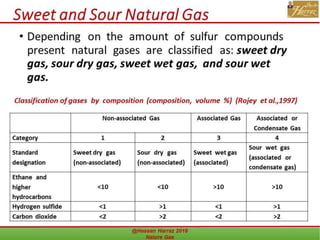
the basic tools necessary for studying Natural Gas
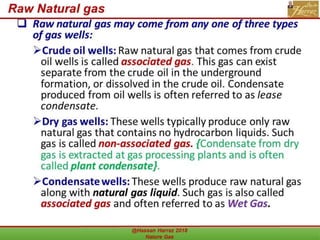
deposits,
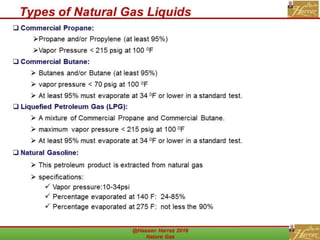
(ii) understanding the different types of Natural Gas,
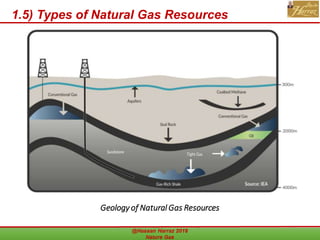
(iii) understanding the processes of Natural Gas,
(iv) understanding the relationship between the
distribution of Natural Gas, and Plate Tectonics,
and
(vi) gaining some knowledge of the environmental
problems associated with the extraction and
utilization of Natural Gas Resources.
Introduction
 An Introduction to Natural Gas Deposits is to
geologists.
 This course provides a non-technical introduction to
the basic concepts of:
 Natural Gas Resources in :
 Natural Gas Accumulation Types
 Associated and Non-associated Gas
 Sweet and Sour Natural Gas
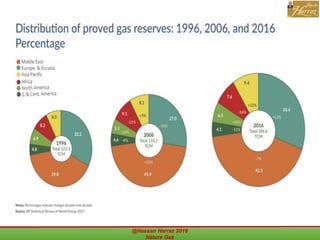
 Natural Gas Industry Value Chain
 Various Products of Raw Gas
 Natural Gas Supply
 Global Natural Gas Production
 With numerous examples, figures and images.
 Also included are some key aspects of the Liquefied Natural
Gas (LNG) Life Cycle Overview
Keywords:
Natural Gas
Unconventional Gas Reservoirs: Shale Gas; Coalbed
Methane (CBM); Tight Reservoir; Gas Hydrates
Hydraulic Fracturing.
Natural Gas Processes; Separating and Treating Well
Fluids
Liquefied Natural Gas (LNG) Life Cycle Overview.
Egyptian Natural Gas Resource (Overview).
Follow me on Social Media
http://facebook.com/hzharraz
http://www.slideshare.net/hzharraz
https://www.linkedin.com/in/hassan-harraz-3172b235
Hassan Z. Harraz
hharraz2006@yahoo.com
Spring 2018
@Hassan Harraz 2018
Nature Gas
7
OUTLINES LECTURE
• This Introduction to Natural Gas overview includes:
@Hassan Harraz 2018 Nature Gas
8
 NATURAL GAS
 Historical Perspective
 What is Natural Gas?
 Natural Gas Composition
 Characterization NaturalGas
 Types of Natural Gas
 Types of Natural Gas Liquids
 Condensate Natural Gas
 Types of NaturalGas Resources
 Resources vs. Reserves
VARIOUS PRODUCTS (or FRACTIONS) OF RAW GAS
USES OF NATURAL GAS
UNIT CONVERSION
 SUPPLY
 Evolution of Global Reserves by Region
 NaturalGas Resources
 Global Production
 NATURAL GAS VALUE CHAIN
INTRODUCTION
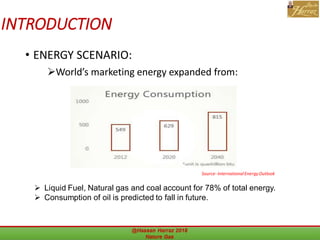
• ENERGY SCENARIO:
World’s marketing energy expanded from:
@Hassan Harraz 2018 Nature Gas 9
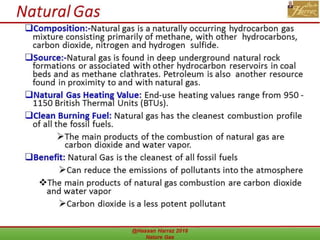
 Liquid Fuel, Natural gas and coal account for 78% of total energy.
 Consumption of oil is predicted to fall in future.
Source-InternationalEnergyOutlook
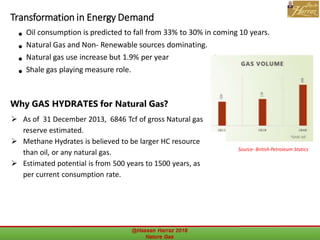
Transformation in Energy Demand
• Oil consumption is predicted to fall from 33% to 30% in coming 10 years.
• Natural Gas and Non- Renewable sources dominating.
• Natural gas use increase but 1.9% per year
• Shale gas playing measure role.
@Hassan Harraz 2018 Nature Gas 10
Why GAS HYDRATES for Natural Gas?
 As of 31 December 2013, 6846 Tcf of gross Natural gas
reserve estimated.
 Methane Hydrates is believed to be larger HC resource
than oil, or any natural gas.
 Estimated potential is from 500 years to 1500 years, as
per current consumption rate.
Source- British Petroleum Statics
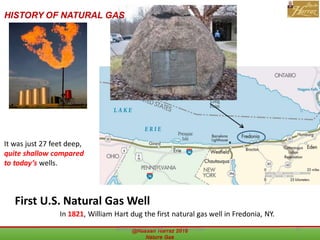
First U.S. Natural Gas Well
In 1821, William Hart dug the first natural gas well in Fredonia, NY.
It was just 27 feet deep,
quite shallow compared
to today’s wells.
HISTORY OF NATURAL GAS
@Hassan Harraz 2018 Nature Gas 11
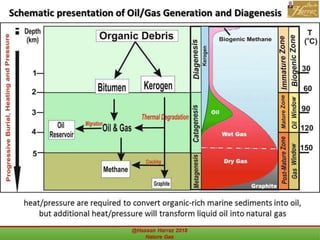
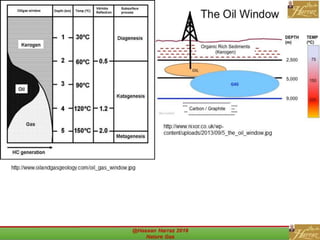
Where does Natural Gas come from?
@Hassan Harraz 2018 Nature Gas 13
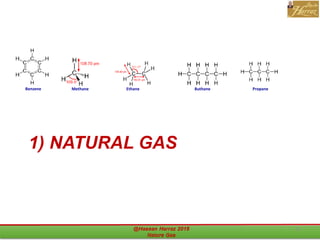
1) NATURAL GAS
@Hassan Harraz 2018 Nature Gas 15
Benzene Methane Ethane Buthane Propane
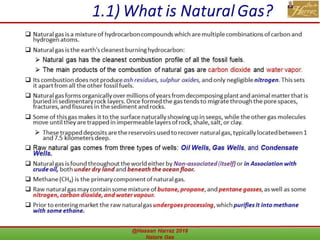
1.1) What is Natural Gas?
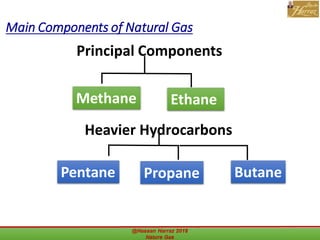
Main Components of Natural Gas
Methane Ethane
Principal Components
Heavier Hydrocarbons
Pentane Propane Butane
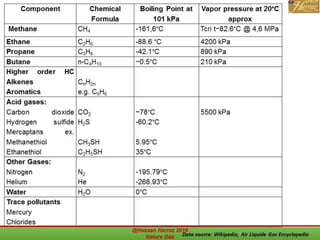
@Hassan Harraz 2018 Nature Gas 19
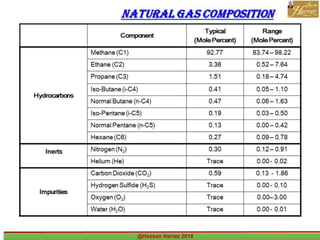
Natural Gas Composition
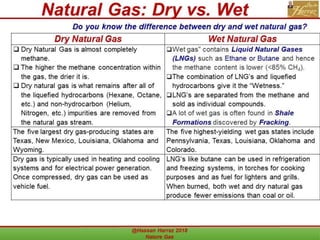
Natural Gas: Dry vs. Wet
Do you know the difference between dry and wet natural gas?
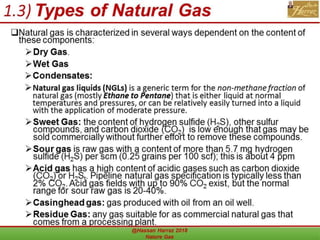
1.3) Types of Natural Gas
 Dry Gas.
 Wet Gas
 Condensates
 Natural gas liquids (NGLs)
 Sweet Gas
 Sour gas
 Acid gas
 Casinghead gas
 Residue Gas
@Hassan Harraz 2018 Nature Gas 23
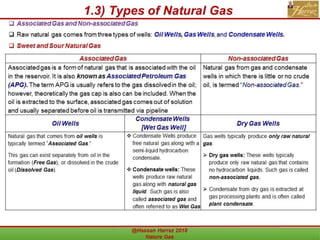
1.3) Types of Natural Gas
Sweet and Sour Natural Gas
Raw Natural gas
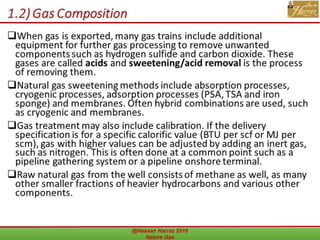
 Raw natural gas may come from any one of three
types of gas wells:
Crude oil wells:
Dry gas wells:
Condensate wells:
@Hassan Harraz 2018 Nature Gas 26
27
Types of Natural Gas Liquids
 Commercial Propane:
 Commercial Butane:
 Liquefied Petroleum Gas (LPG):
 Natural Gasoline:
Geology of Natural Gas Resources
@Hassan Harraz 2018 Nature Gas 28
1.5) Types of Natural Gas Resources
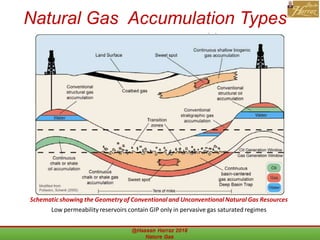
Natural Gas Accumulation Types
Schematic showing the Geometryof Conventional and Unconventional Natural Gas Resources
Low permeability reservoirs contain GIP only in pervasive gas saturated regimes
29
@Hassan Harraz 2018 Nature Gas
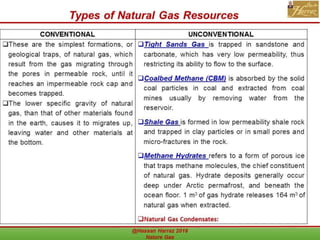
Types of Natural Gas Resources
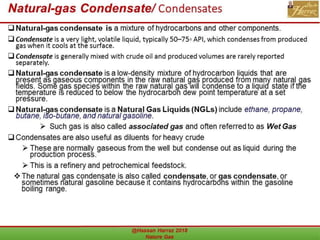
Natural-gas Condensate/ Condensates
@Hassan Harraz 2018 Nature Gas 32
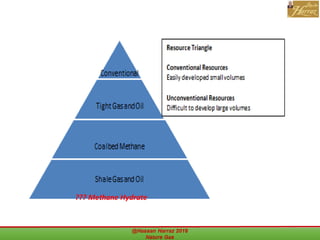
??? Methane Hydrate
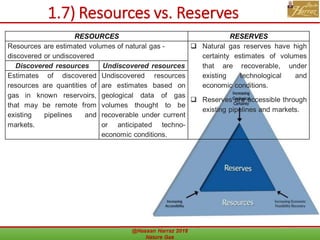
1.7) Resources vs. Reserves
@Hassan Harraz 2018 Nature Gas 33
RESOURCES RESERVES
Resources are estimated volumes of natural gas -
discovered or undiscovered
 Natural gas reserves have high
certainty estimates of volumes
that are recoverable, under
existing technological and
economic conditions.
 Reserves are accessible through
existing pipelines and markets.
Discovered resources Undiscovered resources
Estimates of discovered
resources are quantities of
gas in known reservoirs,
that may be remote from
existing pipelines and
markets.
Undiscovered resources
are estimates based on
geological data of gas
volumes thought to be
recoverable under current
or anticipated techno-
economic conditions.
@Hassan Harraz 2018 Nature Gas 34
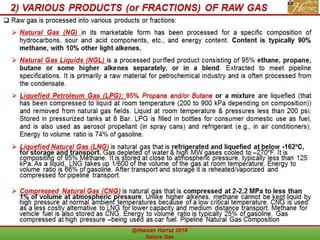
2) VARIOUS PRODUCTS (or FRACTIONS) OF RAW GAS
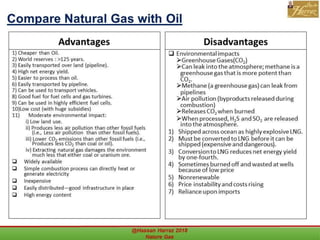
Compare Natural Gas with Oil
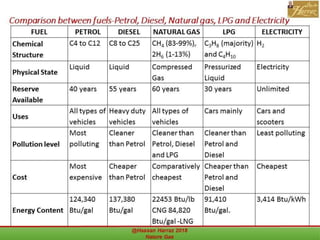
Comparison between fuels-Petrol, Diesel, Natural gas, LPG and Electricity
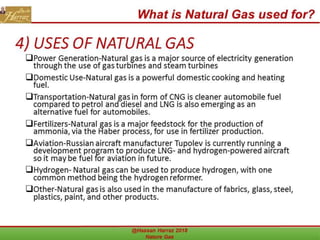
4) USES OF NATURAL GAS
What is Natural Gas used for?
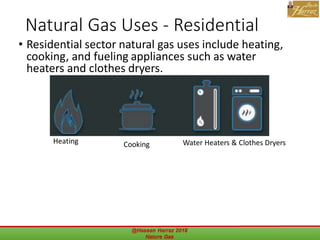
Natural Gas Uses - Residential
• Residential sector natural gas uses include heating,
cooking, and fueling appliances such as water
heaters and clothes dryers.
Water Heaters & Clothes DryersCookingHeating
@Hassan Harraz 2018 Nature Gas 39
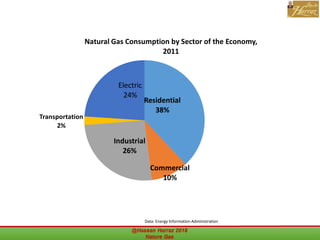
Data: Energy Information Administration
Residential
38%
Commercial
10%
Industrial
26%
Transportation
2%
Electric
24%
Natural Gas Consumption by Sector of the Economy,
2011
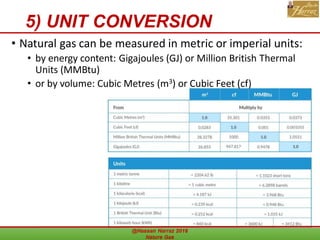
5) UNIT CONVERSION
• Natural gas can be measured in metric or imperial units:
• by energy content: Gigajoules (GJ) or Million British Thermal
Units (MMBtu)
• or by volume: Cubic Metres (m3) or Cubic Feet (cf)
@Hassan Harraz 2018 Nature Gas 41
6) NATURAL GAS
SUPPLY
@Hassan Harraz 2018 Nature Gas 42
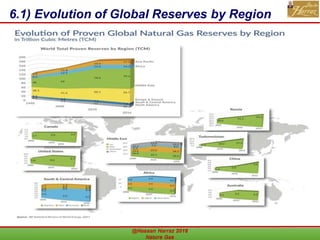
6.1) Evolution of Global Reserves by Region
@Hassan Harraz 2018 Nature Gas 43
8.1) Evolution of Global Reserves by Region
The supply of natural gas is secure, accessible and affordable for
the foreseeable future.
Natural gas is a fuel that performs strongly on security of supply
considerations:
There are sufficient global deposit volumes to meet projected demand.
Deposits are geographically diverse.
Access is greater than it has ever been with the advances in LNG shipping
technologies and evolving business models.
“The remaining resources of natural gas are sufficient to
comfortably meet the projections of global demand growth to
2040 and well beyond.” (IEA,2017).
At the end of 2016, proven reserves were about 215 trillion cubic
meters (tcm), equal to around 60 years of production at current
output rates.
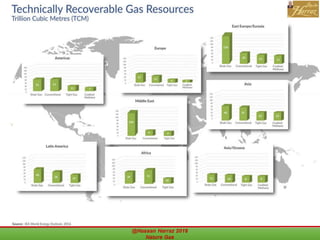
Global resources of natural gas are estimated at nearly 800 tcm,
around 45% of which are unconventional gas (tight gas, shale gas,
CBM), deposits of which are geographically more widespread
than conventional resources. (IEA,2017).
@Hassan Harraz 2018 Nature Gas 44
@Hassan Harraz 2018 Nature Gas 45
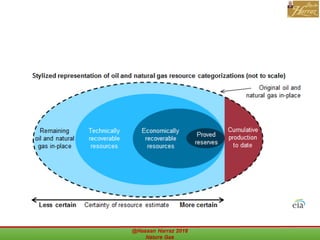
6.2) Natural Gas Resources
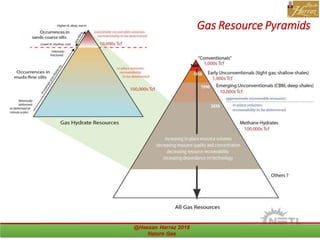
Gas Resource Pyramids
@Hassan Harraz 2018 Nature Gas 47
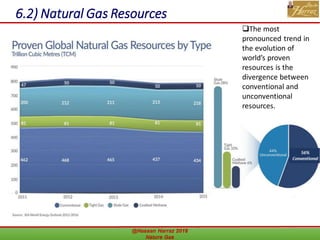
6.2) Natural Gas Resources
@Hassan Harraz 2018 Nature Gas 48
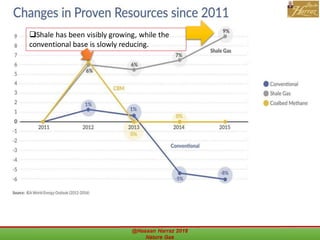
The most
pronounced trend in
the evolution of
world’s proven
resources is the
divergence between
conventional and
unconventional
resources.
@Hassan Harraz 2018 Nature Gas 49
Shale has been visibly growing, while the
conventional base is slowly reducing.
@Hassan Harraz 2018 Nature Gas 50
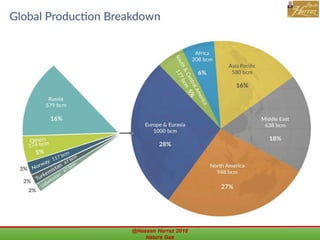
6.3) Global Production
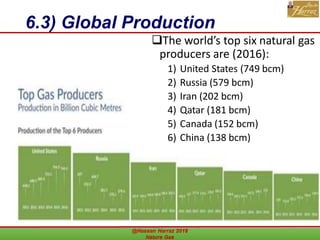
The world’s top six natural gas
producers are (2016):
1) United States (749 bcm)
2) Russia (579 bcm)
3) Iran (202 bcm)
4) Qatar (181 bcm)
5) Canada (152 bcm)
6) China (138 bcm)
@Hassan Harraz 2018 Nature Gas 51
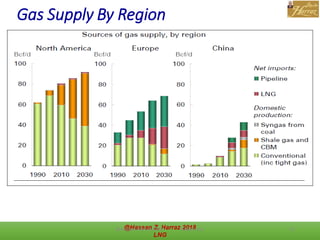
Gas Supply By Region
@Hassan Harraz 2018 Nature Gas 52
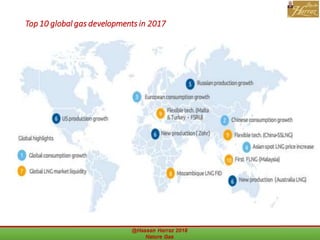
Top 10 global gas developments in 2017
@Hassan Harraz 2018 Nature Gas 53
@Hassan Harraz 2018 Nature Gas 54
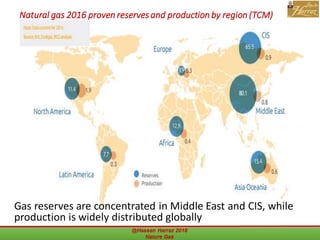
Natural gas 2016 proven reserves and production by region (TCM)
Gas reserves are concentrated in Middle East and CIS, while
production is widely distributed globally
@Hassan Harraz 2018 Nature Gas
55
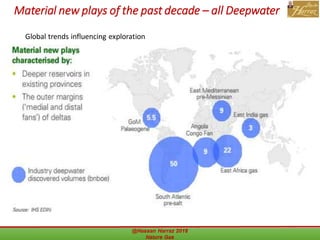
Material new plays of the past decade – all Deepwater
@Hassan Harraz 2018 Nature Gas 56
Global trends influencing exploration
7) NATURAL GAS INDUSTRY VALUE CHAIN
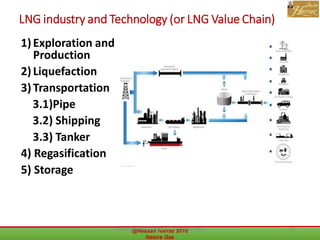
LNG industry and Technology (or LNG Value Chain)
1)Exploration and
Production
2)Liquefaction
3)Transportation
3.1)Pipe
3.2) Shipping
3.3) Tanker
4) Regasification
5) Storage
@Hassan Harraz 2018 Nature Gas 58
References
Masters JA (1979): “Deep Basin Gas Trap, Western Canada,” AAPG Bulletin
63, No. 2: 152.
Rogner H-H (1996). “An Assessment of World
Hydrocarbon Resources,” IIASA, WP–96–26, May
1996.
IGU World LNG Report – 2015 Edition
@Hassan Harraz 2018 Nature Gas 59
@Hassan Harraz 2018 Nature Gas
60

Natural Gas Resources

  • 1.
    @Hassan Harraz 2018 NatureGas Prof. Dr. Hassan Z. Harraz Geology Department, Faculty of Science, Tanta University hharraz2006@yahoo.com Spring 2018
  • 2.
    Outline of Lectures: Topic1: Natural Gas (Overview). Topic 2: Unconventional Gas Reservoir Topic 3: Shale Gas Topic 4:Coalbed Methane (CBM) Topic 5: Tight Reservoir Topic 6: Gas Hydrates Topic 7: Hydraulic Fracturing. Topic 8 : Separating and Treating Well Fluids Topic 9 : Natural Gas Processes Topic 10 : Liquefied Natural Gas (LNG) Life Cycle Overview. Topic 11 : Egyptian Natural Gas Resource (Overview). @Hassan Harraz 2018 Nature Gas 2
  • 3.
    Course objectives:  Theobjectives of this course in Natural Gas Resources are: (i) acquainting students (majors and non-majors) with the basic tools necessary for studying Natural Gas deposits, (ii) understanding the different types of Natural Gas, (iii) understanding the processes of Natural Gas, (iv) understanding the relationship between the distribution of Natural Gas, and Plate Tectonics, and (vi) gaining some knowledge of the environmental problems associated with the extraction and utilization of Natural Gas Resources.
  • 4.
    Introduction  An Introductionto Natural Gas Deposits is to geologists.  This course provides a non-technical introduction to the basic concepts of:  Natural Gas Resources in :  Natural Gas Accumulation Types  Associated and Non-associated Gas  Sweet and Sour Natural Gas  Natural Gas Industry Value Chain  Various Products of Raw Gas  Natural Gas Supply  Global Natural Gas Production  With numerous examples, figures and images.  Also included are some key aspects of the Liquefied Natural Gas (LNG) Life Cycle Overview
  • 5.
    Keywords: Natural Gas Unconventional GasReservoirs: Shale Gas; Coalbed Methane (CBM); Tight Reservoir; Gas Hydrates Hydraulic Fracturing. Natural Gas Processes; Separating and Treating Well Fluids Liquefied Natural Gas (LNG) Life Cycle Overview. Egyptian Natural Gas Resource (Overview).
  • 6.
    Follow me onSocial Media http://facebook.com/hzharraz http://www.slideshare.net/hzharraz https://www.linkedin.com/in/hassan-harraz-3172b235
  • 7.
    Hassan Z. Harraz hharraz2006@yahoo.com Spring2018 @Hassan Harraz 2018 Nature Gas 7
  • 8.
    OUTLINES LECTURE • ThisIntroduction to Natural Gas overview includes: @Hassan Harraz 2018 Nature Gas 8  NATURAL GAS  Historical Perspective  What is Natural Gas?  Natural Gas Composition  Characterization NaturalGas  Types of Natural Gas  Types of Natural Gas Liquids  Condensate Natural Gas  Types of NaturalGas Resources  Resources vs. Reserves VARIOUS PRODUCTS (or FRACTIONS) OF RAW GAS USES OF NATURAL GAS UNIT CONVERSION  SUPPLY  Evolution of Global Reserves by Region  NaturalGas Resources  Global Production  NATURAL GAS VALUE CHAIN
  • 9.
    INTRODUCTION • ENERGY SCENARIO: World’smarketing energy expanded from: @Hassan Harraz 2018 Nature Gas 9  Liquid Fuel, Natural gas and coal account for 78% of total energy.  Consumption of oil is predicted to fall in future. Source-InternationalEnergyOutlook
  • 10.
    Transformation in EnergyDemand • Oil consumption is predicted to fall from 33% to 30% in coming 10 years. • Natural Gas and Non- Renewable sources dominating. • Natural gas use increase but 1.9% per year • Shale gas playing measure role. @Hassan Harraz 2018 Nature Gas 10 Why GAS HYDRATES for Natural Gas?  As of 31 December 2013, 6846 Tcf of gross Natural gas reserve estimated.  Methane Hydrates is believed to be larger HC resource than oil, or any natural gas.  Estimated potential is from 500 years to 1500 years, as per current consumption rate. Source- British Petroleum Statics
  • 11.
    First U.S. NaturalGas Well In 1821, William Hart dug the first natural gas well in Fredonia, NY. It was just 27 feet deep, quite shallow compared to today’s wells. HISTORY OF NATURAL GAS @Hassan Harraz 2018 Nature Gas 11
  • 12.
    Where does NaturalGas come from?
  • 13.
    @Hassan Harraz 2018Nature Gas 13
  • 15.
    1) NATURAL GAS @HassanHarraz 2018 Nature Gas 15 Benzene Methane Ethane Buthane Propane
  • 16.
    1.1) What isNatural Gas?
  • 19.
    Main Components ofNatural Gas Methane Ethane Principal Components Heavier Hydrocarbons Pentane Propane Butane @Hassan Harraz 2018 Nature Gas 19
  • 20.
  • 22.
    Natural Gas: Dryvs. Wet Do you know the difference between dry and wet natural gas?
  • 23.
    1.3) Types ofNatural Gas  Dry Gas.  Wet Gas  Condensates  Natural gas liquids (NGLs)  Sweet Gas  Sour gas  Acid gas  Casinghead gas  Residue Gas @Hassan Harraz 2018 Nature Gas 23
  • 24.
    1.3) Types ofNatural Gas
  • 25.
    Sweet and SourNatural Gas
  • 26.
    Raw Natural gas Raw natural gas may come from any one of three types of gas wells: Crude oil wells: Dry gas wells: Condensate wells: @Hassan Harraz 2018 Nature Gas 26
  • 27.
    27 Types of NaturalGas Liquids  Commercial Propane:  Commercial Butane:  Liquefied Petroleum Gas (LPG):  Natural Gasoline:
  • 28.
    Geology of NaturalGas Resources @Hassan Harraz 2018 Nature Gas 28 1.5) Types of Natural Gas Resources
  • 29.
    Natural Gas AccumulationTypes Schematic showing the Geometryof Conventional and Unconventional Natural Gas Resources Low permeability reservoirs contain GIP only in pervasive gas saturated regimes 29 @Hassan Harraz 2018 Nature Gas
  • 30.
    Types of NaturalGas Resources
  • 31.
  • 32.
    @Hassan Harraz 2018Nature Gas 32 ??? Methane Hydrate
  • 33.
    1.7) Resources vs.Reserves @Hassan Harraz 2018 Nature Gas 33 RESOURCES RESERVES Resources are estimated volumes of natural gas - discovered or undiscovered  Natural gas reserves have high certainty estimates of volumes that are recoverable, under existing technological and economic conditions.  Reserves are accessible through existing pipelines and markets. Discovered resources Undiscovered resources Estimates of discovered resources are quantities of gas in known reservoirs, that may be remote from existing pipelines and markets. Undiscovered resources are estimates based on geological data of gas volumes thought to be recoverable under current or anticipated techno- economic conditions.
  • 34.
    @Hassan Harraz 2018Nature Gas 34
  • 35.
    2) VARIOUS PRODUCTS(or FRACTIONS) OF RAW GAS
  • 36.
  • 37.
    Comparison between fuels-Petrol,Diesel, Natural gas, LPG and Electricity
  • 38.
    4) USES OFNATURAL GAS What is Natural Gas used for?
  • 39.
    Natural Gas Uses- Residential • Residential sector natural gas uses include heating, cooking, and fueling appliances such as water heaters and clothes dryers. Water Heaters & Clothes DryersCookingHeating @Hassan Harraz 2018 Nature Gas 39
  • 40.
    Data: Energy InformationAdministration Residential 38% Commercial 10% Industrial 26% Transportation 2% Electric 24% Natural Gas Consumption by Sector of the Economy, 2011
  • 41.
    5) UNIT CONVERSION •Natural gas can be measured in metric or imperial units: • by energy content: Gigajoules (GJ) or Million British Thermal Units (MMBtu) • or by volume: Cubic Metres (m3) or Cubic Feet (cf) @Hassan Harraz 2018 Nature Gas 41
  • 42.
    6) NATURAL GAS SUPPLY @HassanHarraz 2018 Nature Gas 42
  • 43.
    6.1) Evolution ofGlobal Reserves by Region @Hassan Harraz 2018 Nature Gas 43
  • 44.
    8.1) Evolution ofGlobal Reserves by Region The supply of natural gas is secure, accessible and affordable for the foreseeable future. Natural gas is a fuel that performs strongly on security of supply considerations: There are sufficient global deposit volumes to meet projected demand. Deposits are geographically diverse. Access is greater than it has ever been with the advances in LNG shipping technologies and evolving business models. “The remaining resources of natural gas are sufficient to comfortably meet the projections of global demand growth to 2040 and well beyond.” (IEA,2017). At the end of 2016, proven reserves were about 215 trillion cubic meters (tcm), equal to around 60 years of production at current output rates. Global resources of natural gas are estimated at nearly 800 tcm, around 45% of which are unconventional gas (tight gas, shale gas, CBM), deposits of which are geographically more widespread than conventional resources. (IEA,2017). @Hassan Harraz 2018 Nature Gas 44
  • 45.
    @Hassan Harraz 2018Nature Gas 45
  • 46.
  • 47.
    Gas Resource Pyramids @HassanHarraz 2018 Nature Gas 47
  • 48.
    6.2) Natural GasResources @Hassan Harraz 2018 Nature Gas 48 The most pronounced trend in the evolution of world’s proven resources is the divergence between conventional and unconventional resources.
  • 49.
    @Hassan Harraz 2018Nature Gas 49 Shale has been visibly growing, while the conventional base is slowly reducing.
  • 50.
    @Hassan Harraz 2018Nature Gas 50
  • 51.
    6.3) Global Production Theworld’s top six natural gas producers are (2016): 1) United States (749 bcm) 2) Russia (579 bcm) 3) Iran (202 bcm) 4) Qatar (181 bcm) 5) Canada (152 bcm) 6) China (138 bcm) @Hassan Harraz 2018 Nature Gas 51
  • 52.
    Gas Supply ByRegion @Hassan Harraz 2018 Nature Gas 52
  • 53.
    Top 10 globalgas developments in 2017 @Hassan Harraz 2018 Nature Gas 53
  • 54.
    @Hassan Harraz 2018Nature Gas 54
  • 55.
    Natural gas 2016proven reserves and production by region (TCM) Gas reserves are concentrated in Middle East and CIS, while production is widely distributed globally @Hassan Harraz 2018 Nature Gas 55
  • 56.
    Material new playsof the past decade – all Deepwater @Hassan Harraz 2018 Nature Gas 56 Global trends influencing exploration
  • 57.
    7) NATURAL GASINDUSTRY VALUE CHAIN
  • 58.
    LNG industry andTechnology (or LNG Value Chain) 1)Exploration and Production 2)Liquefaction 3)Transportation 3.1)Pipe 3.2) Shipping 3.3) Tanker 4) Regasification 5) Storage @Hassan Harraz 2018 Nature Gas 58
  • 59.
    References Masters JA (1979):“Deep Basin Gas Trap, Western Canada,” AAPG Bulletin 63, No. 2: 152. Rogner H-H (1996). “An Assessment of World Hydrocarbon Resources,” IIASA, WP–96–26, May 1996. IGU World LNG Report – 2015 Edition @Hassan Harraz 2018 Nature Gas 59
  • 60.
    @Hassan Harraz 2018Nature Gas 60