関係詞
重要度 難易度
★★★★★ ★★★★☆
Copyright Gakushin-Juku All Rights Reserved. 1/42
日本語と違って、英語では
後置修飾がよく使われます。
Copyright Gakushin-Juku All Rights Reserved. 2/42
その後置修飾の代表格が
関係詞による修飾です。
Copyright Gakushin-Juku All Rights Reserved. 3/42
ここでは、関係詞を含む
英文を読む練習します。
Copyright Gakushin-Juku All Rights Reserved.
使う例文は4つ
4/42
I know of one Japanese student
from another class who has
spent time in New Zealand and
is planning to participate.
(2015年 第5問)
例文1
Copyright Gakushin-Juku All Rights Reserved. 5/42
※know of ~は「直接は知らないが、
名前やうわさ話は知っている」という感じ
I know of one Japanese student
from another class who has
spent time in New Zealand and
is planning to participate.
Copyright Gakushin-Juku All Rights Reserved.
「私は一人の日本人の生徒を知って
います」
この部分が文の中心
6/42
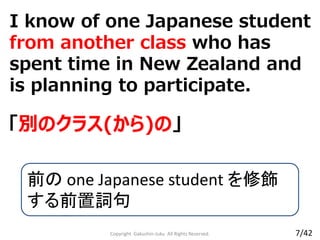
I know of one Japanese student
from another class who has
spent time in New Zealand and
is planning to participate.
Copyright Gakushin-Juku All Rights Reserved.
「別のクラス(から)の」
前の one Japanese student を修飾
する前置詞句
7/42
I know of one Japanese student
from another class who has
spent time in New Zealand and
is planning to participate.
Copyright Gakushin-Juku All Rights Reserved.
「ニュージーランドで過ごしたことがある」
whoは関係代名詞。
(その先行詞は何ですか?)
8/42
I know of one Japanese student
from another class who has
spent time in New Zealand and
is planning to participate.
Copyright Gakushin-Juku All Rights Reserved.
この who の先行詞は直前の another
class ではなく one Japanese student
【確認】whoの先行詞は「人」
基本を大切に!
9/42
I know of one Japanese student
from another class who has
spent time in New Zealand and
is planning to participate.
Copyright Gakushin-Juku All Rights Reserved.
「そして、参加することを計画している
(=参加するつもりである)」
次スライドの図で、この文の構造を
確認して下さい
10/42
who
Copyright Gakushin-Juku All Rights Reserved.
I know of
from another class
is planning
to participate
and
has spent time
in New Zealand
one Japanese student
||
||
11/42
「私は、ニュージーランドで過ごした
ことがあって、(クラブに)参加する
つもりでいる別のクラスの一人の
日本人の生徒を知っています」
例文1の全訳
Copyright Gakushin-Juku All Rights Reserved. 12/42
In my case, the rich cultural
experience my host family
provided and the host family
themselves were the best part
of my stay.
(2012年 第5問)
例文2
Copyright Gakushin-Juku All Rights Reserved. 13/42
In my case, the rich cultural
experience my host family
provided and the host family
themselves were the best part
of my stay.
Copyright Gakushin-Juku All Rights Reserved.
「私の場合、」
前置詞句なので、まだ主語は出てない
14/42
In my case, the rich cultural
experience my host family
provided and the host family
themselves were the best part
of my stay.
Copyright Gakushin-Juku All Rights Reserved.
「豊かな文化的な経験」
この部分が文の主語
(その中心は experience)
15/42
In my case, the rich cultural
experience my host family
provided and the host family
themselves were the best part
of my stay.
Copyright Gakushin-Juku All Rights Reserved.
「私のホストファミリーが提供した」
この部分と、直前の the rich cultural
experience との関係を考えてください
16/42
※my hostの前に、関係代名詞which
[that]が省略されている
In my case, the rich cultural
experience my host family
provided and the host family
themselves were the best part
of my stay.
Copyright Gakushin-Juku All Rights Reserved.
この部分は the rich cultural experience
を修飾する関係詞節です
17/42
こういう関係代名詞の省略は
読解の重要ポイントです。
Copyright Gakushin-Juku All Rights Reserved.
the rich cultural experience
(which[that]) my host family
provided
1つの正念場
18/42
In my case, the rich cultural
experience my host family
provided and the host family
themselves were the best part
of my stay.
Copyright Gakushin-Juku All Rights Reserved.
「そして、そのホストファミリーそのもの
(が)」
この and は the rich cultural experience
と the host family という名詞同士を接続
19/42
In my case, the rich cultural
experience my host family
provided and the host family
themselves were the best part
of my stay.
Copyright Gakushin-Juku All Rights Reserved.
「私の滞在の最も良かった部分でした」
やや長めの主部の後に出てきた述語
動詞 were をしっかり押さえましょう
20/42
「私の場合、ホストファミリーが提供
してくれた豊かな文化的経験とホスト
ファミリーそのものが、私の滞在の
最も良かった部分でした」
例文2の全訳
Copyright Gakushin-Juku All Rights Reserved. 21/42
Actually, I had sort of wanted to
see a Korean drama that my
mother had seen and told me
about. But he wanted to see the
science fiction movie that just
opened today ― the one that
everyone has been talking about.
(2012年 追試 第5問)
例文3
Copyright Gakushin-Juku All Rights Reserved. 22/42
Actually, I had sort of wanted to
see a Korean drama that my
mother had seen and told me
about. But he wanted to see the
science fiction movie that just
opened today ― the one that
everyone has been talking about.
Copyright Gakushin-Juku All Rights Reserved.
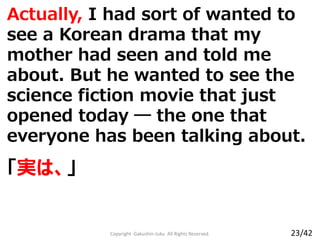
「実は、」
23/42
Actually, I had sort of wanted to
see a Korean drama that my
mother had seen and told me
about. But he wanted to see the
science fiction movie that just
opened today ― the one that
everyone has been talking about.
Copyright Gakushin-Juku All Rights Reserved.
「私は韓国のドラマを見たいと幾分か
思っていました」
24/42
Actually, I had sort of wanted to
see a Korean drama that my
mother had seen and told me
about. But he wanted to see the
science fiction movie that just
opened today ― the one that
everyone has been talking about.
Copyright Gakushin-Juku All Rights Reserved.
「私の母が見た」
この that は目的格の関係代名詞
(先行詞は a Korean drama )
25/42
Actually, I had sort of wanted to
see a Korean drama that my
mother had seen and told me
about. But he wanted to see the
science fiction movie that just
opened today ― the one that
everyone has been talking about.
Copyright Gakushin-Juku All Rights Reserved.
「そして、それについて話した」
この部分も、that が導く関係詞節の続き
( and は seen と told を対等に接続)
26/42
Actually, I had sort of wanted to
see a Korean drama that my
mother had seen and told me
about. But he wanted to see the
science fiction movie that just
opened today ― the one that
everyone has been talking about.
Copyright Gakushin-Juku All Rights Reserved.
「しかし、彼はSF映画を見たかった」
27/42
Actually, I had sort of wanted to
see a Korean drama that my
mother had seen and told me
about. But he wanted to see the
science fiction movie that just
opened today ― the one that
everyone has been talking about.
Copyright Gakushin-Juku All Rights Reserved.
「ちょうど今日始まった」
28/42
この that は主格の関係代名詞
(先行詞は the science fiction movie )
Actually, I had sort of wanted to
see a Korean drama that my
mother had seen and told me
about. But he wanted to see the
science fiction movie that just
opened today ― the one that
everyone has been talking about.
Copyright Gakushin-Juku All Rights Reserved.
「みんながずっと話している映画」
the one (= movie) の後の that は
目的格の関係代名詞 29/42
Actually, I had sort of wanted to
see a Korean drama that my
mother had seen and told me
about. But he wanted to see the
science fiction movie that just
opened today ― the one that
everyone has been talking about.
Copyright Gakushin-Juku All Rights Reserved.
関係代名詞 that の重要性が分かる
文章でした。主格・目的格の違いを
確実に読み取ることが大事です。
30/42
「実は私は、母が見て私に話してくれた
韓国のドラマを見たいと幾分か思って
いました。
しかし、彼はちょうど今日始まったSF映
画を見たかったのです。― みんなが
ずっと話している映画です」
例文3の全訳
Copyright Gakushin-Juku All Rights Reserved. 31/42
For me, a hobby is something
that you enjoy investing time
and money in, which means
you have to be committed to it.
(2010年 追試 第3問B)
例文4
Copyright Gakushin-Juku All Rights Reserved. 32/42
For me, a hobby is something
that you enjoy investing time
and money in, which means
you have to be committed to it.
Copyright Gakushin-Juku All Rights Reserved.
「私にとって、」
前置詞句 (もちろん主語ではない)
33/42
For me, a hobby is something
that you enjoy investing time
and money in, which means
you have to be committed to it.
Copyright Gakushin-Juku All Rights Reserved.
「趣味は何かです」
この部分が文の中心
S (a hobby) V (is) C (something)
34/42
For me, a hobby is something
that you enjoy investing time
and money in, which means
you have to be committed to it.
Copyright Gakushin-Juku All Rights Reserved.
「人が時間とお金を注ぎ込むことを
楽しむ」
この that は目的格の関係代名詞
※次のスライドで構造を確認して下さい
35/42
a hobby is
Copyright Gakushin-Juku All Rights Reserved.
関係代名詞 that は前置詞 in の
目的語になっています
that you enjoy investing
something
time and money in
※invest A in B 「AをBに注ぎ込む」
36/42
For me, a hobby is something
that you enjoy investing time
and money in, which means
you have to be committed to it.
Copyright Gakushin-Juku All Rights Reserved.
「つまり、そのことは~を意味します
(=~ということです)」
この which は関係代名詞の非限定用法
(先行詞は何か考えてください)
37/42
For me, a hobby is something
that you enjoy investing time
and money in, which means
you have to be committed to it.
Copyright Gakushin-Juku All Rights Reserved.
この関係代名詞 which の先行詞は、
その前の文(下線部)の内容です
※この 「・・・ ,which means ~」の
形はよく使われるので要チェック!
38/42
For me, a hobby is something
that you enjoy investing time
and money in, which means
you have to be committed to it.
Copyright Gakushin-Juku All Rights Reserved.
「人が、それに本気で取り組まなければ
ならないということ」
この部分は means の目的語のthat節
( you の前の that が省略されている)
39/42
「私にとって、趣味は、人がそれに
時間とお金を注ぎ込むのを楽しむ
ものです。つまり、人はそれに本気
で取り組まなければならないという
ことです」
例文4の全訳
Copyright Gakushin-Juku All Rights Reserved. 40/42
以上
Copyright Gakushin-Juku All Rights Reserved. 41/42
ありがとうございました。
Copyright Gakushin-Juku All Rights Reserved. 42/42

センター読解(関係詞)

  • 1.
  • 2.
  • 3.
  • 4.
  • 5.
    I know ofone Japanese student from another class who has spent time in New Zealand and is planning to participate. (2015年 第5問) 例文1 Copyright Gakushin-Juku All Rights Reserved. 5/42
  • 6.
    ※know of ~は「直接は知らないが、 名前やうわさ話は知っている」という感じ Iknow of one Japanese student from another class who has spent time in New Zealand and is planning to participate. Copyright Gakushin-Juku All Rights Reserved. 「私は一人の日本人の生徒を知って います」 この部分が文の中心 6/42
  • 7.
    I know ofone Japanese student from another class who has spent time in New Zealand and is planning to participate. Copyright Gakushin-Juku All Rights Reserved. 「別のクラス(から)の」 前の one Japanese student を修飾 する前置詞句 7/42
  • 8.
    I know ofone Japanese student from another class who has spent time in New Zealand and is planning to participate. Copyright Gakushin-Juku All Rights Reserved. 「ニュージーランドで過ごしたことがある」 whoは関係代名詞。 (その先行詞は何ですか?) 8/42
  • 9.
    I know ofone Japanese student from another class who has spent time in New Zealand and is planning to participate. Copyright Gakushin-Juku All Rights Reserved. この who の先行詞は直前の another class ではなく one Japanese student 【確認】whoの先行詞は「人」 基本を大切に! 9/42
  • 10.
    I know ofone Japanese student from another class who has spent time in New Zealand and is planning to participate. Copyright Gakushin-Juku All Rights Reserved. 「そして、参加することを計画している (=参加するつもりである)」 次スライドの図で、この文の構造を 確認して下さい 10/42
  • 11.
    who Copyright Gakushin-Juku AllRights Reserved. I know of from another class is planning to participate and has spent time in New Zealand one Japanese student || || 11/42
  • 12.
  • 13.
    In my case,the rich cultural experience my host family provided and the host family themselves were the best part of my stay. (2012年 第5問) 例文2 Copyright Gakushin-Juku All Rights Reserved. 13/42
  • 14.
    In my case,the rich cultural experience my host family provided and the host family themselves were the best part of my stay. Copyright Gakushin-Juku All Rights Reserved. 「私の場合、」 前置詞句なので、まだ主語は出てない 14/42
  • 15.
    In my case,the rich cultural experience my host family provided and the host family themselves were the best part of my stay. Copyright Gakushin-Juku All Rights Reserved. 「豊かな文化的な経験」 この部分が文の主語 (その中心は experience) 15/42
  • 16.
    In my case,the rich cultural experience my host family provided and the host family themselves were the best part of my stay. Copyright Gakushin-Juku All Rights Reserved. 「私のホストファミリーが提供した」 この部分と、直前の the rich cultural experience との関係を考えてください 16/42
  • 17.
    ※my hostの前に、関係代名詞which [that]が省略されている In mycase, the rich cultural experience my host family provided and the host family themselves were the best part of my stay. Copyright Gakushin-Juku All Rights Reserved. この部分は the rich cultural experience を修飾する関係詞節です 17/42
  • 18.
    こういう関係代名詞の省略は 読解の重要ポイントです。 Copyright Gakushin-Juku AllRights Reserved. the rich cultural experience (which[that]) my host family provided 1つの正念場 18/42
  • 19.
    In my case,the rich cultural experience my host family provided and the host family themselves were the best part of my stay. Copyright Gakushin-Juku All Rights Reserved. 「そして、そのホストファミリーそのもの (が)」 この and は the rich cultural experience と the host family という名詞同士を接続 19/42
  • 20.
    In my case,the rich cultural experience my host family provided and the host family themselves were the best part of my stay. Copyright Gakushin-Juku All Rights Reserved. 「私の滞在の最も良かった部分でした」 やや長めの主部の後に出てきた述語 動詞 were をしっかり押さえましょう 20/42
  • 21.
  • 22.
    Actually, I hadsort of wanted to see a Korean drama that my mother had seen and told me about. But he wanted to see the science fiction movie that just opened today ― the one that everyone has been talking about. (2012年 追試 第5問) 例文3 Copyright Gakushin-Juku All Rights Reserved. 22/42
  • 23.
    Actually, I hadsort of wanted to see a Korean drama that my mother had seen and told me about. But he wanted to see the science fiction movie that just opened today ― the one that everyone has been talking about. Copyright Gakushin-Juku All Rights Reserved. 「実は、」 23/42
  • 24.
    Actually, I hadsort of wanted to see a Korean drama that my mother had seen and told me about. But he wanted to see the science fiction movie that just opened today ― the one that everyone has been talking about. Copyright Gakushin-Juku All Rights Reserved. 「私は韓国のドラマを見たいと幾分か 思っていました」 24/42
  • 25.
    Actually, I hadsort of wanted to see a Korean drama that my mother had seen and told me about. But he wanted to see the science fiction movie that just opened today ― the one that everyone has been talking about. Copyright Gakushin-Juku All Rights Reserved. 「私の母が見た」 この that は目的格の関係代名詞 (先行詞は a Korean drama ) 25/42
  • 26.
    Actually, I hadsort of wanted to see a Korean drama that my mother had seen and told me about. But he wanted to see the science fiction movie that just opened today ― the one that everyone has been talking about. Copyright Gakushin-Juku All Rights Reserved. 「そして、それについて話した」 この部分も、that が導く関係詞節の続き ( and は seen と told を対等に接続) 26/42
  • 27.
    Actually, I hadsort of wanted to see a Korean drama that my mother had seen and told me about. But he wanted to see the science fiction movie that just opened today ― the one that everyone has been talking about. Copyright Gakushin-Juku All Rights Reserved. 「しかし、彼はSF映画を見たかった」 27/42
  • 28.
    Actually, I hadsort of wanted to see a Korean drama that my mother had seen and told me about. But he wanted to see the science fiction movie that just opened today ― the one that everyone has been talking about. Copyright Gakushin-Juku All Rights Reserved. 「ちょうど今日始まった」 28/42 この that は主格の関係代名詞 (先行詞は the science fiction movie )
  • 29.
    Actually, I hadsort of wanted to see a Korean drama that my mother had seen and told me about. But he wanted to see the science fiction movie that just opened today ― the one that everyone has been talking about. Copyright Gakushin-Juku All Rights Reserved. 「みんながずっと話している映画」 the one (= movie) の後の that は 目的格の関係代名詞 29/42
  • 30.
    Actually, I hadsort of wanted to see a Korean drama that my mother had seen and told me about. But he wanted to see the science fiction movie that just opened today ― the one that everyone has been talking about. Copyright Gakushin-Juku All Rights Reserved. 関係代名詞 that の重要性が分かる 文章でした。主格・目的格の違いを 確実に読み取ることが大事です。 30/42
  • 31.
  • 32.
    For me, ahobby is something that you enjoy investing time and money in, which means you have to be committed to it. (2010年 追試 第3問B) 例文4 Copyright Gakushin-Juku All Rights Reserved. 32/42
  • 33.
    For me, ahobby is something that you enjoy investing time and money in, which means you have to be committed to it. Copyright Gakushin-Juku All Rights Reserved. 「私にとって、」 前置詞句 (もちろん主語ではない) 33/42
  • 34.
    For me, ahobby is something that you enjoy investing time and money in, which means you have to be committed to it. Copyright Gakushin-Juku All Rights Reserved. 「趣味は何かです」 この部分が文の中心 S (a hobby) V (is) C (something) 34/42
  • 35.
    For me, ahobby is something that you enjoy investing time and money in, which means you have to be committed to it. Copyright Gakushin-Juku All Rights Reserved. 「人が時間とお金を注ぎ込むことを 楽しむ」 この that は目的格の関係代名詞 ※次のスライドで構造を確認して下さい 35/42
  • 36.
    a hobby is CopyrightGakushin-Juku All Rights Reserved. 関係代名詞 that は前置詞 in の 目的語になっています that you enjoy investing something time and money in ※invest A in B 「AをBに注ぎ込む」 36/42
  • 37.
    For me, ahobby is something that you enjoy investing time and money in, which means you have to be committed to it. Copyright Gakushin-Juku All Rights Reserved. 「つまり、そのことは~を意味します (=~ということです)」 この which は関係代名詞の非限定用法 (先行詞は何か考えてください) 37/42
  • 38.
    For me, ahobby is something that you enjoy investing time and money in, which means you have to be committed to it. Copyright Gakushin-Juku All Rights Reserved. この関係代名詞 which の先行詞は、 その前の文(下線部)の内容です ※この 「・・・ ,which means ~」の 形はよく使われるので要チェック! 38/42
  • 39.
    For me, ahobby is something that you enjoy investing time and money in, which means you have to be committed to it. Copyright Gakushin-Juku All Rights Reserved. 「人が、それに本気で取り組まなければ ならないということ」 この部分は means の目的語のthat節 ( you の前の that が省略されている) 39/42
  • 40.
  • 41.
    以上 Copyright Gakushin-Juku AllRights Reserved. 41/42
  • 42.