間接疑問文
重要度 難易度
★★★☆☆ ★★★☆☆
Copyright Gakushin-Juku All Rights Reserved. 1/29
Copyright Gakushin-Juku All Rights Reserved.
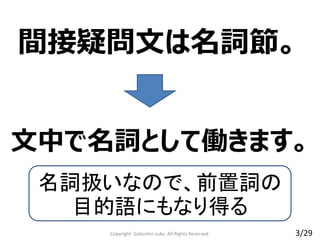
間接疑問文は名詞節。
2/29
間接疑問文は名詞節。
Copyright Gakushin-Juku All Rights Reserved.
文中で名詞として働きます。
名詞扱いなので、前置詞の
目的語にもなり得る
3/29
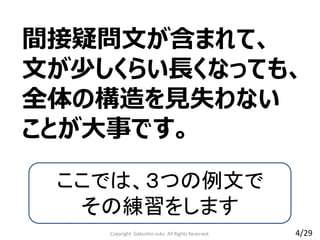
間接疑問文が含まれて、
文が少しくらい長くなっても、
全体の構造を見失わない
ことが大事です。
ここでは、3つの例文で
その練習をします
Copyright Gakushin-Juku All Rights Reserved. 4/29
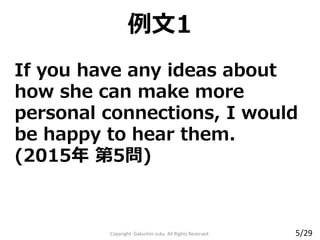
If you have any ideas about
how she can make more
personal connections, I would
be happy to hear them.
(2015年 第5問)
例文1
Copyright Gakushin-Juku All Rights Reserved. 5/29
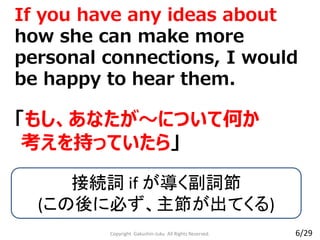
If you have any ideas about
how she can make more
personal connections, I would
be happy to hear them.
Copyright Gakushin-Juku All Rights Reserved.
「もし、あなたが~について何か
考えを持っていたら」
接続詞 if が導く副詞節
(この後に必ず、主節が出てくる)
6/29
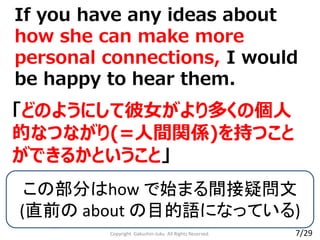
If you have any ideas about
how she can make more
personal connections, I would
be happy to hear them.
Copyright Gakushin-Juku All Rights Reserved.
「どのようにして彼女がより多くの個人
的なつながり(=人間関係)を持つこと
ができるかということ」
この部分はhow で始まる間接疑問文
(直前の about の目的語になっている)
7/29
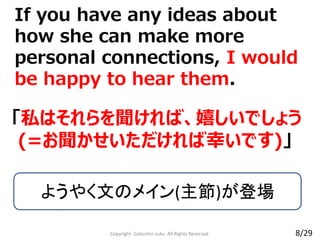
If you have any ideas about
how she can make more
personal connections, I would
be happy to hear them.
Copyright Gakushin-Juku All Rights Reserved.
「私はそれらを聞ければ、嬉しいでしょう
(=お聞かせいただければ幸いです)」
ようやく文のメイン(主節)が登場
8/29
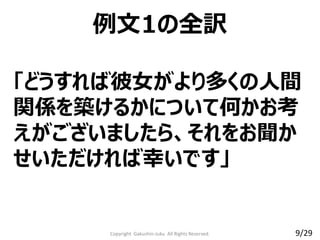
「どうすれば彼女がより多くの人間
関係を築けるかについて何かお考
えがございましたら、それをお聞か
せいただければ幸いです」
例文1の全訳
Copyright Gakushin-Juku All Rights Reserved. 9/29
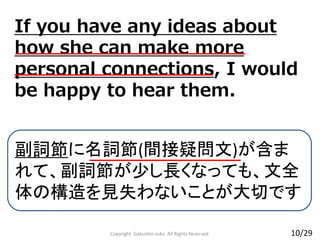
If you have any ideas about
how she can make more
personal connections, I would
be happy to hear them.
Copyright Gakushin-Juku All Rights Reserved.
副詞節に名詞節(間接疑問文)が含ま
れて、副詞節が少し長くなっても、文全
体の構造を見失わないことが大切です
10/29
Copyright Gakushin-Juku All Rights Reserved.
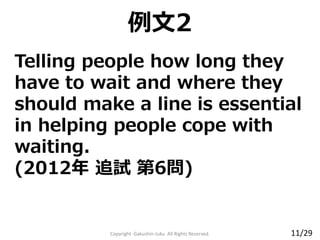
Telling people how long they
have to wait and where they
should make a line is essential
in helping people cope with
waiting.
(2012年 追試 第6問)
例文2
11/29
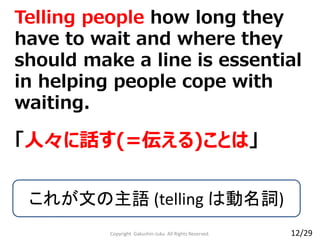
Copyright Gakushin-Juku All Rights Reserved.
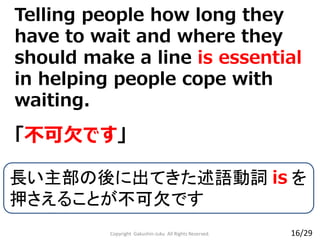
Telling people how long they
have to wait and where they
should make a line is essential
in helping people cope with
waiting.
「人々に話す(=伝える)ことは」
これが文の主語 (telling は動名詞)
12/29
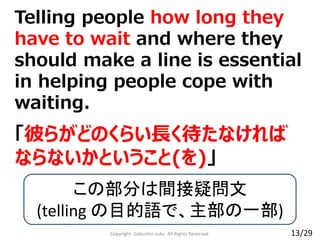
Copyright Gakushin-Juku All Rights Reserved.
Telling people how long they
have to wait and where they
should make a line is essential
in helping people cope with
waiting.
「彼らがどのくらい長く待たなければ
ならないかということ(を)」
この部分は間接疑問文
(telling の目的語で、主部の一部)
13/29
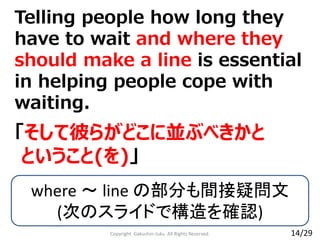
Copyright Gakushin-Juku All Rights Reserved.
Telling people how long they
have to wait and where they
should make a line is essential
in helping people cope with
waiting.
「そして彼らがどこに並ぶべきかと
ということ(を)」
where ~ line の部分も間接疑問文
(次のスライドで構造を確認)
14/29
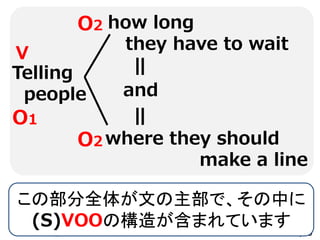
Copyright Gakushin-Juku All Rights Reserved.
Telling
people
how long
they have to wait
where they should
make a line
and
||
||
V
O1
O2
O2
15/29
この部分全体が文の主部で、その中に
(S)VOOの構造が含まれています
Copyright Gakushin-Juku All Rights Reserved.
Telling people how long they
have to wait and where they
should make a line is essential
in helping people cope with
waiting.
「不可欠です」
長い主部の後に出てきた述語動詞 is を
押さえることが不可欠です
16/29
Copyright Gakushin-Juku All Rights Reserved.
Telling people how long they
have to wait and where they
should make a line is essential
in helping people cope with
waiting.
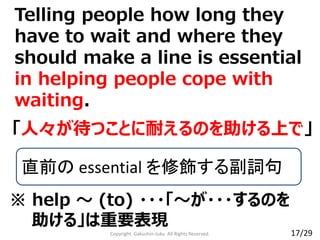
「人々が待つことに耐えるのを助ける上で」
直前の essential を修飾する副詞句
※ help ~ (to) ・・・「~が・・・するのを
助ける」は重要表現
17/29
Copyright Gakushin-Juku All Rights Reserved.
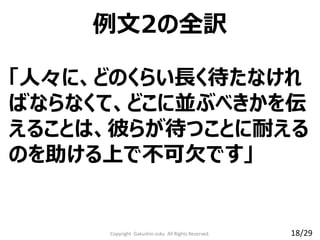
例文2の全訳
「人々に、どのくらい長く待たなけれ
ばならなくて、どこに並ぶべきかを伝
えることは、彼らが待つことに耐える
のを助ける上で不可欠です」
18/29
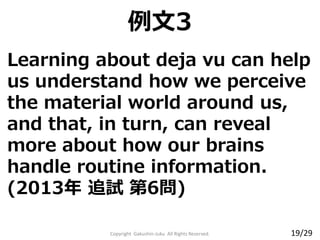
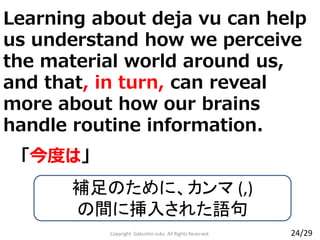
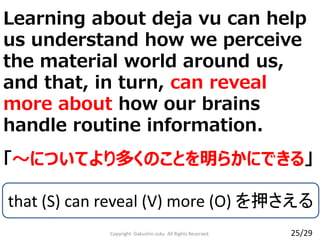
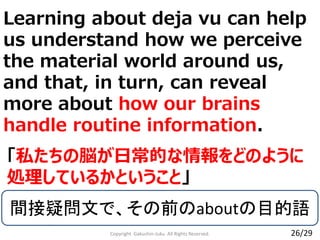
Learning about deja vu can help
us understand how we perceive
the material world around us,
and that, in turn, can reveal
more about how our brains
handle routine information.
(2013年 追試 第6問)
Copyright Gakushin-Juku All Rights Reserved.
例文3
19/29
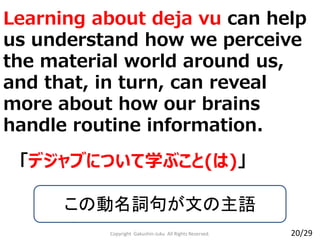
Learning about deja vu can help
us understand how we perceive
the material world around us,
and that, in turn, can reveal
more about how our brains
handle routine information.
Copyright Gakushin-Juku All Rights Reserved.
「デジャブについて学ぶこと(は)」
この動名詞句が文の主語
20/29
Learning about deja vu can help
us understand how we perceive
the material world around us,
and that, in turn, can reveal
more about how our brains
handle routine information.
Copyright Gakushin-Juku All Rights Reserved.
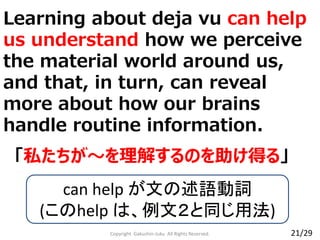
「私たちが~を理解するのを助け得る」
can help が文の述語動詞
(このhelp は、例文2と同じ用法)
21/29
Learning about deja vu can help
us understand how we perceive
the material world around us,
and that, in turn, can reveal
more about how our brains
handle routine information.
Copyright Gakushin-Juku All Rights Reserved.
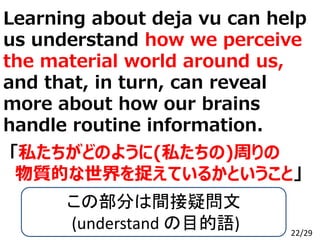
「私たちがどのように(私たちの)周りの
物質的な世界を捉えているかということ」
この部分は間接疑問文
(understand の目的語) 22/29
Learning about deja vu can help
us understand how we perceive
the material world around us,
and that, in turn, can reveal
more about how our brains
handle routine information.
Copyright Gakushin-Juku All Rights Reserved.
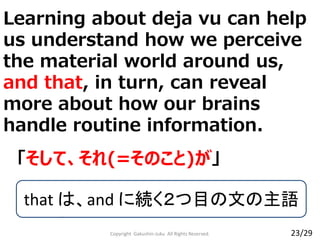
「そして、それ(=そのこと)が」
that は、and に続く2つ目の文の主語
23/29
Copyright Gakushin-Juku All Rights Reserved.
「今度は」
補足のために、カンマ (,)
の間に挿入された語句
24/29
Learning about deja vu can help
us understand how we perceive
the material world around us,
and that, in turn, can reveal
more about how our brains
handle routine information.
Copyright Gakushin-Juku All Rights Reserved.
「~についてより多くのことを明らかにできる」
25/29
that (S) can reveal (V) more (O) を押さえる
Learning about deja vu can help
us understand how we perceive
the material world around us,
and that, in turn, can reveal
more about how our brains
handle routine information.
Copyright Gakushin-Juku All Rights Reserved.
「私たちの脳が日常的な情報をどのように
処理しているかということ」
26/29
間接疑問文で、その前のaboutの目的語
Learning about deja vu can help
us understand how we perceive
the material world around us,
and that, in turn, can reveal
more about how our brains
handle routine information.
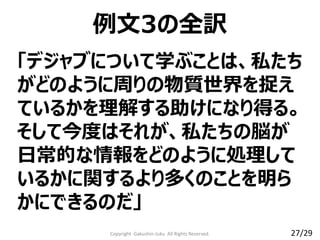
「デジャブについて学ぶことは、私たち
がどのように周りの物質世界を捉え
ているかを理解する助けになり得る。
そして今度はそれが、私たちの脳が
日常的な情報をどのように処理して
いるかに関するより多くのことを明ら
かにできるのだ」
Copyright Gakushin-Juku All Rights Reserved.
例文3の全訳
27/29
以上
Copyright Gakushin-Juku All Rights Reserved. 28/29
ありがとうございました。
Copyright Gakushin-Juku All Rights Reserved. 29/29

センター読解(間接疑問文)

  • 1.
  • 2.
    Copyright Gakushin-Juku AllRights Reserved. 間接疑問文は名詞節。 2/29
  • 3.
    間接疑問文は名詞節。 Copyright Gakushin-Juku AllRights Reserved. 文中で名詞として働きます。 名詞扱いなので、前置詞の 目的語にもなり得る 3/29
  • 4.
  • 5.
    If you haveany ideas about how she can make more personal connections, I would be happy to hear them. (2015年 第5問) 例文1 Copyright Gakushin-Juku All Rights Reserved. 5/29
  • 6.
    If you haveany ideas about how she can make more personal connections, I would be happy to hear them. Copyright Gakushin-Juku All Rights Reserved. 「もし、あなたが~について何か 考えを持っていたら」 接続詞 if が導く副詞節 (この後に必ず、主節が出てくる) 6/29
  • 7.
    If you haveany ideas about how she can make more personal connections, I would be happy to hear them. Copyright Gakushin-Juku All Rights Reserved. 「どのようにして彼女がより多くの個人 的なつながり(=人間関係)を持つこと ができるかということ」 この部分はhow で始まる間接疑問文 (直前の about の目的語になっている) 7/29
  • 8.
    If you haveany ideas about how she can make more personal connections, I would be happy to hear them. Copyright Gakushin-Juku All Rights Reserved. 「私はそれらを聞ければ、嬉しいでしょう (=お聞かせいただければ幸いです)」 ようやく文のメイン(主節)が登場 8/29
  • 9.
  • 10.
    If you haveany ideas about how she can make more personal connections, I would be happy to hear them. Copyright Gakushin-Juku All Rights Reserved. 副詞節に名詞節(間接疑問文)が含ま れて、副詞節が少し長くなっても、文全 体の構造を見失わないことが大切です 10/29
  • 11.
    Copyright Gakushin-Juku AllRights Reserved. Telling people how long they have to wait and where they should make a line is essential in helping people cope with waiting. (2012年 追試 第6問) 例文2 11/29
  • 12.
    Copyright Gakushin-Juku AllRights Reserved. Telling people how long they have to wait and where they should make a line is essential in helping people cope with waiting. 「人々に話す(=伝える)ことは」 これが文の主語 (telling は動名詞) 12/29
  • 13.
    Copyright Gakushin-Juku AllRights Reserved. Telling people how long they have to wait and where they should make a line is essential in helping people cope with waiting. 「彼らがどのくらい長く待たなければ ならないかということ(を)」 この部分は間接疑問文 (telling の目的語で、主部の一部) 13/29
  • 14.
    Copyright Gakushin-Juku AllRights Reserved. Telling people how long they have to wait and where they should make a line is essential in helping people cope with waiting. 「そして彼らがどこに並ぶべきかと ということ(を)」 where ~ line の部分も間接疑問文 (次のスライドで構造を確認) 14/29
  • 15.
    Copyright Gakushin-Juku AllRights Reserved. Telling people how long they have to wait where they should make a line and || || V O1 O2 O2 15/29 この部分全体が文の主部で、その中に (S)VOOの構造が含まれています
  • 16.
    Copyright Gakushin-Juku AllRights Reserved. Telling people how long they have to wait and where they should make a line is essential in helping people cope with waiting. 「不可欠です」 長い主部の後に出てきた述語動詞 is を 押さえることが不可欠です 16/29
  • 17.
    Copyright Gakushin-Juku AllRights Reserved. Telling people how long they have to wait and where they should make a line is essential in helping people cope with waiting. 「人々が待つことに耐えるのを助ける上で」 直前の essential を修飾する副詞句 ※ help ~ (to) ・・・「~が・・・するのを 助ける」は重要表現 17/29
  • 18.
    Copyright Gakushin-Juku AllRights Reserved. 例文2の全訳 「人々に、どのくらい長く待たなけれ ばならなくて、どこに並ぶべきかを伝 えることは、彼らが待つことに耐える のを助ける上で不可欠です」 18/29
  • 19.
    Learning about dejavu can help us understand how we perceive the material world around us, and that, in turn, can reveal more about how our brains handle routine information. (2013年 追試 第6問) Copyright Gakushin-Juku All Rights Reserved. 例文3 19/29
  • 20.
    Learning about dejavu can help us understand how we perceive the material world around us, and that, in turn, can reveal more about how our brains handle routine information. Copyright Gakushin-Juku All Rights Reserved. 「デジャブについて学ぶこと(は)」 この動名詞句が文の主語 20/29
  • 21.
    Learning about dejavu can help us understand how we perceive the material world around us, and that, in turn, can reveal more about how our brains handle routine information. Copyright Gakushin-Juku All Rights Reserved. 「私たちが~を理解するのを助け得る」 can help が文の述語動詞 (このhelp は、例文2と同じ用法) 21/29
  • 22.
    Learning about dejavu can help us understand how we perceive the material world around us, and that, in turn, can reveal more about how our brains handle routine information. Copyright Gakushin-Juku All Rights Reserved. 「私たちがどのように(私たちの)周りの 物質的な世界を捉えているかということ」 この部分は間接疑問文 (understand の目的語) 22/29
  • 23.
    Learning about dejavu can help us understand how we perceive the material world around us, and that, in turn, can reveal more about how our brains handle routine information. Copyright Gakushin-Juku All Rights Reserved. 「そして、それ(=そのこと)が」 that は、and に続く2つ目の文の主語 23/29
  • 24.
    Copyright Gakushin-Juku AllRights Reserved. 「今度は」 補足のために、カンマ (,) の間に挿入された語句 24/29 Learning about deja vu can help us understand how we perceive the material world around us, and that, in turn, can reveal more about how our brains handle routine information.
  • 25.
    Copyright Gakushin-Juku AllRights Reserved. 「~についてより多くのことを明らかにできる」 25/29 that (S) can reveal (V) more (O) を押さえる Learning about deja vu can help us understand how we perceive the material world around us, and that, in turn, can reveal more about how our brains handle routine information.
  • 26.
    Copyright Gakushin-Juku AllRights Reserved. 「私たちの脳が日常的な情報をどのように 処理しているかということ」 26/29 間接疑問文で、その前のaboutの目的語 Learning about deja vu can help us understand how we perceive the material world around us, and that, in turn, can reveal more about how our brains handle routine information.
  • 27.
  • 28.
    以上 Copyright Gakushin-Juku AllRights Reserved. 28/29
  • 29.