副詞節
重要度 難易度
★★★★☆ ★★☆☆☆
Copyright Gakushin-Juku All Rights Reserved. 1/32
副詞節は
従属節の1つ
Copyright Gakushin-Juku All Rights Reserved. 2/32
主節と副詞節のメリハリを
意識して読んでください。
Copyright Gakushin-Juku All Rights Reserved.
例文は4つです
3/32
Although she had attended
schools in Japan before we went
to Chicago, it‘s Anna’s first year
at a Japanese junior high school.
(2015年 第5問)
例文1
Copyright Gakushin-Juku All Rights Reserved. 4/32
Although she had attended
schools in Japan before we went
to Chicago, it‘s Anna’s first year
at a Japanese junior high school.
Copyright Gakushin-Juku All Rights Reserved.
「彼女は日本の学校に通っていた
けれども」
接続詞 although が導く副詞節
(この後に必ず、主節が出てきます)
5/32
Although she had attended
schools in Japan before we went
to Chicago, it‘s Anna’s first year
at a Japanese junior high school.
Copyright Gakushin-Juku All Rights Reserved.
「私たちがシカゴに行った前に」
接続詞 before が導く副詞節 (ここまでの
構造を次のスライドで確認して下さい)
6/32
Although she had attended
schools in Japan before we went
to Chicago, it‘s Anna’s first year
at a Japanese junior high school.
Copyright Gakushin-Juku All Rights Reserved.
【確認】althoughで始まる副詞節の中に、
beforeで始まる副詞節が含まれている
7/32
Although she had attended
schools in Japan before we went
to Chicago, it’s Anna’s first year
at a Japanese junior high school.
Copyright Gakushin-Juku All Rights Reserved.
「今はアンナの最初の年です」
副詞節が終わって、文の主節が登場
※この it は現在の状況を漠然と表す用法
8/32
Although she had attended
schools in Japan before we went
to Chicago, it’s Anna’s first year
at a Japanese junior high school.
Copyright Gakushin-Juku All Rights Reserved.
「日本の中学校での」
前の Anna’s first year を
修飾する前置詞句
9/32
「私たちがシカゴに行く前、彼女は
日本の学校に通っていましたが、
今はアンナにとって日本の中学校
での最初の年です」
例文1の全訳
Copyright Gakushin-Juku All Rights Reserved. 10/32
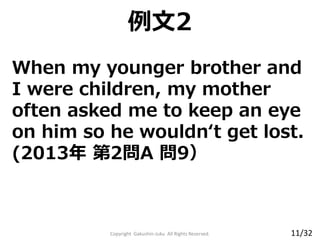
When my younger brother and
I were children, my mother
often asked me to keep an eye
on him so he wouldn‘t get lost.
(2013年 第2問A 問9)
Copyright Gakushin-Juku All Rights Reserved.
例文2
11/32
When my younger brother and
I were children, my mother
often asked me to keep an eye
on him so he wouldn‘t get lost.
Copyright Gakushin-Juku All Rights Reserved.
「私の弟と私が子供だった時」
接続詞 when で始まる副詞節
(この後、主節が出てくると予測しましょう)
12/32
When my younger brother and
I were children, my mother
often asked me to keep an eye
on him so he wouldn‘t get lost.
Copyright Gakushin-Juku All Rights Reserved.
「私の母はよく私に頼んだ」
予想通り、文の主節が登場
13/32
When my younger brother and
I were children, my mother
often asked me to keep an eye
on him so he wouldn‘t get lost.
Copyright Gakushin-Juku All Rights Reserved.
「彼(=弟)から目を離さないよう」
ask ~ to ・・・ 「~に・・・するよう頼む」
14/32
When my younger brother and
I were children, my mother
often asked me to keep an eye
on him so he wouldn‘t get lost.
Copyright Gakushin-Juku All Rights Reserved.
「彼が迷子にならないように」
so (that) S won't ~「Sが~しないように」
15/32
「弟と私が子供だった時、母はよく、
弟が迷子にならないよう、弟から
目を離さないでと私に頼んだ」
Copyright Gakushin-Juku All Rights Reserved.
例文2の全訳
16/32
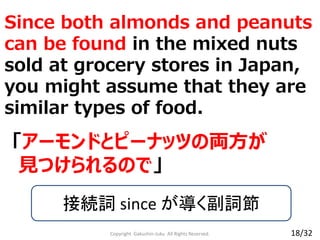
Since both almonds and peanuts
can be found in the mixed nuts
sold at grocery stores in Japan,
you might assume that they are
similar types of food.
(2012年 第3問C)
Copyright Gakushin-Juku All Rights Reserved.
例文3
17/32
Since both almonds and peanuts
can be found in the mixed nuts
sold at grocery stores in Japan,
you might assume that they are
similar types of food.
Copyright Gakushin-Juku All Rights Reserved.
「アーモンドとピーナッツの両方が
見つけられるので」
接続詞 since が導く副詞節
18/32
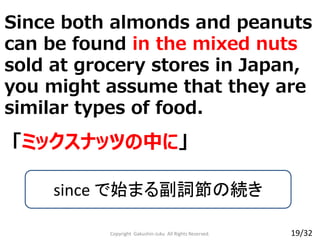
Since both almonds and peanuts
can be found in the mixed nuts
sold at grocery stores in Japan,
you might assume that they are
similar types of food.
Copyright Gakushin-Juku All Rights Reserved.
「ミックスナッツの中に」
since で始まる副詞節の続き
19/32
Since both almonds and peanuts
can be found in the mixed nuts
sold at grocery stores in Japan,
you might assume that they are
similar types of food.
Copyright Gakushin-Juku All Rights Reserved.
「日本の食料品店で売られている」
過去分詞による後置修飾
(直前の the mixed nuts を修飾)
20/32
Since both almonds and peanuts
can be found in the mixed nuts
sold at grocery stores in Japan,
you might assume that they are
similar types of food.
Copyright Gakushin-Juku All Rights Reserved.
「あなたは~と思い込んでいるかも
しれない」
ここでようやく主節がお出まし
21/32
Since both almonds and peanuts
can be found in the mixed nuts
sold at grocery stores in Japan,
you might assume that they are
similar types of food.
Copyright Gakushin-Juku All Rights Reserved.
「それらが似た種類の食品であると
いうこと」
この部分は assume の目的語のthat節
22/32
「アーモンドとピーナッツは両方とも、
日本の食料品店で売られているミッ
クスナッツの中にあるので、あなたは、
それらが似た種類の食品だと思い
込んでいるかもしれない」
Copyright Gakushin-Juku All Rights Reserved.
例文3の全訳
23/32
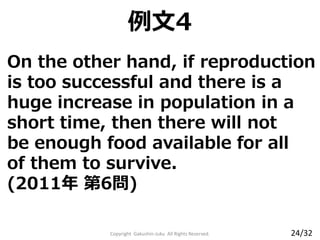
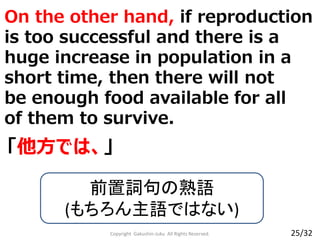
On the other hand, if reproduction
is too successful and there is a
huge increase in population in a
short time, then there will not
be enough food available for all
of them to survive.
(2011年 第6問)
Copyright Gakushin-Juku All Rights Reserved.
例文4
24/32
On the other hand, if reproduction
is too successful and there is a
huge increase in population in a
short time, then there will not
be enough food available for all
of them to survive.
Copyright Gakushin-Juku All Rights Reserved.
「他方では、」
前置詞句の熟語
(もちろん主語ではない)
25/32
On the other hand, if reproduction
is too successful and there is a
huge increase in population in a
short time, then there will not
be enough food available for all
of them to survive.
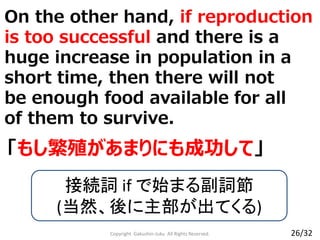
Copyright Gakushin-Juku All Rights Reserved.
「もし繁殖があまりにも成功して」
接続詞 if で始まる副詞節
(当然、後に主部が出てくる)
26/32
On the other hand, if reproduction
is too successful and there is a
huge increase in population in a
short time, then there will not
be enough food available for all
of them to survive.
Copyright Gakushin-Juku All Rights Reserved.
「そして、短期間に個体数における大幅
な増加がある(=個体数が大幅に増加
する)のなら、」
ここまでが if で始まる副詞節
27/32
On the other hand, if reproduction
is too successful and there is a
huge increase in population in a
short time, then there will not
be enough food available for all
of them to survive.
Copyright Gakushin-Juku All Rights Reserved.
「得られる十分な食料はないだろう
(=十分な食料は得られなくなるだろう)」
やっと文のメイン(主節)が登場
28/32
On the other hand, if reproduction
is too successful and there is a
huge increase in population in a
short time, then there will not
be enough food available for all
of them to survive.
Copyright Gakushin-Juku All Rights Reserved.
「彼らの全てが生存できるための」
to不定詞の形容詞用法
(for ~ は to不定詞の意味上の主語)
29/32
「一方、もし繁殖が成功しすぎて、
短期間に個体数が大幅に増加す
れば、彼らの全てが生存できるだ
けの十分な食料は得られなくなる
だろう」
Copyright Gakushin-Juku All Rights Reserved.
例文4の全訳
30/32
以上
Copyright Gakushin-Juku All Rights Reserved. 31/32
ありがとうございました。
Copyright Gakushin-Juku All Rights Reserved. 32/32

センター読解(副詞節)

  • 1.
  • 2.
  • 3.
  • 4.
    Although she hadattended schools in Japan before we went to Chicago, it‘s Anna’s first year at a Japanese junior high school. (2015年 第5問) 例文1 Copyright Gakushin-Juku All Rights Reserved. 4/32
  • 5.
    Although she hadattended schools in Japan before we went to Chicago, it‘s Anna’s first year at a Japanese junior high school. Copyright Gakushin-Juku All Rights Reserved. 「彼女は日本の学校に通っていた けれども」 接続詞 although が導く副詞節 (この後に必ず、主節が出てきます) 5/32
  • 6.
    Although she hadattended schools in Japan before we went to Chicago, it‘s Anna’s first year at a Japanese junior high school. Copyright Gakushin-Juku All Rights Reserved. 「私たちがシカゴに行った前に」 接続詞 before が導く副詞節 (ここまでの 構造を次のスライドで確認して下さい) 6/32
  • 7.
    Although she hadattended schools in Japan before we went to Chicago, it‘s Anna’s first year at a Japanese junior high school. Copyright Gakushin-Juku All Rights Reserved. 【確認】althoughで始まる副詞節の中に、 beforeで始まる副詞節が含まれている 7/32
  • 8.
    Although she hadattended schools in Japan before we went to Chicago, it’s Anna’s first year at a Japanese junior high school. Copyright Gakushin-Juku All Rights Reserved. 「今はアンナの最初の年です」 副詞節が終わって、文の主節が登場 ※この it は現在の状況を漠然と表す用法 8/32
  • 9.
    Although she hadattended schools in Japan before we went to Chicago, it’s Anna’s first year at a Japanese junior high school. Copyright Gakushin-Juku All Rights Reserved. 「日本の中学校での」 前の Anna’s first year を 修飾する前置詞句 9/32
  • 10.
  • 11.
    When my youngerbrother and I were children, my mother often asked me to keep an eye on him so he wouldn‘t get lost. (2013年 第2問A 問9) Copyright Gakushin-Juku All Rights Reserved. 例文2 11/32
  • 12.
    When my youngerbrother and I were children, my mother often asked me to keep an eye on him so he wouldn‘t get lost. Copyright Gakushin-Juku All Rights Reserved. 「私の弟と私が子供だった時」 接続詞 when で始まる副詞節 (この後、主節が出てくると予測しましょう) 12/32
  • 13.
    When my youngerbrother and I were children, my mother often asked me to keep an eye on him so he wouldn‘t get lost. Copyright Gakushin-Juku All Rights Reserved. 「私の母はよく私に頼んだ」 予想通り、文の主節が登場 13/32
  • 14.
    When my youngerbrother and I were children, my mother often asked me to keep an eye on him so he wouldn‘t get lost. Copyright Gakushin-Juku All Rights Reserved. 「彼(=弟)から目を離さないよう」 ask ~ to ・・・ 「~に・・・するよう頼む」 14/32
  • 15.
    When my youngerbrother and I were children, my mother often asked me to keep an eye on him so he wouldn‘t get lost. Copyright Gakushin-Juku All Rights Reserved. 「彼が迷子にならないように」 so (that) S won't ~「Sが~しないように」 15/32
  • 16.
  • 17.
    Since both almondsand peanuts can be found in the mixed nuts sold at grocery stores in Japan, you might assume that they are similar types of food. (2012年 第3問C) Copyright Gakushin-Juku All Rights Reserved. 例文3 17/32
  • 18.
    Since both almondsand peanuts can be found in the mixed nuts sold at grocery stores in Japan, you might assume that they are similar types of food. Copyright Gakushin-Juku All Rights Reserved. 「アーモンドとピーナッツの両方が 見つけられるので」 接続詞 since が導く副詞節 18/32
  • 19.
    Since both almondsand peanuts can be found in the mixed nuts sold at grocery stores in Japan, you might assume that they are similar types of food. Copyright Gakushin-Juku All Rights Reserved. 「ミックスナッツの中に」 since で始まる副詞節の続き 19/32
  • 20.
    Since both almondsand peanuts can be found in the mixed nuts sold at grocery stores in Japan, you might assume that they are similar types of food. Copyright Gakushin-Juku All Rights Reserved. 「日本の食料品店で売られている」 過去分詞による後置修飾 (直前の the mixed nuts を修飾) 20/32
  • 21.
    Since both almondsand peanuts can be found in the mixed nuts sold at grocery stores in Japan, you might assume that they are similar types of food. Copyright Gakushin-Juku All Rights Reserved. 「あなたは~と思い込んでいるかも しれない」 ここでようやく主節がお出まし 21/32
  • 22.
    Since both almondsand peanuts can be found in the mixed nuts sold at grocery stores in Japan, you might assume that they are similar types of food. Copyright Gakushin-Juku All Rights Reserved. 「それらが似た種類の食品であると いうこと」 この部分は assume の目的語のthat節 22/32
  • 23.
  • 24.
    On the otherhand, if reproduction is too successful and there is a huge increase in population in a short time, then there will not be enough food available for all of them to survive. (2011年 第6問) Copyright Gakushin-Juku All Rights Reserved. 例文4 24/32
  • 25.
    On the otherhand, if reproduction is too successful and there is a huge increase in population in a short time, then there will not be enough food available for all of them to survive. Copyright Gakushin-Juku All Rights Reserved. 「他方では、」 前置詞句の熟語 (もちろん主語ではない) 25/32
  • 26.
    On the otherhand, if reproduction is too successful and there is a huge increase in population in a short time, then there will not be enough food available for all of them to survive. Copyright Gakushin-Juku All Rights Reserved. 「もし繁殖があまりにも成功して」 接続詞 if で始まる副詞節 (当然、後に主部が出てくる) 26/32
  • 27.
    On the otherhand, if reproduction is too successful and there is a huge increase in population in a short time, then there will not be enough food available for all of them to survive. Copyright Gakushin-Juku All Rights Reserved. 「そして、短期間に個体数における大幅 な増加がある(=個体数が大幅に増加 する)のなら、」 ここまでが if で始まる副詞節 27/32
  • 28.
    On the otherhand, if reproduction is too successful and there is a huge increase in population in a short time, then there will not be enough food available for all of them to survive. Copyright Gakushin-Juku All Rights Reserved. 「得られる十分な食料はないだろう (=十分な食料は得られなくなるだろう)」 やっと文のメイン(主節)が登場 28/32
  • 29.
    On the otherhand, if reproduction is too successful and there is a huge increase in population in a short time, then there will not be enough food available for all of them to survive. Copyright Gakushin-Juku All Rights Reserved. 「彼らの全てが生存できるための」 to不定詞の形容詞用法 (for ~ は to不定詞の意味上の主語) 29/32
  • 30.
  • 31.
    以上 Copyright Gakushin-Juku AllRights Reserved. 31/32
  • 32.