HEALTH PLANING
Prepared by
Hawraz Faris Saadi
BSc. in Nursing
1
Planning
 The process of setting goals, developing strategies, outlining
tasks and timetables to achieving the goals.
 Planning is deciding in advance what to do, how to do and
who is to do it.
Planning bridges the gap between where we are to, where we
want to go. It makes possible things to occur which would not
otherwise occur.
2
Health Planning
“The orderly process of defining health problems, identifying
unmet needs and surveying the resources to meet them,
establishing priority goals that are realistic and feasible and
projecting administrative action, concerned not only with the
adequacy, efficacy and efficiency of health services but also
with those factors of ecology , social and individual behavior
that affect the health of the individual and the community”
WHO .
3
Elements of Health planning
1. Objectives (the thing to be attained)
2. Policies (guiding principles to be followed in the
achievement of the objective)
3. Programs (step by step sequence to be implemented)
4. Schedules (time framework in which the work is to be done)
5. Budget (the amount of money / resources put aside for the
plan)
4
1. Objective
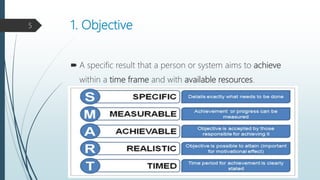
 A specific result that a person or system aims to achieve
within a time frame and with available resources.
5
2. Policies
 A policy is a deliberate system of principles to guide
decisions and achieve rational outcomes.
A. Distributive policies
B. Regulatory policies
C. Constituent policies
6
A. Distributive policies
 Distributive policies extend goods and services to members
of an organization, as well as distributing the costs of the
goods/services amongst the members of the organization.
 Example :government policies that impact spending
for welfare, public education, highways, and public safety,
7
B. Regulatory policies
 Regulatory policies, or mandates, limit the discretion of
individuals and agencies, or otherwise compel certain types
of behavior.
 These policies are generally thought to be best applied when
good behavior can be easily defined and bad behavior can
be easily regulated and punished through fines or sanctions.
8
C. Constituent policies
 Constituent policies create executive power entities, or deal
with laws. Constituent policies also deal with Fiscal Policy in
some circumstances
9
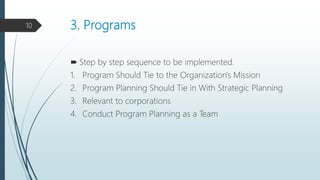
3. Programs
 Step by step sequence to be implemented.
1. Program Should Tie to the Organization's Mission
2. Program Planning Should Tie in With Strategic Planning
3. Relevant to corporations
4. Conduct Program Planning as a Team
10
4. Schedules
 Time framework in which the work is to be done
5. Budget
 The amount of money / resources put aside for the plan
11
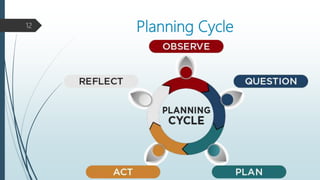
Planning Cycle12
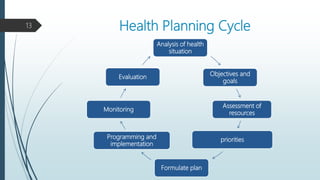
Health Planning Cycle13
Analysis of health
situation
Objectives and
goals
Assessment of
resources
priorities
Formulate plan
Programming and
implementation
Monitoring
Evaluation
1. Analysis of the health situation
1. Population
2. Statistics of morbidity and mortality
3. Epidemiology
4. Medical care facilities
5. Manpower (Human Resource)
6. Attitudes and beliefs
14
2. Establishment of objectives & goals
1. It should be set by a person having authority.
2. The goal should be SMART
3. It should be Specific, Measurable, Achievable, Relevant,
Time limited.
4. Should be Acceptability
15
3. Assessment of resources
1. Manpower(HR)
2. Money
3. Materials
4. Skills and knowledge
5. Technical needs
16
4. Fixing priorities
 The SWOT analysis helps to the better understanding of the
strategic alternatives and choices. It helps to ask, and answer,
the following questions of how do it:
1. Build on the strengths.
2. Shore up the weaknesses.
3. Capitalize on the opportunities.
4. Manage the threats.
17
4. Fixing priorities Cont.
Establish the priorities in the order of magnitude of
health problems.
Should be based on financial constraint, mortality and
morbidity data, diseases which can be prevented at low
cost politicaly and community interest.
18
5. Write formulated plans
1. The Plan should be complete in all aspect.
2. Detailed detecting input and output
3. Cost and time needed for each stage of implementation.
4. Contained working guidance for execution
5. Evaluation should be built in
19
6. Programming and implantation
1. Assign and fix responsibilities
2. Define roles and tasks
3. Selection, training, motivation and supervision
4. Organization and communication
5. Efficiency of health institutions
20
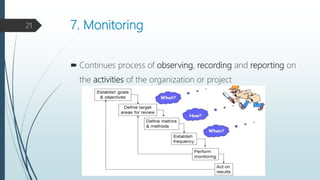
7. Monitoring
 Continues process of observing, recording and reporting on
the activities of the organization or project
21
8. Evaluation
 Measures the degree to which objectives and targets are
fulfilled and the quality of results obtained and we have
three types of Evaluation
1. Structure evaluation
2. Process evaluation
3. Outcome evaluation
22
23

Health planing

  • 1.
    HEALTH PLANING Prepared by HawrazFaris Saadi BSc. in Nursing 1
  • 2.
    Planning  The processof setting goals, developing strategies, outlining tasks and timetables to achieving the goals.  Planning is deciding in advance what to do, how to do and who is to do it. Planning bridges the gap between where we are to, where we want to go. It makes possible things to occur which would not otherwise occur. 2
  • 3.
    Health Planning “The orderlyprocess of defining health problems, identifying unmet needs and surveying the resources to meet them, establishing priority goals that are realistic and feasible and projecting administrative action, concerned not only with the adequacy, efficacy and efficiency of health services but also with those factors of ecology , social and individual behavior that affect the health of the individual and the community” WHO . 3
  • 4.
    Elements of Healthplanning 1. Objectives (the thing to be attained) 2. Policies (guiding principles to be followed in the achievement of the objective) 3. Programs (step by step sequence to be implemented) 4. Schedules (time framework in which the work is to be done) 5. Budget (the amount of money / resources put aside for the plan) 4
  • 5.
    1. Objective  Aspecific result that a person or system aims to achieve within a time frame and with available resources. 5
  • 6.
    2. Policies  Apolicy is a deliberate system of principles to guide decisions and achieve rational outcomes. A. Distributive policies B. Regulatory policies C. Constituent policies 6
  • 7.
    A. Distributive policies Distributive policies extend goods and services to members of an organization, as well as distributing the costs of the goods/services amongst the members of the organization.  Example :government policies that impact spending for welfare, public education, highways, and public safety, 7
  • 8.
    B. Regulatory policies Regulatory policies, or mandates, limit the discretion of individuals and agencies, or otherwise compel certain types of behavior.  These policies are generally thought to be best applied when good behavior can be easily defined and bad behavior can be easily regulated and punished through fines or sanctions. 8
  • 9.
    C. Constituent policies Constituent policies create executive power entities, or deal with laws. Constituent policies also deal with Fiscal Policy in some circumstances 9
  • 10.
    3. Programs  Stepby step sequence to be implemented. 1. Program Should Tie to the Organization's Mission 2. Program Planning Should Tie in With Strategic Planning 3. Relevant to corporations 4. Conduct Program Planning as a Team 10
  • 11.
    4. Schedules  Timeframework in which the work is to be done 5. Budget  The amount of money / resources put aside for the plan 11
  • 12.
  • 13.
    Health Planning Cycle13 Analysisof health situation Objectives and goals Assessment of resources priorities Formulate plan Programming and implementation Monitoring Evaluation
  • 14.
    1. Analysis ofthe health situation 1. Population 2. Statistics of morbidity and mortality 3. Epidemiology 4. Medical care facilities 5. Manpower (Human Resource) 6. Attitudes and beliefs 14
  • 15.
    2. Establishment ofobjectives & goals 1. It should be set by a person having authority. 2. The goal should be SMART 3. It should be Specific, Measurable, Achievable, Relevant, Time limited. 4. Should be Acceptability 15
  • 16.
    3. Assessment ofresources 1. Manpower(HR) 2. Money 3. Materials 4. Skills and knowledge 5. Technical needs 16
  • 17.
    4. Fixing priorities The SWOT analysis helps to the better understanding of the strategic alternatives and choices. It helps to ask, and answer, the following questions of how do it: 1. Build on the strengths. 2. Shore up the weaknesses. 3. Capitalize on the opportunities. 4. Manage the threats. 17
  • 18.
    4. Fixing prioritiesCont. Establish the priorities in the order of magnitude of health problems. Should be based on financial constraint, mortality and morbidity data, diseases which can be prevented at low cost politicaly and community interest. 18
  • 19.
    5. Write formulatedplans 1. The Plan should be complete in all aspect. 2. Detailed detecting input and output 3. Cost and time needed for each stage of implementation. 4. Contained working guidance for execution 5. Evaluation should be built in 19
  • 20.
    6. Programming andimplantation 1. Assign and fix responsibilities 2. Define roles and tasks 3. Selection, training, motivation and supervision 4. Organization and communication 5. Efficiency of health institutions 20
  • 21.
    7. Monitoring  Continuesprocess of observing, recording and reporting on the activities of the organization or project 21
  • 22.
    8. Evaluation  Measuresthe degree to which objectives and targets are fulfilled and the quality of results obtained and we have three types of Evaluation 1. Structure evaluation 2. Process evaluation 3. Outcome evaluation 22
  • 23.

Editor's Notes

  • #3 what to do how to do who is to do it
  • #4 Adequacy= قدرة Efficacy = فعالية efficiency = والكفاءة
  • #7 Theodore J. Lowi, famous American political scientist proposed four types of policy deliberate = متعمد
  • #10 تتعامل السياسات التأسيسية أيضًا مع السياسة المالية في بعض الظروف
  • #18 Shore = دعم Capitalize = الاستفادة
  • #19 Shore = دعم Capitalize = الاستفادة
  • #20 Execution = تنفيذ