HEALTH
PLANNING
AND
MANAGEMENT
DR MAMATA M NAIK
2nd MDS
PUBLIC HEALTH DENTISTRY
1. HEALTH PLANNING
2. PLANNING CYCLE
3. HEALTH MANAGEMENT
4. MANAGEMENT METHODS
5. HEALTH PLANNING IN INDIA
6. CONCLUSION
CONTENTS
INTRODUCTION
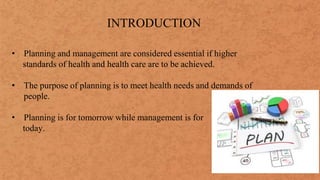
• Planning and management are considered essential if higher
standards of health and health care are to be achieved.
• The purpose of planning is to meet health needs and demands of
people.
• Planning is for tomorrow while management is for
today.
• The process of ….. setting goals, developing strategies and outlining
tasks and schedules to accomplish the goals.
• Planning is deciding in advance what to do, how to do and who is to
do it.
• It bridges - gap between where we are to, where we want to go.
• It makes possible things to occur which would not otherwise occur.
Purpose of planning :
 To match the limited resources with many problems.
 To eliminate wasteful expenditure or duplication of expenditure.
 To develop the best course of action to accomplish a defined
objective.
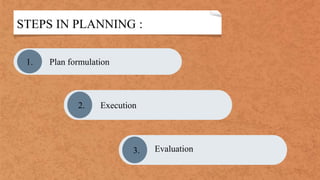
STEPS IN PLANNING :
Plan formulation
1.
Execution
2.
Evaluation
3.
HEALTH PLANNING
National Development Planning has been defined as “continuous,
systematic, coordinated, planning for the investment of the resources of a
country (men, money and materials) in programmes aimed at achieving the
most rapid economic and social development possible "
HEALTH PLANNING
National Health Planning has been defined as "the orderly process of
defining community health problems, identifying unmet needs and surveying
the resources to meet them, establishing priority goals that are realistic and
feasible and projecting administrative action to accomplish the purpose of the
proposed programme"
Rationale for Health Planning
• Delivery of effective health services to the population with in
resources provided
• Translation of “new policy” statement into operational plan
• Re-planning on the basis of an already existing plan for the purpose of
reviewing existing health problems and needs and rendering services more
effective and efficient
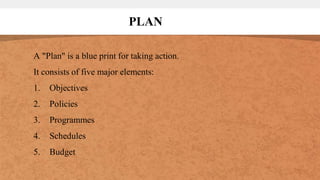
PLAN
A "Plan" is a blue print for taking action.
It consists of five major elements:
1. Objectives
2. Policies
3. Programmes
4. Schedules
5. Budget
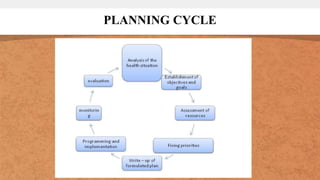
PLANNING CYCLE
1. Analysis of health situation:
 Collection, assessment and interpretation of information in such a way as to
provide a clear picture of the health situation.
 Essential requirements
a) Geographical distribution and epidemiology
b) Population statistics
c) Attitudes and beliefs
d) Statistics of morbidity and mortality
e) Manpower (HR)
f) Existing medical care facilities
g) Training facilities available
2. Establishment of objectives and goals:
 Objectives and goals are needed to guide efforts.
 Objectives must be established at all levels, down to the smallest
organizational unit.
 At upper levels - general; at successively lower levels – more specified
and detailed.
 Time and resources are important factors.
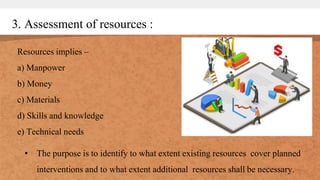
3. Assessment of resources :
Resources implies –
a) Manpower
b) Money
c) Materials
d) Skills and knowledge
e) Technical needs
• The purpose is to identify to what extent existing resources cover planned
interventions and to what extent additional resources shall be necessary.
4.Fixing priorities :
Attention is paid to:
 financial constraints
 mortality and morbidity data,
 diseases which can be prevented at low cost,
 saving the lives of younger people in whom there has
been considerable social investment.
5. Write - up formulated plans :
a) Detailed detecting of inputs and outputs
b) Contain working guidance for all those who are responsible for execution
c) Each stage of plan is defined ,costed – time required is calculated
d)Any modifications related to allocating resources – Govt or planning
committee.
6. Programming and implementation :
 Plan execution depends - existence of effective organization.
 The organizational structure - incorporate well-defined procedures to be
followed, fixation of responsibility - different workers for achieving -
predetermined objectives.
7. Monitoring :
It is the day-to-day follow-up of activities during - implementation to ensure
- proceeding as planned and are on schedule.
• Continuous process of observing, recording and reporting on the
activities of the organization or project
• Keeping track of activities
• Identifying deviations- taking correct actions.
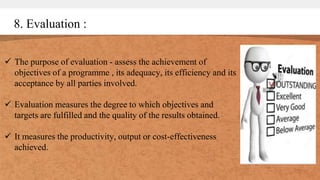
8. Evaluation :
 The purpose of evaluation - assess the achievement of
objectives of a programme , its adequacy, its efficiency and its
acceptance by all parties involved.
 Evaluation measures the degree to which objectives and
targets are fulfilled and the quality of the results obtained.
 It measures the productivity, output or cost-effectiveness
achieved.
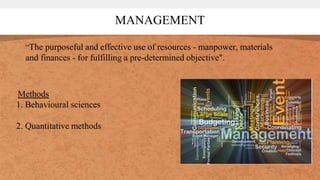
MANAGEMENT
“The purposeful and effective use of resources - manpower, materials
and finances - for fulfilling a pre-determined objective".
Methods
1. Behavioural sciences
2. Quantitative methods
MANAGEMENT
Consists of four basic activities :
(i) planning: determining what is to be done.
(ii) organizing: setting up the framework or apparatus and making it
possible for groups to do the work.
(iii) communicating: motivating people to do the work.
(iv) monitoring (controlling): checking to make sure the work is
progressing satisfactorily.
MANAGEMENT METHODS AND TECHNIQUES
Methods based on behavioral sciences :
• Organizational design
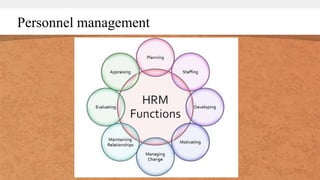
• Personnel management
• Communication
• Information systems
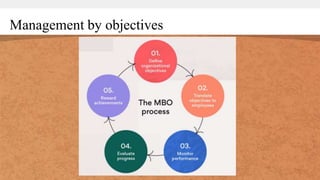
• Management by objectives
MANAGEMENT METHODS AND TECHNIQUES
Quantitative methods:
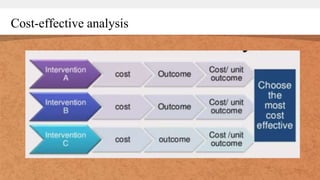
 Cost- benefit analysis
 Cost-effective analysis
 Cost- accounting
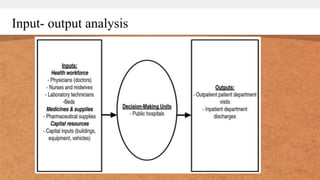
 Input- output analysis
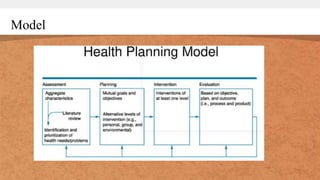
 Model
 Systems analysis
 Network analysis
 Planning- Programming- Budgeting
system (PPBS)
 Work Sampling
 Decision making
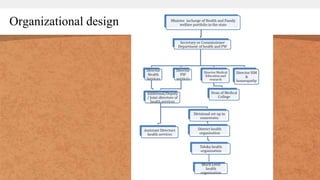
Organizational design :
 Poor organization results in waste of resources.
 As to meet the health needs and demands of the people.
 Design - reviewed every few years - changing concepts or purpose,
changing problems and changing technology.
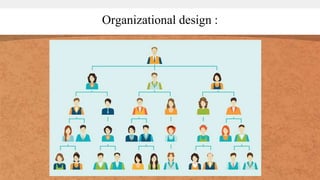
Organizational design :
Organizational design
Personnel management
Communication
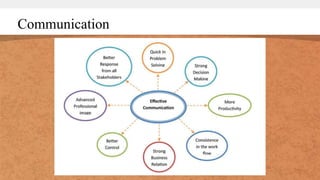
 Better communication contributes – effective functioning –
organisation
 Communication roadblocks exist at various levels.
 Communication barriers - delays in regular reporting and notification
in the compilation of statistics
in the release of supplies and salaries
in the institution of prompt remedial measures.
 To solve the communication problems – through proper channels.
Communication
Information systems
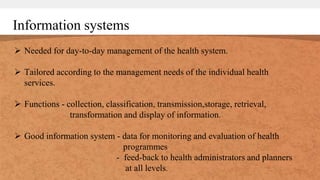
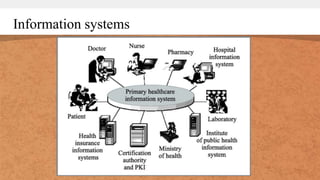
 Needed for day-to-day management of the health system.
 Tailored according to the management needs of the individual health
services.
 Functions - collection, classification, transmission,storage, retrieval,
transformation and display of information.
 Good information system - data for monitoring and evaluation of health
programmes
- feed-back to health administrators and planners
at all levels.
Information systems
Management by objectives
Quantitative methods
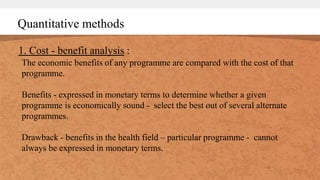
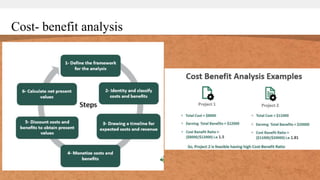
1. Cost - benefit analysis :
The economic benefits of any programme are compared with the cost of that
programme.
Benefits - expressed in monetary terms to determine whether a given
programme is economically sound - select the best out of several alternate
programmes.
Drawback - benefits in the health field – particular programme - cannot
always be expressed in monetary terms.
Cost- benefit analysis
Cost-effective analysis
Cost - accounting
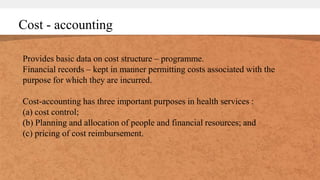
Provides basic data on cost structure – programme.
Financial records – kept in manner permitting costs associated with the
purpose for which they are incurred.
Cost-accounting has three important purposes in health services :
(a) cost control;
(b) Planning and allocation of people and financial resources; and
(c) pricing of cost reimbursement.
Input- output analysis
Model
Systems analysis
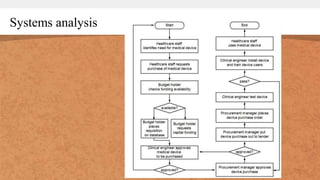
 Purpose of systems analysis - decision maker - course of action -
investigating his problem, searching out objectives, finding out alternative
solutions, evaluation of the alternatives in terms of cost-effectiveness, re-
examination of the objectives if necessary.
 Ex : hospital supply system, an information system, a total community health
service system.
Systems analysis
Network analysis
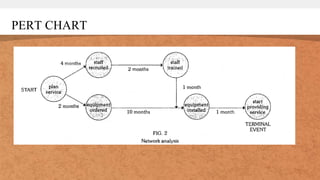
A network is a graphic plan of all events and activities to be completed in
order to reach an end objective.
It brings greater discipline in planning.
The two common types of network technique are
(a) PERT
(b) CPM
Network analysis
1) PERT (Programme Evaluation and Review Technique) :
• Is a management technique which makes possible more detailed planning
and more comprehensive supervision.
• The essence of PERT is to construct an Arrow Diagram.
• To calculate the time by which each activity must be completed, and to identify
those activities that are critical.
• All concerned in a project - know what is expected of them ,
• Minimise any delays or crises in the implementation of the plan.
PERT CHART
PERT (Programme Evaluation and Review Technique)
It aids in planning, scheduling and monitoring the project
It allows better communication between the various levels of management
It identifies potential problems
It furnishes continuous, timely progress reports
It forms a solid foundation upon which to build an evaluation and checking system
Network Analysis
CRITICAL PATH METHOD (CPM)
The longest path of the network is called "critical path".
If any activity along the critical path is delayed, the entire project will be delayed
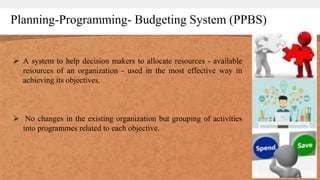
Planning-Programming- Budgeting System (PPBS)
 A system to help decision makers to allocate resources - available
resources of an organization - used in the most effective way in
achieving its objectives.
 No changes in the existing organization but grouping of activities
into programmes related to each objective.
Work Sampling
 It is systematic observation and recording of activities - carried out at
predetermined or random intervals.
 The major parameters - analysed - type of activities performed and the time
needed to do specified jobs.
 Permits judgements – current staff, job description and training.
 Helps in standardising the methods of performing jobs and determining the
manpower
Decision Making
 Decisions should not be made with incomplete data.
 In the health sector, decisions have to be made about development of
resources, optimum work load for medical and paramedical workers,
strategies for providing health care, etc.
Health planning in India
PLANNING COMMISSION
 Govt of India - set up in 1950 - assessment of the material, capital and
human resources of the country, and to draft developmental plans for
the most effective utilization of these resources.
 Over the years, the Planning Commission - formulating successive
Five Year Plans – through which it scrutinizes and analyzes various
schemes and projects
 Reviews from time to time the progress made in various directions and
recommends - Government - problems and policies needed for rapid
and balanced economic development
Health planning
Is an integral part of national socio-economic planning.
The guide-lines for national health planning - number of committees appointed -
Government of India from time to time to review the existing health situation and
recommend measures for further action.
The goal of national health planning in India was to attain Health for All by the year
2000.
Health committees
1. BHORE COMMITTEE -- (1946)
2. MUDALIAR COMMITTEE – (1962)
3. CHADAH COMMITTEE – (1963)
4. MUKHERJI COMMITTEE – (1965,1966)
5. JUNGALWALLA COMMITTEE – (1967)
6. KARTHAR SINGH COMMITTEE – (1973)
7. SHRIVASTAV COMMITTEE -- (1975)
8. RURAL HEALTH SCHEME – (1977)
9. HEALTH FOR ALL BY 2000 - REPORT OF THE
WORKING GROUP, 1981
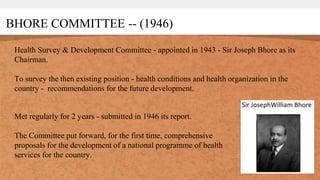
BHORE COMMITTEE -- (1946)
Health Survey & Development Committee - appointed in 1943 - Sir Joseph Bhore as its
Chairman.
To survey the then existing position - health conditions and health organization in the
country - recommendations for the future development.
Met regularly for 2 years - submitted in 1946 its report.
The Committee put forward, for the first time, comprehensive
proposals for the development of a national programme of health
services for the country.
BHORE COMMITTEE -- (1946)
Recommendations :
(1) Integration of preventive and
curative services at all
administrative levels;
(2) Development of primary health centres in 2 stages :
(a) Short-term measure
Each primary health centre in the rural areas –
population of 40,000.
2 medical officers, 4 public health nurses,
one nurse, 4 midwives, 4 trained dias
2 sanitary inspectors, 2 health assistants,1
pharmacist, and 15 other class IV employees
(b) Long-term programme (also called the 3 million
plan) :
primary health units - 75-bedded hospitals
-10,000 to 20,000 population
secondary units - 650-bedded hospitals,
district hospitals with 2,500 beds
(3) Major changes in medical
education - 3 month's training in
preventive and social medicine
to prepare "social physicians".
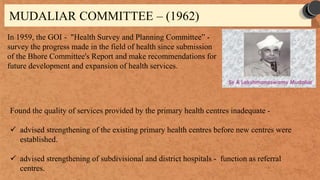
MUDALIAR COMMITTEE – (1962)
In 1959, the GOI - "Health Survey and Planning Committee” -
survey the progress made in the field of health since submission
of the Bhore Committee's Report and make recommendations for
future development and expansion of health services.
Found the quality of services provided by the primary health centres inadequate -
 advised strengthening of the existing primary health centres before new centres were
established.
 advised strengthening of subdivisional and district hospitals - function as referral
centres.
MUDALIAR COMMITTEE – (1962)
Recommendations :
(1) Consolidation of advances - first two five year plans
(2) Strengthening of the district hospital to serve as central base with specialist services
(3) Regional organizations in each state between the headquarters organization and
Regional DD or AD - each to supervise 2 or 3 district medical and health officers;
(4) Each PHC not to serve more than 40,000 population;
(5) To improve the quality of health care provided by the PHCs
(6) Integration of medical and health services as recommended by the Bhore Committee;
(7) Constitution of an All India Health Service on the pattern of Indian Administrative
Service.
CHADAH COMMITTEE – (1963)
 In 1963, Committee appointed - GOI - under the Chairmanship of Dr. M.S.
Chadah, the then Director General of health Services.
 To study the arrangements necessary for the maintenance phase of the National
Malaria Eradication Programme
Recommendations
 "vigilance” operations in respect of the NMEP should be the responsibility of the
general health services. i.e. primary health centres at the block level.
CHADAH COMMITTEE – (1963)
 Vigilance operations - monthly home visits - implemented through basic health
workers. One basic health worker per 10,000 population was recommended.
 “Multipurpose" workers - additional duties of collection of vital statistics and family
planning, in addition to malaria vigilance.
MUKHERJI COMMITTEE – (1965)
 Within couple of years - Chadah Committee's recommendations by some states - the basic
health workers - not function effectively as multipurpose workers.
 Malaria vigilance operations – suffered, family planning programme could not be carried
out satisfactorily.
 "Mukerji Committee, 1965” - Shri Mukerji, the then Secretary of Health to the
Government of India - review the strategy for the family planning programme.
Recommendations :
 Separate staff for the family planning programme.
 The family planning assistants - family planning duties only.
 The basic health workers - purposes other than family
planning.
 To delink the malaria activities from family planning.
MUKHERJI COMMITTEE – (1966)
Following 13th Meeting - Central Council of Health held at Bangalore in June, 1966 -
state finding it difficult to take burden of maintenance phase of malaria and other prog.
like small pox, leprosy, FP, trachoma .
These and related questions may be examined - committee of Health Secretaries -
Chairmanship of the Union Health Secretary, Shri Mukerji.
Recommendations:
• Basic Health Services to be provided at block level
• Strengthening required at higher level
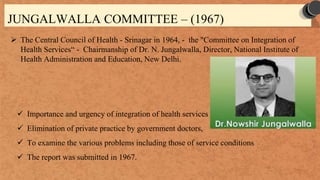
JUNGALWALLA COMMITTEE – (1967)
 The Central Council of Health - Srinagar in 1964, - the "Committee on Integration of
Health Services“ - Chairmanship of Dr. N. Jungalwalla, Director, National Institute of
Health Administration and Education, New Delhi.
 Importance and urgency of integration of health services
 Elimination of private practice by government doctors,
 To examine the various problems including those of service conditions
 The report was submitted in 1967.
JUNGALWALLA COMMITTEE – (1967)
Recommendations :
The main steps recommended towards integration were:
• Unified cadre ,Common seniority
• Recognition of extra qualifications
• Equal pay for equal work
• Special pay for specialized work
• No private practice, and good service conditions
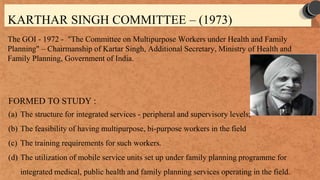
KARTHAR SINGH COMMITTEE – (1973)
The GOI - 1972 - "The Committee on Multipurpose Workers under Health and Family
Planning" – Chairmanship of Kartar Singh, Additional Secretary, Ministry of Health and
Family Planning, Government of India.
FORMED TO STUDY :
(a) The structure for integrated services - peripheral and supervisory levels;
(b) The feasibility of having multipurpose, bi-purpose workers in the field
(c) The training requirements for such workers.
(d) The utilization of mobile service units set up under family planning programme for
integrated medical, public health and family planning services operating in the field.
KARTHAR SINGH COMMITTEE – (1973)
Recommendations :-
 ANMs to be replaced - newly designated "Female Health Workers",
 Basic Health Workers, Malaria Surveillance Workers, Vaccinators, the family planning
health assistants - designated as male health workers.
 For proper coverage - one PHC for population of 50,000.
 Each PHC - divided into 16 sub centres - population of 3000 to 3500 - topography and
means of communications
 Each sub centre - team of one male and one female health worker
 The doctor in charge of a PHC - overall charge of all the supervisors and health workers
in his area.
SHRIVASTAV COMMITTEE - (1975)
GOI - November 1974 - 'Group on Medical Education and Support Manpower' popularly
known as - Shrivastav Committee
(1) Suitable curriculum for training - health assistants - serve as a link between - medical
practitioners and the multipurpose workers - forming an effective team - deliver health
care, family welfare and nutritional services
(2) Steps for improving - existing medical educational processes.
SHRIVASTAV COMMITTEE - (1975)
Recommendations :
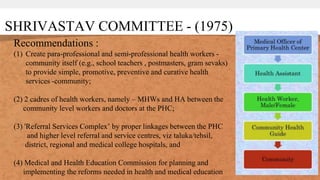
(1) Create para-professional and semi-professional health workers -
community itself (e.g., school teachers , postmasters, gram sevaks)
to provide simple, promotive, preventive and curative health
services -community;
(2) 2 cadres of health workers, namely – MHWs and HA between the
community level workers and doctors at the PHC;
(3) 'Referral Services Complex’ by proper linkages between the PHC
and higher level referral and service centres, viz taluka/tehsil,
district, regional and medical college hospitals, and
(4) Medical and Health Education Commission for planning and
implementing the reforms needed in health and medical education
RURAL HEALTH SCHEME – (1977)
The basic recommendations – Shrivastav Committee - accepted by the Government in
1977, which led to the launching of the Rural Health Scheme.
• Primary health care should be provided - community through Specially trained worker
- health of the people is placed in hand of people themselves.
• Reorientation Training of multipurpose workers engaged in communicable disease
program.
• Involvement of Medical colleges in the selected PHC - re-orienting medical education
to the need of rural people.
HEALTH FOR ALL BY 2000 AD - REPORT OF THE
WORKING GROUP, 1981
A working group on Health - Planning Commission in 1980 with the Secretary, Ministry of
Health and Family Welfare, as its Chairman.
 To identify, in programme terms, the goal for Health for All by 2000 AD and to
outline the specific programmes for the sixth Five Year Plan.
 Had also evolved fairly specific indices and targets to be achieved in the country by
2000 AD.
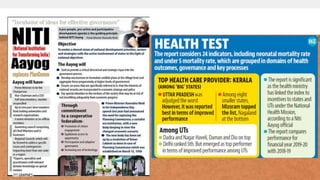
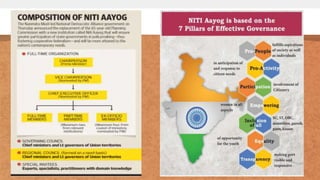
NITI AAYOG
A plan can play a vital role in helping to avoid mistakes or recognize
hidden opportunities.
Planning helps in forecasting the future, making the future visible to some
extent
Health planning improves health care delivery systems.
Properly designed health systems have a strong preventive component
which can detect possible illnesses through a combination of action and
advice.
CONCLUSION
REFERENCES :
 Park’s Textbook of preventive and social Medicine – 25th edition
 Jong A, editor. Community dental health. Mosby; 1993.
 National Programme of India, J. Kishore
 Ministry of health, Govt of India
HEALTH PLANNING.pptx

HEALTH PLANNING.pptx

  • 1.
    HEALTH PLANNING AND MANAGEMENT DR MAMATA MNAIK 2nd MDS PUBLIC HEALTH DENTISTRY
  • 2.
    1. HEALTH PLANNING 2.PLANNING CYCLE 3. HEALTH MANAGEMENT 4. MANAGEMENT METHODS 5. HEALTH PLANNING IN INDIA 6. CONCLUSION CONTENTS
  • 3.
    INTRODUCTION • Planning andmanagement are considered essential if higher standards of health and health care are to be achieved. • The purpose of planning is to meet health needs and demands of people. • Planning is for tomorrow while management is for today.
  • 4.
    • The processof ….. setting goals, developing strategies and outlining tasks and schedules to accomplish the goals. • Planning is deciding in advance what to do, how to do and who is to do it. • It bridges - gap between where we are to, where we want to go. • It makes possible things to occur which would not otherwise occur.
  • 5.
    Purpose of planning:  To match the limited resources with many problems.  To eliminate wasteful expenditure or duplication of expenditure.  To develop the best course of action to accomplish a defined objective.
  • 6.
    STEPS IN PLANNING: Plan formulation 1. Execution 2. Evaluation 3.
  • 7.
    HEALTH PLANNING National DevelopmentPlanning has been defined as “continuous, systematic, coordinated, planning for the investment of the resources of a country (men, money and materials) in programmes aimed at achieving the most rapid economic and social development possible "
  • 8.
    HEALTH PLANNING National HealthPlanning has been defined as "the orderly process of defining community health problems, identifying unmet needs and surveying the resources to meet them, establishing priority goals that are realistic and feasible and projecting administrative action to accomplish the purpose of the proposed programme"
  • 9.
    Rationale for HealthPlanning • Delivery of effective health services to the population with in resources provided • Translation of “new policy” statement into operational plan • Re-planning on the basis of an already existing plan for the purpose of reviewing existing health problems and needs and rendering services more effective and efficient
  • 10.
    PLAN A "Plan" isa blue print for taking action. It consists of five major elements: 1. Objectives 2. Policies 3. Programmes 4. Schedules 5. Budget
  • 11.
  • 12.
    1. Analysis ofhealth situation:  Collection, assessment and interpretation of information in such a way as to provide a clear picture of the health situation.  Essential requirements a) Geographical distribution and epidemiology b) Population statistics c) Attitudes and beliefs d) Statistics of morbidity and mortality e) Manpower (HR) f) Existing medical care facilities g) Training facilities available
  • 13.
    2. Establishment ofobjectives and goals:  Objectives and goals are needed to guide efforts.  Objectives must be established at all levels, down to the smallest organizational unit.  At upper levels - general; at successively lower levels – more specified and detailed.  Time and resources are important factors.
  • 14.
    3. Assessment ofresources : Resources implies – a) Manpower b) Money c) Materials d) Skills and knowledge e) Technical needs • The purpose is to identify to what extent existing resources cover planned interventions and to what extent additional resources shall be necessary.
  • 15.
    4.Fixing priorities : Attentionis paid to:  financial constraints  mortality and morbidity data,  diseases which can be prevented at low cost,  saving the lives of younger people in whom there has been considerable social investment.
  • 16.
    5. Write -up formulated plans : a) Detailed detecting of inputs and outputs b) Contain working guidance for all those who are responsible for execution c) Each stage of plan is defined ,costed – time required is calculated d)Any modifications related to allocating resources – Govt or planning committee.
  • 17.
    6. Programming andimplementation :  Plan execution depends - existence of effective organization.  The organizational structure - incorporate well-defined procedures to be followed, fixation of responsibility - different workers for achieving - predetermined objectives.
  • 18.
    7. Monitoring : Itis the day-to-day follow-up of activities during - implementation to ensure - proceeding as planned and are on schedule. • Continuous process of observing, recording and reporting on the activities of the organization or project • Keeping track of activities • Identifying deviations- taking correct actions.
  • 19.
    8. Evaluation : The purpose of evaluation - assess the achievement of objectives of a programme , its adequacy, its efficiency and its acceptance by all parties involved.  Evaluation measures the degree to which objectives and targets are fulfilled and the quality of the results obtained.  It measures the productivity, output or cost-effectiveness achieved.
  • 20.
    MANAGEMENT “The purposeful andeffective use of resources - manpower, materials and finances - for fulfilling a pre-determined objective". Methods 1. Behavioural sciences 2. Quantitative methods
  • 21.
    MANAGEMENT Consists of fourbasic activities : (i) planning: determining what is to be done. (ii) organizing: setting up the framework or apparatus and making it possible for groups to do the work. (iii) communicating: motivating people to do the work. (iv) monitoring (controlling): checking to make sure the work is progressing satisfactorily.
  • 22.
    MANAGEMENT METHODS ANDTECHNIQUES Methods based on behavioral sciences : • Organizational design • Personnel management • Communication • Information systems • Management by objectives
  • 23.
    MANAGEMENT METHODS ANDTECHNIQUES Quantitative methods:  Cost- benefit analysis  Cost-effective analysis  Cost- accounting  Input- output analysis  Model  Systems analysis  Network analysis  Planning- Programming- Budgeting system (PPBS)  Work Sampling  Decision making
  • 24.
    Organizational design : Poor organization results in waste of resources.  As to meet the health needs and demands of the people.  Design - reviewed every few years - changing concepts or purpose, changing problems and changing technology.
  • 25.
  • 26.
  • 27.
  • 28.
    Communication  Better communicationcontributes – effective functioning – organisation  Communication roadblocks exist at various levels.  Communication barriers - delays in regular reporting and notification in the compilation of statistics in the release of supplies and salaries in the institution of prompt remedial measures.  To solve the communication problems – through proper channels.
  • 29.
  • 30.
    Information systems  Neededfor day-to-day management of the health system.  Tailored according to the management needs of the individual health services.  Functions - collection, classification, transmission,storage, retrieval, transformation and display of information.  Good information system - data for monitoring and evaluation of health programmes - feed-back to health administrators and planners at all levels.
  • 31.
  • 32.
  • 33.
    Quantitative methods 1. Cost- benefit analysis : The economic benefits of any programme are compared with the cost of that programme. Benefits - expressed in monetary terms to determine whether a given programme is economically sound - select the best out of several alternate programmes. Drawback - benefits in the health field – particular programme - cannot always be expressed in monetary terms.
  • 34.
  • 35.
  • 36.
    Cost - accounting Providesbasic data on cost structure – programme. Financial records – kept in manner permitting costs associated with the purpose for which they are incurred. Cost-accounting has three important purposes in health services : (a) cost control; (b) Planning and allocation of people and financial resources; and (c) pricing of cost reimbursement.
  • 37.
  • 38.
  • 39.
    Systems analysis  Purposeof systems analysis - decision maker - course of action - investigating his problem, searching out objectives, finding out alternative solutions, evaluation of the alternatives in terms of cost-effectiveness, re- examination of the objectives if necessary.  Ex : hospital supply system, an information system, a total community health service system.
  • 40.
  • 41.
    Network analysis A networkis a graphic plan of all events and activities to be completed in order to reach an end objective. It brings greater discipline in planning. The two common types of network technique are (a) PERT (b) CPM
  • 42.
    Network analysis 1) PERT(Programme Evaluation and Review Technique) : • Is a management technique which makes possible more detailed planning and more comprehensive supervision. • The essence of PERT is to construct an Arrow Diagram. • To calculate the time by which each activity must be completed, and to identify those activities that are critical. • All concerned in a project - know what is expected of them , • Minimise any delays or crises in the implementation of the plan.
  • 43.
  • 44.
    PERT (Programme Evaluationand Review Technique) It aids in planning, scheduling and monitoring the project It allows better communication between the various levels of management It identifies potential problems It furnishes continuous, timely progress reports It forms a solid foundation upon which to build an evaluation and checking system
  • 45.
    Network Analysis CRITICAL PATHMETHOD (CPM) The longest path of the network is called "critical path". If any activity along the critical path is delayed, the entire project will be delayed
  • 46.
    Planning-Programming- Budgeting System(PPBS)  A system to help decision makers to allocate resources - available resources of an organization - used in the most effective way in achieving its objectives.  No changes in the existing organization but grouping of activities into programmes related to each objective.
  • 47.
    Work Sampling  Itis systematic observation and recording of activities - carried out at predetermined or random intervals.  The major parameters - analysed - type of activities performed and the time needed to do specified jobs.  Permits judgements – current staff, job description and training.  Helps in standardising the methods of performing jobs and determining the manpower
  • 48.
    Decision Making  Decisionsshould not be made with incomplete data.  In the health sector, decisions have to be made about development of resources, optimum work load for medical and paramedical workers, strategies for providing health care, etc.
  • 49.
  • 50.
    PLANNING COMMISSION  Govtof India - set up in 1950 - assessment of the material, capital and human resources of the country, and to draft developmental plans for the most effective utilization of these resources.  Over the years, the Planning Commission - formulating successive Five Year Plans – through which it scrutinizes and analyzes various schemes and projects  Reviews from time to time the progress made in various directions and recommends - Government - problems and policies needed for rapid and balanced economic development
  • 51.
    Health planning Is anintegral part of national socio-economic planning. The guide-lines for national health planning - number of committees appointed - Government of India from time to time to review the existing health situation and recommend measures for further action. The goal of national health planning in India was to attain Health for All by the year 2000.
  • 52.
    Health committees 1. BHORECOMMITTEE -- (1946) 2. MUDALIAR COMMITTEE – (1962) 3. CHADAH COMMITTEE – (1963) 4. MUKHERJI COMMITTEE – (1965,1966) 5. JUNGALWALLA COMMITTEE – (1967) 6. KARTHAR SINGH COMMITTEE – (1973) 7. SHRIVASTAV COMMITTEE -- (1975) 8. RURAL HEALTH SCHEME – (1977) 9. HEALTH FOR ALL BY 2000 - REPORT OF THE WORKING GROUP, 1981
  • 53.
    BHORE COMMITTEE --(1946) Health Survey & Development Committee - appointed in 1943 - Sir Joseph Bhore as its Chairman. To survey the then existing position - health conditions and health organization in the country - recommendations for the future development. Met regularly for 2 years - submitted in 1946 its report. The Committee put forward, for the first time, comprehensive proposals for the development of a national programme of health services for the country.
  • 54.
    BHORE COMMITTEE --(1946) Recommendations : (1) Integration of preventive and curative services at all administrative levels; (2) Development of primary health centres in 2 stages : (a) Short-term measure Each primary health centre in the rural areas – population of 40,000. 2 medical officers, 4 public health nurses, one nurse, 4 midwives, 4 trained dias 2 sanitary inspectors, 2 health assistants,1 pharmacist, and 15 other class IV employees (b) Long-term programme (also called the 3 million plan) : primary health units - 75-bedded hospitals -10,000 to 20,000 population secondary units - 650-bedded hospitals, district hospitals with 2,500 beds (3) Major changes in medical education - 3 month's training in preventive and social medicine to prepare "social physicians".
  • 55.
    MUDALIAR COMMITTEE –(1962) In 1959, the GOI - "Health Survey and Planning Committee” - survey the progress made in the field of health since submission of the Bhore Committee's Report and make recommendations for future development and expansion of health services. Found the quality of services provided by the primary health centres inadequate -  advised strengthening of the existing primary health centres before new centres were established.  advised strengthening of subdivisional and district hospitals - function as referral centres.
  • 56.
    MUDALIAR COMMITTEE –(1962) Recommendations : (1) Consolidation of advances - first two five year plans (2) Strengthening of the district hospital to serve as central base with specialist services (3) Regional organizations in each state between the headquarters organization and Regional DD or AD - each to supervise 2 or 3 district medical and health officers; (4) Each PHC not to serve more than 40,000 population; (5) To improve the quality of health care provided by the PHCs (6) Integration of medical and health services as recommended by the Bhore Committee; (7) Constitution of an All India Health Service on the pattern of Indian Administrative Service.
  • 57.
    CHADAH COMMITTEE –(1963)  In 1963, Committee appointed - GOI - under the Chairmanship of Dr. M.S. Chadah, the then Director General of health Services.  To study the arrangements necessary for the maintenance phase of the National Malaria Eradication Programme
  • 58.
    Recommendations  "vigilance” operationsin respect of the NMEP should be the responsibility of the general health services. i.e. primary health centres at the block level. CHADAH COMMITTEE – (1963)  Vigilance operations - monthly home visits - implemented through basic health workers. One basic health worker per 10,000 population was recommended.  “Multipurpose" workers - additional duties of collection of vital statistics and family planning, in addition to malaria vigilance.
  • 59.
    MUKHERJI COMMITTEE –(1965)  Within couple of years - Chadah Committee's recommendations by some states - the basic health workers - not function effectively as multipurpose workers.  Malaria vigilance operations – suffered, family planning programme could not be carried out satisfactorily.  "Mukerji Committee, 1965” - Shri Mukerji, the then Secretary of Health to the Government of India - review the strategy for the family planning programme. Recommendations :  Separate staff for the family planning programme.  The family planning assistants - family planning duties only.  The basic health workers - purposes other than family planning.  To delink the malaria activities from family planning.
  • 60.
    MUKHERJI COMMITTEE –(1966) Following 13th Meeting - Central Council of Health held at Bangalore in June, 1966 - state finding it difficult to take burden of maintenance phase of malaria and other prog. like small pox, leprosy, FP, trachoma . These and related questions may be examined - committee of Health Secretaries - Chairmanship of the Union Health Secretary, Shri Mukerji. Recommendations: • Basic Health Services to be provided at block level • Strengthening required at higher level
  • 61.
    JUNGALWALLA COMMITTEE –(1967)  The Central Council of Health - Srinagar in 1964, - the "Committee on Integration of Health Services“ - Chairmanship of Dr. N. Jungalwalla, Director, National Institute of Health Administration and Education, New Delhi.  Importance and urgency of integration of health services  Elimination of private practice by government doctors,  To examine the various problems including those of service conditions  The report was submitted in 1967.
  • 62.
    JUNGALWALLA COMMITTEE –(1967) Recommendations : The main steps recommended towards integration were: • Unified cadre ,Common seniority • Recognition of extra qualifications • Equal pay for equal work • Special pay for specialized work • No private practice, and good service conditions
  • 63.
    KARTHAR SINGH COMMITTEE– (1973) The GOI - 1972 - "The Committee on Multipurpose Workers under Health and Family Planning" – Chairmanship of Kartar Singh, Additional Secretary, Ministry of Health and Family Planning, Government of India. FORMED TO STUDY : (a) The structure for integrated services - peripheral and supervisory levels; (b) The feasibility of having multipurpose, bi-purpose workers in the field (c) The training requirements for such workers. (d) The utilization of mobile service units set up under family planning programme for integrated medical, public health and family planning services operating in the field.
  • 64.
    KARTHAR SINGH COMMITTEE– (1973) Recommendations :-  ANMs to be replaced - newly designated "Female Health Workers",  Basic Health Workers, Malaria Surveillance Workers, Vaccinators, the family planning health assistants - designated as male health workers.  For proper coverage - one PHC for population of 50,000.  Each PHC - divided into 16 sub centres - population of 3000 to 3500 - topography and means of communications  Each sub centre - team of one male and one female health worker  The doctor in charge of a PHC - overall charge of all the supervisors and health workers in his area.
  • 65.
    SHRIVASTAV COMMITTEE -(1975) GOI - November 1974 - 'Group on Medical Education and Support Manpower' popularly known as - Shrivastav Committee (1) Suitable curriculum for training - health assistants - serve as a link between - medical practitioners and the multipurpose workers - forming an effective team - deliver health care, family welfare and nutritional services (2) Steps for improving - existing medical educational processes.
  • 66.
    SHRIVASTAV COMMITTEE -(1975) Recommendations : (1) Create para-professional and semi-professional health workers - community itself (e.g., school teachers , postmasters, gram sevaks) to provide simple, promotive, preventive and curative health services -community; (2) 2 cadres of health workers, namely – MHWs and HA between the community level workers and doctors at the PHC; (3) 'Referral Services Complex’ by proper linkages between the PHC and higher level referral and service centres, viz taluka/tehsil, district, regional and medical college hospitals, and (4) Medical and Health Education Commission for planning and implementing the reforms needed in health and medical education
  • 67.
    RURAL HEALTH SCHEME– (1977) The basic recommendations – Shrivastav Committee - accepted by the Government in 1977, which led to the launching of the Rural Health Scheme. • Primary health care should be provided - community through Specially trained worker - health of the people is placed in hand of people themselves. • Reorientation Training of multipurpose workers engaged in communicable disease program. • Involvement of Medical colleges in the selected PHC - re-orienting medical education to the need of rural people.
  • 68.
    HEALTH FOR ALLBY 2000 AD - REPORT OF THE WORKING GROUP, 1981 A working group on Health - Planning Commission in 1980 with the Secretary, Ministry of Health and Family Welfare, as its Chairman.  To identify, in programme terms, the goal for Health for All by 2000 AD and to outline the specific programmes for the sixth Five Year Plan.  Had also evolved fairly specific indices and targets to be achieved in the country by 2000 AD.
  • 69.
  • 72.
    A plan canplay a vital role in helping to avoid mistakes or recognize hidden opportunities. Planning helps in forecasting the future, making the future visible to some extent Health planning improves health care delivery systems. Properly designed health systems have a strong preventive component which can detect possible illnesses through a combination of action and advice. CONCLUSION
  • 73.
    REFERENCES :  Park’sTextbook of preventive and social Medicine – 25th edition  Jong A, editor. Community dental health. Mosby; 1993.  National Programme of India, J. Kishore  Ministry of health, Govt of India

Editor's Notes

  • #47 Basic concept of management.gives abstract about the reality It tells us how the factors in a system affect one another