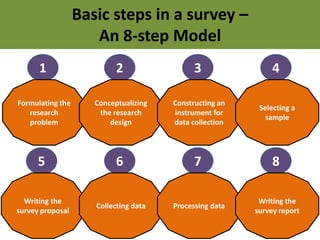
Basic steps in a survey – 
An 8-step Model 
1 
Formulating the 
research 
problem 
2 
Conceptualizing 
the research 
design 
3 
Constructing an 
instrument for 
data collection 
4 
Selecting a 
sample 
5 
Writing the 
survey proposal 
6 
Collecting data 
7 
Processing data 
8 
Writing the 
survey report
2 
Conceptualizing 
the research 
design
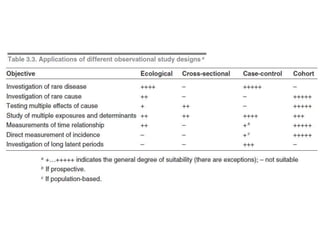
Observational Studies 
• A DESCRIPTIVE STUDY is limited to a 
description of the occurrence of a disease in a 
population and is often the first step in an 
epidemiological investigation. 
• An ANALYTICAL STUDY goes further by 
analyzing relationship between health status 
and other variables.
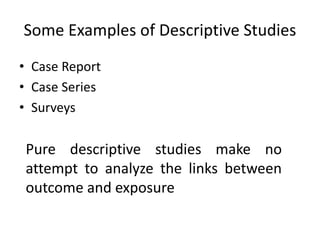
Some Examples of Descriptive Studies 
• Case Report 
• Case Series 
• Surveys 
Pure descriptive studies make no 
attempt to analyze the links between 
outcome and exposure
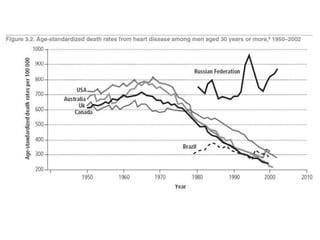
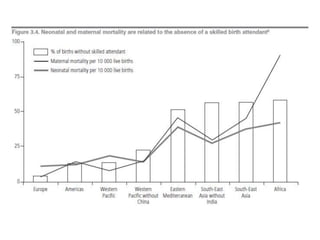
Ecological Studies 
• In an ecological study, the units of analysis are 
groups of people rather than individuals.
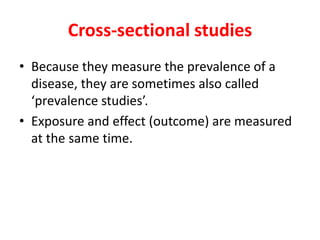
Cross-sectional studies 
• Because they measure the prevalence of a 
disease, they are sometimes also called 
‘prevalence studies’. 
• Exposure and effect (outcome) are measured 
at the same time.
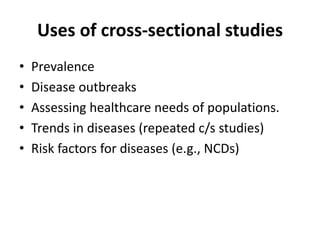
Uses of cross-sectional studies 
• Prevalence 
• Disease outbreaks 
• Assessing healthcare needs of populations. 
• Trends in diseases (repeated c/s studies) 
• Risk factors for diseases (e.g., NCDs)
Advantages and Disadvantages 
• Easy and relatively inexpensive 
• Less time consuming 
• The temporal relationship between exposure 
and effect is difficult to establish.
CASE-CONTROL STUDIES
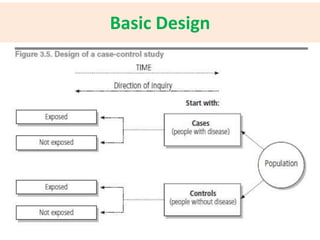
Key Features 
• The exposure experience of a group of people 
who have the disease [CASES] is compared to 
the exposure experience of a similar 
(matched) group who do not have the disease 
[CONTROLS] 
• Suitable for rare diseases or diseases with long 
latency periods 
• The study proceeds backwards from “EFFECT 
to CAUSE’
Basic Design
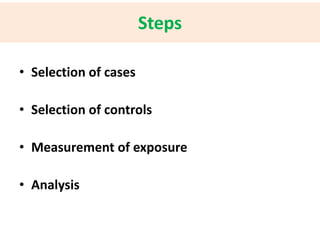
• Selection of cases 
• Selection of controls 
• Measurement of exposure 
• Analysis 
Steps
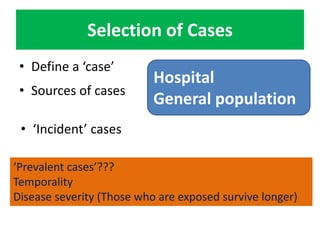
Selection of Cases 
• Define a ‘case’ 
Hospital 
General population 
• Sources of cases 
• ‘Incident’ cases 
‘Prevalent cases’??? 
Temporality 
Disease severity (Those who are exposed survive longer)
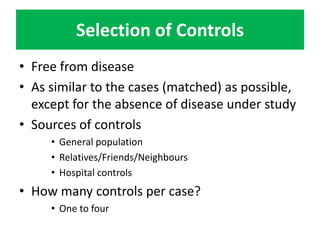
Selection of Controls 
• Free from disease 
• As similar to the cases (matched) as possible, 
except for the absence of disease under study 
• Sources of controls 
• General population 
• Relatives/Friends/Neighbours 
• Hospital controls 
• How many controls per case? 
• One to four
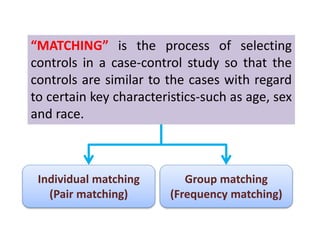
“MATCHING” is the process of selecting 
controls in a case-control study so that the 
controls are similar to the cases with regard 
to certain key characteristics-such as age, sex 
and race. 
Group matching 
(Frequency matching) 
Individual matching 
(Pair matching)
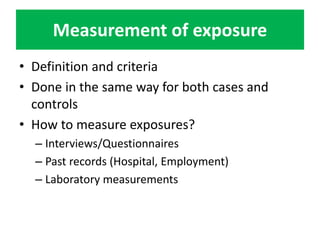
Measurement of exposure 
• Definition and criteria 
• Done in the same way for both cases and 
controls 
• How to measure exposures? 
– Interviews/Questionnaires 
– Past records (Hospital, Employment) 
– Laboratory measurements
Analysis 
• Find exposure rate in cases 
• Find exposure rate in controls 
• Calculate “Odds Ratio”
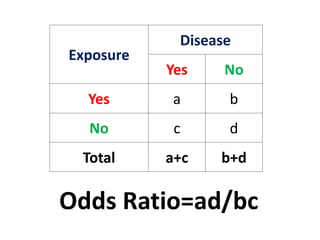
Exposure 
Disease 
Yes No 
Yes a b 
No c d 
Total a+c b+d 
Odds Ratio=ad/bc
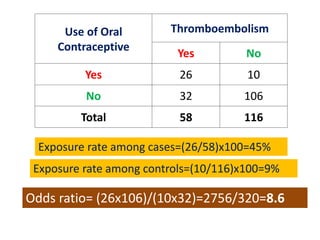
Use of Oral 
Contraceptive 
Thromboembolism 
Yes No 
Yes 26 10 
No 32 106 
Total 58 116 
Exposure rate among cases=(26/58)x100=45% 
Exposure rate among controls=(10/116)x100=9% 
Odds ratio= (26x106)/(10x32)=2756/320=8.6
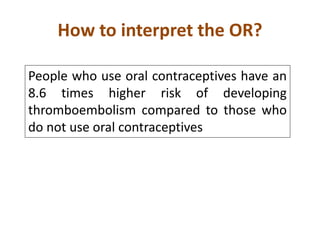
How to interpret the OR? 
People who use oral contraceptives have an 
8.6 times higher risk of developing 
thromboembolism compared to those who 
do not use oral contraceptives
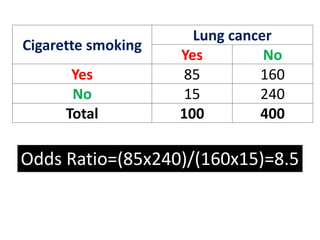
Cigarette smoking 
Lung cancer 
Yes No 
Yes 85 160 
No 15 240 
Total 100 400 
Odds Ratio=(85x240)/(160x15)=8.5
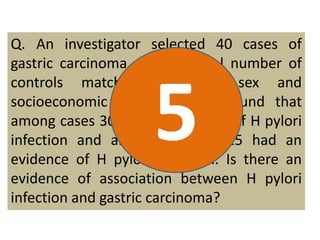
Q. An investigator selected 40 cases of 
gastric carcinoma and an equal number of 
controls matched for age, sex and 
socioeconomic status. It was found that 
among cases 30 had an 5 
evidence of H pylori 
infection and among controls 15 had an 
evidence of H pylori infection. Is there an 
evidence of association between H pylori 
infection and gastric carcinoma?
COHORT STUDIES
Key Features 
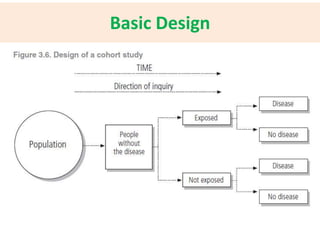
• The study proceeds from “CAUSE to EFFECT” 
• At the start of the study, all participants are 
free from disease. 
• A group of people who are ‘exposed’ to some 
factor and another ‘not-exposed’ group are 
followed up for a certain time. The disease 
rate (incidence of disease) among ‘exposed’ is 
compared to the disease rate among the ‘not-exposed’ 
group.
Basic Design
• Selection of study subjects 
• Obtaining data on exposure 
• Follow-up 
• Analysis 
Steps
Selection of Study Subjects 
• General population 
• Special groups 
– Occupation group 
– Professional group 
• Radiologists 
• Nurses 
• Doctors 
• Teachers, etc. 
Free from study 
disease
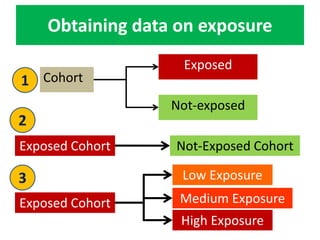
Obtaining data on exposure 
Cohort 
Exposed 
Not-exposed 
1 
2 
Exposed Cohort Not-Exposed Cohort 
3 Low Exposure 
Exposed Cohort 
Medium Exposure 
High Exposure
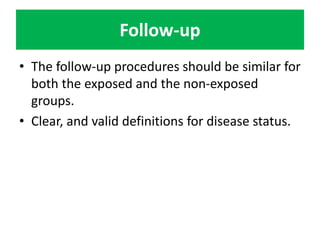
Follow-up 
• The follow-up procedures should be similar for 
both the exposed and the non-exposed 
groups. 
• Clear, and valid definitions for disease status.
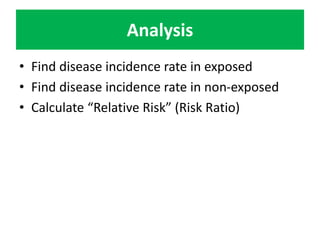
Analysis 
• Find disease incidence rate in exposed 
• Find disease incidence rate in non-exposed 
• Calculate “Relative Risk” (Risk Ratio)
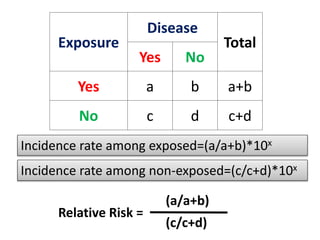
Exposure 
Disease 
Total 
Yes No 
Yes a b a+b 
No c d c+d 
Incidence rate among exposed=(a/a+b)*10x 
Incidence rate among non-exposed=(c/c+d)*10x 
Relative Risk = 
(a/a+b) 
(c/c+d)
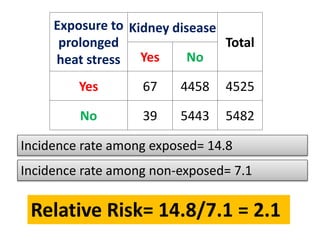
Exposure to 
prolonged 
heat stress 
Kidney disease 
Total 
Yes No 
Yes 67 4458 4525 
No 39 5443 5482 
Incidence rate among exposed= 14.8 
Incidence rate among non-exposed= 7.1 
Relative Risk= 14.8/7.1 = 2.1
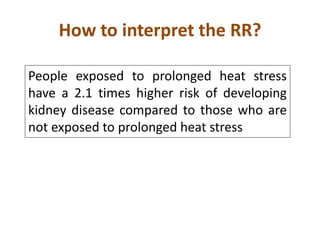
How to interpret the RR? 
People exposed to prolonged heat stress 
have a 2.1 times higher risk of developing 
kidney disease compared to those who are 
not exposed to prolonged heat stress
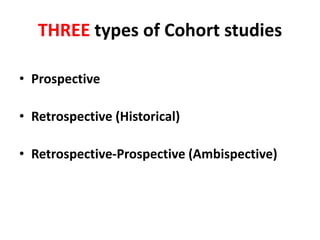
THREE types of Cohort studies 
• Prospective 
• Retrospective (Historical) 
• Retrospective-Prospective (Ambispective)
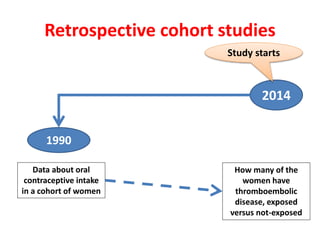
Retrospective cohort studies 
Study starts 
2014 
1990 
Data about oral 
contraceptive intake 
in a cohort of women 
How many of the 
women have 
thromboembolic 
disease, exposed 
versus not-exposed
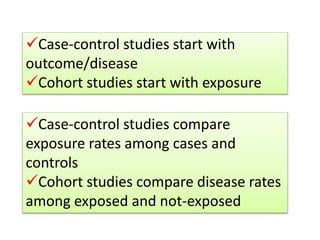
Case-control studies start with 
outcome/disease 
Cohort studies start with exposure 
Case-control studies compare 
exposure rates among cases and 
controls 
Cohort studies compare disease rates 
among exposed and not-exposed
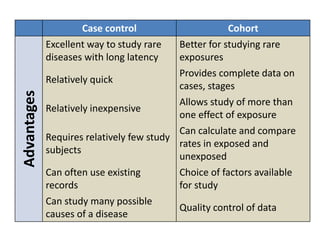
Case control Cohort 
Advantages 
Excellent way to study rare 
diseases with long latency 
Better for studying rare 
exposures 
Relatively quick 
Provides complete data on 
cases, stages 
Relatively inexpensive 
Allows study of more than 
one effect of exposure 
Requires relatively few study 
subjects 
Can calculate and compare 
rates in exposed and 
unexposed 
Can often use existing 
records 
Choice of factors available 
for study 
Can study many possible 
causes of a disease 
Quality control of data
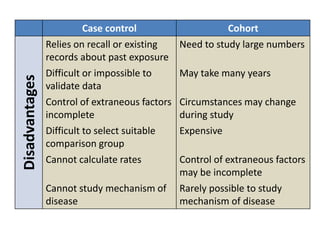
Case control Cohort 
Disadvantages 
Relies on recall or existing 
records about past exposure 
Need to study large numbers 
Difficult or impossible to 
validate data 
May take many years 
Control of extraneous factors 
incomplete 
Circumstances may change 
during study 
Difficult to select suitable 
comparison group 
Expensive 
Cannot calculate rates Control of extraneous factors 
may be incomplete 
Cannot study mechanism of 
disease 
Rarely possible to study 
mechanism of disease
Experimental epidemiology
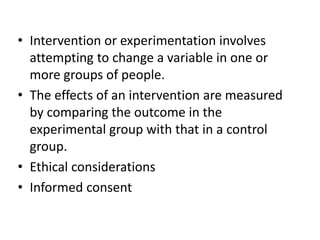
• Intervention or experimentation involves 
attempting to change a variable in one or 
more groups of people. 
• The effects of an intervention are measured 
by comparing the outcome in the 
experimental group with that in a control 
group. 
• Ethical considerations 
• Informed consent
RANDOMIZED CONTROLLED TRIALS
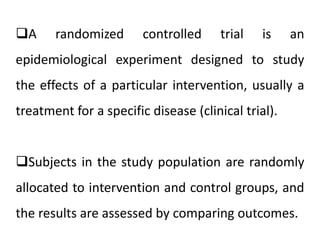
A randomized controlled trial is an 
epidemiological experiment designed to study 
the effects of a particular intervention, usually a 
treatment for a specific disease (clinical trial). 
Subjects in the study population are randomly 
allocated to intervention and control groups, and 
the results are assessed by comparing outcomes.
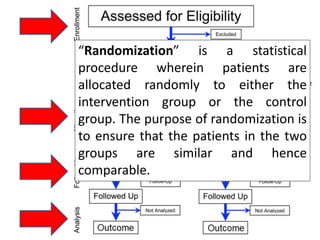
“Randomization” is a statistical 
procedure wherein patients are 
allocated randomly to either the 
intervention group or the control 
group. The purpose of randomization is 
to ensure that the patients in the two 
groups are similar and hence 
comparable.
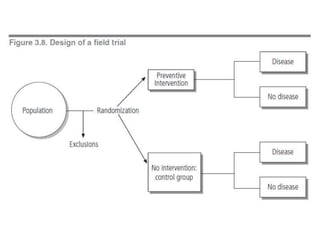
FIELD TRIALS
Field trials, in contrast to clinical trials, 
involve people who are healthy. 
Data collection takes place “in the field,” 
usually among people in the general 
population
COMMUNITY TRIALS
Treatment groups are communities, 
rather than individuals. 
This is particularly appropriate for 
diseases that are influenced by social 
conditions, and for which prevention 
efforts target group behavior.
ERRORS 
IN 
EPIDEMIOLOGICAL STUDIES
RANDOM ERROR 
SYSTEMATIC ERROR
RANDOM ERROR 
• When a value of the sample 
measurement diverges-due to chance 
alone-from that of the true population 
value. 
• Random error is “random”; therefore 
cannot be predicted.
• THREE major sources of random error 
– Individual biological variation 
– Sampling error 
• Increase the size of the sample 
– Measurement error 
• Stringent protocols 
• Systematic quality control measures
SYSTEMATIC ERROR 
• Also called “BIAS” 
• Systematic deviation of results or 
inferences from truth. 
• Bias is defined as ‘any systematic error in 
the design, conduct or analysis of a study 
that results in a mistaken estimate of an 
exposures effect on the risk of disease’.
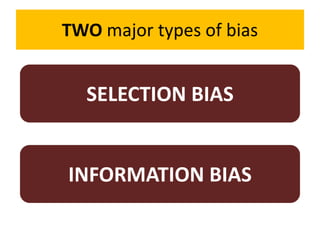
TWO major types of bias 
SELECTION BIAS 
INFORMATION BIAS
SELECTION BIAS 
• A systematic difference between the 
characteristics of the people selected for a 
study and the characteristics of those who are 
not. 
• Examples 
– Bias due to non-response 
– Exclusion bias 
– Berkson’s bias (Berksonian bias)
• Bias due to non-response 
– Those who volunteer to take part in a study are 
different from those who don’t 
• Exclusion bias 
– Different eligibility criteria for cases and controls 
•Berkson’s bias or Berksonian bias
• Berkson’s bias (Berksonian bias) 
–When both exposure and disease under 
study affect selection. This occurs when the 
combination of exposure and disease under 
study increases the chance of admission to 
hospital, leading to a higher exposure rate 
among hospital cases as compared to 
hospital controls. Thus it causes hospital 
cases and controls in a case-control study to 
be systematically different from one 
another.
INFORMATION BIAS 
• A flaw in measuring exposure or outcome 
variables that results in different accuracy of 
information between comparison groups. 
• This usually arises when the way of obtaining 
information about exposure or outcome is 
inadequate and hence may lead to incorrect 
information about exposure or outcome.
Examples of Information bias 
• Misclassification bias 
– Wrongly classify exposure or outcome 
• Recall bias 
– Differential recall about exposure among cases 
and controls. Case are more likely to remember 
exposure as compared to controls 
• Reporting bias 
– Cases may be reluctant to report exposure
• Surveillance bias 
– If exposed group is monitored more closely 
compared to the unexposed group 
• Interviewer bias 
– Knowledge about exposure status may consciously 
or subconsciously influence the interviewers 
measurements biased. Observer bias is a related 
bias. 
• Single-blinding 
• Double-blinding 
• Triple blinding
CONFOUNDING
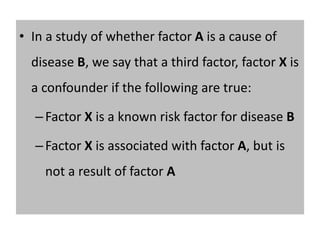
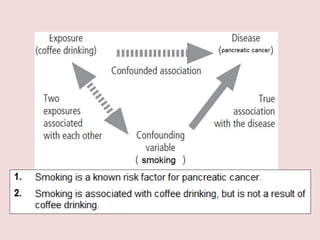
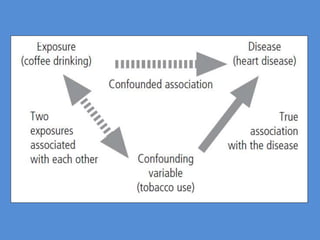
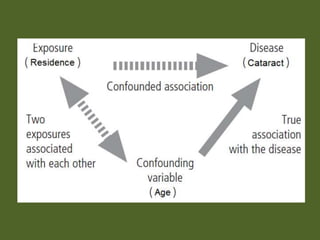
• In a study of whether factor A is a cause of 
disease B, we say that a third factor, factor X is 
a confounder if the following are true: 
– Factor X is a known risk factor for disease B 
– Factor X is associated with factor A, but is 
not a result of factor A
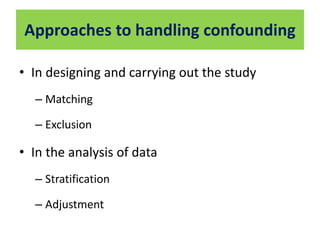
Approaches to handling confounding 
• In designing and carrying out the study 
– Matching 
– Exclusion 
• In the analysis of data 
– Stratification 
– Adjustment

Epidemiological Studies

  • 1.
    Basic steps ina survey – An 8-step Model 1 Formulating the research problem 2 Conceptualizing the research design 3 Constructing an instrument for data collection 4 Selecting a sample 5 Writing the survey proposal 6 Collecting data 7 Processing data 8 Writing the survey report
  • 2.
    2 Conceptualizing theresearch design
  • 4.
    Observational Studies •A DESCRIPTIVE STUDY is limited to a description of the occurrence of a disease in a population and is often the first step in an epidemiological investigation. • An ANALYTICAL STUDY goes further by analyzing relationship between health status and other variables.
  • 6.
    Some Examples ofDescriptive Studies • Case Report • Case Series • Surveys Pure descriptive studies make no attempt to analyze the links between outcome and exposure
  • 8.
    Ecological Studies •In an ecological study, the units of analysis are groups of people rather than individuals.
  • 11.
    Cross-sectional studies •Because they measure the prevalence of a disease, they are sometimes also called ‘prevalence studies’. • Exposure and effect (outcome) are measured at the same time.
  • 12.
    Uses of cross-sectionalstudies • Prevalence • Disease outbreaks • Assessing healthcare needs of populations. • Trends in diseases (repeated c/s studies) • Risk factors for diseases (e.g., NCDs)
  • 13.
    Advantages and Disadvantages • Easy and relatively inexpensive • Less time consuming • The temporal relationship between exposure and effect is difficult to establish.
  • 14.
  • 15.
    Key Features •The exposure experience of a group of people who have the disease [CASES] is compared to the exposure experience of a similar (matched) group who do not have the disease [CONTROLS] • Suitable for rare diseases or diseases with long latency periods • The study proceeds backwards from “EFFECT to CAUSE’
  • 16.
  • 17.
    • Selection ofcases • Selection of controls • Measurement of exposure • Analysis Steps
  • 18.
    Selection of Cases • Define a ‘case’ Hospital General population • Sources of cases • ‘Incident’ cases ‘Prevalent cases’??? Temporality Disease severity (Those who are exposed survive longer)
  • 19.
    Selection of Controls • Free from disease • As similar to the cases (matched) as possible, except for the absence of disease under study • Sources of controls • General population • Relatives/Friends/Neighbours • Hospital controls • How many controls per case? • One to four
  • 20.
    “MATCHING” is theprocess of selecting controls in a case-control study so that the controls are similar to the cases with regard to certain key characteristics-such as age, sex and race. Group matching (Frequency matching) Individual matching (Pair matching)
  • 21.
    Measurement of exposure • Definition and criteria • Done in the same way for both cases and controls • How to measure exposures? – Interviews/Questionnaires – Past records (Hospital, Employment) – Laboratory measurements
  • 22.
    Analysis • Findexposure rate in cases • Find exposure rate in controls • Calculate “Odds Ratio”
  • 23.
    Exposure Disease YesNo Yes a b No c d Total a+c b+d Odds Ratio=ad/bc
  • 24.
    Use of Oral Contraceptive Thromboembolism Yes No Yes 26 10 No 32 106 Total 58 116 Exposure rate among cases=(26/58)x100=45% Exposure rate among controls=(10/116)x100=9% Odds ratio= (26x106)/(10x32)=2756/320=8.6
  • 25.
    How to interpretthe OR? People who use oral contraceptives have an 8.6 times higher risk of developing thromboembolism compared to those who do not use oral contraceptives
  • 26.
    Cigarette smoking Lungcancer Yes No Yes 85 160 No 15 240 Total 100 400 Odds Ratio=(85x240)/(160x15)=8.5
  • 27.
    Q. An investigatorselected 40 cases of gastric carcinoma and an equal number of controls matched for age, sex and socioeconomic status. It was found that among cases 30 had an 5 evidence of H pylori infection and among controls 15 had an evidence of H pylori infection. Is there an evidence of association between H pylori infection and gastric carcinoma?
  • 29.
  • 30.
    Key Features •The study proceeds from “CAUSE to EFFECT” • At the start of the study, all participants are free from disease. • A group of people who are ‘exposed’ to some factor and another ‘not-exposed’ group are followed up for a certain time. The disease rate (incidence of disease) among ‘exposed’ is compared to the disease rate among the ‘not-exposed’ group.
  • 31.
  • 32.
    • Selection ofstudy subjects • Obtaining data on exposure • Follow-up • Analysis Steps
  • 33.
    Selection of StudySubjects • General population • Special groups – Occupation group – Professional group • Radiologists • Nurses • Doctors • Teachers, etc. Free from study disease
  • 34.
    Obtaining data onexposure Cohort Exposed Not-exposed 1 2 Exposed Cohort Not-Exposed Cohort 3 Low Exposure Exposed Cohort Medium Exposure High Exposure
  • 35.
    Follow-up • Thefollow-up procedures should be similar for both the exposed and the non-exposed groups. • Clear, and valid definitions for disease status.
  • 36.
    Analysis • Finddisease incidence rate in exposed • Find disease incidence rate in non-exposed • Calculate “Relative Risk” (Risk Ratio)
  • 37.
    Exposure Disease Total Yes No Yes a b a+b No c d c+d Incidence rate among exposed=(a/a+b)*10x Incidence rate among non-exposed=(c/c+d)*10x Relative Risk = (a/a+b) (c/c+d)
  • 38.
    Exposure to prolonged heat stress Kidney disease Total Yes No Yes 67 4458 4525 No 39 5443 5482 Incidence rate among exposed= 14.8 Incidence rate among non-exposed= 7.1 Relative Risk= 14.8/7.1 = 2.1
  • 39.
    How to interpretthe RR? People exposed to prolonged heat stress have a 2.1 times higher risk of developing kidney disease compared to those who are not exposed to prolonged heat stress
  • 40.
    THREE types ofCohort studies • Prospective • Retrospective (Historical) • Retrospective-Prospective (Ambispective)
  • 41.
    Retrospective cohort studies Study starts 2014 1990 Data about oral contraceptive intake in a cohort of women How many of the women have thromboembolic disease, exposed versus not-exposed
  • 42.
    Case-control studies startwith outcome/disease Cohort studies start with exposure Case-control studies compare exposure rates among cases and controls Cohort studies compare disease rates among exposed and not-exposed
  • 43.
    Case control Cohort Advantages Excellent way to study rare diseases with long latency Better for studying rare exposures Relatively quick Provides complete data on cases, stages Relatively inexpensive Allows study of more than one effect of exposure Requires relatively few study subjects Can calculate and compare rates in exposed and unexposed Can often use existing records Choice of factors available for study Can study many possible causes of a disease Quality control of data
  • 44.
    Case control Cohort Disadvantages Relies on recall or existing records about past exposure Need to study large numbers Difficult or impossible to validate data May take many years Control of extraneous factors incomplete Circumstances may change during study Difficult to select suitable comparison group Expensive Cannot calculate rates Control of extraneous factors may be incomplete Cannot study mechanism of disease Rarely possible to study mechanism of disease
  • 47.
  • 48.
    • Intervention orexperimentation involves attempting to change a variable in one or more groups of people. • The effects of an intervention are measured by comparing the outcome in the experimental group with that in a control group. • Ethical considerations • Informed consent
  • 49.
  • 50.
    A randomized controlledtrial is an epidemiological experiment designed to study the effects of a particular intervention, usually a treatment for a specific disease (clinical trial). Subjects in the study population are randomly allocated to intervention and control groups, and the results are assessed by comparing outcomes.
  • 51.
    “Randomization” is astatistical procedure wherein patients are allocated randomly to either the intervention group or the control group. The purpose of randomization is to ensure that the patients in the two groups are similar and hence comparable.
  • 52.
  • 53.
    Field trials, incontrast to clinical trials, involve people who are healthy. Data collection takes place “in the field,” usually among people in the general population
  • 55.
  • 56.
    Treatment groups arecommunities, rather than individuals. This is particularly appropriate for diseases that are influenced by social conditions, and for which prevention efforts target group behavior.
  • 57.
  • 58.
  • 59.
    RANDOM ERROR •When a value of the sample measurement diverges-due to chance alone-from that of the true population value. • Random error is “random”; therefore cannot be predicted.
  • 60.
    • THREE majorsources of random error – Individual biological variation – Sampling error • Increase the size of the sample – Measurement error • Stringent protocols • Systematic quality control measures
  • 61.
    SYSTEMATIC ERROR •Also called “BIAS” • Systematic deviation of results or inferences from truth. • Bias is defined as ‘any systematic error in the design, conduct or analysis of a study that results in a mistaken estimate of an exposures effect on the risk of disease’.
  • 62.
    TWO major typesof bias SELECTION BIAS INFORMATION BIAS
  • 63.
    SELECTION BIAS •A systematic difference between the characteristics of the people selected for a study and the characteristics of those who are not. • Examples – Bias due to non-response – Exclusion bias – Berkson’s bias (Berksonian bias)
  • 64.
    • Bias dueto non-response – Those who volunteer to take part in a study are different from those who don’t • Exclusion bias – Different eligibility criteria for cases and controls •Berkson’s bias or Berksonian bias
  • 65.
    • Berkson’s bias(Berksonian bias) –When both exposure and disease under study affect selection. This occurs when the combination of exposure and disease under study increases the chance of admission to hospital, leading to a higher exposure rate among hospital cases as compared to hospital controls. Thus it causes hospital cases and controls in a case-control study to be systematically different from one another.
  • 66.
    INFORMATION BIAS •A flaw in measuring exposure or outcome variables that results in different accuracy of information between comparison groups. • This usually arises when the way of obtaining information about exposure or outcome is inadequate and hence may lead to incorrect information about exposure or outcome.
  • 67.
    Examples of Informationbias • Misclassification bias – Wrongly classify exposure or outcome • Recall bias – Differential recall about exposure among cases and controls. Case are more likely to remember exposure as compared to controls • Reporting bias – Cases may be reluctant to report exposure
  • 68.
    • Surveillance bias – If exposed group is monitored more closely compared to the unexposed group • Interviewer bias – Knowledge about exposure status may consciously or subconsciously influence the interviewers measurements biased. Observer bias is a related bias. • Single-blinding • Double-blinding • Triple blinding
  • 69.
  • 70.
    • In astudy of whether factor A is a cause of disease B, we say that a third factor, factor X is a confounder if the following are true: – Factor X is a known risk factor for disease B – Factor X is associated with factor A, but is not a result of factor A
  • 74.
    Approaches to handlingconfounding • In designing and carrying out the study – Matching – Exclusion • In the analysis of data – Stratification – Adjustment