Research methodology part 1

Editor's Notes

  • #6 1) Basic research is search for knowledge without any specific purpose. Applied research is problem oriented- finding solu to an existing prob 2) Empirical means that it is based on observation an dexperience more than upon theory and abstraction.
  • #7 What is the purpose of health research? 1) by improving education, service, practice & delivery. 2) To improve all phases of oral health care 3) in individuals and in grps
  • #8 Indigenous- occuring naturally in a particular place
  • #9 Rationale – set of reasons
  • #10 Feasibility means smethng which can be easily done. Infrastructure means facilities.
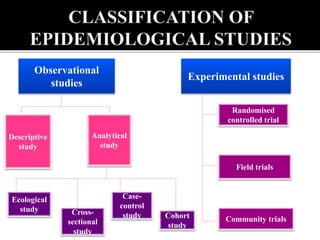
  • #13 Ecological or corelational ; cross sectional study or prevalence; case control or case reference; cohort or followup. Decriptive study is limited to description of a disease in apopulation i.e pattern of occurrence of disease. Analytical study goes by analysing the relationship between health status and other variables.
  • #14 Meticulous observations made in africa by Burkitt led to the eventual incrimination of Epstein barr virus as the etiological factor of the type of cancer known as Burkitts lymphoma. It was the epidemiological study in New Guinea of “kuru” , a herediatary neurological disorder that led to the discovery of slow virus infections as the cause of chronic degenerative neurological disorders in human beings.
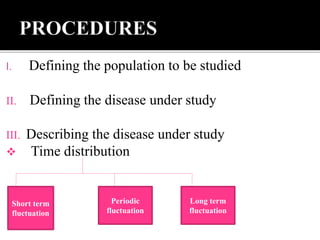
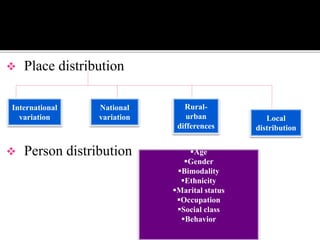
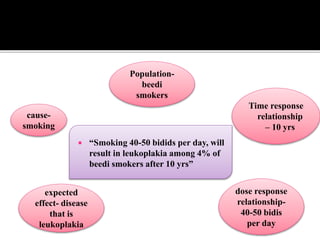
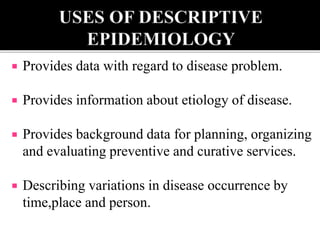
  • #15 Define the population not only in terms of total number but also its composition in terms of age, sex, occupation. Helps to determine pop at risk.Once the population has been defined, one needs to define the disease to be investigated. It should be both valid nd precise to enable to identify those who have d disease from those who do not hve d disease. The primary objective of descriptive epidemiology is to describe the distribution of disease by time,place nd person & identifying those characteristics associated with presence or absence of disease in individuals.
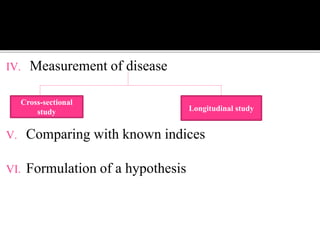
  • #17 Measurement of disease in terms of mortility and morbidity…cross sectional or prevalence study cross sectional- both exposure nd outcme at sme time. Longitudinal is cross sectional study done for a longer duration. Comparision is done to find out which population is at risk.
  • #20 Analytical studies are the second majot type of epidemiological study
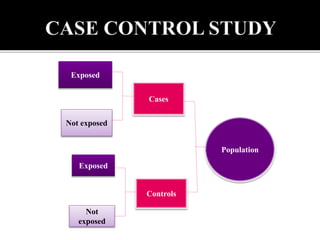
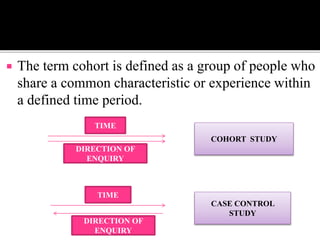
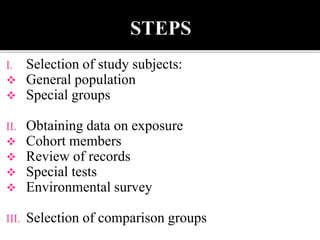
  • #22 Also known as retrospective study
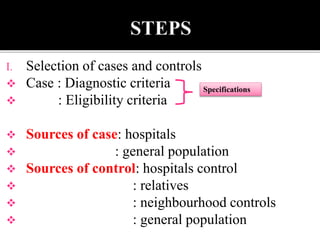
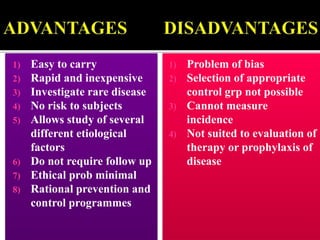
  • #24 Control must be free form the disease. They must be as similar to cases as possible, except for the absence of disease under study. hospital controli sbias bcoz may be dey hve sme disease which is influenced by factor under study. Eg oral cancer nd smoking. Nd lung cancer
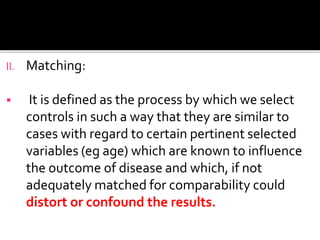
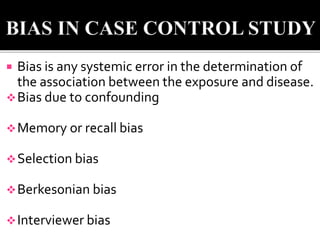
  • #25 Confounding factor is one which is associated with both exposure and disease and is distributed unequally in study and control grp. Example of age
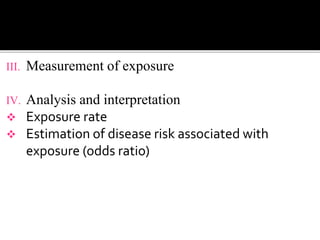
  • #26 Measurement of exposure by interview, questionnaire, past record , clinical or laboratory investigation
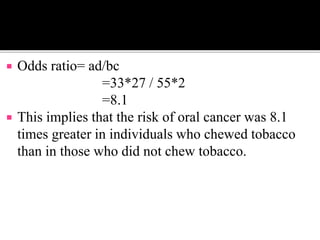
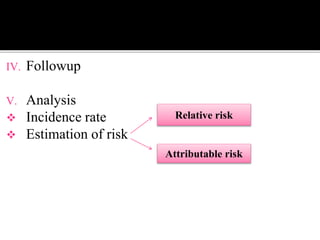
  • #27 Relative risk
  • #29 Berkesonian bias is termed after Dr Joseph Berkson who recognize this problem. Occurs in hospital based studies.
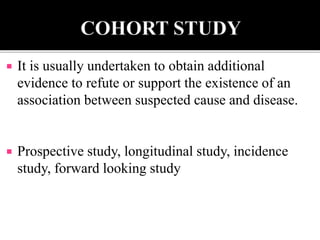
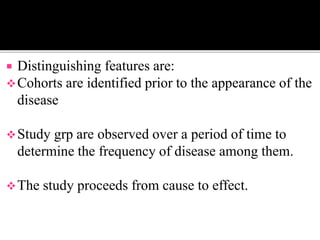
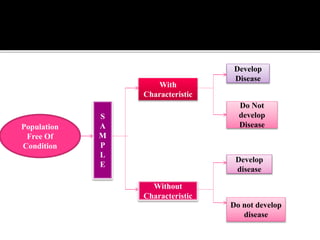
  • #33 Cohort must be free from the disease under study.
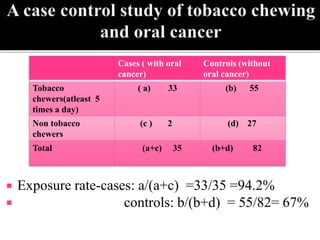
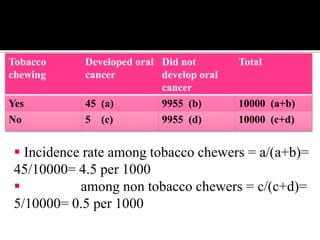
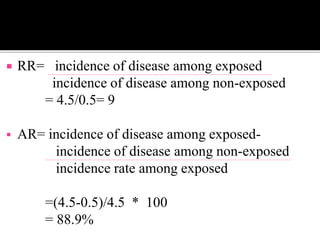
  • #38 Relative risk implies 9 times higher risk of development of oral cancer in tobacco chewers compared to non-chewers. RR of 1 indicates no association, >1 indicates positive association .. AA- out of the total risk of development of cancer in chewers, 88.9% is attributed to tobacco chewing.
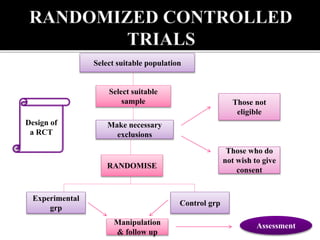
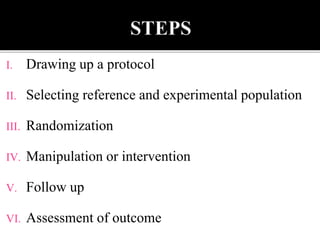
  • #42 Protocol specifies the aims and objectives of the study, criteria for the selection of study and control grps, sample size, allocation of study subjects into study and control grp.treatment to be apllied and upto the stage evaluation. Assessment of outcme- positive and negative results
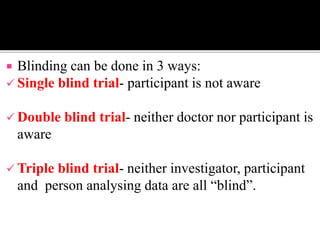
  • #43 2 sources of bias- on part of participants- feel bttr when they cme to know they receivng sme new treatment. Observer bias- investigatir may be influenced if he knows beforehand the particular therapy to which pt is subjected.
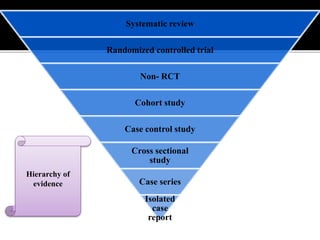
  • #46 The hierarchy of evidence that is generated from various studies is shown in following figure
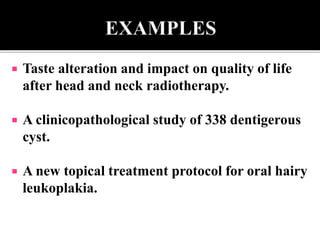
  • #47 1) – COHORT 2) CASE CONTROL 3) RCT
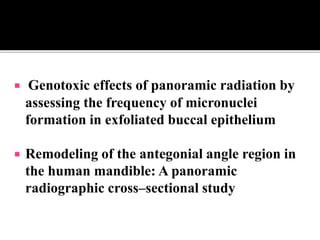
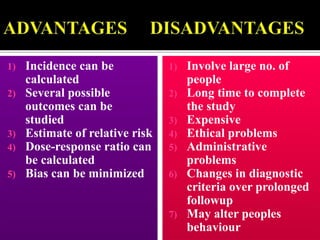
  • #48 1) COHORT 2) CROSS SECTIONAL
  • #49 1) CROSS SECTIONAL 2) RCT