The Five S’s (5S) ofThe Five S’s (5S) of
Good HousekeepingGood Housekeeping
For
TEAM PACIFIC CORPORATION
By: Rose B. Pano
HR Training
5 S Presentation
5S are 5 Japanese Words5S are 5 Japanese Words
 SEIRI
 SEITON
 SEISO
 SEIKETSU
 SHITSUKE
5 S Presentation
5S means:5S means:
Seiri – items for keeps and items for
wastebasket
Seiton – arranged in order for easy
use
Seiso – cleaning the workplace
Seiketsu – high standard of
housekeeping
Shitsuke – training and disciplining
people to follow 5S
5 S Presentation
5S: In Japanese,5S: In Japanese,
English and TagalogEnglish and Tagalog
Seiri Sort Suriin
Seiton Segregate Salansanin
Seiso Sanitize Simutin
Seiketsu Standardize Siguruhin
Shitsuke Self Discipline Sariling kusaShitsuke Self Discipline Sariling kusa
5 S Presentation
The 5 S’sThe 5 S’s
is the practice ofis the practice of
good housekeeping.good housekeeping.
5 S Presentation
How do you describeHow do you describe
your work place?your work place?
Is it 1st
Class?
No one throws trash around.
Is it 2nd
Class?
Some people throw trash and some
clean.
Or is it 3rd
Class?
Everyone throws trash and no one
cleans.
5 S Presentation
SEIRI (Sort)SEIRI (Sort)
• Look and see the things of
use and not of use.
• Sort useful from useless
• No use: throw away!
• No use: not yours
Not yours: ask whose
Don’t know whose, no
use: throw away!
5 S Presentation
Look and see
the things
Useful
Useless
Not Yours
Throw Away
Yours
Ask whose
by announcement
????
Give to owner
SEIRISEIRI
Throw Away
Useless but can
not be thrown
away immediately
Place tag
when to
remove the
item
5 S Presentation
Why 5S (SEIRI) FailsWhy 5S (SEIRI) Fails
 KASI:
 “Sayang, Wag mong itapon”
 “Puede pang magamit yan”
 “Itabi mo muna”
 “Me centimental value sakin yan”
 “Akin nalang”
 “mapapag kakitaan pa yan”
 Etc.
5 S Presentation
Standard of Seiri (Sort)Standard of Seiri (Sort)
Sort items that are useful from items
that no longer of use
Throw away items that are useless
Useless items that are not yours, return
to owner
5 S Presentation
SEITON (Segregate)SEITON (Segregate)
 Means items in
proper order for
easy use and
safekeeping
 Always in use, near you
 Less in use, further
from you!
 Seldom use, much
further
 Put labels, colors
 Fixed place for items
 Items can be seen
 Items can be taken out
 Items can be returned
5 S Presentation
SEITON (Segregate)SEITON (Segregate)
Tools & Systems in Segregation
Storage place
Open shelves
Labels
Code Name
Color coding
Numbering
Alphabets
5 S Presentation
SEITON: fix positionsSEITON: fix positions
(Segregate)(Segregate)
General division, then sub division,
example:
D/A Materials -> leadframe -> package ->
supplier
-> Solder -> solder type ->
supplier
Use of shelves for easy ID
Use of labels, color coding,
5 S Presentation
1. Can see
2. Can take out
3. Can return
1. Where?… Fixed
position
2. What? … Fixed
items
3. How many? …
Fixed quantity.
SEITON: OrganizingSEITON: Organizing
5 S Presentation
Why SEITON FailsWhy SEITON Fails
 Lack of knowledge in organization and
classification
 Lack of creativity to use names, titles,
colors, numbers, alphabets, etc. to
segregate things
 Have the habit of “maňana system in
filing”….. “filing can be done later when I
have time”.
 Do not know the value of classification,
segregation and filing as part of job.
 “Minamaliit ang trabaho ng pagpa-file”.
5 S Presentation
Standard of SEITONStandard of SEITON
 Decide which things should be put where:
Always in use, place near you
Less in use, place further from you
Seldom in use, place slightly further away
 Label items and storage areas to identify what is kept
and to distinguish them from other necessary items
Put labels, colors, numbering, alphabet
Fixed place for items
Items can be seen immediately
items can be taken out immediately
items can be returned immediately
5 S Presentation
SEISO (Sanitize)SEISO (Sanitize)
To clean your
work place so
that there would
be no dust
anywhere.
5 S Presentation
How to Practice SEISOHow to Practice SEISO
(SANITIZING)(SANITIZING)
 “lugar mo, linis mo”
 “lugar mo, linis ko rin”
 “lugar ko, alaga ko”
 “di ko lugar, alaga ko rin”
 “lugar ko linis ko gabi at araw”
 “di ko lugar, mas lalo kong dapat
pangalagaan”
5 S Presentation
Why SEISO FailsWhy SEISO Fails
 Kasi:
 “Tamad maglinis!”.
 “Hindi tinatapon sa tamang lagayan ang
basura
 “Inaasa pa sa Environmental Aides
(EA’s) ang paglilinis!”
 “Hindi marunong sumunod sa cleaning
schedule at responsibilities na inatas
sa kanila!”
5 S Presentation
Standard of SEISOStandard of SEISO
 Don’t wait until things get dirty, clean
them regularly.
 Put aside 5 minutes of your first and last
hour of work to clean your workplace.
 Never throw anything around or dirty any
place.
 Organize cleaning responsibilities and
procedure.
 Make a cleaning schedule.
5 S Presentation
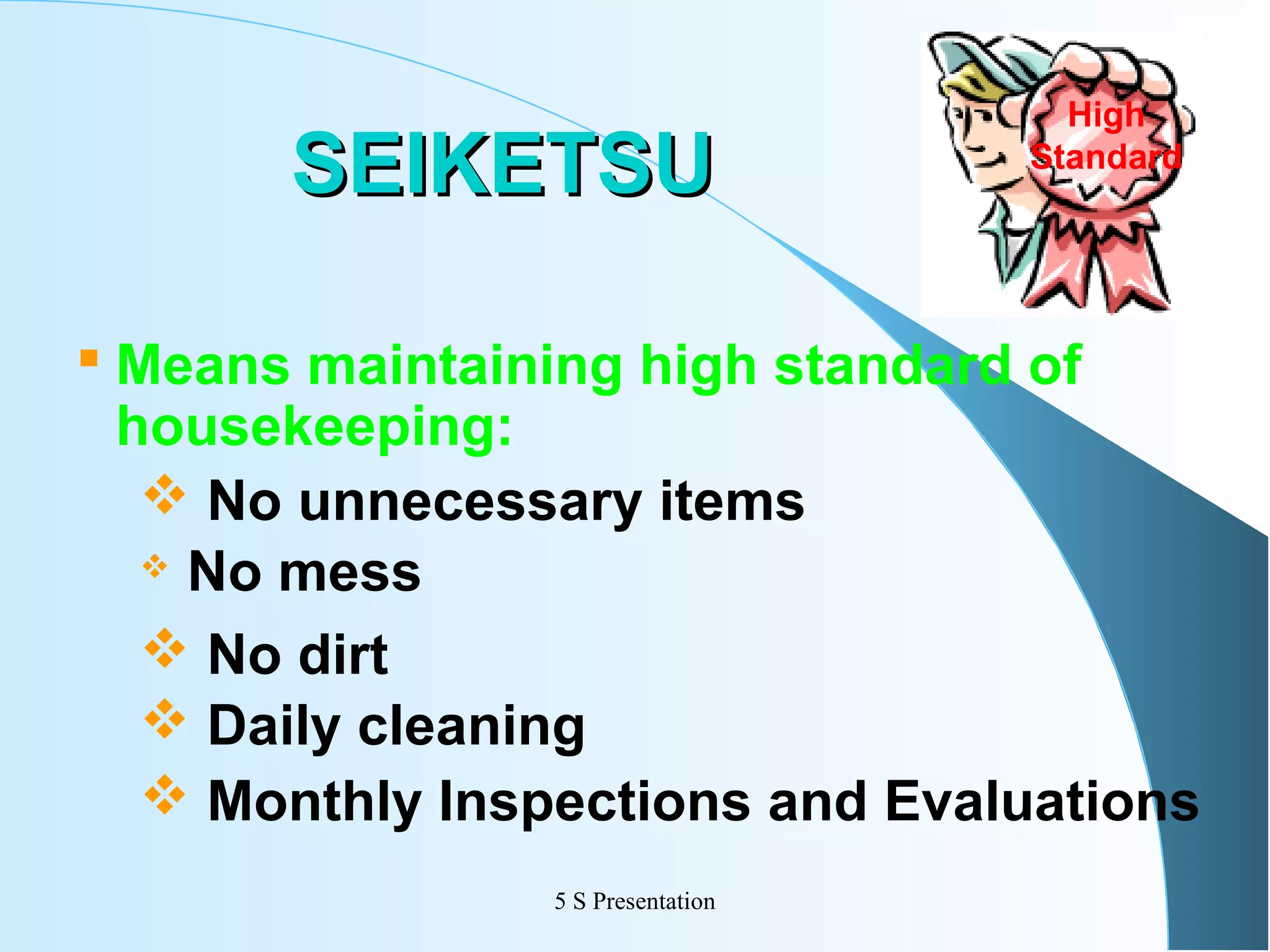
SEIKETSUSEIKETSU
 No mess
High
Standard
 Means maintaining high standard of
housekeeping:
 No unnecessary items
 No dirt
 Daily cleaning
 Monthly Inspections and Evaluations
5 S Presentation
Why SEIKETSU FailsWhy SEIKETSU Fails
 Frequent change of standards
 5S is not recognized as one of the factors
to look into employee’s performance
 Because employees are not aware of the
standards of 5S.
5 S Presentation
SEIKETSU: StandardsSEIKETSU: Standards
Hold a departmental competition
Create a maintenance system
Establish continuous improvement
programs
Include 5S in employee’s Key Result
Areas (KRA)
Include 5S in performance appraisal of
each department and employee
5 S Presentation
SHITSUKESHITSUKE

Spontaneous practice of 5S
No need to be told
No need to be scolded
No need to be reminded --
JUST DO IT !
No complaints
5 S Presentation
SHITSUKE: self disciplineSHITSUKE: self discipline
Reflection of personality, habits
and attitudes
A way of life
Definition of character and life
style
5 S Presentation
Why SHITSUKE FailsWhy SHITSUKE Fails
 Kasi:
 “Ang nagpapatupad ay hindi
sumusunod sa alituntunin!”
 “Hindi consistent sa pagpapatupad.”
 “Nasa kultura na nila ang pagiging
madumi sa sarili!”
5 S Presentation
SHITSUKE: StandardsSHITSUKE: Standards
 Always remember the value of your
housekeeping efforts.
 Treat your workplace as your second
home.
 Aside from cleaning, think of how you can
beautify your workplace.
5 S Presentation
5S: Impact5S: Impact
Efficiency
Quality
Safety
Timeliness
Profitability
Longevity
Cost Effectiveness
Graceful Lifestyle
5 S Presentation
Reasons why some peopleReasons why some people
do not practice 5S?do not practice 5S?
 Because they are lazy!
 Because they were not trained and educated to
do so!
 Because they feel degraded when doing so!
 Because they came from a 3rd class environment
 Because they have certain hatred in their heart
 Because they thought somebody should do it for
them
 Because they were not aware of international
standard of good housekeeping
5 S Presentation
5S5S
 5S – makes a pleasant workplace
 5S – helps in work efficiency
 5S – leads to better quality of life
 5S – leads to 1st
class area
 5S – helps gain respect of others
 5S - is high standard of living
 5S – makes people admire you
 5S – Increases customers
 5S – Increases income and profitability
5S - makes you a better person

The Five S’s (5S) of Good Housekeeping

  • 1.
    The Five S’s(5S) ofThe Five S’s (5S) of Good HousekeepingGood Housekeeping For TEAM PACIFIC CORPORATION By: Rose B. Pano HR Training
  • 2.
    5 S Presentation 5Sare 5 Japanese Words5S are 5 Japanese Words  SEIRI  SEITON  SEISO  SEIKETSU  SHITSUKE
  • 3.
    5 S Presentation 5Smeans:5S means: Seiri – items for keeps and items for wastebasket Seiton – arranged in order for easy use Seiso – cleaning the workplace Seiketsu – high standard of housekeeping Shitsuke – training and disciplining people to follow 5S
  • 4.
    5 S Presentation 5S:In Japanese,5S: In Japanese, English and TagalogEnglish and Tagalog Seiri Sort Suriin Seiton Segregate Salansanin Seiso Sanitize Simutin Seiketsu Standardize Siguruhin Shitsuke Self Discipline Sariling kusaShitsuke Self Discipline Sariling kusa
  • 5.
    5 S Presentation The5 S’sThe 5 S’s is the practice ofis the practice of good housekeeping.good housekeeping.
  • 6.
    5 S Presentation Howdo you describeHow do you describe your work place?your work place? Is it 1st Class? No one throws trash around. Is it 2nd Class? Some people throw trash and some clean. Or is it 3rd Class? Everyone throws trash and no one cleans.
  • 7.
    5 S Presentation SEIRI(Sort)SEIRI (Sort) • Look and see the things of use and not of use. • Sort useful from useless • No use: throw away! • No use: not yours Not yours: ask whose Don’t know whose, no use: throw away!
  • 8.
    5 S Presentation Lookand see the things Useful Useless Not Yours Throw Away Yours Ask whose by announcement ???? Give to owner SEIRISEIRI Throw Away Useless but can not be thrown away immediately Place tag when to remove the item
  • 9.
    5 S Presentation Why5S (SEIRI) FailsWhy 5S (SEIRI) Fails  KASI:  “Sayang, Wag mong itapon”  “Puede pang magamit yan”  “Itabi mo muna”  “Me centimental value sakin yan”  “Akin nalang”  “mapapag kakitaan pa yan”  Etc.
  • 10.
    5 S Presentation Standardof Seiri (Sort)Standard of Seiri (Sort) Sort items that are useful from items that no longer of use Throw away items that are useless Useless items that are not yours, return to owner
  • 11.
    5 S Presentation SEITON(Segregate)SEITON (Segregate)  Means items in proper order for easy use and safekeeping  Always in use, near you  Less in use, further from you!  Seldom use, much further  Put labels, colors  Fixed place for items  Items can be seen  Items can be taken out  Items can be returned
  • 12.
    5 S Presentation SEITON(Segregate)SEITON (Segregate) Tools & Systems in Segregation Storage place Open shelves Labels Code Name Color coding Numbering Alphabets
  • 13.
    5 S Presentation SEITON:fix positionsSEITON: fix positions (Segregate)(Segregate) General division, then sub division, example: D/A Materials -> leadframe -> package -> supplier -> Solder -> solder type -> supplier Use of shelves for easy ID Use of labels, color coding,
  • 14.
    5 S Presentation 1.Can see 2. Can take out 3. Can return 1. Where?… Fixed position 2. What? … Fixed items 3. How many? … Fixed quantity. SEITON: OrganizingSEITON: Organizing
  • 15.
    5 S Presentation WhySEITON FailsWhy SEITON Fails  Lack of knowledge in organization and classification  Lack of creativity to use names, titles, colors, numbers, alphabets, etc. to segregate things  Have the habit of “maňana system in filing”….. “filing can be done later when I have time”.  Do not know the value of classification, segregation and filing as part of job.  “Minamaliit ang trabaho ng pagpa-file”.
  • 16.
    5 S Presentation Standardof SEITONStandard of SEITON  Decide which things should be put where: Always in use, place near you Less in use, place further from you Seldom in use, place slightly further away  Label items and storage areas to identify what is kept and to distinguish them from other necessary items Put labels, colors, numbering, alphabet Fixed place for items Items can be seen immediately items can be taken out immediately items can be returned immediately
  • 17.
    5 S Presentation SEISO(Sanitize)SEISO (Sanitize) To clean your work place so that there would be no dust anywhere.
  • 18.
    5 S Presentation Howto Practice SEISOHow to Practice SEISO (SANITIZING)(SANITIZING)  “lugar mo, linis mo”  “lugar mo, linis ko rin”  “lugar ko, alaga ko”  “di ko lugar, alaga ko rin”  “lugar ko linis ko gabi at araw”  “di ko lugar, mas lalo kong dapat pangalagaan”
  • 19.
    5 S Presentation WhySEISO FailsWhy SEISO Fails  Kasi:  “Tamad maglinis!”.  “Hindi tinatapon sa tamang lagayan ang basura  “Inaasa pa sa Environmental Aides (EA’s) ang paglilinis!”  “Hindi marunong sumunod sa cleaning schedule at responsibilities na inatas sa kanila!”
  • 20.
    5 S Presentation Standardof SEISOStandard of SEISO  Don’t wait until things get dirty, clean them regularly.  Put aside 5 minutes of your first and last hour of work to clean your workplace.  Never throw anything around or dirty any place.  Organize cleaning responsibilities and procedure.  Make a cleaning schedule.
  • 21.
    5 S Presentation SEIKETSUSEIKETSU No mess High Standard  Means maintaining high standard of housekeeping:  No unnecessary items  No dirt  Daily cleaning  Monthly Inspections and Evaluations
  • 22.
    5 S Presentation WhySEIKETSU FailsWhy SEIKETSU Fails  Frequent change of standards  5S is not recognized as one of the factors to look into employee’s performance  Because employees are not aware of the standards of 5S.
  • 23.
    5 S Presentation SEIKETSU:StandardsSEIKETSU: Standards Hold a departmental competition Create a maintenance system Establish continuous improvement programs Include 5S in employee’s Key Result Areas (KRA) Include 5S in performance appraisal of each department and employee
  • 24.
    5 S Presentation SHITSUKESHITSUKE  Spontaneouspractice of 5S No need to be told No need to be scolded No need to be reminded -- JUST DO IT ! No complaints
  • 25.
    5 S Presentation SHITSUKE:self disciplineSHITSUKE: self discipline Reflection of personality, habits and attitudes A way of life Definition of character and life style
  • 26.
    5 S Presentation WhySHITSUKE FailsWhy SHITSUKE Fails  Kasi:  “Ang nagpapatupad ay hindi sumusunod sa alituntunin!”  “Hindi consistent sa pagpapatupad.”  “Nasa kultura na nila ang pagiging madumi sa sarili!”
  • 27.
    5 S Presentation SHITSUKE:StandardsSHITSUKE: Standards  Always remember the value of your housekeeping efforts.  Treat your workplace as your second home.  Aside from cleaning, think of how you can beautify your workplace.
  • 28.
    5 S Presentation 5S:Impact5S: Impact Efficiency Quality Safety Timeliness Profitability Longevity Cost Effectiveness Graceful Lifestyle
  • 29.
    5 S Presentation Reasonswhy some peopleReasons why some people do not practice 5S?do not practice 5S?  Because they are lazy!  Because they were not trained and educated to do so!  Because they feel degraded when doing so!  Because they came from a 3rd class environment  Because they have certain hatred in their heart  Because they thought somebody should do it for them  Because they were not aware of international standard of good housekeeping
  • 30.
    5 S Presentation 5S5S 5S – makes a pleasant workplace  5S – helps in work efficiency  5S – leads to better quality of life  5S – leads to 1st class area  5S – helps gain respect of others  5S - is high standard of living  5S – makes people admire you  5S – Increases customers  5S – Increases income and profitability 5S - makes you a better person