A Semi-Detailed Lesson Plan in Housekeeping
I. Objectives:
At the end of the lesson the learners shall be able to:
a) Define the meaning of 5’S of Good Housekeeping
b) Differentiate the 5’S from each other
c) Appreciate how they can be applied in their specific work areas and the benefits that can be
brought by practicing 5’S.
d) Practice cleanliness and orderliness in a house or in a working area.
II. Subject Matter
A. Topic: 5’S of Good Housekeeping
B. References: Technology and Livelihood Education (Housekeeping – Chapter 2) First
Edition, 2014, pages 57-60, Jesus B. Nazareno
C. Materials: PowerPoint Presentation, Laptop, Television, Whiteboard
III. Procedures:
Teacher’s Activity
A. Preliminaries
 Opening Prayer
 Classroom Management
 Checking of Attendance
B. Review
 What have you learned in our previous
lesson?
Very Good Ana!
 What are the different types of Housekeeping?
Good Job Joshua! There are 2 types of
Housekeeping.
 Can anyone give me a meaning and
example of those types of
Housekeeping?
Excellent Karyl! The Institutional is ….
while the Domestic is…..
Is it clear?
Student’s Activity
Student #1:
The different types of housekeeping Ma’am
Student #2:
The Institutional and Domestic Housekeeping
Ma’am
Student #3:
The Institutional is maintenance that is done in
commercial lodging building.
The Domestic is maintenance that is done in a
residential building.
Yes Ma’am (All Student)
Do you have any question or clarification to
our previous lesson? Before we proceed to
our new Lesson
Okay since all of you understand our previous
lesson let us proceed to the next lesson.
C. Motivation
Picture Analysis:
The students will be group into 3 group. Each
group will be giving a picture and they will analyze
and explain those picture
 Did you enjoy our activity?
Good to hear that!
 Do you think class what are the advantage
if you are well organize?
 What are the problem that could be
avoided by implementing cleanliness
None (All Student)
(Each group will present their activity)
Group 1 presented
Group 2 presented
Group 3 presented
Yes Ma’am
Student #4:
You will be comfortable to work.
Student #5:
Ma’am I think it can cause an accident and you
cannot work comfortable.
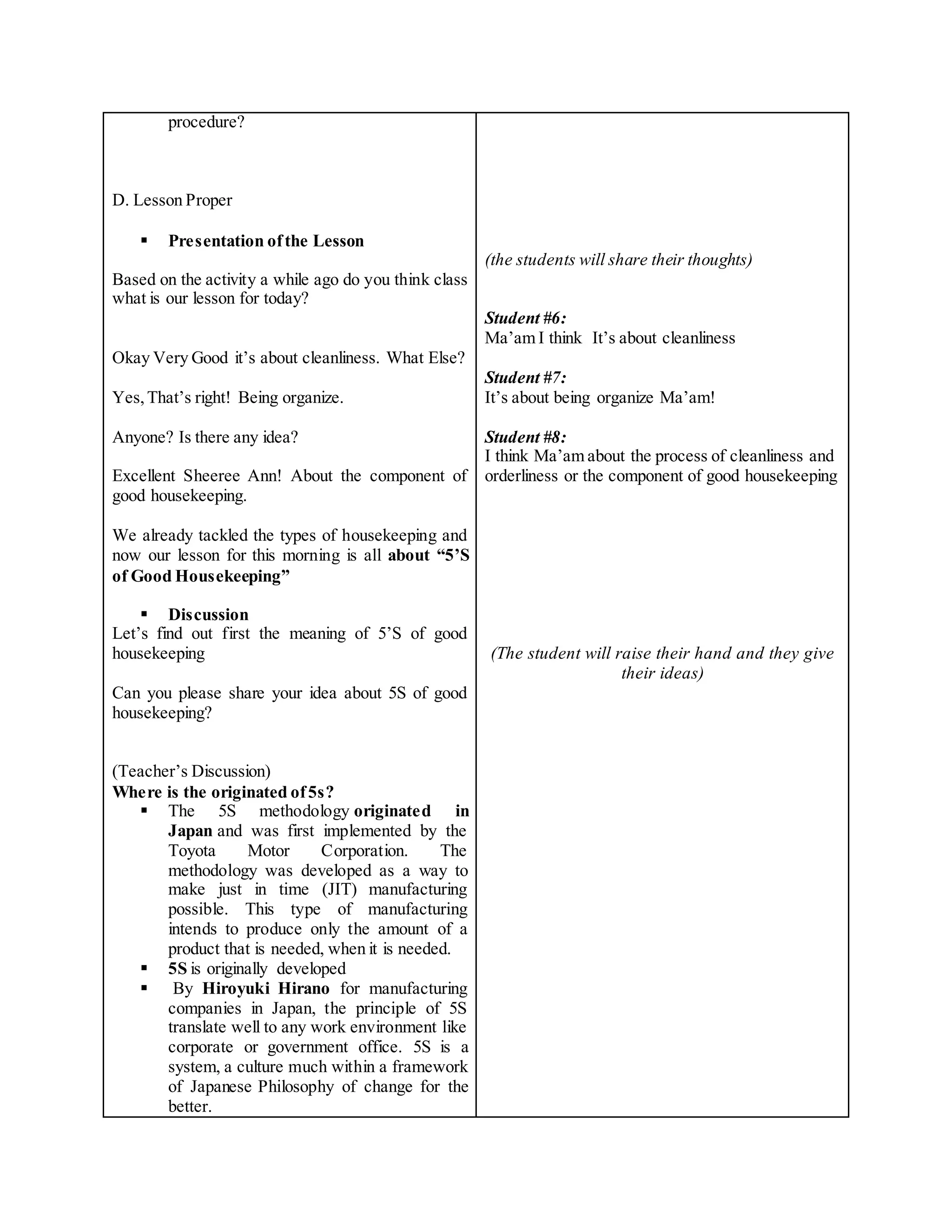
procedure?
D. Lesson Proper
 Presentation ofthe Lesson
Based on the activity a while ago do you think class
what is our lesson for today?
Okay Very Good it’s about cleanliness. What Else?
Yes,That’s right! Being organize.
Anyone? Is there any idea?
Excellent Sheeree Ann! About the component of
good housekeeping.
We already tackled the types of housekeeping and
now our lesson for this morning is all about “5’S
of Good Housekeeping”
 Discussion
Let’s find out first the meaning of 5’S of good
housekeeping
Can you please share your idea about 5S of good
housekeeping?
(Teacher’s Discussion)
Where is the originated of5s?
 The 5S methodology originated in
Japan and was first implemented by the
Toyota Motor Corporation. The
methodology was developed as a way to
make just in time (JIT) manufacturing
possible. This type of manufacturing
intends to produce only the amount of a
product that is needed, when it is needed.
 5S is originally developed
 By Hiroyuki Hirano for manufacturing
companies in Japan, the principle of 5S
translate well to any work environment like
corporate or government office. 5S is a
system, a culture much within a framework
of Japanese Philosophy of change for the
better.
(the students will share their thoughts)
Student #6:
Ma’am I think It’s about cleanliness
Student #7:
It’s about being organize Ma’am!
Student #8:
I think Ma’am about the process of cleanliness and
orderliness or the component of good housekeeping
(The student will raise their hand and they give
their ideas)
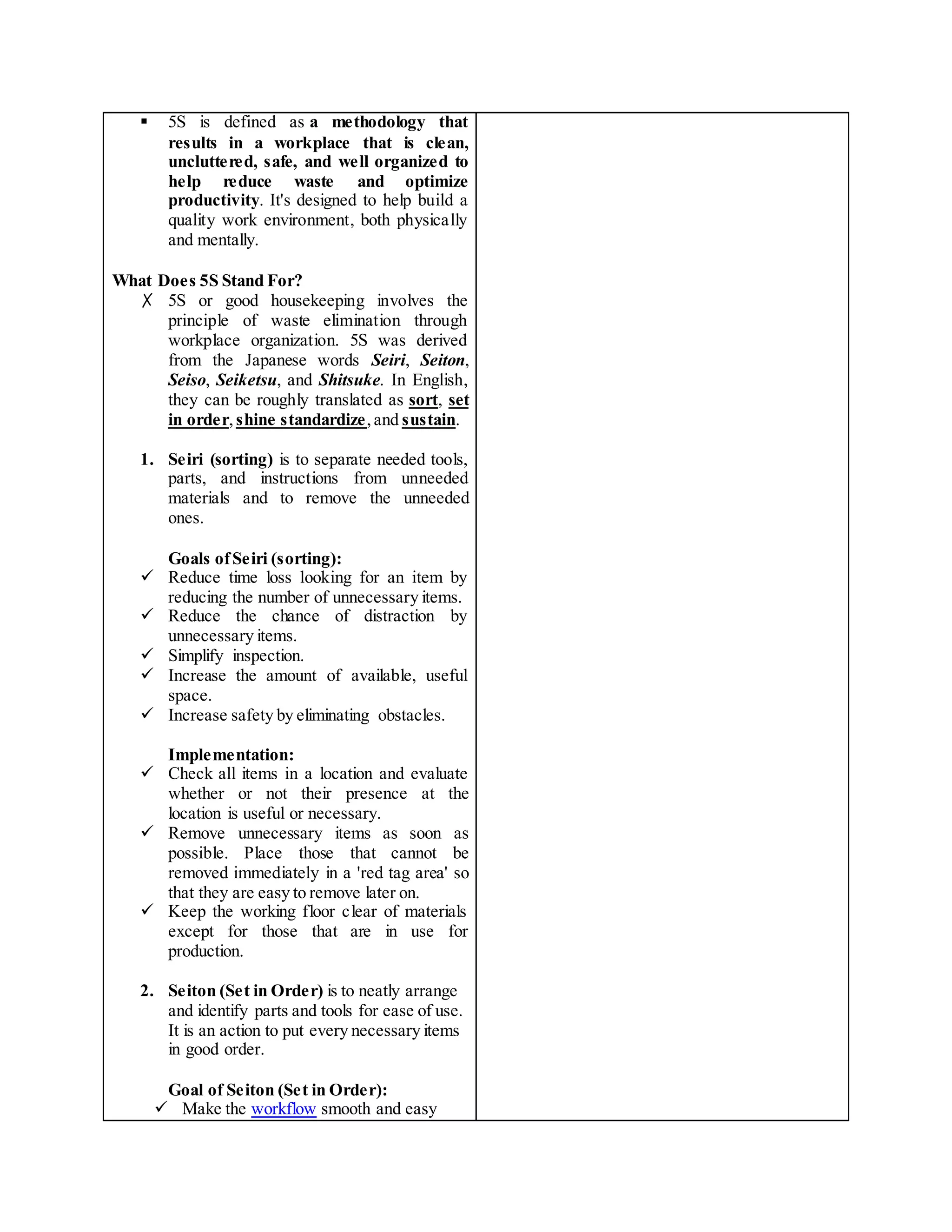
 5S is defined as a methodology that
results in a workplace that is clean,
uncluttered, safe, and well organized to
help reduce waste and optimize
productivity. It's designed to help build a
quality work environment, both physically
and mentally.
What Does 5S Stand For?
✗ 5S or good housekeeping involves the
principle of waste elimination through
workplace organization. 5S was derived
from the Japanese words Seiri, Seiton,
Seiso, Seiketsu, and Shitsuke. In English,
they can be roughly translated as sort, set
in order,shine standardize,and sustain.
1. Seiri (sorting) is to separate needed tools,
parts, and instructions from unneeded
materials and to remove the unneeded
ones.
Goals ofSeiri (sorting):
 Reduce time loss looking for an item by
reducing the number of unnecessary items.
 Reduce the chance of distraction by
unnecessary items.
 Simplify inspection.
 Increase the amount of available, useful
space.
 Increase safety by eliminating obstacles.
Implementation:
 Check all items in a location and evaluate
whether or not their presence at the
location is useful or necessary.
 Remove unnecessary items as soon as
possible. Place those that cannot be
removed immediately in a 'red tag area' so
that they are easy to remove later on.
 Keep the working floor clear of materials
except for those that are in use for
production.
2. Seiton (Set in Order) is to neatly arrange
and identify parts and tools for ease of use.
It is an action to put every necessary items
in good order.
Goal of Seiton (Set in Order):
 Make the workflow smooth and easy
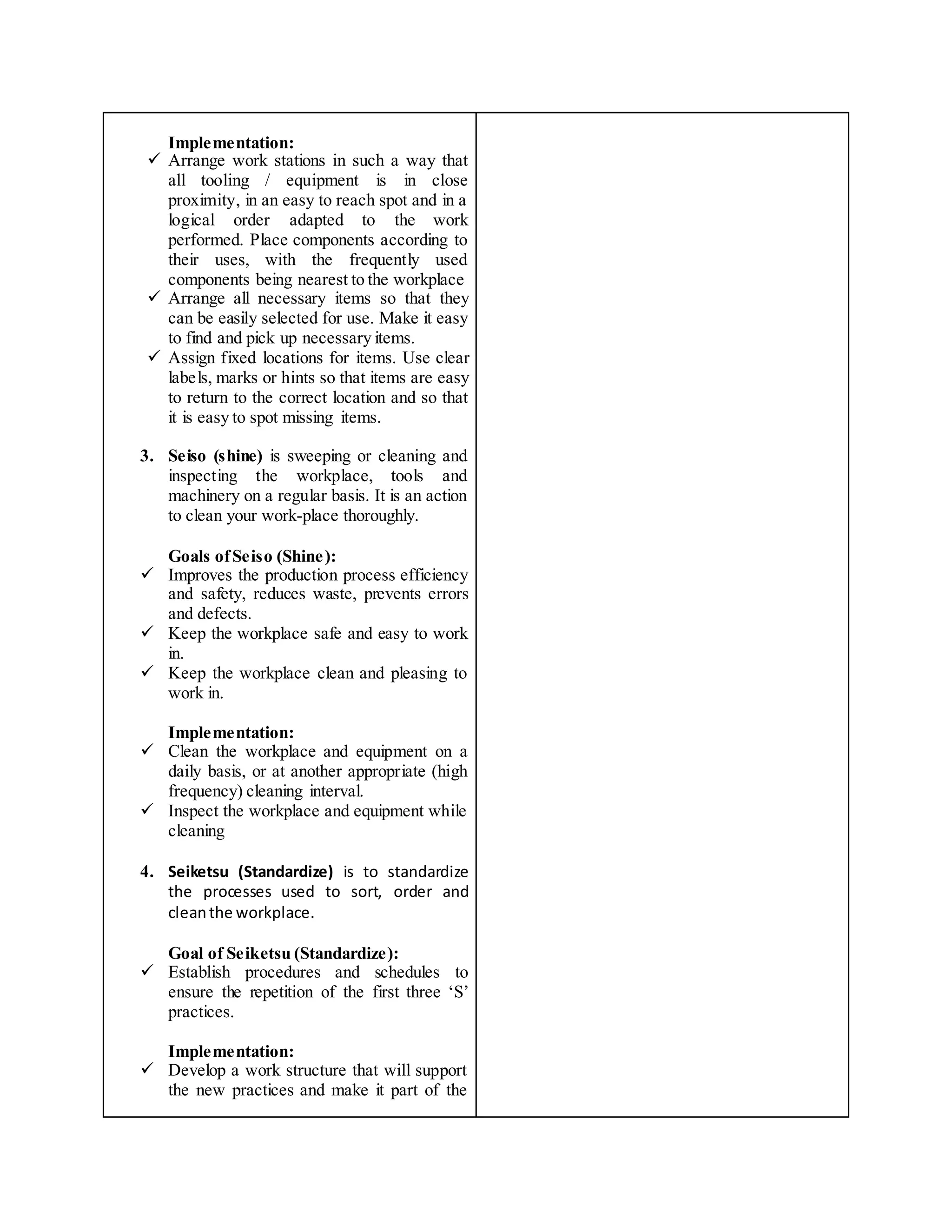
Implementation:
 Arrange work stations in such a way that
all tooling / equipment is in close
proximity, in an easy to reach spot and in a
logical order adapted to the work
performed. Place components according to
their uses, with the frequently used
components being nearest to the workplace
 Arrange all necessary items so that they
can be easily selected for use. Make it easy
to find and pick up necessary items.
 Assign fixed locations for items. Use clear
labels, marks or hints so that items are easy
to return to the correct location and so that
it is easy to spot missing items.
3. Seiso (shine) is sweeping or cleaning and
inspecting the workplace, tools and
machinery on a regular basis. It is an action
to clean your work-place thoroughly.
Goals ofSeiso (Shine):
 Improves the production process efficiency
and safety, reduces waste, prevents errors
and defects.
 Keep the workplace safe and easy to work
in.
 Keep the workplace clean and pleasing to
work in.
Implementation:
 Clean the workplace and equipment on a
daily basis, or at another appropriate (high
frequency) cleaning interval.
 Inspect the workplace and equipment while
cleaning
4. Seiketsu (Standardize) is to standardize
the processes used to sort, order and
cleanthe workplace.
Goal of Seiketsu (Standardize):
 Establish procedures and schedules to
ensure the repetition of the first three ‘S’
practices.
Implementation:
 Develop a work structure that will support
the new practices and make it part of the
daily routine.
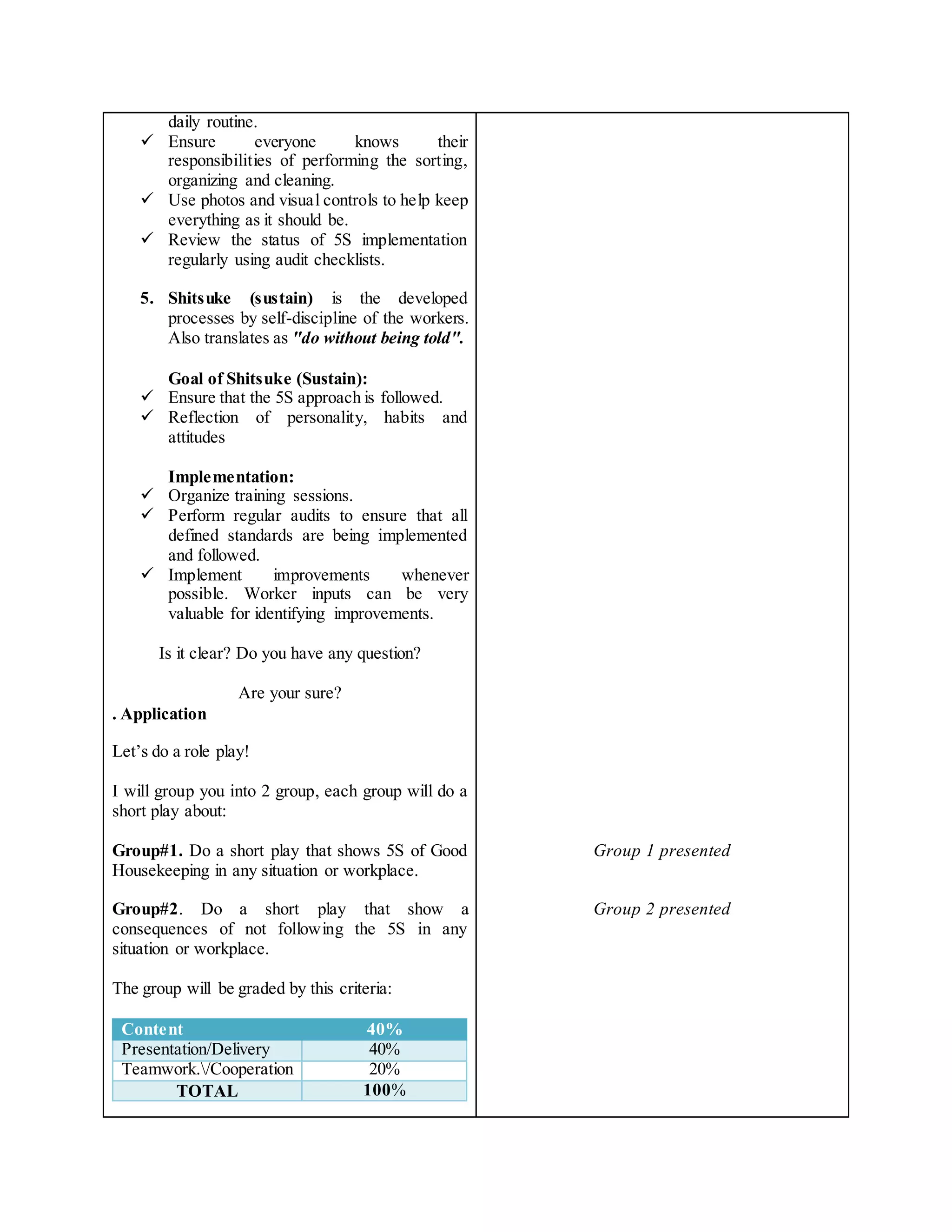
 Ensure everyone knows their
responsibilities of performing the sorting,
organizing and cleaning.
 Use photos and visual controls to help keep
everything as it should be.
 Review the status of 5S implementation
regularly using audit checklists.
5. Shitsuke (sustain) is the developed
processes by self-discipline of the workers.
Also translates as "do without being told".
Goal of Shitsuke (Sustain):
 Ensure that the 5S approach is followed.
 Reflection of personality, habits and
attitudes
Implementation:
 Organize training sessions.
 Perform regular audits to ensure that all
defined standards are being implemented
and followed.
 Implement improvements whenever
possible. Worker inputs can be very
valuable for identifying improvements.
Is it clear? Do you have any question?
Are your sure?
. Application
Let’s do a role play!
I will group you into 2 group, each group will do a
short play about:
Group#1. Do a short play that shows 5S of Good
Housekeeping in any situation or workplace.
Group#2. Do a short play that show a
consequences of not following the 5S in any
situation or workplace.
The group will be graded by this criteria:
Content 40%
Presentation/Delivery 40%
Teamwork./Cooperation 20%
TOTAL 100%
Group 1 presented
Group 2 presented
1. Did you enjoy the activity?
2. What did you realize after the activity?
Exactly Lyka! The activity you played is show the
importance of 5S in our daily life.
E. Generalization
Well, Let’s see. Let’s have a recap.
We will play a game (Pass the ball)
(Teacher explain the game)
Are your Ready?
I will show you a question and you will identify the
the 5S. Okay?
1. What is the Japanese Word for
“SUSTAIN”?
2. What is the Japanese Word for “SHINE”?
3. What is the Japanese Word for “SET IN
ORDER”
4. What is the Japanese Word for “SORITNG”?
5. What is the Japanese Word for
“STANDARDIZE”?
6. Schedule regular cleaning and maintenance
by conducting seiri, seiton, seiso daily.
7. Clean the work are by conducting a
cleanup campaign
8. Make 5S a way of life by forming the habit
of always following the first four “S”
9. Eliminate whatever is not needed by
separating needed tools, parts, and
instructions from unneeded materials
10. Organize whatever remains by neatly
arranging and identifying parts and tools
for ease of use
11. Setting up standards and specifications
12. Sustain and developed processes by self-
discipline of the workers
13. Sorting through all items and removing all
unnecessary items
14. There must be a place for everything and
everything should be in its place after use
15. How do you apply 5S in your daily life?
Cites a situation. How this 5S can change
your daily habit?
Yes Ma’am! (all the student)
I realized Ma’am the importance of 5S in our daily
life.
Okay Ma’am!
Yessss!
Good Job Class! You really understand our lesson
for today. Since you all know the 5S of Good
Housekeeping, now it’s your turn!
G. Evaluation
Okay, since that the lesson is cleared to all of you
and you don’t have any question. Let us have a
quiz.
Get 1 sheet of Paper and answer these questions. I
will give you a 15mins to answer it. Okay?
Part 1
Identify the following statement. Write your
answer on the space provided.
___________________1. It is a condition were
high standard of good housekeeping is maintained
so that there is no dust anywhere.
___________________2. This is the task of
identifying available files and materials and sorting
out what is necessary and what needs to be
disposed.
___________________3. It means putting all
necessary item in proper order and in their proper
place.
___________________4. It is an action to sweep
your workplace thoroughly.
___________________5. It is a systematized
approach to organize work areas, keep rules and
standards, and maintain the discipline needed to do
a good job.
Part 2
Translate the 5S in Japanese Word
SORT - ________________
SET IN ORDER - ________________
SHINE - ________________
STANDARDIZE - ________________
SUSTAIN - ________________
Part 3. (10pts)
Give the benefits and importance of 5S in your
daily life
Are you done?
Okay! Let us check your quiz, don’t change your
paper to your seatmate you will be the one who will
Okay Ma’am!
(All the studentsparticipate and answered the
questions)
1. SHITSUKE
2. SEISO
3. SEITON
4. SEIRI
5. SEIKETSU
6. SEIKETSU (STANDARDIZE)
7. SEISO (SHINE)
8. SHITSUKE (SUSTAIN)
9. SEIRI (SORTING)
10. SEITON (SET IN ORDER)
11. SEIKETSU (STANDARDIZE)
12. SHITSUKE (SUSTAIN)
13. SEIRI (SORTING)
14. SEIRI(SORTING)
Yes Ma’am! (all student)
Student answer the questions:
check your own quiz. “Honesty is the Best Policy”
Write your score and pass it on the front and I will
be the one who will check the Part 3 of your quiz.
H. Assignment
Do a research and write it in your notebook.
1) Definition of Room Status
2) Identify status code use in checking room
Do you have any question?
Are you sure?
Okay class if you don’t have any question, see you
on next meeting!
Okay please all stand for our closing prayer, can
you lead the prayer Karel.
Goodbye Class and see you in next meeting!
1. Standardized - Shitsuke
2. Sorting - Seiri
3. Sustain – Shitsuke
4. Shine - Seiso
5. Set in Order - Seiton
6. Seiri
7. Seiton
8. Seiso
9. Seiketsu
10. Shitsuke
(Students copy the assignment)
None Ma’am!
Yes Ma’am!
Okay Ma’am!
Karellead the closing prayer
AMEN!
Goodbye and thankyou

5S of Good Housekeeping.docx

  • 1.
    A Semi-Detailed LessonPlan in Housekeeping I. Objectives: At the end of the lesson the learners shall be able to: a) Define the meaning of 5’S of Good Housekeeping b) Differentiate the 5’S from each other c) Appreciate how they can be applied in their specific work areas and the benefits that can be brought by practicing 5’S. d) Practice cleanliness and orderliness in a house or in a working area. II. Subject Matter A. Topic: 5’S of Good Housekeeping B. References: Technology and Livelihood Education (Housekeeping – Chapter 2) First Edition, 2014, pages 57-60, Jesus B. Nazareno C. Materials: PowerPoint Presentation, Laptop, Television, Whiteboard III. Procedures: Teacher’s Activity A. Preliminaries  Opening Prayer  Classroom Management  Checking of Attendance B. Review  What have you learned in our previous lesson? Very Good Ana!  What are the different types of Housekeeping? Good Job Joshua! There are 2 types of Housekeeping.  Can anyone give me a meaning and example of those types of Housekeeping? Excellent Karyl! The Institutional is …. while the Domestic is….. Is it clear? Student’s Activity Student #1: The different types of housekeeping Ma’am Student #2: The Institutional and Domestic Housekeeping Ma’am Student #3: The Institutional is maintenance that is done in commercial lodging building. The Domestic is maintenance that is done in a residential building. Yes Ma’am (All Student)
  • 2.
    Do you haveany question or clarification to our previous lesson? Before we proceed to our new Lesson Okay since all of you understand our previous lesson let us proceed to the next lesson. C. Motivation Picture Analysis: The students will be group into 3 group. Each group will be giving a picture and they will analyze and explain those picture  Did you enjoy our activity? Good to hear that!  Do you think class what are the advantage if you are well organize?  What are the problem that could be avoided by implementing cleanliness None (All Student) (Each group will present their activity) Group 1 presented Group 2 presented Group 3 presented Yes Ma’am Student #4: You will be comfortable to work. Student #5: Ma’am I think it can cause an accident and you cannot work comfortable.
  • 3.
    procedure? D. Lesson Proper Presentation ofthe Lesson Based on the activity a while ago do you think class what is our lesson for today? Okay Very Good it’s about cleanliness. What Else? Yes,That’s right! Being organize. Anyone? Is there any idea? Excellent Sheeree Ann! About the component of good housekeeping. We already tackled the types of housekeeping and now our lesson for this morning is all about “5’S of Good Housekeeping”  Discussion Let’s find out first the meaning of 5’S of good housekeeping Can you please share your idea about 5S of good housekeeping? (Teacher’s Discussion) Where is the originated of5s?  The 5S methodology originated in Japan and was first implemented by the Toyota Motor Corporation. The methodology was developed as a way to make just in time (JIT) manufacturing possible. This type of manufacturing intends to produce only the amount of a product that is needed, when it is needed.  5S is originally developed  By Hiroyuki Hirano for manufacturing companies in Japan, the principle of 5S translate well to any work environment like corporate or government office. 5S is a system, a culture much within a framework of Japanese Philosophy of change for the better. (the students will share their thoughts) Student #6: Ma’am I think It’s about cleanliness Student #7: It’s about being organize Ma’am! Student #8: I think Ma’am about the process of cleanliness and orderliness or the component of good housekeeping (The student will raise their hand and they give their ideas)
  • 4.
     5S isdefined as a methodology that results in a workplace that is clean, uncluttered, safe, and well organized to help reduce waste and optimize productivity. It's designed to help build a quality work environment, both physically and mentally. What Does 5S Stand For? ✗ 5S or good housekeeping involves the principle of waste elimination through workplace organization. 5S was derived from the Japanese words Seiri, Seiton, Seiso, Seiketsu, and Shitsuke. In English, they can be roughly translated as sort, set in order,shine standardize,and sustain. 1. Seiri (sorting) is to separate needed tools, parts, and instructions from unneeded materials and to remove the unneeded ones. Goals ofSeiri (sorting):  Reduce time loss looking for an item by reducing the number of unnecessary items.  Reduce the chance of distraction by unnecessary items.  Simplify inspection.  Increase the amount of available, useful space.  Increase safety by eliminating obstacles. Implementation:  Check all items in a location and evaluate whether or not their presence at the location is useful or necessary.  Remove unnecessary items as soon as possible. Place those that cannot be removed immediately in a 'red tag area' so that they are easy to remove later on.  Keep the working floor clear of materials except for those that are in use for production. 2. Seiton (Set in Order) is to neatly arrange and identify parts and tools for ease of use. It is an action to put every necessary items in good order. Goal of Seiton (Set in Order):  Make the workflow smooth and easy
  • 5.
    Implementation:  Arrange workstations in such a way that all tooling / equipment is in close proximity, in an easy to reach spot and in a logical order adapted to the work performed. Place components according to their uses, with the frequently used components being nearest to the workplace  Arrange all necessary items so that they can be easily selected for use. Make it easy to find and pick up necessary items.  Assign fixed locations for items. Use clear labels, marks or hints so that items are easy to return to the correct location and so that it is easy to spot missing items. 3. Seiso (shine) is sweeping or cleaning and inspecting the workplace, tools and machinery on a regular basis. It is an action to clean your work-place thoroughly. Goals ofSeiso (Shine):  Improves the production process efficiency and safety, reduces waste, prevents errors and defects.  Keep the workplace safe and easy to work in.  Keep the workplace clean and pleasing to work in. Implementation:  Clean the workplace and equipment on a daily basis, or at another appropriate (high frequency) cleaning interval.  Inspect the workplace and equipment while cleaning 4. Seiketsu (Standardize) is to standardize the processes used to sort, order and cleanthe workplace. Goal of Seiketsu (Standardize):  Establish procedures and schedules to ensure the repetition of the first three ‘S’ practices. Implementation:  Develop a work structure that will support the new practices and make it part of the
  • 6.
    daily routine.  Ensureeveryone knows their responsibilities of performing the sorting, organizing and cleaning.  Use photos and visual controls to help keep everything as it should be.  Review the status of 5S implementation regularly using audit checklists. 5. Shitsuke (sustain) is the developed processes by self-discipline of the workers. Also translates as "do without being told". Goal of Shitsuke (Sustain):  Ensure that the 5S approach is followed.  Reflection of personality, habits and attitudes Implementation:  Organize training sessions.  Perform regular audits to ensure that all defined standards are being implemented and followed.  Implement improvements whenever possible. Worker inputs can be very valuable for identifying improvements. Is it clear? Do you have any question? Are your sure? . Application Let’s do a role play! I will group you into 2 group, each group will do a short play about: Group#1. Do a short play that shows 5S of Good Housekeeping in any situation or workplace. Group#2. Do a short play that show a consequences of not following the 5S in any situation or workplace. The group will be graded by this criteria: Content 40% Presentation/Delivery 40% Teamwork./Cooperation 20% TOTAL 100% Group 1 presented Group 2 presented
  • 7.
    1. Did youenjoy the activity? 2. What did you realize after the activity? Exactly Lyka! The activity you played is show the importance of 5S in our daily life. E. Generalization Well, Let’s see. Let’s have a recap. We will play a game (Pass the ball) (Teacher explain the game) Are your Ready? I will show you a question and you will identify the the 5S. Okay? 1. What is the Japanese Word for “SUSTAIN”? 2. What is the Japanese Word for “SHINE”? 3. What is the Japanese Word for “SET IN ORDER” 4. What is the Japanese Word for “SORITNG”? 5. What is the Japanese Word for “STANDARDIZE”? 6. Schedule regular cleaning and maintenance by conducting seiri, seiton, seiso daily. 7. Clean the work are by conducting a cleanup campaign 8. Make 5S a way of life by forming the habit of always following the first four “S” 9. Eliminate whatever is not needed by separating needed tools, parts, and instructions from unneeded materials 10. Organize whatever remains by neatly arranging and identifying parts and tools for ease of use 11. Setting up standards and specifications 12. Sustain and developed processes by self- discipline of the workers 13. Sorting through all items and removing all unnecessary items 14. There must be a place for everything and everything should be in its place after use 15. How do you apply 5S in your daily life? Cites a situation. How this 5S can change your daily habit? Yes Ma’am! (all the student) I realized Ma’am the importance of 5S in our daily life. Okay Ma’am! Yessss!
  • 8.
    Good Job Class!You really understand our lesson for today. Since you all know the 5S of Good Housekeeping, now it’s your turn! G. Evaluation Okay, since that the lesson is cleared to all of you and you don’t have any question. Let us have a quiz. Get 1 sheet of Paper and answer these questions. I will give you a 15mins to answer it. Okay? Part 1 Identify the following statement. Write your answer on the space provided. ___________________1. It is a condition were high standard of good housekeeping is maintained so that there is no dust anywhere. ___________________2. This is the task of identifying available files and materials and sorting out what is necessary and what needs to be disposed. ___________________3. It means putting all necessary item in proper order and in their proper place. ___________________4. It is an action to sweep your workplace thoroughly. ___________________5. It is a systematized approach to organize work areas, keep rules and standards, and maintain the discipline needed to do a good job. Part 2 Translate the 5S in Japanese Word SORT - ________________ SET IN ORDER - ________________ SHINE - ________________ STANDARDIZE - ________________ SUSTAIN - ________________ Part 3. (10pts) Give the benefits and importance of 5S in your daily life Are you done? Okay! Let us check your quiz, don’t change your paper to your seatmate you will be the one who will Okay Ma’am! (All the studentsparticipate and answered the questions) 1. SHITSUKE 2. SEISO 3. SEITON 4. SEIRI 5. SEIKETSU 6. SEIKETSU (STANDARDIZE) 7. SEISO (SHINE) 8. SHITSUKE (SUSTAIN) 9. SEIRI (SORTING) 10. SEITON (SET IN ORDER) 11. SEIKETSU (STANDARDIZE) 12. SHITSUKE (SUSTAIN) 13. SEIRI (SORTING) 14. SEIRI(SORTING) Yes Ma’am! (all student) Student answer the questions:
  • 9.
    check your ownquiz. “Honesty is the Best Policy” Write your score and pass it on the front and I will be the one who will check the Part 3 of your quiz. H. Assignment Do a research and write it in your notebook. 1) Definition of Room Status 2) Identify status code use in checking room Do you have any question? Are you sure? Okay class if you don’t have any question, see you on next meeting! Okay please all stand for our closing prayer, can you lead the prayer Karel. Goodbye Class and see you in next meeting! 1. Standardized - Shitsuke 2. Sorting - Seiri 3. Sustain – Shitsuke 4. Shine - Seiso 5. Set in Order - Seiton 6. Seiri 7. Seiton 8. Seiso 9. Seiketsu 10. Shitsuke (Students copy the assignment) None Ma’am! Yes Ma’am! Okay Ma’am! Karellead the closing prayer AMEN! Goodbye and thankyou