High Level Languages
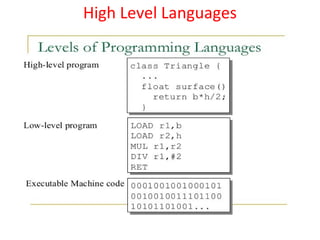
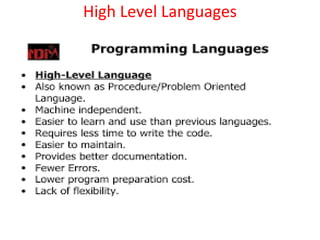
A high-level language (HLL) is a programming language such
as C, FORTRAN, or Pascal that enables a programmer to
write programs that are more or less independent of a particular
type of computer. Such languages are considered high-level because
they are closer to human languages and further from machine
languages.
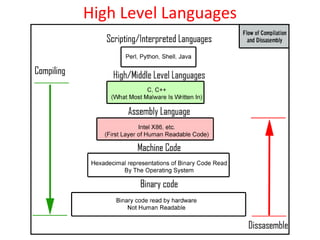
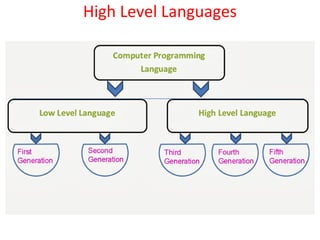
In contrast, assembly languages are considered low-level because
they are very close to machine languages.
Similar examples are Python, C, Fortran or Pascal. Such languages
are considered as high-level language because they are closer to
human languages and much further from machine languages. When I
say human language, I don’t mean what we talk in our day-to-day
life. It means the code is something we can understand by knowing
some basics in programming. The code written is almost readable by
humans, something that can be read and pronounced.
High Level Languages
Low Level Vs High Level programming languages
1) Platform Dependencies
First, you should know about the platform, here platform
means Computer Hardware (Computer configuration).
Low Level programming languages are platform dependent
that means programs written in Low Level language can run
on the same hardware with same configuration, you cannot
run them on hardware that has different configuration.
High Level programming languages are platform independent
that means programs written in High Level language can run
on different hardware with different configuration.
Remember: High Level programming languages are platform
independent that doesn’t mean they are operating system
independent. System hardware configuration may be
different but Operating systems should be same.
High Level Languages
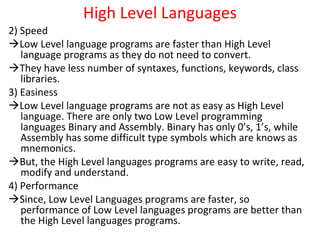
2) Speed
Low Level language programs are faster than High Level
language programs as they do not need to convert.
They have less number of syntaxes, functions, keywords, class
libraries.
3) Easiness
Low Level language programs are not as easy as High Level
language. There are only two Low Level programming
languages Binary and Assembly. Binary has only 0’s, 1’s, while
Assembly has some difficult type symbols which are knows as
mnemonics.
But, the High Level languages programs are easy to write, read,
modify and understand.
4) Performance
Since, Low Level Languages programs are faster, so
performance of Low Level languages programs are better than
the High Level languages programs.
High Level Languages
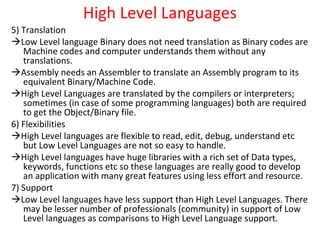
5) Translation
Low Level language Binary does not need translation as Binary codes are
Machine codes and computer understands them without any
translations.
Assembly needs an Assembler to translate an Assembly program to its
equivalent Binary/Machine Code.
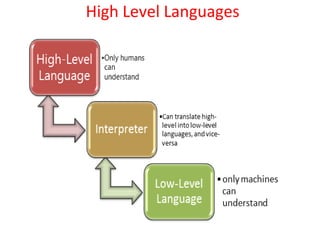
High Level Languages are translated by the compilers or interpreters;
sometimes (in case of some programming languages) both are required
to get the Object/Binary file.
6) Flexibilities
High Level languages are flexible to read, edit, debug, understand etc
but Low Level Languages are not so easy to handle.
High Level languages have huge libraries with a rich set of Data types,
keywords, functions etc so these languages are really good to develop
an application with many great features using less effort and resource.
7) Support
Low Level languages have less support than High Level Languages. There
may be lesser number of professionals (community) in support of Low
Level languages as comparisons to High Level Language support.
High Level Languages
5) Translation
Low Level language Binary does not need translation as Binary codes are
Machine codes and computer understands them without any
translations.
Assembly needs an Assembler to translate an Assembly program to its
equivalent Binary/Machine Code.
High Level Languages are translated by the compilers or interpreters;
sometimes (in case of some programming languages) both are required
to get the Object/Binary file.
6) Flexibilities
High Level languages are flexible to read, edit, debug, understand etc
but Low Level Languages are not so easy to handle.
High Level languages have huge libraries with a rich set of Data types,
keywords, functions etc so these languages are really good to develop
an application with many great features using less effort and resource.
7) Support
Low Level languages have less support than High Level Languages. There
may be lesser number of professionals (community) in support of Low
Level languages as comparisons to High Level Language support.

High level languages representation

  • 1.
    High Level Languages Ahigh-level language (HLL) is a programming language such as C, FORTRAN, or Pascal that enables a programmer to write programs that are more or less independent of a particular type of computer. Such languages are considered high-level because they are closer to human languages and further from machine languages. In contrast, assembly languages are considered low-level because they are very close to machine languages. Similar examples are Python, C, Fortran or Pascal. Such languages are considered as high-level language because they are closer to human languages and much further from machine languages. When I say human language, I don’t mean what we talk in our day-to-day life. It means the code is something we can understand by knowing some basics in programming. The code written is almost readable by humans, something that can be read and pronounced.
  • 2.
  • 3.
  • 4.
  • 5.
  • 6.
  • 7.
    High Level Languages LowLevel Vs High Level programming languages 1) Platform Dependencies First, you should know about the platform, here platform means Computer Hardware (Computer configuration). Low Level programming languages are platform dependent that means programs written in Low Level language can run on the same hardware with same configuration, you cannot run them on hardware that has different configuration. High Level programming languages are platform independent that means programs written in High Level language can run on different hardware with different configuration. Remember: High Level programming languages are platform independent that doesn’t mean they are operating system independent. System hardware configuration may be different but Operating systems should be same.
  • 8.
    High Level Languages 2)Speed Low Level language programs are faster than High Level language programs as they do not need to convert. They have less number of syntaxes, functions, keywords, class libraries. 3) Easiness Low Level language programs are not as easy as High Level language. There are only two Low Level programming languages Binary and Assembly. Binary has only 0’s, 1’s, while Assembly has some difficult type symbols which are knows as mnemonics. But, the High Level languages programs are easy to write, read, modify and understand. 4) Performance Since, Low Level Languages programs are faster, so performance of Low Level languages programs are better than the High Level languages programs.
  • 9.
    High Level Languages 5)Translation Low Level language Binary does not need translation as Binary codes are Machine codes and computer understands them without any translations. Assembly needs an Assembler to translate an Assembly program to its equivalent Binary/Machine Code. High Level Languages are translated by the compilers or interpreters; sometimes (in case of some programming languages) both are required to get the Object/Binary file. 6) Flexibilities High Level languages are flexible to read, edit, debug, understand etc but Low Level Languages are not so easy to handle. High Level languages have huge libraries with a rich set of Data types, keywords, functions etc so these languages are really good to develop an application with many great features using less effort and resource. 7) Support Low Level languages have less support than High Level Languages. There may be lesser number of professionals (community) in support of Low Level languages as comparisons to High Level Language support.
  • 10.
    High Level Languages 5)Translation Low Level language Binary does not need translation as Binary codes are Machine codes and computer understands them without any translations. Assembly needs an Assembler to translate an Assembly program to its equivalent Binary/Machine Code. High Level Languages are translated by the compilers or interpreters; sometimes (in case of some programming languages) both are required to get the Object/Binary file. 6) Flexibilities High Level languages are flexible to read, edit, debug, understand etc but Low Level Languages are not so easy to handle. High Level languages have huge libraries with a rich set of Data types, keywords, functions etc so these languages are really good to develop an application with many great features using less effort and resource. 7) Support Low Level languages have less support than High Level Languages. There may be lesser number of professionals (community) in support of Low Level languages as comparisons to High Level Language support.