Humans need a language like Hindi, Telugu, English, or any other
regional language or just a body gesture to tell things, express
feelings and to communicate with others. Have you ever
wondered how we talk to computers? Isn’t it mysterious and
exciting?
A computer cannot understand human languages
directly. So, we need a language to communicate with
a computer. We developed several languages as a
method of computer communications. Simply, the
languages which are used to communicate with a
computer are called computer languages.
A computer language is a group of
instructions that are used to create
computer programs. This is the brief of
computer languages. The main goal is to
achieve human-computer interaction.
4
HIGHLEVELLANGUAGE
High Level computer
languages are the advanced
development languages in
the evolution of computer
languages. These languages
are designed to make the
programming easier and less
error-free.
High level language uses
words and commands along
with symbols and numbers.
The keywords used in High
3
ASSEMBLYLANGUAGE
Assembly level language in
computer programming has
evolved with the
advancements in the machine
language. Assembly language
uses symbols, which are
popularly known as
mnemonics in computer
terminology to write the
instructions. So,
comparatively writing a
program in Assembly
language is more
understandable to the Human
than Machine Language.
2
MACHINELANGUAGE
As discussed above,
Machine level
language is a type
of Low level
language. Machine
language is
considered to be
the oldest computer
language. Machine
language is
developed by only
using binary
numbers i.e., 0 and
1. So, the
1
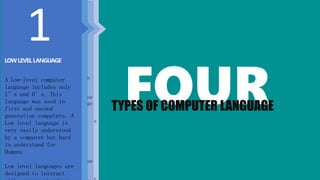
A Low-level computer
language includes only
1’s and 0’s. This
language was used in
first and second
generation computers. A
Low level language is
very easily understood
by a computer but hard
to understand for
Humans
Low level languages are
designed to interact
LOWLEVELLANGUAGE
FOUR
TYPES OF COMPUTER LANGUAGE
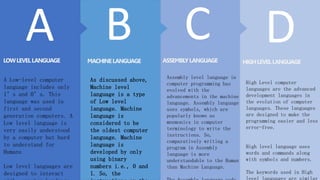
D
HIGHLEVELLANGUAGE
High Level computer
languages are the advanced
development languages in
the evolution of computer
languages. These languages
are designed to make the
programming easier and less
error-free.
High level language uses
words and commands along
with symbols and numbers.
The keywords used in High
C
ASSEMBLYLANGUAGE
Assembly level language in
computer programming has
evolved with the
advancements in the machine
language. Assembly language
uses symbols, which are
popularly known as
mnemonics in computer
terminology to write the
instructions. So,
comparatively writing a
program in Assembly
language is more
understandable to the Human
than Machine Language.
B
MACHINELANGUAGE
As discussed above,
Machine level
language is a type
of Low level
language. Machine
language is
considered to be
the oldest computer
language. Machine
language is
developed by only
using binary
numbers i.e., 0 and
1. So, the
A
A Low-level computer
language includes only
1’s and 0’s. This
language was used in
first and second
generation computers. A
Low level language is
very easily understood
by a computer but hard
to understand for
Humans
Low level languages are
designed to interact
LOWLEVELLANGUAGE
C
C++
Python
C# PHP
Java
Java
Script
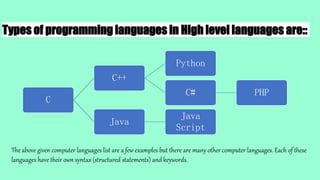
Types of programming languages in High level languages are::
The above given computer languages list are a few examples but there are many other computer languages. Each of these
languages have their own syntax (structured statements) and keywords.
Important Terms Used in Computer Language
1. Statement: A statement is telling a
computer on how to do a desired action
using words or instructions.
2. Syntax: Syntax is the structured
arrangement of statements.
3. Algorithm: Algorithm is a set of instructions
written to solve a problem. It's the logical
thought process of a computer.
4. Binary numbers: Binary numbers are a way
of expressing data. The numbers 1 and 0
are called binary numbers. Computers can
only understand binary language.
Computers can be able to process millions
of 1’s and 0’s.
5. Coding: Do you know “what is computer
code”? Coding is the process of creating
computer instructions. Computer codes are
also called Programs.
A simple C language code to print a
statement is given below.
6. Debug: Debugging is the process of finding
and removing errors from a code.
7. Assemblar: An Assembler is a computer
program designed in such a way that it
converts mnemonics to 0’s and 1’s.
Low-
level computer languages, like assembly, directly
represent machine instructions and are closely tied to
hardware, requiring deep understanding. High-level
languages, such as Python or Java, offer abstraction
and readability closer to natural language, enhancing
programmer productivity despite potential
performance trade-offs.
You
High-level languages prioritize ease of use and
readability, offering features like automatic memory
management and extensive libraries. They enable
developers to write code more quickly and maintain it
efficiently over time. Additionally, high-level languages
are often more portable across different platforms and
architectures, further enhancing their appeal in
modern software development.
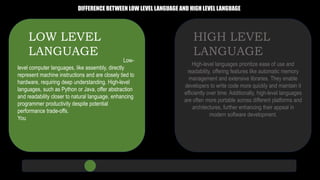
DIFFERENCE BETWEEN LOW LEVEL LANGUAGE AND HIGH LEVEL LANGUAGE
LOW LEVEL
LANGUAGE
HIGH LEVEL
LANGUAGE
Low-
level computer languages, like assembly, directly
represent machine instructions and are closely tied to
hardware, requiring deep understanding. High-level
languages, such as Python or Java, offer abstraction
and readability closer to natural language, enhancing
programmer productivity despite potential
performance trade-offs.
You
High-level languages prioritize ease of use and
readability, offering features like automatic memory
management and extensive libraries. They enable
developers to write code more quickly and maintain it
efficiently over time. Additionally, high-level languages
are often more portable across different platforms and
architectures, further enhancing their appeal in
modern software development.
DIFFERENCE BETWEEN LOW LEVEL LANGUAGE AND HIGH LEVEL LANGUAGE
LOW LEVEL
LANGUAGE
HIGH LEVEL
LANGUAGE
SUMMARY
Learning about programming languages is
extremely interesting as it gives a way for the
technology-driven society we are living in today.
Programming languages have come a long way
from early machine codes to the human-readable
code that now leads our favorite technologies.
Computer programming will continue to evolve in
the same way that it has for the past few years,
keep learning the computer languages and it will
be exciting to watch what the future holds.
Presentation by Kiah Mehul Upadhyay

Computer language 6th standard 201 .pptx

  • 3.
    Humans need alanguage like Hindi, Telugu, English, or any other regional language or just a body gesture to tell things, express feelings and to communicate with others. Have you ever wondered how we talk to computers? Isn’t it mysterious and exciting? A computer cannot understand human languages directly. So, we need a language to communicate with a computer. We developed several languages as a method of computer communications. Simply, the languages which are used to communicate with a computer are called computer languages.
  • 4.
    A computer languageis a group of instructions that are used to create computer programs. This is the brief of computer languages. The main goal is to achieve human-computer interaction.
  • 5.
    4 HIGHLEVELLANGUAGE High Level computer languagesare the advanced development languages in the evolution of computer languages. These languages are designed to make the programming easier and less error-free. High level language uses words and commands along with symbols and numbers. The keywords used in High 3 ASSEMBLYLANGUAGE Assembly level language in computer programming has evolved with the advancements in the machine language. Assembly language uses symbols, which are popularly known as mnemonics in computer terminology to write the instructions. So, comparatively writing a program in Assembly language is more understandable to the Human than Machine Language. 2 MACHINELANGUAGE As discussed above, Machine level language is a type of Low level language. Machine language is considered to be the oldest computer language. Machine language is developed by only using binary numbers i.e., 0 and 1. So, the 1 A Low-level computer language includes only 1’s and 0’s. This language was used in first and second generation computers. A Low level language is very easily understood by a computer but hard to understand for Humans Low level languages are designed to interact LOWLEVELLANGUAGE FOUR TYPES OF COMPUTER LANGUAGE
  • 6.
    D HIGHLEVELLANGUAGE High Level computer languagesare the advanced development languages in the evolution of computer languages. These languages are designed to make the programming easier and less error-free. High level language uses words and commands along with symbols and numbers. The keywords used in High C ASSEMBLYLANGUAGE Assembly level language in computer programming has evolved with the advancements in the machine language. Assembly language uses symbols, which are popularly known as mnemonics in computer terminology to write the instructions. So, comparatively writing a program in Assembly language is more understandable to the Human than Machine Language. B MACHINELANGUAGE As discussed above, Machine level language is a type of Low level language. Machine language is considered to be the oldest computer language. Machine language is developed by only using binary numbers i.e., 0 and 1. So, the A A Low-level computer language includes only 1’s and 0’s. This language was used in first and second generation computers. A Low level language is very easily understood by a computer but hard to understand for Humans Low level languages are designed to interact LOWLEVELLANGUAGE
  • 7.
    C C++ Python C# PHP Java Java Script Types ofprogramming languages in High level languages are:: The above given computer languages list are a few examples but there are many other computer languages. Each of these languages have their own syntax (structured statements) and keywords.
  • 8.
    Important Terms Usedin Computer Language 1. Statement: A statement is telling a computer on how to do a desired action using words or instructions. 2. Syntax: Syntax is the structured arrangement of statements. 3. Algorithm: Algorithm is a set of instructions written to solve a problem. It's the logical thought process of a computer. 4. Binary numbers: Binary numbers are a way of expressing data. The numbers 1 and 0 are called binary numbers. Computers can only understand binary language. Computers can be able to process millions of 1’s and 0’s. 5. Coding: Do you know “what is computer code”? Coding is the process of creating computer instructions. Computer codes are also called Programs. A simple C language code to print a statement is given below. 6. Debug: Debugging is the process of finding and removing errors from a code. 7. Assemblar: An Assembler is a computer program designed in such a way that it converts mnemonics to 0’s and 1’s.
  • 9.
    Low- level computer languages,like assembly, directly represent machine instructions and are closely tied to hardware, requiring deep understanding. High-level languages, such as Python or Java, offer abstraction and readability closer to natural language, enhancing programmer productivity despite potential performance trade-offs. You High-level languages prioritize ease of use and readability, offering features like automatic memory management and extensive libraries. They enable developers to write code more quickly and maintain it efficiently over time. Additionally, high-level languages are often more portable across different platforms and architectures, further enhancing their appeal in modern software development. DIFFERENCE BETWEEN LOW LEVEL LANGUAGE AND HIGH LEVEL LANGUAGE LOW LEVEL LANGUAGE HIGH LEVEL LANGUAGE
  • 10.
    Low- level computer languages,like assembly, directly represent machine instructions and are closely tied to hardware, requiring deep understanding. High-level languages, such as Python or Java, offer abstraction and readability closer to natural language, enhancing programmer productivity despite potential performance trade-offs. You High-level languages prioritize ease of use and readability, offering features like automatic memory management and extensive libraries. They enable developers to write code more quickly and maintain it efficiently over time. Additionally, high-level languages are often more portable across different platforms and architectures, further enhancing their appeal in modern software development. DIFFERENCE BETWEEN LOW LEVEL LANGUAGE AND HIGH LEVEL LANGUAGE LOW LEVEL LANGUAGE HIGH LEVEL LANGUAGE
  • 11.
    SUMMARY Learning about programminglanguages is extremely interesting as it gives a way for the technology-driven society we are living in today. Programming languages have come a long way from early machine codes to the human-readable code that now leads our favorite technologies. Computer programming will continue to evolve in the same way that it has for the past few years, keep learning the computer languages and it will be exciting to watch what the future holds.
  • 12.
    Presentation by KiahMehul Upadhyay