Computer Language
By Varun Thapa
1
Topic Cover :-
What is Computer Language ?
Classification of Computer Language.
Difference Between Low level and High
level Language.
2
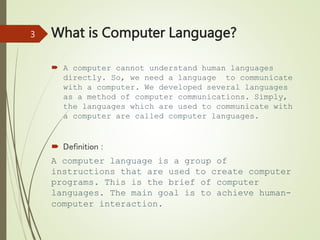
What is Computer Language?
 A computer cannot understand human languages
directly. So, we need a language to communicate
with a computer. We developed several languages
as a method of computer communications. Simply,
the languages which are used to communicate with
a computer are called computer languages.
 Definition :
A computer language is a group of
instructions that are used to create computer
programs. This is the brief of computer
languages. The main goal is to achieve human-
computer interaction.
3
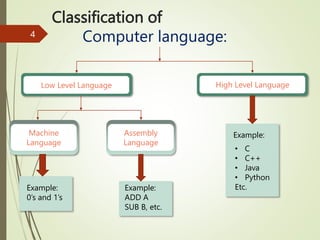
Classification of
Computer language:
Machine
Language
Low Level Language High Level Language
Assembly
Language
Example:
• C
• C++
• Java
• Python
Etc.
Example:
0’s and 1’s
Example:
ADD A
SUB B, etc.
4
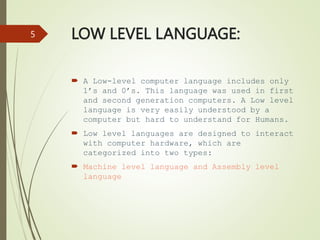
LOW LEVEL LANGUAGE:
 A Low-level computer language includes only
1’s and 0’s. This language was used in first
and second generation computers. A Low level
language is very easily understood by a
computer but hard to understand for Humans.
 Low level languages are designed to interact
with computer hardware, which are
categorized into two types:
 Machine level language and Assembly level
language
5
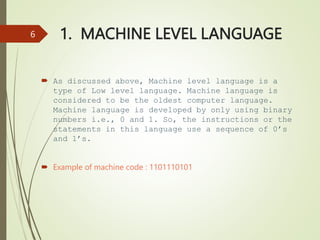
1. MACHINE LEVEL LANGUAGE
 As discussed above, Machine level language is a
type of Low level language. Machine language is
considered to be the oldest computer language.
Machine language is developed by only using binary
numbers i.e., 0 and 1. So, the instructions or the
statements in this language use a sequence of 0’s
and 1’s.
 Example of machine code : 1101110101
6
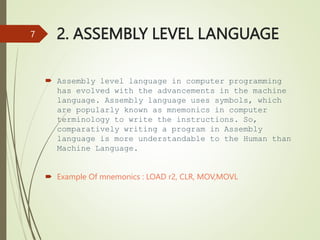
2. ASSEMBLY LEVEL LANGUAGE
 Assembly level language in computer programming
has evolved with the advancements in the machine
language. Assembly language uses symbols, which
are popularly known as mnemonics in computer
terminology to write the instructions. So,
comparatively writing a program in Assembly
language is more understandable to the Human than
Machine Language.
 Example Of mnemonics : LOAD r2, CLR, MOV,MOVL
7
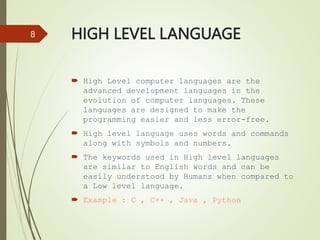
HIGH LEVEL LANGUAGE
 High Level computer languages are the
advanced development languages in the
evolution of computer languages. These
languages are designed to make the
programming easier and less error-free.
 High level language uses words and commands
along with symbols and numbers.
 The keywords used in High level languages
are similar to English words and can be
easily understood by Humans when compared to
a Low level language.
 Example : C , C++ , Java , Python
8
Difference Between
High Level Language
and
Low Level Language:
9
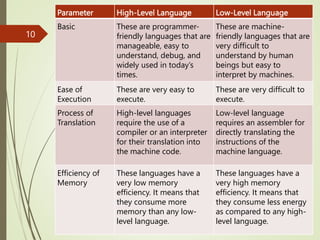
Parameter High-Level Language Low-Level Language
Basic These are programmer-
friendly languages that are
manageable, easy to
understand, debug, and
widely used in today’s
times.
These are machine-
friendly languages that are
very difficult to
understand by human
beings but easy to
interpret by machines.
Ease of
Execution
These are very easy to
execute.
These are very difficult to
execute.
Process of
Translation
High-level languages
require the use of a
compiler or an interpreter
for their translation into
the machine code.
Low-level language
requires an assembler for
directly translating the
instructions of the
machine language.
Efficiency of
Memory
These languages have a
very low memory
efficiency. It means that
they consume more
memory than any low-
level language.
These languages have a
very high memory
efficiency. It means that
they consume less energy
as compared to any high-
level language.
10
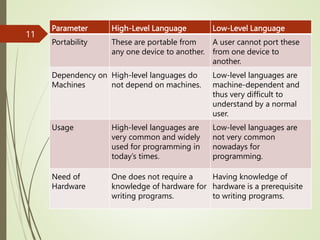
Parameter High-Level Language Low-Level Language
Portability These are portable from
any one device to another.
A user cannot port these
from one device to
another.
Dependency on
Machines
High-level languages do
not depend on machines.
Low-level languages are
machine-dependent and
thus very difficult to
understand by a normal
user.
Usage High-level languages are
very common and widely
used for programming in
today’s times.
Low-level languages are
not very common
nowadays for
programming.
Need of
Hardware
One does not require a
knowledge of hardware for
writing programs.
Having knowledge of
hardware is a prerequisite
to writing programs.
11
12

Computer Language -by VarunThapa.pptx

  • 1.
  • 2.
    Topic Cover :- Whatis Computer Language ? Classification of Computer Language. Difference Between Low level and High level Language. 2
  • 3.
    What is ComputerLanguage?  A computer cannot understand human languages directly. So, we need a language to communicate with a computer. We developed several languages as a method of computer communications. Simply, the languages which are used to communicate with a computer are called computer languages.  Definition : A computer language is a group of instructions that are used to create computer programs. This is the brief of computer languages. The main goal is to achieve human- computer interaction. 3
  • 4.
    Classification of Computer language: Machine Language LowLevel Language High Level Language Assembly Language Example: • C • C++ • Java • Python Etc. Example: 0’s and 1’s Example: ADD A SUB B, etc. 4
  • 5.
    LOW LEVEL LANGUAGE: A Low-level computer language includes only 1’s and 0’s. This language was used in first and second generation computers. A Low level language is very easily understood by a computer but hard to understand for Humans.  Low level languages are designed to interact with computer hardware, which are categorized into two types:  Machine level language and Assembly level language 5
  • 6.
    1. MACHINE LEVELLANGUAGE  As discussed above, Machine level language is a type of Low level language. Machine language is considered to be the oldest computer language. Machine language is developed by only using binary numbers i.e., 0 and 1. So, the instructions or the statements in this language use a sequence of 0’s and 1’s.  Example of machine code : 1101110101 6
  • 7.
    2. ASSEMBLY LEVELLANGUAGE  Assembly level language in computer programming has evolved with the advancements in the machine language. Assembly language uses symbols, which are popularly known as mnemonics in computer terminology to write the instructions. So, comparatively writing a program in Assembly language is more understandable to the Human than Machine Language.  Example Of mnemonics : LOAD r2, CLR, MOV,MOVL 7
  • 8.
    HIGH LEVEL LANGUAGE High Level computer languages are the advanced development languages in the evolution of computer languages. These languages are designed to make the programming easier and less error-free.  High level language uses words and commands along with symbols and numbers.  The keywords used in High level languages are similar to English words and can be easily understood by Humans when compared to a Low level language.  Example : C , C++ , Java , Python 8
  • 9.
    Difference Between High LevelLanguage and Low Level Language: 9
  • 10.
    Parameter High-Level LanguageLow-Level Language Basic These are programmer- friendly languages that are manageable, easy to understand, debug, and widely used in today’s times. These are machine- friendly languages that are very difficult to understand by human beings but easy to interpret by machines. Ease of Execution These are very easy to execute. These are very difficult to execute. Process of Translation High-level languages require the use of a compiler or an interpreter for their translation into the machine code. Low-level language requires an assembler for directly translating the instructions of the machine language. Efficiency of Memory These languages have a very low memory efficiency. It means that they consume more memory than any low- level language. These languages have a very high memory efficiency. It means that they consume less energy as compared to any high- level language. 10
  • 11.
    Parameter High-Level LanguageLow-Level Language Portability These are portable from any one device to another. A user cannot port these from one device to another. Dependency on Machines High-level languages do not depend on machines. Low-level languages are machine-dependent and thus very difficult to understand by a normal user. Usage High-level languages are very common and widely used for programming in today’s times. Low-level languages are not very common nowadays for programming. Need of Hardware One does not require a knowledge of hardware for writing programs. Having knowledge of hardware is a prerequisite to writing programs. 11
  • 12.