Definition:-
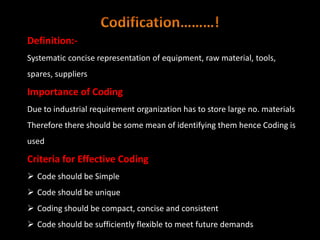
Systematic concise representation of equipment, raw material, tools,
spares, suppliers
Importance of Coding
Due to industrial requirement organization has to store large no. materials
Therefore there should be some mean of identifying them hence Coding is
used
Criteria for Effective Coding
 Code should be Simple
 Code should be unique
 Coding should be compact, concise and consistent
 Code should be sufficiently flexible to meet future demands
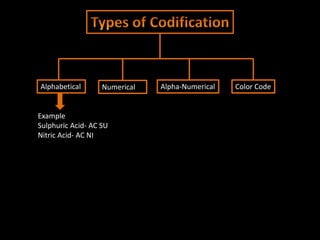
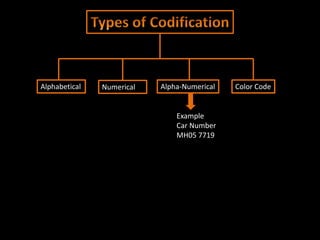
Alphabetical Numerical Alpha-Numerical Color Code
Example
Sulphuric Acid- AC SU
Nitric Acid- AC NI
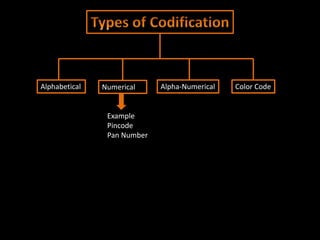
Alphabetical Numerical Alpha-Numerical Color Code
Example
Pincode
Pan Number
Alphabetical Numerical Alpha-Numerical Color Code
Example
Car Number
MH05 7719
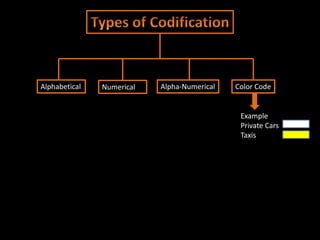
Alphabetical Numerical Alpha-Numerical Color Code
Example
Private Cars
Taxis
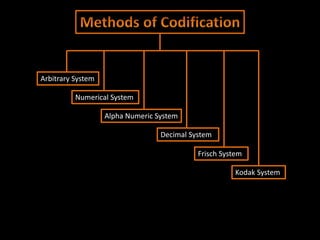
Arbitrary System
Numerical System
Alpha Numeric System
Decimal System
Frisch System
Kodak System
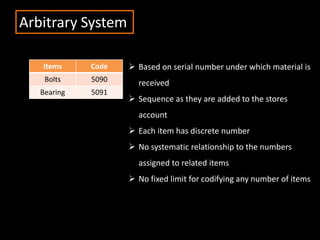
Arbitrary System
Items Code
Bolts 5090
Bearing 5091
 Based on serial number under which material is
received
 Sequence as they are added to the stores
account
 Each item has discrete number
 No systematic relationship to the numbers
assigned to related items
 No fixed limit for codifying any number of items
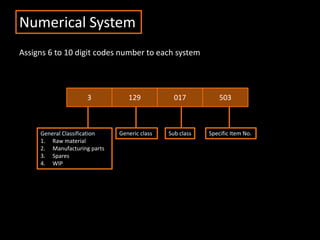
Numerical System
Assigns 6 to 10 digit codes number to each system
3 129 017 503
General Classification
1. Raw material
2. Manufacturing parts
3. Spares
4. WIP
Generic class Sub class Specific Item No.
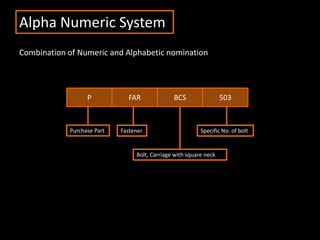
Alpha Numeric System
Combination of Numeric and Alphabetic nomination
P FAR BCS 503
Specific No. of bolt
Bolt, Carriage with square neck
FastenerPurchase Part
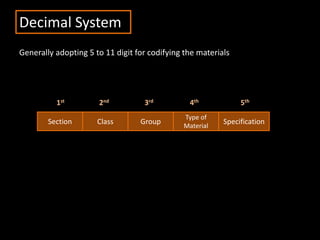
Decimal System
Generally adopting 5 to 11 digit for codifying the materials
Class Group
Type of
Material
SpecificationSection
1st 2nd 3rd 4th 5th
Frisch System
 7 digits applied in 3 stages
 Grouping is based on
 Suitable Preliminary Categories:- Assemblies, Subassemblies,
Components and off the shelf item
 Preliminary Categories:- Items are grouped within the respective
class in order to bring similar item together
Kodak System
 10 digit numerical data
 Grouping is based on Source of supply
 All the materials are divided in 100 basic classification
 For example, if bolt is listed as hardware item if this is listed
in hardware catalogues & available with hardware suppliers
 For example, if this bolt is available as a part of the machine,
it will be available under maintenance
• Result of rationalized codification reduces the no. of Items
• Systematic grouping of similar items
• Avoid the confusion caused by long description of the items
• Helps in avoiding duplication of items
• Enables the easy recognition of an item in the stores
• Minimizing of clerical work
• Accurate and logical identification
• Accurate and reliable accounting and recording
• Prevention of duplication
• Avoidance of Long description of Items
STANDARDISATION & CODIFICATION CASE
STUDY
• The problem- Railways in India
– Need thousands of parts to produce end product
– Necessary to number the parts for systemization &thus avoid
confusion
– necessary to deliver the right item in the right quantity to the right
place at the right time and at reasonable cost
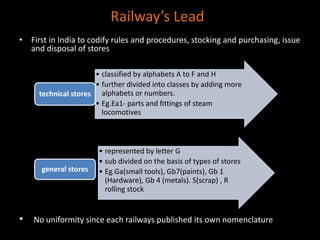
Railway’s Lead
• First in India to codify rules and procedures, stocking and purchasing, issue
and disposal of stores
• No uniformity since each railways published its own nomenclature
• classified by alphabets A to F and H
• further divided into classes by adding more
alphabets or numbers.
• Eg.Ea1- parts and fittings of steam
locomotives
technical stores
• represented by letter G
• sub divided on the basis of types of stores
• Eg.Ga(small tools), Gb7(paints), Gb 1
(Hardware), Gb 4 (metals). S(scrap) , R
rolling stock
general stores
Paranjape Committee’s Recommendations
• railways should compile and publish a catalogue of
standardized items
• computerize inventory control
• 1967- committee appointed to examine the different systems
adopted by different railways
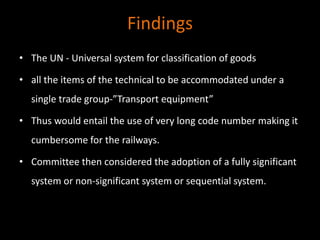
Findings
• The UN - Universal system for classification of goods
• all the items of the technical to be accommodated under a
single trade group-”Transport equipment”
• Thus would entail the use of very long code number making it
cumbersome for the railways.
• Committee then considered the adoption of a fully significant
system or non-significant system or sequential system.
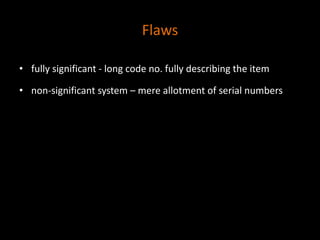
Flaws
• fully significant - long code no. fully describing the item
• non-significant system – mere allotment of serial numbers
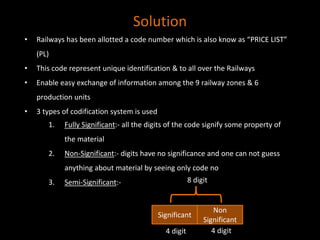
• Railways has been allotted a code number which is also know as “PRICE LIST”
(PL)
• This code represent unique identification & to all over the Railways
• Enable easy exchange of information among the 9 railway zones & 6
production units
• 3 types of codification system is used
1. Fully Significant:- all the digits of the code signify some property of
the material
2. Non-Significant:- digits have no significance and one can not guess
anything about material by seeing only code no
3. Semi-Significant:-
Significant
Non
Significant
8 digit
4 digit 4 digit
Solution
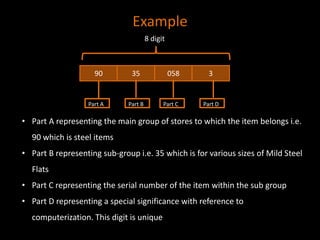
90 35 058 3
Part A Part B Part C Part D
• Part A representing the main group of stores to which the item belongs i.e.
90 which is steel items
• Part B representing sub-group i.e. 35 which is for various sizes of Mild Steel
Flats
• Part C representing the serial number of the item within the sub group
• Part D representing a special significance with reference to
computerization. This digit is unique
8 digit
Example
Codification

Codification

  • 2.
    Definition:- Systematic concise representationof equipment, raw material, tools, spares, suppliers Importance of Coding Due to industrial requirement organization has to store large no. materials Therefore there should be some mean of identifying them hence Coding is used Criteria for Effective Coding  Code should be Simple  Code should be unique  Coding should be compact, concise and consistent  Code should be sufficiently flexible to meet future demands
  • 3.
    Alphabetical Numerical Alpha-NumericalColor Code Example Sulphuric Acid- AC SU Nitric Acid- AC NI
  • 4.
    Alphabetical Numerical Alpha-NumericalColor Code Example Pincode Pan Number
  • 5.
    Alphabetical Numerical Alpha-NumericalColor Code Example Car Number MH05 7719
  • 6.
    Alphabetical Numerical Alpha-NumericalColor Code Example Private Cars Taxis
  • 7.
    Arbitrary System Numerical System AlphaNumeric System Decimal System Frisch System Kodak System
  • 8.
    Arbitrary System Items Code Bolts5090 Bearing 5091  Based on serial number under which material is received  Sequence as they are added to the stores account  Each item has discrete number  No systematic relationship to the numbers assigned to related items  No fixed limit for codifying any number of items
  • 9.
    Numerical System Assigns 6to 10 digit codes number to each system 3 129 017 503 General Classification 1. Raw material 2. Manufacturing parts 3. Spares 4. WIP Generic class Sub class Specific Item No.
  • 10.
    Alpha Numeric System Combinationof Numeric and Alphabetic nomination P FAR BCS 503 Specific No. of bolt Bolt, Carriage with square neck FastenerPurchase Part
  • 11.
    Decimal System Generally adopting5 to 11 digit for codifying the materials Class Group Type of Material SpecificationSection 1st 2nd 3rd 4th 5th
  • 12.
    Frisch System  7digits applied in 3 stages  Grouping is based on  Suitable Preliminary Categories:- Assemblies, Subassemblies, Components and off the shelf item  Preliminary Categories:- Items are grouped within the respective class in order to bring similar item together
  • 13.
    Kodak System  10digit numerical data  Grouping is based on Source of supply  All the materials are divided in 100 basic classification  For example, if bolt is listed as hardware item if this is listed in hardware catalogues & available with hardware suppliers  For example, if this bolt is available as a part of the machine, it will be available under maintenance
  • 14.
    • Result ofrationalized codification reduces the no. of Items • Systematic grouping of similar items • Avoid the confusion caused by long description of the items • Helps in avoiding duplication of items • Enables the easy recognition of an item in the stores • Minimizing of clerical work • Accurate and logical identification • Accurate and reliable accounting and recording • Prevention of duplication • Avoidance of Long description of Items
  • 15.
    STANDARDISATION & CODIFICATIONCASE STUDY • The problem- Railways in India – Need thousands of parts to produce end product – Necessary to number the parts for systemization &thus avoid confusion – necessary to deliver the right item in the right quantity to the right place at the right time and at reasonable cost
  • 16.
    Railway’s Lead • Firstin India to codify rules and procedures, stocking and purchasing, issue and disposal of stores • No uniformity since each railways published its own nomenclature • classified by alphabets A to F and H • further divided into classes by adding more alphabets or numbers. • Eg.Ea1- parts and fittings of steam locomotives technical stores • represented by letter G • sub divided on the basis of types of stores • Eg.Ga(small tools), Gb7(paints), Gb 1 (Hardware), Gb 4 (metals). S(scrap) , R rolling stock general stores
  • 17.
    Paranjape Committee’s Recommendations •railways should compile and publish a catalogue of standardized items • computerize inventory control • 1967- committee appointed to examine the different systems adopted by different railways
  • 18.
    Findings • The UN- Universal system for classification of goods • all the items of the technical to be accommodated under a single trade group-”Transport equipment” • Thus would entail the use of very long code number making it cumbersome for the railways. • Committee then considered the adoption of a fully significant system or non-significant system or sequential system.
  • 19.
    Flaws • fully significant- long code no. fully describing the item • non-significant system – mere allotment of serial numbers
  • 20.
    • Railways hasbeen allotted a code number which is also know as “PRICE LIST” (PL) • This code represent unique identification & to all over the Railways • Enable easy exchange of information among the 9 railway zones & 6 production units • 3 types of codification system is used 1. Fully Significant:- all the digits of the code signify some property of the material 2. Non-Significant:- digits have no significance and one can not guess anything about material by seeing only code no 3. Semi-Significant:- Significant Non Significant 8 digit 4 digit 4 digit Solution
  • 21.
    90 35 0583 Part A Part B Part C Part D • Part A representing the main group of stores to which the item belongs i.e. 90 which is steel items • Part B representing sub-group i.e. 35 which is for various sizes of Mild Steel Flats • Part C representing the serial number of the item within the sub group • Part D representing a special significance with reference to computerization. This digit is unique 8 digit Example