LABORATORY
HYGIENE & SAFETY
Dr. T. Geetha
Assistant Professor
Department of Chemistry
St.Mary’s College, Thrissur
Laboratory Hygiene & Safety
Laboratory is a place that provides facilities and controlled
conditions for carrying out scientific experiments and research
Laboratory Safety -Dr. T. Geetha, St. Mary’s College, Thrissur 2
Laboratory Hygiene & Safety
• Safety is freedom from danger, injury, or damage.
• Being safe -actions by you & by others
• always seek to do those things that prevent incidents
that might cause injury and harm.
3
Laboratory Hygiene & Safety
• Safety is freedom from danger, injury, or damage.
• Being safe -actions by you & by others
• always seek to do those things that prevent incidents
that might cause injury and harm.
4
Laboratory Hygiene & Safety
To ensure safety we must
• Recognize hazards.
• Assess the risks of hazards. - RAMP
• Minimize the risks of hazards.
• Prepare for emergencies.
5
Laboratory Hygiene & Safety
• A hazard is a potential source of danger or harm
• chemicals -inherent hazardous properties
• safety - minimizing, managing, or controlling these hazards
6
Laboratory Hygiene & Safety
• Risk is the probability of suffering harm from being exposed
to a hazard or unsafe situation.
• The level of risk depends on many things beyond the inherent
hazard of a chemical. For example, the amount of the
chemical, the form it is in (gas, liquid, or solid), and how you
handle the chemical all affect the level of risk
7
Laboratory Hygiene & Safety
• Risk is the probability of suffering harm from being exposed
to a hazard or unsafe situation
level of risk –
• the amount of the chemical,
• the form it is in (gas, liquid, or solid),
• and how you handle the chemical
8
Laboratory Hygiene & Safety
Three factors contribute to safety:
• environmental
• person factors
• behavioral factors
9
Laboratory Hygiene & Safety
environmental factors including facilities, location,
equipment, procedures, and standards
10
Laboratory Hygiene & Safety
• person factors - attitude, beliefs, personality,
knowledge, skills, and abilities
Dr. T. Geetha, St. Mary’s college, Thrissur 11
I need to be more
careful about things
on the floor that I
might trip over
Laboratory Hygiene & Safety
behavior factors including safe and risky practices
anything out of place- move it back out of the way
12
Laboratory Hygiene & Safety
Safety Rules for Laboratories
1. Follow instructor
2. Wear proper eye protection
3. Wear clothing that protects against
exposure and provides protection
from spills. -lab coat
13
Laboratory Hygiene & Safety
• Avoid loose cloths
• Confine long hair
• Avoid wearing dangling jewelery
• Do not use personal handkerchief in lab
14
Laboratory Hygiene & Safety
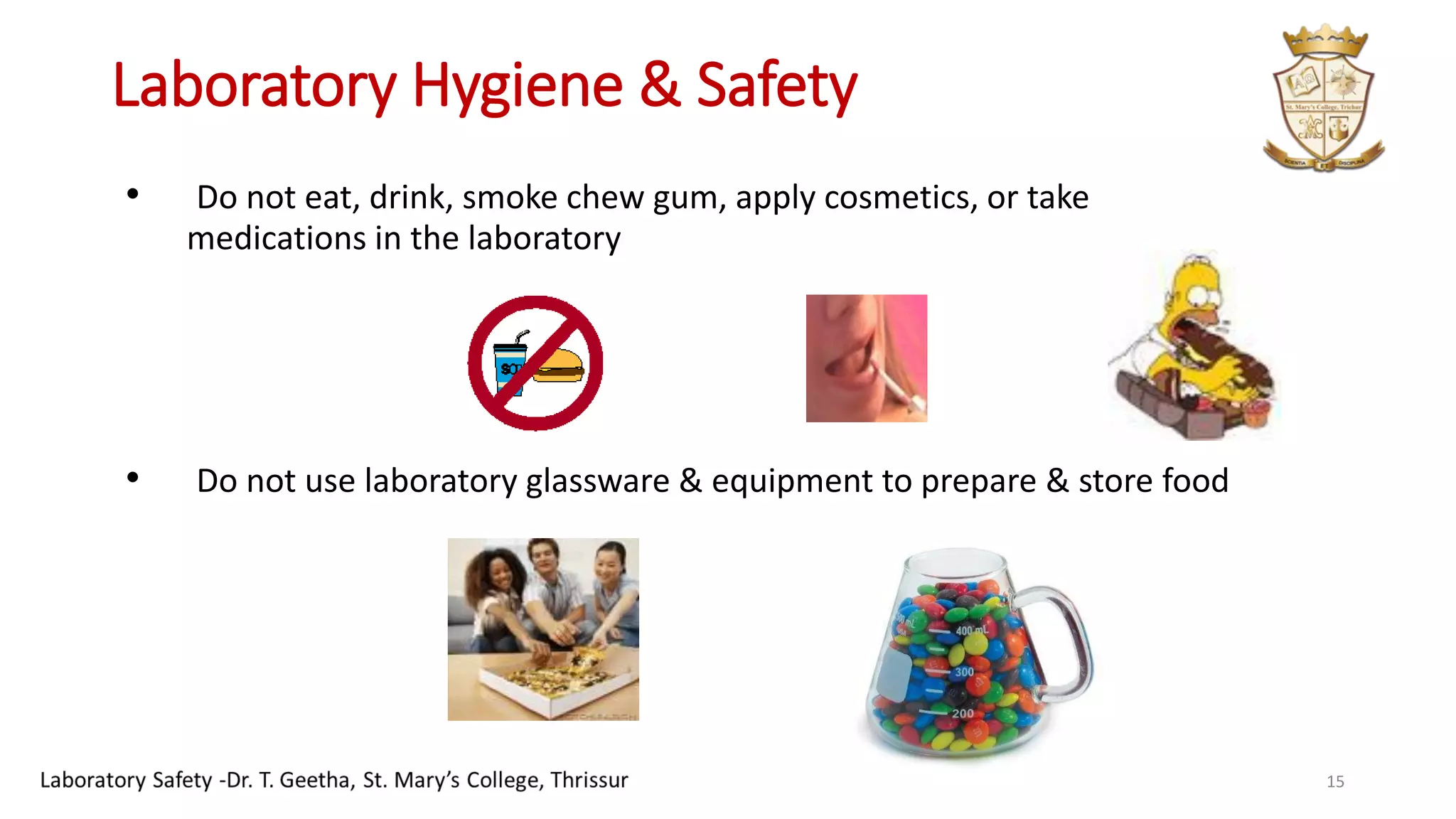
• Do not eat, drink, smoke chew gum, apply cosmetics, or take
medications in the laboratory
• Do not use laboratory glassware & equipment to prepare & store food
15
Laboratory Hygiene & Safety
• Keep hands away from eye nose mouth face hair & open skin
wound
• Clean all spills immediately & remove broken glassware
• Use books & journals only in clean area to prevent contamination
• In case of hazardous spill inform instructors
• There should be no boisterous conduct, excessive noise (radios,
DVD players, iPods), or practical jokes in the laboratory.
16
Laboratory Hygiene & Safety
• Never taste any laboratory chemical
• When smelling a chemical, gently waft the vapors toward your nose.
• Do not directly inhale the vapors
• If any chemical spills on your skin or in your eyes - flush affected area with
water - notify the instructor
17
Laboratory Hygiene & Safety
• Use test tube holder for heating test tube
• Know Location of emergency equipment
• If any chemical spills on your skin or in your eyes - flush affected area with water
- notify the instructor
18
Laboratory Hygiene & Safety
• Do not work alone in the laboratory
• Do not heat flammable liquids with a Bunsen burner or other open flame
19
Laboratory Hygiene & Safety
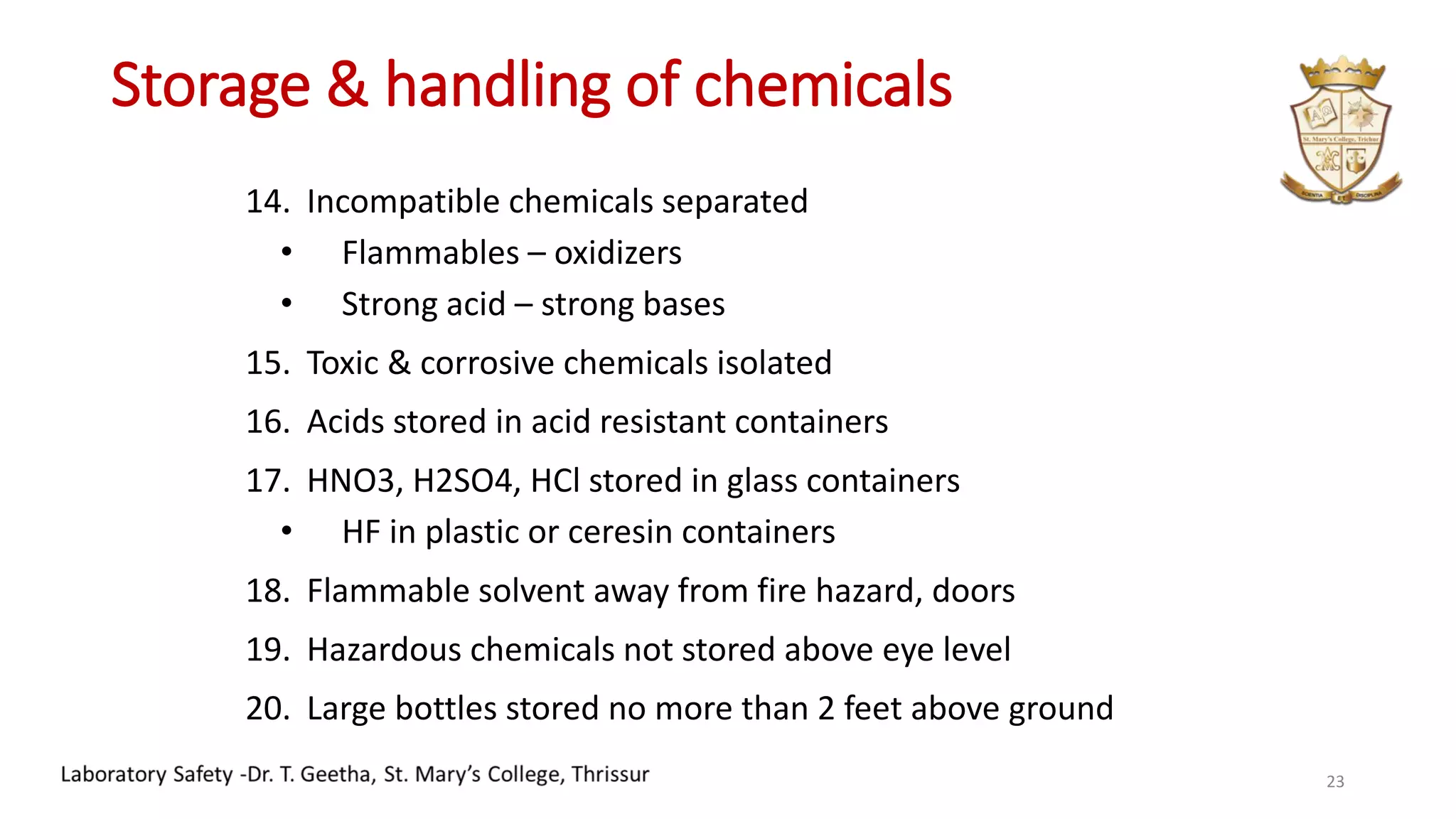
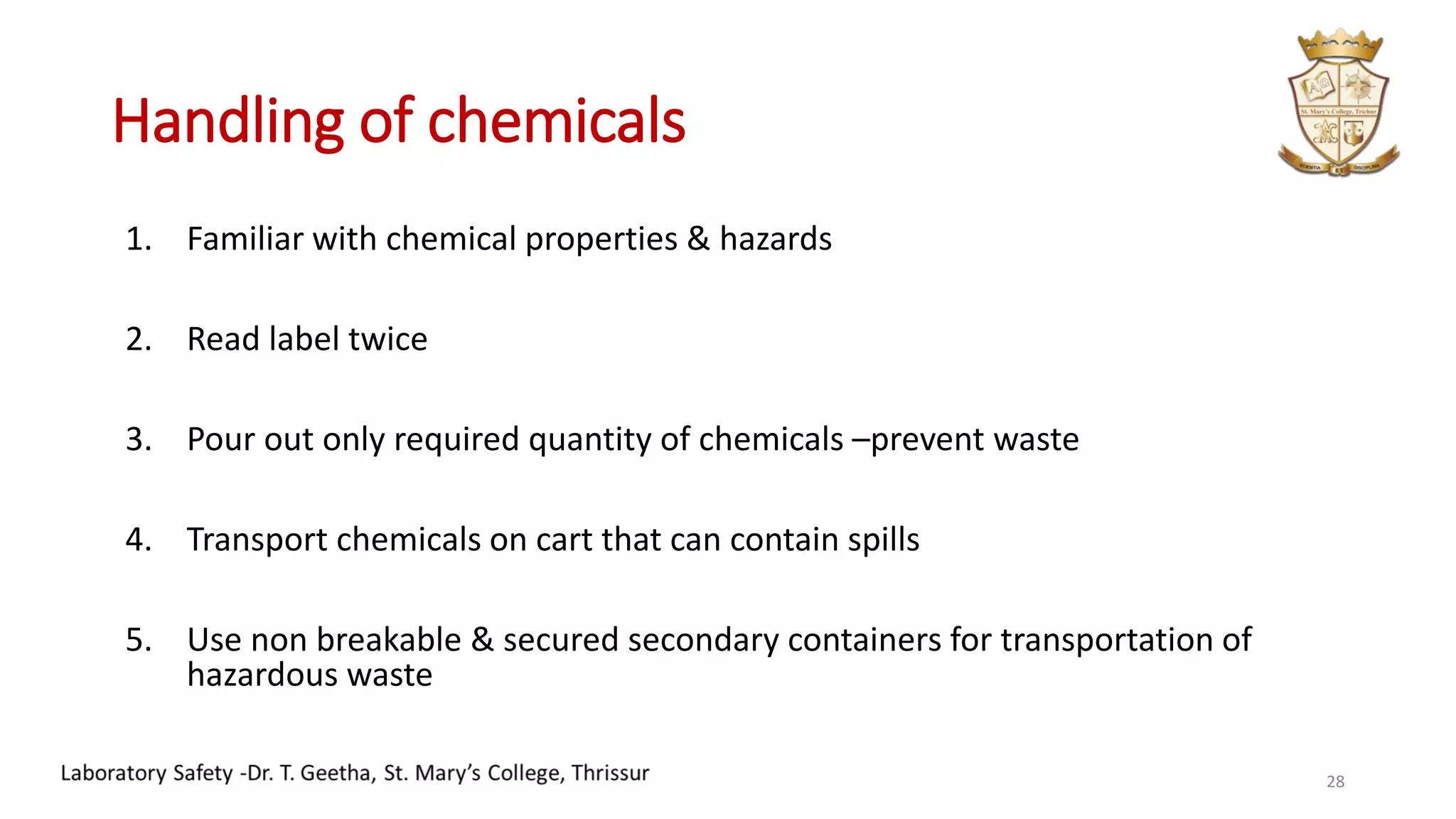
• Label all containers with chemicals or solutions
• Dispose of waste chemicals in the containers provided
20
Storage & handling of chemicals
Chemical storage area
1. Located away from process area & occupied building
2. Constructed from fire resistant material
3. must have continuous ventilation
4. Checked periodically for odour
5. Passageways not to be blocked
6. Should not have floor drains tp prevent contamination with
water
7. Proper posting in front of store room
21
Storage & handling of chemicals
8. Chemicals to be delivered to storage area for proper
maintenance of inventory
9. All containers in good condition & properly closed
10. Tanks & containers properly labeled
11. Secondary containment for all liquid hazardous materials
12. reserve supply of chemicals kept minimum
13. Expired chemicals marked for disposal
22
Storage & handling of chemicals
14. Incompatible chemicals separated
• Flammables – oxidizers
• Strong acid – strong bases
15. Toxic & corrosive chemicals isolated
16. Acids stored in acid resistant containers
17. HNO3, H2SO4, HCl stored in glass containers
• HF in plastic or ceresin containers
18. Flammable solvent away from fire hazard, doors
19. Hazardous chemicals not stored above eye level
20. Large bottles stored no more than 2 feet above ground
23
Inside laboratory
1. Large quantity of chemicals not to be stored in lab
2. Working quantity of routinely used chemicals
3. Minimum quantity of hazardous chemicals
• Lab -50L of flammable liquid
• Bench - 500mL in closed vessel
4. Chemicals arranged in compatible families
5. Not arranged alphabetically
24
Inside laboratory
6. Shelf with small frontal barriers – prevent sliding
7. Chemicals not to be stored above eye level
8. Chemicals not to be stored on floor
9. Chemicals kept away from heaters & sunlight
10. Clearly & legibly labled
11. Refrigerator used to store chemicals not to store food
25
Inside laboratory
12. Chemicals that react vigorously with water kept away from possible contact
13. Toxic, volatile, carcinogenic & reactive chemicals tightly sealed with
appropriate stoppers
14. Potentially explosives flammable chemicals stored only in rated or explosion
proof refrigerators
15. Do not store chemicals in fume cupboard
16. Compressed gas cylinders kept upright, away from heat source without
blocking exits
26
MSDS
Material Safety Data Sheet
• Information bulletin of a chemical that describes properties, health hazards,
routes of exposure, precaution for safe handling, emergency first aid & control
measures
27
Handling of chemicals
1. Familiar with chemical properties & hazards
2. Read label twice
3. Pour out only required quantity of chemicals –prevent waste
4. Transport chemicals on cart that can contain spills
5. Use non breakable & secured secondary containers for transportation of
hazardous waste
28
Handling of chemicals
6. Do not touch chemicals with hand
7. Do not smell chemicals directly
8. Do not taste chemicals
9. Do not hurry
10. While diluting add acid to water not vice versa
29
Handling of chemicals
11. Avoid mouth suction of pipette
12. Do not use damaged equipment
13. Ensure ventilation of lab
14. Close containers when not in use
15. Do not use metal spatula to handle peroxides – metals can catalyze their
explosive decomposition, use ceramic, Teflon or wooden spatula
30
Simple First Aid – Electric shock
• Switch of source of electricity
• Check victim for breathing & heartbeat
• If unresponsive or shows abnormal breathing - CPR (Cardiopulmonary
resuscitation)
• Arrange emergency medical aid
31
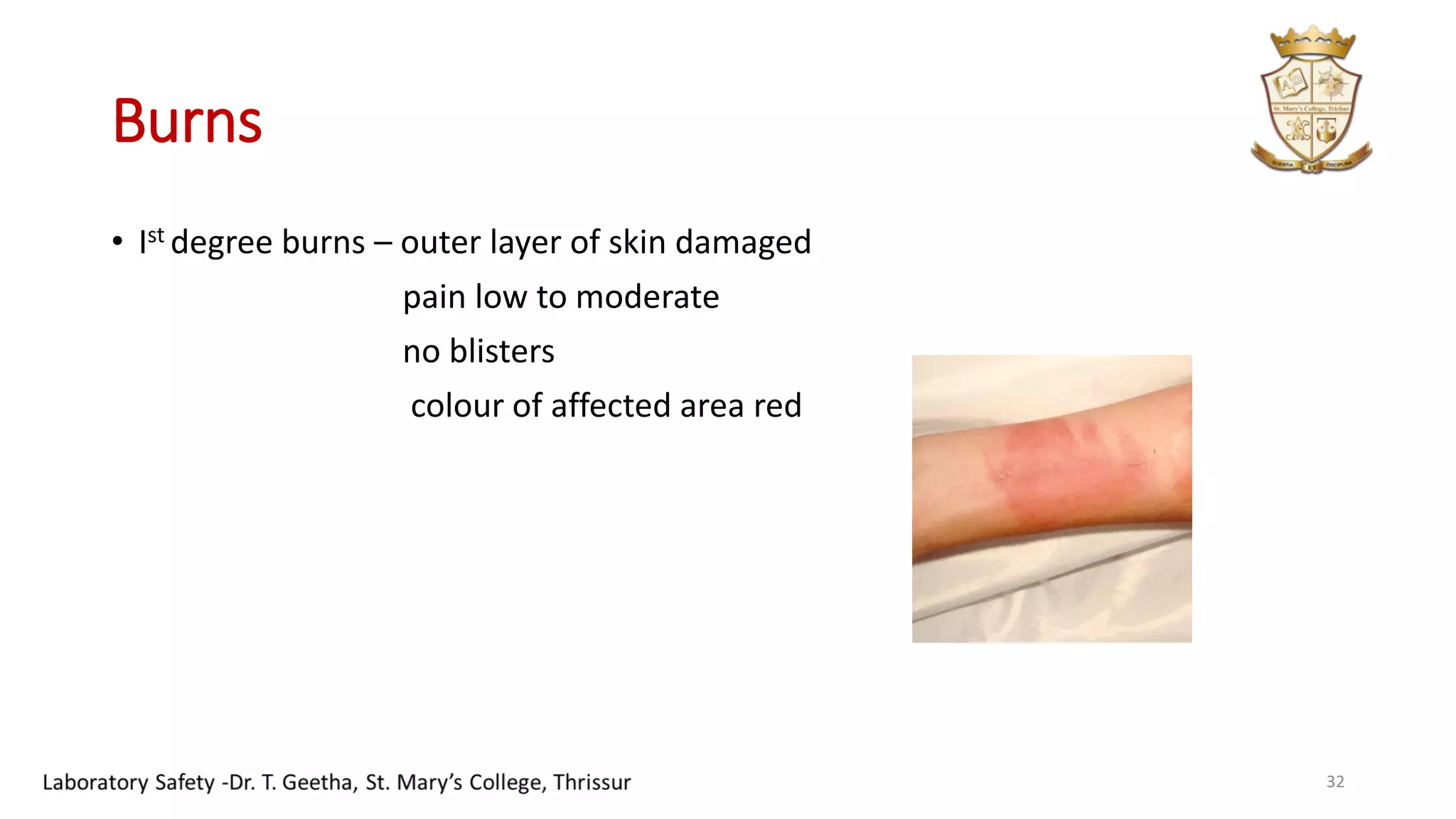
Burns
• Ist degree burns – outer layer of skin damaged
pain low to moderate
no blisters
colour of affected area red
32
Burns
2nd degree burn – outer & second layer of skin
damaged
pain level high
blisters present
colour of area red
33
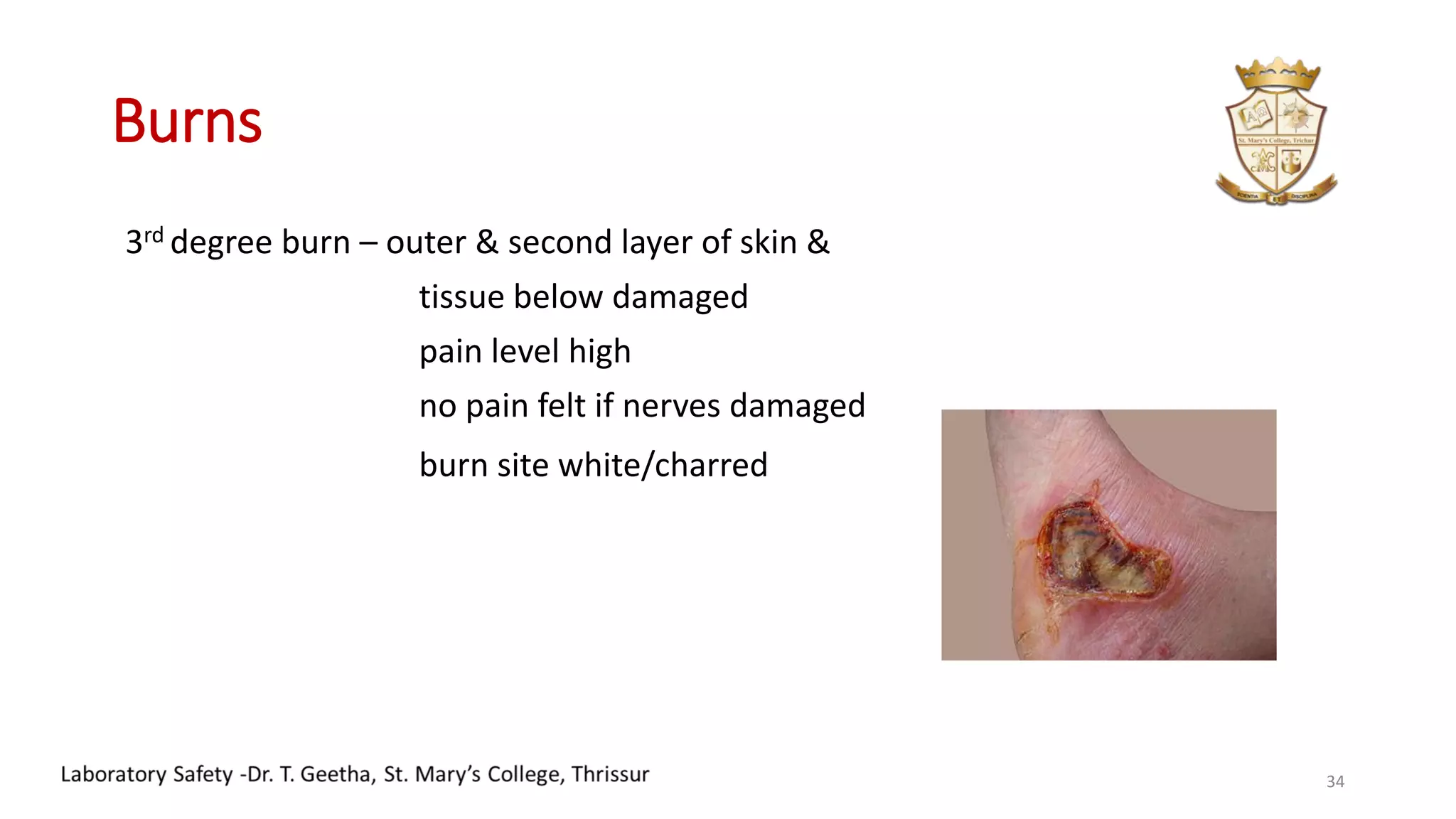
Burns
3rd degree burn – outer & second layer of skin &
tissue below damaged
pain level high
no pain felt if nerves damaged
burn site white/charred
34
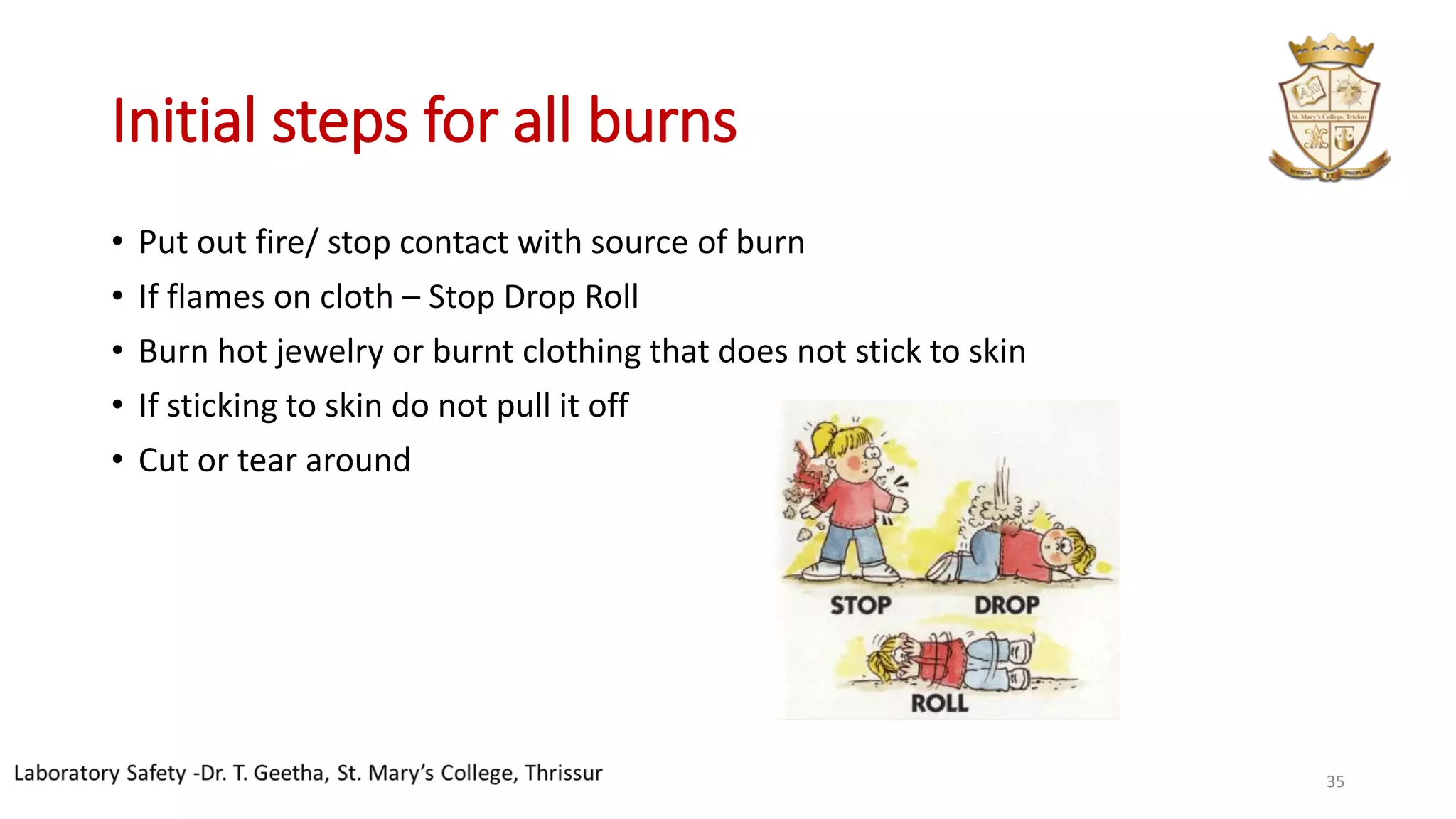
Initial steps for all burns
• Put out fire/ stop contact with source of burn
• If flames on cloth – Stop Drop Roll
• Burn hot jewelry or burnt clothing that does not stick to skin
• If sticking to skin do not pull it off
• Cut or tear around
35
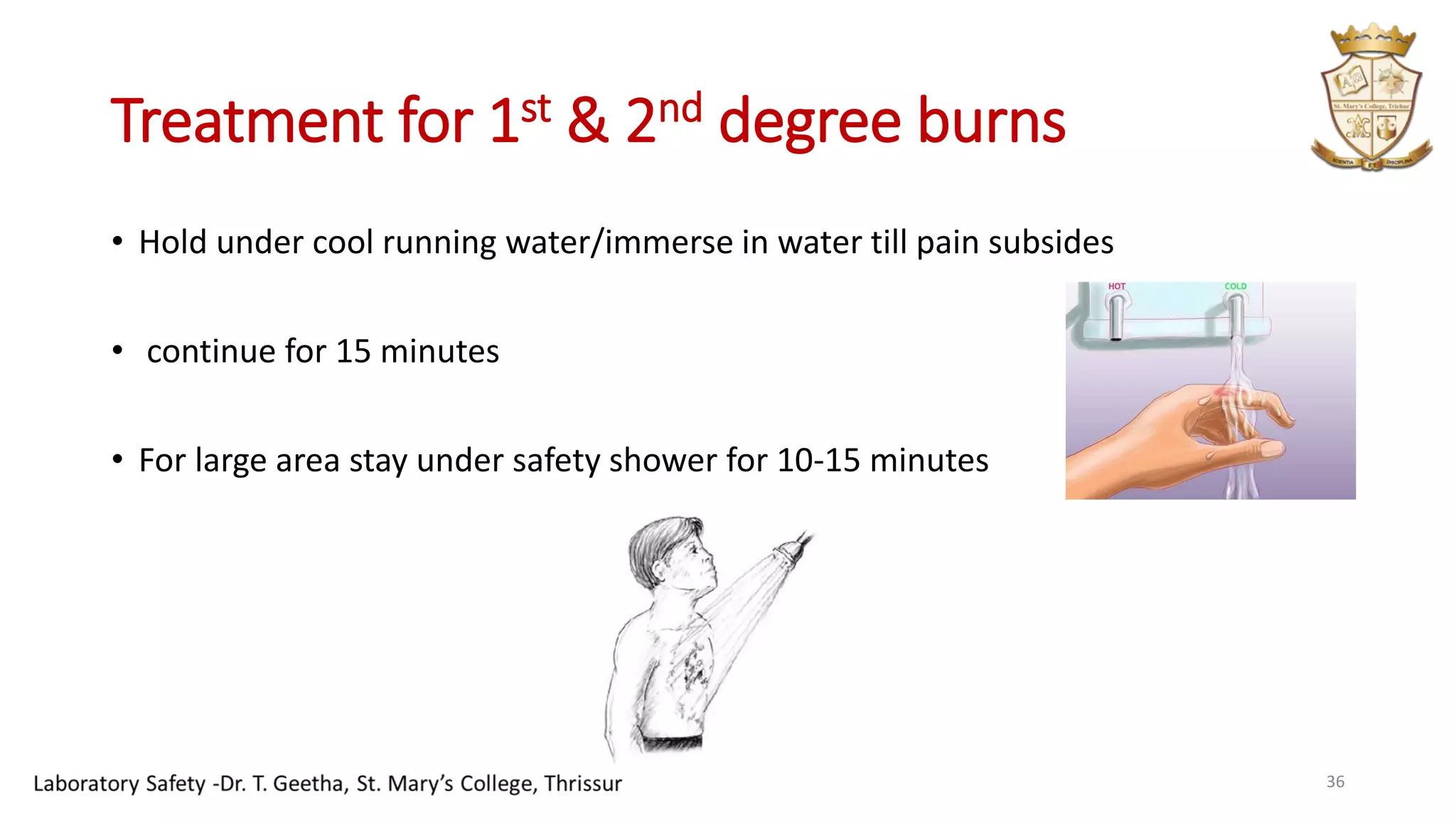
Treatment for 1st & 2nd degree burns
• Hold under cool running water/immerse in water till pain subsides
• continue for 15 minutes
• For large area stay under safety shower for 10-15 minutes
36
Treatment for 1st & 2nd degree burns
Don’t - break blisters
apply ice, cream, honey, butter, cream
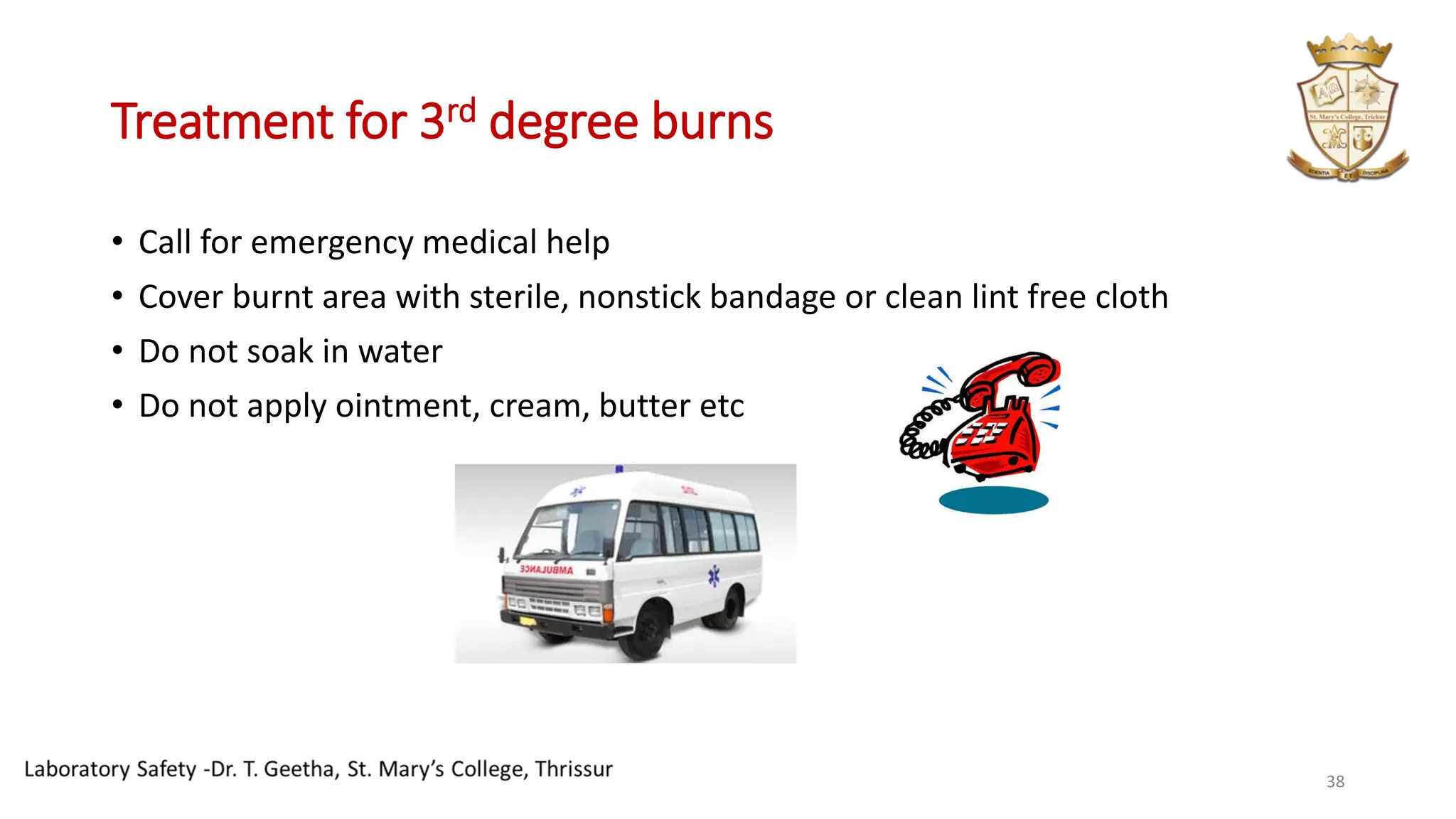
Cover with sterile non adhesive bandage
Seek medical advice
37
Treatment for 3rd degree burns
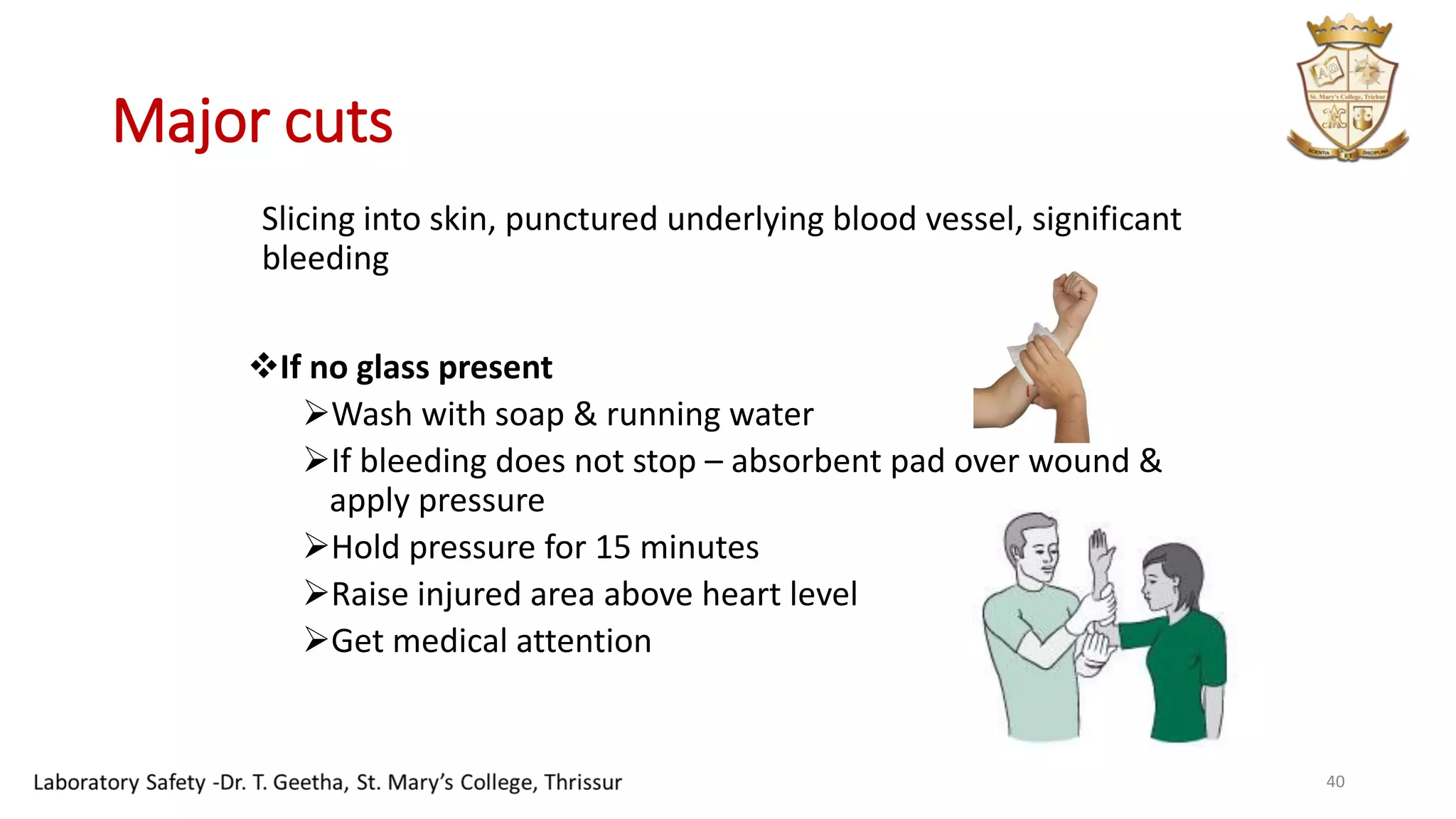
• Call for emergency medical help
• Cover burnt area with sterile, nonstick bandage or clean lint free cloth
• Do not soak in water
• Do not apply ointment, cream, butter etc
38
Cut by glass
MINOR CUTS
• let it bleed to wash out foreign particles
• Wash with antibacterial soap, cold running water
• Dry with sterile pad
• Apply antiseptic cream
39
Major cuts
Slicing into skin, punctured underlying blood vessel, significant
bleeding
❖If no glass present
➢Wash with soap & running water
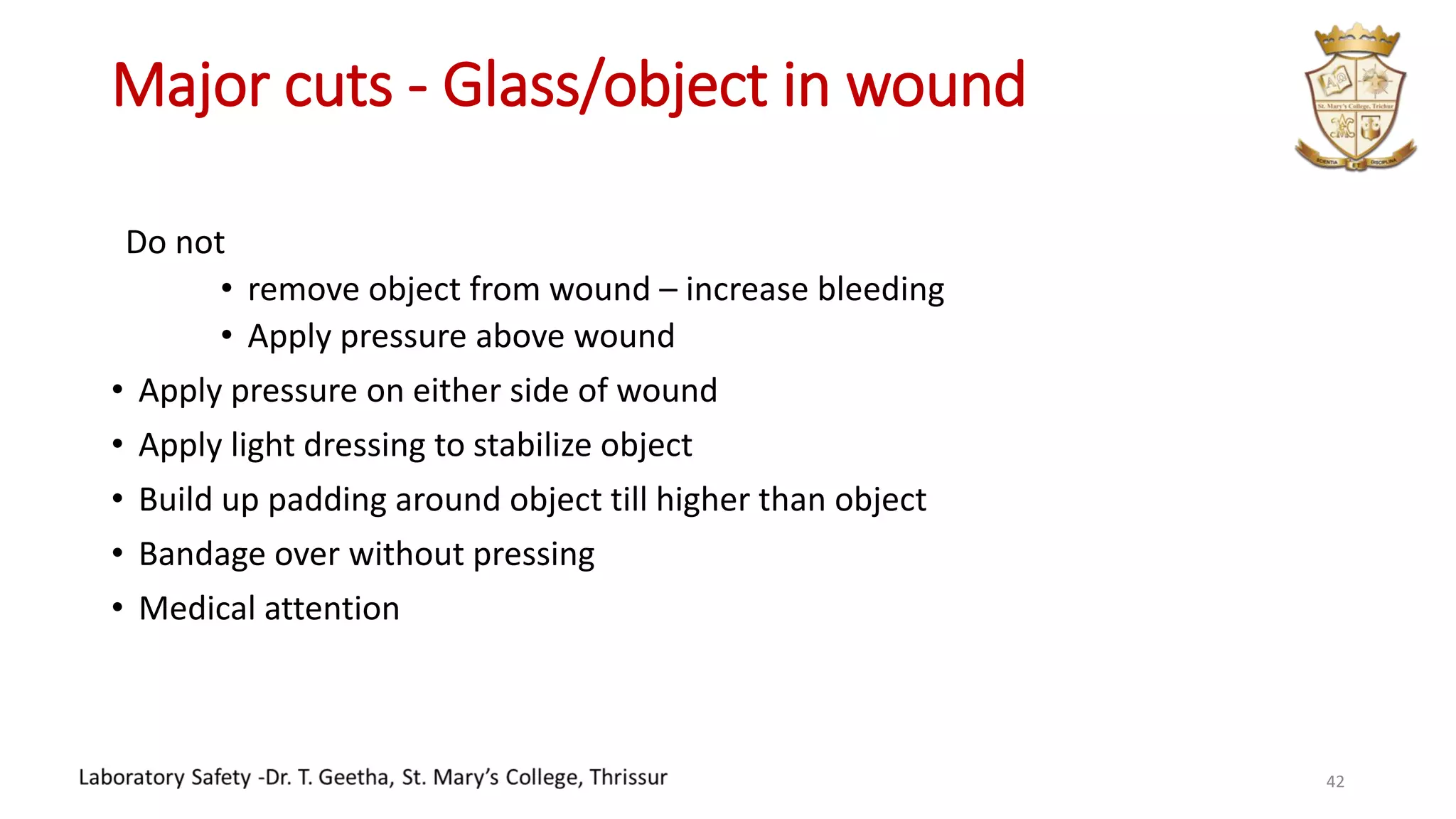
➢If bleeding does not stop – absorbent pad over wound &
apply pressure
➢Hold pressure for 15 minutes
➢Raise injured area above heart level
➢Get medical attention
40
Major cuts
Small glass piece in wound
➢Wash with cool running water
➢Flush glass out
➢If glass piece suspected – do not apply pressure
➢Lightly apply sterile dressing
➢Get medical attention
41
Major cuts - Glass/object in wound
Do not
• remove object from wound – increase bleeding
• Apply pressure above wound
• Apply pressure on either side of wound
• Apply light dressing to stabilize object
• Build up padding around object till higher than object
• Bandage over without pressing
• Medical attention
42
Inhalation of poisonous gas
• Remove to prevent further inhalation
• Take to fresh air
• Give CPR
• Check MSDS for first aid information
• Do not attempt rescue unless safe to do so
43
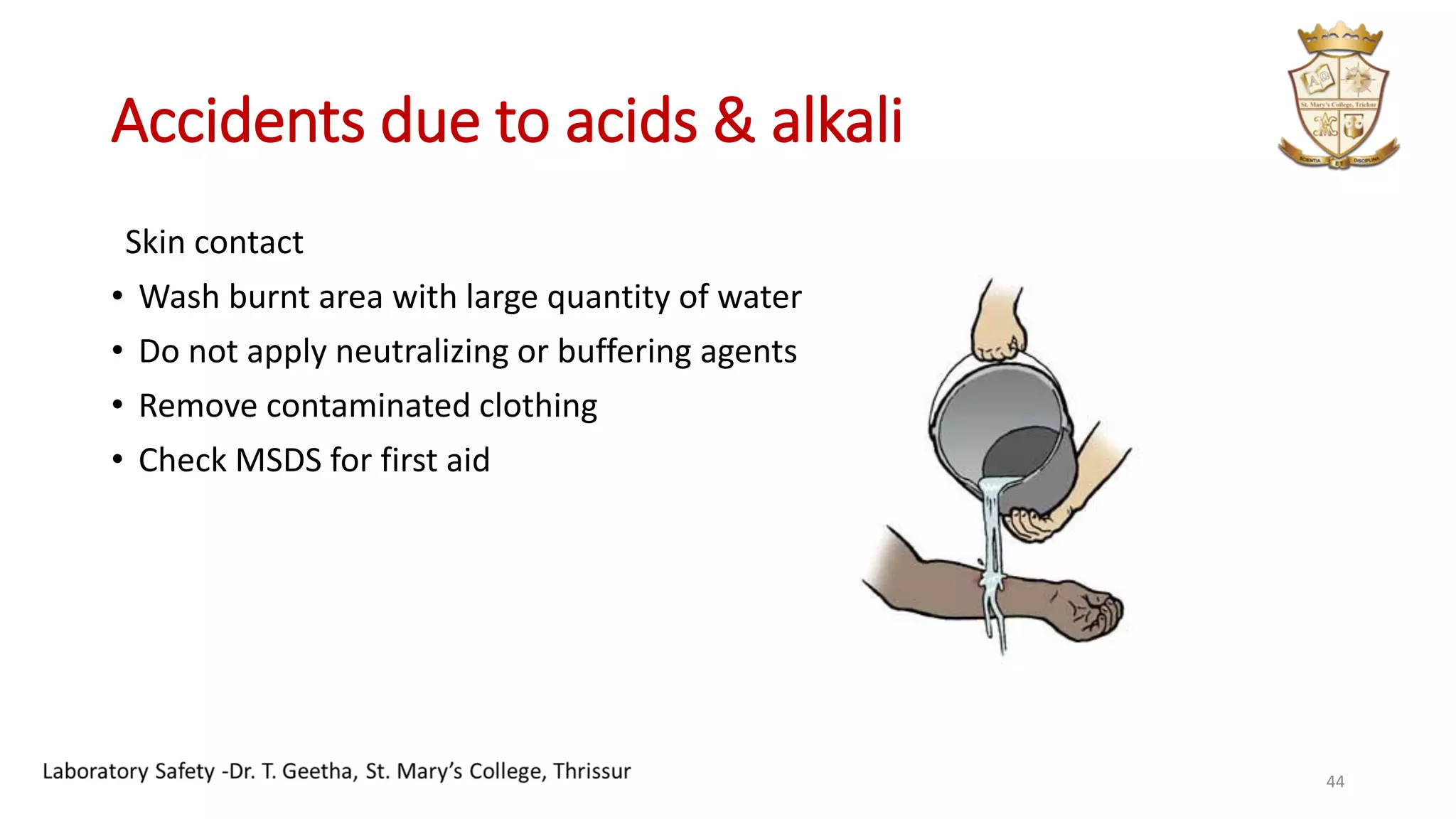
Accidents due to acids & alkali
Skin contact
• Wash burnt area with large quantity of water
• Do not apply neutralizing or buffering agents
• Remove contaminated clothing
• Check MSDS for first aid
44
Eye contact
• Wash with large amount of running water
• Occasionally lift & lower upper lid
• Remove contact lens after hurried wash
• Medical attention
45
Disposal of sodium
• Add scraps of sodium to 95% ethanol in fume hood
• At least 20ml for 1g Na
• Solvent should not boil
• C2H5ONa formed
• When visually reaction is complete, add water with swirling
• Allow to stand, dilute & discard
46
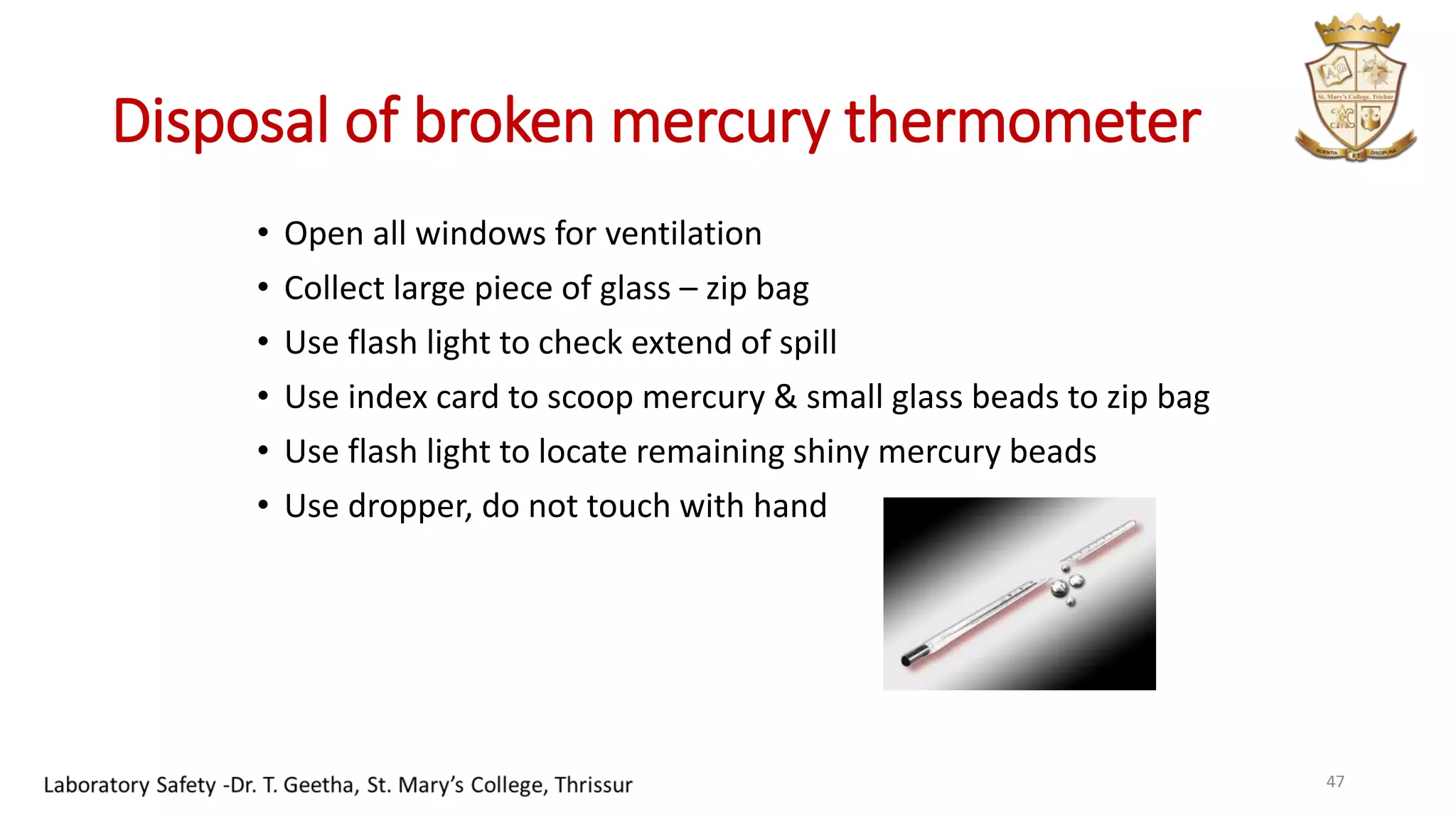
Disposal of broken mercury thermometer
• Open all windows for ventilation
• Collect large piece of glass – zip bag
• Use flash light to check extend of spill
• Use index card to scoop mercury & small glass beads to zip bag
• Use flash light to locate remaining shiny mercury beads
• Use dropper, do not touch with hand
47
Disposal of broken mercury thermometer
• Wrap a piece of scotch tape around gloved index finger with sticky side out & dab
contaminated area
• Used index card, dropper, tape, glove into zip bag
• Moisten Zn powder rub over contaminated area –leave for a day –solid amalgam
formed
• 20% solution of Calcium polysulphide –solid mercuric sulphide formed
• Use index card to scrap of solid product –zip bag
• Zip bag, clothings etc sealed & disposed
48
Kodaikanal experience
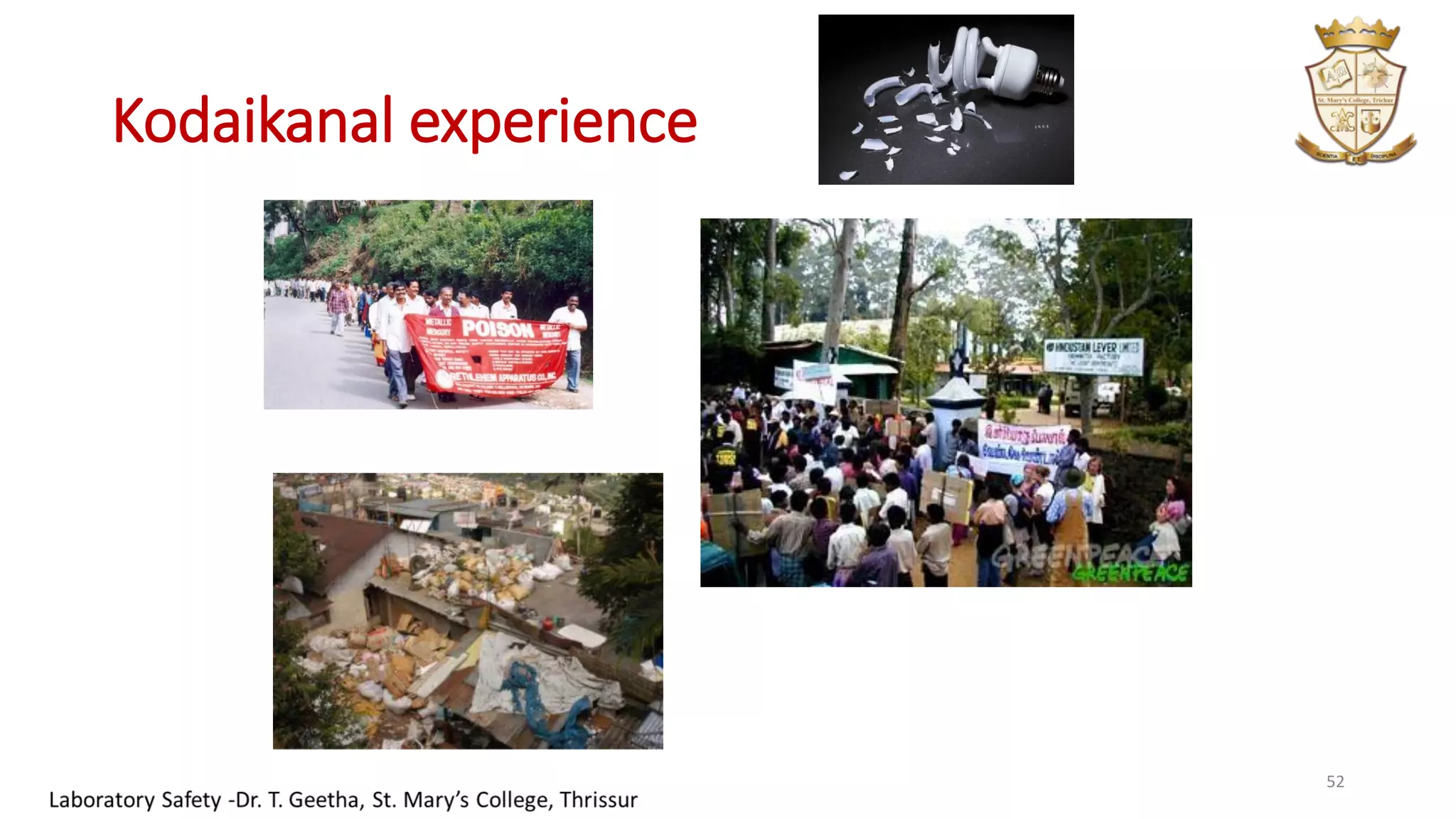
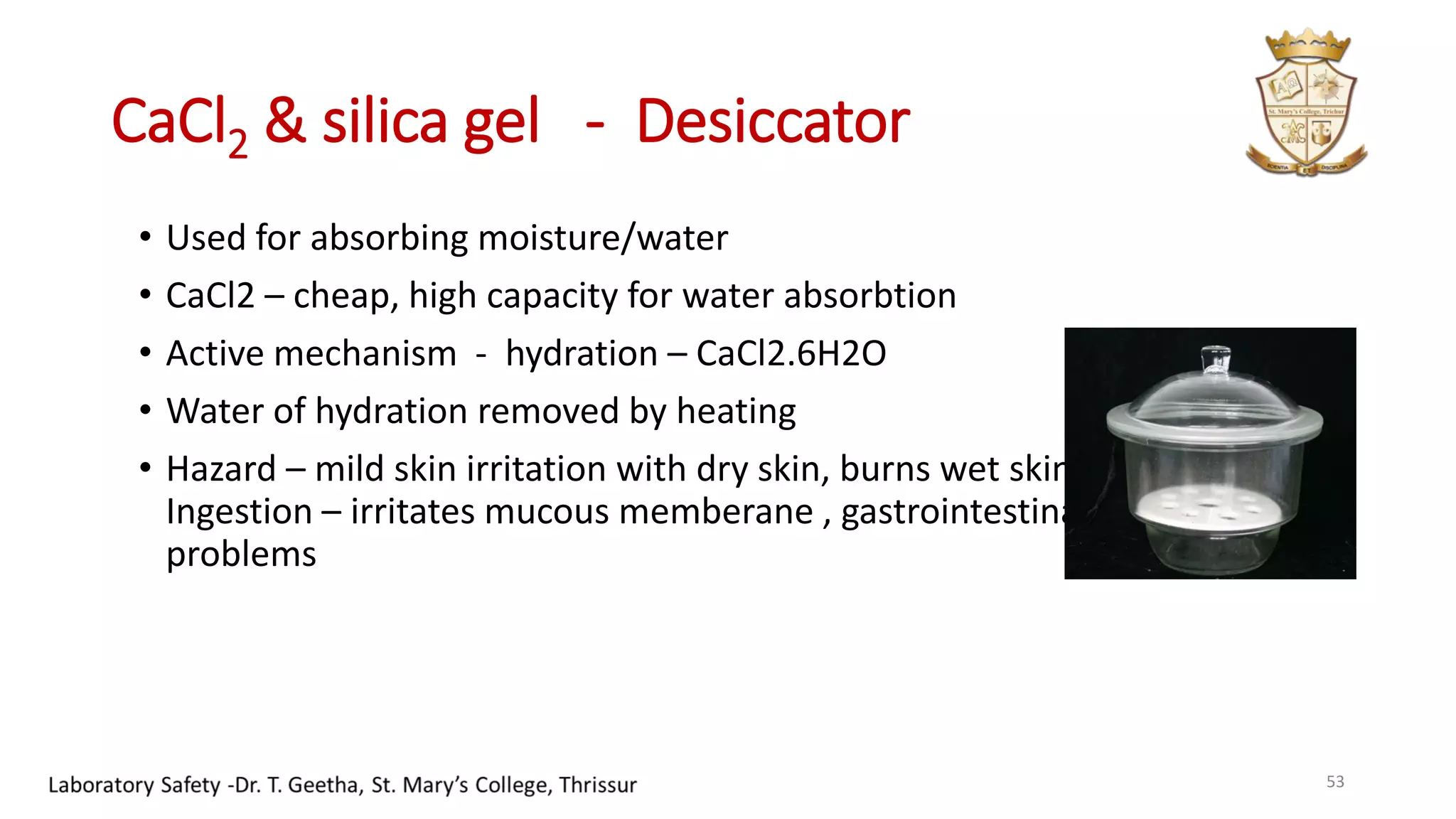
• mercury thermometer factory in Kodaikanal -
Hindustan Lever Ltd
• moved to India in 1983 after it was shut down in
Watertown, New York
• Tons of mercury waste from broken thermometers
• agitation by environmental activist
• Environmental authorities ordered the company to
collect and dispose of the waste
49
Kodaikanal experience
• Company plan to dispose waste flawed & lacked
environmental safeguards
• Health problems caused by mercury depend on how
much has entered your body
• Regardless of quantity, all mercury spills should be
treated seriously
50
Kodaikanal experience
• 2003, the Tamil Nadu Pollution Control Board ordered the company to ship the
mercury-laden waste back to the United States for proper disposal
• Waste packed into containers and brought to a port in Tamil Nadu for loading
onto a ship bound for the U.S.
• The ship, carrying some 300 tons of mercury-contaminated waste from
Kodaikanal, departed for Bethlehem Apparatus, a mercury recycling plant in
Pennsylvania
51
Kodaikanal experience
52
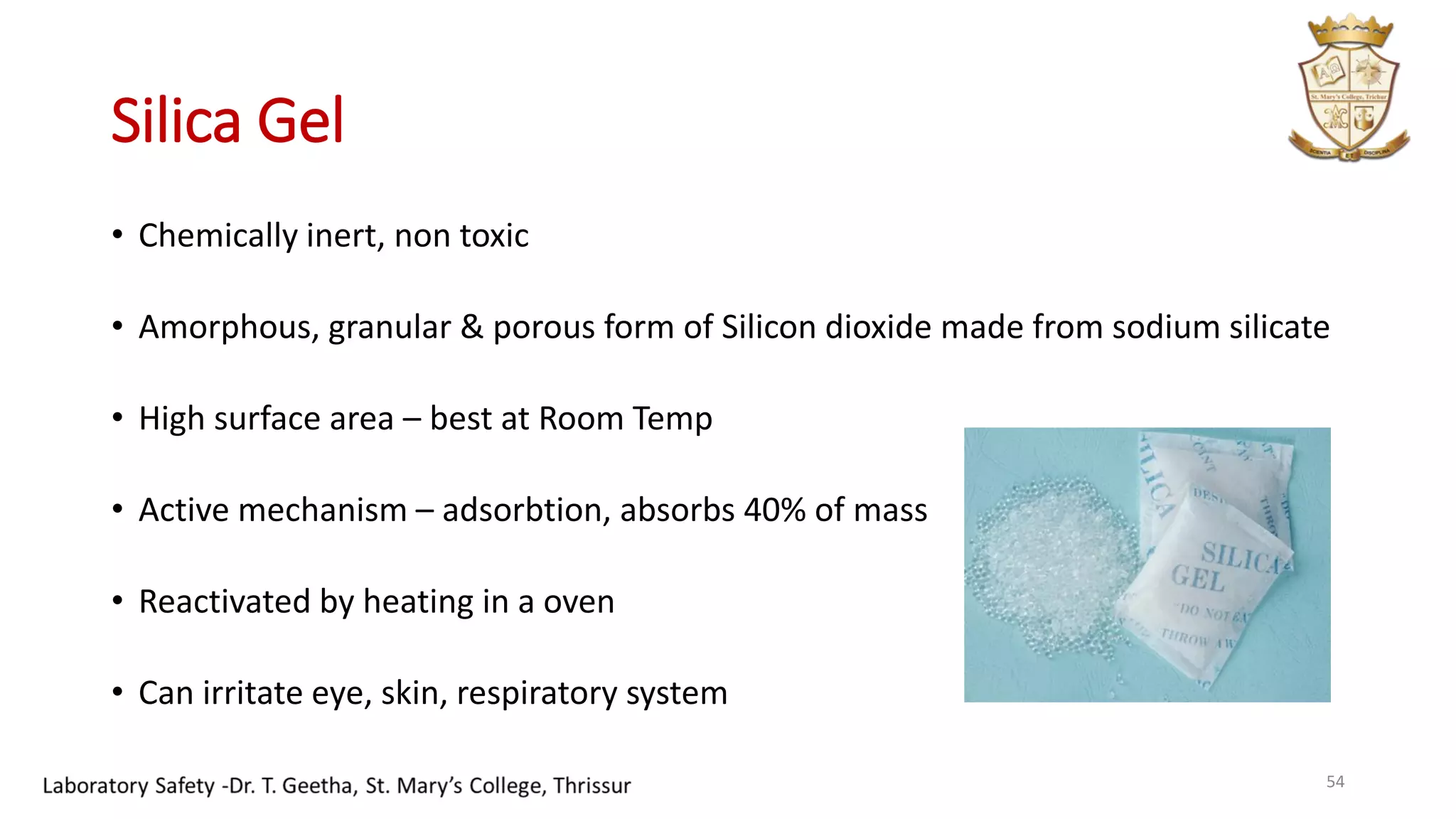
CaCl2 & silica gel - Desiccator
• Used for absorbing moisture/water
• CaCl2 – cheap, high capacity for water absorbtion
• Active mechanism - hydration – CaCl2.6H2O
• Water of hydration removed by heating
• Hazard – mild skin irritation with dry skin, burns wet skin;
Ingestion – irritates mucous memberane , gastrointestinal
problems
53
Silica Gel
• Chemically inert, non toxic
• Amorphous, granular & porous form of Silicon dioxide made from sodium silicate
• High surface area – best at Room Temp
• Active mechanism – adsorbtion, absorbs 40% of mass
• Reactivated by heating in a oven
• Can irritate eye, skin, respiratory system
54
Indicating type silica gel
• Incorporates Cobalt chloride
• Deep blue –dry
• Saturated with moisture - pink
• Reactivated by heating
• CoCl2 – highly toxic, carcinogenic,
• Leaches into ground water on disposal - Environmental hazard
55
Risk & Safety Phrases
System of hazard codes & phrases for labeling hazardous chemicals
• R Phrase – risk phrase – Hazard codes & associated phrase to indicate
the nature of risk
56
Code Phrase
Code
combination
statement
R14 Reacts violently with water
R14/15
Reacts violently with
water, liberating
extremely flammable gasR15
Contact with water liberates
extremely flammable gases
R45 May cause cancer
R45/46
May cause cancer and
heritable genetic damageR46
May cause inheritable
genetic damage
Risk & Safety Phrases
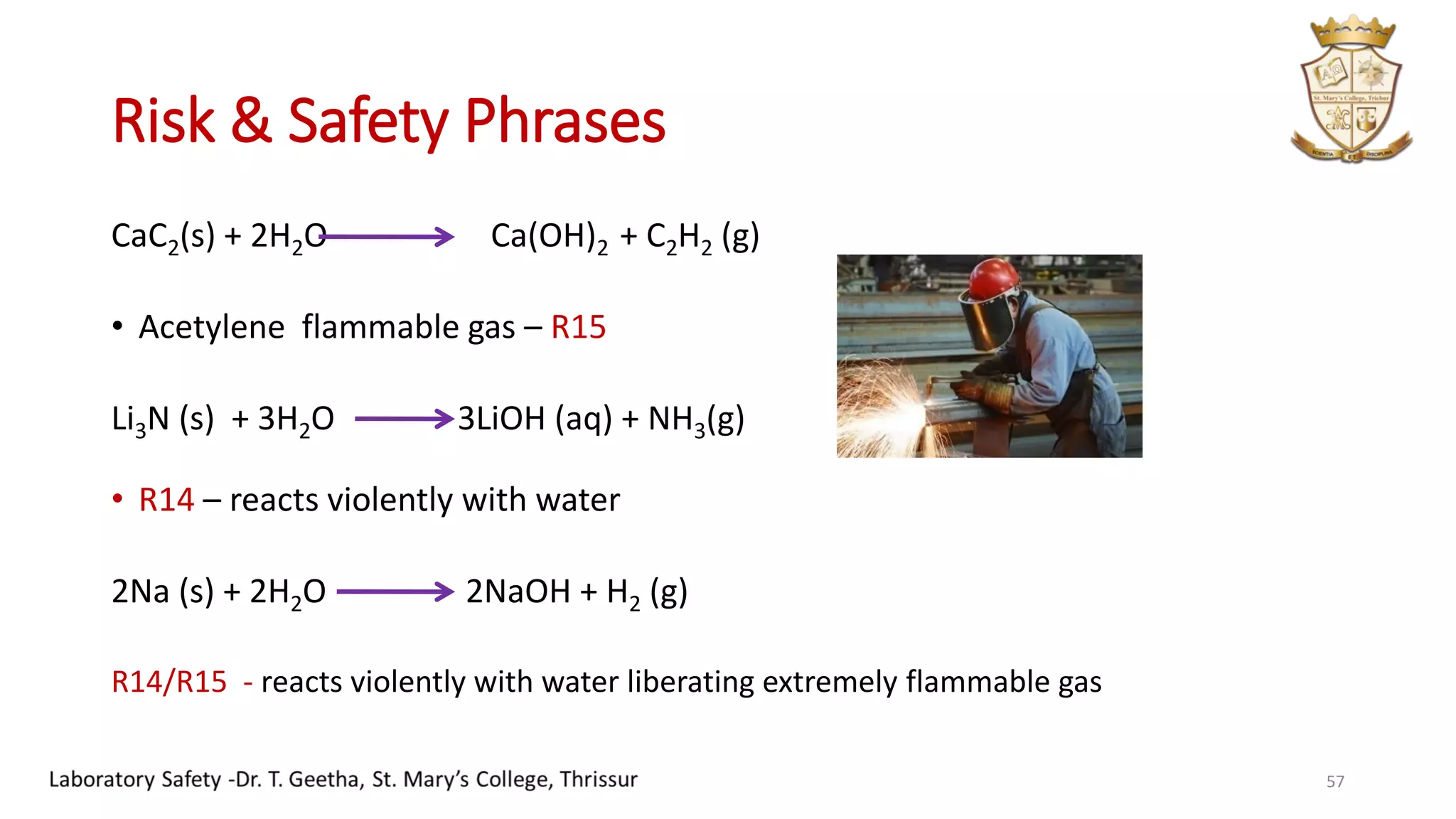
CaC2(s) + 2H2O Ca(OH)2 + C2H2 (g)
• Acetylene flammable gas – R15
Li3N (s) + 3H2O 3LiOH (aq) + NH3(g)
• R14 – reacts violently with water
2Na (s) + 2H2O 2NaOH + H2 (g)
R14/R15 - reacts violently with water liberating extremely flammable gas
57
S phrase ( safety Phrase)
Safety codes & associated phrases to indicate safety advice about dangerous
substance & preparations
58
Code Phrase Code combination statement
S37 Wear suitable gloves
S37/39
Wear suitable gloves and
eye/face protectionS39 Wear eye/face protection
S29 Do not empty into drains
S29/56
Do not empty into drains,
dispose of this material
and its container at
hazardous or special waste
collection point
S56
Dispose of this material
and its container at
hazardous or special
waste collection point
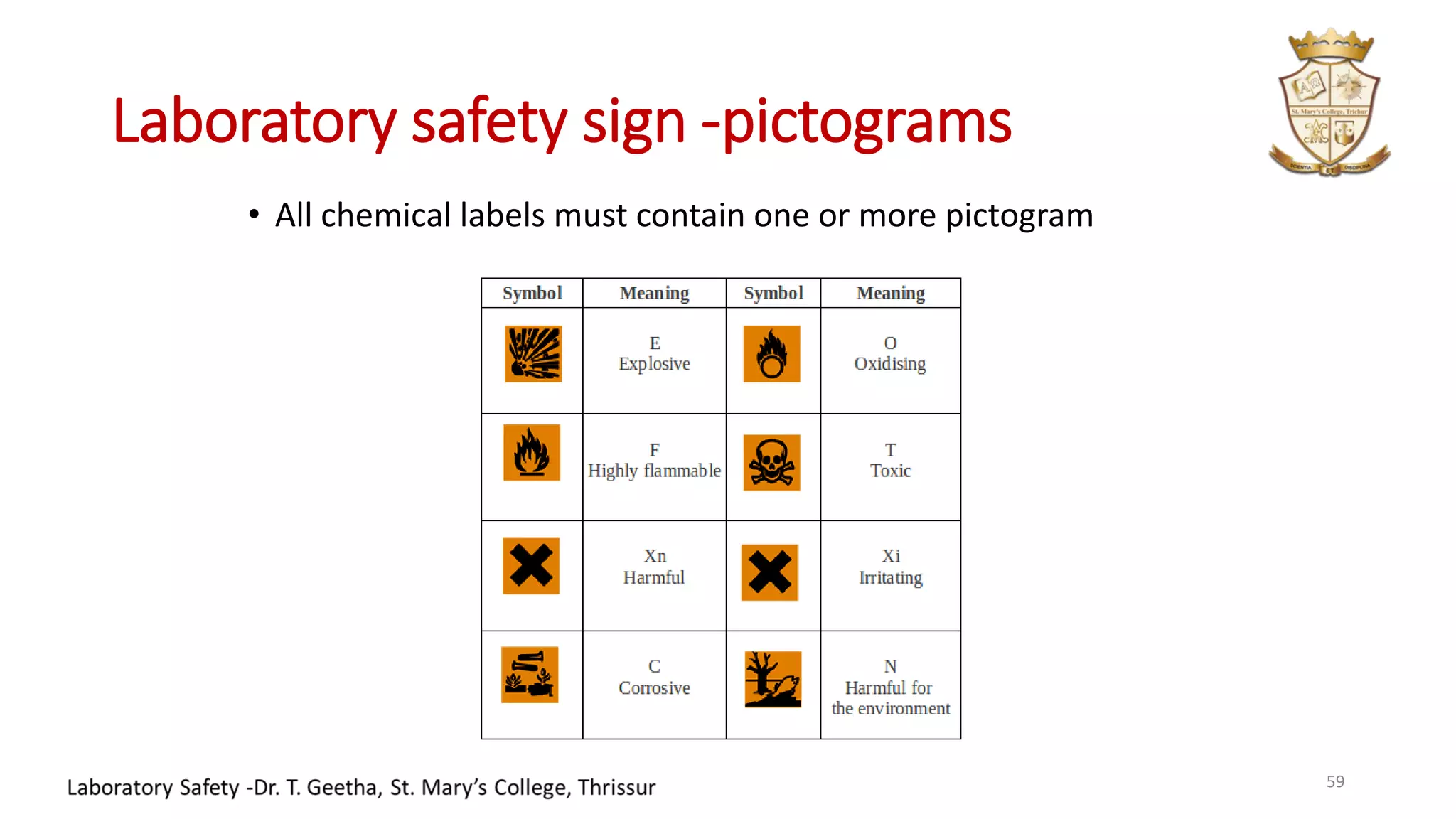
Laboratory safety sign -pictograms
• All chemical labels must contain one or more pictogram
59
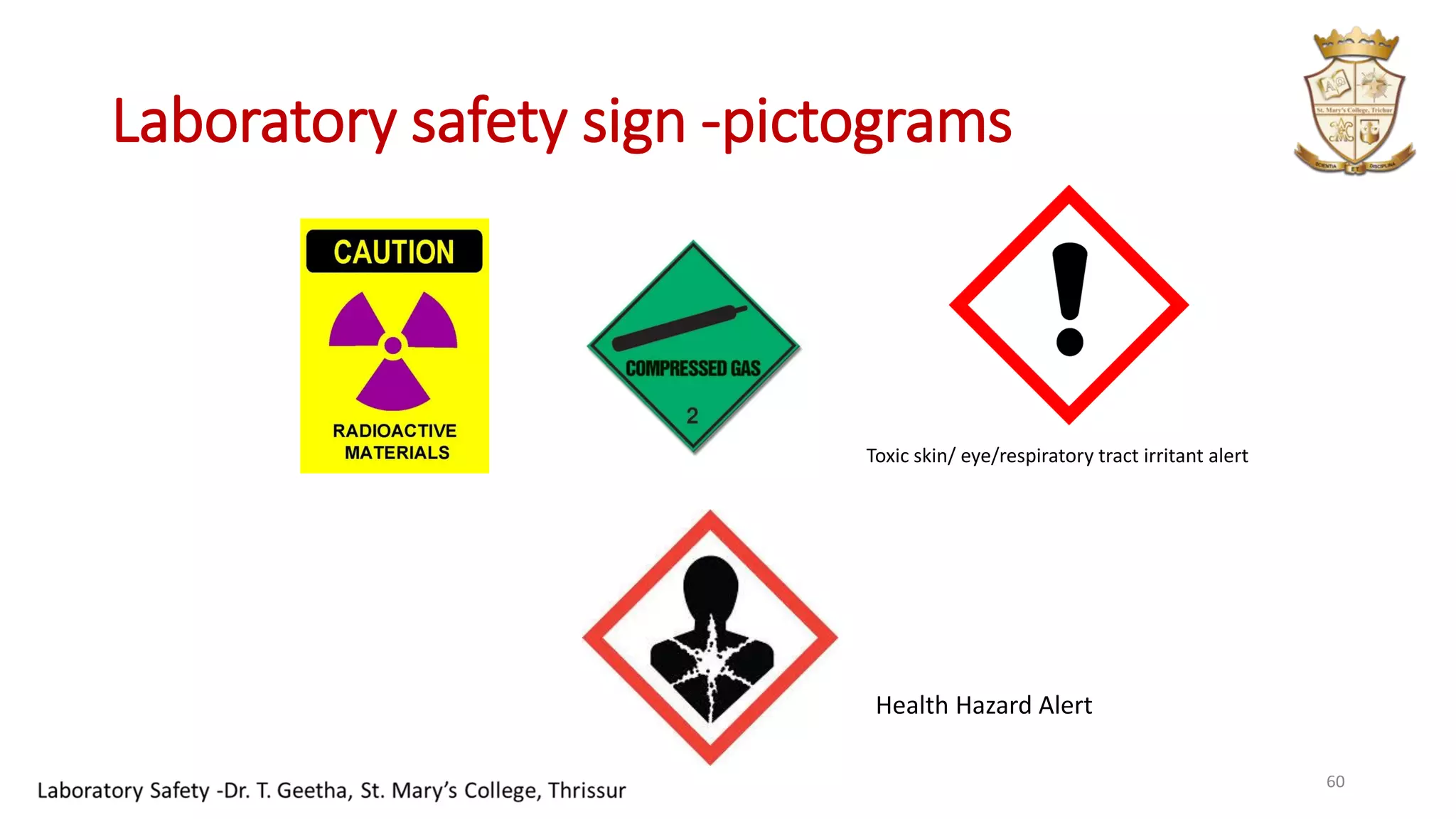
Laboratory safety sign -pictograms
60
Toxic skin/ eye/respiratory tract irritant alert
Health Hazard Alert
Reference
Laboratory safety for chemistry students
– Robert H Hill & David C Finster
61
62

Laboratory Hygiene & Saftey

  • 1.
    LABORATORY HYGIENE & SAFETY Dr.T. Geetha Assistant Professor Department of Chemistry St.Mary’s College, Thrissur
  • 2.
    Laboratory Hygiene &Safety Laboratory is a place that provides facilities and controlled conditions for carrying out scientific experiments and research Laboratory Safety -Dr. T. Geetha, St. Mary’s College, Thrissur 2
  • 3.
    Laboratory Hygiene &Safety • Safety is freedom from danger, injury, or damage. • Being safe -actions by you & by others • always seek to do those things that prevent incidents that might cause injury and harm. 3
  • 4.
    Laboratory Hygiene &Safety • Safety is freedom from danger, injury, or damage. • Being safe -actions by you & by others • always seek to do those things that prevent incidents that might cause injury and harm. 4
  • 5.
    Laboratory Hygiene &Safety To ensure safety we must • Recognize hazards. • Assess the risks of hazards. - RAMP • Minimize the risks of hazards. • Prepare for emergencies. 5
  • 6.
    Laboratory Hygiene &Safety • A hazard is a potential source of danger or harm • chemicals -inherent hazardous properties • safety - minimizing, managing, or controlling these hazards 6
  • 7.
    Laboratory Hygiene &Safety • Risk is the probability of suffering harm from being exposed to a hazard or unsafe situation. • The level of risk depends on many things beyond the inherent hazard of a chemical. For example, the amount of the chemical, the form it is in (gas, liquid, or solid), and how you handle the chemical all affect the level of risk 7
  • 8.
    Laboratory Hygiene &Safety • Risk is the probability of suffering harm from being exposed to a hazard or unsafe situation level of risk – • the amount of the chemical, • the form it is in (gas, liquid, or solid), • and how you handle the chemical 8
  • 9.
    Laboratory Hygiene &Safety Three factors contribute to safety: • environmental • person factors • behavioral factors 9
  • 10.
    Laboratory Hygiene &Safety environmental factors including facilities, location, equipment, procedures, and standards 10
  • 11.
    Laboratory Hygiene &Safety • person factors - attitude, beliefs, personality, knowledge, skills, and abilities Dr. T. Geetha, St. Mary’s college, Thrissur 11 I need to be more careful about things on the floor that I might trip over
  • 12.
    Laboratory Hygiene &Safety behavior factors including safe and risky practices anything out of place- move it back out of the way 12
  • 13.
    Laboratory Hygiene &Safety Safety Rules for Laboratories 1. Follow instructor 2. Wear proper eye protection 3. Wear clothing that protects against exposure and provides protection from spills. -lab coat 13
  • 14.
    Laboratory Hygiene &Safety • Avoid loose cloths • Confine long hair • Avoid wearing dangling jewelery • Do not use personal handkerchief in lab 14
  • 15.
    Laboratory Hygiene &Safety • Do not eat, drink, smoke chew gum, apply cosmetics, or take medications in the laboratory • Do not use laboratory glassware & equipment to prepare & store food 15
  • 16.
    Laboratory Hygiene &Safety • Keep hands away from eye nose mouth face hair & open skin wound • Clean all spills immediately & remove broken glassware • Use books & journals only in clean area to prevent contamination • In case of hazardous spill inform instructors • There should be no boisterous conduct, excessive noise (radios, DVD players, iPods), or practical jokes in the laboratory. 16
  • 17.
    Laboratory Hygiene &Safety • Never taste any laboratory chemical • When smelling a chemical, gently waft the vapors toward your nose. • Do not directly inhale the vapors • If any chemical spills on your skin or in your eyes - flush affected area with water - notify the instructor 17
  • 18.
    Laboratory Hygiene &Safety • Use test tube holder for heating test tube • Know Location of emergency equipment • If any chemical spills on your skin or in your eyes - flush affected area with water - notify the instructor 18
  • 19.
    Laboratory Hygiene &Safety • Do not work alone in the laboratory • Do not heat flammable liquids with a Bunsen burner or other open flame 19
  • 20.
    Laboratory Hygiene &Safety • Label all containers with chemicals or solutions • Dispose of waste chemicals in the containers provided 20
  • 21.
    Storage & handlingof chemicals Chemical storage area 1. Located away from process area & occupied building 2. Constructed from fire resistant material 3. must have continuous ventilation 4. Checked periodically for odour 5. Passageways not to be blocked 6. Should not have floor drains tp prevent contamination with water 7. Proper posting in front of store room 21
  • 22.
    Storage & handlingof chemicals 8. Chemicals to be delivered to storage area for proper maintenance of inventory 9. All containers in good condition & properly closed 10. Tanks & containers properly labeled 11. Secondary containment for all liquid hazardous materials 12. reserve supply of chemicals kept minimum 13. Expired chemicals marked for disposal 22
  • 23.
    Storage & handlingof chemicals 14. Incompatible chemicals separated • Flammables – oxidizers • Strong acid – strong bases 15. Toxic & corrosive chemicals isolated 16. Acids stored in acid resistant containers 17. HNO3, H2SO4, HCl stored in glass containers • HF in plastic or ceresin containers 18. Flammable solvent away from fire hazard, doors 19. Hazardous chemicals not stored above eye level 20. Large bottles stored no more than 2 feet above ground 23
  • 24.
    Inside laboratory 1. Largequantity of chemicals not to be stored in lab 2. Working quantity of routinely used chemicals 3. Minimum quantity of hazardous chemicals • Lab -50L of flammable liquid • Bench - 500mL in closed vessel 4. Chemicals arranged in compatible families 5. Not arranged alphabetically 24
  • 25.
    Inside laboratory 6. Shelfwith small frontal barriers – prevent sliding 7. Chemicals not to be stored above eye level 8. Chemicals not to be stored on floor 9. Chemicals kept away from heaters & sunlight 10. Clearly & legibly labled 11. Refrigerator used to store chemicals not to store food 25
  • 26.
    Inside laboratory 12. Chemicalsthat react vigorously with water kept away from possible contact 13. Toxic, volatile, carcinogenic & reactive chemicals tightly sealed with appropriate stoppers 14. Potentially explosives flammable chemicals stored only in rated or explosion proof refrigerators 15. Do not store chemicals in fume cupboard 16. Compressed gas cylinders kept upright, away from heat source without blocking exits 26
  • 27.
    MSDS Material Safety DataSheet • Information bulletin of a chemical that describes properties, health hazards, routes of exposure, precaution for safe handling, emergency first aid & control measures 27
  • 28.
    Handling of chemicals 1.Familiar with chemical properties & hazards 2. Read label twice 3. Pour out only required quantity of chemicals –prevent waste 4. Transport chemicals on cart that can contain spills 5. Use non breakable & secured secondary containers for transportation of hazardous waste 28
  • 29.
    Handling of chemicals 6.Do not touch chemicals with hand 7. Do not smell chemicals directly 8. Do not taste chemicals 9. Do not hurry 10. While diluting add acid to water not vice versa 29
  • 30.
    Handling of chemicals 11.Avoid mouth suction of pipette 12. Do not use damaged equipment 13. Ensure ventilation of lab 14. Close containers when not in use 15. Do not use metal spatula to handle peroxides – metals can catalyze their explosive decomposition, use ceramic, Teflon or wooden spatula 30
  • 31.
    Simple First Aid– Electric shock • Switch of source of electricity • Check victim for breathing & heartbeat • If unresponsive or shows abnormal breathing - CPR (Cardiopulmonary resuscitation) • Arrange emergency medical aid 31
  • 32.
    Burns • Ist degreeburns – outer layer of skin damaged pain low to moderate no blisters colour of affected area red 32
  • 33.
    Burns 2nd degree burn– outer & second layer of skin damaged pain level high blisters present colour of area red 33
  • 34.
    Burns 3rd degree burn– outer & second layer of skin & tissue below damaged pain level high no pain felt if nerves damaged burn site white/charred 34
  • 35.
    Initial steps forall burns • Put out fire/ stop contact with source of burn • If flames on cloth – Stop Drop Roll • Burn hot jewelry or burnt clothing that does not stick to skin • If sticking to skin do not pull it off • Cut or tear around 35
  • 36.
    Treatment for 1st& 2nd degree burns • Hold under cool running water/immerse in water till pain subsides • continue for 15 minutes • For large area stay under safety shower for 10-15 minutes 36
  • 37.
    Treatment for 1st& 2nd degree burns Don’t - break blisters apply ice, cream, honey, butter, cream Cover with sterile non adhesive bandage Seek medical advice 37
  • 38.
    Treatment for 3rddegree burns • Call for emergency medical help • Cover burnt area with sterile, nonstick bandage or clean lint free cloth • Do not soak in water • Do not apply ointment, cream, butter etc 38
  • 39.
    Cut by glass MINORCUTS • let it bleed to wash out foreign particles • Wash with antibacterial soap, cold running water • Dry with sterile pad • Apply antiseptic cream 39
  • 40.
    Major cuts Slicing intoskin, punctured underlying blood vessel, significant bleeding ❖If no glass present ➢Wash with soap & running water ➢If bleeding does not stop – absorbent pad over wound & apply pressure ➢Hold pressure for 15 minutes ➢Raise injured area above heart level ➢Get medical attention 40
  • 41.
    Major cuts Small glasspiece in wound ➢Wash with cool running water ➢Flush glass out ➢If glass piece suspected – do not apply pressure ➢Lightly apply sterile dressing ➢Get medical attention 41
  • 42.
    Major cuts -Glass/object in wound Do not • remove object from wound – increase bleeding • Apply pressure above wound • Apply pressure on either side of wound • Apply light dressing to stabilize object • Build up padding around object till higher than object • Bandage over without pressing • Medical attention 42
  • 43.
    Inhalation of poisonousgas • Remove to prevent further inhalation • Take to fresh air • Give CPR • Check MSDS for first aid information • Do not attempt rescue unless safe to do so 43
  • 44.
    Accidents due toacids & alkali Skin contact • Wash burnt area with large quantity of water • Do not apply neutralizing or buffering agents • Remove contaminated clothing • Check MSDS for first aid 44
  • 45.
    Eye contact • Washwith large amount of running water • Occasionally lift & lower upper lid • Remove contact lens after hurried wash • Medical attention 45
  • 46.
    Disposal of sodium •Add scraps of sodium to 95% ethanol in fume hood • At least 20ml for 1g Na • Solvent should not boil • C2H5ONa formed • When visually reaction is complete, add water with swirling • Allow to stand, dilute & discard 46
  • 47.
    Disposal of brokenmercury thermometer • Open all windows for ventilation • Collect large piece of glass – zip bag • Use flash light to check extend of spill • Use index card to scoop mercury & small glass beads to zip bag • Use flash light to locate remaining shiny mercury beads • Use dropper, do not touch with hand 47
  • 48.
    Disposal of brokenmercury thermometer • Wrap a piece of scotch tape around gloved index finger with sticky side out & dab contaminated area • Used index card, dropper, tape, glove into zip bag • Moisten Zn powder rub over contaminated area –leave for a day –solid amalgam formed • 20% solution of Calcium polysulphide –solid mercuric sulphide formed • Use index card to scrap of solid product –zip bag • Zip bag, clothings etc sealed & disposed 48
  • 49.
    Kodaikanal experience • mercurythermometer factory in Kodaikanal - Hindustan Lever Ltd • moved to India in 1983 after it was shut down in Watertown, New York • Tons of mercury waste from broken thermometers • agitation by environmental activist • Environmental authorities ordered the company to collect and dispose of the waste 49
  • 50.
    Kodaikanal experience • Companyplan to dispose waste flawed & lacked environmental safeguards • Health problems caused by mercury depend on how much has entered your body • Regardless of quantity, all mercury spills should be treated seriously 50
  • 51.
    Kodaikanal experience • 2003,the Tamil Nadu Pollution Control Board ordered the company to ship the mercury-laden waste back to the United States for proper disposal • Waste packed into containers and brought to a port in Tamil Nadu for loading onto a ship bound for the U.S. • The ship, carrying some 300 tons of mercury-contaminated waste from Kodaikanal, departed for Bethlehem Apparatus, a mercury recycling plant in Pennsylvania 51
  • 52.
  • 53.
    CaCl2 & silicagel - Desiccator • Used for absorbing moisture/water • CaCl2 – cheap, high capacity for water absorbtion • Active mechanism - hydration – CaCl2.6H2O • Water of hydration removed by heating • Hazard – mild skin irritation with dry skin, burns wet skin; Ingestion – irritates mucous memberane , gastrointestinal problems 53
  • 54.
    Silica Gel • Chemicallyinert, non toxic • Amorphous, granular & porous form of Silicon dioxide made from sodium silicate • High surface area – best at Room Temp • Active mechanism – adsorbtion, absorbs 40% of mass • Reactivated by heating in a oven • Can irritate eye, skin, respiratory system 54
  • 55.
    Indicating type silicagel • Incorporates Cobalt chloride • Deep blue –dry • Saturated with moisture - pink • Reactivated by heating • CoCl2 – highly toxic, carcinogenic, • Leaches into ground water on disposal - Environmental hazard 55
  • 56.
    Risk & SafetyPhrases System of hazard codes & phrases for labeling hazardous chemicals • R Phrase – risk phrase – Hazard codes & associated phrase to indicate the nature of risk 56 Code Phrase Code combination statement R14 Reacts violently with water R14/15 Reacts violently with water, liberating extremely flammable gasR15 Contact with water liberates extremely flammable gases R45 May cause cancer R45/46 May cause cancer and heritable genetic damageR46 May cause inheritable genetic damage
  • 57.
    Risk & SafetyPhrases CaC2(s) + 2H2O Ca(OH)2 + C2H2 (g) • Acetylene flammable gas – R15 Li3N (s) + 3H2O 3LiOH (aq) + NH3(g) • R14 – reacts violently with water 2Na (s) + 2H2O 2NaOH + H2 (g) R14/R15 - reacts violently with water liberating extremely flammable gas 57
  • 58.
    S phrase (safety Phrase) Safety codes & associated phrases to indicate safety advice about dangerous substance & preparations 58 Code Phrase Code combination statement S37 Wear suitable gloves S37/39 Wear suitable gloves and eye/face protectionS39 Wear eye/face protection S29 Do not empty into drains S29/56 Do not empty into drains, dispose of this material and its container at hazardous or special waste collection point S56 Dispose of this material and its container at hazardous or special waste collection point
  • 59.
    Laboratory safety sign-pictograms • All chemical labels must contain one or more pictogram 59
  • 60.
    Laboratory safety sign-pictograms 60 Toxic skin/ eye/respiratory tract irritant alert Health Hazard Alert
  • 61.
    Reference Laboratory safety forchemistry students – Robert H Hill & David C Finster 61
  • 62.