LABORATORY HYGIENE &
SAFETY
Laboratory is a place that provides
facilities and controlled conditions for
carrying out scientific experiments and
research
PRE-TEST
1. Electrical safety should not be ignored in
the laboratory. T or F
2. Inspections of laboratories are not
necessary. T or F
3. It is acceptable to eat and drink in a
laboratory. T or F
4. Who is responsible of supplying PPE?
5. What does MSDS stand for?
Safe laboratory procedures and
training are needed for everyone!
So No One Can Injure/Harm to
himself or others.
WHY IS LABORATORY SAFETY
IMPORTANT?
 TO PREVENT:
– adverse health effects from exposure to
chemicals
– exposure to organisms, diseases, etc. in
laboratories
– laboratory equipment hazards - if not
maintained properly
Laboratory Hygiene and
Safety
 Safety is freedom from danger, injury, or damage.
 Being safe -actions by you & by others
 Always seek to do those things that prevent incidents
that might cause injury and harm.
Laboratory Hygiene and Safety
To ensure safety we must
 Recognize hazards.
 Assess the risks of hazards.
 Minimize the risks of hazards.
 Prepare for emergencies.
 - RAMP-
Laboratory Hygiene and Safety
 A hazard is a potential source of danger or harm
 chemicals -inherent hazardous properties
 safety - minimizing, managing, or controlling these
hazards
Laboratory Hygiene and Safety
 Risk is the probability of suffering harm from being
exposed to a hazard or unsafe situation
 Level of risk depends on 3 factors:
1. The amount of the chemical
2. The form it is in (gas, liquid, or solid)
3. How you handle the chemical
Laboratory Hygiene and Safety
 Three factors contribute to safety:
 Environmental factors
 person factors
 behavioral factors
Laboratory Hygiene and Safety
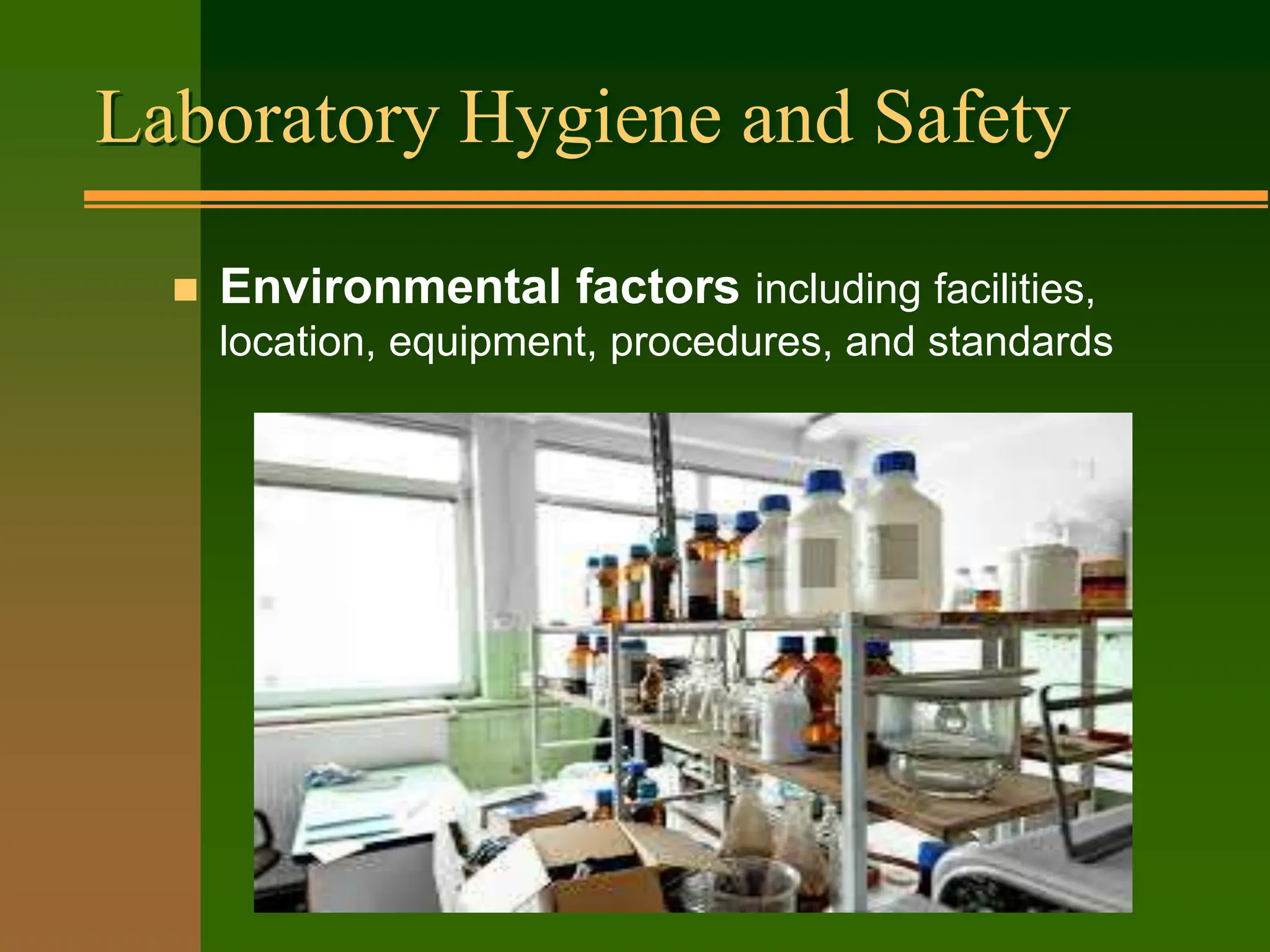
 Environmental factors including facilities,
location, equipment, procedures, and standards
Laboratory Hygiene and Safety
 Person factors - attitude, beliefs, personality,
knowledge, skills, and abilities
Laboratory Hygiene and Safety
 Behavior factors including safe and risky
practices anything out of place- move it back out of
the way
Lab safety must be taught to :
– all employees, including service groups
– undergraduate students
– graduate students
– professors
– visitors
REVIEW LABORATORY
SAFETY WHEN:
 new employees
 new procedures
 a change in procedures
 new equipment
LAB SAFETY CONT..
LABORATORY PROCEDURES
MUST BE SITE SPECIFIC !
based on your lab needs,
conditions, and equipment
TYPES OF LABORATORIES
 Pathology
 Chemistry
 Biology
 Radiation
 Soils
 Concrete/Asphalt
Laboratory Policies and Procedures
Must be:
written and available
AREAS TO COVER
 General procedures or rules
 Glassware
 Material handling and care
 Equipment
 Safety equipment
 Electrical safety
 Disposal procedures
 Emergency response plans
 Inspections
General Procedures or Safety Rules:
– No food or drink allowed in the laboratory
– No mouth pipetting
– Individuals not allowed to work in the
laboratory alone
– Wear required personal protective
equipment
– No smoking in laboratory
– Maintain good housekeeping habits
GLASSWARE PROCEDURES
 Storage
 Proper use
 Cleaning
 Cleaning up broken glassware
 Disposal of broken glassware
Glassware Handling
Is this what your lab looks like?
Glassware handling cont
 Or does it look like this?
Laboratory Materials
 Can include
– chemicals
– plants
– animals
– pathogens
– organisms
Procedures for handling chemicals
– proper labeling, including wastes
– proper storage
storage cabinets
store compatible chemicals together
rooms properly vented & correct temperature
Procedures for handling chemicals cont.
 Maintain a current inventory
 Purchasing procedures
 Proper handling
– use label or MSDS
– never test by taste or odor
– acids poured into water never vice versa
– take precautions and use proper equipment when
stirring or heating flammable liquids
– follow “industry standards” for labeling all
chemicals
Handling animals and plants
 Procedures for caring for animals and plants
including feeding and watering
 Procedures for cleaning cages
 Procedures for cleaning and/or decontaminating
rooms or locations
 Procedures for entering & leaving contaminated
areas
 Procedures for handling the animals or plants
 Procedures for animal bites or scratches
 Procedures for disposal to prevent spread of disease
Handling of diseases or organisms
 Allow only authorized individuals in infectious
disease laboratories
 Do not allow individuals to work alone
 Procedures for proper use of equipment and
maintenance
 Use proper containers for transportation, incubation,
and storage
 Labeling of laboratories and cultures
 Proper disinfecting procedures
 Hygiene procedures
 Procedures for exposure or release of material
Handling and Using Lab Equipment
– Proper installation
– Training on proper
use
– Manuals or written
procedures
available
– Inspections
– Maintenance
– DOCUMENT
EQUIPMENT INCLUDES:
 Meters
 Refrigerators
 Autoclaves
 Scales
 Hoods
 Drying oven
 Compressed gas
cylinders
 Bunsen burners
Lab Equipment
Which picture represents a proper hood?
SAFETY EQUIPMENT
– proper equipment must be available
– requires training for the location so
individuals know how and when to use
equipment appropriately
– training on the correct
maintenance &
storage is also
necessary
SAFETY EQUIPMENT
– FIRST AID AND
MEDICAL TRT
– EMERGENCY
EQUIPMENT
– SHOWERS,
EYEWASH
STATIONS
– MSDS’S
– PPE
First Aid and Medical Treatment
 First aid kit available and properly
stocked (nothing expired)
 Trained first aid attendant or
 Medical facilities within 15 minutes
 Emergency numbers posted
Emergency Equipment
 Fire blankets
 Fire extinguishers
 Emergency notification system
 Unrestricted means of communication
 Any other emergency equipment
needed for your specific laboratory
needs
Emergency Showers &
Eyewash Stations
 Immediate washing of the skin and eye
with generous amounts of water is the
most effective first aid treatment for
chemical burns (unless chemical reacts
unfavorably to water-MSDS)
Emergency Showers and Eyewash Stations
must be available
showers must be tested for proper
operation with results documented
Alternatives to Installed Showers
and Eyewashes
 Portable showers or eyewashes
 Attachments that connect to existing
faucets
– must supply at least 15 minutes of
continuous water
– must stay on until turned off
Material Safety Data Sheets, (MSDS)
– required for each
chemical
– requires employee
and student review
– must be accessable
for
employees/student
MSDS FILE
MSDS Information Includes:
 Nomenclature including chemical family
and formula
 Hazardous ingredients
 Physical data
 Fire and explosion hazard
 Health hazard
 Spill and leak procedures
 Special protection information
 Storage and handling precautions
Personal Protective Equipment
 AGENCY MUST:
– Provide PPE for all employees
at no cost to the employee
– train employees how to use PPE properly
– train employees on the limitation(s) of PPE
– train employees in proper care, storage,
and useful life, and disposal of PPE
Appropriate PPE:
– aprons,lab coats
– gloves-
latex,nitrile,neoprene
– goggles, face shields,
safety glasses
– respirators-full, partial,
dust mask
– noise protection
DISPOSAL PROCEDURES
– chemical wastes
– organisms, diseases, animals
– glassware
– spills
– sharps
DISPOSAL PROCEDURES
CONT.
 Trained persons designated to handle
disposal
 Meet all required rules and regulations
 Proper collection containers
 Waste collection contracts
 Does not expose humans, animals,
plants, etc upon disposal - may include
decontamination, sterilization,
incineration, autoclaving
EMERGENCY RESPONSE PLAN
 agencies should develop an
emergency response plan BEFORE
an emergency
 review with employees (students)
make sure they understand the plan
completely
Emergency Response Plan should
include:
–recognizing emergencies
–lines of authority
–methods of communication
–safe sites and evacuation routes
–site security and control
Emergency Response Plan should
include cont.:
–decontamination procedures
–provisions for medical treatment
–emergency alerting and response
procedures
–PPE and emergency equipment for
clean-up
–follow up
INSPECTION OF LABORATORIES
 Develop inspection report appropriate
for laboratory
 cover all areas related to laboratory
– personnel practices
– operational practices
– equipment
– emergency protection equipment
– materials inventory
– miscellaneous
WEB ADDRESS
 http://www.doa.state.la.us/orm/lp.htm
POST-TEST
1. Laboratory equipment does not require
regular maintenance. T or F
2. It is acceptable to eat and drink in the
laboratory. T or F
3. What is the most effective first aid treatment
for chemical burns?
4. Chemicals should be stored according to
compatibility. T or F
POST-TEST
5. Fume hoods should be used for chemical
storage. T or F
6. What does MSDS stand for?
7. What is some of the information an MSDS
can provide?
8. Electrical safety should not be ignored in
the laboratory. T or F
9. Name PPE that might be used in the lab.
POST-TEST
10. Who should receive lab safety training?
11. The same laboratory procedures apply to
every lab. T or F
12. Who is responsible for supplying PPE?
13. Inspections of laboratories are not
necessary. T or F
14. Chemical wastes can be disposed of in the
regular trash. T or F
POST-TEST
15. There is no need to test emergency
showers. T or F
16. Developing your emergency plan as an
emergency is occurring is the best method
of development. T or F
THANK YOU FOR ATTENDING

Lab-Safety.ppt FOR MLT STUDENTS AND LAB PROFESSIONALSND LAB

  • 1.
    LABORATORY HYGIENE & SAFETY Laboratoryis a place that provides facilities and controlled conditions for carrying out scientific experiments and research
  • 2.
    PRE-TEST 1. Electrical safetyshould not be ignored in the laboratory. T or F 2. Inspections of laboratories are not necessary. T or F 3. It is acceptable to eat and drink in a laboratory. T or F 4. Who is responsible of supplying PPE? 5. What does MSDS stand for?
  • 3.
    Safe laboratory proceduresand training are needed for everyone! So No One Can Injure/Harm to himself or others.
  • 4.
    WHY IS LABORATORYSAFETY IMPORTANT?  TO PREVENT: – adverse health effects from exposure to chemicals – exposure to organisms, diseases, etc. in laboratories – laboratory equipment hazards - if not maintained properly
  • 5.
    Laboratory Hygiene and Safety Safety is freedom from danger, injury, or damage.  Being safe -actions by you & by others  Always seek to do those things that prevent incidents that might cause injury and harm.
  • 6.
    Laboratory Hygiene andSafety To ensure safety we must  Recognize hazards.  Assess the risks of hazards.  Minimize the risks of hazards.  Prepare for emergencies.  - RAMP-
  • 7.
    Laboratory Hygiene andSafety  A hazard is a potential source of danger or harm  chemicals -inherent hazardous properties  safety - minimizing, managing, or controlling these hazards
  • 8.
    Laboratory Hygiene andSafety  Risk is the probability of suffering harm from being exposed to a hazard or unsafe situation  Level of risk depends on 3 factors: 1. The amount of the chemical 2. The form it is in (gas, liquid, or solid) 3. How you handle the chemical
  • 9.
    Laboratory Hygiene andSafety  Three factors contribute to safety:  Environmental factors  person factors  behavioral factors
  • 10.
    Laboratory Hygiene andSafety  Environmental factors including facilities, location, equipment, procedures, and standards
  • 11.
    Laboratory Hygiene andSafety  Person factors - attitude, beliefs, personality, knowledge, skills, and abilities
  • 12.
    Laboratory Hygiene andSafety  Behavior factors including safe and risky practices anything out of place- move it back out of the way
  • 13.
    Lab safety mustbe taught to : – all employees, including service groups – undergraduate students – graduate students – professors – visitors
  • 14.
    REVIEW LABORATORY SAFETY WHEN: new employees  new procedures  a change in procedures  new equipment
  • 15.
    LAB SAFETY CONT.. LABORATORYPROCEDURES MUST BE SITE SPECIFIC ! based on your lab needs, conditions, and equipment
  • 16.
    TYPES OF LABORATORIES Pathology  Chemistry  Biology  Radiation  Soils  Concrete/Asphalt
  • 17.
    Laboratory Policies andProcedures Must be: written and available
  • 18.
    AREAS TO COVER General procedures or rules  Glassware  Material handling and care  Equipment  Safety equipment  Electrical safety  Disposal procedures  Emergency response plans  Inspections
  • 19.
    General Procedures orSafety Rules: – No food or drink allowed in the laboratory – No mouth pipetting – Individuals not allowed to work in the laboratory alone – Wear required personal protective equipment – No smoking in laboratory – Maintain good housekeeping habits
  • 20.
    GLASSWARE PROCEDURES  Storage Proper use  Cleaning  Cleaning up broken glassware  Disposal of broken glassware
  • 21.
    Glassware Handling Is thiswhat your lab looks like?
  • 22.
    Glassware handling cont Or does it look like this?
  • 23.
    Laboratory Materials  Caninclude – chemicals – plants – animals – pathogens – organisms
  • 24.
    Procedures for handlingchemicals – proper labeling, including wastes – proper storage storage cabinets store compatible chemicals together rooms properly vented & correct temperature
  • 25.
    Procedures for handlingchemicals cont.  Maintain a current inventory  Purchasing procedures  Proper handling – use label or MSDS – never test by taste or odor – acids poured into water never vice versa – take precautions and use proper equipment when stirring or heating flammable liquids – follow “industry standards” for labeling all chemicals
  • 26.
    Handling animals andplants  Procedures for caring for animals and plants including feeding and watering  Procedures for cleaning cages  Procedures for cleaning and/or decontaminating rooms or locations  Procedures for entering & leaving contaminated areas  Procedures for handling the animals or plants  Procedures for animal bites or scratches  Procedures for disposal to prevent spread of disease
  • 27.
    Handling of diseasesor organisms  Allow only authorized individuals in infectious disease laboratories  Do not allow individuals to work alone  Procedures for proper use of equipment and maintenance  Use proper containers for transportation, incubation, and storage  Labeling of laboratories and cultures  Proper disinfecting procedures  Hygiene procedures  Procedures for exposure or release of material
  • 28.
    Handling and UsingLab Equipment – Proper installation – Training on proper use – Manuals or written procedures available – Inspections – Maintenance – DOCUMENT
  • 29.
    EQUIPMENT INCLUDES:  Meters Refrigerators  Autoclaves  Scales  Hoods  Drying oven  Compressed gas cylinders  Bunsen burners
  • 30.
    Lab Equipment Which picturerepresents a proper hood?
  • 31.
    SAFETY EQUIPMENT – properequipment must be available – requires training for the location so individuals know how and when to use equipment appropriately – training on the correct maintenance & storage is also necessary
  • 32.
    SAFETY EQUIPMENT – FIRSTAID AND MEDICAL TRT – EMERGENCY EQUIPMENT – SHOWERS, EYEWASH STATIONS – MSDS’S – PPE
  • 33.
    First Aid andMedical Treatment  First aid kit available and properly stocked (nothing expired)  Trained first aid attendant or  Medical facilities within 15 minutes  Emergency numbers posted
  • 34.
    Emergency Equipment  Fireblankets  Fire extinguishers  Emergency notification system  Unrestricted means of communication  Any other emergency equipment needed for your specific laboratory needs
  • 35.
    Emergency Showers & EyewashStations  Immediate washing of the skin and eye with generous amounts of water is the most effective first aid treatment for chemical burns (unless chemical reacts unfavorably to water-MSDS)
  • 36.
    Emergency Showers andEyewash Stations must be available showers must be tested for proper operation with results documented
  • 37.
    Alternatives to InstalledShowers and Eyewashes  Portable showers or eyewashes  Attachments that connect to existing faucets – must supply at least 15 minutes of continuous water – must stay on until turned off
  • 38.
    Material Safety DataSheets, (MSDS) – required for each chemical – requires employee and student review – must be accessable for employees/student MSDS FILE
  • 39.
    MSDS Information Includes: Nomenclature including chemical family and formula  Hazardous ingredients  Physical data  Fire and explosion hazard  Health hazard  Spill and leak procedures  Special protection information  Storage and handling precautions
  • 40.
    Personal Protective Equipment AGENCY MUST: – Provide PPE for all employees at no cost to the employee – train employees how to use PPE properly – train employees on the limitation(s) of PPE – train employees in proper care, storage, and useful life, and disposal of PPE
  • 41.
    Appropriate PPE: – aprons,labcoats – gloves- latex,nitrile,neoprene – goggles, face shields, safety glasses – respirators-full, partial, dust mask – noise protection
  • 42.
    DISPOSAL PROCEDURES – chemicalwastes – organisms, diseases, animals – glassware – spills – sharps
  • 43.
    DISPOSAL PROCEDURES CONT.  Trainedpersons designated to handle disposal  Meet all required rules and regulations  Proper collection containers  Waste collection contracts  Does not expose humans, animals, plants, etc upon disposal - may include decontamination, sterilization, incineration, autoclaving
  • 44.
    EMERGENCY RESPONSE PLAN agencies should develop an emergency response plan BEFORE an emergency  review with employees (students) make sure they understand the plan completely
  • 45.
    Emergency Response Planshould include: –recognizing emergencies –lines of authority –methods of communication –safe sites and evacuation routes –site security and control
  • 46.
    Emergency Response Planshould include cont.: –decontamination procedures –provisions for medical treatment –emergency alerting and response procedures –PPE and emergency equipment for clean-up –follow up
  • 47.
    INSPECTION OF LABORATORIES Develop inspection report appropriate for laboratory  cover all areas related to laboratory – personnel practices – operational practices – equipment – emergency protection equipment – materials inventory – miscellaneous
  • 52.
  • 53.
    POST-TEST 1. Laboratory equipmentdoes not require regular maintenance. T or F 2. It is acceptable to eat and drink in the laboratory. T or F 3. What is the most effective first aid treatment for chemical burns? 4. Chemicals should be stored according to compatibility. T or F
  • 54.
    POST-TEST 5. Fume hoodsshould be used for chemical storage. T or F 6. What does MSDS stand for? 7. What is some of the information an MSDS can provide? 8. Electrical safety should not be ignored in the laboratory. T or F 9. Name PPE that might be used in the lab.
  • 55.
    POST-TEST 10. Who shouldreceive lab safety training? 11. The same laboratory procedures apply to every lab. T or F 12. Who is responsible for supplying PPE? 13. Inspections of laboratories are not necessary. T or F 14. Chemical wastes can be disposed of in the regular trash. T or F
  • 56.
    POST-TEST 15. There isno need to test emergency showers. T or F 16. Developing your emergency plan as an emergency is occurring is the best method of development. T or F
  • 57.
    THANK YOU FORATTENDING

Editor's Notes

  • #54 False. Some equipment does need regular inspections False. Nor is it ok to put on makeup Immediate washing with generous amounts of clean water True. Read the label if any questions
  • #55 False. They are not for storage. Material Safety Data Sheet Chemical family name, fire and explosion hazard, health hazards, PPE requirements, spill and leak procedures, storage and handling procedures, special protection information. True Aprons, gloves, goggles, face shields, safety goggles, respirators, noise protection
  • #56 Everyone, employees, students (graduates, and undergraduates). Professors, and visitors. False, they need to be specific The agency False Trick question. Depends upon the chemical waste. Read the label.
  • #57  False False. Develop it and practice it.