Laboratory Hazards, Safety and
Contamination
PHARMATRUST PROFESSIONAL COLLEGE
MLT1 (Group 2)
1
Pharmatrust Professional College
Department Of Medical Laboratory Technology
SCC NEW-WEIJA (CAMPUS)
ACCRA, GHANA
Compiled by
Eric Gokah Rita Boah
Nadjo Deen Aikens Mensah
PHARMATRUST PROFESSIONAL COLLEGE
MLT1 (Group 2)
2
Introduction
A HAZARD is a situation that poses a level of
threat to life, health, property, or
environment. These hazards are also very
dangerous for human and animal life in the
laboratory.
PHARMATRUST PROFESSIONAL COLLEGE
MLT1 (Group 2)
3
TYPES OF HAZARDS
Basically laboratory hazards fall in three, these
include;
• Chemical hazard
• Biological hazard
• Physical hazard
PHARMATRUST PROFESSIONAL COLLEGE
MLT1 (Group 2)
4
Chemical Hazards
Chemical hazard is occupational hazard caused by
exposure to chemical at the workplace.
Cleaning agents and disinfectants, solvents, and are
examples of chemical hazards
PHARMATRUST PROFESSIONAL COLLEGE
MLT1 (Group 2)
5
Biological Hazards
Biological hazards include potential exposures to
allergens, infectious zoonotics (animal
diseases transmissible to humans), and
experimental agents such as viral vectors.
PHARMATRUST PROFESSIONAL COLLEGE
MLT1 (Group 2)
6
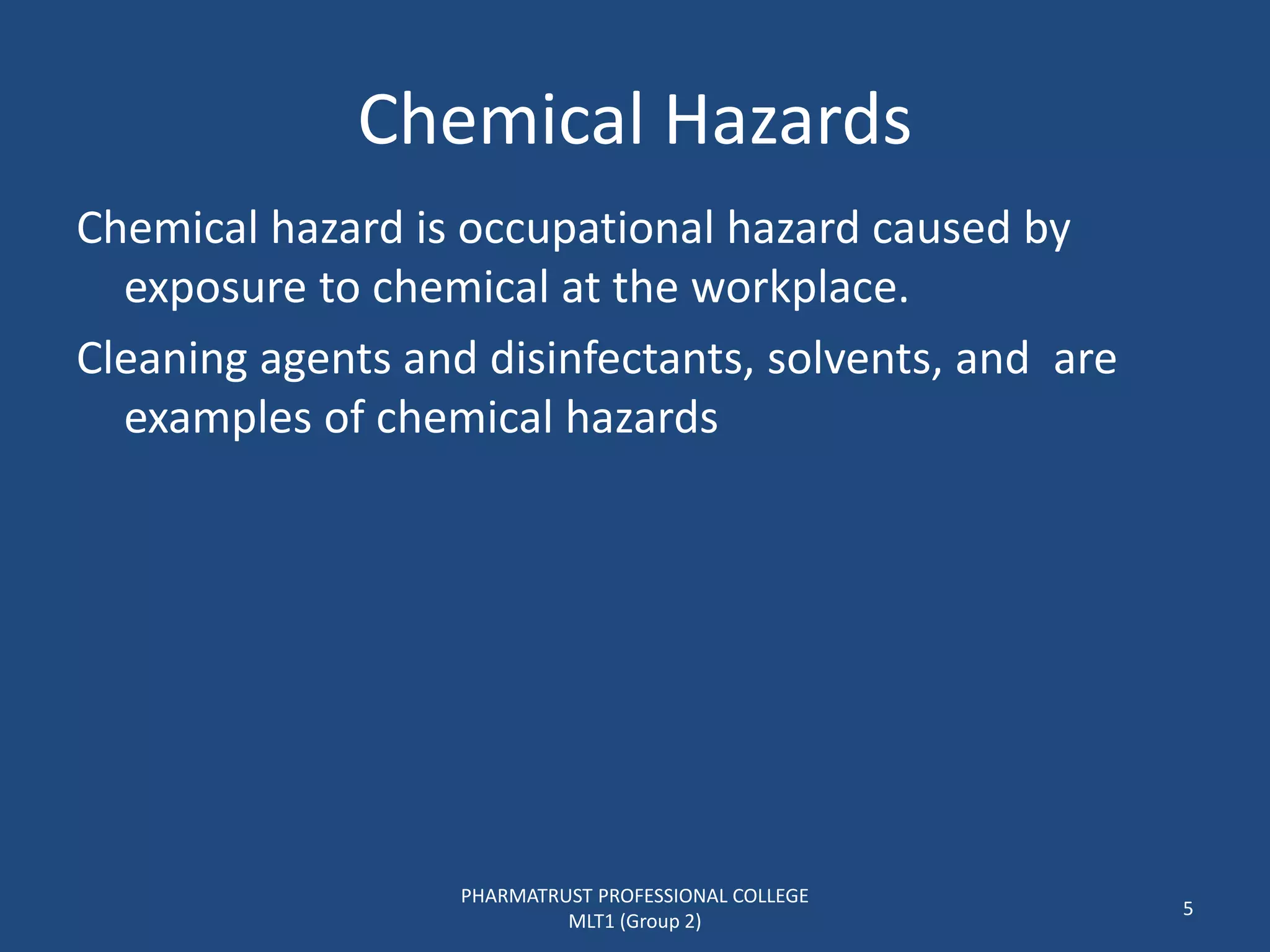
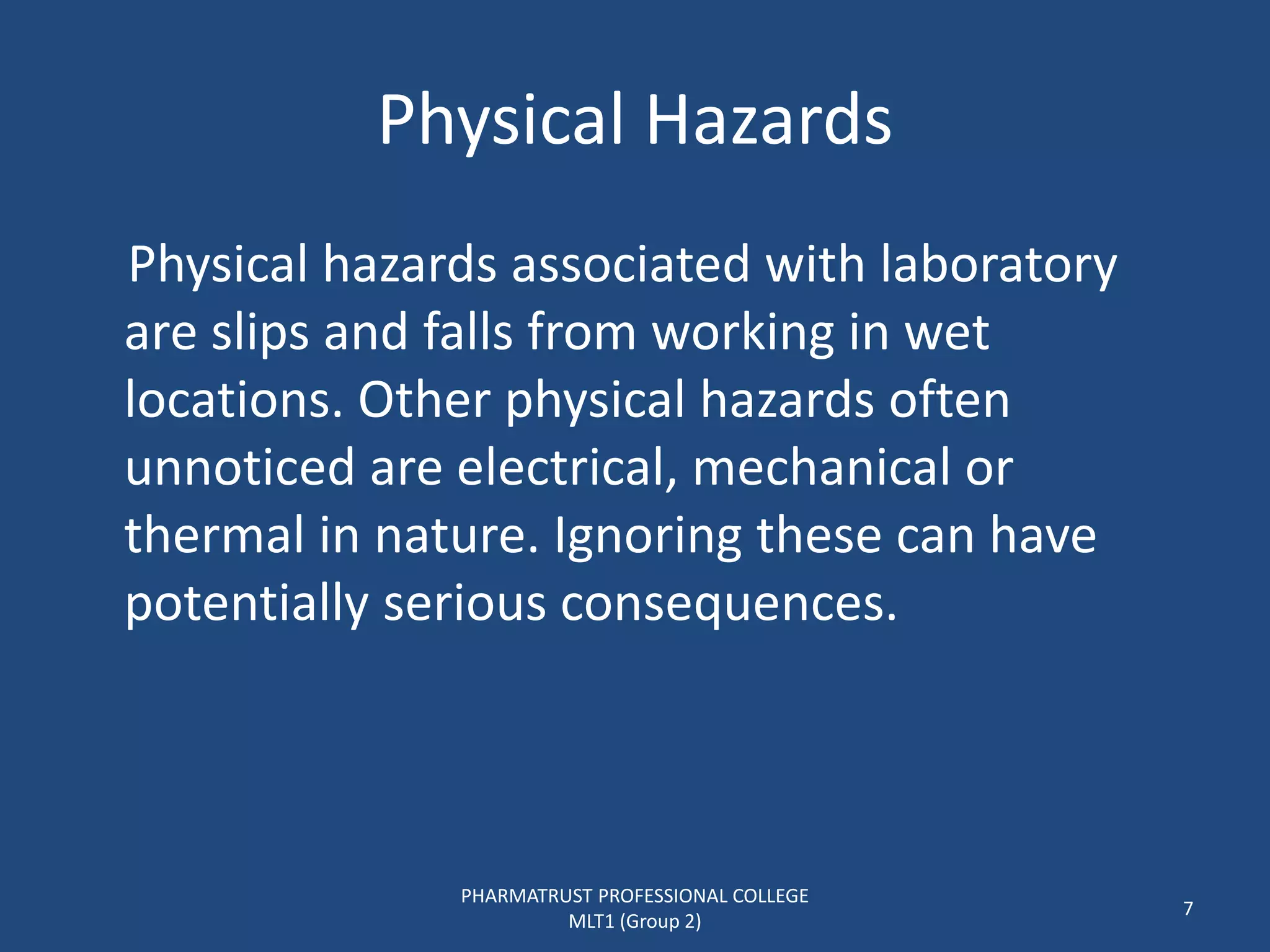
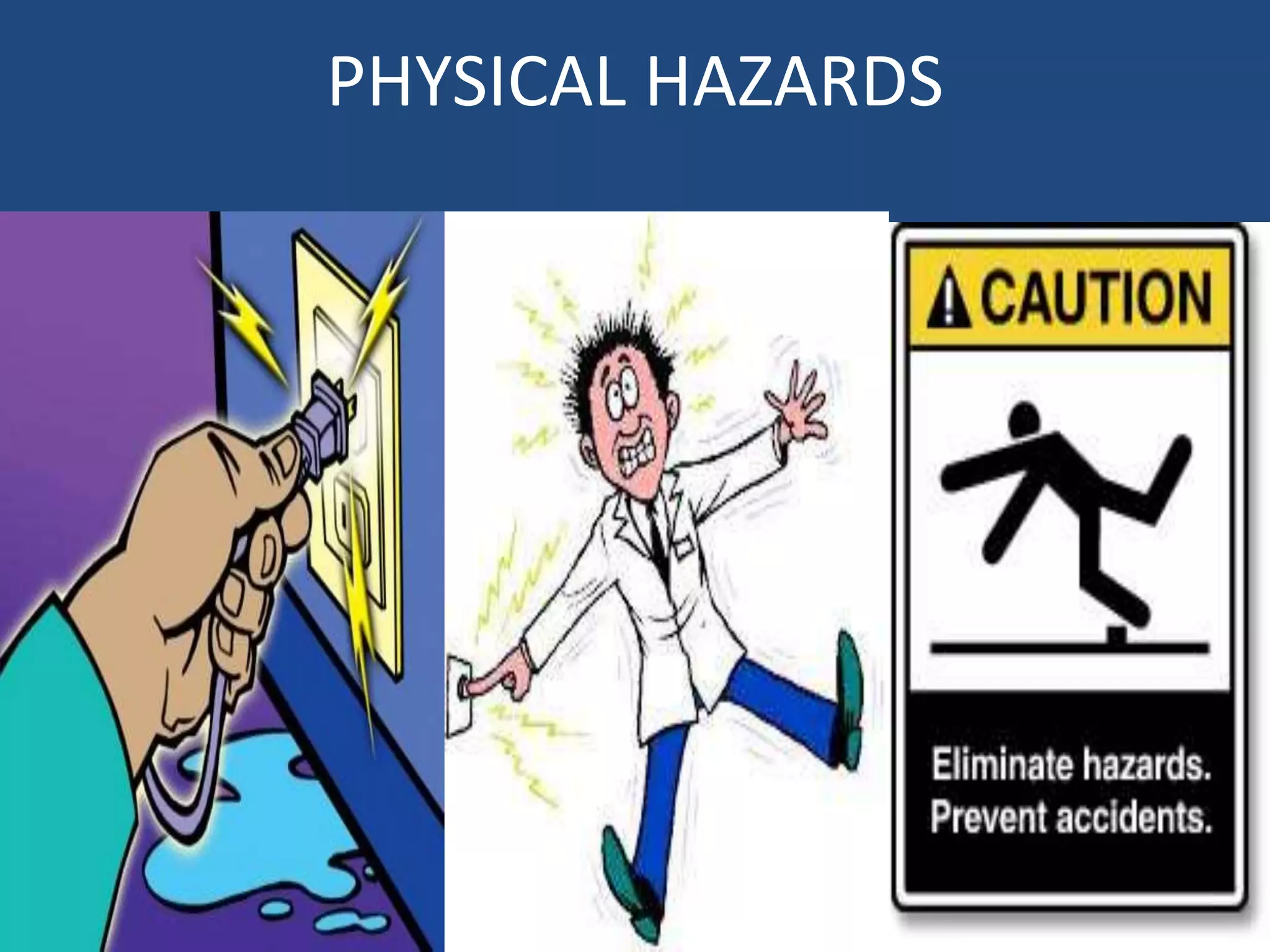
Physical Hazards
Physical hazards associated with laboratory
are slips and falls from working in wet
locations. Other physical hazards often
unnoticed are electrical, mechanical or
thermal in nature. Ignoring these can have
potentially serious consequences.
PHARMATRUST PROFESSIONAL COLLEGE
MLT1 (Group 2)
7
PHYSICAL HAZARDS
PHARMATRUST PROFESSIONAL COLLEGE
MLT1 (Group 2)
8
Sterilization
Sterilization is the killing or complete elimination of all
microorganisms including bacterial spores which are highly
resistant.
Disinfection is the application of disinfectant on inanimate
objects in the reduction of microbes to reduce its
pathogenicity. Some organisms and bacterial spores may
survive.
Disinfectants are chemicals that are used for disinfection.
Disinfectants are used only on inanimate objects.
Antiseptics are mild forms of disinfectants that are used
externally on living tissues to reduce the microbial load on the
surface of skin and mucous membranes.
PHARMATRUST PROFESSIONAL COLLEGE
MLT1 (Group 2)
9
STERILISATION METHODS
• HEAT
• CHEMICAL
• FILTRATION
• RADIATION
PHARMATRUST PROFESSIONAL COLLEGE
MLT1 (Group 2)
10
Uses of Sterilization
1. Sterilization for Surgical Procedures: Gloves,
aprons, surgical instruments, syringes etc. are
to be sterilized.
2. Sterilization in Microbiological works like
preparation of culture media, reagents and
equipments where a sterile condition is to be
maintained.
PHARMATRUST PROFESSIONAL COLLEGE
MLT1 (Group 2)
11
PHARMATRUST PROFESSIONAL COLLEGE
MLT1 (Group 2)
12
Heat method of sterilization
Steam (moist heat)
This method of sterilization involve the use of
autoclave which operates on the same principle as
the domestic pressure cooker. Most heat in a form of
pressurized steam is highly effective in killing of
micro organisms, Autoclaves use steam heated to
121-134 °C under pressure. To achieve sterility, the
article is heated in a chamber by injected steam until
the article reaches a time and temperature set point.
PHARMATRUST PROFESSIONAL COLLEGE
MLT1 (Group 2)
13
Autoclave
PHARMATRUST PROFESSIONAL COLLEGE
MLT1 (Group 2)
14
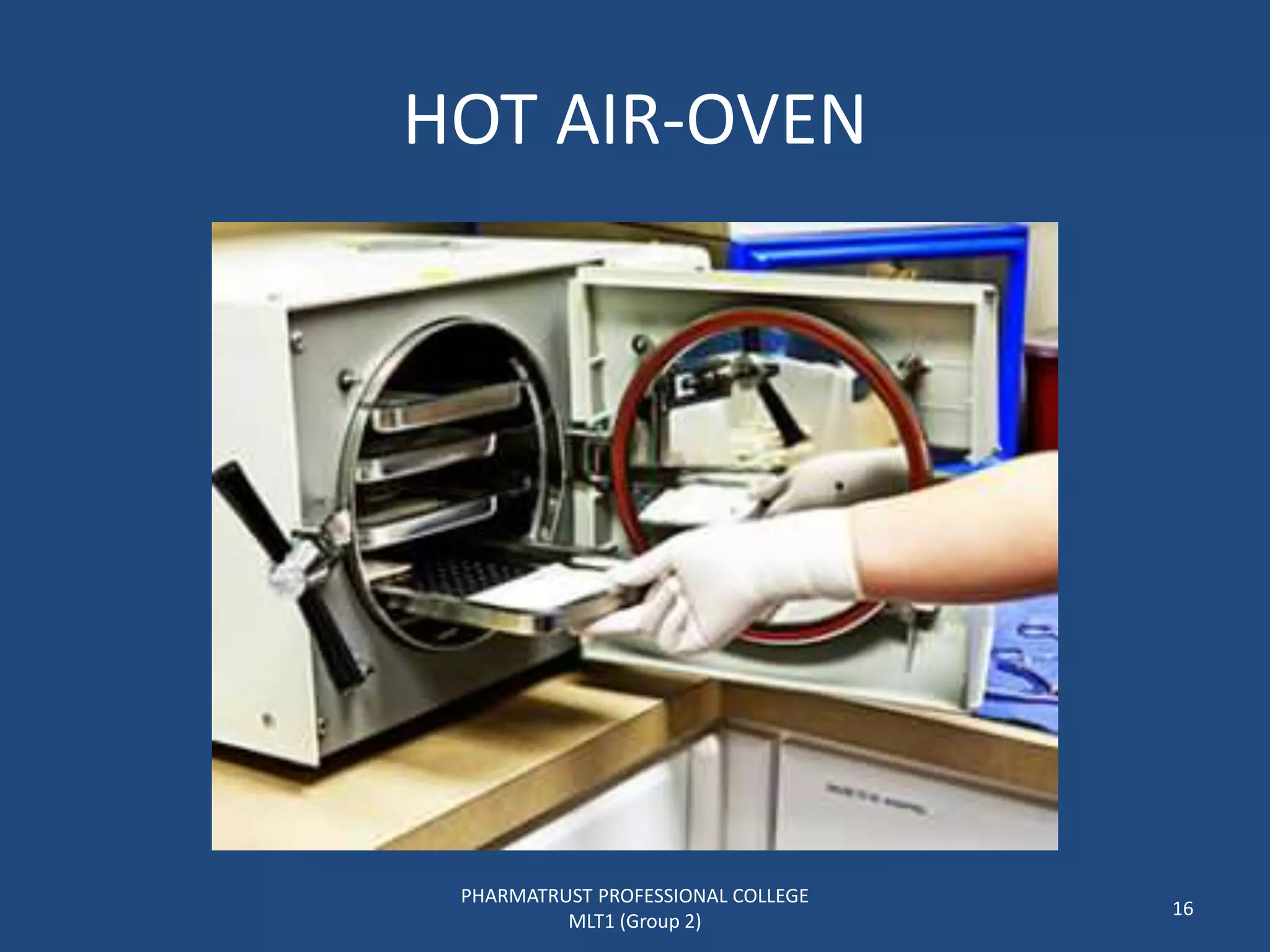
Dry heat
Hot-air ovens are mainly used in the sterilizing glassware such
as Petri dish,pipettes,flasks and test tubes. It consist of an
insulated cabinet containing a heating element and a fan to
keep the hot-air circulating at a constant temperature it is also
equipped a temperature regulator and a thermostat. For a
normal sterilization, the oven should operate at a
temperature of 175⁰C for 1hour. Petri dish , pipettes are
packed in canister before being sterilized
PHARMATRUST PROFESSIONAL COLLEGE
MLT1 (Group 2)
15
HOT AIR-OVEN
PHARMATRUST PROFESSIONAL COLLEGE
MLT1 (Group 2)
16
FLAMING
RED HEAT
Flaming is done to loops and straight-wires in microbiology
labs.
Sterility is the watch word in microbiology and bacteriology
since microbes cant be seen with naked eye.
Leaving the loop in the flame of a Bunsen burner or alcohol
lamp until it glows red ensures that any infectious agent gets
inactivated. This is done to prevent contamination in
laboratory. When this is not done properly it could trigger
false positive or negative which could go a long way to
mislead the Doctor
PHARMATRUST PROFESSIONAL COLLEGE
MLT1 (Group 2)
17
RED HEATING
PHARMATRUST PROFESSIONAL COLLEGE
MLT1 (Group 2)
18
PHARMATRUST PROFESSIONAL COLLEGE
MLT1 (Group 2)
19
RADIATION METHOD
There are two types of radiations available for
sterilization non-ionic and ionic radiation.
• Non-ionic radiations are safe to the operator of
sterilization and they are like UV radiations, they can
be used even at the door entrances to prevent entry
of live microbes through the air.
• Ionizing radiation sterilization. They are powerful and
very effective for sterilization X-rays, γ-rays etc.
PHARMATRUST PROFESSIONAL COLLEGE
MLT1 (Group 2)
20
Uv sterilizer
PHARMATRUST PROFESSIONAL COLLEGE
MLT1 (Group 2)
21
PHARMATRUST PROFESSIONAL COLLEGE
MLT1 (Group 2)
22
MEMBRANE FILTERATION
Filtration: Here the liquids are filtered
through bacterial filters to remove any
microbes present. This is an effective
method of sterilization for heat sensitive
liquids.
PHARMATRUST PROFESSIONAL COLLEGE
MLT1 (Group 2)
23
General laboratory safety
Never eat, drink, or smoke while working in
the laboratory.
Read labels carefully.
Do not use any equipment unless you are
trained and approved as a user by your
supervisor.
Wear gloves when using any hazardous or
toxic agent.
PHARMATRUST PROFESSIONAL COLLEGE
MLT1 (Group 2)
24
handling dangerous substances.
 Disposal -
 Shoes are required when working in the
machine shops.
Keep the work area clear of all materials
except those needed for your work.
Failure -
PHARMATRUST PROFESSIONAL COLLEGE
MLT1 (Group 2)
25
PHARMATRUST PROFESSIONAL COLLEGE
MLT1 (Group 2)
26
PHARMATRUST PROFESSIONAL COLLEGE
MLT1 (Group 2)
27
PHARMATRUST PROFESSIONAL COLLEGE
MLT1 (Group 2)
28
Compiled by Nadjo Deen
+233244902797
nadjodeen@yahoo.com
PHARMATRUST PROFESSIONAL COLLEGE
MLT1 (Group 2)
29
THANK YOU
PHARMATRUST PROFESSIONAL COLLEGE
MLT1 (Group 2)
30

Laboratory hazards, safety and contamination

  • 1.
    Laboratory Hazards, Safetyand Contamination PHARMATRUST PROFESSIONAL COLLEGE MLT1 (Group 2) 1
  • 2.
    Pharmatrust Professional College DepartmentOf Medical Laboratory Technology SCC NEW-WEIJA (CAMPUS) ACCRA, GHANA Compiled by Eric Gokah Rita Boah Nadjo Deen Aikens Mensah PHARMATRUST PROFESSIONAL COLLEGE MLT1 (Group 2) 2
  • 3.
    Introduction A HAZARD isa situation that poses a level of threat to life, health, property, or environment. These hazards are also very dangerous for human and animal life in the laboratory. PHARMATRUST PROFESSIONAL COLLEGE MLT1 (Group 2) 3
  • 4.
    TYPES OF HAZARDS Basicallylaboratory hazards fall in three, these include; • Chemical hazard • Biological hazard • Physical hazard PHARMATRUST PROFESSIONAL COLLEGE MLT1 (Group 2) 4
  • 5.
    Chemical Hazards Chemical hazardis occupational hazard caused by exposure to chemical at the workplace. Cleaning agents and disinfectants, solvents, and are examples of chemical hazards PHARMATRUST PROFESSIONAL COLLEGE MLT1 (Group 2) 5
  • 6.
    Biological Hazards Biological hazardsinclude potential exposures to allergens, infectious zoonotics (animal diseases transmissible to humans), and experimental agents such as viral vectors. PHARMATRUST PROFESSIONAL COLLEGE MLT1 (Group 2) 6
  • 7.
    Physical Hazards Physical hazardsassociated with laboratory are slips and falls from working in wet locations. Other physical hazards often unnoticed are electrical, mechanical or thermal in nature. Ignoring these can have potentially serious consequences. PHARMATRUST PROFESSIONAL COLLEGE MLT1 (Group 2) 7
  • 8.
  • 9.
    Sterilization Sterilization is thekilling or complete elimination of all microorganisms including bacterial spores which are highly resistant. Disinfection is the application of disinfectant on inanimate objects in the reduction of microbes to reduce its pathogenicity. Some organisms and bacterial spores may survive. Disinfectants are chemicals that are used for disinfection. Disinfectants are used only on inanimate objects. Antiseptics are mild forms of disinfectants that are used externally on living tissues to reduce the microbial load on the surface of skin and mucous membranes. PHARMATRUST PROFESSIONAL COLLEGE MLT1 (Group 2) 9
  • 10.
    STERILISATION METHODS • HEAT •CHEMICAL • FILTRATION • RADIATION PHARMATRUST PROFESSIONAL COLLEGE MLT1 (Group 2) 10
  • 11.
    Uses of Sterilization 1.Sterilization for Surgical Procedures: Gloves, aprons, surgical instruments, syringes etc. are to be sterilized. 2. Sterilization in Microbiological works like preparation of culture media, reagents and equipments where a sterile condition is to be maintained. PHARMATRUST PROFESSIONAL COLLEGE MLT1 (Group 2) 11
  • 12.
  • 13.
    Heat method ofsterilization Steam (moist heat) This method of sterilization involve the use of autoclave which operates on the same principle as the domestic pressure cooker. Most heat in a form of pressurized steam is highly effective in killing of micro organisms, Autoclaves use steam heated to 121-134 °C under pressure. To achieve sterility, the article is heated in a chamber by injected steam until the article reaches a time and temperature set point. PHARMATRUST PROFESSIONAL COLLEGE MLT1 (Group 2) 13
  • 14.
  • 15.
    Dry heat Hot-air ovensare mainly used in the sterilizing glassware such as Petri dish,pipettes,flasks and test tubes. It consist of an insulated cabinet containing a heating element and a fan to keep the hot-air circulating at a constant temperature it is also equipped a temperature regulator and a thermostat. For a normal sterilization, the oven should operate at a temperature of 175⁰C for 1hour. Petri dish , pipettes are packed in canister before being sterilized PHARMATRUST PROFESSIONAL COLLEGE MLT1 (Group 2) 15
  • 16.
    HOT AIR-OVEN PHARMATRUST PROFESSIONALCOLLEGE MLT1 (Group 2) 16
  • 17.
    FLAMING RED HEAT Flaming isdone to loops and straight-wires in microbiology labs. Sterility is the watch word in microbiology and bacteriology since microbes cant be seen with naked eye. Leaving the loop in the flame of a Bunsen burner or alcohol lamp until it glows red ensures that any infectious agent gets inactivated. This is done to prevent contamination in laboratory. When this is not done properly it could trigger false positive or negative which could go a long way to mislead the Doctor PHARMATRUST PROFESSIONAL COLLEGE MLT1 (Group 2) 17
  • 18.
    RED HEATING PHARMATRUST PROFESSIONALCOLLEGE MLT1 (Group 2) 18
  • 19.
  • 20.
    RADIATION METHOD There aretwo types of radiations available for sterilization non-ionic and ionic radiation. • Non-ionic radiations are safe to the operator of sterilization and they are like UV radiations, they can be used even at the door entrances to prevent entry of live microbes through the air. • Ionizing radiation sterilization. They are powerful and very effective for sterilization X-rays, γ-rays etc. PHARMATRUST PROFESSIONAL COLLEGE MLT1 (Group 2) 20
  • 21.
    Uv sterilizer PHARMATRUST PROFESSIONALCOLLEGE MLT1 (Group 2) 21
  • 22.
  • 23.
    MEMBRANE FILTERATION Filtration: Herethe liquids are filtered through bacterial filters to remove any microbes present. This is an effective method of sterilization for heat sensitive liquids. PHARMATRUST PROFESSIONAL COLLEGE MLT1 (Group 2) 23
  • 24.
    General laboratory safety Nevereat, drink, or smoke while working in the laboratory. Read labels carefully. Do not use any equipment unless you are trained and approved as a user by your supervisor. Wear gloves when using any hazardous or toxic agent. PHARMATRUST PROFESSIONAL COLLEGE MLT1 (Group 2) 24
  • 25.
    handling dangerous substances. Disposal -  Shoes are required when working in the machine shops. Keep the work area clear of all materials except those needed for your work. Failure - PHARMATRUST PROFESSIONAL COLLEGE MLT1 (Group 2) 25
  • 26.
  • 27.
  • 28.
  • 29.
    Compiled by NadjoDeen +233244902797 nadjodeen@yahoo.com PHARMATRUST PROFESSIONAL COLLEGE MLT1 (Group 2) 29
  • 30.
    THANK YOU PHARMATRUST PROFESSIONALCOLLEGE MLT1 (Group 2) 30