ETHERS AND EPOXIDE
Dr. T. Geetha
Assistant Professor
Department of Chemistry
St. Mary’s College, Thrissur
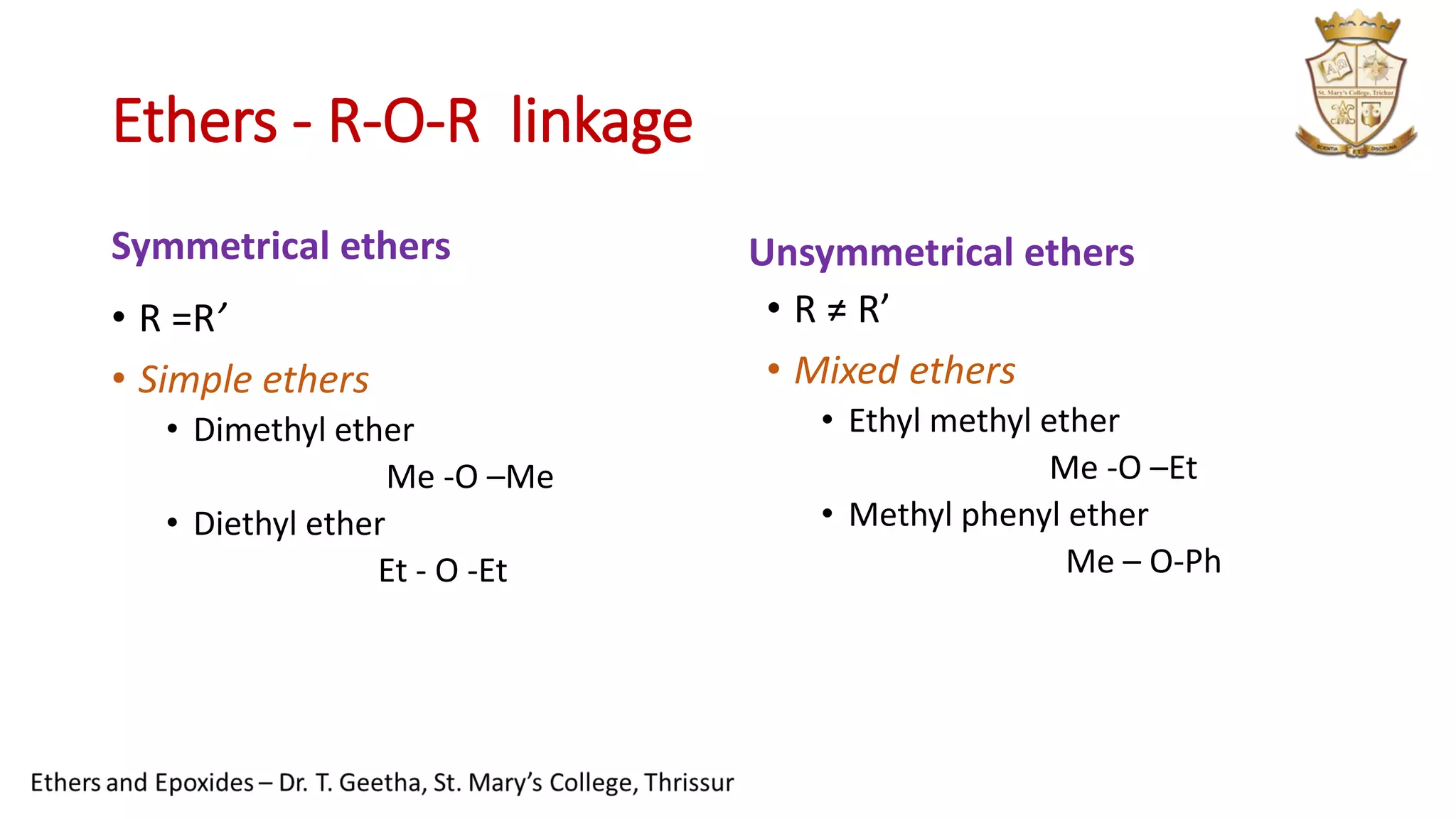
Ethers - R-O-R linkage
Symmetrical ethers
• R =R’
• Simple ethers
• Dimethyl ether
Me -O –Me
• Diethyl ether
Et - O -Et
Unsymmetrical ethers
• R ≠ R’
• Mixed ethers
• Ethyl methyl ether
Me -O –Et
• Methyl phenyl ether
Me – O-Ph
Nomenclature
•Simple ethers - assigned common names
• Name both alkyl groups bonded to the oxygen, arrange these
names alphabetically, and add the word ether
• For symmetrical ethers, name the alkyl group and add the prefix
“di-”
Ethers and Epoxides – Dr. T. Geetha, St. Mary’s College, Thrissur
Nomenclature - IUPAC system
• One alkyl group is named as a hydrocarbon chain, the other is named as part of a
substituent bonded to that chain:
• Name the simpler alkyl group as an alkoxy substituent by changing the –yl
ending of the alkyl group to –oxy.
• Name the remaining alkyl group as an alkane, with the alkoxy group as a
substituent bonded to this chain
Ethers and Epoxides – Dr. T. Geetha, St. Mary’s College, Thrissur
Nomenclature - IUPAC system
• CH3CH2CH2OCH3
➢1-methoxypropane
• CH3CH(OCH3)CH3
➢2-methoxypropane
• CH3CH(CH3)OCH3CH(CH3)
➢2-(2-Propoxy)propane
Polyether
• More than one ether linkage
• Named as Oxa derivative of alkane corresponding to total number of
C & O atom present
• CH3-O-CH2CH2CH2-O-CH3
➢ 1,3-dimethoxypropane or 2,6-Dioxaheptane
• CH3OCH2CH2CH3
➢2-oxapentane
Ethers and Epoxides – Dr. T. Geetha, St. Mary’s College, Thrissur
Cyclic ether
• Epoxides – alkene oxides
• 3 membered cyclic ether
Ethylene oxide Propyleneoxide Butyleneoxide
Epoxy ethane 1,2-Epoxypropane 2,3-Epoxybutane
Ethene oxide 1,2 – Propene Oxide 2,3- Butene Oxide
Ethers and Epoxides – Dr. T. Geetha, St. Mary’s College, Thrissur
Cyclic ether
• Tetrahydrofuran
• Tetrahydropyran
Cyclic ether - IUPAC
Ethers and Epoxides – Dr. T. Geetha, St. Mary’s College, Thrissur
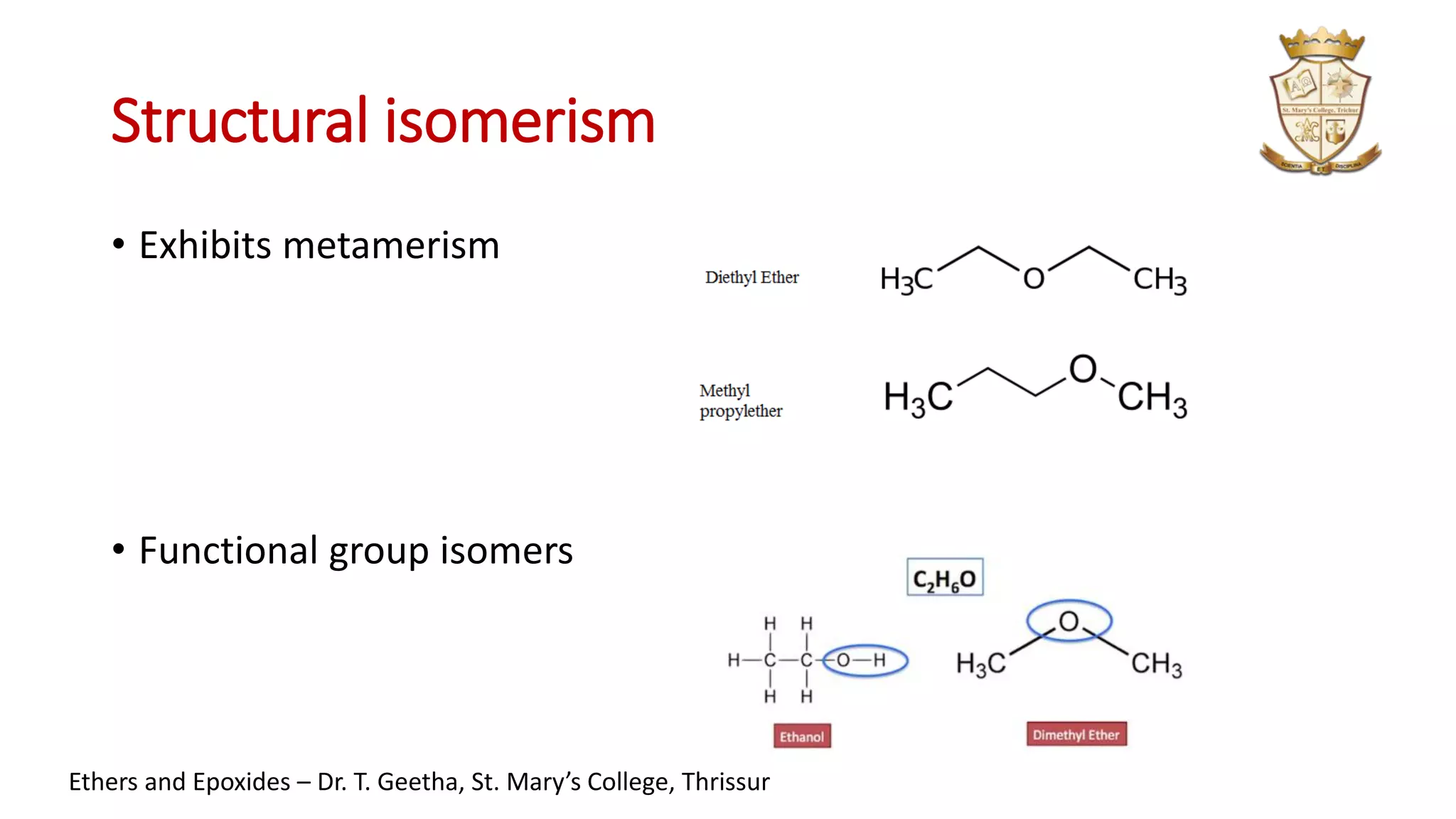
Structural isomerism
• Exhibits metamerism
• Functional group isomers
Ethers and Epoxides – Dr. T. Geetha, St. Mary’s College, Thrissur
Preparation
• Dehydrogenation of alcohol
• Industrial synthesis for diethyl ether:
2 CH3CH2-OH + H2SO4 140oC CH3CH2-O-CH2CH3 + H2O
• SN2 mechanism
• Not generally useful for syntheses of ethers in the lab:
a) Only symmetric ethers can be made this way.
b) Conditions are very compound specific
( at 180o ethanol would yield ethylene instead of the ether)
Ethers and Epoxides – Dr. T. Geetha, St. Mary’s College, Thrissur
Williamson ether synthesis
• reaction between a metal alkoxide & alkyl halide
• R-O-Na+ + R´-X → R-O-R´ + NaX
• R´-X should be CH3 or 1o
• SN2 mechanism
Ethers and Epoxides – Dr. T. Geetha, St. Mary’s College, Thrissur
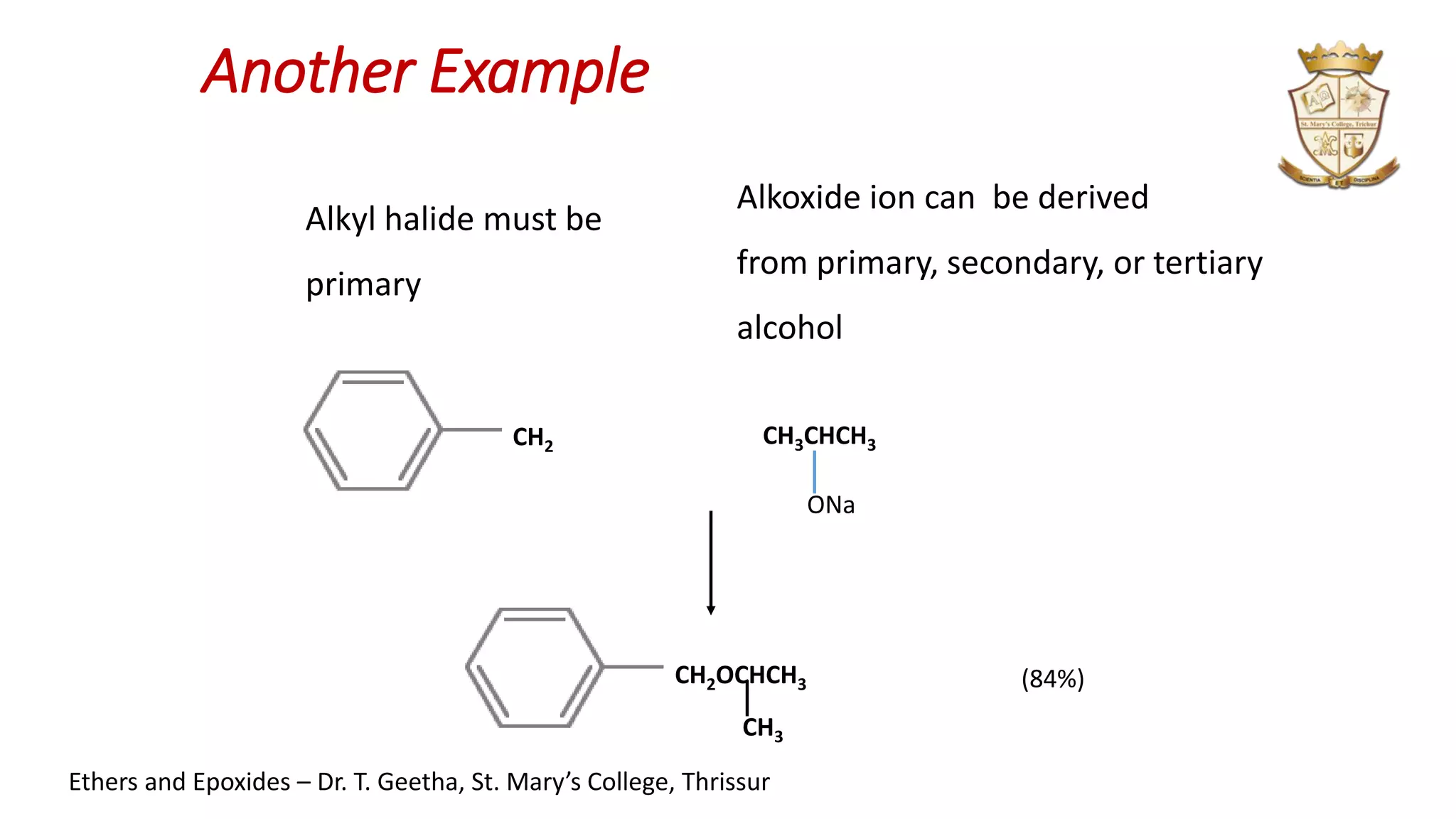
Another Example
+ CH3CHCH3
ONa
CH2Cl
(84%)CH2OCHCH3
CH3
Alkyl halide must be
primary
Alkoxide ion can be derived
from primary, secondary, or tertiary
alcohol
Ethers and Epoxides – Dr. T. Geetha, St. Mary’s College, Thrissur
CH3CHCH3
OH
Na (s)
CH2OH
HCl or SOCl2
CH2OCHCH3
CH3
CH2Cl + CH3CHCH3
ONa
(84%)
1o Halides & Alkoxides
Ethers and Epoxides – Dr. T. Geetha, St. Mary’s College, Thrissur
What if the alkyl halide is not primary?
SN2 vs E2
CH2ONa + CH3CHCH3
Br
CH2OH + H2C CHCH3
Elimination produces the major product.
Ethers and Epoxides – Dr. T. Geetha, St. Mary’s College, Thrissur
Alkoxides
• Alkoxides can be prepared from alcohols by a BrØnsted-Lowry acid—base reaction
• For example, sodium ethoxide (NaOCH2CH3) is prepared by treating ethanol with NaH
• NaH is an especially good base for forming alkoxide - by-product of the reaction,
H2, is a gas that just bubbles out of the reaction mixture
Ethers and Epoxides – Dr. T. Geetha, St. Mary’s College, Thrissur
oxygen is sp3 hybridized, bond angle ~ 109.5o
ethers are polar; no hydrogen bonding
mp/bp moderate
water insoluble
Ethers and epoxides exhibit dipole-dipole interactions because they have a bent
structure with two polar bonds
Diethyl ether = very important organic solvent, polar, water insoluble, bp = 35o.
Very flammable & forms explosive peroxides
R
O
R'
: :
Ethers and Epoxides – Dr. T. Geetha, St. Mary’s College, Thrissur
Physical properties:
Chemical reaction of ethers
• Two lone pair – Lewis Base
• Basic property –
•
• Forms etherates with Lewis acid such as BF3
R
O
R'
: :
Ethers and Epoxides – Dr. T. Geetha, St. Mary’s College, Thrissur
Chemical reaction of ethers
• Basic property –
• Oxonium salt with cold conc. inorganic acid
R
O
R'
: :
Ethers and Epoxides – Dr. T. Geetha, St. Mary’s College, Thrissur
Chemical reaction of ethers
Acid cleavage
R-O-R´ + (conc) HX heat R-X + R´-OH
If excess of HX is used, the alcohol formed reacts further to give alkyl halide
R-O-R´ + (conc) HX heat R-X + R´-X
X = Br, I
Ethers and Epoxides – Dr. T. Geetha, St. Mary’s College, Thrissur
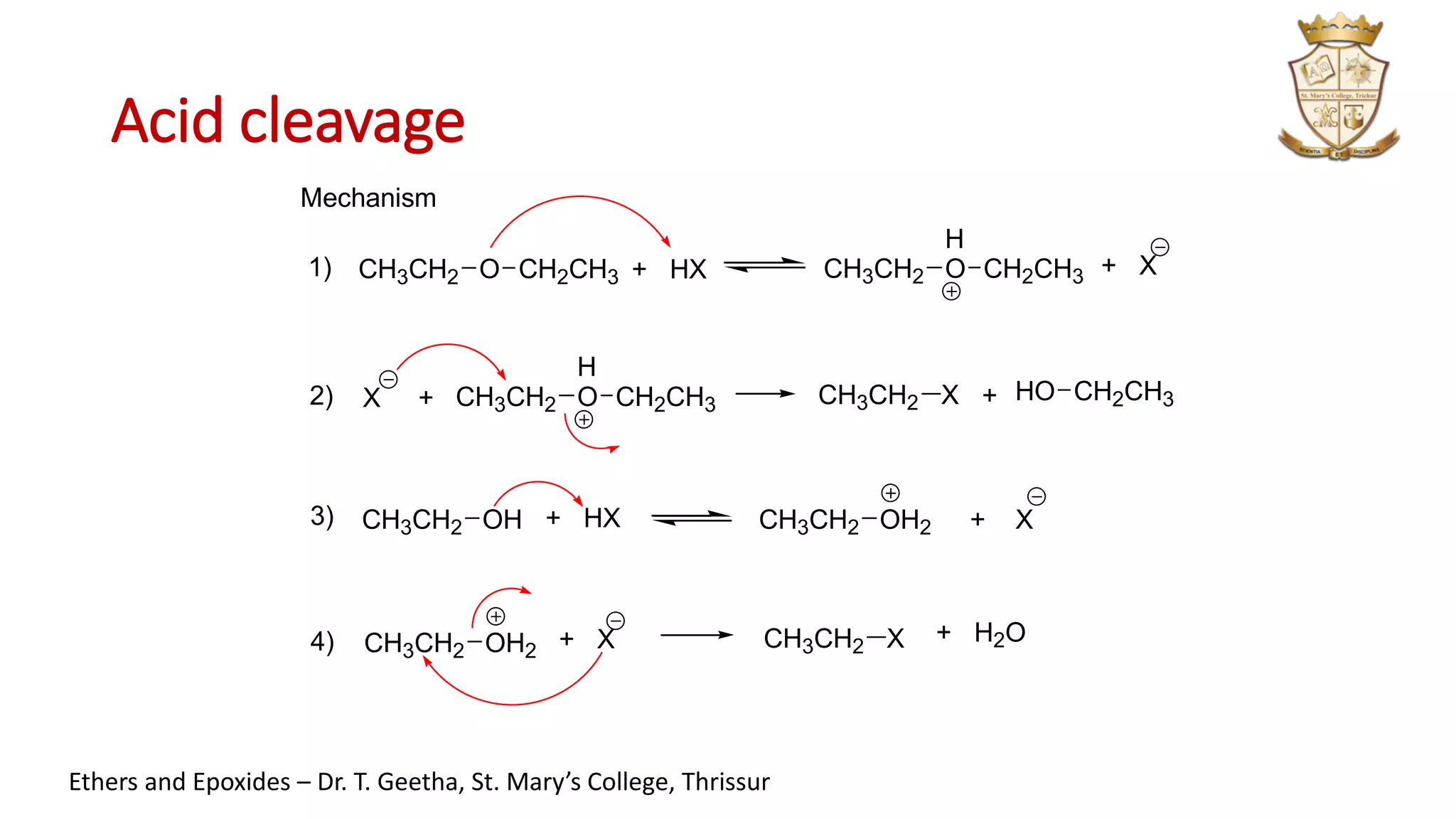
Acid cleavage
Mechanism
1) O CH2CH3CH3CH2 + HX
H
O CH2CH3CH3CH2 + X
H
O CH2CH3CH3CH22) X + CH3CH2 X + HO CH2CH3
3) CH3CH2 OH + HX CH3CH2 OH2
4) CH3CH2 OH2 + X CH3CH2 X + H2O
+ X
Ethers and Epoxides – Dr. T. Geetha, St. Mary’s College, Thrissur
Reactions of unsymmetrical ether
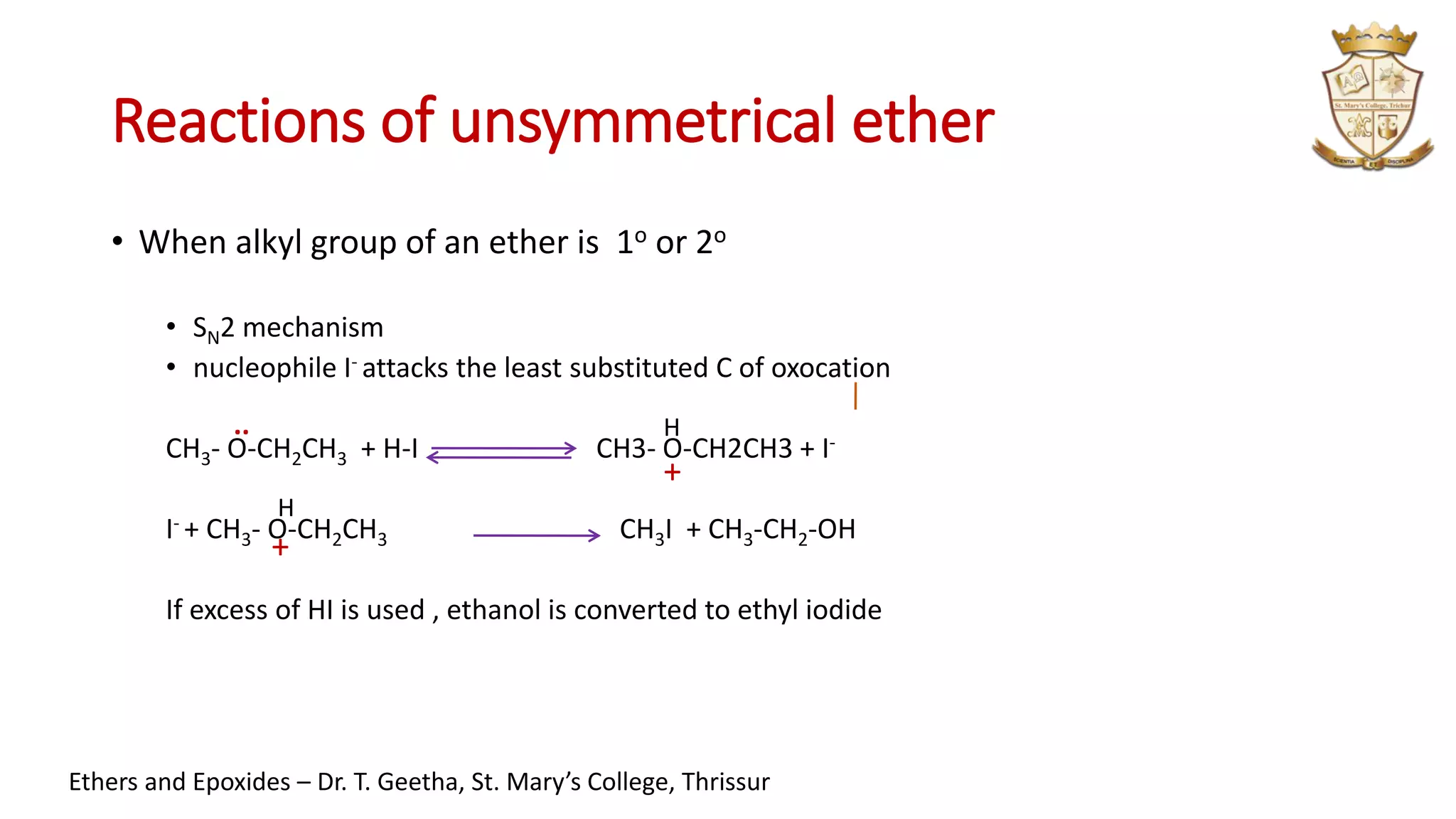
• When alkyl group of an ether is 1o or 2o
• SN2 mechanism
• nucleophile I- attacks the least substituted C of oxocation
CH3- O-CH2CH3 + H-I CH3- O-CH2CH3 + I-
I- + CH3- O-CH2CH3 CH3I + CH3-CH2-OH
If excess of HI is used , ethanol is converted to ethyl iodide
..
+
+
Ethers and Epoxides – Dr. T. Geetha, St. Mary’s College, Thrissur
H
H
When alkyl group of an ether is 3o
slow
+ I-
Fast
SN1 reaction
Ethers and Epoxides – Dr. T. Geetha, St. Mary’s College, Thrissur
HI+
Reaction of aryl ether
• Anisole reacts with HI CH3-O-CH3 + HI CH3I +C6H5OH
Ethers and Epoxides – Dr. T. Geetha, St. Mary’s College, Thrissur
Claisen rearrangement
• [3,3]-sigmatropic rearrangement
• allyl phenyl ether is converted thermally to an unsaturated carbonyl compound
followed by rearomatisation
Ethers and Epoxides – Dr. T. Geetha, St. Mary’s College, Thrissur
Claisen rearrangement
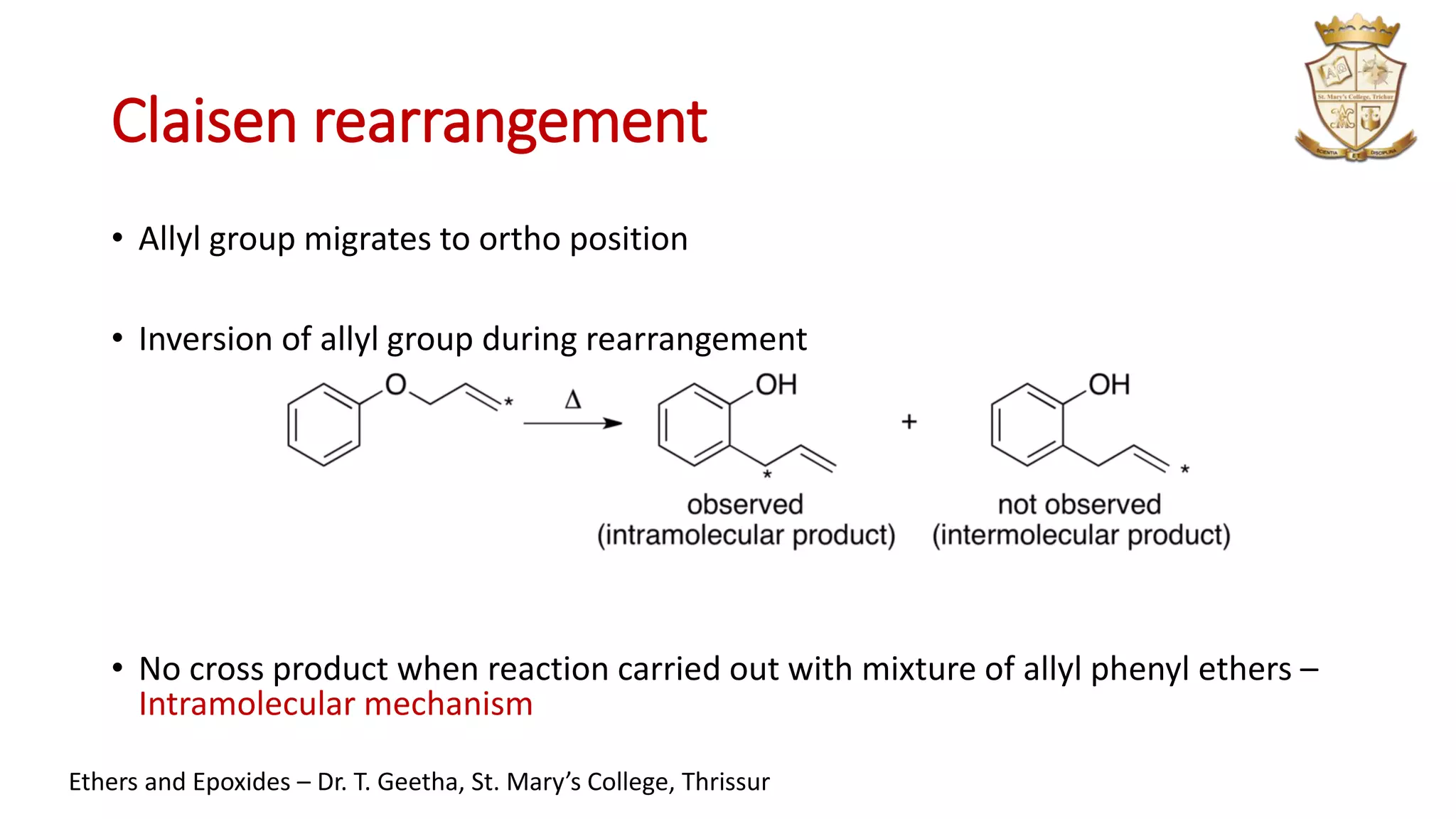
• Allyl group migrates to ortho position
• Inversion of allyl group during rearrangement
• No cross product when reaction carried out with mixture of allyl phenyl ethers –
Intramolecular mechanism
Ethers and Epoxides – Dr. T. Geetha, St. Mary’s College, Thrissur
Claisen rearrangement
• ortho position is preferred
• If both ortho position occupied – migrate to para position
Ethers and Epoxides – Dr. T. Geetha, St. Mary’s College, Thrissur
Zeisel’s method -estimation of methoxy group
The precipitate of AgI is collected washed dried and weighted
Ethers and Epoxides – Dr. T. Geetha, St. Mary’s College, Thrissur
Zeisel’s method
No. of methoxy group in compound = (w2 x M)/(234 x w1)
M= Molecular mass of sample
Ethers and Epoxides – Dr. T. Geetha, St. Mary’s College, Thrissur
Epoxide - Preperation
• Epoxidation of alkene
• Reaction of alkenes with peracid
Ethers and Epoxides – Dr. T. Geetha, St. Mary’s College, Thrissur
Epoxidation of alkene
Ethers and Epoxides – Dr. T. Geetha, St. Mary’s College, Thrissur
Preparation from halohydrin
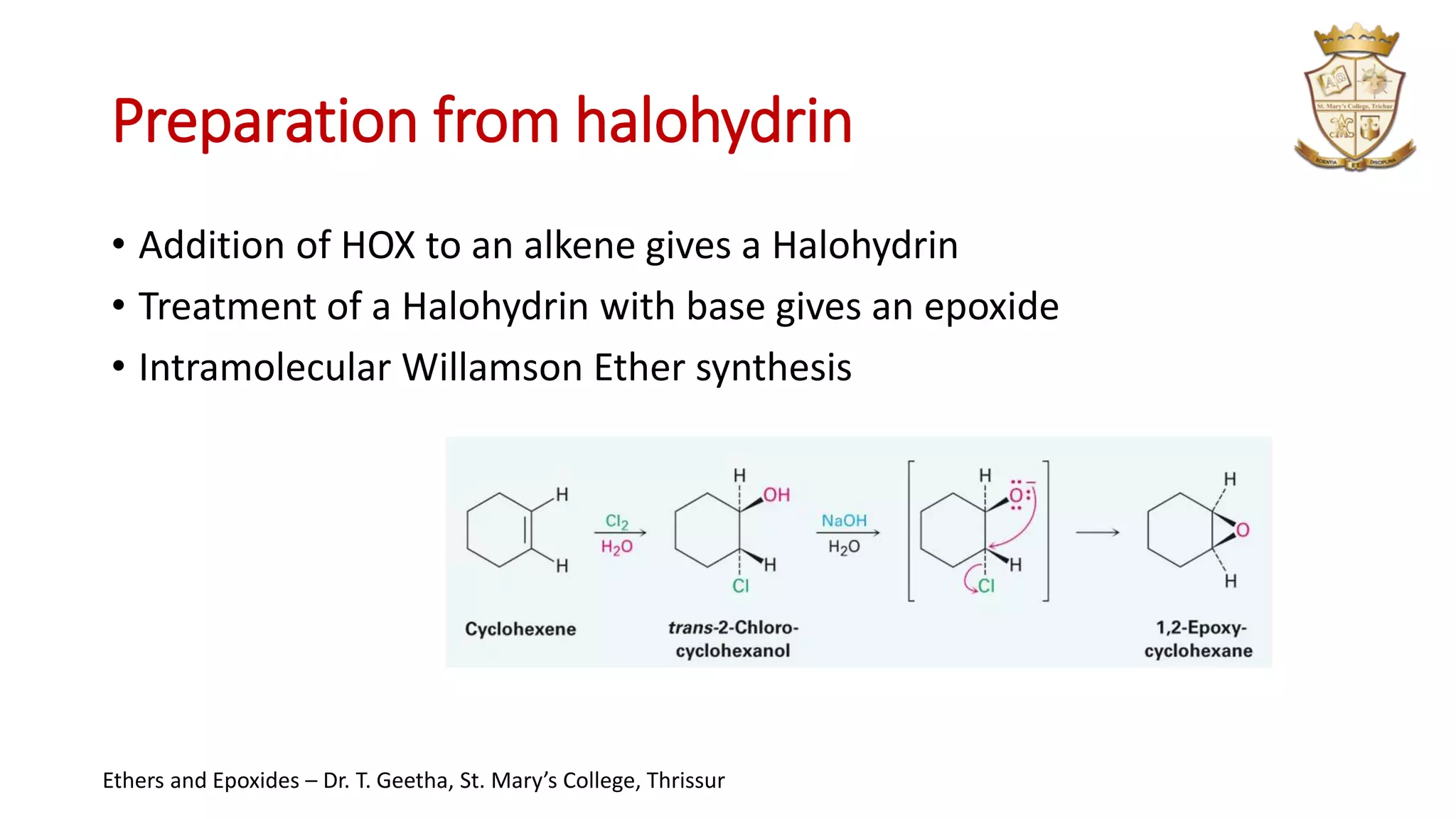
• Addition of HOX to an alkene gives a Halohydrin
• Treatment of a Halohydrin with base gives an epoxide
• Intramolecular Willamson Ether synthesis
Ethers and Epoxides – Dr. T. Geetha, St. Mary’s College, Thrissur
Industrial synthesis of ethylene oxide
• Controlled oxidation (using oxygen or air) of ethylene over a silver
catalyst
• Exothermic
• Excessive rise in temperature & over oxidation – complete
combustion liberating H2O & CO2
• High temperature cause degradation of catalyst
Ag/Al2O3 also acts as catalyst
Ethers and Epoxides – Dr. T. Geetha, St. Mary’s College, Thrissur
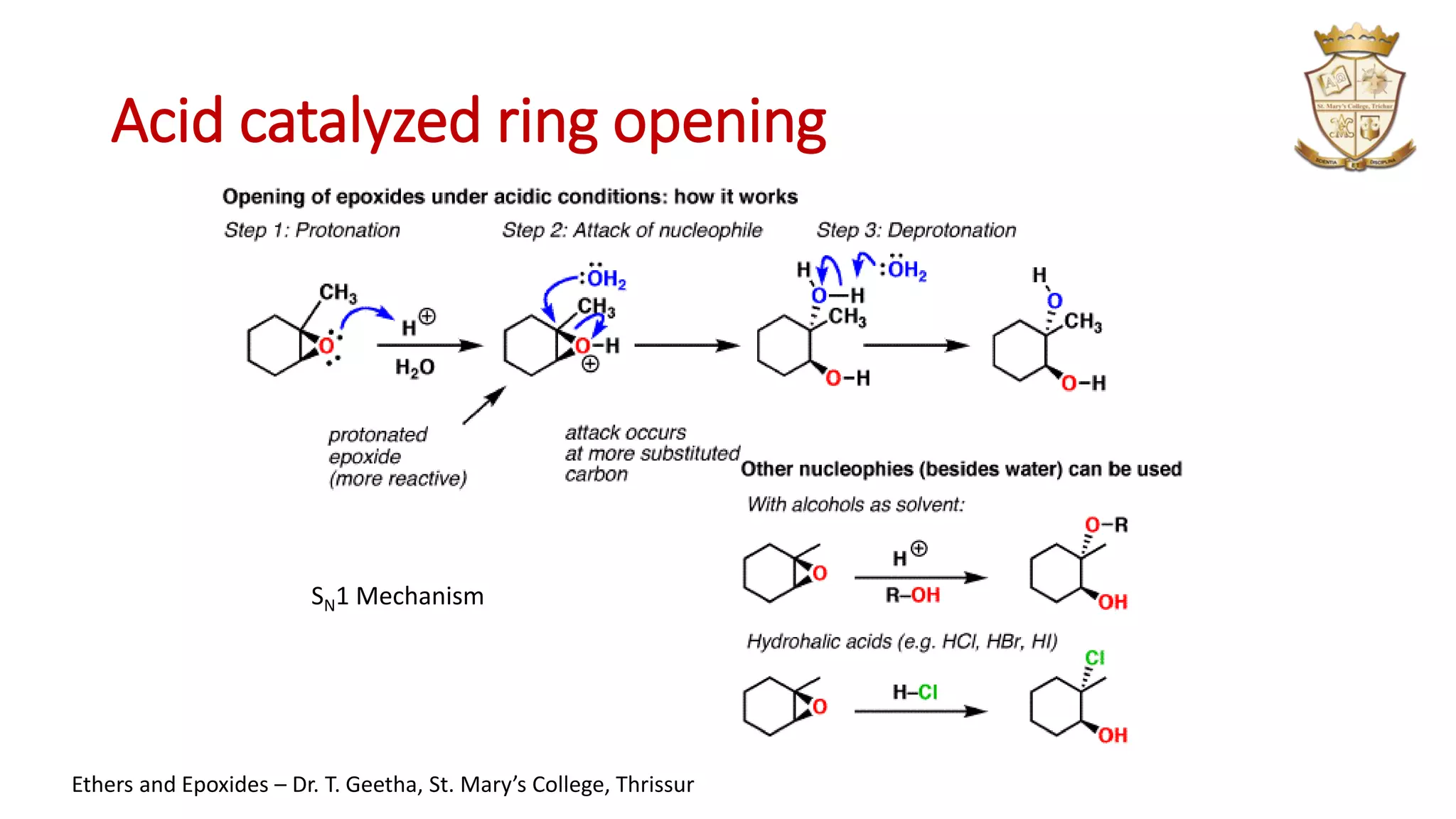
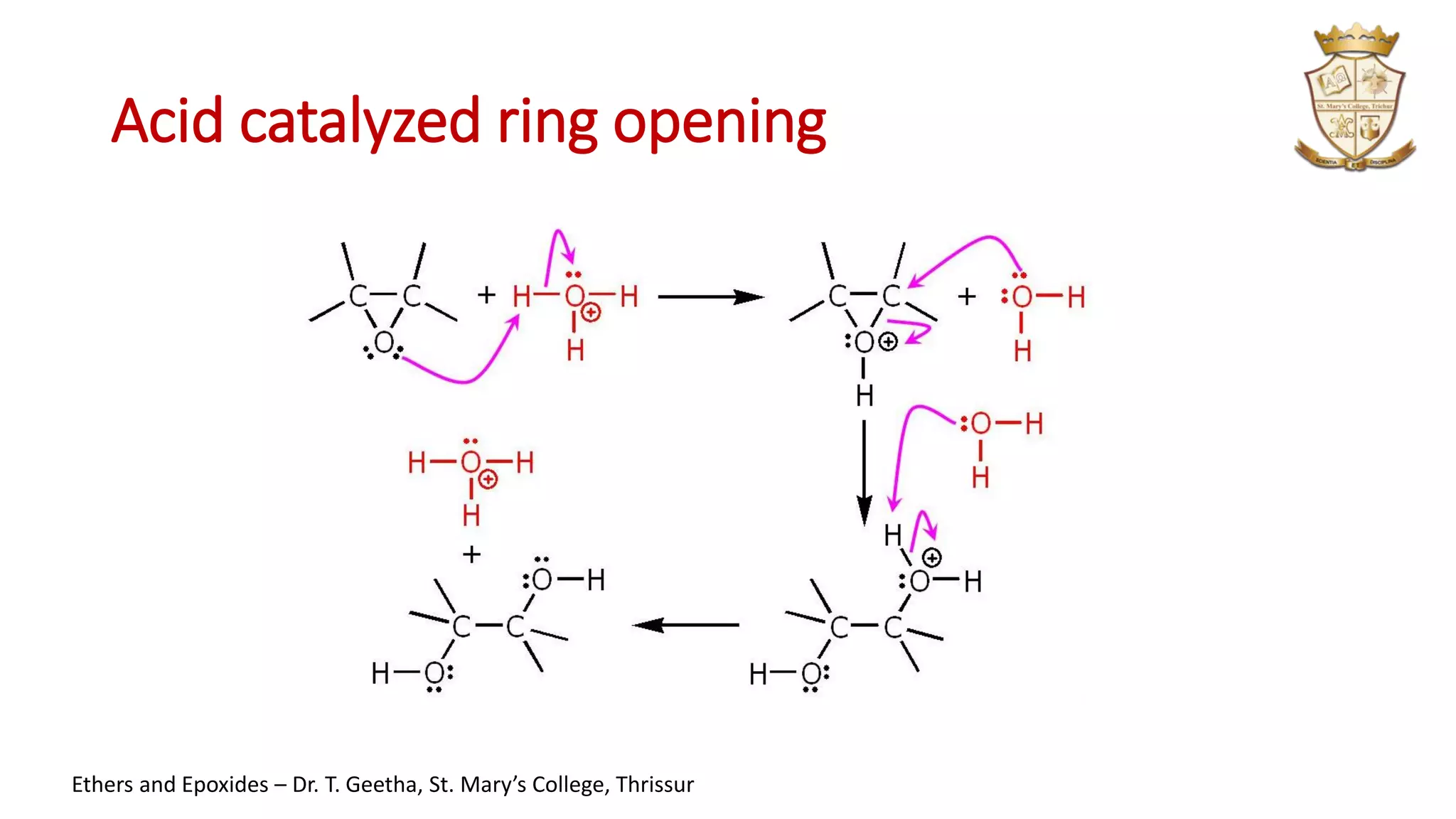
Acid catalyzed ring opening
SN1 Mechanism
Ethers and Epoxides – Dr. T. Geetha, St. Mary’s College, Thrissur
Acid catalyzed ring opening
Ethers and Epoxides – Dr. T. Geetha, St. Mary’s College, Thrissur
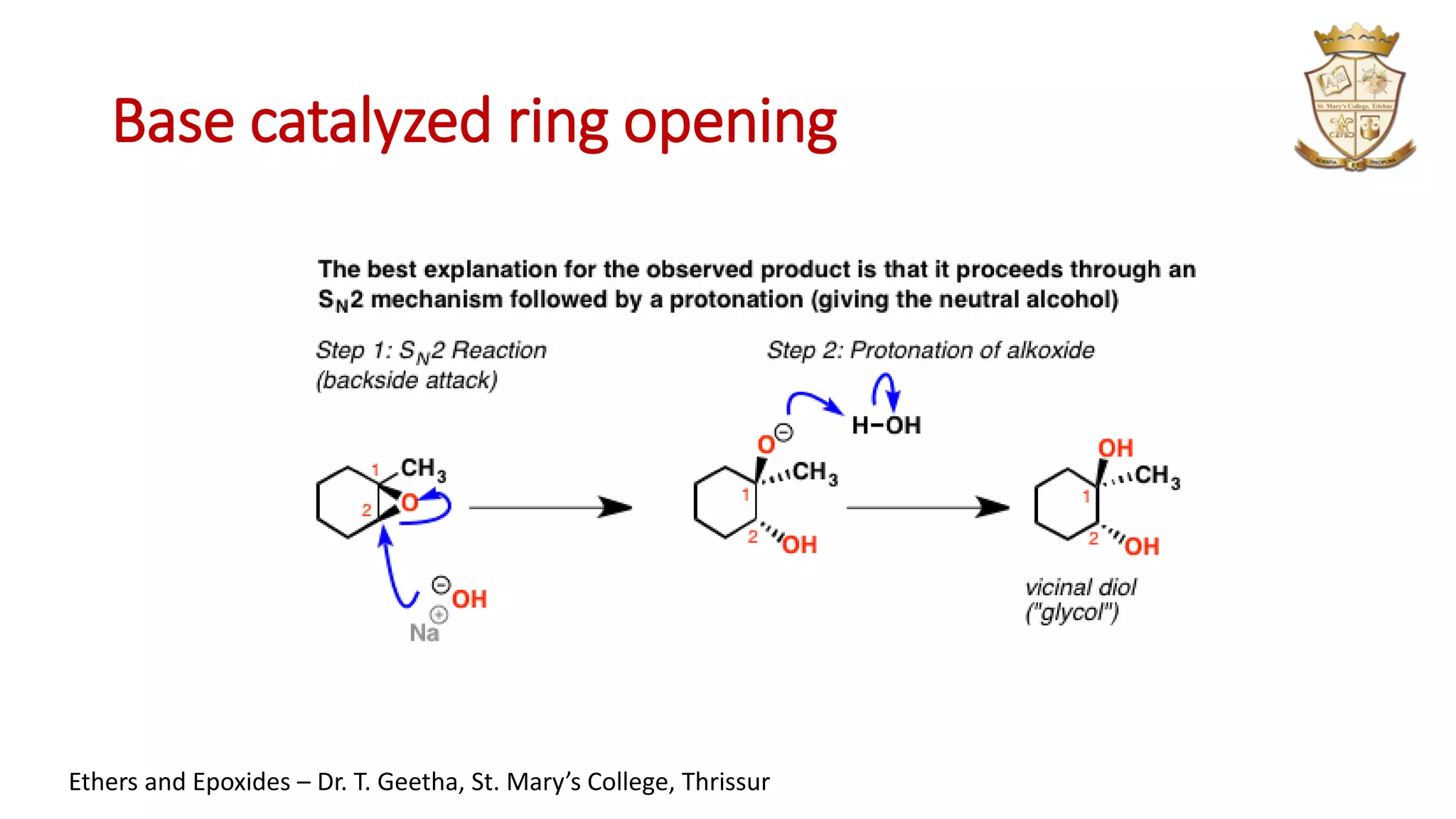
Base catalyzed ring opening
Ethers and Epoxides – Dr. T. Geetha, St. Mary’s College, Thrissur
Comparison
SN1 Mechanism
SN2 Mechanism
Ethers and Epoxides – Dr. T. Geetha, St. Mary’s College, Thrissur
Comparison – unsymmetrical epoxide
Acid catalyzed ring opening
Base catalyzed ring opening
Ethers and Epoxides – Dr. T. Geetha, St. Mary’s College, Thrissur
Crown Ether
•Structure
cyclic polyethers derived from repeating
—OCH2CH2— units
•Properties
form stable complexes with metal ions
•Applications
synthetic reactions involving anions
•Naming
x = total no. of atoms in ring: [x] Crown- no. of oxygen atoms
Ethers and Epoxides – Dr. T. Geetha, St. Mary’s College, Thrissur
These compounds are called Crown ethers because their molecule have a crown-
like shape. The bracket number represents the ring size and the terminal numbers
gives the number of oxygen. The oxygen are usually separated by two carbons.
Ethers and Epoxides – Dr. T. Geetha, St. Mary’s College, Thrissur
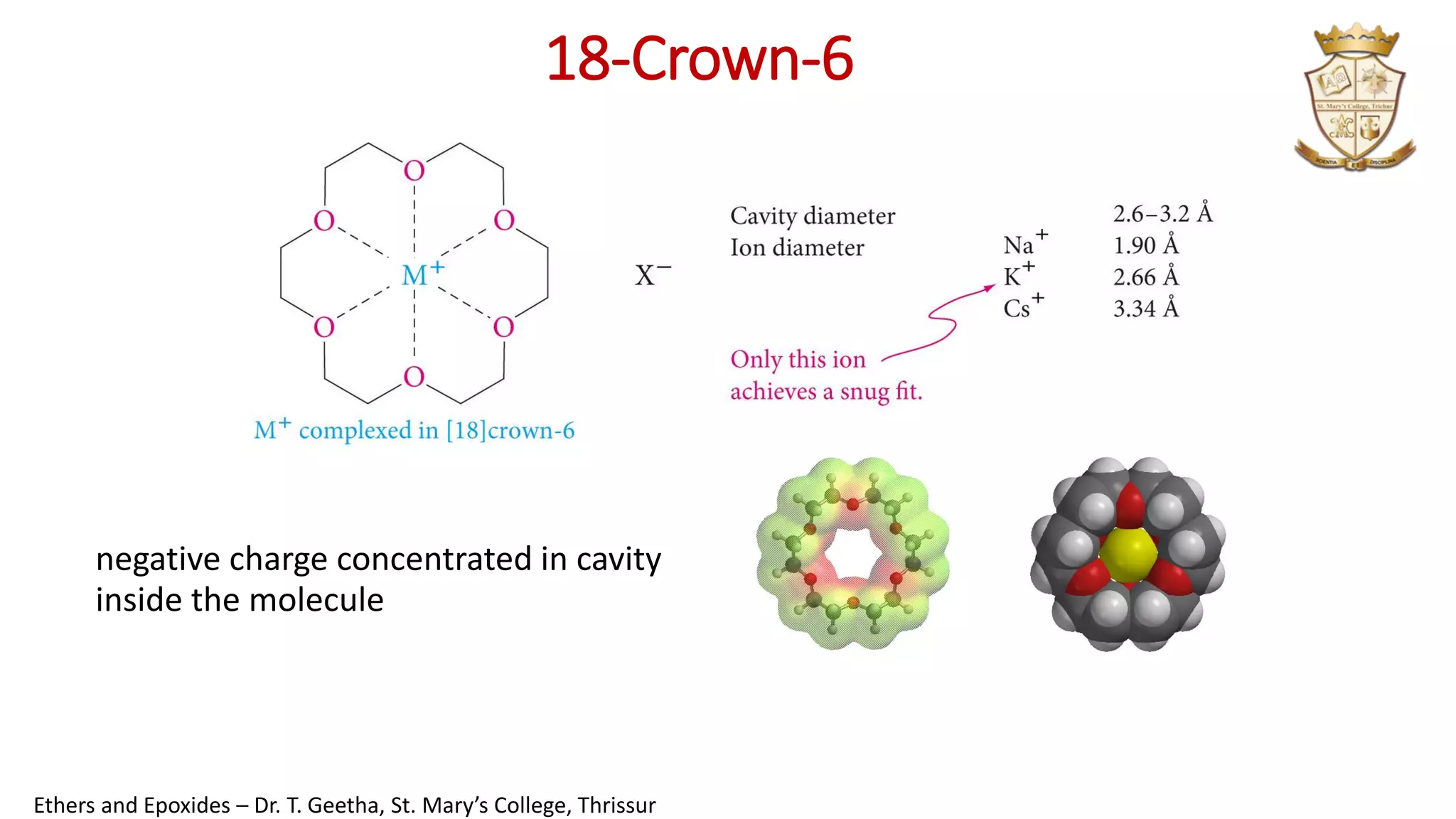
18-Crown-6
negative charge concentrated in cavity
inside the molecule
Ethers and Epoxides – Dr. T. Geetha, St. Mary’s College, Thrissur
Ion Size & Crown Ether Complexes
K+
Na+
Li+
18-Crown-6
12-Crown-4
15-Crown-5
Ethers and Epoxides – Dr. T. Geetha, St. Mary’s College, Thrissur
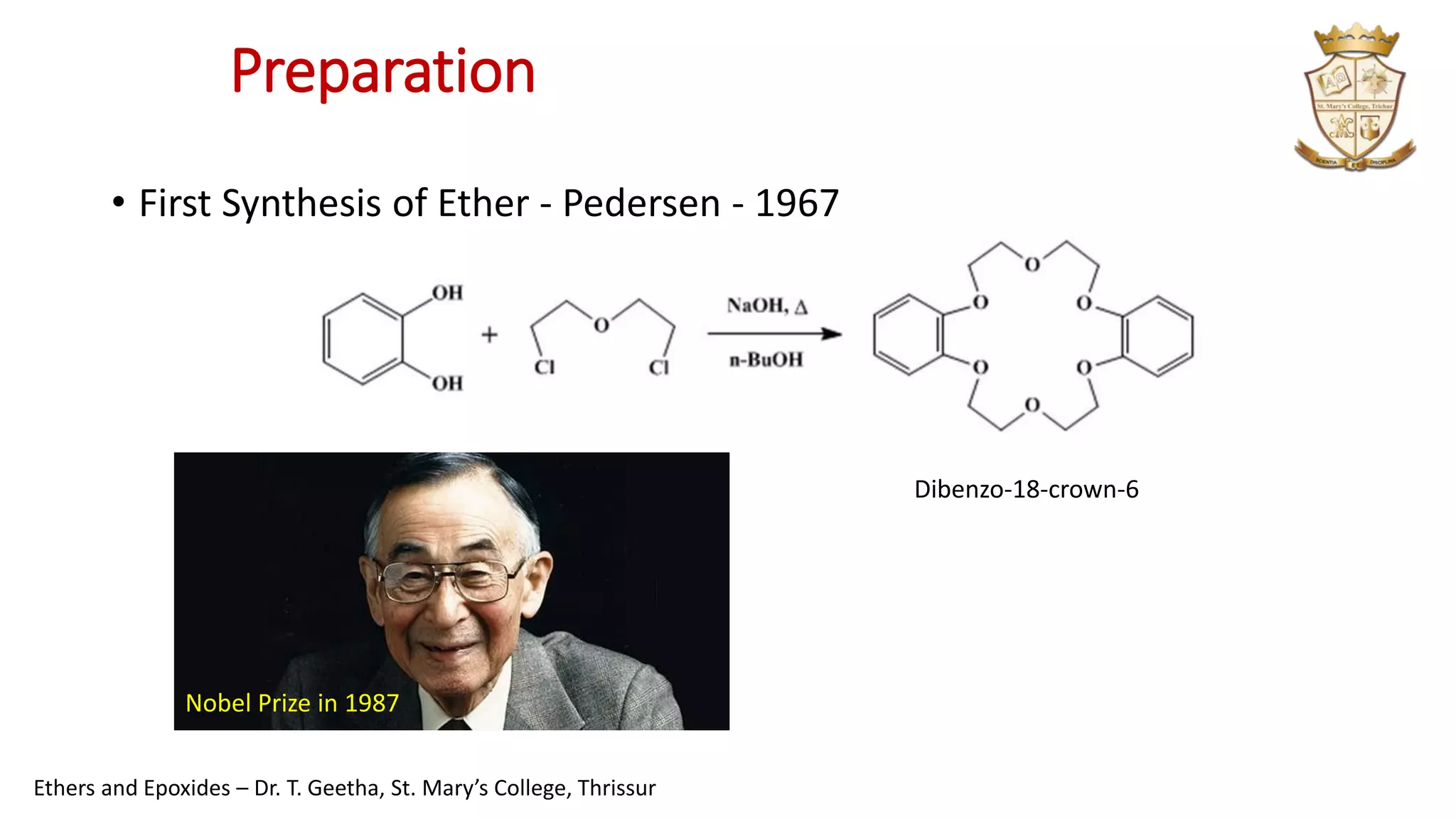
Preparation
• First Synthesis of Ether - Pedersen - 1967
Dibenzo-18-crown-6
Nobel Prize in 1987
Ethers and Epoxides – Dr. T. Geetha, St. Mary’s College, Thrissur
Preparation
Triethylene glycol tosylate
+
Triethylene glycol Potassium tertiary Butoxide
Ethers and Epoxides – Dr. T. Geetha, St. Mary’s College, Thrissur
Application
• Formation of Host Guest complex – inclusion compound
• Phase transfer catalyst – maintains homogeneity between aqueous and organic
substrate
• Reaction between aq. KMnO4 & Organic substrate in organic solvent is
accelerated by adding crown ether
• Chiral crown ether used for resolution of racemic mixture
• Accelerates nucleophilic substitution and elimination reaction
Ethers and Epoxides – Dr. T. Geetha, St. Mary’s College, Thrissur
Reference
• Morrison & Boyd, Organic Chemistry, VIth ed, Prentice Hall of India Pvt. Ltd., New
Delhi, 1998
• Bruice – Organic Chemistry, 3rd edition, Pearson Education, New Series 2001
• B.S. Bahl & Arun Bahl, Adv. Org. Chemistry., S.Chand & Co New Delhi
• Tiwari, Mehrothra, & Vishnoi, Text book of Organic Chemistry., Vikas Publishing
House Pvt.Ltd, New Delhi
Ethers and Epoxides – Dr. T. Geetha, St. Mary’s College, Thrissur
Ethers and epoxide

Ethers and epoxide

  • 1.
    ETHERS AND EPOXIDE Dr.T. Geetha Assistant Professor Department of Chemistry St. Mary’s College, Thrissur
  • 2.
    Ethers - R-O-Rlinkage Symmetrical ethers • R =R’ • Simple ethers • Dimethyl ether Me -O –Me • Diethyl ether Et - O -Et Unsymmetrical ethers • R ≠ R’ • Mixed ethers • Ethyl methyl ether Me -O –Et • Methyl phenyl ether Me – O-Ph
  • 3.
    Nomenclature •Simple ethers -assigned common names • Name both alkyl groups bonded to the oxygen, arrange these names alphabetically, and add the word ether • For symmetrical ethers, name the alkyl group and add the prefix “di-” Ethers and Epoxides – Dr. T. Geetha, St. Mary’s College, Thrissur
  • 4.
    Nomenclature - IUPACsystem • One alkyl group is named as a hydrocarbon chain, the other is named as part of a substituent bonded to that chain: • Name the simpler alkyl group as an alkoxy substituent by changing the –yl ending of the alkyl group to –oxy. • Name the remaining alkyl group as an alkane, with the alkoxy group as a substituent bonded to this chain Ethers and Epoxides – Dr. T. Geetha, St. Mary’s College, Thrissur
  • 5.
    Nomenclature - IUPACsystem • CH3CH2CH2OCH3 ➢1-methoxypropane • CH3CH(OCH3)CH3 ➢2-methoxypropane • CH3CH(CH3)OCH3CH(CH3) ➢2-(2-Propoxy)propane
  • 6.
    Polyether • More thanone ether linkage • Named as Oxa derivative of alkane corresponding to total number of C & O atom present • CH3-O-CH2CH2CH2-O-CH3 ➢ 1,3-dimethoxypropane or 2,6-Dioxaheptane • CH3OCH2CH2CH3 ➢2-oxapentane Ethers and Epoxides – Dr. T. Geetha, St. Mary’s College, Thrissur
  • 7.
    Cyclic ether • Epoxides– alkene oxides • 3 membered cyclic ether Ethylene oxide Propyleneoxide Butyleneoxide Epoxy ethane 1,2-Epoxypropane 2,3-Epoxybutane Ethene oxide 1,2 – Propene Oxide 2,3- Butene Oxide Ethers and Epoxides – Dr. T. Geetha, St. Mary’s College, Thrissur
  • 8.
  • 9.
    Cyclic ether -IUPAC Ethers and Epoxides – Dr. T. Geetha, St. Mary’s College, Thrissur
  • 10.
    Structural isomerism • Exhibitsmetamerism • Functional group isomers Ethers and Epoxides – Dr. T. Geetha, St. Mary’s College, Thrissur
  • 11.
    Preparation • Dehydrogenation ofalcohol • Industrial synthesis for diethyl ether: 2 CH3CH2-OH + H2SO4 140oC CH3CH2-O-CH2CH3 + H2O • SN2 mechanism • Not generally useful for syntheses of ethers in the lab: a) Only symmetric ethers can be made this way. b) Conditions are very compound specific ( at 180o ethanol would yield ethylene instead of the ether) Ethers and Epoxides – Dr. T. Geetha, St. Mary’s College, Thrissur
  • 12.
    Williamson ether synthesis •reaction between a metal alkoxide & alkyl halide • R-O-Na+ + R´-X → R-O-R´ + NaX • R´-X should be CH3 or 1o • SN2 mechanism Ethers and Epoxides – Dr. T. Geetha, St. Mary’s College, Thrissur
  • 13.
    Another Example + CH3CHCH3 ONa CH2Cl (84%)CH2OCHCH3 CH3 Alkylhalide must be primary Alkoxide ion can be derived from primary, secondary, or tertiary alcohol Ethers and Epoxides – Dr. T. Geetha, St. Mary’s College, Thrissur
  • 14.
    CH3CHCH3 OH Na (s) CH2OH HCl orSOCl2 CH2OCHCH3 CH3 CH2Cl + CH3CHCH3 ONa (84%) 1o Halides & Alkoxides Ethers and Epoxides – Dr. T. Geetha, St. Mary’s College, Thrissur
  • 15.
    What if thealkyl halide is not primary? SN2 vs E2 CH2ONa + CH3CHCH3 Br CH2OH + H2C CHCH3 Elimination produces the major product. Ethers and Epoxides – Dr. T. Geetha, St. Mary’s College, Thrissur
  • 16.
    Alkoxides • Alkoxides canbe prepared from alcohols by a BrØnsted-Lowry acid—base reaction • For example, sodium ethoxide (NaOCH2CH3) is prepared by treating ethanol with NaH • NaH is an especially good base for forming alkoxide - by-product of the reaction, H2, is a gas that just bubbles out of the reaction mixture Ethers and Epoxides – Dr. T. Geetha, St. Mary’s College, Thrissur
  • 17.
    oxygen is sp3hybridized, bond angle ~ 109.5o ethers are polar; no hydrogen bonding mp/bp moderate water insoluble Ethers and epoxides exhibit dipole-dipole interactions because they have a bent structure with two polar bonds Diethyl ether = very important organic solvent, polar, water insoluble, bp = 35o. Very flammable & forms explosive peroxides R O R' : : Ethers and Epoxides – Dr. T. Geetha, St. Mary’s College, Thrissur Physical properties:
  • 18.
    Chemical reaction ofethers • Two lone pair – Lewis Base • Basic property – • • Forms etherates with Lewis acid such as BF3 R O R' : : Ethers and Epoxides – Dr. T. Geetha, St. Mary’s College, Thrissur
  • 19.
    Chemical reaction ofethers • Basic property – • Oxonium salt with cold conc. inorganic acid R O R' : : Ethers and Epoxides – Dr. T. Geetha, St. Mary’s College, Thrissur
  • 20.
    Chemical reaction ofethers Acid cleavage R-O-R´ + (conc) HX heat R-X + R´-OH If excess of HX is used, the alcohol formed reacts further to give alkyl halide R-O-R´ + (conc) HX heat R-X + R´-X X = Br, I Ethers and Epoxides – Dr. T. Geetha, St. Mary’s College, Thrissur
  • 21.
    Acid cleavage Mechanism 1) OCH2CH3CH3CH2 + HX H O CH2CH3CH3CH2 + X H O CH2CH3CH3CH22) X + CH3CH2 X + HO CH2CH3 3) CH3CH2 OH + HX CH3CH2 OH2 4) CH3CH2 OH2 + X CH3CH2 X + H2O + X Ethers and Epoxides – Dr. T. Geetha, St. Mary’s College, Thrissur
  • 22.
    Reactions of unsymmetricalether • When alkyl group of an ether is 1o or 2o • SN2 mechanism • nucleophile I- attacks the least substituted C of oxocation CH3- O-CH2CH3 + H-I CH3- O-CH2CH3 + I- I- + CH3- O-CH2CH3 CH3I + CH3-CH2-OH If excess of HI is used , ethanol is converted to ethyl iodide .. + + Ethers and Epoxides – Dr. T. Geetha, St. Mary’s College, Thrissur H H
  • 23.
    When alkyl groupof an ether is 3o slow + I- Fast SN1 reaction Ethers and Epoxides – Dr. T. Geetha, St. Mary’s College, Thrissur HI+
  • 24.
    Reaction of arylether • Anisole reacts with HI CH3-O-CH3 + HI CH3I +C6H5OH Ethers and Epoxides – Dr. T. Geetha, St. Mary’s College, Thrissur
  • 25.
    Claisen rearrangement • [3,3]-sigmatropicrearrangement • allyl phenyl ether is converted thermally to an unsaturated carbonyl compound followed by rearomatisation Ethers and Epoxides – Dr. T. Geetha, St. Mary’s College, Thrissur
  • 26.
    Claisen rearrangement • Allylgroup migrates to ortho position • Inversion of allyl group during rearrangement • No cross product when reaction carried out with mixture of allyl phenyl ethers – Intramolecular mechanism Ethers and Epoxides – Dr. T. Geetha, St. Mary’s College, Thrissur
  • 27.
    Claisen rearrangement • orthoposition is preferred • If both ortho position occupied – migrate to para position Ethers and Epoxides – Dr. T. Geetha, St. Mary’s College, Thrissur
  • 28.
    Zeisel’s method -estimationof methoxy group The precipitate of AgI is collected washed dried and weighted Ethers and Epoxides – Dr. T. Geetha, St. Mary’s College, Thrissur
  • 29.
    Zeisel’s method No. ofmethoxy group in compound = (w2 x M)/(234 x w1) M= Molecular mass of sample Ethers and Epoxides – Dr. T. Geetha, St. Mary’s College, Thrissur
  • 30.
    Epoxide - Preperation •Epoxidation of alkene • Reaction of alkenes with peracid Ethers and Epoxides – Dr. T. Geetha, St. Mary’s College, Thrissur
  • 31.
    Epoxidation of alkene Ethersand Epoxides – Dr. T. Geetha, St. Mary’s College, Thrissur
  • 32.
    Preparation from halohydrin •Addition of HOX to an alkene gives a Halohydrin • Treatment of a Halohydrin with base gives an epoxide • Intramolecular Willamson Ether synthesis Ethers and Epoxides – Dr. T. Geetha, St. Mary’s College, Thrissur
  • 33.
    Industrial synthesis ofethylene oxide • Controlled oxidation (using oxygen or air) of ethylene over a silver catalyst • Exothermic • Excessive rise in temperature & over oxidation – complete combustion liberating H2O & CO2 • High temperature cause degradation of catalyst Ag/Al2O3 also acts as catalyst Ethers and Epoxides – Dr. T. Geetha, St. Mary’s College, Thrissur
  • 34.
    Acid catalyzed ringopening SN1 Mechanism Ethers and Epoxides – Dr. T. Geetha, St. Mary’s College, Thrissur
  • 35.
    Acid catalyzed ringopening Ethers and Epoxides – Dr. T. Geetha, St. Mary’s College, Thrissur
  • 36.
    Base catalyzed ringopening Ethers and Epoxides – Dr. T. Geetha, St. Mary’s College, Thrissur
  • 37.
    Comparison SN1 Mechanism SN2 Mechanism Ethersand Epoxides – Dr. T. Geetha, St. Mary’s College, Thrissur
  • 38.
    Comparison – unsymmetricalepoxide Acid catalyzed ring opening Base catalyzed ring opening Ethers and Epoxides – Dr. T. Geetha, St. Mary’s College, Thrissur
  • 39.
    Crown Ether •Structure cyclic polyethersderived from repeating —OCH2CH2— units •Properties form stable complexes with metal ions •Applications synthetic reactions involving anions •Naming x = total no. of atoms in ring: [x] Crown- no. of oxygen atoms Ethers and Epoxides – Dr. T. Geetha, St. Mary’s College, Thrissur
  • 40.
    These compounds arecalled Crown ethers because their molecule have a crown- like shape. The bracket number represents the ring size and the terminal numbers gives the number of oxygen. The oxygen are usually separated by two carbons. Ethers and Epoxides – Dr. T. Geetha, St. Mary’s College, Thrissur
  • 41.
    18-Crown-6 negative charge concentratedin cavity inside the molecule Ethers and Epoxides – Dr. T. Geetha, St. Mary’s College, Thrissur
  • 42.
    Ion Size &Crown Ether Complexes K+ Na+ Li+ 18-Crown-6 12-Crown-4 15-Crown-5 Ethers and Epoxides – Dr. T. Geetha, St. Mary’s College, Thrissur
  • 43.
    Preparation • First Synthesisof Ether - Pedersen - 1967 Dibenzo-18-crown-6 Nobel Prize in 1987 Ethers and Epoxides – Dr. T. Geetha, St. Mary’s College, Thrissur
  • 44.
    Preparation Triethylene glycol tosylate + Triethyleneglycol Potassium tertiary Butoxide Ethers and Epoxides – Dr. T. Geetha, St. Mary’s College, Thrissur
  • 45.
    Application • Formation ofHost Guest complex – inclusion compound • Phase transfer catalyst – maintains homogeneity between aqueous and organic substrate • Reaction between aq. KMnO4 & Organic substrate in organic solvent is accelerated by adding crown ether • Chiral crown ether used for resolution of racemic mixture • Accelerates nucleophilic substitution and elimination reaction Ethers and Epoxides – Dr. T. Geetha, St. Mary’s College, Thrissur
  • 46.
    Reference • Morrison &Boyd, Organic Chemistry, VIth ed, Prentice Hall of India Pvt. Ltd., New Delhi, 1998 • Bruice – Organic Chemistry, 3rd edition, Pearson Education, New Series 2001 • B.S. Bahl & Arun Bahl, Adv. Org. Chemistry., S.Chand & Co New Delhi • Tiwari, Mehrothra, & Vishnoi, Text book of Organic Chemistry., Vikas Publishing House Pvt.Ltd, New Delhi Ethers and Epoxides – Dr. T. Geetha, St. Mary’s College, Thrissur