Resident: B.Ankhzaya (MNUMS)
Airway management
1. Routine airway management
2. Airway assessment
3. Equipment
4. Technique
5. Difficult Airway Algorithm
6. Reference
Content:
• Expert airway management is an essential skill in anesthetic
practice.
• Routine airway management associated with general anesthesia
consists of:
• Airway assessment
• Preparation and equipment check
• Patient positioning
• Preoxygenation
• Bag and mask ventilation (BMV)
• Intubation (if indicated)
• Confirmation of endotracheal tube placement
• Intraoperative management and
troubleshooting
• Extubation
Routine airway management
• Mouth opening
• Upper lip bite test
• Mallampati classifcation
• Thyromental distance
• Neck circumference
Airway assessment
Mallampati classifcation
Cormack-Lehanne Score
The following equipment is routinely needed in airway management
situations:
• An oxygen source
• BMV capability
• Laryngoscopes (direct and video)
• Several endotracheal tubes of different sizes
• Other (not endotracheal tube) airway devices(eg, oral, nasal airways)
• Suction
• Oximetry and CO2 detection
• Stethoscope
• Tape
• Blood pressure and electrocardiography (ECG)monitors
• Intravenous access
Equipment
Oral Airways
Oral Airways
Nasal Airways
Face Mask Design & Technique
One-handed face mask technique
Two -handed face mask technique
POSITIONING
Preoxygenation
Preoxygenation (denitrogenation) should be practiced in all cases when time
allows. This procedure entails the replacement of the lung’s nitrogen volume
with oxygen to provide a reservoir for diffusion of oxygen into the alveolar
capillary bed after the onset of apnea (as associated with direct laryngoscopy
for tracheal intubation).
1. Breathing room air results in desaturation to below 90% after approximately
1 to 2 minutes of apnea.
2. An alternative to breathing oxygen for 5 minutes is to use a series of four
vital capacity breaths of 100% oxygen over a 30-second period.
• Endotracheal intubation is employed both for the conduct of general anesthesia and
to facilitate the ventilator management of the critically ill.
• Standards govern TT manufacturing (AmericanNational Standard for Anesthetic
Equipment; ANSI Z–79).
ENDOTRACHEAL INTUBATION
There are two major types of cuffs
• High pressure (low volume)
High-pressure cuffs are associated with more ischemic damage to the
tracheal mucosa and are less suitable for intubations of long duration.
• Low-pressure cuffs may increase the likelihood of sore throat
(larger mucosal contact area), aspiration, spontaneous extubation, and
difficult insertion (because of the floppy cuff ).
Nonetheless, because of their lower incidence of mucosal damage, low-
pressure cuffs are generally employed.
Cuff pressure depends on several factors: inflation volume, the diameter of the
cuff in relation to the trachea, tracheal and cuff compliance, and
intrathoracic pressure (cuff pressures increase with coughing).
ENDOTRACHEAL INTUBATION
Specialized EET
Double-Lumen tube
Double-Lumen tube
Laser-Resistant EET
LARYGOSCOPES (Indirect)
Macintosh Blades
Miller Blades
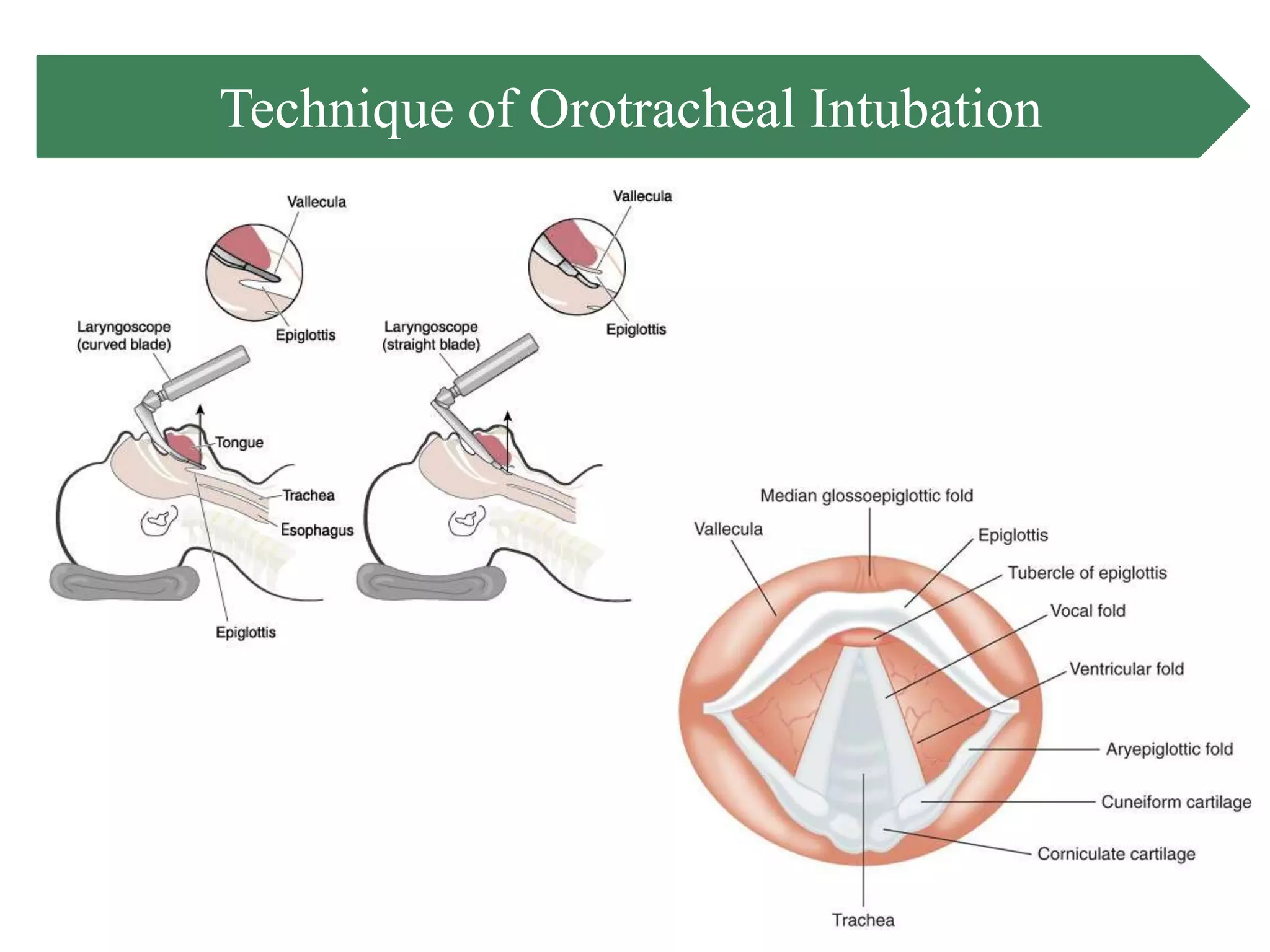
Technique of Orotracheal Intubation
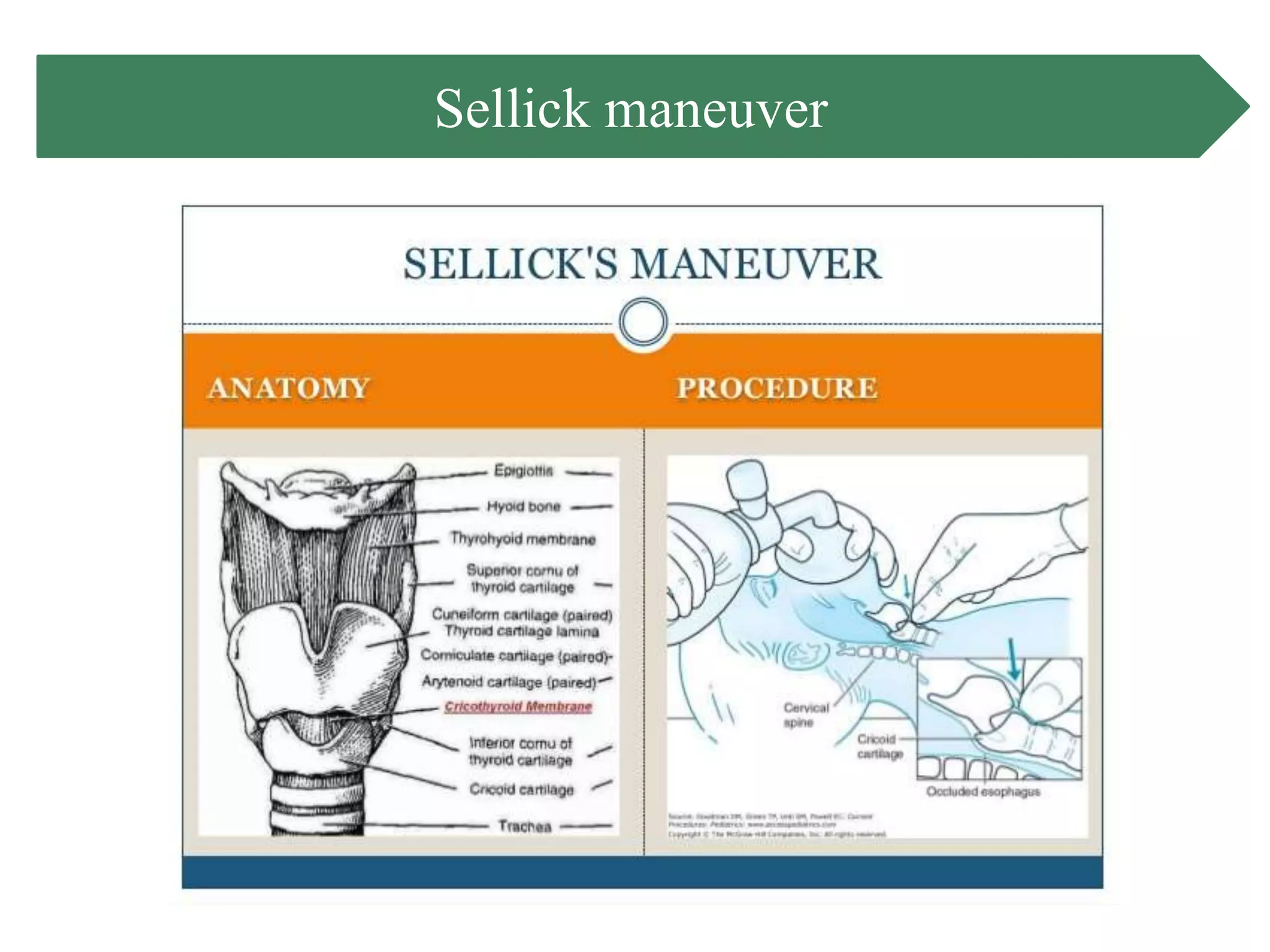
Sellick maneuver
B.U.R.P
Nasotracheal Intubation
Complications of Laryngoscopy & Intubation
Optical Intubating Stylet
The McGrath laryngoscope
The GlideScope
Airtraq
• In some situations—for example, patients with unstable cervical spines, poor range
of motion of the temporomandibular joint, or certain congenital or acquired upper
airway anomalies—laryngoscopy with direct or indirect laryngoscopes may be
undesirable or impossible.
Flexible Fiberoptic Bronchoscopes
Fiberoptic intubation (FOI) is routinely performed in awake or sedated patients
with problematic airways.
FOI is ideal for:
• A small mouth opening
• Minimizing cervical spine movement in trauma or rheumatoid arthritis
• Upper airway obstruction, such as angioedema or tumor mass
• Facial deformities, facial trauma
FOI can be performed awake or asleep via oral or nasal routes.
• Awake FOI: predicted inability to ventilate by mask, upper airway
obstruction
Asleep FOI: Failed intubation, desire for minimal C spine movement in
patients who refuse awake intubation
• Oral FOI: Facial, skull injuries
• Nasal FOI: A poor mouth opening
Flexible Fiberoptic Bronchoscopes
Supraglottic airway device (SAD)
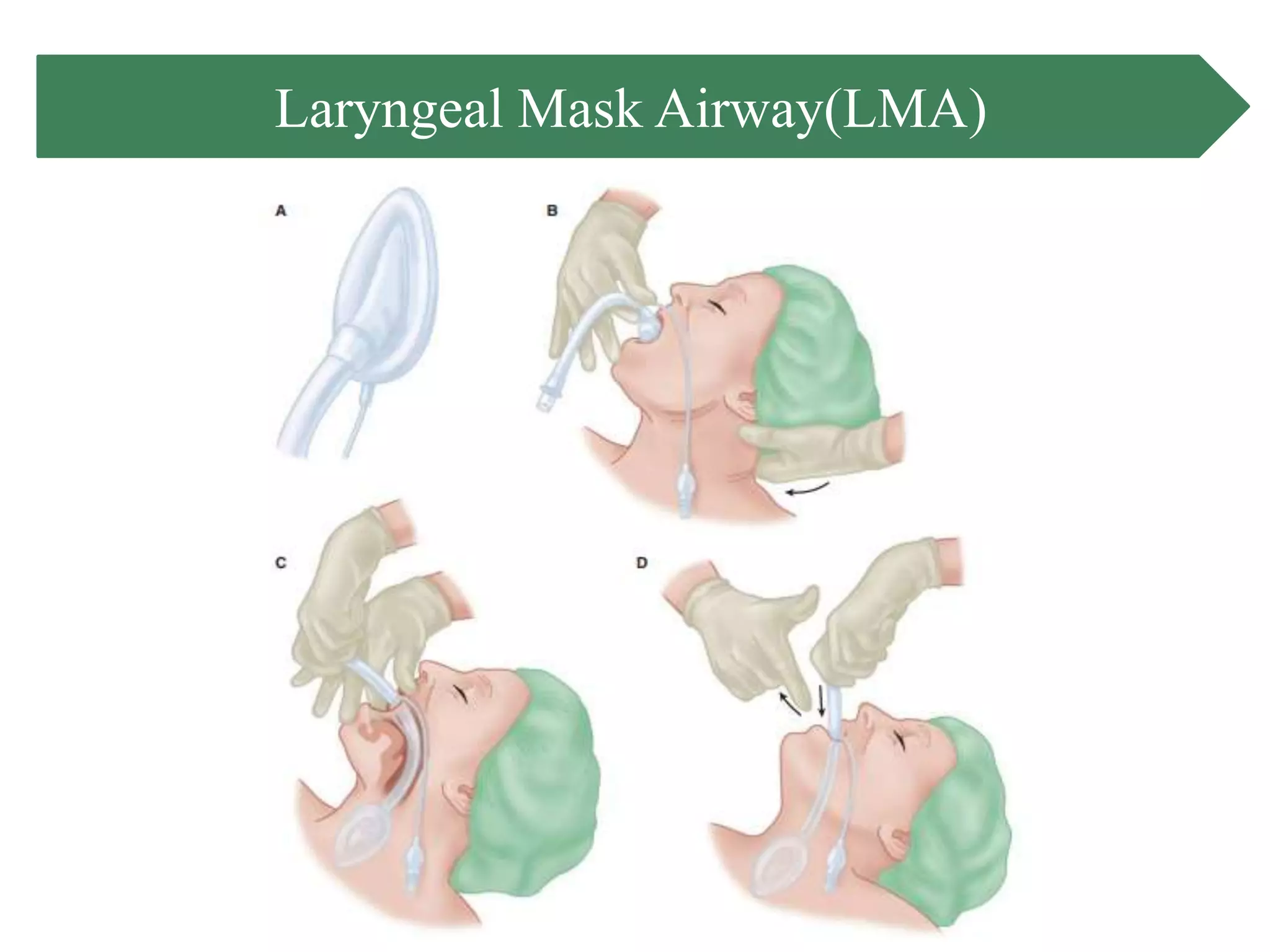
• Laryngeal Mask Airway(LMA)
Laryngeal Mask Airway(LMA)
Patients with:
• Pharyngeal pathology (eg, abscess),
• Pharyngeal obstruction
• Full stomachs (eg, pregnancy, hiatal hernia),
• Low pulmonary compliance (eg, restrictive airways disease) requiring
peak inspiratory pressures greater than 30 cm H2O.
The LMA has been avoided in patients with bronchospasm or high airway resistance,
but new evidence suggests that because it is not placed in the trachea, use of an
LMA is associated with less bronchospasm than a TT.
SUCCESS RATE 95-99%
Insertion can be performed under topical anesthesia and bilateral superior laryngeal
nerve blocks, if the airway must be secured while the patient is awake.
Relative contraindications for the LMA
• The ProSeal LMA, which permits passage of a gastric tube to decompress the
stomach
Variations in LMA design include:
The I-Gel
The I-Gel
The I-Gel
It has the following features:
• Single use.
• Cuffless: the mask is made of a soft polymer and is shaped similarly to an
inflated LMA posteriorly with its anterior shape designed to ‘fit the
perilaryngeal structures’.
• Narrow-bore oesophageal drain tube.
• Short, wide-bore airway tube.
• Integral bite block.
First time insertion success rates are 85% and this approaches 100% with three
attempts.
Supreme LMA (SLMA)
• Single use
• Large inflatable plastic cuff, but no
posterior cuff (PLMA)
• Oesophageal drain tube
• Preformed semi-rigid tube
• Fins in the mask bowl to prevent epiglottic
obstruction
(90% first attempt, 100% after three attempts)
The Fastrach intubation LMA
The LMA CTrach
Esophageal–Tracheal Combitube
King Laryngeal Tube
Bougle
TECHNIQUES OF EXTUBATION
• Most often, extubation should be performed when a patient is either deeply anesthetized or awake.
In either case, adequate recovery from neuromuscular blocking agents should be established prior to extubation.
If neuromuscular blocking agents are used, the patient has at least a period of controlled mechanical ventilation and likely
must be weaned from the ventilator before extubation can occur.
• Extubation during a light plane of anesthesia (ie, a state between deep and awake) is avoided because of an
increased risk of laryngospasm.
The distinction between deep and light anesthesia is usually apparent during pharyngeal suctioning: any reaction to
suctioning (eg, breath holding, coughing) signals a light plane of anesthesia, whereas no reaction is characteristic of a
deep plane. Similarly, eye opening or purposeful movements imply that the patient is sufficiently awake for extubation.
• Extubating an awake patient is usually associated with coughing (bucking) on the TT.
This reaction increases the heart rate, central venouspressure, arterial blood pressure, intracranial pressure,
intraabdominal pressure, and intraocular pressure. It may also cause wound dehiscence and increased bleeding. The
presence of a TT in an awake asthmatic patient may trigger bronchospasm.
• Some practitioners attempt to decrease the likelihood of these eff ects by administering 1.5 mg/kg of intravenous
lidocaine 1–2 min before suctioning and extubation; however, extubation during deep anesthesia may be preferable
in patients who cannot tolerate these eff ects (provided such patients are not at risk of aspiration and/or do not have
airways that may be difficult to control after removal of the TT).
• Regardless of whether the tube is removed when the patient is deeply anesthetized or awake, the patient’s pharynx
should be thoroughly suctioned before extubation to decrease the potential for aspiration of blood and secretions.
In addition, patients should be ventilated with 100% oxygen in case it becomes difficult to establish an airway after the
TT is removed. Just prior to extubation, the TT is untaped or untied and its cuff is deflated. Th e tube is withdrawn in a
single smooth motion, and a face mask is applied to deliver oxygen. Oxygen delivery by face mask is maintained during
the period of transportation to the postanesthesia care area.
Difficult Intubation
Difficult Airway Algorithm
Surgical Airway Technique
Rapid 4 step technique –Cricothyroidotomy
Seldinger Technique for Cricothyroidotomy /Melker /
References
1. file:///D:/My%20lessons/Anasthesiology%20Residency%201st/Resident
%20Ankhzaya's%20files/Books%20of%20Anesthesiology/Morgan%205t
h%20Edition.pdf
2. https://www.google.mn/?gfe_rd=cr&dcr=0&ei=fvsYWrC5I9TA8gee96ao
BA
Airway management

Airway management

  • 1.
  • 2.
    1. Routine airwaymanagement 2. Airway assessment 3. Equipment 4. Technique 5. Difficult Airway Algorithm 6. Reference Content:
  • 3.
    • Expert airwaymanagement is an essential skill in anesthetic practice. • Routine airway management associated with general anesthesia consists of: • Airway assessment • Preparation and equipment check • Patient positioning • Preoxygenation • Bag and mask ventilation (BMV) • Intubation (if indicated) • Confirmation of endotracheal tube placement • Intraoperative management and troubleshooting • Extubation Routine airway management
  • 4.
    • Mouth opening •Upper lip bite test • Mallampati classifcation • Thyromental distance • Neck circumference Airway assessment
  • 5.
  • 6.
  • 7.
  • 9.
    The following equipmentis routinely needed in airway management situations: • An oxygen source • BMV capability • Laryngoscopes (direct and video) • Several endotracheal tubes of different sizes • Other (not endotracheal tube) airway devices(eg, oral, nasal airways) • Suction • Oximetry and CO2 detection • Stethoscope • Tape • Blood pressure and electrocardiography (ECG)monitors • Intravenous access Equipment
  • 10.
  • 11.
  • 12.
  • 14.
    Face Mask Design& Technique
  • 15.
  • 16.
    Two -handed facemask technique
  • 17.
  • 18.
    Preoxygenation Preoxygenation (denitrogenation) shouldbe practiced in all cases when time allows. This procedure entails the replacement of the lung’s nitrogen volume with oxygen to provide a reservoir for diffusion of oxygen into the alveolar capillary bed after the onset of apnea (as associated with direct laryngoscopy for tracheal intubation). 1. Breathing room air results in desaturation to below 90% after approximately 1 to 2 minutes of apnea. 2. An alternative to breathing oxygen for 5 minutes is to use a series of four vital capacity breaths of 100% oxygen over a 30-second period.
  • 19.
    • Endotracheal intubationis employed both for the conduct of general anesthesia and to facilitate the ventilator management of the critically ill. • Standards govern TT manufacturing (AmericanNational Standard for Anesthetic Equipment; ANSI Z–79). ENDOTRACHEAL INTUBATION
  • 20.
  • 21.
    There are twomajor types of cuffs • High pressure (low volume) High-pressure cuffs are associated with more ischemic damage to the tracheal mucosa and are less suitable for intubations of long duration. • Low-pressure cuffs may increase the likelihood of sore throat (larger mucosal contact area), aspiration, spontaneous extubation, and difficult insertion (because of the floppy cuff ). Nonetheless, because of their lower incidence of mucosal damage, low- pressure cuffs are generally employed. Cuff pressure depends on several factors: inflation volume, the diameter of the cuff in relation to the trachea, tracheal and cuff compliance, and intrathoracic pressure (cuff pressures increase with coughing). ENDOTRACHEAL INTUBATION
  • 22.
  • 23.
  • 24.
  • 25.
  • 26.
  • 27.
  • 28.
  • 29.
  • 30.
  • 31.
  • 32.
  • 34.
  • 35.
  • 36.
  • 37.
  • 38.
  • 39.
    • In somesituations—for example, patients with unstable cervical spines, poor range of motion of the temporomandibular joint, or certain congenital or acquired upper airway anomalies—laryngoscopy with direct or indirect laryngoscopes may be undesirable or impossible. Flexible Fiberoptic Bronchoscopes
  • 40.
    Fiberoptic intubation (FOI)is routinely performed in awake or sedated patients with problematic airways. FOI is ideal for: • A small mouth opening • Minimizing cervical spine movement in trauma or rheumatoid arthritis • Upper airway obstruction, such as angioedema or tumor mass • Facial deformities, facial trauma FOI can be performed awake or asleep via oral or nasal routes. • Awake FOI: predicted inability to ventilate by mask, upper airway obstruction Asleep FOI: Failed intubation, desire for minimal C spine movement in patients who refuse awake intubation • Oral FOI: Facial, skull injuries • Nasal FOI: A poor mouth opening Flexible Fiberoptic Bronchoscopes
  • 41.
    Supraglottic airway device(SAD) • Laryngeal Mask Airway(LMA)
  • 42.
  • 43.
  • 44.
  • 45.
    Patients with: • Pharyngealpathology (eg, abscess), • Pharyngeal obstruction • Full stomachs (eg, pregnancy, hiatal hernia), • Low pulmonary compliance (eg, restrictive airways disease) requiring peak inspiratory pressures greater than 30 cm H2O. The LMA has been avoided in patients with bronchospasm or high airway resistance, but new evidence suggests that because it is not placed in the trachea, use of an LMA is associated with less bronchospasm than a TT. SUCCESS RATE 95-99% Insertion can be performed under topical anesthesia and bilateral superior laryngeal nerve blocks, if the airway must be secured while the patient is awake. Relative contraindications for the LMA
  • 48.
    • The ProSealLMA, which permits passage of a gastric tube to decompress the stomach Variations in LMA design include:
  • 49.
  • 50.
  • 51.
    The I-Gel It hasthe following features: • Single use. • Cuffless: the mask is made of a soft polymer and is shaped similarly to an inflated LMA posteriorly with its anterior shape designed to ‘fit the perilaryngeal structures’. • Narrow-bore oesophageal drain tube. • Short, wide-bore airway tube. • Integral bite block. First time insertion success rates are 85% and this approaches 100% with three attempts.
  • 52.
    Supreme LMA (SLMA) •Single use • Large inflatable plastic cuff, but no posterior cuff (PLMA) • Oesophageal drain tube • Preformed semi-rigid tube • Fins in the mask bowl to prevent epiglottic obstruction (90% first attempt, 100% after three attempts)
  • 53.
  • 54.
  • 55.
  • 56.
  • 57.
  • 58.
  • 59.
    TECHNIQUES OF EXTUBATION •Most often, extubation should be performed when a patient is either deeply anesthetized or awake. In either case, adequate recovery from neuromuscular blocking agents should be established prior to extubation. If neuromuscular blocking agents are used, the patient has at least a period of controlled mechanical ventilation and likely must be weaned from the ventilator before extubation can occur. • Extubation during a light plane of anesthesia (ie, a state between deep and awake) is avoided because of an increased risk of laryngospasm. The distinction between deep and light anesthesia is usually apparent during pharyngeal suctioning: any reaction to suctioning (eg, breath holding, coughing) signals a light plane of anesthesia, whereas no reaction is characteristic of a deep plane. Similarly, eye opening or purposeful movements imply that the patient is sufficiently awake for extubation. • Extubating an awake patient is usually associated with coughing (bucking) on the TT. This reaction increases the heart rate, central venouspressure, arterial blood pressure, intracranial pressure, intraabdominal pressure, and intraocular pressure. It may also cause wound dehiscence and increased bleeding. The presence of a TT in an awake asthmatic patient may trigger bronchospasm. • Some practitioners attempt to decrease the likelihood of these eff ects by administering 1.5 mg/kg of intravenous lidocaine 1–2 min before suctioning and extubation; however, extubation during deep anesthesia may be preferable in patients who cannot tolerate these eff ects (provided such patients are not at risk of aspiration and/or do not have airways that may be difficult to control after removal of the TT). • Regardless of whether the tube is removed when the patient is deeply anesthetized or awake, the patient’s pharynx should be thoroughly suctioned before extubation to decrease the potential for aspiration of blood and secretions. In addition, patients should be ventilated with 100% oxygen in case it becomes difficult to establish an airway after the TT is removed. Just prior to extubation, the TT is untaped or untied and its cuff is deflated. Th e tube is withdrawn in a single smooth motion, and a face mask is applied to deliver oxygen. Oxygen delivery by face mask is maintained during the period of transportation to the postanesthesia care area.
  • 60.
  • 61.
  • 62.
  • 63.
  • 64.
  • 65.
  • 66.
  • 67.
  • 68.
  • 69.
  • 70.
  • 71.
  • 72.
  • 73.
  • 74.
    Rapid 4 steptechnique –Cricothyroidotomy
  • 75.
    Rapid 4 steptechnique –Cricothyroidotomy
  • 76.
    Rapid 4 steptechnique –Cricothyroidotomy
  • 77.
    Rapid 4 steptechnique –Cricothyroidotomy
  • 78.
    Seldinger Technique forCricothyroidotomy /Melker /
  • 79.
    Seldinger Technique forCricothyroidotomy /Melker /
  • 80.
    Seldinger Technique forCricothyroidotomy /Melker /
  • 81.
    Seldinger Technique forCricothyroidotomy /Melker /
  • 82.
    Seldinger Technique forCricothyroidotomy /Melker /
  • 83.
    Seldinger Technique forCricothyroidotomy /Melker /
  • 84.
    Seldinger Technique forCricothyroidotomy /Melker /
  • 86.