Establishing the Performance Measurement Baseline (PMB) The Performance Measurement Baseline is a time–phased schedule of all the work to be performed, the budgeted cost for this work, and the organizational elements that produce the deliverables from this work.  Glen B. Alleman Vice President, Strategy and Performance Management Lewis & Fowler 8310 South Valley Highway Suite 300 Englewood, Colorado 80112 www.lewisandfowler.com [email_address]
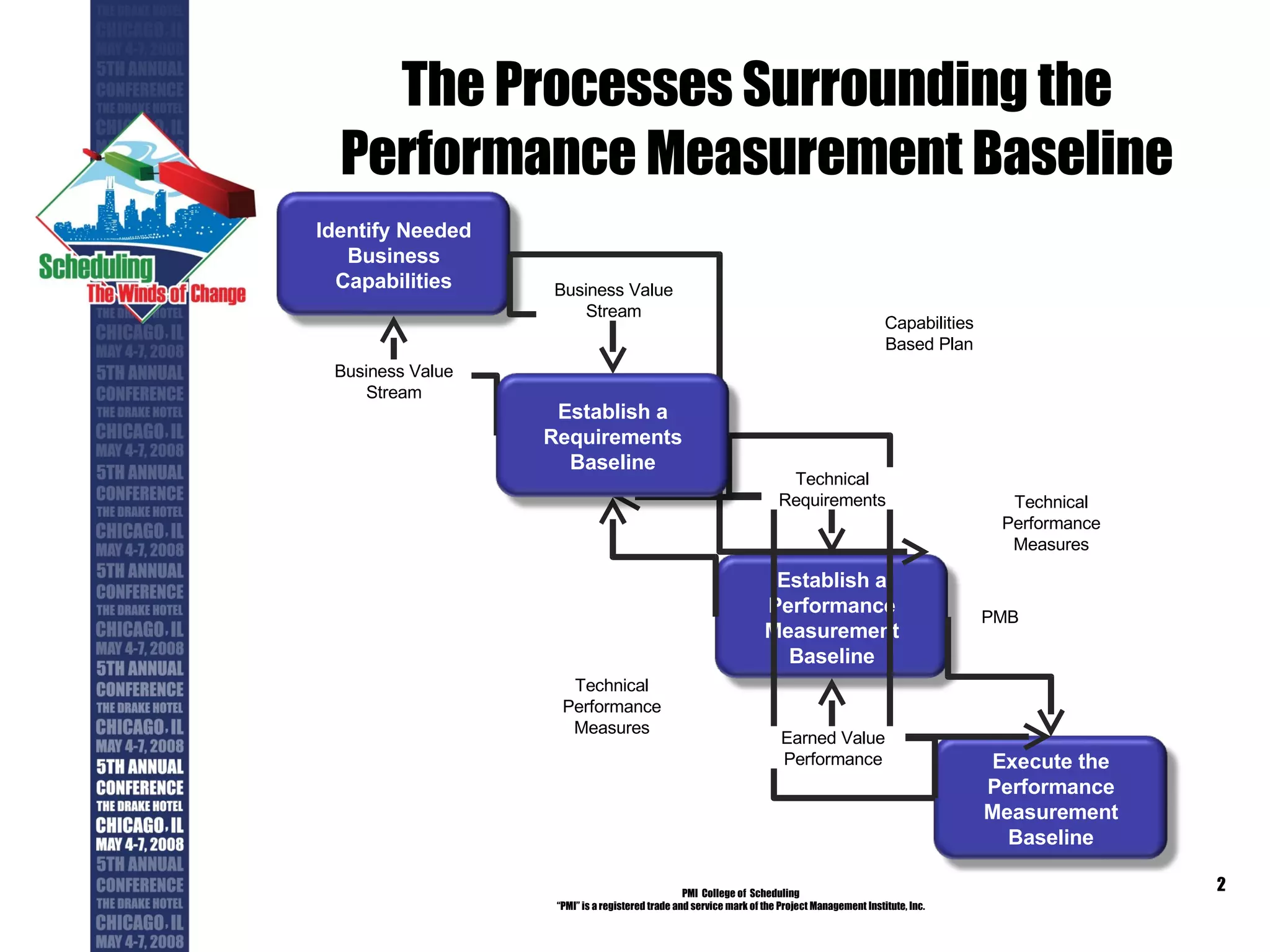
The Processes Surrounding the Performance Measurement Baseline PMI  College of  Scheduling “ PMI” is a registered trade and service mark of the Project Management Institute, Inc. Identify Needed Business Capabilities Establish a Performance Measurement Baseline Execute the Performance Measurement Baseline Capabilities Based Plan Business Value Stream Earned Value Performance Technical Performance Measures Business Value Stream Technical Requirements Establish a Requirements Baseline Technical Performance Measures PMB
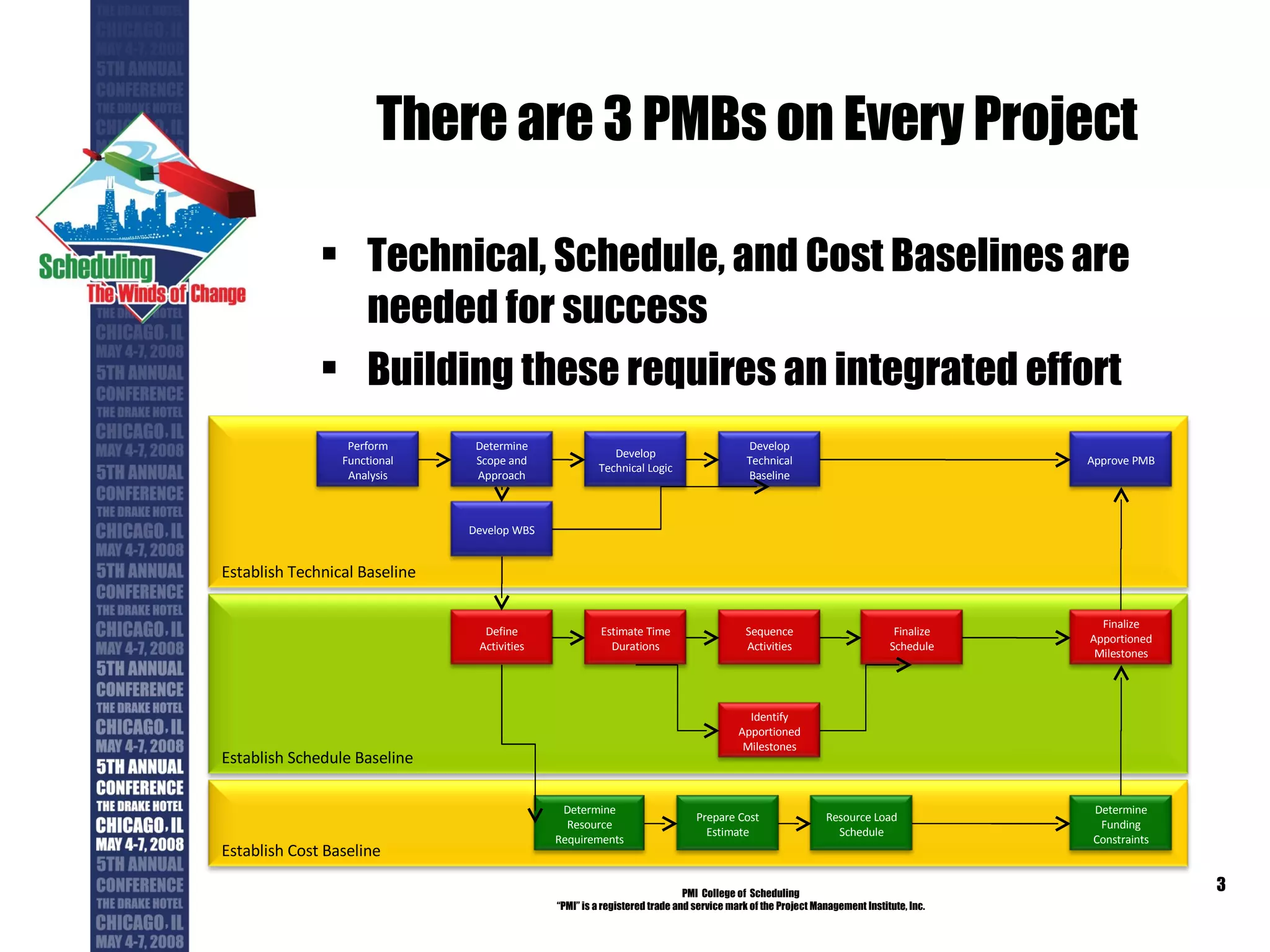
There are 3 PMBs on Every Project Technical, Schedule, and Cost Baselines are needed for success Building these requires an integrated effort PMI  College of  Scheduling “ PMI” is a registered trade and service mark of the Project Management Institute, Inc. Establish Cost Baseline Establish Schedule Baseline Establish Technical Baseline Perform Functional Analysis Determine Scope and Approach Develop Technical Logic Develop Technical Baseline Develop WBS Define Activities Estimate Time Durations Sequence Activities Finalize Schedule Identify Apportioned Milestones Determine Resource Requirements Prepare Cost Estimate Resource Load Schedule Finalize Apportioned Milestones Determine Funding Constraints Approve PMB
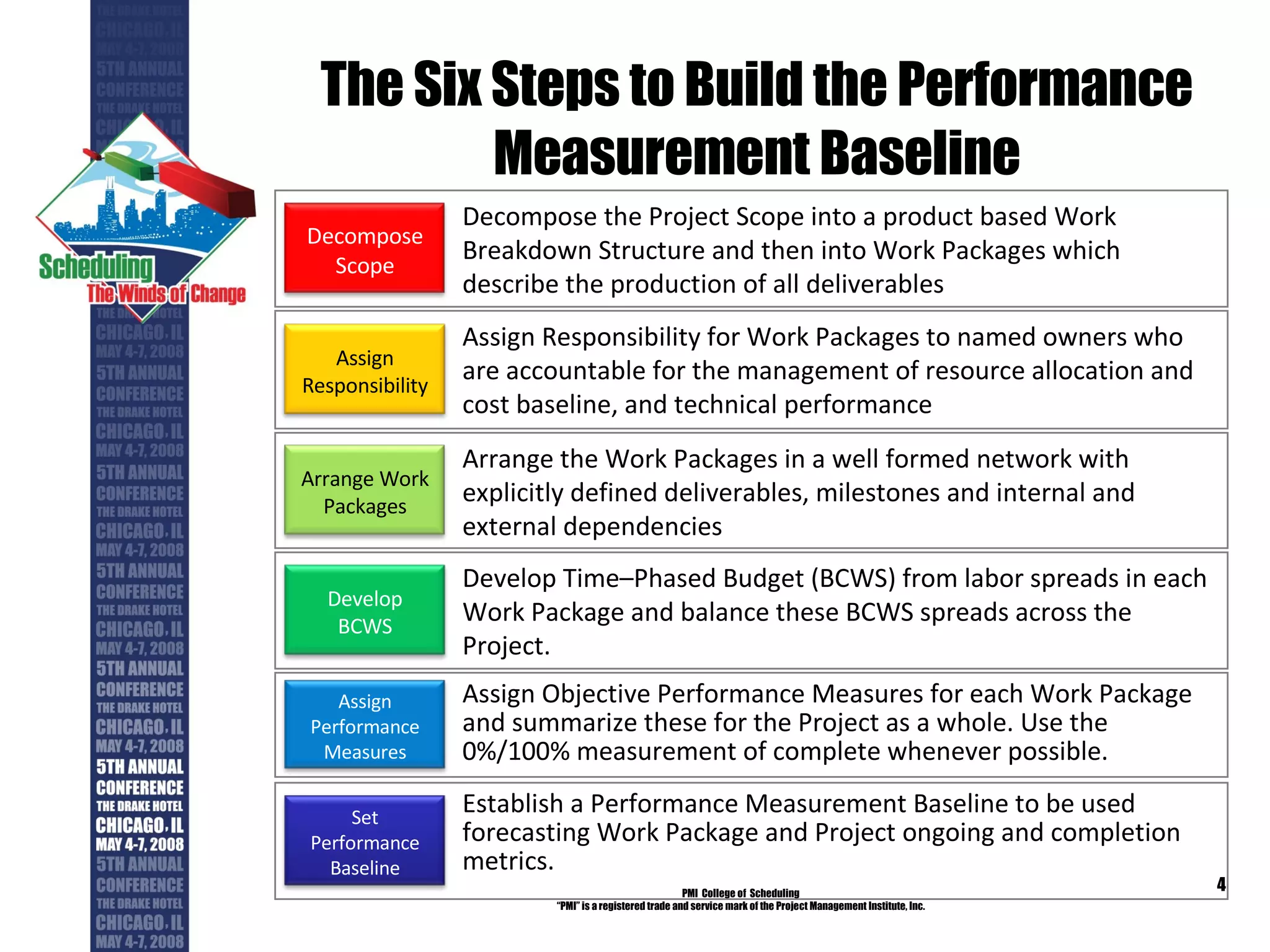
The Six Steps to Build the Performance Measurement Baseline PMI  College of  Scheduling “ PMI” is a registered trade and service mark of the Project Management Institute, Inc. Decompose the Project Scope into a product based Work Breakdown Structure and then into Work Packages which describe the production of all deliverables Decompose Scope Assign Responsibility for Work Packages to named owners who are accountable for the management of resource allocation and cost baseline, and technical performance Assign Responsibility Arrange the Work Packages in a well formed network with explicitly defined deliverables, milestones and internal and external dependencies Arrange Work Packages Develop Time–Phased Budget (BCWS) from labor spreads in each Work Package and balance these BCWS spreads across the Project. Develop BCWS Assign Objective Performance Measures for each Work Package and summarize these for the Project as a whole. Use the 0%/100% measurement of complete whenever possible. Assign Performance Measures Establish a Performance Measurement Baseline to be used forecasting Work Package and Project ongoing and completion metrics. Set Performance Baseline
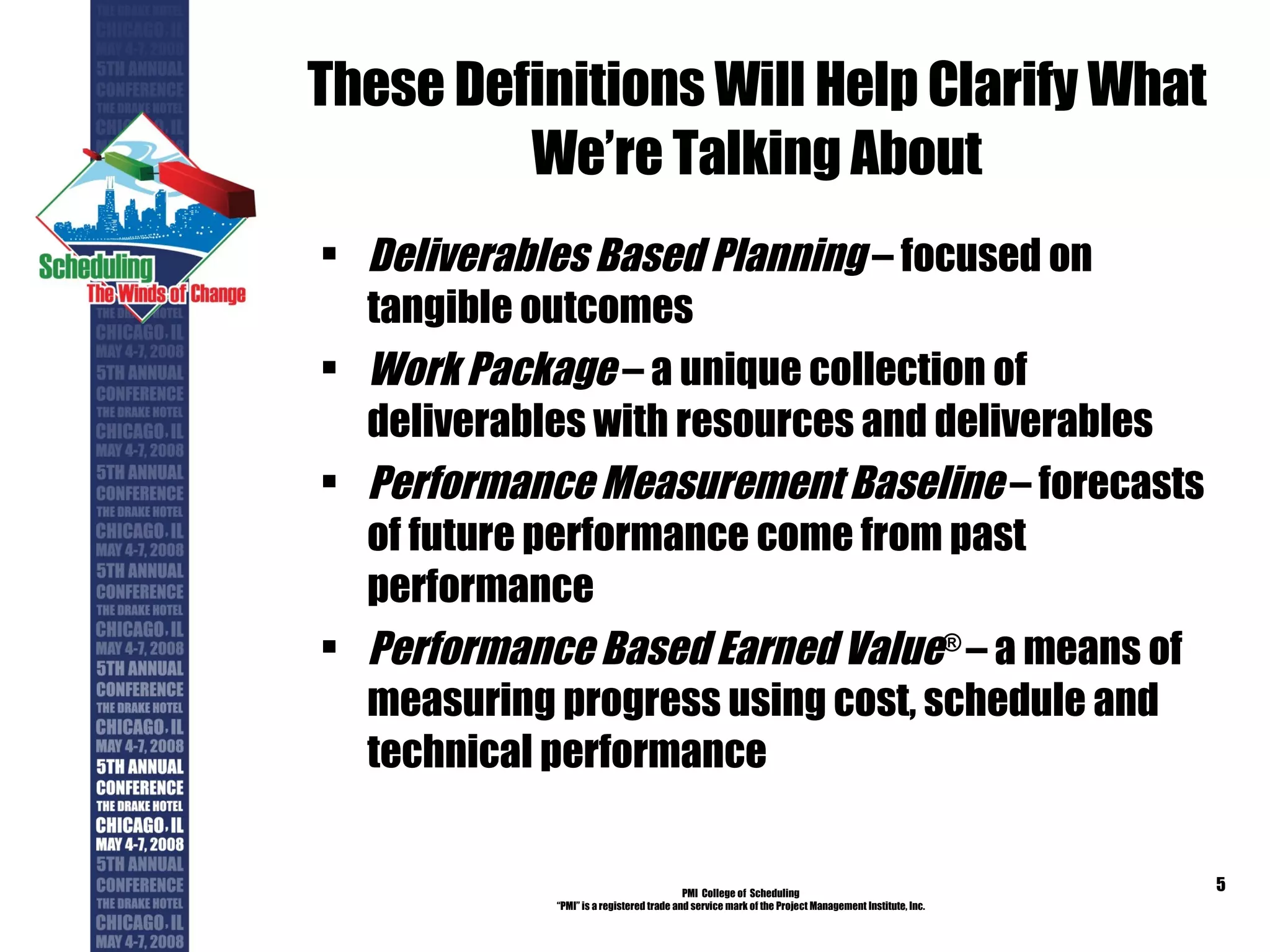
These Definitions Will Help Clarify What We’re Talking About Deliverables Based Planning  – focused on tangible outcomes Work Package  – a unique collection of deliverables with resources and deliverables Performance Measurement Baseline  – forecasts of future performance come from past performance Performance Based Earned Value ®  – a means of measuring progress using cost, schedule and technical performance PMI  College of  Scheduling “ PMI” is a registered trade and service mark of the Project Management Institute, Inc.
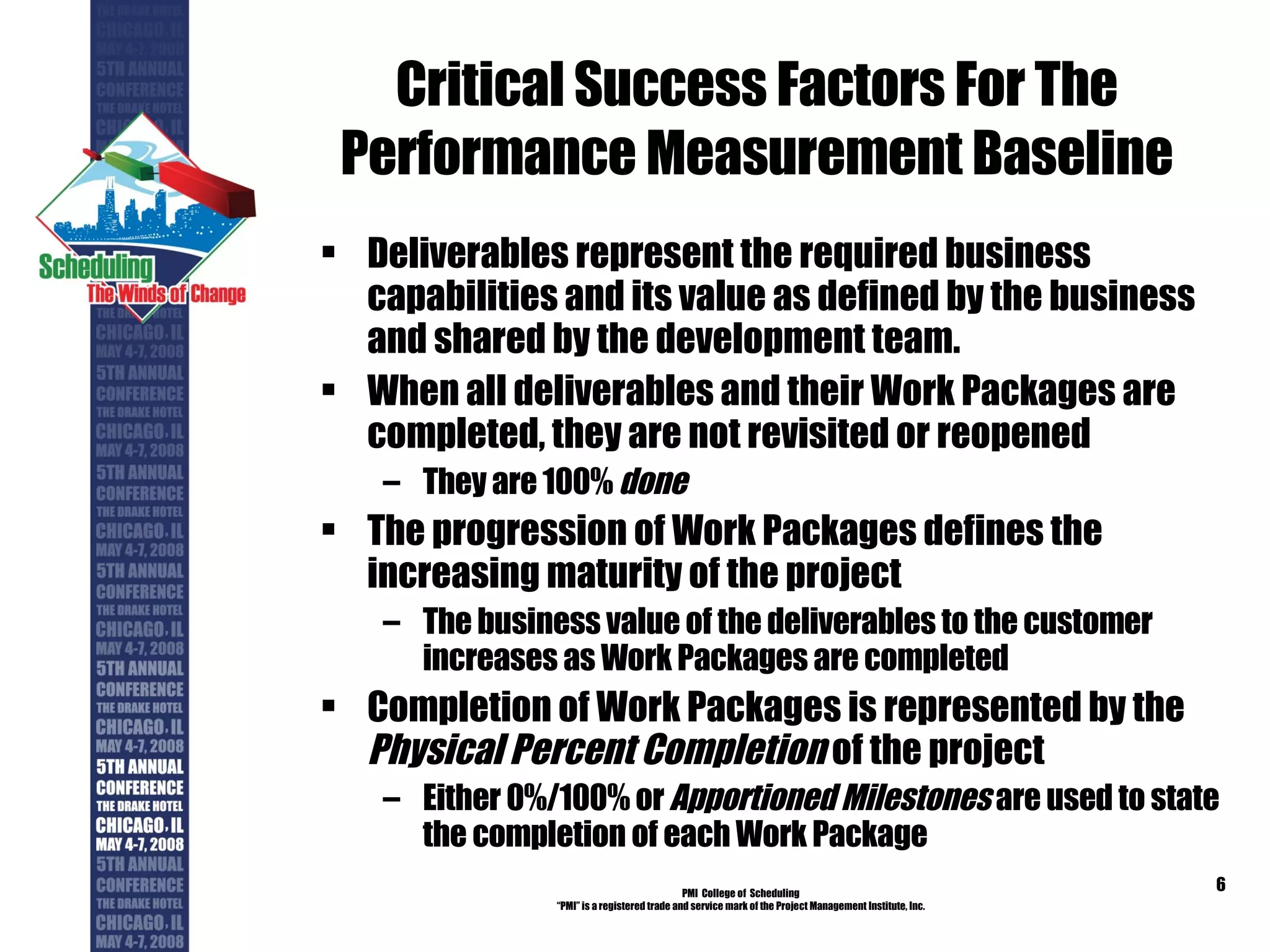
Critical Success Factors For The Performance Measurement Baseline Deliverables represent the required business capabilities and its value as defined by the business and shared by the development team. When all deliverables and their Work Packages are completed, they are not revisited or reopened They are 100%  done The progression of Work Packages defines the increasing maturity of the project The business value of the deliverables to the customer increases as Work Packages are completed Completion of Work Packages is represented by the  Physical Percent Completion  of the project Either 0%/100% or  Apportioned Milestones  are used to state the completion of each Work Package PMI  College of  Scheduling “ PMI” is a registered trade and service mark of the Project Management Institute, Inc.
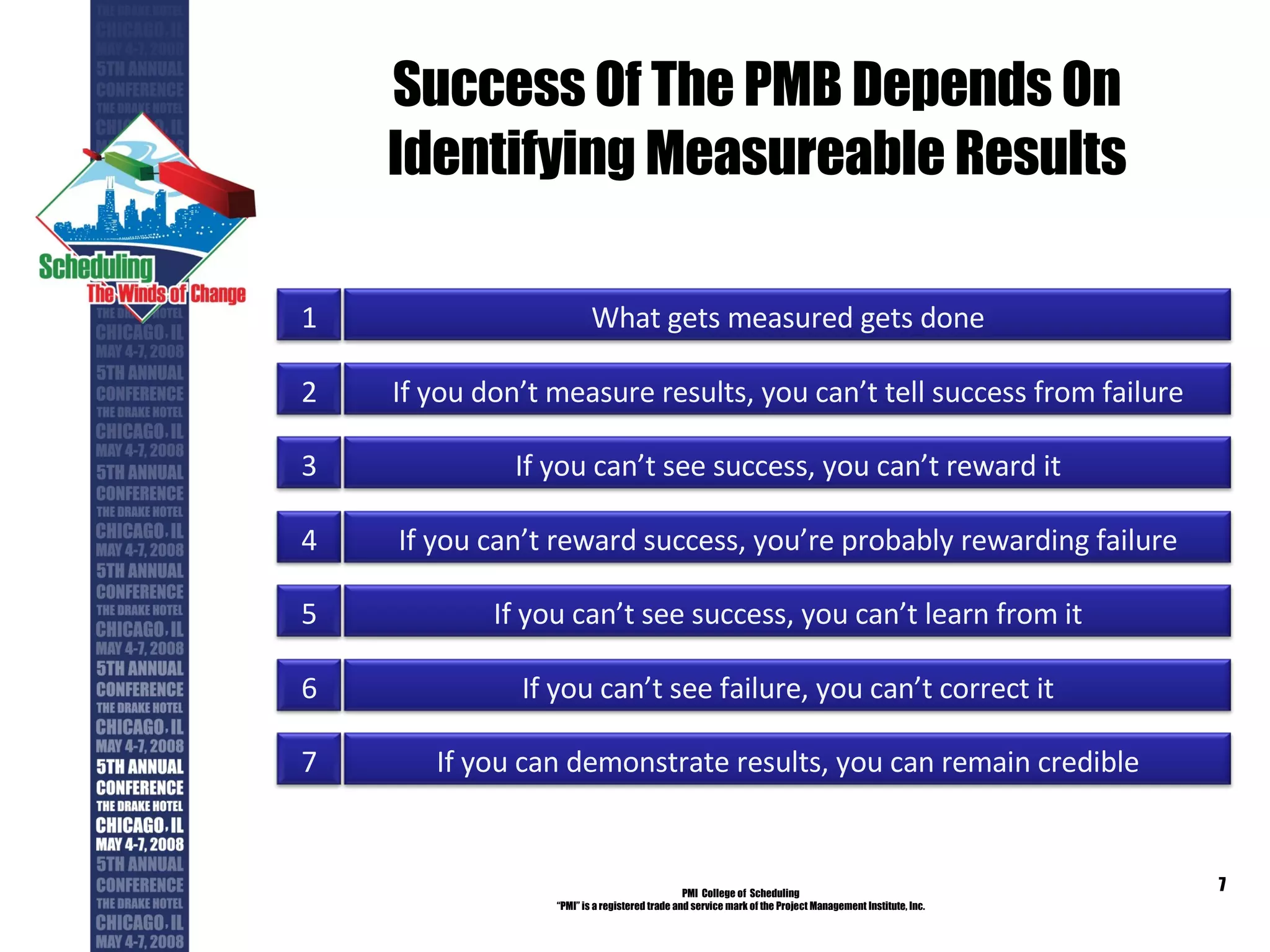
Success Of The PMB Depends On Identifying Measureable Results PMI  College of  Scheduling “ PMI” is a registered trade and service mark of the Project Management Institute, Inc. What gets measured gets done 1 If you don’t measure results, you can’t tell success from failure 2 If you can’t see success, you can’t reward it 3 If you can’t reward success, you’re probably rewarding failure 4 If you can demonstrate results, you can remain credible 7 If you can’t see success, you can’t learn from it 5 If you can’t see failure, you can’t correct it 6
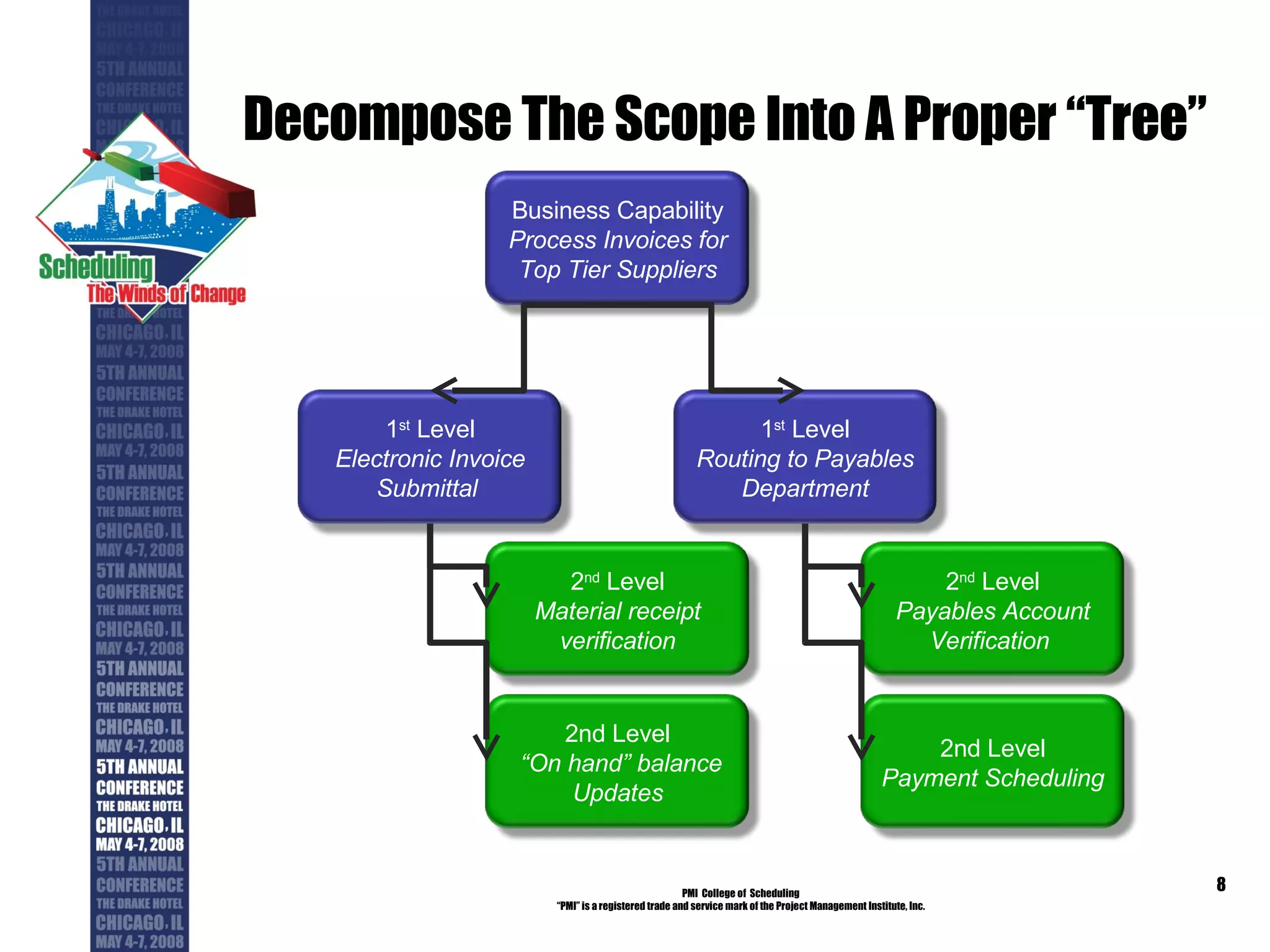
Decompose The Scope Into A Proper “Tree” PMI  College of  Scheduling “ PMI” is a registered trade and service mark of the Project Management Institute, Inc. Business Capability Process Invoices for Top Tier Suppliers 1 st  Level Electronic Invoice Submittal  1 st  Level Routing to Payables Department 2 nd  Level Payables Account Verification  2nd Level Payment Scheduling  2 nd  Level Material receipt verification 2nd Level “ On hand” balance Updates
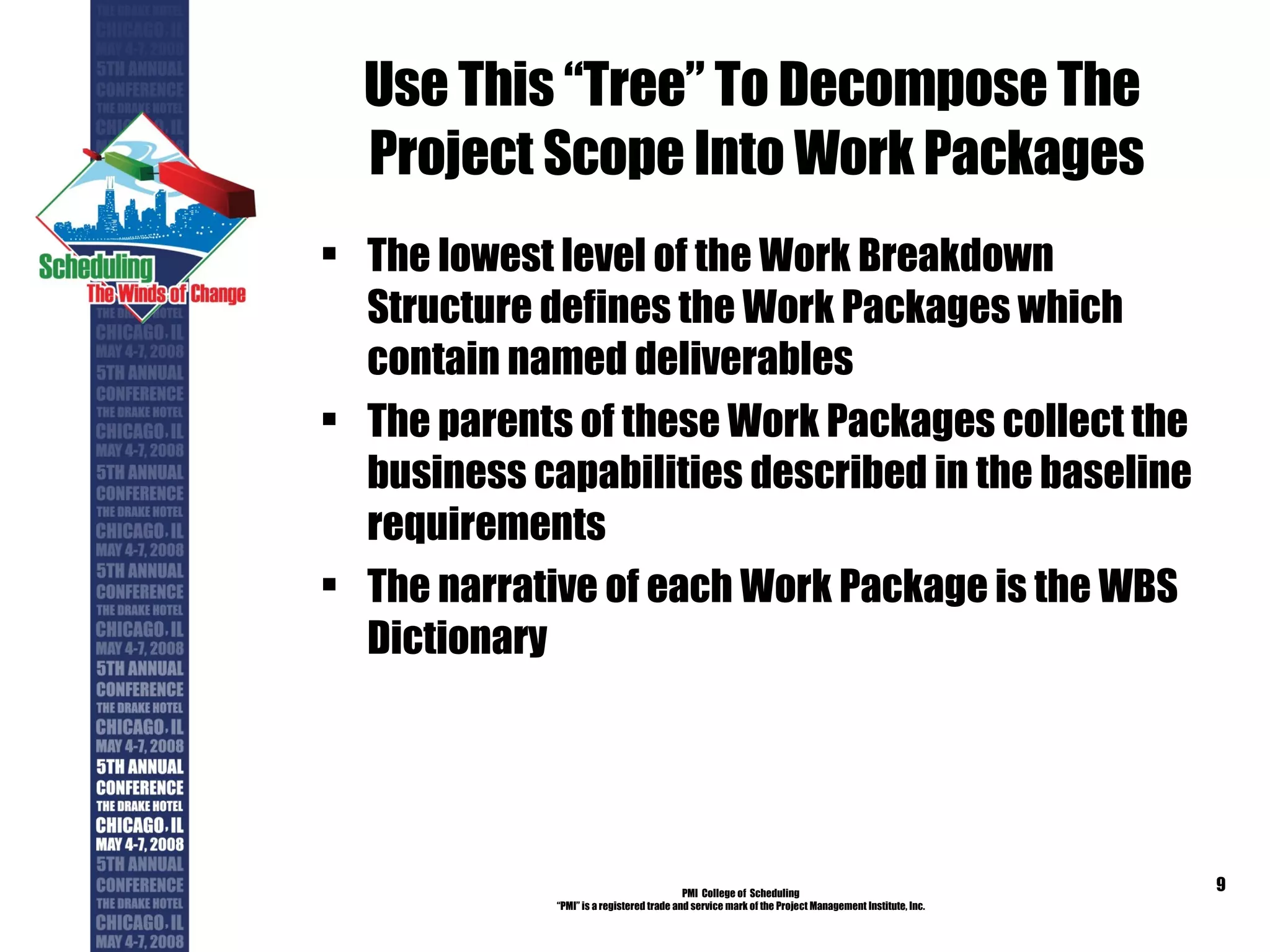
Use This “Tree” To Decompose The  Project Scope Into Work Packages The lowest level of the Work Breakdown Structure defines the Work Packages which contain named deliverables The parents of these Work Packages collect the business capabilities described in the baseline requirements The narrative of each Work Package is the WBS Dictionary PMI  College of  Scheduling “ PMI” is a registered trade and service mark of the Project Management Institute, Inc.
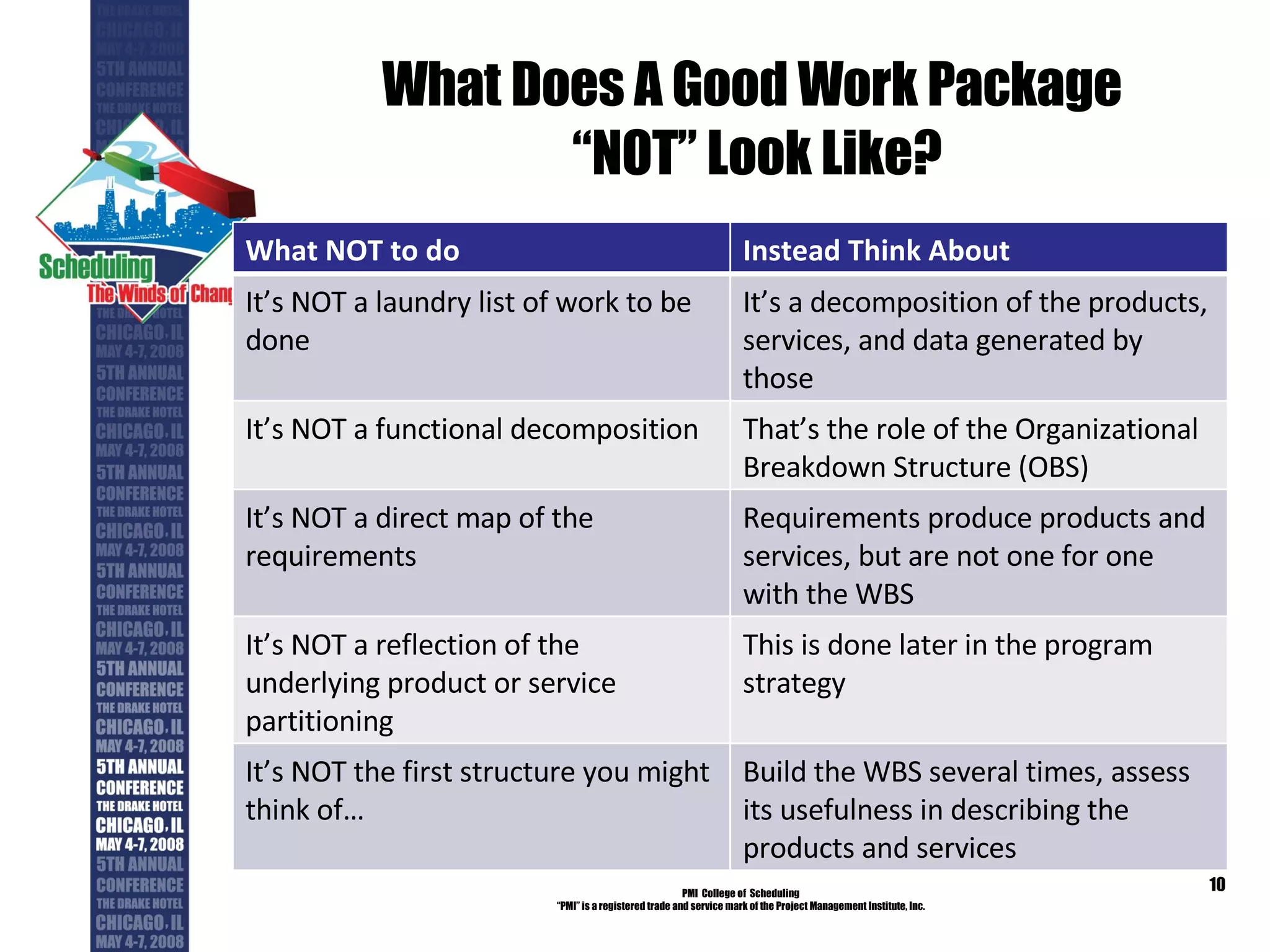
What Does A Good Work Package  “NOT” Look Like? PMI  College of  Scheduling “ PMI” is a registered trade and service mark of the Project Management Institute, Inc. What NOT to do Instead Think About It’s NOT a laundry list of work to be done It’s a decomposition of the products, services, and data generated by those It’s NOT a functional decomposition That’s the role of the Organizational Breakdown Structure (OBS) It’s NOT a direct map of the requirements Requirements produce products and services, but are not one for one with the WBS It’s NOT a reflection of the underlying product or service partitioning This is done later in the program strategy It’s NOT the first structure you might think of… Build the WBS several times, assess its usefulness in describing the products and services
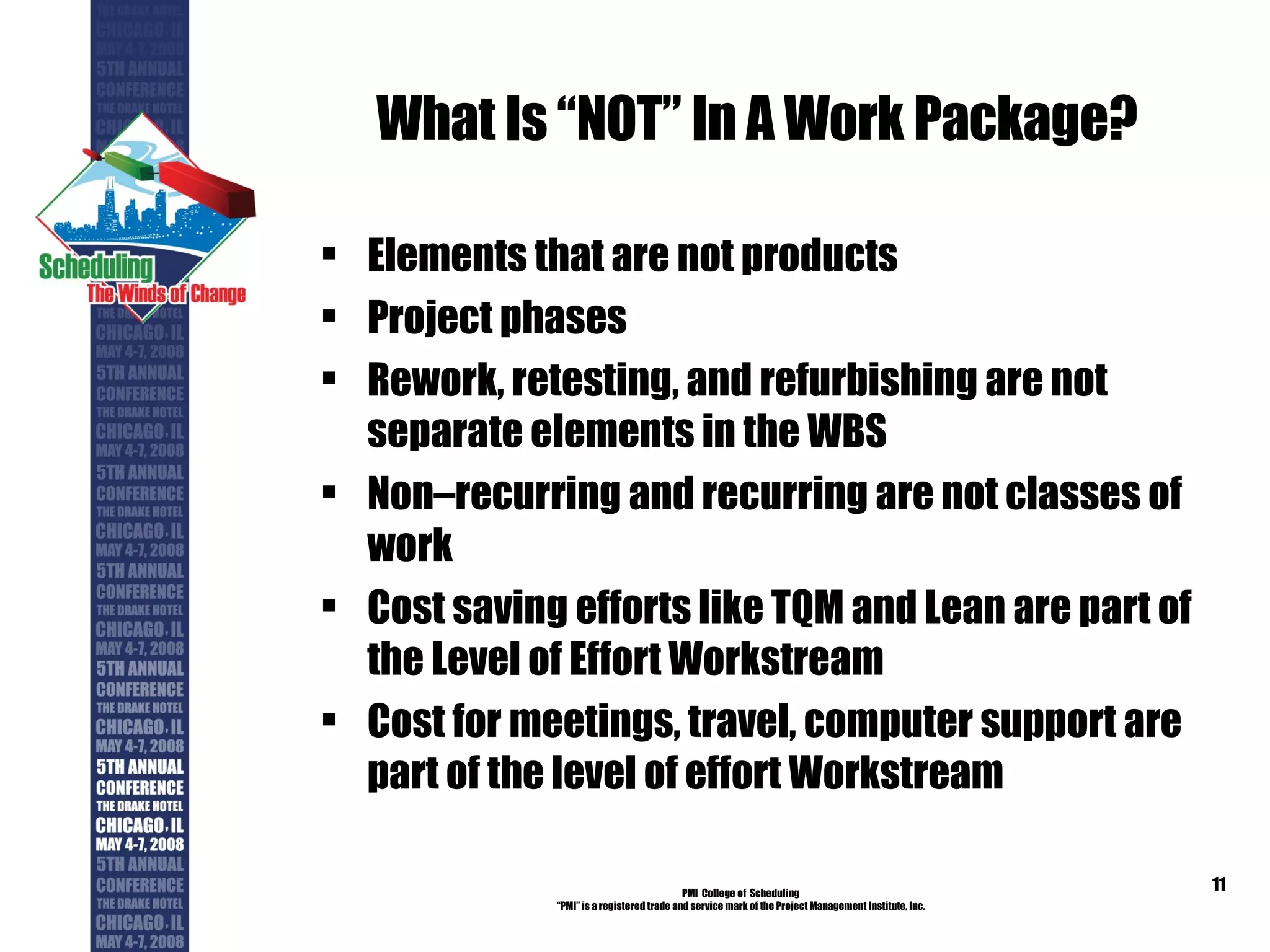
What Is “NOT” In A Work Package? Elements that are not products Project phases Rework, retesting, and refurbishing are not separate elements in the WBS Non–recurring and recurring are not classes of work Cost saving efforts like TQM and Lean are part of the Level of Effort Workstream Cost for meetings, travel, computer support are part of the level of effort Workstream PMI  College of  Scheduling “ PMI” is a registered trade and service mark of the Project Management Institute, Inc.
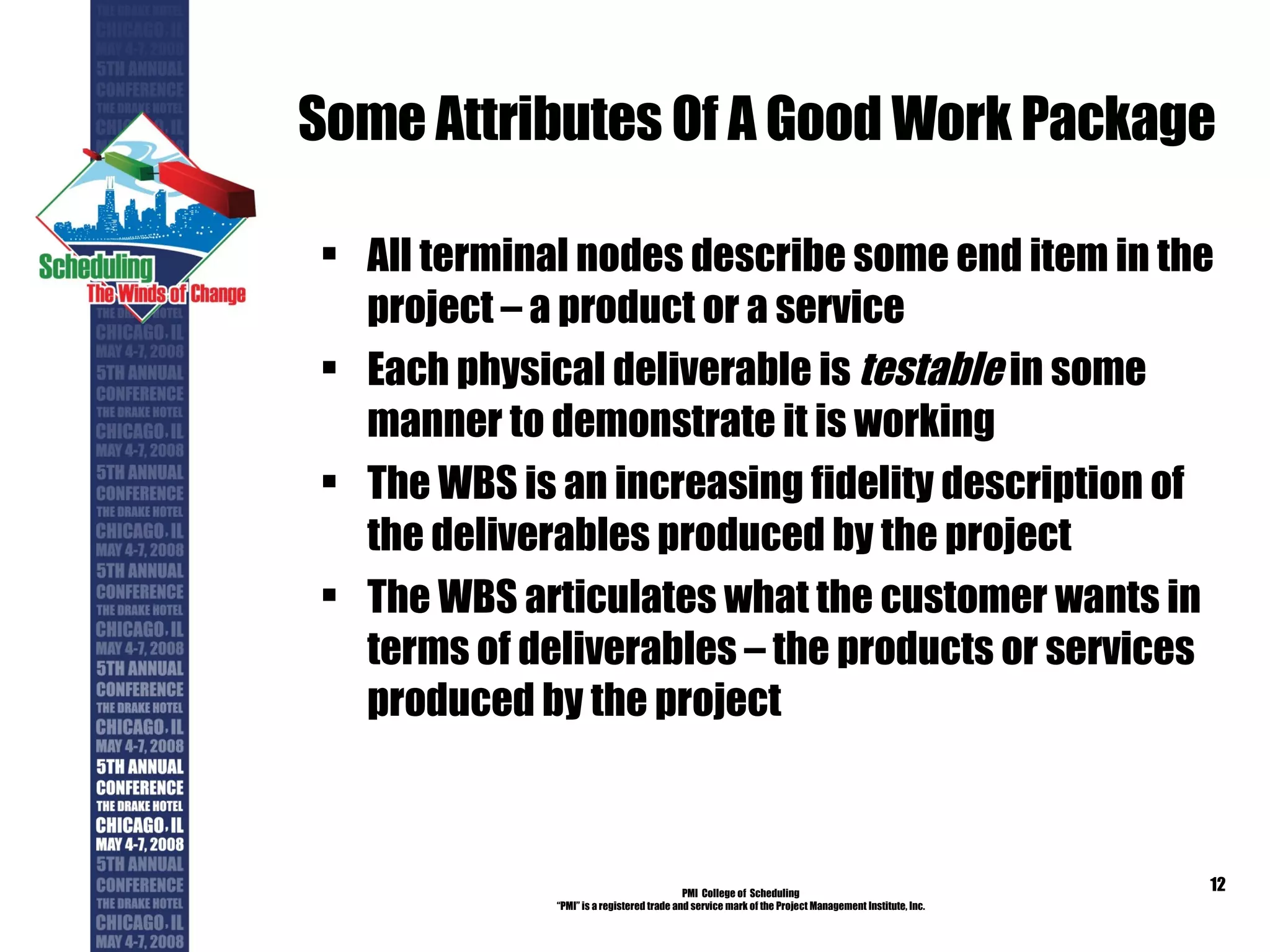
Some Attributes Of A Good Work Package All terminal nodes describe some end item in the project – a product or a service Each physical deliverable is  testable  in some manner to demonstrate it is working  The WBS is an increasing fidelity description of the deliverables produced by the project The WBS articulates what the customer wants in terms of deliverables – the products or services produced by the project PMI  College of  Scheduling “ PMI” is a registered trade and service mark of the Project Management Institute, Inc.
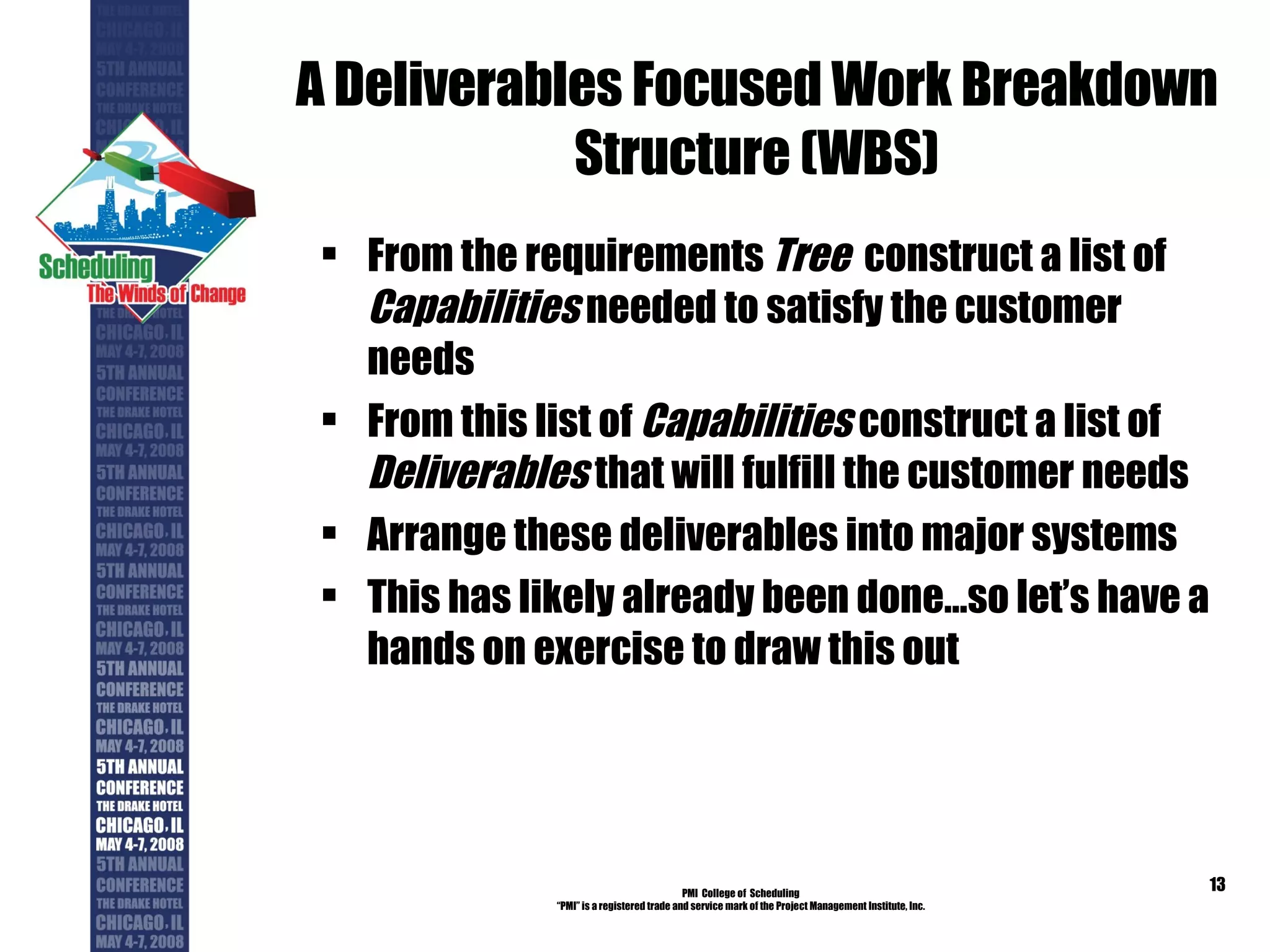
A Deliverables Focused Work Breakdown Structure (WBS) From the requirements  Tree   construct a list of  Capabilities  needed to satisfy the customer needs From this list of  Capabilities  construct a list of  Deliverables  that will fulfill the customer needs Arrange these deliverables into major systems This has likely already been done…so let’s have a hands on exercise to draw this out PMI  College of  Scheduling “ PMI” is a registered trade and service mark of the Project Management Institute, Inc.
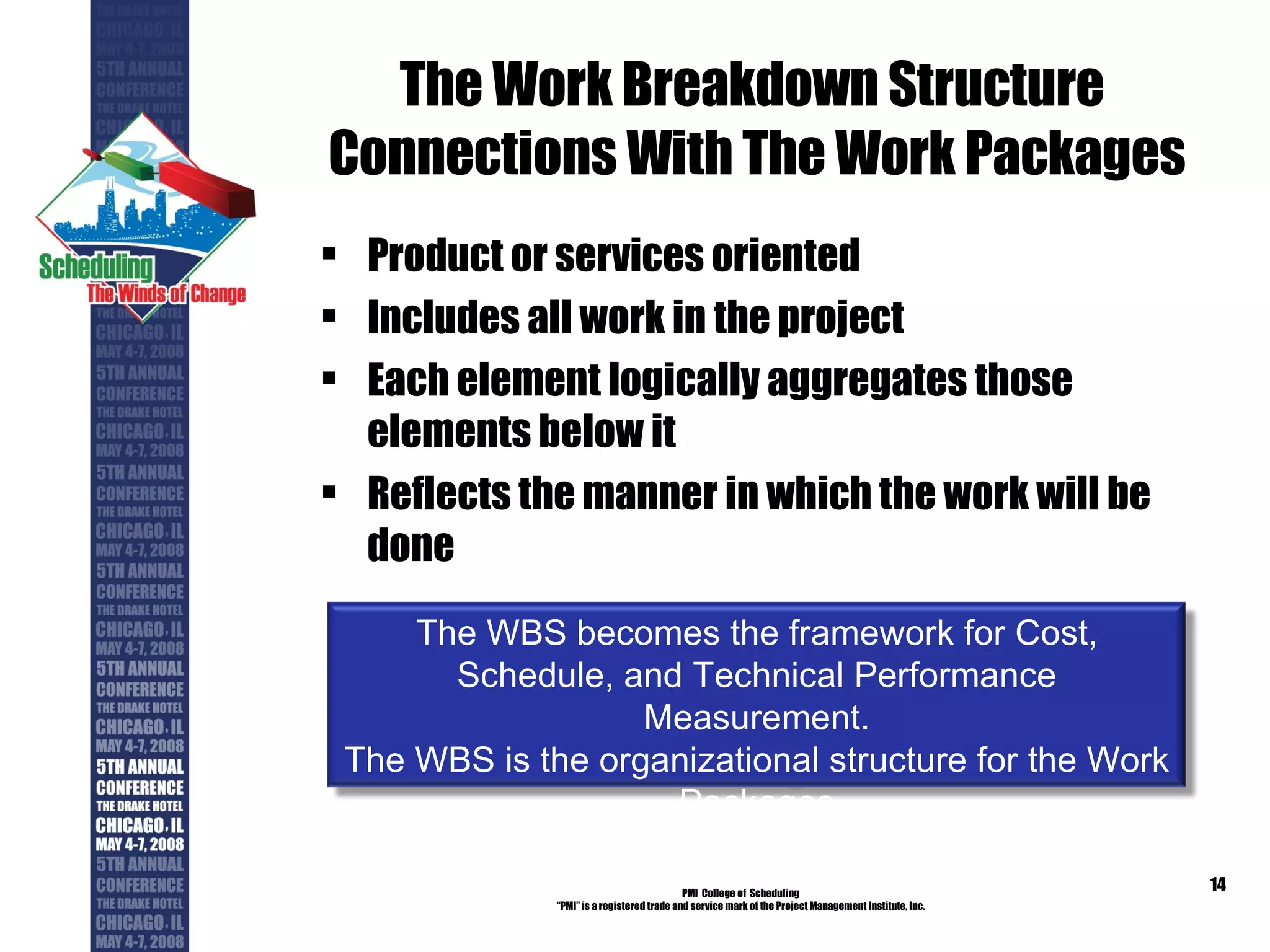
The Work Breakdown Structure  Connections With The Work Packages Product or services oriented Includes all work in the project Each element logically aggregates those elements below it Reflects the manner in which the work will be done PMI  College of  Scheduling “ PMI” is a registered trade and service mark of the Project Management Institute, Inc. The WBS becomes the framework for Cost, Schedule, and Technical Performance Measurement. The WBS is the organizational structure for the Work Packages
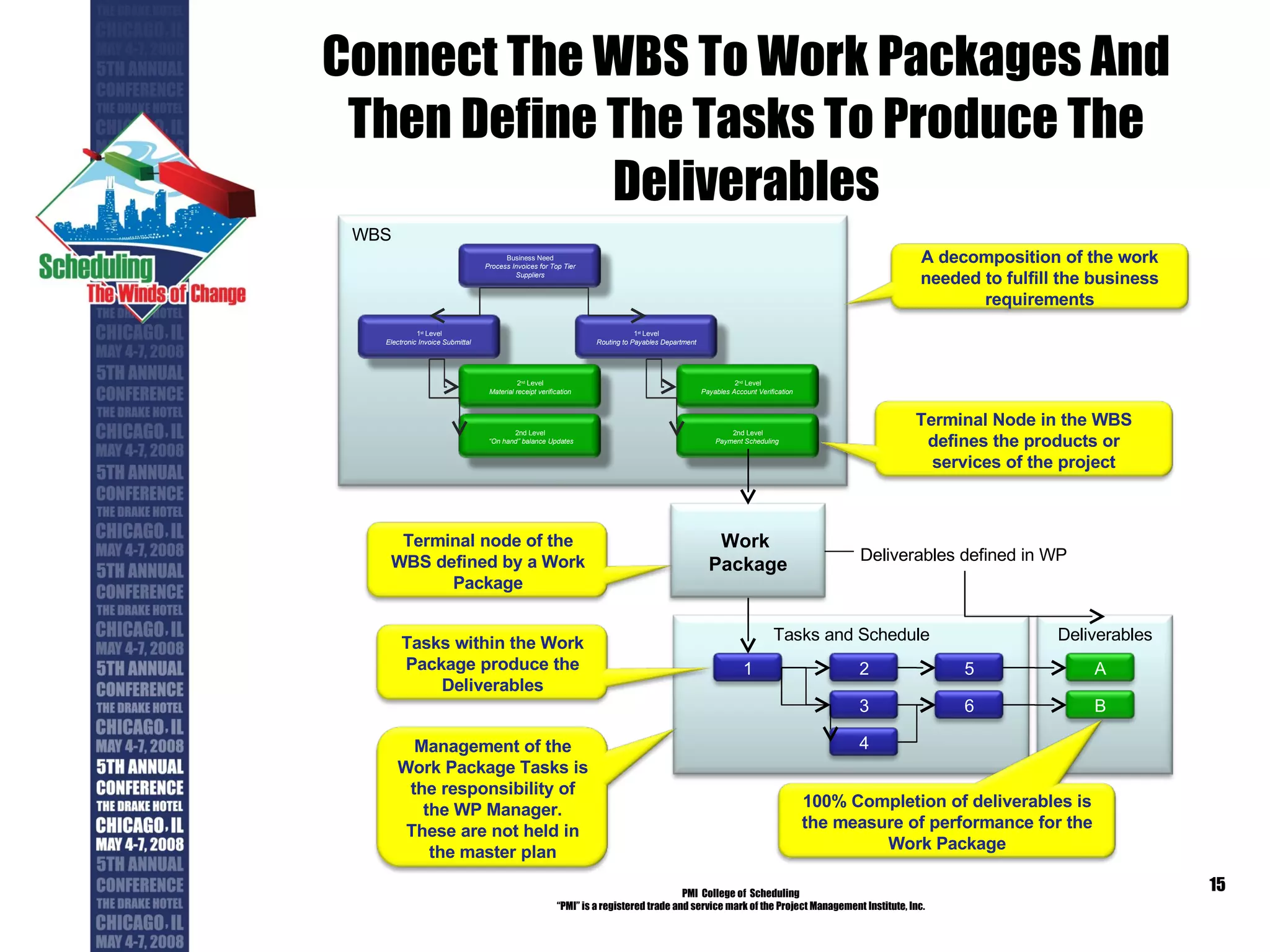
Connect The WBS To Work Packages And Then Define The Tasks To Produce The Deliverables PMI  College of  Scheduling “ PMI” is a registered trade and service mark of the Project Management Institute, Inc. Deliverables WBS Tasks and Schedule Business Need Process Invoices for Top Tier Suppliers 1 st  Level Electronic Invoice Submittal  1 st  Level Routing to Payables Department 2 nd  Level Payables Account Verification  2nd Level Payment Scheduling  2 nd  Level Material receipt verification 2nd Level “ On hand” balance Updates Work  Package 1 2 3 4 6 5 A B Deliverables defined in WP Terminal Node in the WBS defines the products or services of the project Terminal node of the WBS defined by a Work Package Tasks within the Work Package produce the Deliverables 100% Completion of deliverables is the measure of performance for the Work Package Management of the Work Package Tasks is the responsibility of the WP Manager. These are not held in the master plan A decomposition of the work needed to fulfill the business requirements
Steps In Building The Work Packages Step 1 – define what is going to be delivered to produce business value One or more Deliverables produced within a Work Package Step 2 – define the effort and duration along with the confidence levels Only effort and total duration Level of confidence for effort and duration PMI  College of  Scheduling “ PMI” is a registered trade and service mark of the Project Management Institute, Inc.
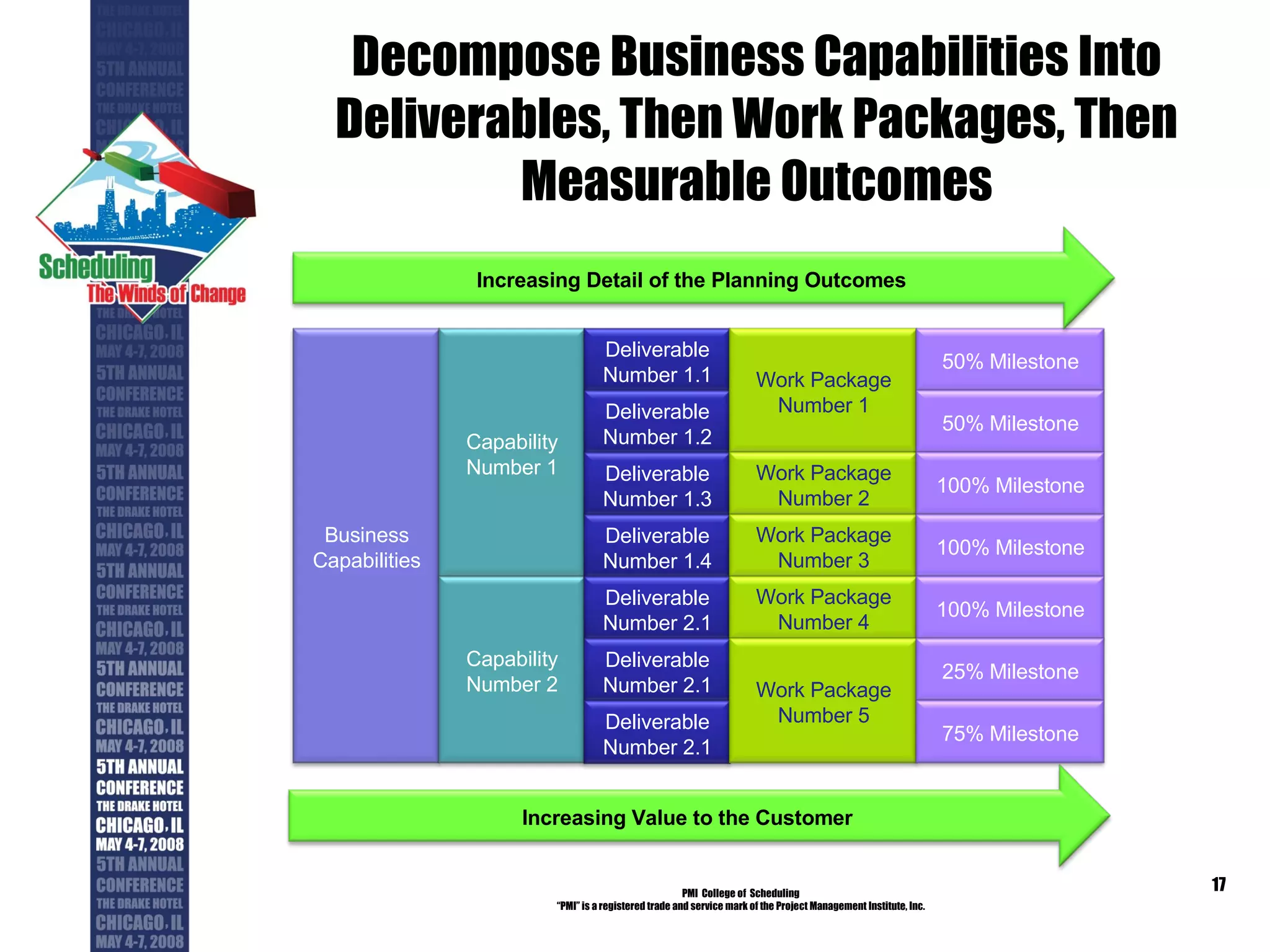
Decompose Business Capabilities Into Deliverables, Then Work Packages, Then Measurable Outcomes PMI  College of  Scheduling “ PMI” is a registered trade and service mark of the Project Management Institute, Inc. Business Capabilities Capability Number 1 Capability Number 2 Deliverable Number 1.1 Deliverable Number 1.2 Deliverable Number 1.3 Deliverable Number 1.4 Work Package Number 1 Work Package Number 2 Work Package Number 3 50% Milestone 50% Milestone 100% Milestone 100% Milestone Deliverable Number 2.1 Work Package Number 4 100% Milestone Deliverable Number 2.1 Deliverable Number 2.1 Work Package Number 5 25% Milestone 75% Milestone Increasing Detail of the Planning Outcomes Increasing Value to the Customer
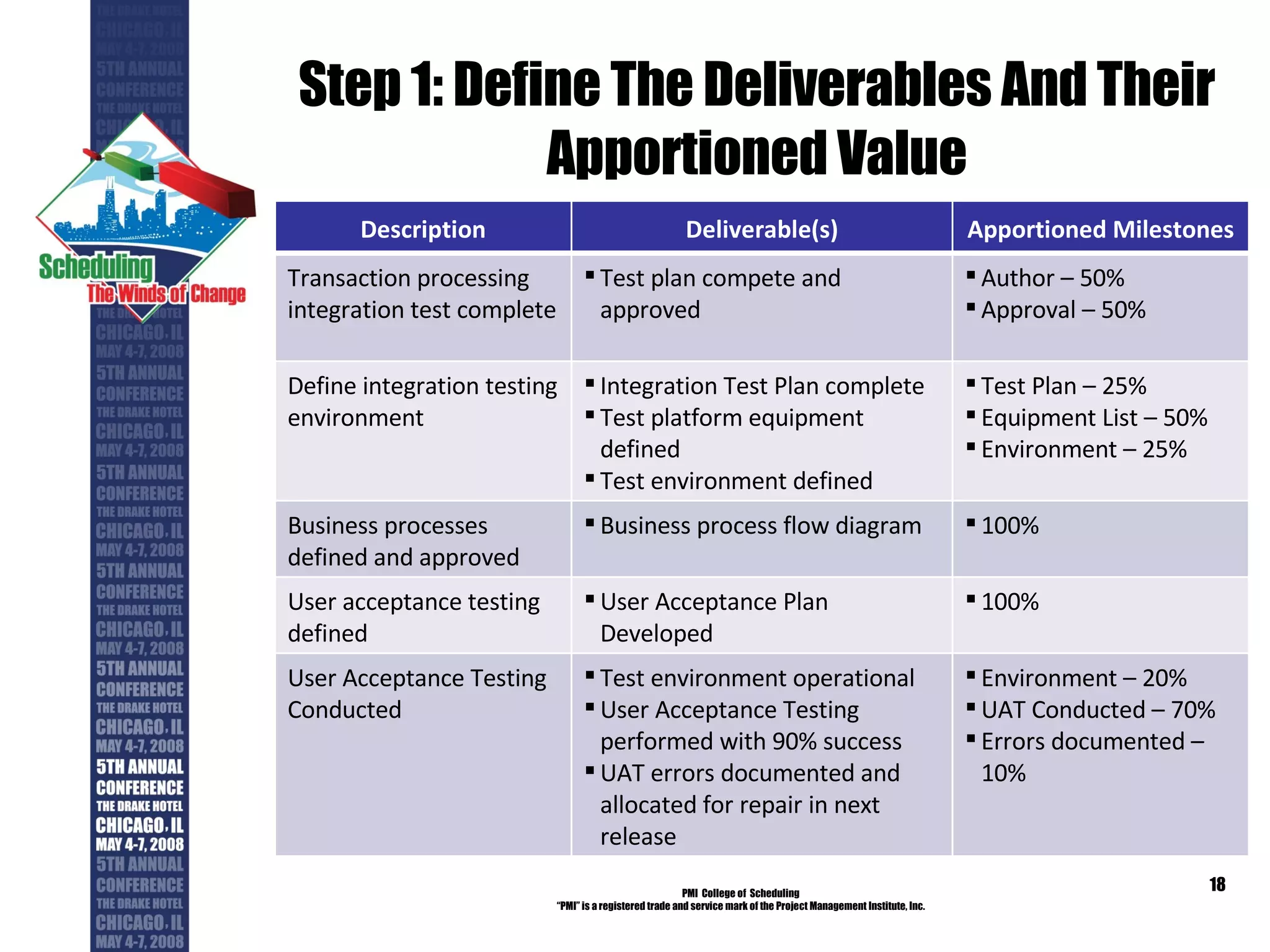
Step 1: Define The Deliverables And Their Apportioned Value PMI  College of  Scheduling “ PMI” is a registered trade and service mark of the Project Management Institute, Inc. Description Deliverable(s) Apportioned Milestones Transaction processing integration test complete Test plan compete and approved Author – 50% Approval – 50% Define integration testing environment Integration Test Plan complete Test platform equipment defined Test environment defined Test Plan – 25% Equipment List – 50% Environment – 25% Business processes defined and approved Business process flow diagram 100% User acceptance testing defined User Acceptance Plan Developed 100% User Acceptance Testing Conducted Test environment operational User Acceptance Testing performed with 90% success UAT errors documented and allocated for repair in next release Environment – 20% UAT Conducted – 70% Errors documented – 10%
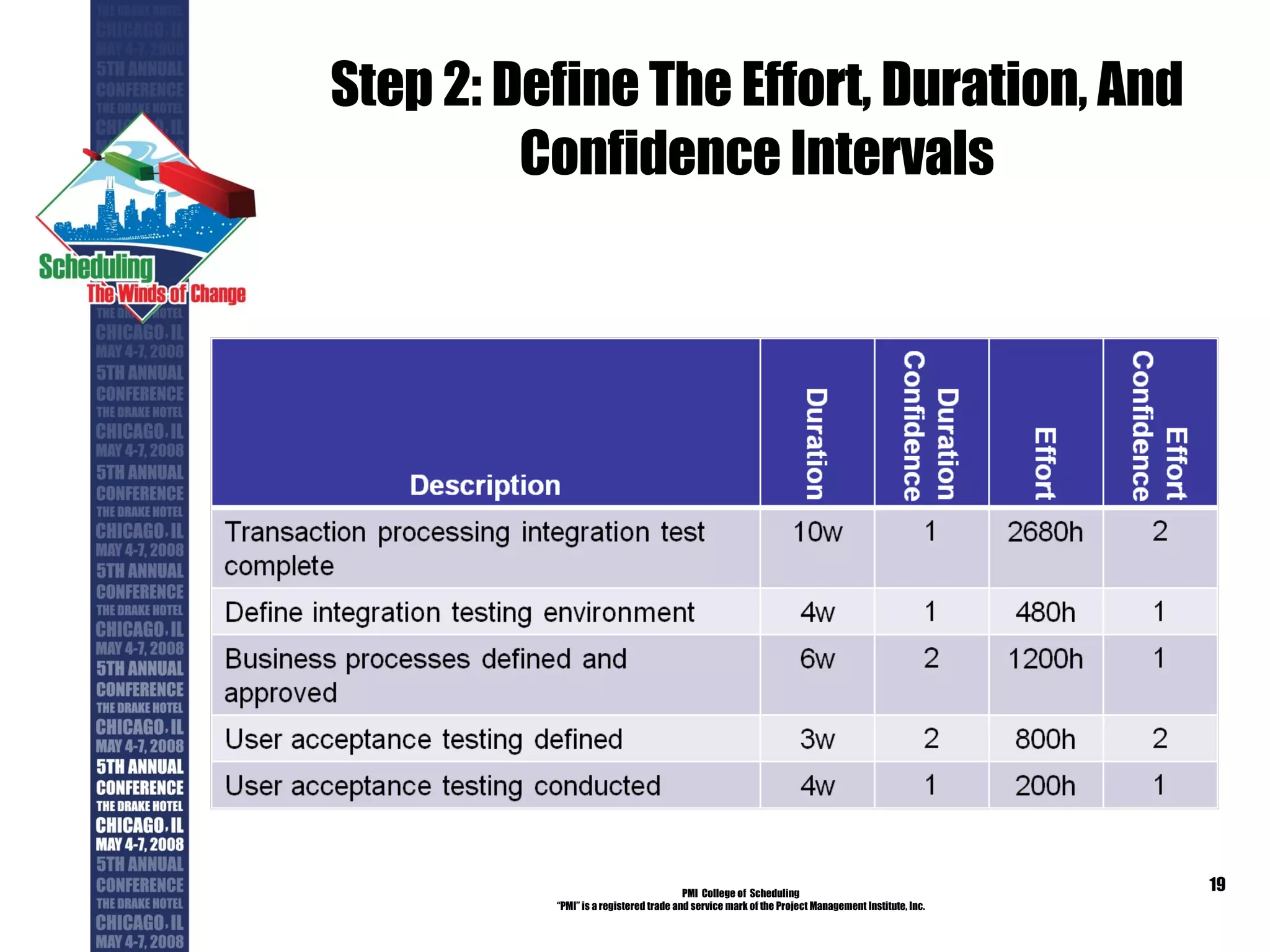
Step 2: Define The Effort, Duration, And Confidence Intervals PMI  College of  Scheduling “ PMI” is a registered trade and service mark of the Project Management Institute, Inc.
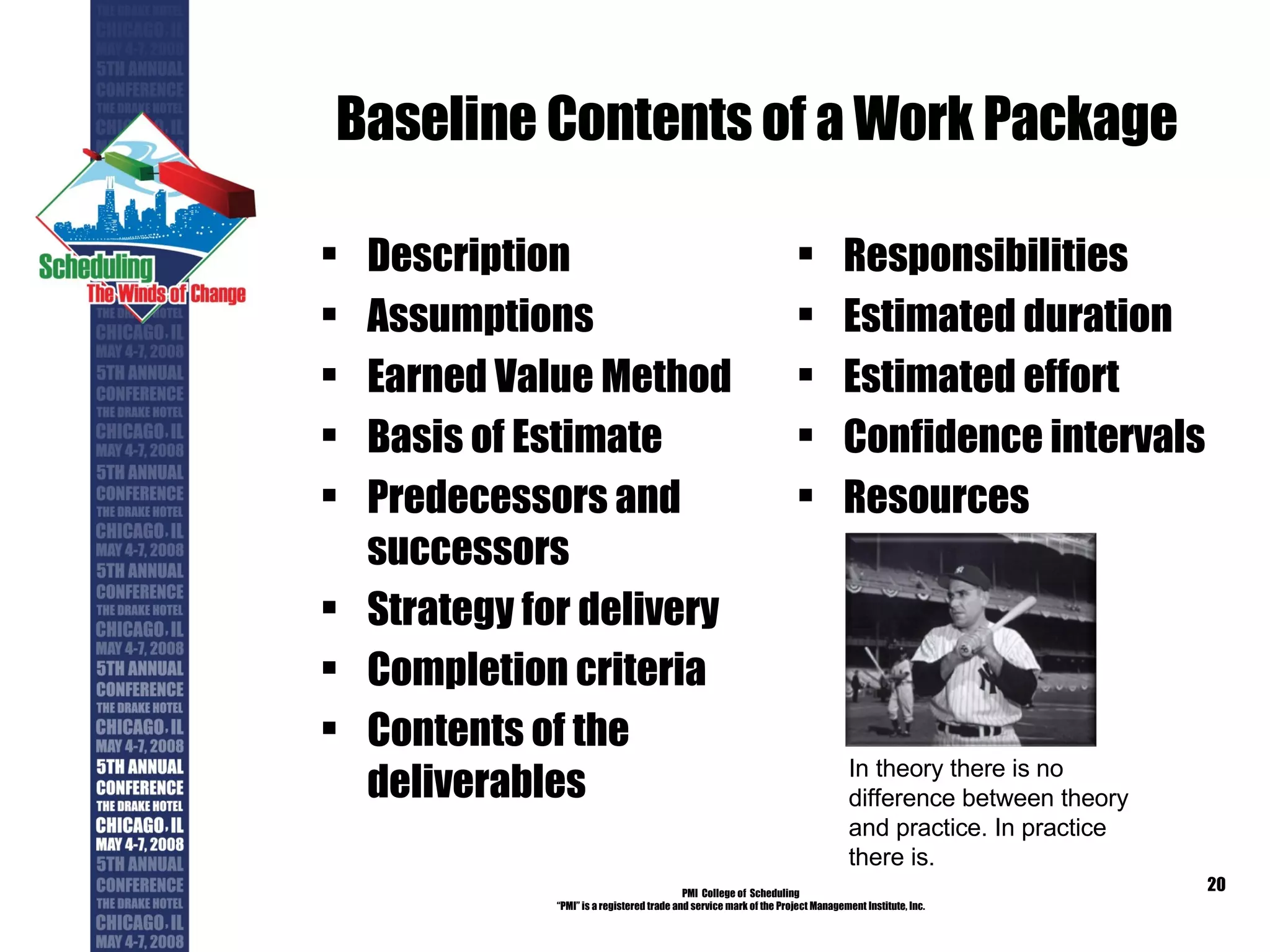
Baseline Contents of a Work Package Description Assumptions Earned Value Method Basis of Estimate Predecessors and successors Strategy for delivery Completion criteria Contents of the deliverables Responsibilities Estimated duration Estimated effort Confidence intervals Resources PMI  College of  Scheduling “ PMI” is a registered trade and service mark of the Project Management Institute, Inc. In theory there is no difference between theory and practice. In practice there is.
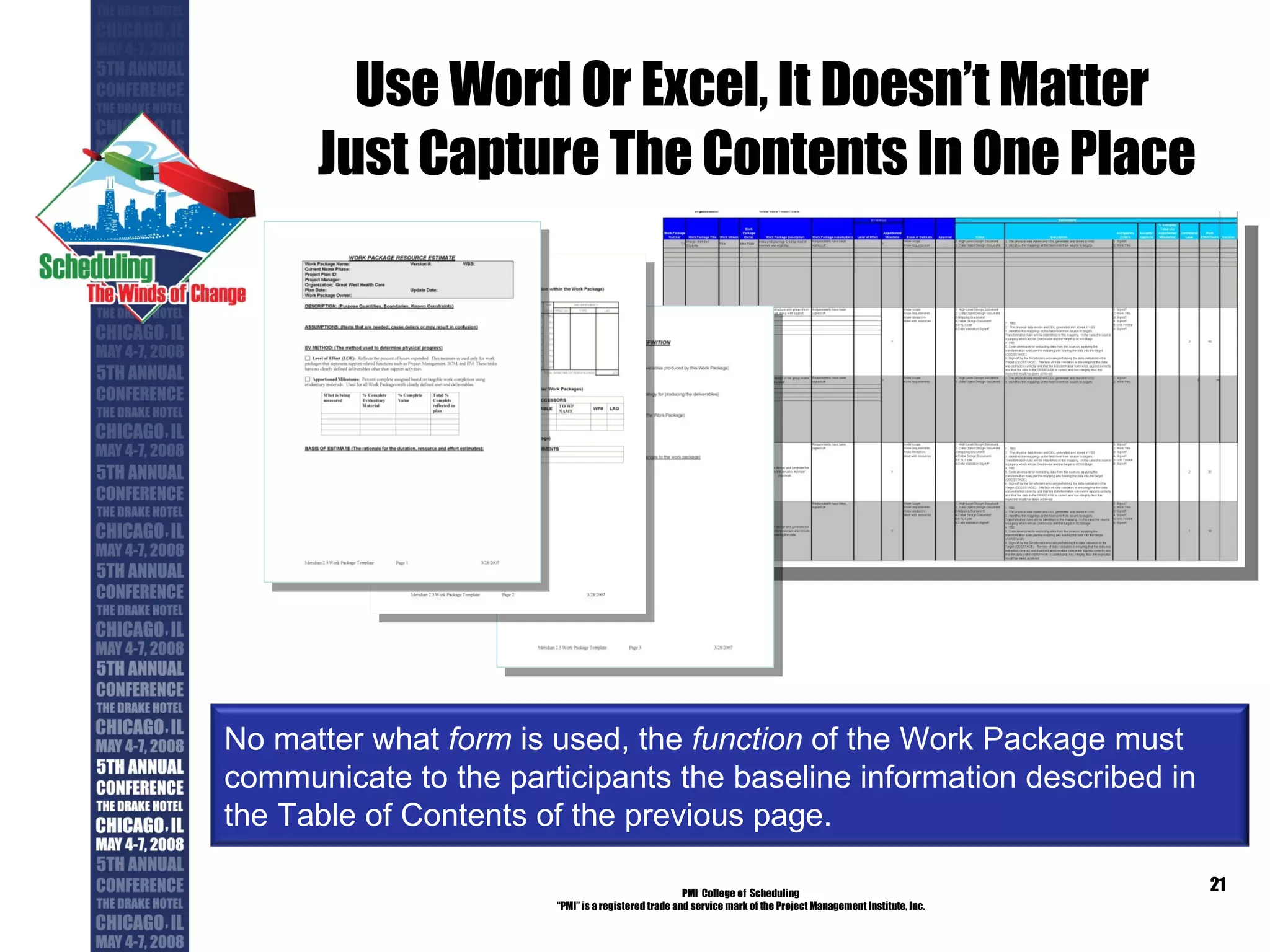
Use Word Or Excel, It Doesn’t Matter  Just Capture The Contents In One Place PMI  College of  Scheduling “ PMI” is a registered trade and service mark of the Project Management Institute, Inc. No matter what  form  is used, the  function  of the Work Package must communicate to the participants the baseline information described in the Table of Contents of the previous page.
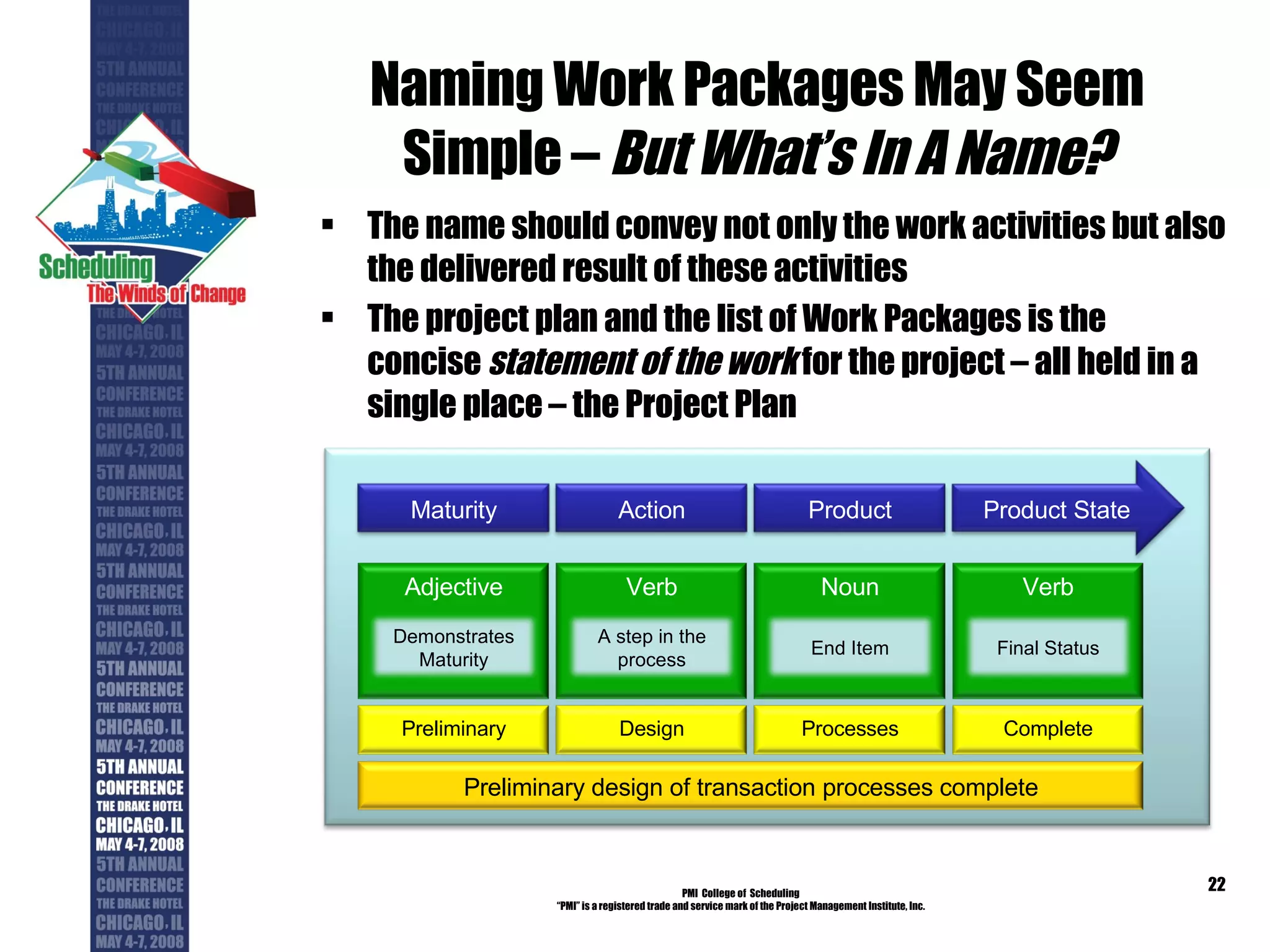
Naming Work Packages May Seem Simple –  But What’s In A Name? The name should convey not only the work activities but also the delivered result of these activities The project plan and the list of Work Packages is the concise  statement of the work  for the project – all held in a single place – the Project Plan PMI  College of  Scheduling “ PMI” is a registered trade and service mark of the Project Management Institute, Inc. Maturity Action Product Product State Adjective Verb Noun Verb Demonstrates Maturity A step in the process End Item Final Status Preliminary Design Processes Complete Preliminary design of transaction processes complete
Work Package Description A clear and concise description of what the Work Package produces in terms of deliverables This is your  elevator pitch   when someone asks “what does the Work Package you’re working on do when its all done?” Deliverables are meaning to the customer – speak in deliverables terms PMI  College of  Scheduling “ PMI” is a registered trade and service mark of the Project Management Institute, Inc. If you can’t tell the story between the lobby and the 9 th  floor, then you haven't got a clear picture of what “done” looks like.
Assumptions Make it clear (and concise) what you expect to be in place before the Work Package starts State these in terms of deliverables themselves What they are Who you’re getting them from A little bit of why you need them Have a mitigation plan when the assumption isn’t true PMI  College of  Scheduling “ PMI” is a registered trade and service mark of the Project Management Institute, Inc. Assumptions are repulsive, especially to gravity.
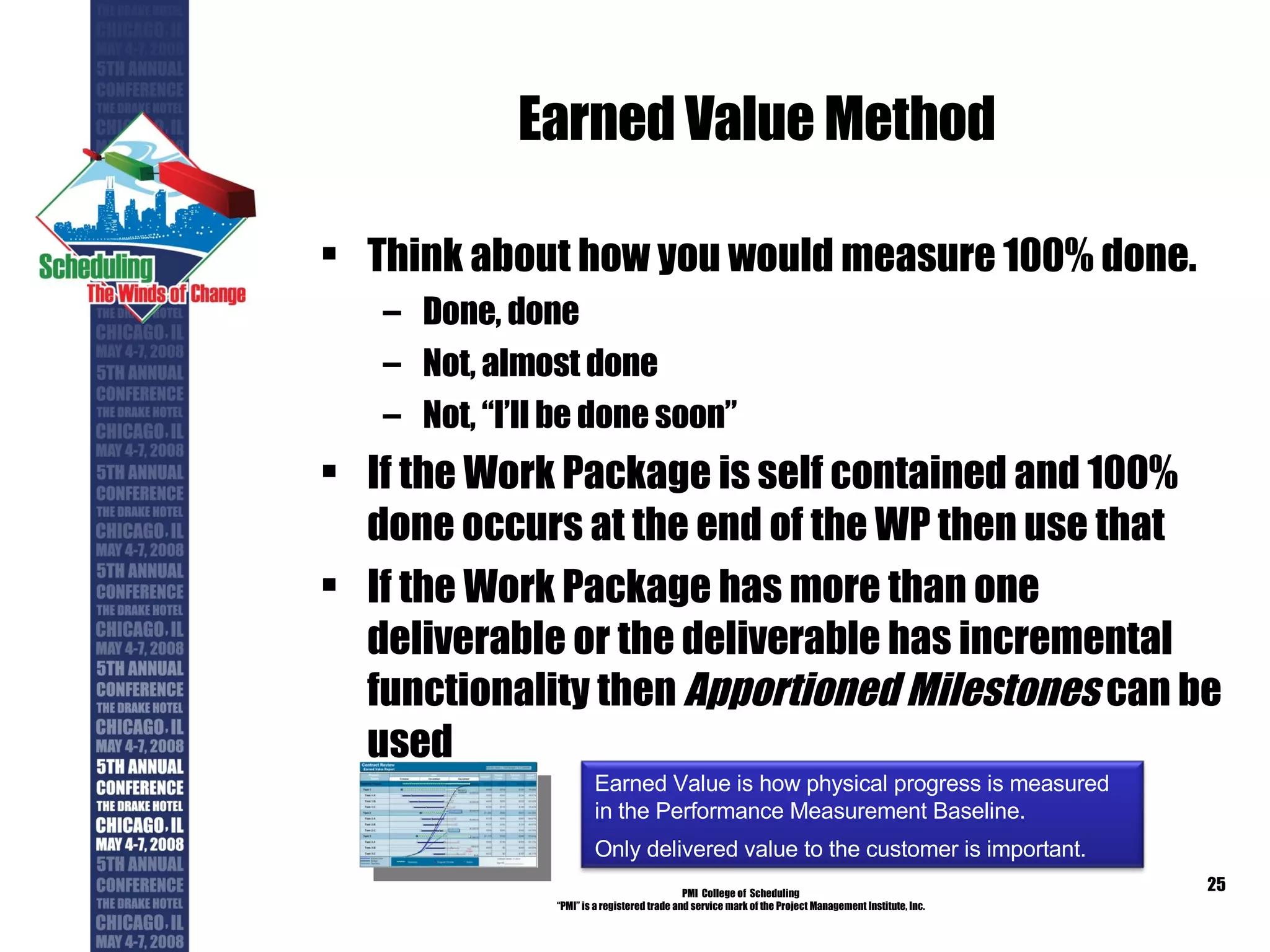
Earned Value Method Think about how you would measure 100% done. Done, done Not, almost done Not, “I’ll be done soon” If the Work Package is self contained and 100% done occurs at the end of the WP then use that If the Work Package has more than one deliverable or the deliverable has incremental functionality then  Apportioned Milestones  can be used PMI  College of  Scheduling “ PMI” is a registered trade and service mark of the Project Management Institute, Inc. Earned Value is how physical progress is measured in the Performance Measurement Baseline. Only delivered value to the customer is important.
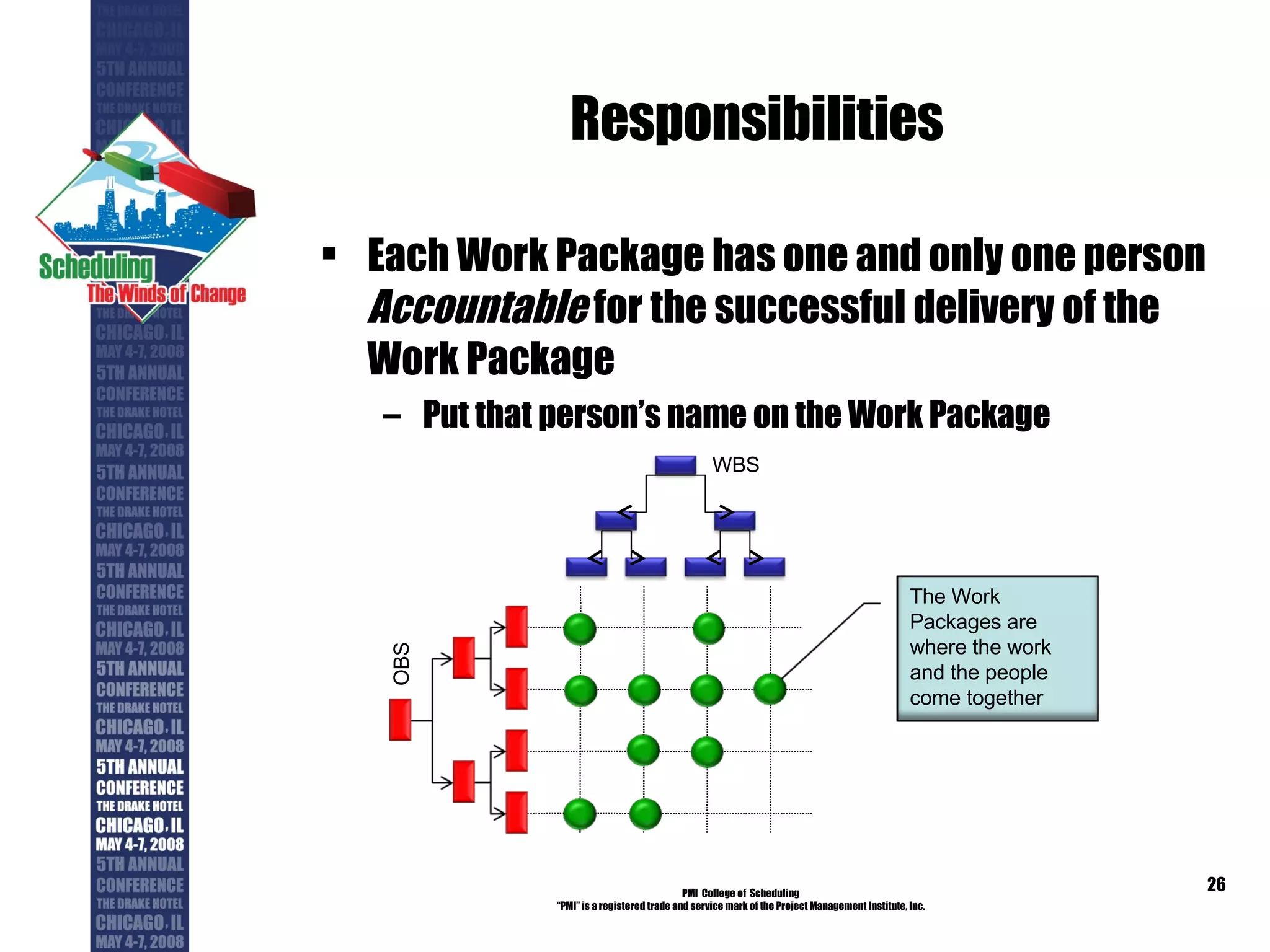
Responsibilities Each Work Package has one and only one person  Accountable  for the successful delivery of the Work Package Put that person’s name on the Work Package PMI  College of  Scheduling “ PMI” is a registered trade and service mark of the Project Management Institute, Inc. WBS OBS The Work Packages are where the work and the people come together
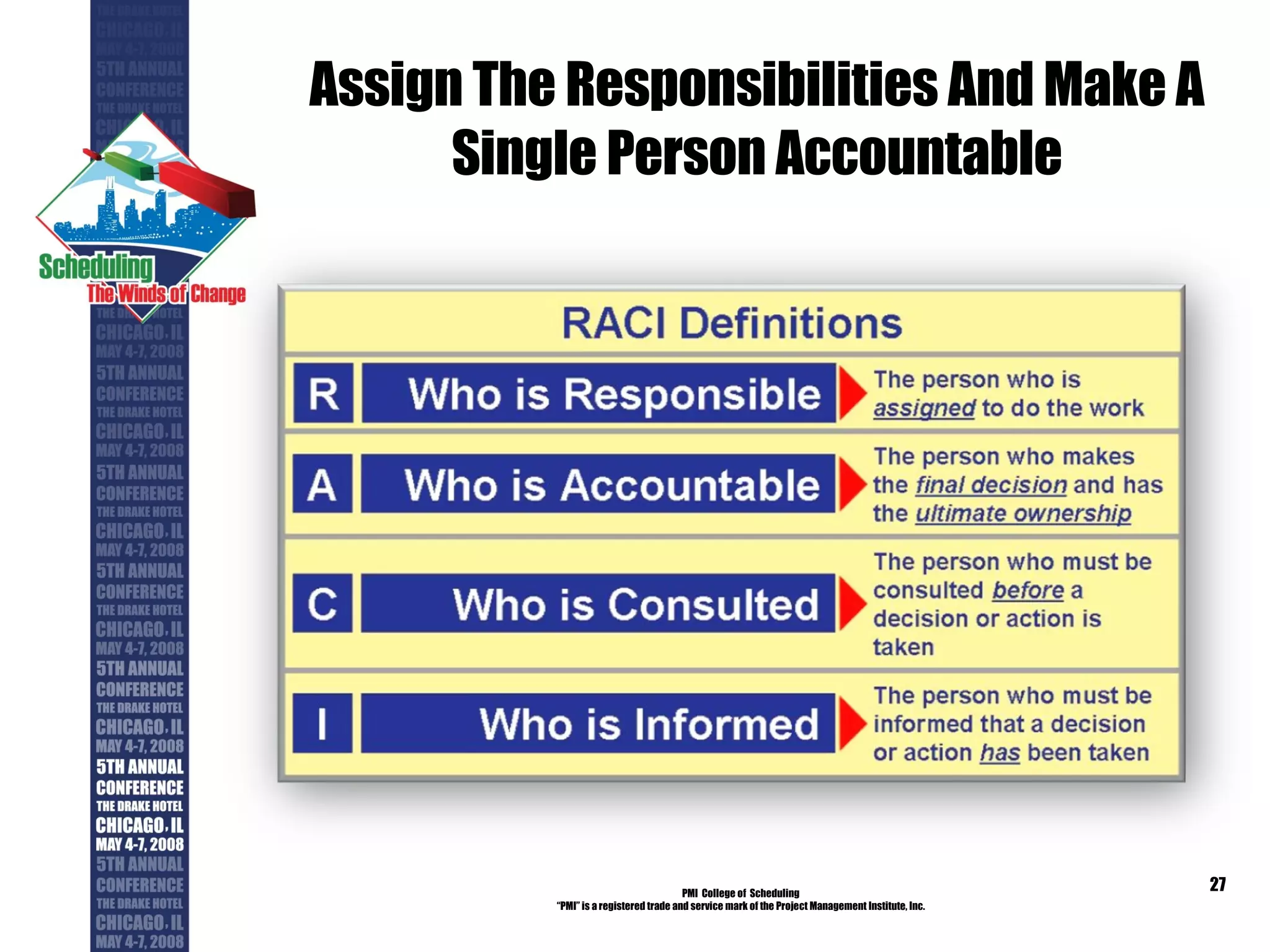
Assign The Responsibilities And Make A Single Person Accountable PMI  College of  Scheduling “ PMI” is a registered trade and service mark of the Project Management Institute, Inc.
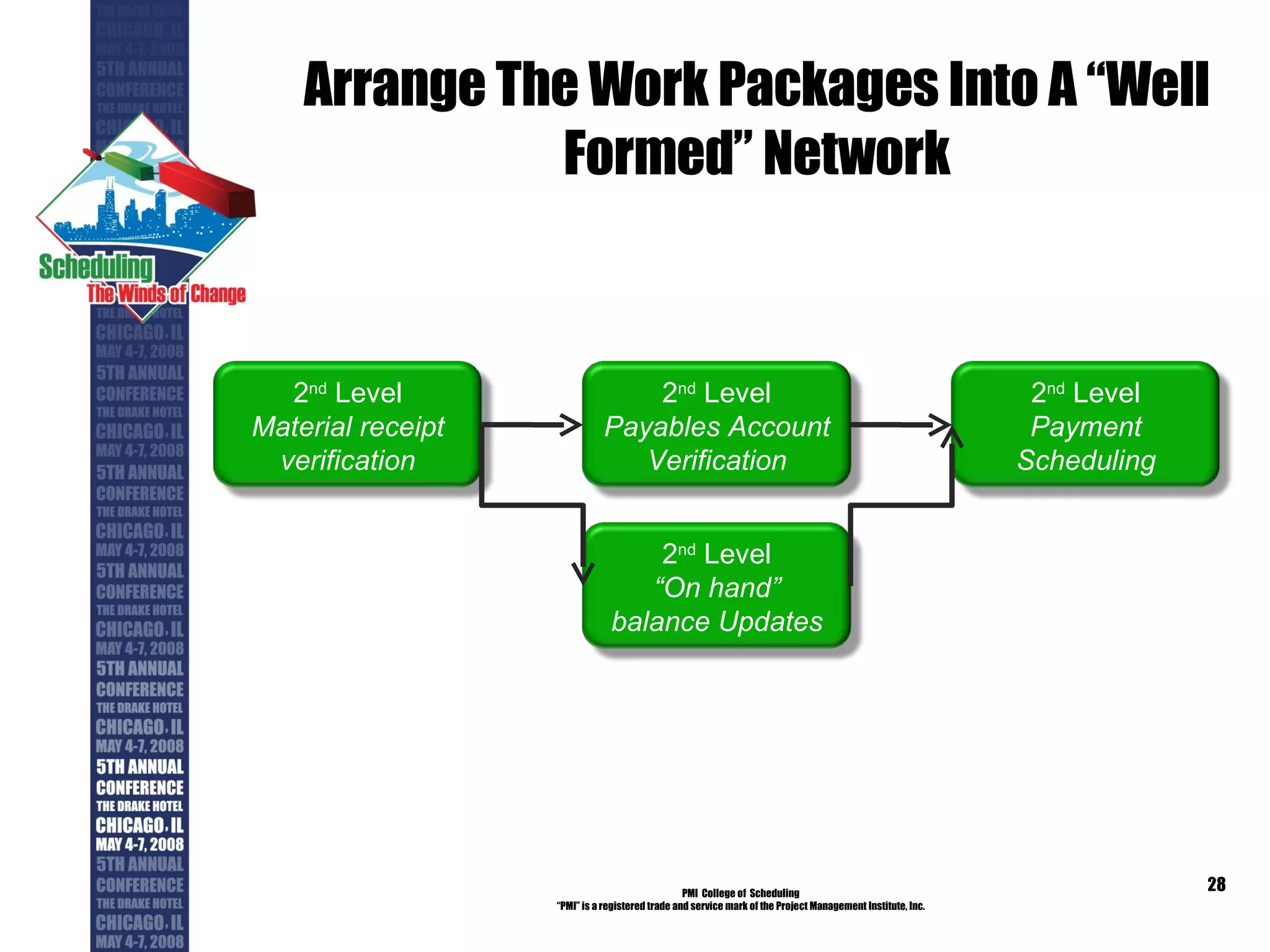
Arrange The Work Packages Into A “Well Formed” Network PMI  College of  Scheduling “ PMI” is a registered trade and service mark of the Project Management Institute, Inc. 2 nd  Level Payables Account Verification 2 nd  Level Payment Scheduling 2 nd  Level Material receipt verification 2 nd  Level “ On hand” balance Updates
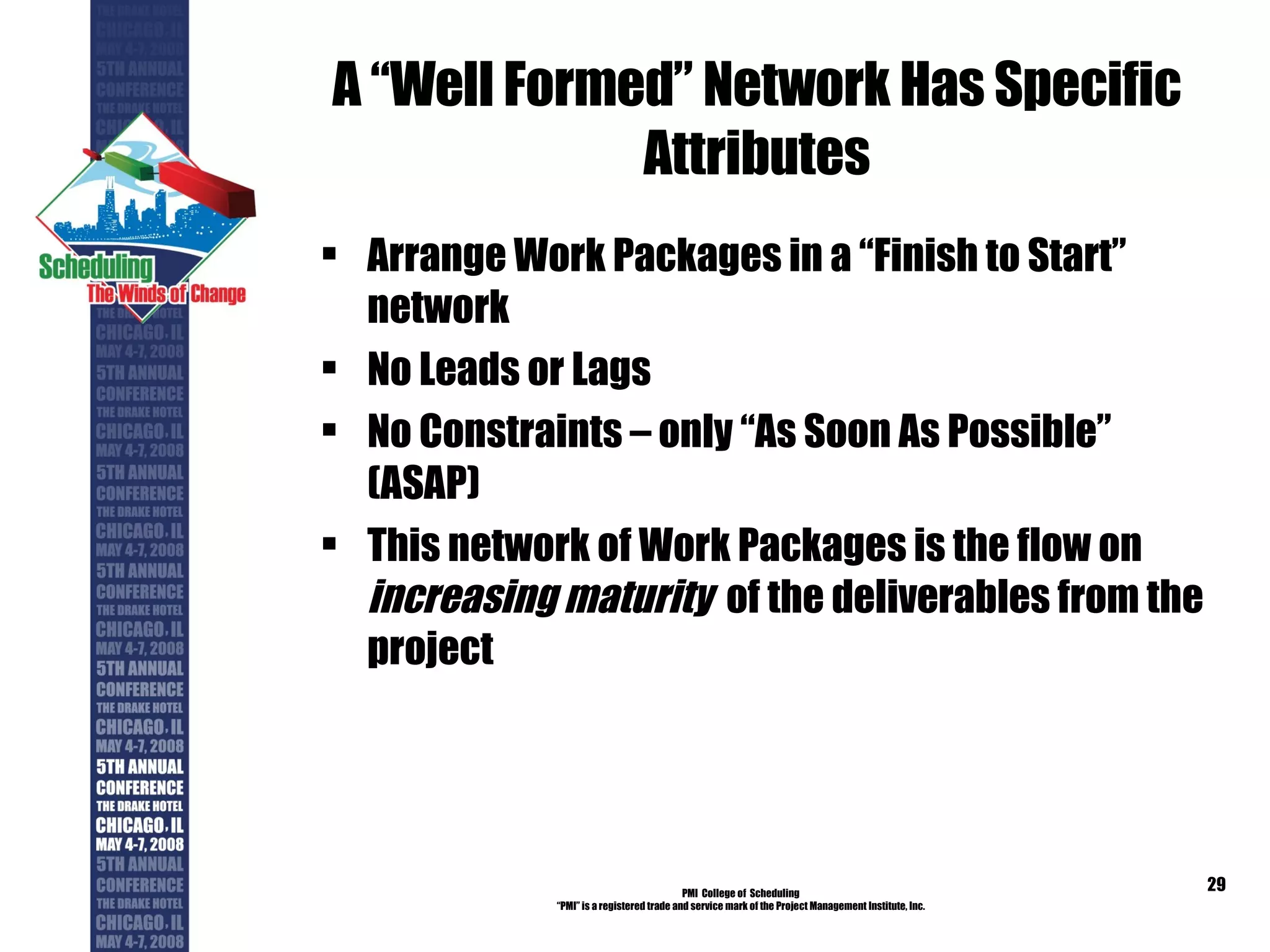
A “Well Formed” Network Has Specific Attributes Arrange Work Packages in a “Finish to Start” network No Leads or Lags No Constraints – only “As Soon As Possible” (ASAP) This network of Work Packages is the flow on  increasing maturity   of the deliverables from the project PMI  College of  Scheduling “ PMI” is a registered trade and service mark of the Project Management Institute, Inc.
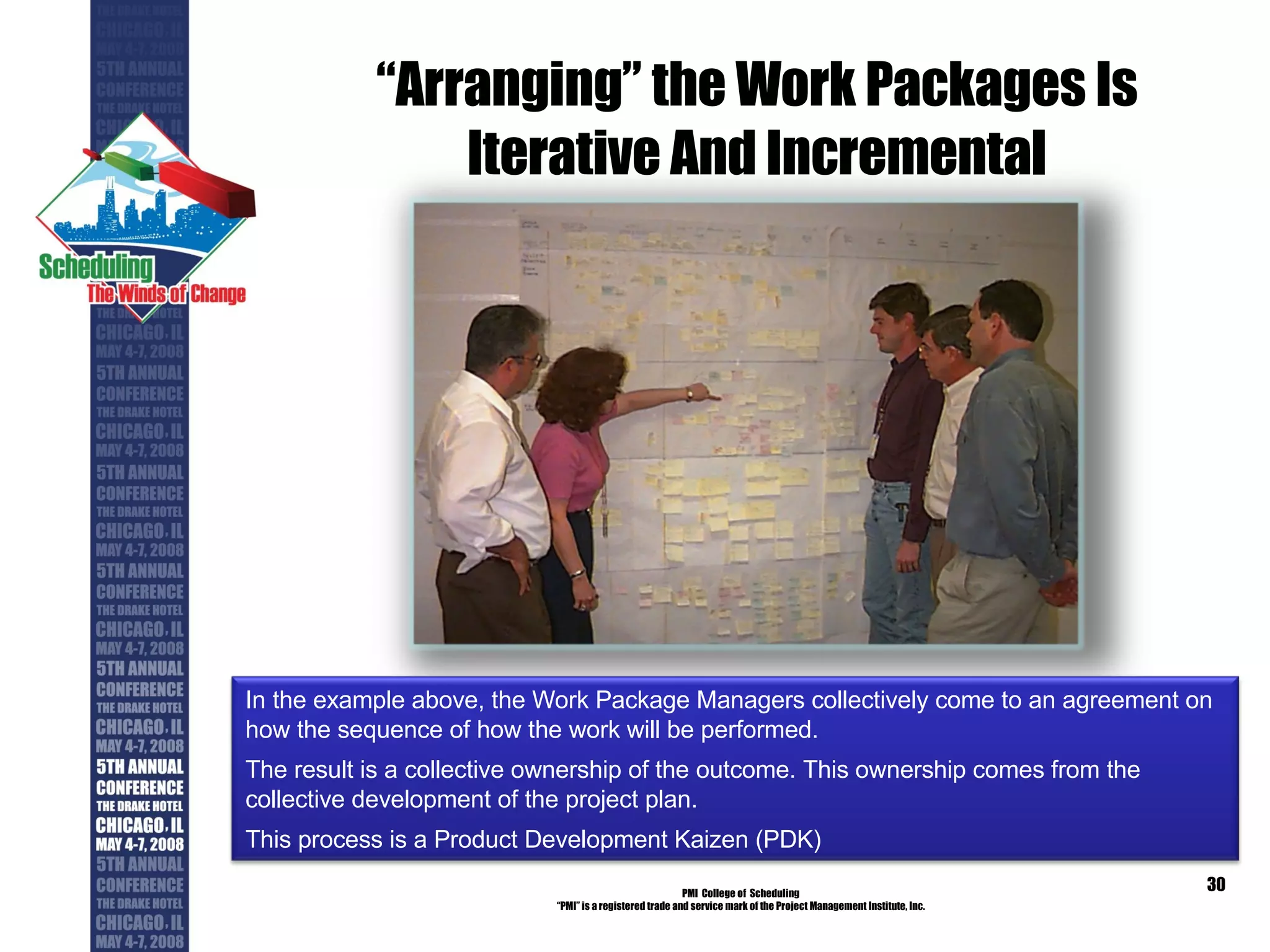
“ Arranging” the Work Packages Is Iterative And Incremental PMI  College of  Scheduling “ PMI” is a registered trade and service mark of the Project Management Institute, Inc. In the example above, the Work Package Managers collectively come to an agreement on how the sequence of how the work will be performed.  The result is a collective ownership of the outcome. This ownership comes from the collective development of the project plan. This process is a Product Development Kaizen (PDK)
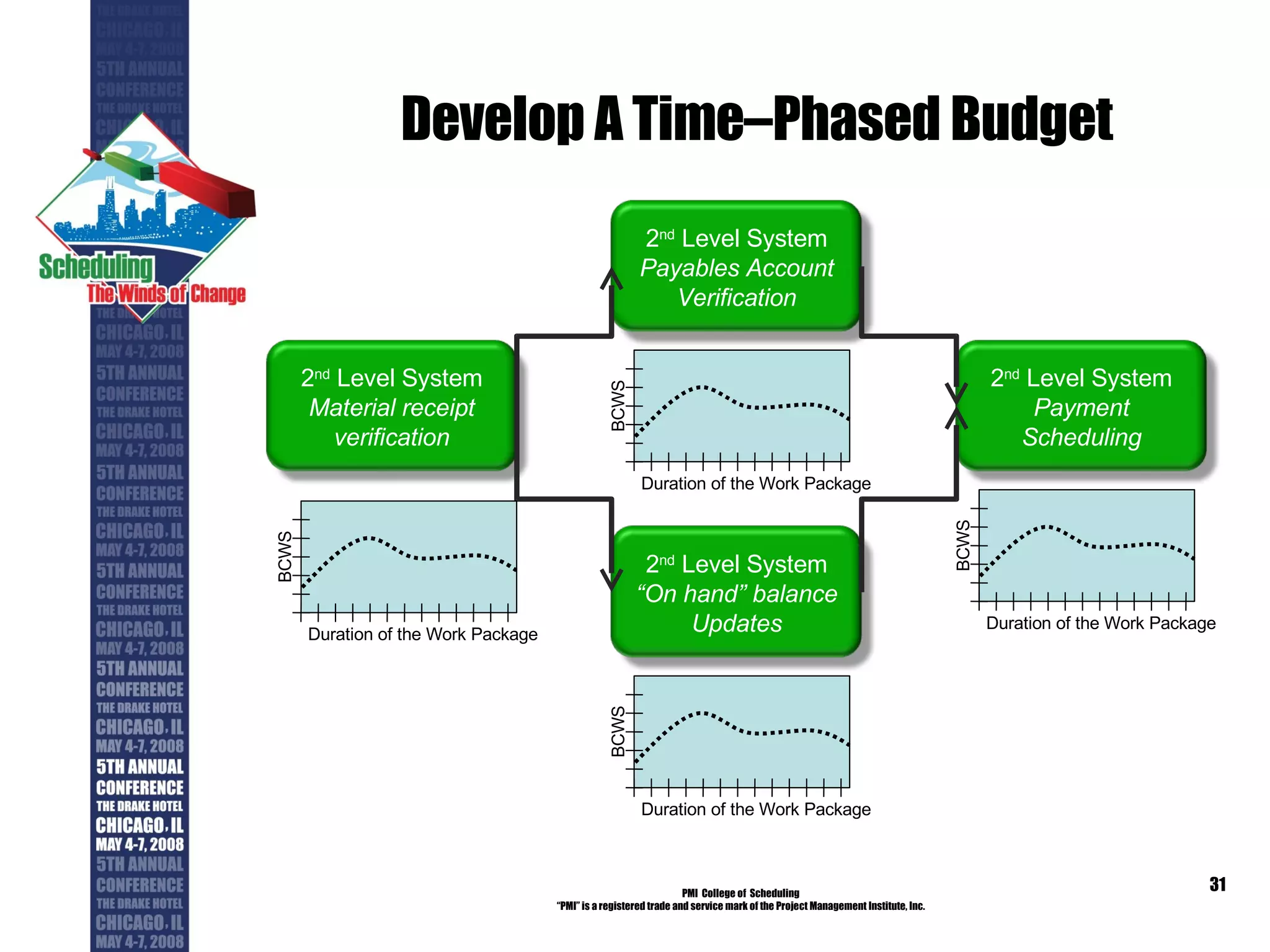
Develop A Time–Phased Budget PMI  College of  Scheduling “ PMI” is a registered trade and service mark of the Project Management Institute, Inc. 2 nd  Level System Payables Account Verification 2 nd  Level System Payment Scheduling 2 nd  Level System Material receipt verification 2 nd  Level System “ On hand” balance Updates Duration of the Work Package BCWS Duration of the Work Package BCWS Duration of the Work Package BCWS Duration of the Work Package BCWS
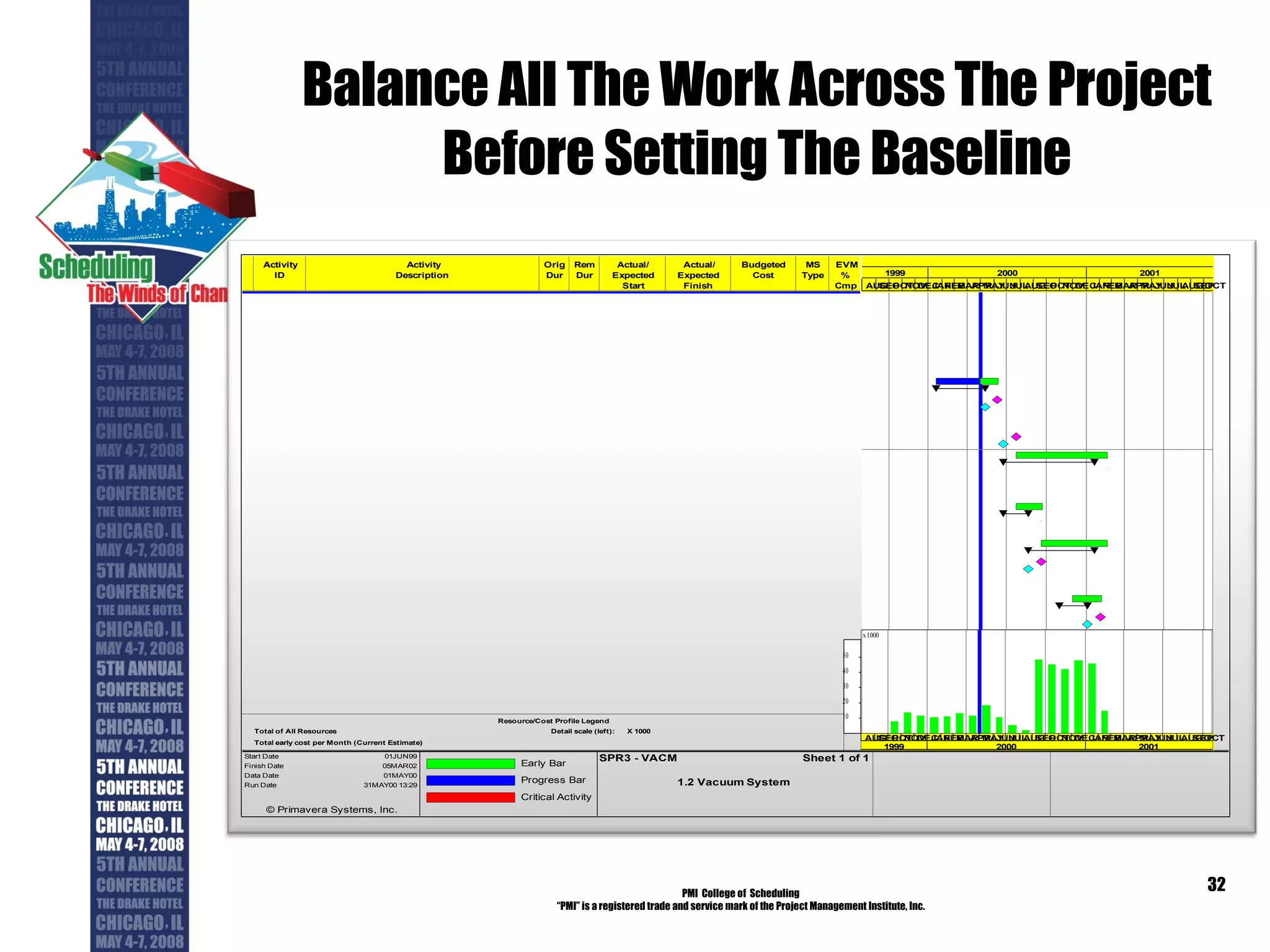
Balance All The Work Across The Project Before Setting The Baseline PMI  College of  Scheduling “ PMI” is a registered trade and service mark of the Project Management Institute, Inc.
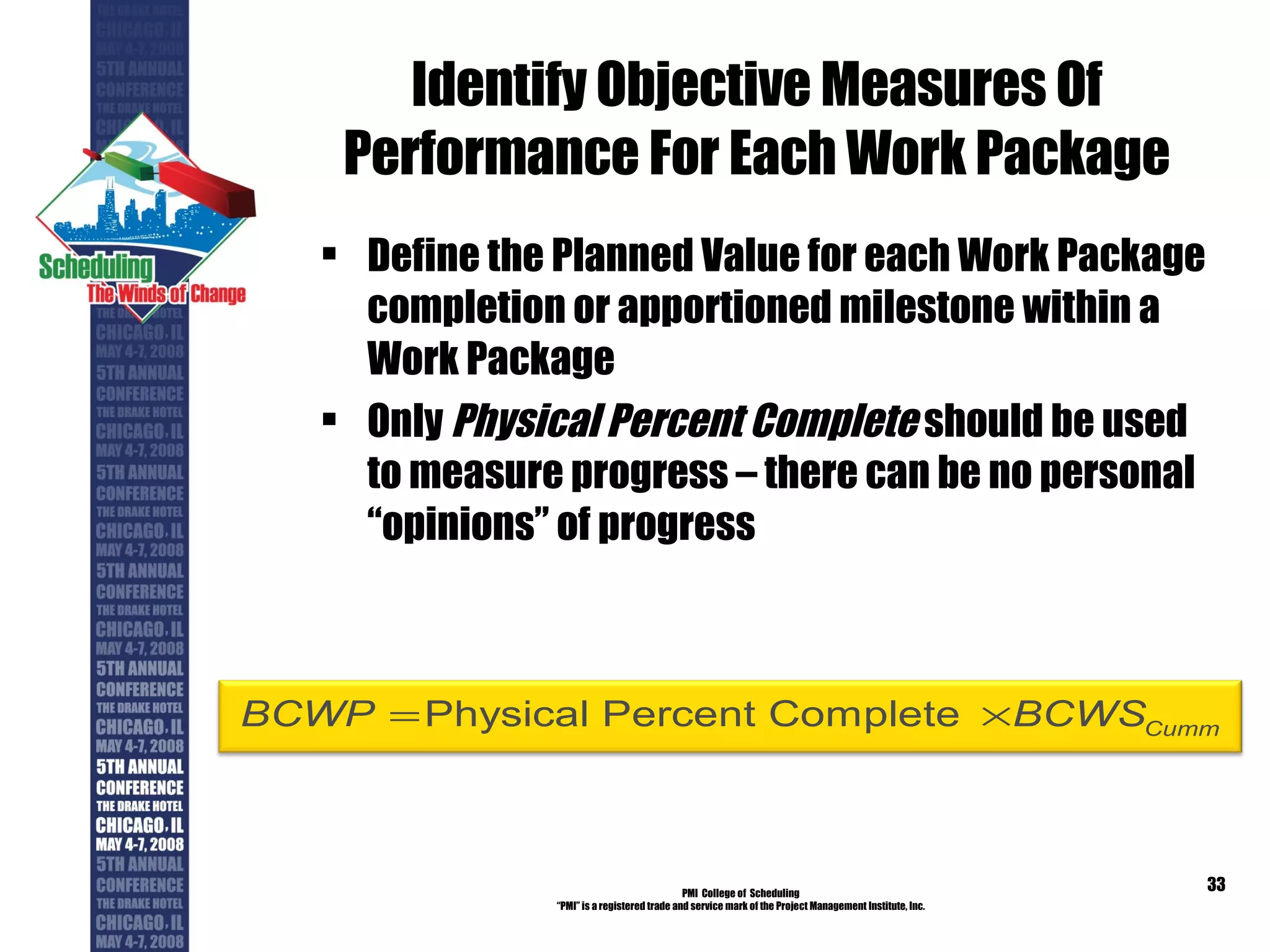
Identify Objective Measures Of Performance For Each Work Package Define the Planned Value for each Work Package completion or apportioned milestone within a Work Package Only  Physical Percent Complete  should be used to measure progress – there can be no personal “opinions” of progress PMI  College of  Scheduling “ PMI” is a registered trade and service mark of the Project Management Institute, Inc.
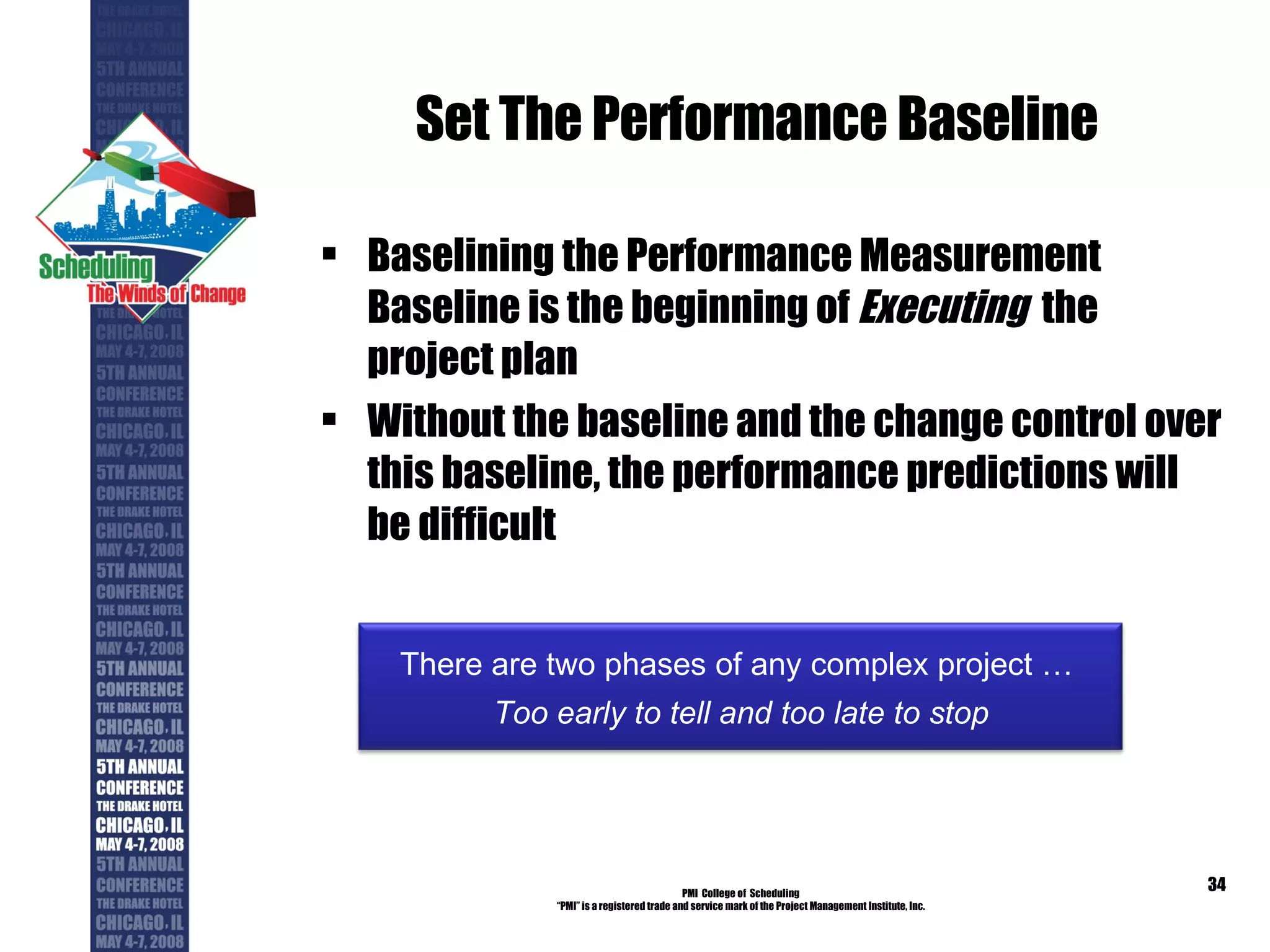
Set The Performance Baseline Baselining the Performance Measurement Baseline is the beginning of  Executing   the project plan Without the baseline and the change control over this baseline, the performance predictions will be difficult  PMI  College of  Scheduling “ PMI” is a registered trade and service mark of the Project Management Institute, Inc. There are two phases of any complex project …  Too early to tell and too late to stop
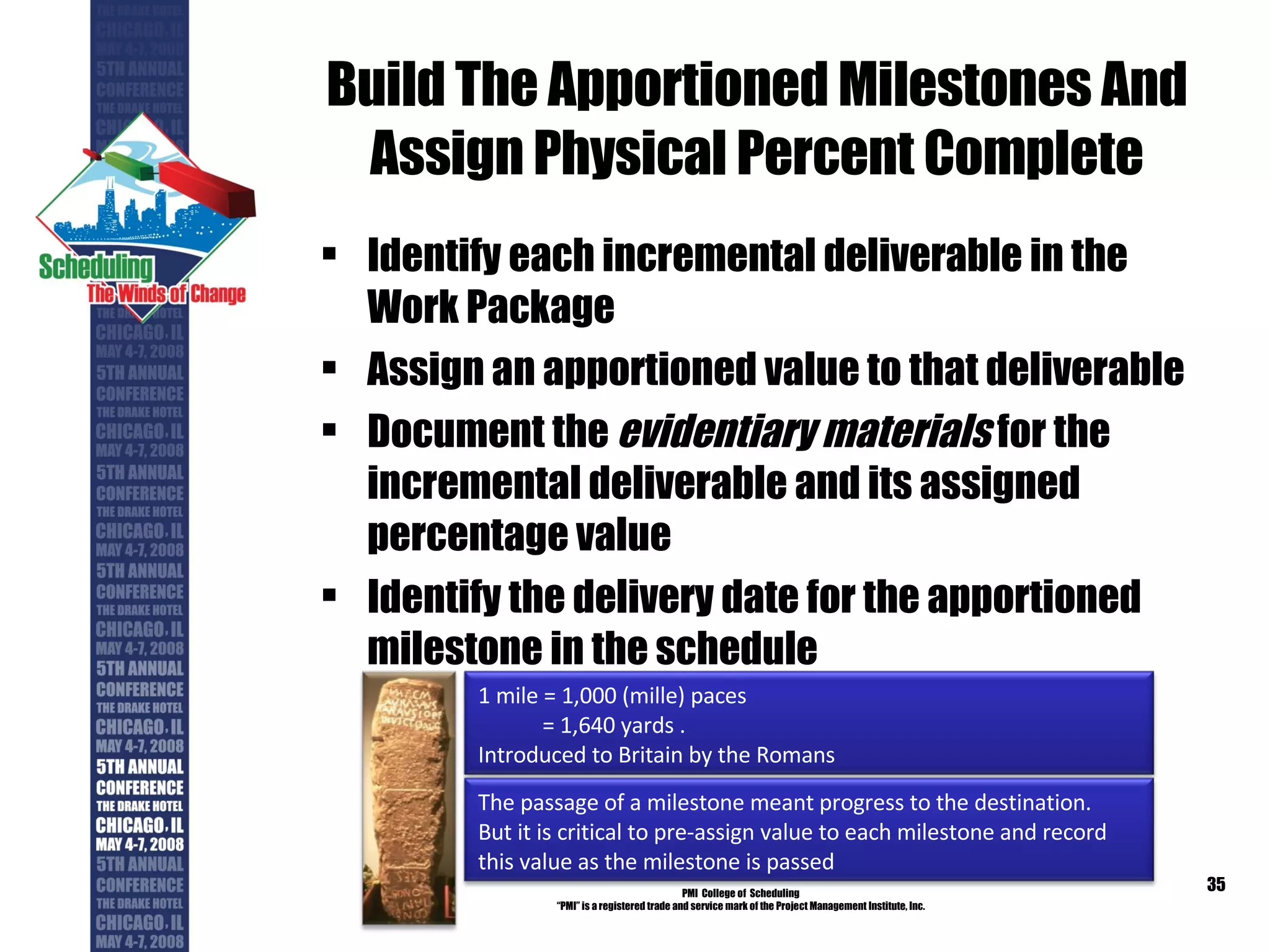
Build The Apportioned Milestones And Assign Physical Percent Complete Identify each incremental deliverable in the Work Package Assign an apportioned value to that deliverable Document the  evidentiary materials  for the incremental deliverable and its assigned percentage value Identify the delivery date for the apportioned milestone in the schedule PMI  College of  Scheduling “ PMI” is a registered trade and service mark of the Project Management Institute, Inc. 1 mile = 1,000 (mille) paces  = 1,640 yards .  Introduced to Britain by the Romans The passage of a milestone meant progress to the destination. But it is critical to pre-assign value to each milestone and record this value as the milestone is passed
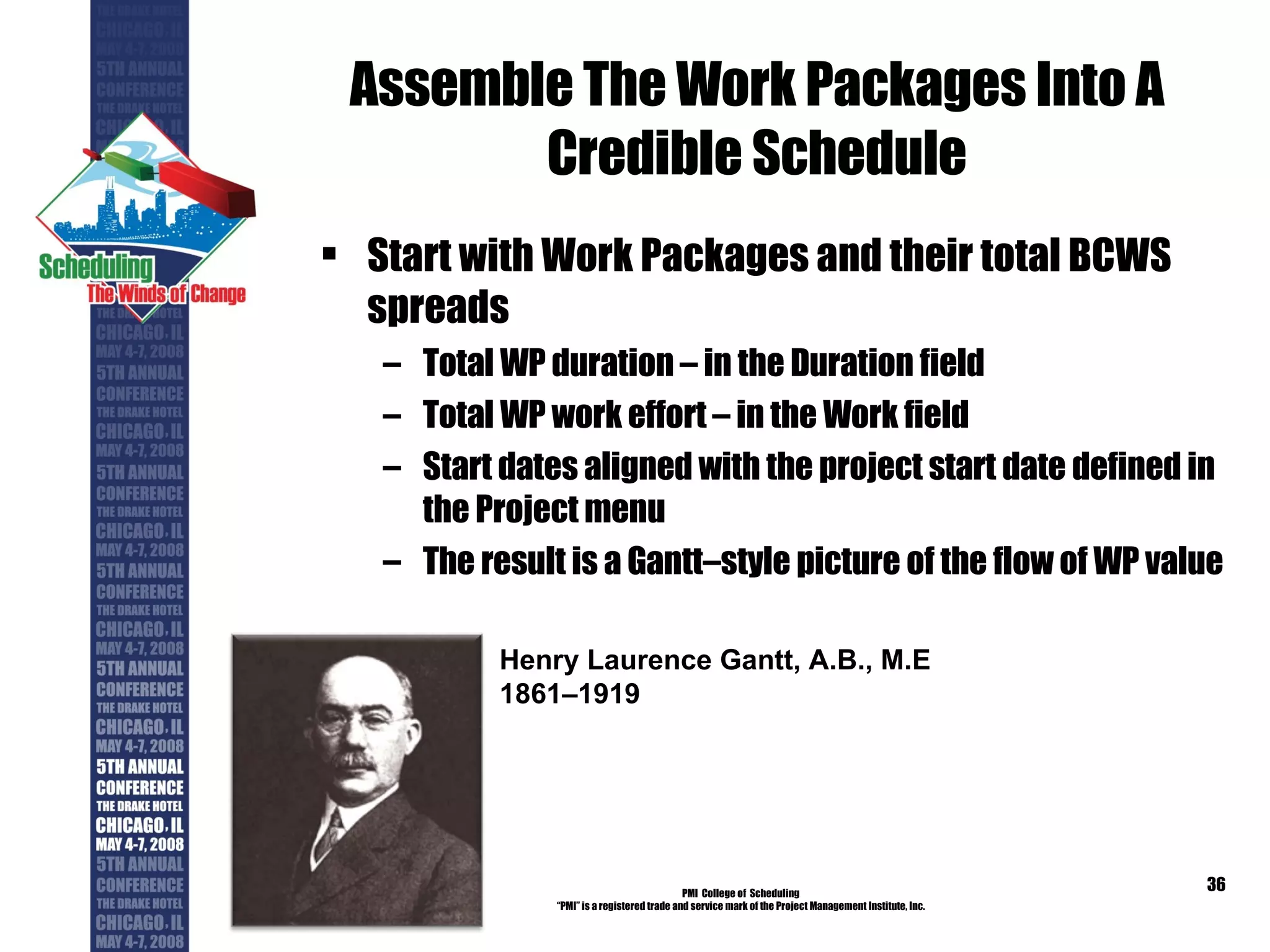
Assemble The Work Packages Into A Credible Schedule Start with Work Packages and their total BCWS spreads Total WP duration – in the Duration field Total WP work effort – in the Work field Start dates aligned with the project start date defined in the Project menu The result is a Gantt–style picture of the flow of WP value PMI  College of  Scheduling “ PMI” is a registered trade and service mark of the Project Management Institute, Inc. Henry Laurence Gantt, A.B., M.E 1861–1919
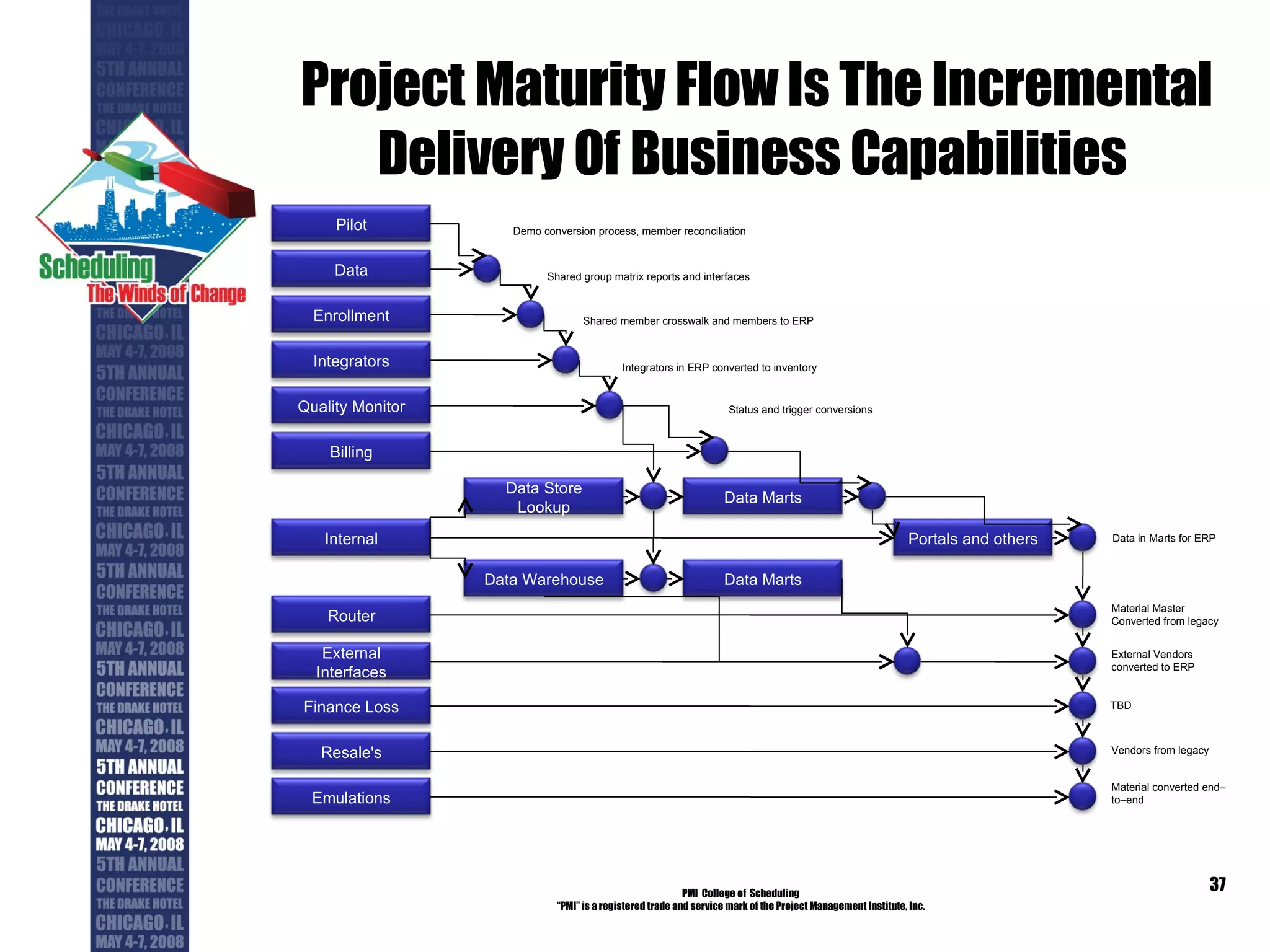
Project Maturity Flow Is The Incremental Delivery Of Business Capabilities  PMI  College of  Scheduling “ PMI” is a registered trade and service mark of the Project Management Institute, Inc. Pilot Data Enrollment Integrators Quality Monitor Internal Router External Interfaces Finance Loss Data Store Lookup Data Warehouse Data Marts Data Marts Portals and others Billing Resale's Emulations Demo conversion process, member reconciliation Shared group matrix reports and interfaces Shared member crosswalk and members to ERP Integrators in ERP converted to inventory Status and trigger conversions Data in Marts for ERP Material Master Converted from legacy External Vendors converted to ERP TBD Vendors from legacy Material converted end–to–end
Analyzing And Assessing The Network Of Work Packages Requires Understanding Critical path Accuracy Integration Realism Performance Variances Forecasting What–If Analysis  Risk Resources  PMI  College of  Scheduling “ PMI” is a registered trade and service mark of the Project Management Institute, Inc. A credible schedule cannot be just a list of activities. It must be an accurate model of the project strategy and execution that can be analyzed, assessed, and used to answer risk based questions.
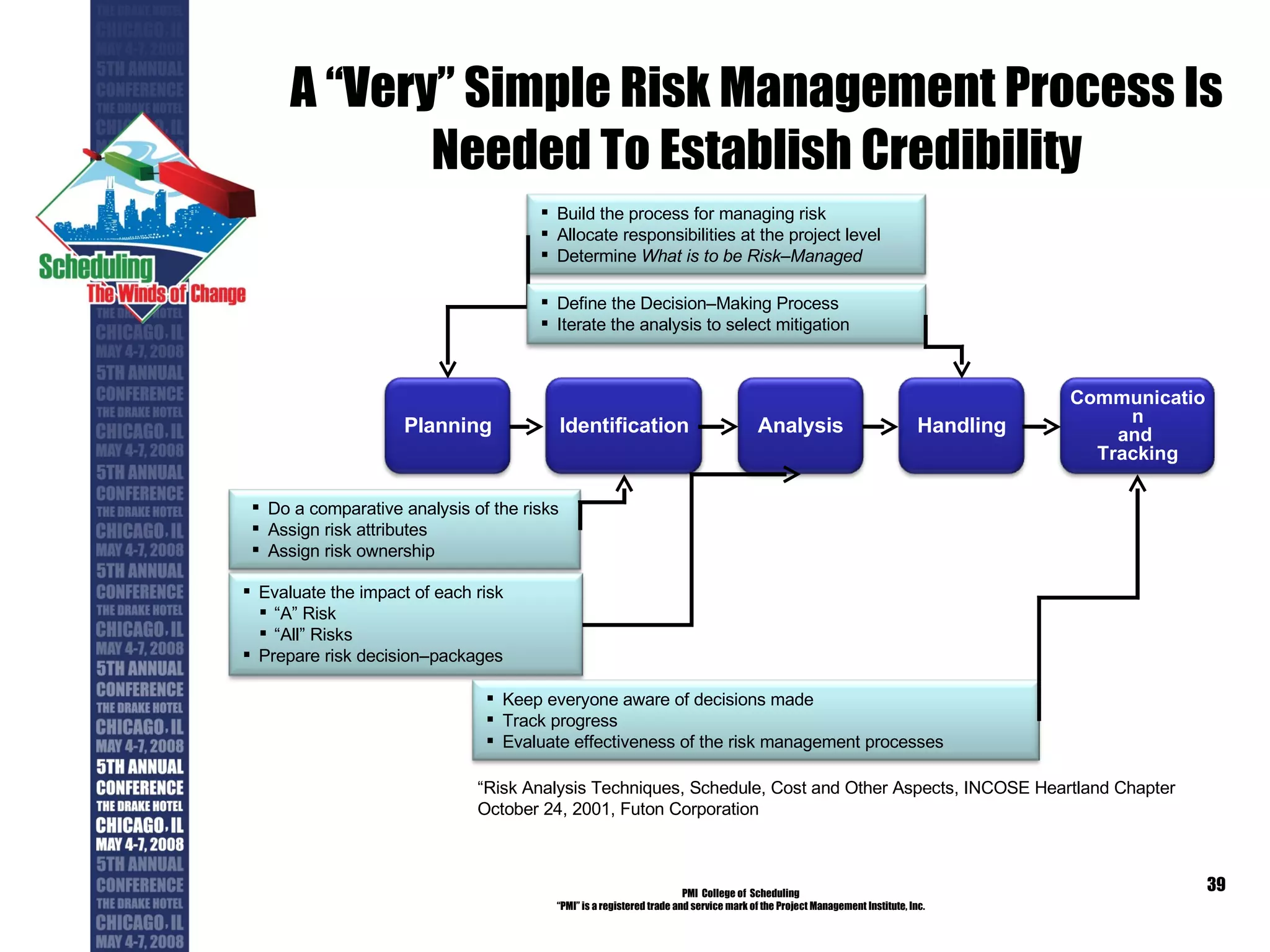
A “Very” Simple Risk Management Process Is Needed To Establish Credibility PMI  College of  Scheduling “ PMI” is a registered trade and service mark of the Project Management Institute, Inc. Planning Identification Analysis Handling Communication and  Tracking Build the process for managing risk Allocate responsibilities at the project level Determine  What is to be Risk–Managed Do a comparative analysis of the risks Assign risk attributes Assign risk ownership Evaluate the impact of each risk “ A” Risk “ All” Risks Prepare risk decision–packages Define the Decision–Making Process Iterate the analysis to select mitigation Keep everyone aware of decisions made Track progress  Evaluate effectiveness of the risk management processes “ Risk Analysis Techniques, Schedule, Cost and Other Aspects, INCOSE Heartland Chapter October 24, 2001, Futon Corporation
Integrating Cost, Schedule, And Technical Performance PMI  College of  Scheduling “ PMI” is a registered trade and service mark of the Project Management Institute, Inc. Cost, Schedule, Technical Model † WBS Task 100 Task 101 Task 102 Task 103 Task 104 Task 105 Task 106 † This is a Key concept. This is the part of the process that integrates the cost and schedule risk impacts to provide the basis of a credible schedule. Probability Density Function Research the Project Find Analogies Ask Endless Questions Analyze the Results What can go wrong? How likely is it to go wrong? What is the cause? What is the consequence? Monte Carlo Simulation Tool is Mandatory 1.0 .8 .6 .4 .2 0 Days, Facilities, Parts, People Cumulative Distribution Function Days, Facilities, Parts and People
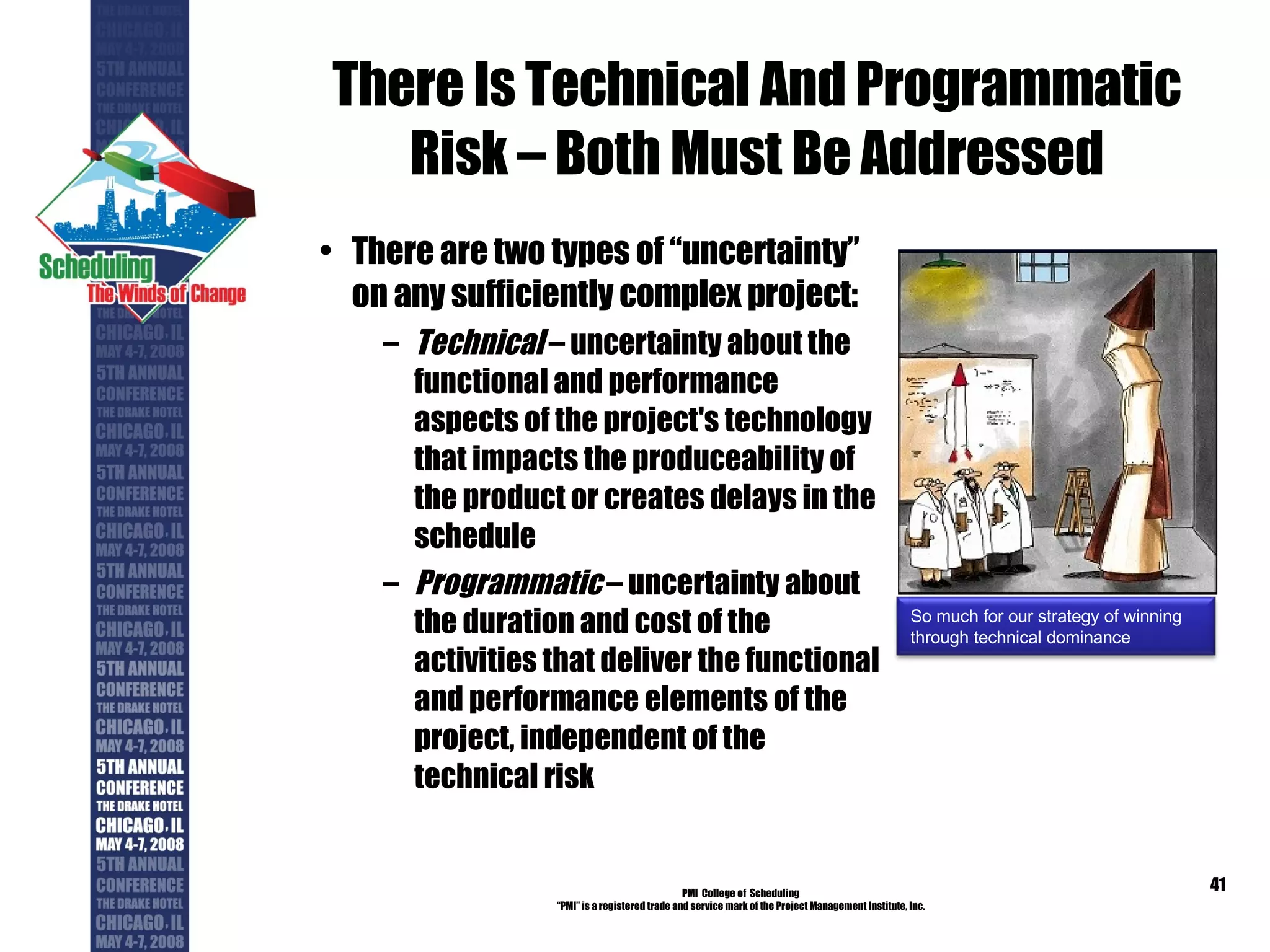
There Is Technical And Programmatic Risk – Both Must Be Addressed There are two types of “uncertainty” on any sufficiently complex project: Technical  – uncertainty about the functional and performance aspects of the project's technology that impacts the produceability of the product or creates delays in the schedule Programmatic  – uncertainty about the duration and cost of the activities that deliver the functional and performance elements of the project, independent of the technical risk PMI  College of  Scheduling “ PMI” is a registered trade and service mark of the Project Management Institute, Inc. So much for our strategy of winning through technical dominance
Wrap Up PMI  College of  Scheduling “ PMI” is a registered trade and service mark of the Project Management Institute, Inc. A good plan, violently executed now is better than a perfect plan executed next week –  General George S. Patton
In The End Its All About The Schedule A slipping schedule is simply unacceptable “ Attack” the schedule as soon as possible and never stop attacking Update schedules monthly or more frequently, look at it everyday Earned Value really works if – and this is a big if – you are ruthless about following the EV process. This can’t be said strong enough – use EV in the way it was designed to be used. Keep all the data “clean” and use it to make management decisions PMI  College of  Scheduling “ PMI” is a registered trade and service mark of the Project Management Institute, Inc.
Troubled Projects Always Have A Common Set Of Attributes Inattention to budgetary responsibilities Work authorization not always followed Budget and data reconciliation issues Lack of an integrated management system Baseline fluctuations &frequent replanning Current period and retroactive changes Improper use of management reserve Earned Value techniques not reflecting actual accomplishments Untimely and unrealistic Latest Revised Estimates (LRE) Progress not monitored in a regular and consistent manner Lack of vertical and horizontal traceability (critical path) Not capturing and using cost and schedule data for corrective action Lack of predictive variance analysis Lack of internal surveillance and controls Managerial actions not demonstrated using Earned Value PMI  College of  Scheduling “ PMI” is a registered trade and service mark of the Project Management Institute, Inc. A ship on the beach is a lighthouse to the sea – Dutch Proverb

Establishing the Performance Measurement Baseline

  • 1.
    Establishing the PerformanceMeasurement Baseline (PMB) The Performance Measurement Baseline is a time–phased schedule of all the work to be performed, the budgeted cost for this work, and the organizational elements that produce the deliverables from this work. Glen B. Alleman Vice President, Strategy and Performance Management Lewis & Fowler 8310 South Valley Highway Suite 300 Englewood, Colorado 80112 www.lewisandfowler.com [email_address]
  • 2.
    The Processes Surroundingthe Performance Measurement Baseline PMI College of Scheduling “ PMI” is a registered trade and service mark of the Project Management Institute, Inc. Identify Needed Business Capabilities Establish a Performance Measurement Baseline Execute the Performance Measurement Baseline Capabilities Based Plan Business Value Stream Earned Value Performance Technical Performance Measures Business Value Stream Technical Requirements Establish a Requirements Baseline Technical Performance Measures PMB
  • 3.
    There are 3PMBs on Every Project Technical, Schedule, and Cost Baselines are needed for success Building these requires an integrated effort PMI College of Scheduling “ PMI” is a registered trade and service mark of the Project Management Institute, Inc. Establish Cost Baseline Establish Schedule Baseline Establish Technical Baseline Perform Functional Analysis Determine Scope and Approach Develop Technical Logic Develop Technical Baseline Develop WBS Define Activities Estimate Time Durations Sequence Activities Finalize Schedule Identify Apportioned Milestones Determine Resource Requirements Prepare Cost Estimate Resource Load Schedule Finalize Apportioned Milestones Determine Funding Constraints Approve PMB
  • 4.
    The Six Stepsto Build the Performance Measurement Baseline PMI College of Scheduling “ PMI” is a registered trade and service mark of the Project Management Institute, Inc. Decompose the Project Scope into a product based Work Breakdown Structure and then into Work Packages which describe the production of all deliverables Decompose Scope Assign Responsibility for Work Packages to named owners who are accountable for the management of resource allocation and cost baseline, and technical performance Assign Responsibility Arrange the Work Packages in a well formed network with explicitly defined deliverables, milestones and internal and external dependencies Arrange Work Packages Develop Time–Phased Budget (BCWS) from labor spreads in each Work Package and balance these BCWS spreads across the Project. Develop BCWS Assign Objective Performance Measures for each Work Package and summarize these for the Project as a whole. Use the 0%/100% measurement of complete whenever possible. Assign Performance Measures Establish a Performance Measurement Baseline to be used forecasting Work Package and Project ongoing and completion metrics. Set Performance Baseline
  • 5.
    These Definitions WillHelp Clarify What We’re Talking About Deliverables Based Planning – focused on tangible outcomes Work Package – a unique collection of deliverables with resources and deliverables Performance Measurement Baseline – forecasts of future performance come from past performance Performance Based Earned Value ® – a means of measuring progress using cost, schedule and technical performance PMI College of Scheduling “ PMI” is a registered trade and service mark of the Project Management Institute, Inc.
  • 6.
    Critical Success FactorsFor The Performance Measurement Baseline Deliverables represent the required business capabilities and its value as defined by the business and shared by the development team. When all deliverables and their Work Packages are completed, they are not revisited or reopened They are 100% done The progression of Work Packages defines the increasing maturity of the project The business value of the deliverables to the customer increases as Work Packages are completed Completion of Work Packages is represented by the Physical Percent Completion of the project Either 0%/100% or Apportioned Milestones are used to state the completion of each Work Package PMI College of Scheduling “ PMI” is a registered trade and service mark of the Project Management Institute, Inc.
  • 7.
    Success Of ThePMB Depends On Identifying Measureable Results PMI College of Scheduling “ PMI” is a registered trade and service mark of the Project Management Institute, Inc. What gets measured gets done 1 If you don’t measure results, you can’t tell success from failure 2 If you can’t see success, you can’t reward it 3 If you can’t reward success, you’re probably rewarding failure 4 If you can demonstrate results, you can remain credible 7 If you can’t see success, you can’t learn from it 5 If you can’t see failure, you can’t correct it 6
  • 8.
    Decompose The ScopeInto A Proper “Tree” PMI College of Scheduling “ PMI” is a registered trade and service mark of the Project Management Institute, Inc. Business Capability Process Invoices for Top Tier Suppliers 1 st Level Electronic Invoice Submittal 1 st Level Routing to Payables Department 2 nd Level Payables Account Verification 2nd Level Payment Scheduling 2 nd Level Material receipt verification 2nd Level “ On hand” balance Updates
  • 9.
    Use This “Tree”To Decompose The Project Scope Into Work Packages The lowest level of the Work Breakdown Structure defines the Work Packages which contain named deliverables The parents of these Work Packages collect the business capabilities described in the baseline requirements The narrative of each Work Package is the WBS Dictionary PMI College of Scheduling “ PMI” is a registered trade and service mark of the Project Management Institute, Inc.
  • 10.
    What Does AGood Work Package “NOT” Look Like? PMI College of Scheduling “ PMI” is a registered trade and service mark of the Project Management Institute, Inc. What NOT to do Instead Think About It’s NOT a laundry list of work to be done It’s a decomposition of the products, services, and data generated by those It’s NOT a functional decomposition That’s the role of the Organizational Breakdown Structure (OBS) It’s NOT a direct map of the requirements Requirements produce products and services, but are not one for one with the WBS It’s NOT a reflection of the underlying product or service partitioning This is done later in the program strategy It’s NOT the first structure you might think of… Build the WBS several times, assess its usefulness in describing the products and services
  • 11.
    What Is “NOT”In A Work Package? Elements that are not products Project phases Rework, retesting, and refurbishing are not separate elements in the WBS Non–recurring and recurring are not classes of work Cost saving efforts like TQM and Lean are part of the Level of Effort Workstream Cost for meetings, travel, computer support are part of the level of effort Workstream PMI College of Scheduling “ PMI” is a registered trade and service mark of the Project Management Institute, Inc.
  • 12.
    Some Attributes OfA Good Work Package All terminal nodes describe some end item in the project – a product or a service Each physical deliverable is testable in some manner to demonstrate it is working The WBS is an increasing fidelity description of the deliverables produced by the project The WBS articulates what the customer wants in terms of deliverables – the products or services produced by the project PMI College of Scheduling “ PMI” is a registered trade and service mark of the Project Management Institute, Inc.
  • 13.
    A Deliverables FocusedWork Breakdown Structure (WBS) From the requirements Tree construct a list of Capabilities needed to satisfy the customer needs From this list of Capabilities construct a list of Deliverables that will fulfill the customer needs Arrange these deliverables into major systems This has likely already been done…so let’s have a hands on exercise to draw this out PMI College of Scheduling “ PMI” is a registered trade and service mark of the Project Management Institute, Inc.
  • 14.
    The Work BreakdownStructure Connections With The Work Packages Product or services oriented Includes all work in the project Each element logically aggregates those elements below it Reflects the manner in which the work will be done PMI College of Scheduling “ PMI” is a registered trade and service mark of the Project Management Institute, Inc. The WBS becomes the framework for Cost, Schedule, and Technical Performance Measurement. The WBS is the organizational structure for the Work Packages
  • 15.
    Connect The WBSTo Work Packages And Then Define The Tasks To Produce The Deliverables PMI College of Scheduling “ PMI” is a registered trade and service mark of the Project Management Institute, Inc. Deliverables WBS Tasks and Schedule Business Need Process Invoices for Top Tier Suppliers 1 st Level Electronic Invoice Submittal 1 st Level Routing to Payables Department 2 nd Level Payables Account Verification 2nd Level Payment Scheduling 2 nd Level Material receipt verification 2nd Level “ On hand” balance Updates Work Package 1 2 3 4 6 5 A B Deliverables defined in WP Terminal Node in the WBS defines the products or services of the project Terminal node of the WBS defined by a Work Package Tasks within the Work Package produce the Deliverables 100% Completion of deliverables is the measure of performance for the Work Package Management of the Work Package Tasks is the responsibility of the WP Manager. These are not held in the master plan A decomposition of the work needed to fulfill the business requirements
  • 16.
    Steps In BuildingThe Work Packages Step 1 – define what is going to be delivered to produce business value One or more Deliverables produced within a Work Package Step 2 – define the effort and duration along with the confidence levels Only effort and total duration Level of confidence for effort and duration PMI College of Scheduling “ PMI” is a registered trade and service mark of the Project Management Institute, Inc.
  • 17.
    Decompose Business CapabilitiesInto Deliverables, Then Work Packages, Then Measurable Outcomes PMI College of Scheduling “ PMI” is a registered trade and service mark of the Project Management Institute, Inc. Business Capabilities Capability Number 1 Capability Number 2 Deliverable Number 1.1 Deliverable Number 1.2 Deliverable Number 1.3 Deliverable Number 1.4 Work Package Number 1 Work Package Number 2 Work Package Number 3 50% Milestone 50% Milestone 100% Milestone 100% Milestone Deliverable Number 2.1 Work Package Number 4 100% Milestone Deliverable Number 2.1 Deliverable Number 2.1 Work Package Number 5 25% Milestone 75% Milestone Increasing Detail of the Planning Outcomes Increasing Value to the Customer
  • 18.
    Step 1: DefineThe Deliverables And Their Apportioned Value PMI College of Scheduling “ PMI” is a registered trade and service mark of the Project Management Institute, Inc. Description Deliverable(s) Apportioned Milestones Transaction processing integration test complete Test plan compete and approved Author – 50% Approval – 50% Define integration testing environment Integration Test Plan complete Test platform equipment defined Test environment defined Test Plan – 25% Equipment List – 50% Environment – 25% Business processes defined and approved Business process flow diagram 100% User acceptance testing defined User Acceptance Plan Developed 100% User Acceptance Testing Conducted Test environment operational User Acceptance Testing performed with 90% success UAT errors documented and allocated for repair in next release Environment – 20% UAT Conducted – 70% Errors documented – 10%
  • 19.
    Step 2: DefineThe Effort, Duration, And Confidence Intervals PMI College of Scheduling “ PMI” is a registered trade and service mark of the Project Management Institute, Inc.
  • 20.
    Baseline Contents ofa Work Package Description Assumptions Earned Value Method Basis of Estimate Predecessors and successors Strategy for delivery Completion criteria Contents of the deliverables Responsibilities Estimated duration Estimated effort Confidence intervals Resources PMI College of Scheduling “ PMI” is a registered trade and service mark of the Project Management Institute, Inc. In theory there is no difference between theory and practice. In practice there is.
  • 21.
    Use Word OrExcel, It Doesn’t Matter Just Capture The Contents In One Place PMI College of Scheduling “ PMI” is a registered trade and service mark of the Project Management Institute, Inc. No matter what form is used, the function of the Work Package must communicate to the participants the baseline information described in the Table of Contents of the previous page.
  • 22.
    Naming Work PackagesMay Seem Simple – But What’s In A Name? The name should convey not only the work activities but also the delivered result of these activities The project plan and the list of Work Packages is the concise statement of the work for the project – all held in a single place – the Project Plan PMI College of Scheduling “ PMI” is a registered trade and service mark of the Project Management Institute, Inc. Maturity Action Product Product State Adjective Verb Noun Verb Demonstrates Maturity A step in the process End Item Final Status Preliminary Design Processes Complete Preliminary design of transaction processes complete
  • 23.
    Work Package DescriptionA clear and concise description of what the Work Package produces in terms of deliverables This is your elevator pitch when someone asks “what does the Work Package you’re working on do when its all done?” Deliverables are meaning to the customer – speak in deliverables terms PMI College of Scheduling “ PMI” is a registered trade and service mark of the Project Management Institute, Inc. If you can’t tell the story between the lobby and the 9 th floor, then you haven't got a clear picture of what “done” looks like.
  • 24.
    Assumptions Make itclear (and concise) what you expect to be in place before the Work Package starts State these in terms of deliverables themselves What they are Who you’re getting them from A little bit of why you need them Have a mitigation plan when the assumption isn’t true PMI College of Scheduling “ PMI” is a registered trade and service mark of the Project Management Institute, Inc. Assumptions are repulsive, especially to gravity.
  • 25.
    Earned Value MethodThink about how you would measure 100% done. Done, done Not, almost done Not, “I’ll be done soon” If the Work Package is self contained and 100% done occurs at the end of the WP then use that If the Work Package has more than one deliverable or the deliverable has incremental functionality then Apportioned Milestones can be used PMI College of Scheduling “ PMI” is a registered trade and service mark of the Project Management Institute, Inc. Earned Value is how physical progress is measured in the Performance Measurement Baseline. Only delivered value to the customer is important.
  • 26.
    Responsibilities Each WorkPackage has one and only one person Accountable for the successful delivery of the Work Package Put that person’s name on the Work Package PMI College of Scheduling “ PMI” is a registered trade and service mark of the Project Management Institute, Inc. WBS OBS The Work Packages are where the work and the people come together
  • 27.
    Assign The ResponsibilitiesAnd Make A Single Person Accountable PMI College of Scheduling “ PMI” is a registered trade and service mark of the Project Management Institute, Inc.
  • 28.
    Arrange The WorkPackages Into A “Well Formed” Network PMI College of Scheduling “ PMI” is a registered trade and service mark of the Project Management Institute, Inc. 2 nd Level Payables Account Verification 2 nd Level Payment Scheduling 2 nd Level Material receipt verification 2 nd Level “ On hand” balance Updates
  • 29.
    A “Well Formed”Network Has Specific Attributes Arrange Work Packages in a “Finish to Start” network No Leads or Lags No Constraints – only “As Soon As Possible” (ASAP) This network of Work Packages is the flow on increasing maturity of the deliverables from the project PMI College of Scheduling “ PMI” is a registered trade and service mark of the Project Management Institute, Inc.
  • 30.
    “ Arranging” theWork Packages Is Iterative And Incremental PMI College of Scheduling “ PMI” is a registered trade and service mark of the Project Management Institute, Inc. In the example above, the Work Package Managers collectively come to an agreement on how the sequence of how the work will be performed. The result is a collective ownership of the outcome. This ownership comes from the collective development of the project plan. This process is a Product Development Kaizen (PDK)
  • 31.
    Develop A Time–PhasedBudget PMI College of Scheduling “ PMI” is a registered trade and service mark of the Project Management Institute, Inc. 2 nd Level System Payables Account Verification 2 nd Level System Payment Scheduling 2 nd Level System Material receipt verification 2 nd Level System “ On hand” balance Updates Duration of the Work Package BCWS Duration of the Work Package BCWS Duration of the Work Package BCWS Duration of the Work Package BCWS
  • 32.
    Balance All TheWork Across The Project Before Setting The Baseline PMI College of Scheduling “ PMI” is a registered trade and service mark of the Project Management Institute, Inc.
  • 33.
    Identify Objective MeasuresOf Performance For Each Work Package Define the Planned Value for each Work Package completion or apportioned milestone within a Work Package Only Physical Percent Complete should be used to measure progress – there can be no personal “opinions” of progress PMI College of Scheduling “ PMI” is a registered trade and service mark of the Project Management Institute, Inc.
  • 34.
    Set The PerformanceBaseline Baselining the Performance Measurement Baseline is the beginning of Executing the project plan Without the baseline and the change control over this baseline, the performance predictions will be difficult PMI College of Scheduling “ PMI” is a registered trade and service mark of the Project Management Institute, Inc. There are two phases of any complex project … Too early to tell and too late to stop
  • 35.
    Build The ApportionedMilestones And Assign Physical Percent Complete Identify each incremental deliverable in the Work Package Assign an apportioned value to that deliverable Document the evidentiary materials for the incremental deliverable and its assigned percentage value Identify the delivery date for the apportioned milestone in the schedule PMI College of Scheduling “ PMI” is a registered trade and service mark of the Project Management Institute, Inc. 1 mile = 1,000 (mille) paces = 1,640 yards . Introduced to Britain by the Romans The passage of a milestone meant progress to the destination. But it is critical to pre-assign value to each milestone and record this value as the milestone is passed
  • 36.
    Assemble The WorkPackages Into A Credible Schedule Start with Work Packages and their total BCWS spreads Total WP duration – in the Duration field Total WP work effort – in the Work field Start dates aligned with the project start date defined in the Project menu The result is a Gantt–style picture of the flow of WP value PMI College of Scheduling “ PMI” is a registered trade and service mark of the Project Management Institute, Inc. Henry Laurence Gantt, A.B., M.E 1861–1919
  • 37.
    Project Maturity FlowIs The Incremental Delivery Of Business Capabilities PMI College of Scheduling “ PMI” is a registered trade and service mark of the Project Management Institute, Inc. Pilot Data Enrollment Integrators Quality Monitor Internal Router External Interfaces Finance Loss Data Store Lookup Data Warehouse Data Marts Data Marts Portals and others Billing Resale's Emulations Demo conversion process, member reconciliation Shared group matrix reports and interfaces Shared member crosswalk and members to ERP Integrators in ERP converted to inventory Status and trigger conversions Data in Marts for ERP Material Master Converted from legacy External Vendors converted to ERP TBD Vendors from legacy Material converted end–to–end
  • 38.
    Analyzing And AssessingThe Network Of Work Packages Requires Understanding Critical path Accuracy Integration Realism Performance Variances Forecasting What–If Analysis Risk Resources PMI College of Scheduling “ PMI” is a registered trade and service mark of the Project Management Institute, Inc. A credible schedule cannot be just a list of activities. It must be an accurate model of the project strategy and execution that can be analyzed, assessed, and used to answer risk based questions.
  • 39.
    A “Very” SimpleRisk Management Process Is Needed To Establish Credibility PMI College of Scheduling “ PMI” is a registered trade and service mark of the Project Management Institute, Inc. Planning Identification Analysis Handling Communication and Tracking Build the process for managing risk Allocate responsibilities at the project level Determine What is to be Risk–Managed Do a comparative analysis of the risks Assign risk attributes Assign risk ownership Evaluate the impact of each risk “ A” Risk “ All” Risks Prepare risk decision–packages Define the Decision–Making Process Iterate the analysis to select mitigation Keep everyone aware of decisions made Track progress Evaluate effectiveness of the risk management processes “ Risk Analysis Techniques, Schedule, Cost and Other Aspects, INCOSE Heartland Chapter October 24, 2001, Futon Corporation
  • 40.
    Integrating Cost, Schedule,And Technical Performance PMI College of Scheduling “ PMI” is a registered trade and service mark of the Project Management Institute, Inc. Cost, Schedule, Technical Model † WBS Task 100 Task 101 Task 102 Task 103 Task 104 Task 105 Task 106 † This is a Key concept. This is the part of the process that integrates the cost and schedule risk impacts to provide the basis of a credible schedule. Probability Density Function Research the Project Find Analogies Ask Endless Questions Analyze the Results What can go wrong? How likely is it to go wrong? What is the cause? What is the consequence? Monte Carlo Simulation Tool is Mandatory 1.0 .8 .6 .4 .2 0 Days, Facilities, Parts, People Cumulative Distribution Function Days, Facilities, Parts and People
  • 41.
    There Is TechnicalAnd Programmatic Risk – Both Must Be Addressed There are two types of “uncertainty” on any sufficiently complex project: Technical – uncertainty about the functional and performance aspects of the project's technology that impacts the produceability of the product or creates delays in the schedule Programmatic – uncertainty about the duration and cost of the activities that deliver the functional and performance elements of the project, independent of the technical risk PMI College of Scheduling “ PMI” is a registered trade and service mark of the Project Management Institute, Inc. So much for our strategy of winning through technical dominance
  • 42.
    Wrap Up PMI College of Scheduling “ PMI” is a registered trade and service mark of the Project Management Institute, Inc. A good plan, violently executed now is better than a perfect plan executed next week – General George S. Patton
  • 43.
    In The EndIts All About The Schedule A slipping schedule is simply unacceptable “ Attack” the schedule as soon as possible and never stop attacking Update schedules monthly or more frequently, look at it everyday Earned Value really works if – and this is a big if – you are ruthless about following the EV process. This can’t be said strong enough – use EV in the way it was designed to be used. Keep all the data “clean” and use it to make management decisions PMI College of Scheduling “ PMI” is a registered trade and service mark of the Project Management Institute, Inc.
  • 44.
    Troubled Projects AlwaysHave A Common Set Of Attributes Inattention to budgetary responsibilities Work authorization not always followed Budget and data reconciliation issues Lack of an integrated management system Baseline fluctuations &frequent replanning Current period and retroactive changes Improper use of management reserve Earned Value techniques not reflecting actual accomplishments Untimely and unrealistic Latest Revised Estimates (LRE) Progress not monitored in a regular and consistent manner Lack of vertical and horizontal traceability (critical path) Not capturing and using cost and schedule data for corrective action Lack of predictive variance analysis Lack of internal surveillance and controls Managerial actions not demonstrated using Earned Value PMI College of Scheduling “ PMI” is a registered trade and service mark of the Project Management Institute, Inc. A ship on the beach is a lighthouse to the sea – Dutch Proverb

Editor's Notes

  • #2 Thank you for the invitation to speak today. The topic of a Performance Measurement Baseline may sound a bit arcane to some parts of the project management community. In the defense and aerospace community is contractually obligated to manage programs using the Performance Measurement Baseline. So how can we learn from experiences outside of defense and aerospace? This talk is a very quick tour of a larger problem found in all projects – “how do we know when we are done?” and “how can we tell we are actually making progress toward the ‘getting done’ part of the project?” In the 44 slides today we will cover the six steps in defining the performance measurement baseline and a description of what to do with the baseline once you have it. Our Learning Objectives today include: The development of the Performance Measurement Baseline (PMB) is a Practice based on Principles . The Principles come first, then the Practice . Without the Principles a PM might be able to produce a PMB, but with the Principles the PMB can produce a better PMB. The key to success in the Practice of PMB is to know the difference between doing something and doing something for the right reasons. The role of a Principle is to guide the development of Practice . With Principles the Practice becomes clear and can be generalized to broader situations, improved on to make the Practice better, while maintaining the core Principles.