Communication Skills 
By: 
Hashim Khan 
Roll Number: 
DDP-SP13-BEC-053
 Subtractive Manufacturing 
 Creates a product by removing sections from a 
block of material 
 Generates waste through excess material that is 
removed 
 Limited design capabilities 
 Examples 
1. Lathe 
2. CNC
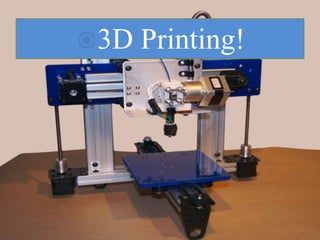
3D Printing!
 Agenda 
 Introduction 
 Applications 
 Research 
 Video Presentation
 Some Facts About 3D Printing: 
 3d printing or additive printing is a process 
that creates a product through adding 
materials layer by layer. 
 The process uses digital files (CAD files 
etc.) 
 Each of the layers can be seen as a thinly 
sliced horizontal cross-section of the 
eventual object.
Working: 
 Cad file i.e. you actually need to design 
your concept on a computer via 
appropriate software. 
 OR 
 You can scan the object using a 3D 
scanner. This will generate the cad file 
for your use by creating a 3D digital copy 
of the object. 
 Then you put this file into another 
software that slices the digital object into 
hundreds or thousands of horizontal 
layers.
When this prepared file is uploaded 
in the 3D printer, the printer creates 
the object layer by layer. The 3D 
printer reads every slice (or 2D 
image) and proceeds to create the 
object blending each layer together 
with no sign of the layering visible, 
resulting in one three dimensional 
object.
BUT!!!
 Not all 3D printers use the same technology 
to realize their objects. 
 Selective laser sintering (SLS) and fused 
deposition modeling (FDM) are the most 
common technologies using this way of 
printing. 
 Another method of printing is to lay liquid 
materials that are cured with different 
technologies. The most common technology 
using this method is called stereo lithography 
(SLA).
 Selective Laser Sintering (SLS) 
 This technology uses a high power laser to fuse small 
particles of plastic, metal, ceramic or glass powders into a 
mass that has the desired three dimensional shape. 
 Fused Deposition Modeling 
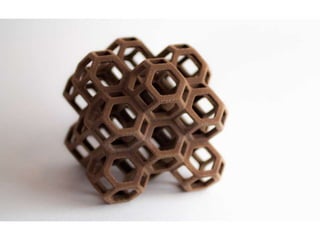
 The FDM technology works using a plastic filament or 
metal wire which is unwound from a coil and supplies 
material to an extrusion nozzle which can turn the flow on 
and off. The nozzle is heated to melt the material and can 
be moved in both horizontal and vertical directions by a 
numerically controlled mechanism, directly controlled by a 
computer-aided manufacturing (CAM) software package. 
The object is produced by extruding melted material to 
form layers as the material hardens immediately after 
extrusion from the 
nozzle.(Thermoplastics (e.g. PLA, ABS), HDPE, eutectic metals, edible 
materials, Rubber (Sugru),Modeling clay, Plasticine, RTV silicone, Porcelain, Metal 
clay (including Precious Metal Clay)
Applications 
• Prototyping/CAD 
• Architecture 
• Paleontology (Restructuring Fossils) 
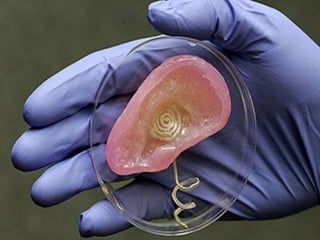
• Biotechnology 
• ETC!!!
 So, What Is The Future? 
 A lot of research is being done on this 
subject because it’s applications are 
tremendous and manifold, also no other 
method provides us such versatility with 
manufacturing as compared with 3D printing, 
actually nothing even comes close… 
 Also it is very popular with the hobbyists 
which takes it to a whole new level because 
of the market being generated for this kind of 
product both as standalone and 
derivatives…
 Research 
 Research regarding the materials being 
employed by this technique is a hot topic 
among scientists these days… 
 Let’s discuss some available commercially! 
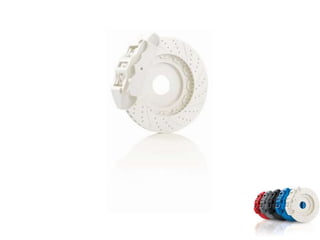
 ABS PLUS 
 It is a production grade thermo plastic that is 
used to print objects. It fuses after heating 
and thus creates an object.
 Poly Jet Photopolymers (By Stratasys) 
 Poly Jet photopolymers offer fine detail along 
with final-product realism surpassing all other 
3D printing technologies. They exhibit a 
chameleon-like ability to simulate clear, 
flexible and rigid materials and engineering 
plastics — and even combine many colors 
and material properties into one model. 
Specialty materials include Bio-compatible 
and Dental. -
 Proto Plant, announced two new materials 
for its line of exotic 3D printer filament: 
Stainless Steel PLA and Magnetic Iron PLA. 
Engineered for printability on home 3D 
printers, Proto-pasta Stainless Steel PLA can 
be polished or brushed for a brilliant metallic 
shine, or left unfinished for a cast metal 
appearance. Great for making realistic 
terminator replicas or giving prototypes an 
industrial design feel and aesthetic.
Philips brand Smit Röntgen has announced 
that it is now the first company to offer 
additive manufactured Tungsten parts. The 
medical imaging component manufacturer is 
using Powder Bed Laser Melting to create 
pure Tungsten products. The 
proprietary laser melting technology requires 
just forty-eight hours to turn a computer 
aided design file into a tangible product. Smit 
Röntgen says that the technology allows for 
the high volume production of pure Tungsten 
parts.
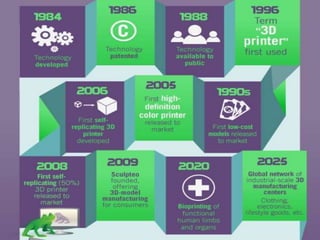
Info graphics!
Food safe glazed ceramics. 
Available in glossy and 
satin finishes, and a variety 
of colors!
Gypsum Printable with 
color textures on the 
surface. Feels like matte 
clay!
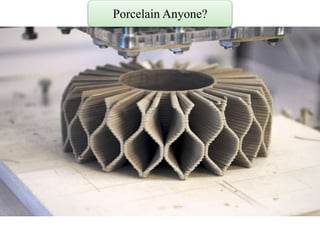
Porcelain Anyone?
May the force be with you!
• See more at: 
http://www.stratasys.com/materials#sthash.Jw 
HMH8aZ.dpuf 
• See more at: 
http://www.stratasys.com/materials#sthash.Jw 
HMH8aZ.dpuf

3 d printing

  • 1.
    Communication Skills By: Hashim Khan Roll Number: DDP-SP13-BEC-053
  • 2.
     Subtractive Manufacturing  Creates a product by removing sections from a block of material  Generates waste through excess material that is removed  Limited design capabilities  Examples 1. Lathe 2. CNC
  • 5.
  • 6.
     Agenda Introduction  Applications  Research  Video Presentation
  • 7.
     Some FactsAbout 3D Printing:  3d printing or additive printing is a process that creates a product through adding materials layer by layer.  The process uses digital files (CAD files etc.)  Each of the layers can be seen as a thinly sliced horizontal cross-section of the eventual object.
  • 8.
    Working:  Cadfile i.e. you actually need to design your concept on a computer via appropriate software.  OR  You can scan the object using a 3D scanner. This will generate the cad file for your use by creating a 3D digital copy of the object.  Then you put this file into another software that slices the digital object into hundreds or thousands of horizontal layers.
  • 9.
    When this preparedfile is uploaded in the 3D printer, the printer creates the object layer by layer. The 3D printer reads every slice (or 2D image) and proceeds to create the object blending each layer together with no sign of the layering visible, resulting in one three dimensional object.
  • 11.
  • 12.
     Not all3D printers use the same technology to realize their objects.  Selective laser sintering (SLS) and fused deposition modeling (FDM) are the most common technologies using this way of printing.  Another method of printing is to lay liquid materials that are cured with different technologies. The most common technology using this method is called stereo lithography (SLA).
  • 13.
     Selective LaserSintering (SLS)  This technology uses a high power laser to fuse small particles of plastic, metal, ceramic or glass powders into a mass that has the desired three dimensional shape.  Fused Deposition Modeling  The FDM technology works using a plastic filament or metal wire which is unwound from a coil and supplies material to an extrusion nozzle which can turn the flow on and off. The nozzle is heated to melt the material and can be moved in both horizontal and vertical directions by a numerically controlled mechanism, directly controlled by a computer-aided manufacturing (CAM) software package. The object is produced by extruding melted material to form layers as the material hardens immediately after extrusion from the nozzle.(Thermoplastics (e.g. PLA, ABS), HDPE, eutectic metals, edible materials, Rubber (Sugru),Modeling clay, Plasticine, RTV silicone, Porcelain, Metal clay (including Precious Metal Clay)
  • 14.
    Applications • Prototyping/CAD • Architecture • Paleontology (Restructuring Fossils) • Biotechnology • ETC!!!
  • 18.
     So, WhatIs The Future?  A lot of research is being done on this subject because it’s applications are tremendous and manifold, also no other method provides us such versatility with manufacturing as compared with 3D printing, actually nothing even comes close…  Also it is very popular with the hobbyists which takes it to a whole new level because of the market being generated for this kind of product both as standalone and derivatives…
  • 20.
     Research Research regarding the materials being employed by this technique is a hot topic among scientists these days…  Let’s discuss some available commercially!  ABS PLUS  It is a production grade thermo plastic that is used to print objects. It fuses after heating and thus creates an object.
  • 22.
     Poly JetPhotopolymers (By Stratasys)  Poly Jet photopolymers offer fine detail along with final-product realism surpassing all other 3D printing technologies. They exhibit a chameleon-like ability to simulate clear, flexible and rigid materials and engineering plastics — and even combine many colors and material properties into one model. Specialty materials include Bio-compatible and Dental. -
  • 23.
     Proto Plant,announced two new materials for its line of exotic 3D printer filament: Stainless Steel PLA and Magnetic Iron PLA. Engineered for printability on home 3D printers, Proto-pasta Stainless Steel PLA can be polished or brushed for a brilliant metallic shine, or left unfinished for a cast metal appearance. Great for making realistic terminator replicas or giving prototypes an industrial design feel and aesthetic.
  • 24.
    Philips brand SmitRöntgen has announced that it is now the first company to offer additive manufactured Tungsten parts. The medical imaging component manufacturer is using Powder Bed Laser Melting to create pure Tungsten products. The proprietary laser melting technology requires just forty-eight hours to turn a computer aided design file into a tangible product. Smit Röntgen says that the technology allows for the high volume production of pure Tungsten parts.
  • 25.
  • 30.
    Food safe glazedceramics. Available in glossy and satin finishes, and a variety of colors!
  • 31.
    Gypsum Printable with color textures on the surface. Feels like matte clay!
  • 32.
  • 34.
    May the forcebe with you!
  • 35.
    • See moreat: http://www.stratasys.com/materials#sthash.Jw HMH8aZ.dpuf • See more at: http://www.stratasys.com/materials#sthash.Jw HMH8aZ.dpuf