+
Reaction Kinetics (A2)
Prepared by: Faiz Abdullah
+
AS recap
In As level, you should know what is:
 Rate of reaction
 Collision theory
 Boltzmann distribution of energy
 Catalyst
 Activation Energy
 Effect of temperature, concentration and catalyst on rate of
reaction
+
For A2,
we are dealing with
DATA MANIPULATION
+
Order of Reaction
What do you mean by order?
+
Measuring rate of reactions
Usually, we are looking at HOW FAST THE CONCENTRATION
OF REACTANTS IS FALLING AT ONE TIME.
Suppose we have:
A(aq)+B(g)  Products
We can measure rate of reaction with:
-The decreasing concentration of A in mol/dm3 in 1 min.
-The decreasing volume of gas B in 1min
+
Orders of reaction
Suppose of you have: A + B  products
From the experiment: you found out that….
When [A] doubles, rate doubles.
Rate of reaction is proportional to [A]
Therefore, order with respect to A is 1
When [A] doubles, rate increases four times
Rate of reaction is proportional to [A]2
Therefore, order of reaction w.r.t. A is 2
When [A] doubles, rate of reaction does not change
Rate of reaction does not depend on [A]
Therefore, order w.r.t A is 0
WARNING:
YOU CANNOT DEDUCE THE ORDER OF
REACTION JUST BY LOOKING AT THE
EQUATION!!!!
ORDERS OF REACTIONS ARE ALWAYS FOUND
BY DOING EXPERIMENTS
+
Rate equation
Suppose A + 2B + C  products
From experiments, we found out that:
[A] doubles, rate of reaction doubles
Therefore, order w.r.t A is 1
[B] doubles, rate of reaction increases
by 4
Therefore, order w.r.t B is 2
[C] doubles, rate of reaction does not change
Therefore, order w.r.t C is 0
Rate Equation:
Rate = k [A] [B]2
Where k is rate constant
+
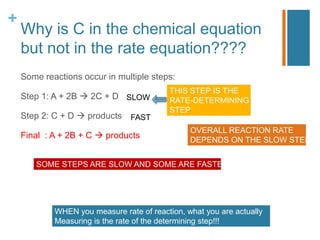
Why is C in the chemical equation
but not in the rate equation????
Some reactions occur in multiple steps:
Step 1: A + 2B  2C + D
Step 2: C + D  products
Final : A + 2B + C  products
SOME STEPS ARE SLOW AND SOME ARE FASTER
SLOW
FAST
THIS STEP IS THE
RATE-DETERMINING
STEP
OVERALL REACTION RATE
DEPENDS ON THE SLOW STEP
WHEN you measure rate of reaction, what you are actually
Measuring is the rate of the determining step!!!
+
Rate constant, k
Rate = k [A] [B]
Rate constant is constant (does not change value) only when
concentrations of reactants are changing.
RATE CONSTANT CHANGES WHEN:
1. TEMPERATURE CHANGES
2. ADDING CATALYST
+
DEDUCING ORDER BY INTIAL
RATES METHOD
Run Initial [A]/mol Initial [B]/mol Initial rate/mols-1
1 1.00 1.00 1.25 x 10⁻²
2 1.00 2.00 2.5 x 10⁻²
3 2.00 2.00 2.5 x 10⁻²
Can you find the rate equation? Can you find k?
Make [A] constant,
[B] x 2, rate x 2
Order w.r.t B is 1
Make [B] constant,
[A] x 2, rate same
Order w.r.t A is 0
Rate = k [B]
k=1.25 x 10⁻² s-1
+
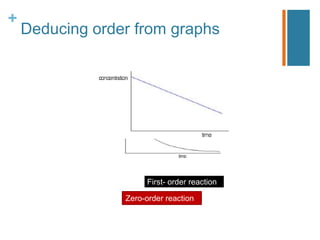
Deducing order from graphs
First- order reaction
Zero-order reaction
+
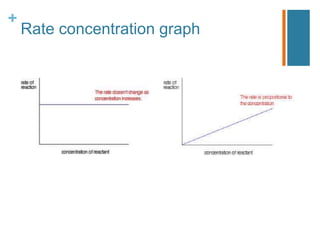
Rate concentration graph
+
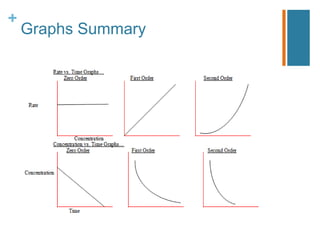
Graphs Summary
+
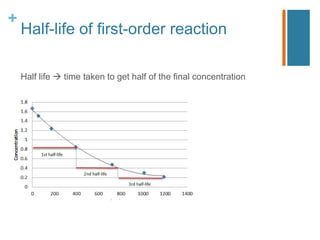
Half-life of first-order reaction
Half life  time taken to get half of the final concentration
+
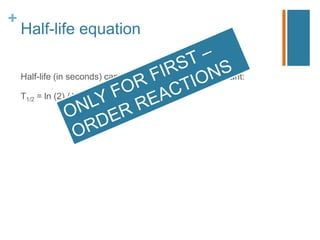
Half-life equation
Half-life (in seconds) can be used to find k, rate constant:
T1/2 = ln (2) / k
+
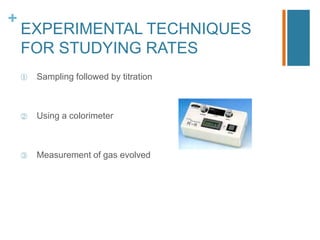
EXPERIMENTAL TECHNIQUES
FOR STUDYING RATES
① Sampling followed by titration
② Using a colorimeter
③ Measurement of gas evolved
+
CATALYST
① Homogenous: catalyst same phase as the reactants
② Heterogeneous: catalyst and reactants different phases
+
CATALYSIS
In AS, you need to know FOUR SPECIFIC EXAMPLES
+
1) HABER PROCESS
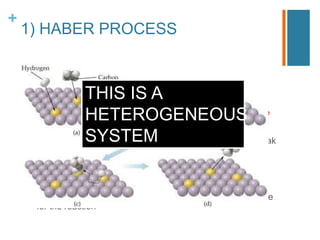
N2 + 3H2  2NH3
Catalyst: Iron
Note: Transition metals are good at acting as catalysts because
their atoms have unfilled d-orbitals.
Gases are adsorbed on to the surface of the metal, forming weak
bonds.
① Formation of bonds with the metal surface weakens the
bonds within the gas molecules
② The orientation of the adsorbed molecules may be favorable
for the reaction
THIS IS A
HETEROGENEOUS
SYSTEM
+
2) Catalytic converters in vehicle
exhausts
+
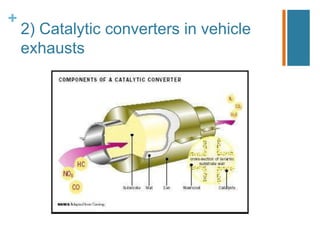
 Catalytic converters in vehicle exhausts aim to remove a
number of pollutant gases from vehicle exhausts.
 Pollutants: Nitrogen oxides, carbon monoxides.
 Inside the ceramic honeycomb, it has a very thin coat of:
o Platinum and palladium: oxidize CO and unburnt hydrocarbons
o Platinum and rhodium: reduce NOx to N2
+
3) Nitrogen oxides in the
atmosphere
 Studies on acid rain have concluded that in the atmosphere the
presence of oxides of nitrogen, particularly NO2, increases rate
of oxidation of SO2  SO3.
 NO2 remains unchanged and is thought to form a weak
intermediate with SO2.
+
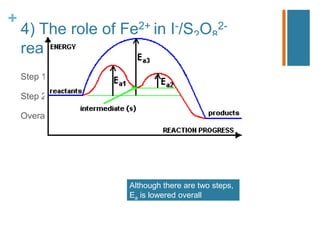
4) The role of Fe2+ in I-/S2O8
2-
reaction
Step 1: S2O8
2- + 2Fe2+  2 SO4
2- + 2Fe3+
Step 2: 2Fe3+ + 2I-  2Fe2+ + I2
Overall reaction: S2O8
2- + 2I-  2Fe2+ + I2
Fe2+ does not change overall
Although there are two steps,
Ea is lowered overall

Chemical kinetics

  • 1.
  • 2.
    + AS recap In Aslevel, you should know what is:  Rate of reaction  Collision theory  Boltzmann distribution of energy  Catalyst  Activation Energy  Effect of temperature, concentration and catalyst on rate of reaction
  • 3.
    + For A2, we aredealing with DATA MANIPULATION
  • 4.
    + Order of Reaction Whatdo you mean by order?
  • 5.
    + Measuring rate ofreactions Usually, we are looking at HOW FAST THE CONCENTRATION OF REACTANTS IS FALLING AT ONE TIME. Suppose we have: A(aq)+B(g)  Products We can measure rate of reaction with: -The decreasing concentration of A in mol/dm3 in 1 min. -The decreasing volume of gas B in 1min
  • 6.
    + Orders of reaction Supposeof you have: A + B  products From the experiment: you found out that…. When [A] doubles, rate doubles. Rate of reaction is proportional to [A] Therefore, order with respect to A is 1 When [A] doubles, rate increases four times Rate of reaction is proportional to [A]2 Therefore, order of reaction w.r.t. A is 2 When [A] doubles, rate of reaction does not change Rate of reaction does not depend on [A] Therefore, order w.r.t A is 0 WARNING: YOU CANNOT DEDUCE THE ORDER OF REACTION JUST BY LOOKING AT THE EQUATION!!!! ORDERS OF REACTIONS ARE ALWAYS FOUND BY DOING EXPERIMENTS
  • 7.
    + Rate equation Suppose A+ 2B + C  products From experiments, we found out that: [A] doubles, rate of reaction doubles Therefore, order w.r.t A is 1 [B] doubles, rate of reaction increases by 4 Therefore, order w.r.t B is 2 [C] doubles, rate of reaction does not change Therefore, order w.r.t C is 0 Rate Equation: Rate = k [A] [B]2 Where k is rate constant
  • 8.
    + Why is Cin the chemical equation but not in the rate equation???? Some reactions occur in multiple steps: Step 1: A + 2B  2C + D Step 2: C + D  products Final : A + 2B + C  products SOME STEPS ARE SLOW AND SOME ARE FASTER SLOW FAST THIS STEP IS THE RATE-DETERMINING STEP OVERALL REACTION RATE DEPENDS ON THE SLOW STEP WHEN you measure rate of reaction, what you are actually Measuring is the rate of the determining step!!!
  • 9.
    + Rate constant, k Rate= k [A] [B] Rate constant is constant (does not change value) only when concentrations of reactants are changing. RATE CONSTANT CHANGES WHEN: 1. TEMPERATURE CHANGES 2. ADDING CATALYST
  • 10.
    + DEDUCING ORDER BYINTIAL RATES METHOD Run Initial [A]/mol Initial [B]/mol Initial rate/mols-1 1 1.00 1.00 1.25 x 10⁻² 2 1.00 2.00 2.5 x 10⁻² 3 2.00 2.00 2.5 x 10⁻² Can you find the rate equation? Can you find k? Make [A] constant, [B] x 2, rate x 2 Order w.r.t B is 1 Make [B] constant, [A] x 2, rate same Order w.r.t A is 0 Rate = k [B] k=1.25 x 10⁻² s-1
  • 11.
    + Deducing order fromgraphs First- order reaction Zero-order reaction
  • 12.
  • 13.
  • 14.
    + Half-life of first-orderreaction Half life  time taken to get half of the final concentration
  • 15.
    + Half-life equation Half-life (inseconds) can be used to find k, rate constant: T1/2 = ln (2) / k
  • 16.
    + EXPERIMENTAL TECHNIQUES FOR STUDYINGRATES ① Sampling followed by titration ② Using a colorimeter ③ Measurement of gas evolved
  • 17.
    + CATALYST ① Homogenous: catalystsame phase as the reactants ② Heterogeneous: catalyst and reactants different phases
  • 18.
    + CATALYSIS In AS, youneed to know FOUR SPECIFIC EXAMPLES
  • 19.
    + 1) HABER PROCESS N2+ 3H2  2NH3 Catalyst: Iron Note: Transition metals are good at acting as catalysts because their atoms have unfilled d-orbitals. Gases are adsorbed on to the surface of the metal, forming weak bonds. ① Formation of bonds with the metal surface weakens the bonds within the gas molecules ② The orientation of the adsorbed molecules may be favorable for the reaction THIS IS A HETEROGENEOUS SYSTEM
  • 20.
    + 2) Catalytic convertersin vehicle exhausts
  • 21.
    +  Catalytic convertersin vehicle exhausts aim to remove a number of pollutant gases from vehicle exhausts.  Pollutants: Nitrogen oxides, carbon monoxides.  Inside the ceramic honeycomb, it has a very thin coat of: o Platinum and palladium: oxidize CO and unburnt hydrocarbons o Platinum and rhodium: reduce NOx to N2
  • 22.
    + 3) Nitrogen oxidesin the atmosphere  Studies on acid rain have concluded that in the atmosphere the presence of oxides of nitrogen, particularly NO2, increases rate of oxidation of SO2  SO3.  NO2 remains unchanged and is thought to form a weak intermediate with SO2.
  • 23.
    + 4) The roleof Fe2+ in I-/S2O8 2- reaction Step 1: S2O8 2- + 2Fe2+  2 SO4 2- + 2Fe3+ Step 2: 2Fe3+ + 2I-  2Fe2+ + I2 Overall reaction: S2O8 2- + 2I-  2Fe2+ + I2 Fe2+ does not change overall Although there are two steps, Ea is lowered overall