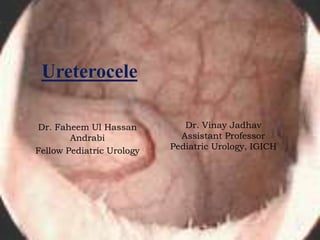
Ureterocele
Dr. Faheem Ul Hassan
Andrabi
Fellow Pediatric Urology
Dr. Vinay Jadhav
Assistant Professor
Pediatric Urology, IGICH
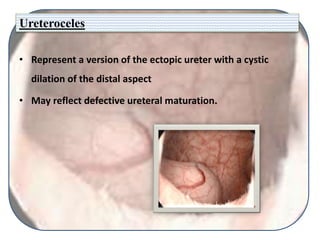
Ureteroceles
• Represent a version of the ectopic ureter with a cystic
dilation of the distal aspect
• May reflect defective ureteral maturation.
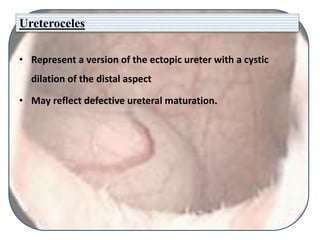
Ureteroceles
• Represent a version of the ectopic ureter with a cystic
dilation of the distal aspect
• May reflect defective ureteral maturation.
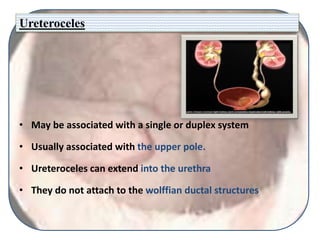
Ureteroceles
• May be associated with a single or duplex system
• Usually associated with the upper pole.
• Ureteroceles can extend into the urethra
• They do not attach to the wolffian ductal structures
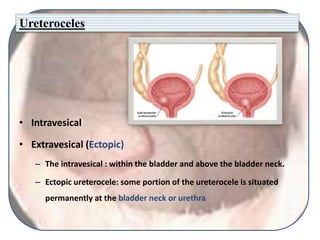
Ureteroceles
• Intravesical
• Extravesical (Ectopic)
– The intravesical : within the bladder and above the bladder neck.
– Ectopic ureterocele: some portion of the ureterocele is situated
permanently at the bladder neck or urethra
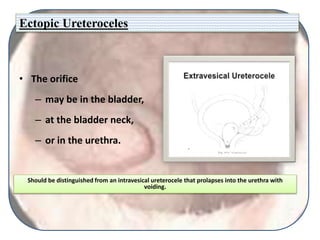
Ectopic Ureteroceles
• The orifice
– may be in the bladder,
– at the bladder neck,
– or in the urethra.
Should be distinguished from an intravesical ureterocele that prolapses into the urethra with
voiding.
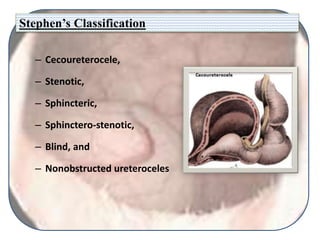
Stephen’s Classification
– Cecoureterocele,
– Stenotic,
– Sphincteric,
– Sphinctero-stenotic,
– Blind, and
– Nonobstructed ureteroceles
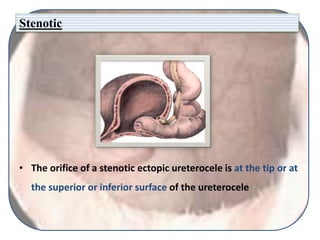
Stenotic
• The orifice of a stenotic ectopic ureterocele is at the tip or at
the superior or inferior surface of the ureterocele
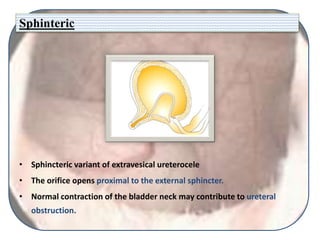
Sphinteric
• Sphincteric variant of extravesical ureterocele
• The orifice opens proximal to the external sphincter.
• Normal contraction of the bladder neck may contribute to ureteral
obstruction.
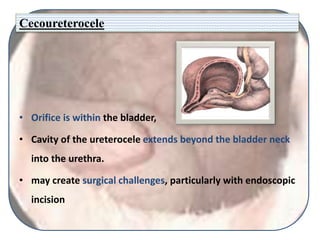
Cecoureterocele
• Orifice is within the bladder,
• Cavity of the ureterocele extends beyond the bladder neck
into the urethra.
• may create surgical challenges, particularly with endoscopic
incision
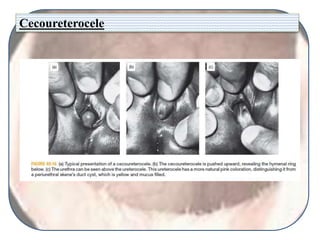
Cecoureterocele
Ureterocele disproportion
• “Nonobstructive” ureterocele with duplication
• diagnostically challenging variant
• Missed by imaging (USG: non-dilating ureter)
• Picked by Cystoscopy
The affected upper pole is typically dysplastic to such a
degree that it is not readily detected on most imaging.
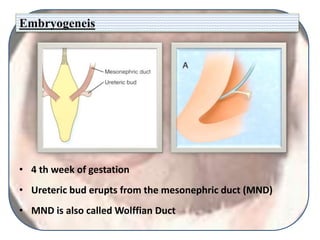
Embryogeneis
• 4 th week of gestation
• Ureteric bud erupts from the mesonephric duct (MND)
• MND is also called Wolffian Duct
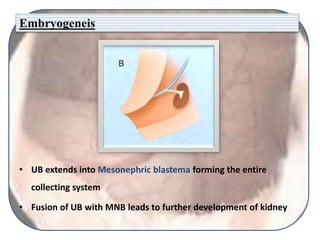
Embryogeneis
• UB extends into Mesonephric blastema forming the entire
collecting system
• Fusion of UB with MNB leads to further development of kidney
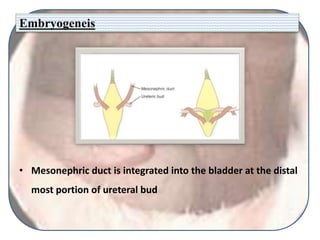
Embryogeneis
• Mesonephric duct is integrated into the bladder at the distal
most portion of ureteral bud
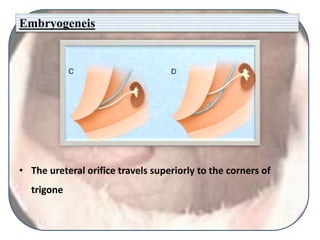
Embryogeneis
• The ureteral orifice travels superiorly to the corners of
trigone
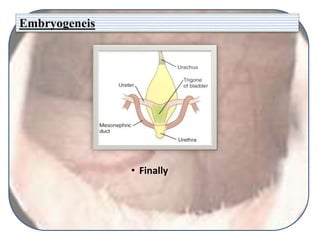
Embryogeneis
• Finally
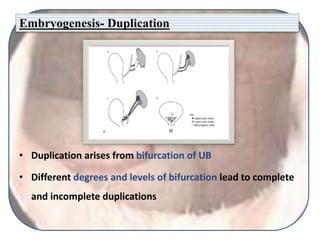
Embryogenesis- Duplication
• Duplication arises from bifurcation of UB
• Different degrees and levels of bifurcation lead to complete
and incomplete duplications
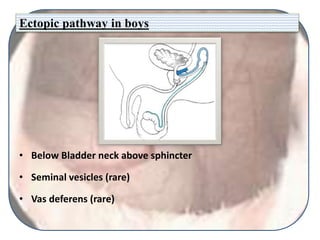
Ectopic pathway in boys
• Below Bladder neck above sphincter
• Seminal vesicles (rare)
• Vas deferens (rare)
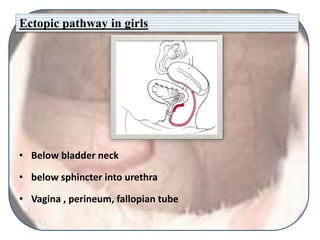
Ectopic pathway in girls
• Below bladder neck
• below sphincter into urethra
• Vagina , perineum, fallopian tube
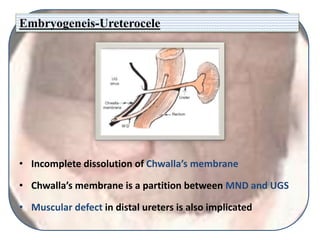
Embryogeneis-Ureterocele
• Incomplete dissolution of Chwalla’s membrane
• Chwalla’s membrane is a partition between MND and UGS
• Muscular defect in distal ureters is also implicated
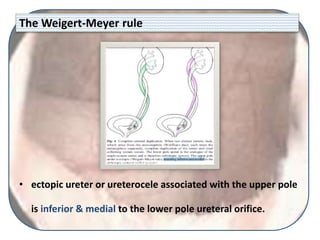
The Weigert-Meyer rule
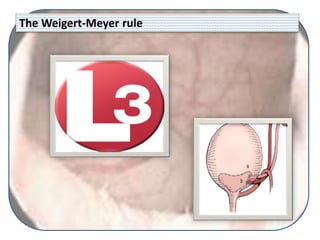
• ectopic ureter or ureterocele associated with the upper pole
is inferior & medial to the lower pole ureteral orifice.
The Weigert-Meyer rule
Epidemiology
• Ureteroceles- 1 per 5000-12000 population;
• 10% bilateral
• 60-80% ectopic,
• 80% associated with upper moiety
• More common in females.
• More common in whites.
Clinical presentation
• Antenatally detected
• Incidental
• Infection
• Incontinence
• Pain
Antenatal USG
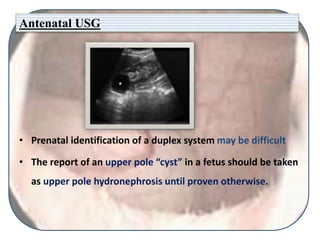
• Prenatal identification of a duplex system may be difficult
• The report of an upper pole “cyst” in a fetus should be taken
as upper pole hydronephrosis until proven otherwise.
Ureteroceles
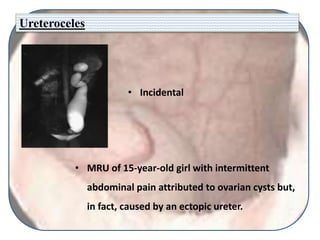
• MRU of 15-year-old girl with intermittent
abdominal pain attributed to ovarian cysts but,
in fact, caused by an ectopic ureter.
• Incidental
Infection
• 8% of childhood UTI are due to duplication
• UTI presents at any age and have a highly variable pattern.
• USG should be obtained in all children with urosepsis.
• clinical response to antibiotic therapy will determine the timing of
intervention
Infection
in ectopic ureter
• Parents may describe a purulent discharge from the
perineum.
• Infection is rare , but it is associated when there is
incontinence.
• Boys may present with epididymitis
Incontinence
• Due to an ectopic ureter in a girl but not in a boy.
• Can occur in untreated ureteroceles
• Incontinence occurs throughout the day without dry interval
• It is difficult to detect before toilet training
Pain
• acute infection,
• episodic obstruction.
• Oder children may have abdominal pain followed by
perineal drainage of urine or purulent material.
Physical examination
• an extravesical ureterocele represents the
most common cause of bladder outlet
obstruction in newborn girls and the second
most common cause in boys, after posterior
urethral valves (PUVs).
Physical exam
In severe cases,
• an abdominal mass becomes palpable
• BOO may be caused by
– an ectopic ureter inserting at veru ( by compressing
bladder neck)
– Cecoureterocele
Ureteroceles
• Ureteral ectopia should be suspected in any infant or child
who presents with a culture-proven case of epididymo-
orchitis.
Physical examination
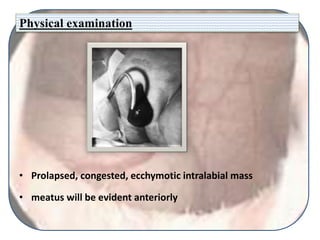
• Prolapsed, congested, ecchymotic intralabial mass
• meatus will be evident anteriorly
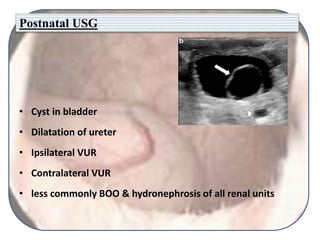
Postnatal USG
• Cyst in bladder
• Dilatation of ureter
• Ipsilateral VUR
• Contralateral VUR
• less commonly BOO & hydronephrosis of all renal units
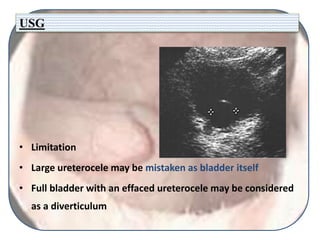
USG
• Limitation
• Large ureterocele may be mistaken as bladder itself
• Full bladder with an effaced ureterocele may be considered
as a diverticulum
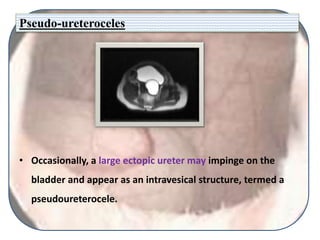
Pseudo-ureteroceles
• Occasionally, a large ectopic ureter may impinge on the
bladder and appear as an intravesical structure, termed a
pseudoureterocele.
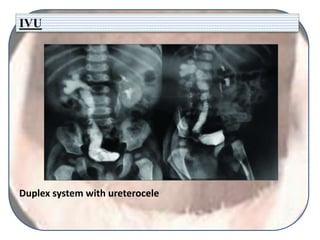
IVU
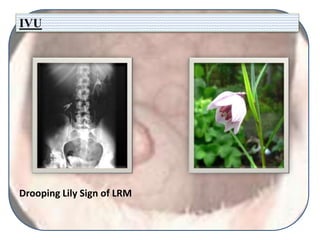
Drooping Lily Sign of LRM
IVU
Duplex system with ureterocele
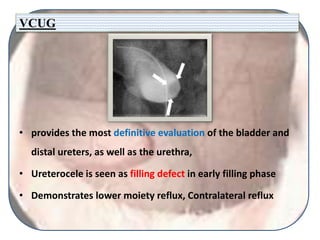
VCUG
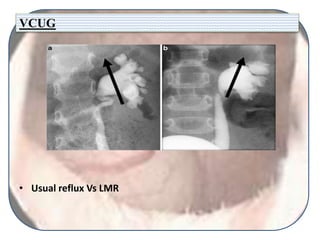
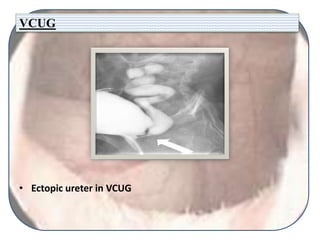
• provides the most definitive evaluation of the bladder and
distal ureters, as well as the urethra,
• Ureterocele is seen as filling defect in early filling phase
• Demonstrates lower moiety reflux, Contralateral reflux
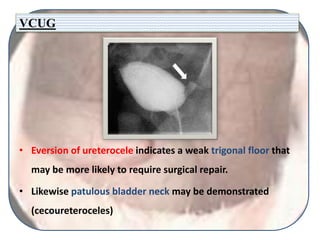
VCUG
• Eversion of ureterocele indicates a weak trigonal floor that
may be more likely to require surgical repair.
• Likewise patulous bladder neck may be demonstrated
(cecoureteroceles)
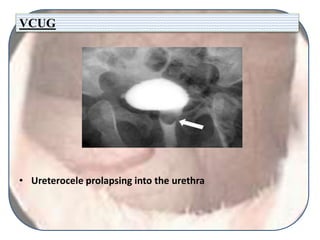
VCUG
• Ureterocele prolapsing into the urethra
VCUG
• Usual reflux Vs LMR
VCUG
• Ectopic ureter in VCUG
Nuclear Imaging
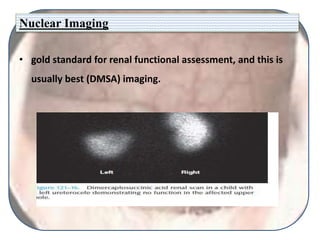
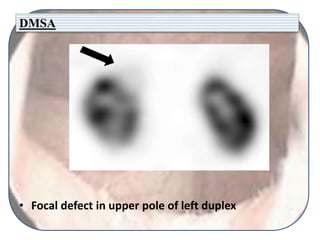
• gold standard for renal functional assessment, and this is
usually best (DMSA) imaging.
DMSA
• Focal defect in upper pole of left duplex
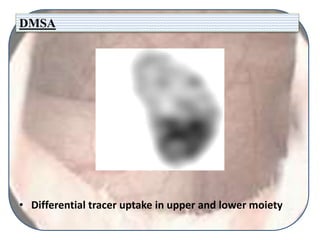
DMSA
• Differential tracer uptake in upper and lower moiety
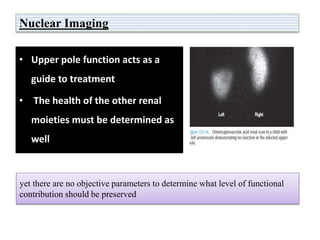
Nuclear Imaging
• Upper pole function acts as a
guide to treatment
• The health of the other renal
moieties must be determined as
well
yet there are no objective parameters to determine what level of functional
contribution should be preserved
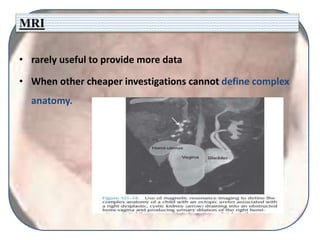
MRI
• rarely useful to provide more data
• When other cheaper investigations cannot define complex
anatomy.
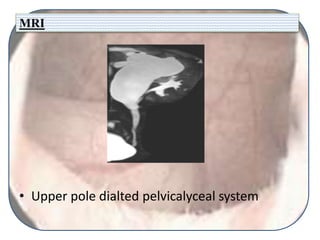
MRI
• Upper pole dialted pelvicalyceal system
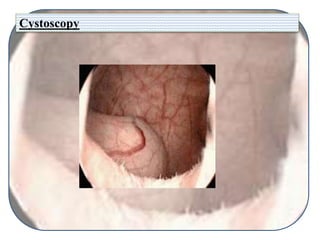
Cystoscopy
Assess character of urethra, bladder neck and trigone
Location of other ureteral orifices should be documented.
Orifice is best seen when we start filling bladder slowly as the ureterocele will flatten later
Urethra is examined carefully for orifice if not seen in bladder.
Ureterocoeles are better seen in early fills
Lowest portion – best site for incision.
Cystoscopy
Reflux
Reflux of ipsilateral lower pole – 50%.
Contralateral reflux in 25% of cases, and
Reflux into ureterocele in 10% of cases.
In an ectopic ureter, ipsilateral lower pole reflux is unlikely
to resolve spontaneously.
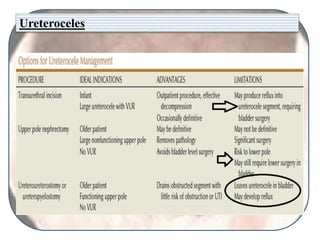
Management
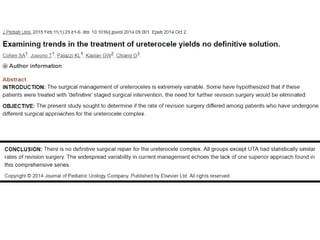
• No Consensus about management
• Treatment tailored to individual patient
Management goals:
• Preservation of renal function;
• Elimination of infection, obstruction, and reflux;
• Maintenance of urinary continence; and
• Minimizing surgical morbidity.
• Early institution of prophylactic antibiotics…… Partial
agreement
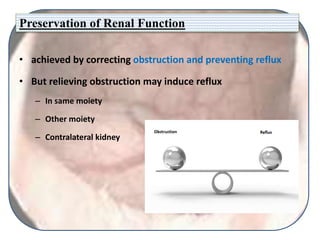
Preservation of Renal Function
• achieved by correcting obstruction and preventing reflux
• But relieving obstruction may induce reflux
– In same moiety
– Other moiety
– Contralateral kidney
Acute decompression
• Indications:
• Ureterocele producing BOO or severe B/L upper tract
obstruction.
• Severe urosepsis.
• Sepsis not responding to appropriate therapy.
• Methods
• For ureterocele- Transurethral Incision (TUI).
• For ectopic ureters- end ureterostomy near bladder.
Definitive surgical options
• For Ectopic ureter
– common sheath reimplantation or
– Uretero-ureterostomy,.
• For Ureterocele-
– TUI,
– Partial nephrouretectomy
– ureterocele excision and common sheath reimplantation or
– Ureteroureterostomy/ Ureteropyelostomy.
Observational management
In patients with
– No obstruction of ipsilateral lower pole or contralateral
kidney
– Limited reflux to lower pole (grade III or less),
– No function of upper pole, or
– No obstruction on diuretic renography.
• Coplen and Austin (2004)
Total reconstruction
• Constitutes:
– Upper pole nephrectomy
– ureterocele excision
– reimplantation of lower
pole ureter
– And Bladder reconstruction
– extensive operation
performed with two
incisions.
• Ideal candidate:
– older child with a
– Massive ureterocele and
– no function of an upper
pole
– significant lower pole
reflux.
– Laparoscopic + pfannsteil
nowadays.
Complications of upper polar nephrectomy:
• It is a technically demanding procedure
• Loss of lower pole function due to injury to vessels.
• Postoperative urinoma
• IVC laceration,
• Duodenal perforation,
• Peritoneal tears.
• Renal tubular acidosis use mannitol.
Surgical management of the refluxing ureteral stump.
• It is difficult to completely separate the distal 2 to 3 cm of
upper pole ureter from lower pole ureter.
• Resect as much as possible safely.
• Complete separation of ureters is discouraged
• Lower ureteric stump may be left there.
• Refluxing stump may be treated by deflux
Ureterocele Excision and Common-Sheath Reimplantation
• Ureters are mobilized and re-implanted together after
ureterocele excision
• The detrusor muscle is plicated if it is attenuated
• Sphincter injury (ureterocele extending beyond the neck)
should be prevented
• Separation of the duplicated ureters during intravesical dissection should be
discouraged (vascular injury)
Ureterocele Excision and Common-Sheath Reimplantation
• Reported results of ureterocele excision and common sheath
reimplantation are good
• persisting reflux can be an issue in 5% to 10% of cases.
• An alternative approach to ureterocele resection is that of
marsupialization.
Lower tract reconstruction:
• Advantage: Relieves obstruction as well as corrects reflux.
• Disadvantages: potential for injury to bladder neck
• If clinically significant reflux persists after other procedures,
lower tract reconstruction may be necessary.
Pyeloureterostomy & ureteroureterostomy
• When upper moiety is preserved
• Anastomosis between upper pole ureter & lower pole ureter
in an end-to-side fashion. .
• proximal anastomoses preferable to a distal
• (yo-yo reflux)
Transurethral incision (TUI)
• Transverse incision through full thickness close to the bladder
floor as possible.
• urine-jet or inner urothelium, confirms adequacy.
• Ectopic ureterocele: Longitudinal incision from intravesical
into urethral portion, or two incisions.
Follow-up
• Follow-up USG after 4-6 weeks to assess degree of
decompression.
• VCUG at 2-3 months to (status of LMR)
• Risk of reoperation high with extravesical ureterocele &
LMR (persisting or new).
Follow-up
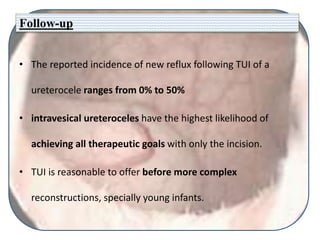
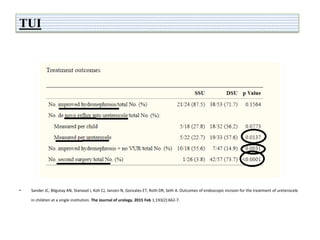
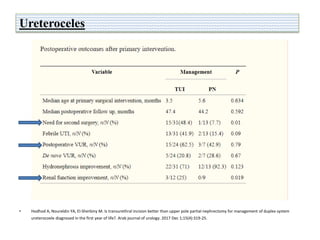
• The reported incidence of new reflux following TUI of a
ureterocele ranges from 0% to 50%
• intravesical ureteroceles have the highest likelihood of
achieving all therapeutic goals with only the incision.
• TUI is reasonable to offer before more complex
reconstructions, specially young infants.
Ureteroceles
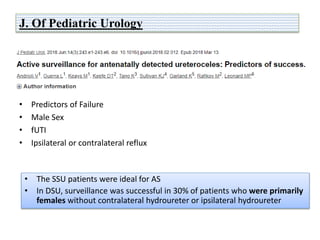
J. Of Pediatric Urology
• Predictors of Failure
• Male Sex
• fUTI
• Ipsilateral or contralateral reflux
• The SSU patients were ideal for AS
• In DSU, surveillance was successful in 30% of patients who were primarily
females without contralateral hydroureter or ipsilateral hydroureter
TUI
• Sander JC, Bilgutay AN, Stanasel I, Koh CJ, Janzen N, Gonzales ET, Roth DR, Seth A. Outcomes of endoscopic incision for the treatment of ureterocele
in children at a single institution. The Journal of urology. 2015 Feb 1;193(2):662-7.
Ureteroceles
• Hodhod A, Noureldin YA, El-Sherbiny M. Is transurethral incision better than upper pole partial nephrectomy for management of duplex system
ureterocoele diagnosed in the first year of life?. Arab journal of urology. 2017 Dec 1;15(4):319-25.
Thank youdrfaheemandrabi@gmail.com

Ureterocele,

  • 1.
    Ureterocele Dr. Faheem UlHassan Andrabi Fellow Pediatric Urology Dr. Vinay Jadhav Assistant Professor Pediatric Urology, IGICH
  • 2.
    Ureteroceles • Represent aversion of the ectopic ureter with a cystic dilation of the distal aspect • May reflect defective ureteral maturation.
  • 3.
    Ureteroceles • Represent aversion of the ectopic ureter with a cystic dilation of the distal aspect • May reflect defective ureteral maturation.
  • 4.
    Ureteroceles • May beassociated with a single or duplex system • Usually associated with the upper pole. • Ureteroceles can extend into the urethra • They do not attach to the wolffian ductal structures
  • 5.
    Ureteroceles • Intravesical • Extravesical(Ectopic) – The intravesical : within the bladder and above the bladder neck. – Ectopic ureterocele: some portion of the ureterocele is situated permanently at the bladder neck or urethra
  • 6.
    Ectopic Ureteroceles • Theorifice – may be in the bladder, – at the bladder neck, – or in the urethra. Should be distinguished from an intravesical ureterocele that prolapses into the urethra with voiding.
  • 7.
    Stephen’s Classification – Cecoureterocele, –Stenotic, – Sphincteric, – Sphinctero-stenotic, – Blind, and – Nonobstructed ureteroceles
  • 8.
    Stenotic • The orificeof a stenotic ectopic ureterocele is at the tip or at the superior or inferior surface of the ureterocele
  • 9.
    Sphinteric • Sphincteric variantof extravesical ureterocele • The orifice opens proximal to the external sphincter. • Normal contraction of the bladder neck may contribute to ureteral obstruction.
  • 10.
    Cecoureterocele • Orifice iswithin the bladder, • Cavity of the ureterocele extends beyond the bladder neck into the urethra. • may create surgical challenges, particularly with endoscopic incision
  • 11.
  • 12.
    Ureterocele disproportion • “Nonobstructive”ureterocele with duplication • diagnostically challenging variant • Missed by imaging (USG: non-dilating ureter) • Picked by Cystoscopy The affected upper pole is typically dysplastic to such a degree that it is not readily detected on most imaging.
  • 13.
    Embryogeneis • 4 thweek of gestation • Ureteric bud erupts from the mesonephric duct (MND) • MND is also called Wolffian Duct
  • 14.
    Embryogeneis • UB extendsinto Mesonephric blastema forming the entire collecting system • Fusion of UB with MNB leads to further development of kidney
  • 15.
    Embryogeneis • Mesonephric ductis integrated into the bladder at the distal most portion of ureteral bud
  • 16.
    Embryogeneis • The ureteralorifice travels superiorly to the corners of trigone
  • 17.
  • 18.
    Embryogenesis- Duplication • Duplicationarises from bifurcation of UB • Different degrees and levels of bifurcation lead to complete and incomplete duplications
  • 19.
    Ectopic pathway inboys • Below Bladder neck above sphincter • Seminal vesicles (rare) • Vas deferens (rare)
  • 20.
    Ectopic pathway ingirls • Below bladder neck • below sphincter into urethra • Vagina , perineum, fallopian tube
  • 21.
    Embryogeneis-Ureterocele • Incomplete dissolutionof Chwalla’s membrane • Chwalla’s membrane is a partition between MND and UGS • Muscular defect in distal ureters is also implicated
  • 22.
    The Weigert-Meyer rule •ectopic ureter or ureterocele associated with the upper pole is inferior & medial to the lower pole ureteral orifice.
  • 23.
  • 24.
    Epidemiology • Ureteroceles- 1per 5000-12000 population; • 10% bilateral • 60-80% ectopic, • 80% associated with upper moiety • More common in females. • More common in whites.
  • 25.
    Clinical presentation • Antenatallydetected • Incidental • Infection • Incontinence • Pain
  • 26.
    Antenatal USG • Prenatalidentification of a duplex system may be difficult • The report of an upper pole “cyst” in a fetus should be taken as upper pole hydronephrosis until proven otherwise.
  • 27.
    Ureteroceles • MRU of15-year-old girl with intermittent abdominal pain attributed to ovarian cysts but, in fact, caused by an ectopic ureter. • Incidental
  • 28.
    Infection • 8% ofchildhood UTI are due to duplication • UTI presents at any age and have a highly variable pattern. • USG should be obtained in all children with urosepsis. • clinical response to antibiotic therapy will determine the timing of intervention
  • 29.
    Infection in ectopic ureter •Parents may describe a purulent discharge from the perineum. • Infection is rare , but it is associated when there is incontinence. • Boys may present with epididymitis
  • 30.
    Incontinence • Due toan ectopic ureter in a girl but not in a boy. • Can occur in untreated ureteroceles • Incontinence occurs throughout the day without dry interval • It is difficult to detect before toilet training
  • 31.
    Pain • acute infection, •episodic obstruction. • Oder children may have abdominal pain followed by perineal drainage of urine or purulent material.
  • 32.
    Physical examination • anextravesical ureterocele represents the most common cause of bladder outlet obstruction in newborn girls and the second most common cause in boys, after posterior urethral valves (PUVs).
  • 33.
    Physical exam In severecases, • an abdominal mass becomes palpable • BOO may be caused by – an ectopic ureter inserting at veru ( by compressing bladder neck) – Cecoureterocele
  • 34.
    Ureteroceles • Ureteral ectopiashould be suspected in any infant or child who presents with a culture-proven case of epididymo- orchitis.
  • 35.
    Physical examination • Prolapsed,congested, ecchymotic intralabial mass • meatus will be evident anteriorly
  • 36.
    Postnatal USG • Cystin bladder • Dilatation of ureter • Ipsilateral VUR • Contralateral VUR • less commonly BOO & hydronephrosis of all renal units
  • 37.
    USG • Limitation • Largeureterocele may be mistaken as bladder itself • Full bladder with an effaced ureterocele may be considered as a diverticulum
  • 38.
    Pseudo-ureteroceles • Occasionally, alarge ectopic ureter may impinge on the bladder and appear as an intravesical structure, termed a pseudoureterocele.
  • 39.
  • 40.
  • 41.
    VCUG • provides themost definitive evaluation of the bladder and distal ureters, as well as the urethra, • Ureterocele is seen as filling defect in early filling phase • Demonstrates lower moiety reflux, Contralateral reflux
  • 42.
    VCUG • Eversion ofureterocele indicates a weak trigonal floor that may be more likely to require surgical repair. • Likewise patulous bladder neck may be demonstrated (cecoureteroceles)
  • 43.
  • 44.
  • 45.
  • 46.
    Nuclear Imaging • goldstandard for renal functional assessment, and this is usually best (DMSA) imaging.
  • 47.
    DMSA • Focal defectin upper pole of left duplex
  • 48.
    DMSA • Differential traceruptake in upper and lower moiety
  • 49.
    Nuclear Imaging • Upperpole function acts as a guide to treatment • The health of the other renal moieties must be determined as well yet there are no objective parameters to determine what level of functional contribution should be preserved
  • 50.
    MRI • rarely usefulto provide more data • When other cheaper investigations cannot define complex anatomy.
  • 51.
    MRI • Upper poledialted pelvicalyceal system
  • 52.
    Cystoscopy Assess character ofurethra, bladder neck and trigone Location of other ureteral orifices should be documented. Orifice is best seen when we start filling bladder slowly as the ureterocele will flatten later Urethra is examined carefully for orifice if not seen in bladder. Ureterocoeles are better seen in early fills Lowest portion – best site for incision.
  • 53.
  • 54.
    Reflux Reflux of ipsilaterallower pole – 50%. Contralateral reflux in 25% of cases, and Reflux into ureterocele in 10% of cases. In an ectopic ureter, ipsilateral lower pole reflux is unlikely to resolve spontaneously.
  • 55.
    Management • No Consensusabout management • Treatment tailored to individual patient
  • 56.
    Management goals: • Preservationof renal function; • Elimination of infection, obstruction, and reflux; • Maintenance of urinary continence; and • Minimizing surgical morbidity. • Early institution of prophylactic antibiotics…… Partial agreement
  • 57.
    Preservation of RenalFunction • achieved by correcting obstruction and preventing reflux • But relieving obstruction may induce reflux – In same moiety – Other moiety – Contralateral kidney
  • 58.
    Acute decompression • Indications: •Ureterocele producing BOO or severe B/L upper tract obstruction. • Severe urosepsis. • Sepsis not responding to appropriate therapy. • Methods • For ureterocele- Transurethral Incision (TUI). • For ectopic ureters- end ureterostomy near bladder.
  • 59.
    Definitive surgical options •For Ectopic ureter – common sheath reimplantation or – Uretero-ureterostomy,. • For Ureterocele- – TUI, – Partial nephrouretectomy – ureterocele excision and common sheath reimplantation or – Ureteroureterostomy/ Ureteropyelostomy.
  • 60.
    Observational management In patientswith – No obstruction of ipsilateral lower pole or contralateral kidney – Limited reflux to lower pole (grade III or less), – No function of upper pole, or – No obstruction on diuretic renography. • Coplen and Austin (2004)
  • 61.
    Total reconstruction • Constitutes: –Upper pole nephrectomy – ureterocele excision – reimplantation of lower pole ureter – And Bladder reconstruction – extensive operation performed with two incisions. • Ideal candidate: – older child with a – Massive ureterocele and – no function of an upper pole – significant lower pole reflux. – Laparoscopic + pfannsteil nowadays.
  • 62.
    Complications of upperpolar nephrectomy: • It is a technically demanding procedure • Loss of lower pole function due to injury to vessels. • Postoperative urinoma • IVC laceration, • Duodenal perforation, • Peritoneal tears. • Renal tubular acidosis use mannitol.
  • 63.
    Surgical management ofthe refluxing ureteral stump. • It is difficult to completely separate the distal 2 to 3 cm of upper pole ureter from lower pole ureter. • Resect as much as possible safely. • Complete separation of ureters is discouraged • Lower ureteric stump may be left there. • Refluxing stump may be treated by deflux
  • 64.
    Ureterocele Excision andCommon-Sheath Reimplantation • Ureters are mobilized and re-implanted together after ureterocele excision • The detrusor muscle is plicated if it is attenuated • Sphincter injury (ureterocele extending beyond the neck) should be prevented • Separation of the duplicated ureters during intravesical dissection should be discouraged (vascular injury)
  • 65.
    Ureterocele Excision andCommon-Sheath Reimplantation • Reported results of ureterocele excision and common sheath reimplantation are good • persisting reflux can be an issue in 5% to 10% of cases. • An alternative approach to ureterocele resection is that of marsupialization.
  • 66.
    Lower tract reconstruction: •Advantage: Relieves obstruction as well as corrects reflux. • Disadvantages: potential for injury to bladder neck • If clinically significant reflux persists after other procedures, lower tract reconstruction may be necessary.
  • 67.
    Pyeloureterostomy & ureteroureterostomy •When upper moiety is preserved • Anastomosis between upper pole ureter & lower pole ureter in an end-to-side fashion. . • proximal anastomoses preferable to a distal • (yo-yo reflux)
  • 68.
    Transurethral incision (TUI) •Transverse incision through full thickness close to the bladder floor as possible. • urine-jet or inner urothelium, confirms adequacy. • Ectopic ureterocele: Longitudinal incision from intravesical into urethral portion, or two incisions.
  • 69.
    Follow-up • Follow-up USGafter 4-6 weeks to assess degree of decompression. • VCUG at 2-3 months to (status of LMR) • Risk of reoperation high with extravesical ureterocele & LMR (persisting or new).
  • 70.
    Follow-up • The reportedincidence of new reflux following TUI of a ureterocele ranges from 0% to 50% • intravesical ureteroceles have the highest likelihood of achieving all therapeutic goals with only the incision. • TUI is reasonable to offer before more complex reconstructions, specially young infants.
  • 71.
  • 73.
    J. Of PediatricUrology • Predictors of Failure • Male Sex • fUTI • Ipsilateral or contralateral reflux • The SSU patients were ideal for AS • In DSU, surveillance was successful in 30% of patients who were primarily females without contralateral hydroureter or ipsilateral hydroureter
  • 74.
    TUI • Sander JC,Bilgutay AN, Stanasel I, Koh CJ, Janzen N, Gonzales ET, Roth DR, Seth A. Outcomes of endoscopic incision for the treatment of ureterocele in children at a single institution. The Journal of urology. 2015 Feb 1;193(2):662-7.
  • 75.
    Ureteroceles • Hodhod A,Noureldin YA, El-Sherbiny M. Is transurethral incision better than upper pole partial nephrectomy for management of duplex system ureterocoele diagnosed in the first year of life?. Arab journal of urology. 2017 Dec 1;15(4):319-25.
  • 79.