



MSRE and CPRE
Dr Faheem Ul Hassan Andrabi
Fellow Pediatric Urology
Prof. Narendrababu
Prof. Pediatric Surgery and Pediatric Urology
IGICH Banglore
Modern Staged Repair of Exstrophy
• Stage I: bladder and posterior urethral closure soon
thereafter birth
• Stage II: epispadias repair at 6–12 months of life
• Stage III: BNR when the bladder capacity is adequate
(usually at 4–5 years of life)
Modern Staged Repair of Exstrophy
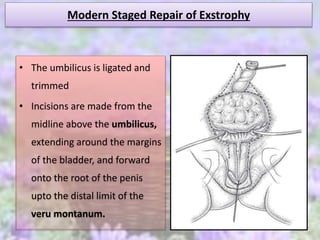
• The umbilicus is ligated and
trimmed
• Incisions are made from the
midline above the umbilicus,
extending around the margins
of the bladder, and forward
onto the root of the penis
upto the distal limit of the
veru montanum.
Modern Staged Repair of Exstrophy
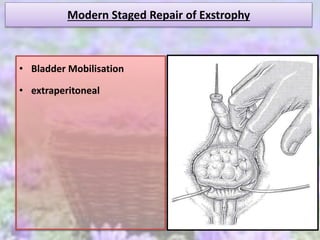
• Bladder Mobilisation
• extraperitoneal
Modern Staged Repair of Exstrophy
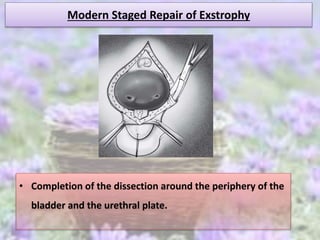
• Completion of the dissection around the periphery of the
bladder and the urethral plate.
Modern Staged Repair of Exstrophy
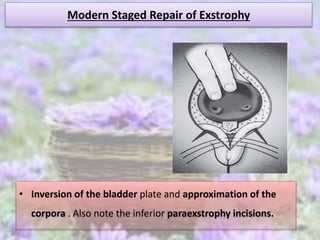
• Inversion of the bladder plate and approximation of the
corpora . Also note the inferior paraexstrophy incisions.
Modern Staged Repair of Exstrophy
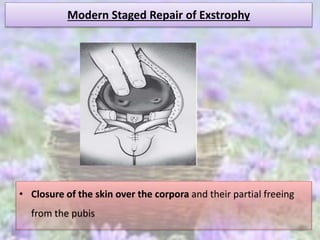
• Closure of the skin over the corpora and their partial freeing
from the pubis
Modern Staged Repair of Exstrophy
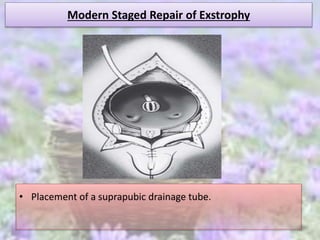
• Placement of a suprapubic drainage tube.
Modern Staged Repair of Exstrophy
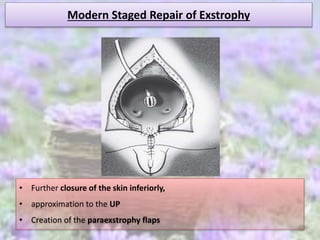
• Further closure of the skin inferiorly,
• approximation to the UP
• Creation of the paraexstrophy flaps
Modern Staged Repair of Exstrophy
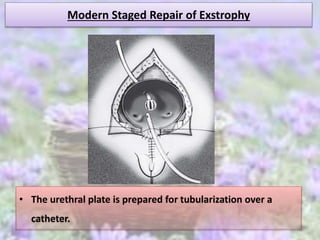
• The urethral plate is prepared for tubularization over a
catheter.
Modern Staged Repair of Exstrophy
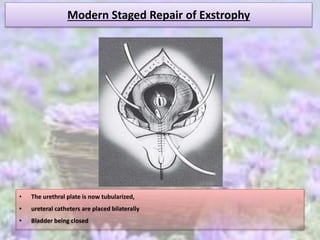
• The urethral plate is now tubularized,
• ureteral catheters are placed bilaterally
• Bladder being closed
Modern Staged Repair of Exstrophy
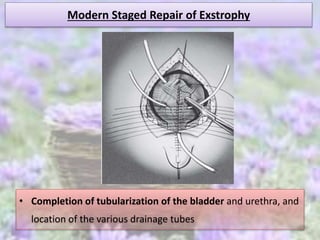
• Completion of tubularization of the bladder and urethra, and
location of the various drainage tubes
Modern Staged Repair of Exstrophy
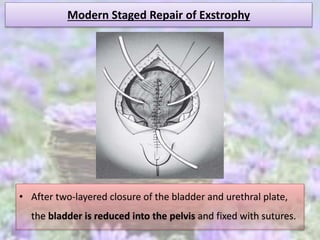
• After two-layered closure of the bladder and urethral plate,
the bladder is reduced into the pelvis and fixed with sutures.
Modern Staged Repair of Exstrophy
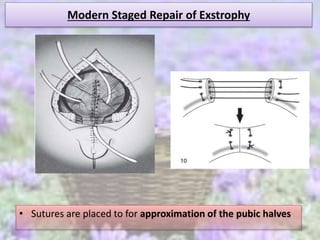
• Sutures are placed to for approximation of the pubic halves
Modern Staged Repair of Exstrophy
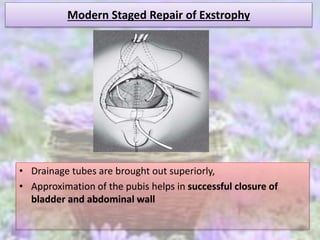
• Drainage tubes are brought out superiorly,
• Approximation of the pubis helps in successful closure of
bladder and abdominal wall
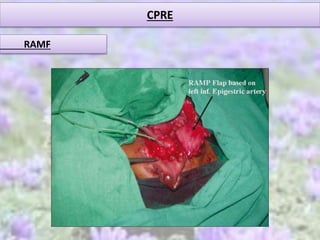
CPRE
RAMF
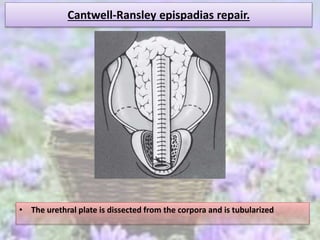
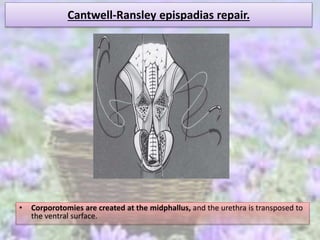
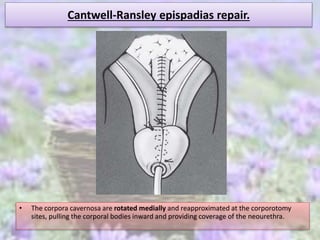
Cantwell-Ransley epispadias repair.
• The urethral plate is dissected from the corpora and is tubularized
Cantwell-Ransley epispadias repair.
• Corporotomies are created at the midphallus, and the urethra is transposed to
the ventral surface.
Cantwell-Ransley epispadias repair.
• The corpora cavernosa are rotated medially and reapproximated at the corporotomy
sites, pulling the corporal bodies inward and providing coverage of the neourethra.
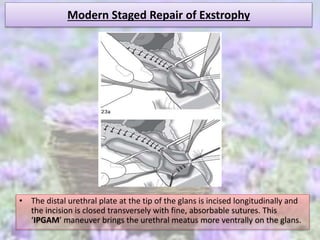
Modern Staged Repair of Exstrophy
• The distal urethral plate at the tip of the glans is incised longitudinally and
the incision is closed transversely with fine, absorbable sutures. This
‘IPGAM’ maneuver brings the urethral meatus more ventrally on the glans.
Modern Staged Repair of Exstrophy
• Following epispadias repair, the patient’s bladder capacity is measured
annually with gravity cystogram under anesthesia.
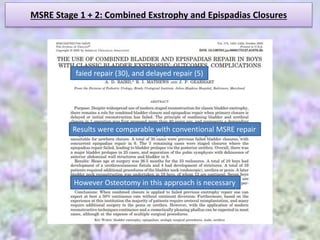
MSRE Stage 1 + 2: Combined Exstrophy and Epispadias Closures
faied repair (30), and delayed repair (5)
Results were comparable with conventional MSRE repair
However Osteotomy in this approach is necessary
Modern Staged Repair of Exstrophy
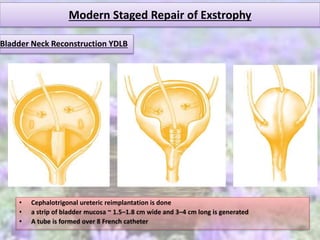
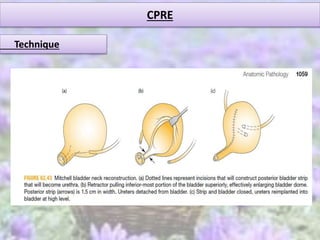
• Cephalotrigonal ureteric reimplantation is done
• a strip of bladder mucosa ~ 1.5–1.8 cm wide and 3–4 cm long is generated
• A tube is formed over 8 French catheter
Bladder Neck Reconstruction YDLB
Modern Staged Repair of Exstrophy
 (1) the urethra is stricture-free and capable of catheterization
 (2) under anesthesia, the bladder capacity is 60–85 cc; and
 (3) the child is mature enough to participate in the
postoperative voiding program (4-5 years)
Pre-requisites of BNR
Modern Staged Repair of Exstrophy
• Surgical success is defined as a dry interval of >2–3 hours and
spontaneous voiding without catheterization.
• YDL-BNR has a urinary continence rates of 30%–80+% for
patients
• Many factors influence the outcome of surgery.
– initial failed bladder closure or
– prior failed BNR
– A preoperative bladder capacity of <85 ccs
Results of BNR
Modern Staged Repair of Exstrophy
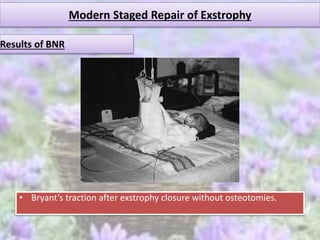
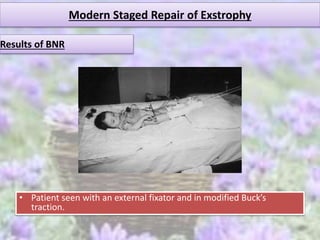
• Use of osteotomies and patient immobilization through spica
casting or Bryant’s traction increases the success of bladder
closure and subsequent continence.
• Delayed bladder closure increases the likelihood of bladder
augmentation due to inadequate bladder capacity that, in turn,
reduces the chance for voluntary voiding.
Results of BNR
Modern Staged Repair of Exstrophy
Results of BNR
• Bryant’s traction after exstrophy closure without osteotomies.
Modern Staged Repair of Exstrophy
Results of BNR
• Patient seen with an external fixator and in modified Buck’s
traction.
Modern Staged Repair of Exstrophy
Results of BNR
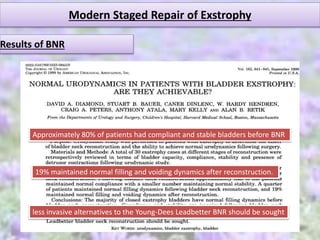
Approximately 80% of patients had compliant and stable bladders before BNR
19% maintained normal filling and voiding dynamics after reconstruction.
less invasive alternatives to the Young-Dees Leadbetter BNR should be sought
Modern Staged Repair of Exstrophy
Results of BNR
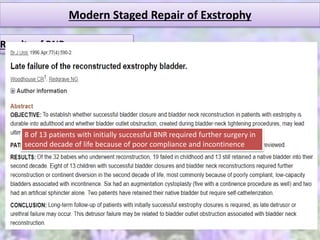
8 of 13 patients with initially successful BNR required further surgery in
second decade of life because of poor compliance and incontinence
Modern Staged Repair of Exstrophy
Artificial Urinary Sphincter
– Plagued by multiple operative revisions
– Used only in older children
– AUS erosions into bladder and bowel may occur
Bladder Neck Wraps and Slings
– does not consistently maintain long-term urinary
continence, especially in male patients
Management of failed BNR
Modern Staged Repair of Exstrophy
• Bladder Neck Bulking Agents
• Bulking agents can be used as an adjunctive procedure for
those patients who demonstrate slight leakage due to stress
incontinence after BNR
• Bladder Neck Closure with CUD
– BNC with Mitrofanoff is an option in those patients who have failed
multiple attempts at BNR.
– This option eliminates the chance to void per urethra
Management of failed BNR
Modern Staged Repair of Exstrophy
• Jeffs and colleagues noted normal upper urinary tracts in 87%
• series from Johns Hopkins also achieved low rates of renal
damage (17%),
• continence rates of 60%–88% are achieved with MSRE
Results of MSRE
early exstrophy closure in conjunction with pelvic ring approximation,
results in a higher rate of continence
Modern Staged Repair of Exstrophy
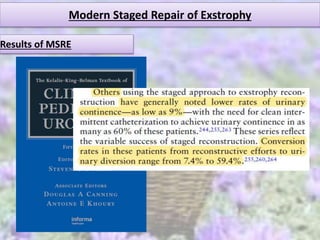
Results of MSRE
Modern Staged Repair of Exstrophy
Failed Initial Closure
– complete bladder dehiscence,
– bladder prolapse with obstruction, and
– stricture of the posterior urethra.
Results of MSRE
Failure of the initial closure significantly decreases the chance of continence
Modern Staged Repair of Exstrophy
Dehiscence
• Can be prevented by
– approximation of the pelvic ring,
– adequate pelvic immobilization,
– prevention of wound infection,
– Prevention of abdominal distention,
– Prventing urinary tube malfunction.
Results of MSRE
The child should be given a 6-month recovery period prior to a second
attempt at closure.
Modern Staged Repair of Exstrophy
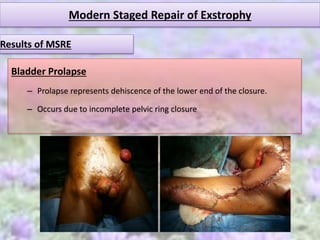
Bladder Prolapse
– Prolapse represents dehiscence of the lower end of the closure.
– Occurs due to incomplete pelvic ring closure
Results of MSRE
Modern Staged Repair of Exstrophy
Bladder outlet obstruction
• is characterized by incresed PVRU.
• It can increases the risk of
– renal damage by raising storage pressures to dangerous levels
– urinary tract infection.
Results of MSRE
The bladder outlet may be assessed with sounds or bougies 4–6 weeks after closure
USG of the bladder and upper tracts should be performed 3 months after closure
Treatment is UD and CIC
Modern Staged Repair of Exstrophy
Neourethral stricture
• it is due to
– paraexstrophy skin flaps in the posterior urethra
– suture reaction
– urethral stents
• RBUS shows features of BOO
• Management options include
– DU
– DVIU
– EPA
– CUD
Results of MSRE
Complete Primary Repair of Exstrophy
In the late 1980s, Mitchell initiated simultaneous bladder and abdominal
wall closure with epispadias repair and bladder neck remodeling
CPRE
this technique may
• decrease costs,
• decrease the morbidity associated with multiple operations
• stimulate early bladder cycling and growth.
• Complete disassembly allows placement of PU and bladder
necks in the pelvis
• Fosters improved bonding between the parents and infant.
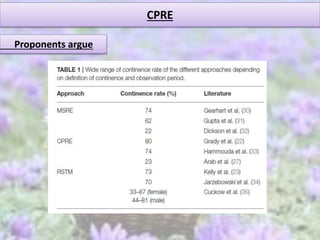
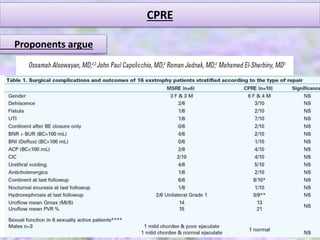
Proponents argue
CPRE
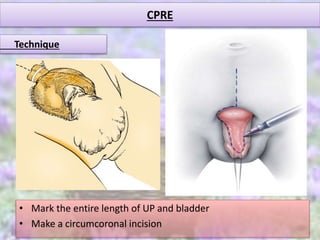
• Mark the entire length of UP and bladder
• Make a circumcoronal incision
Technique
CPRE
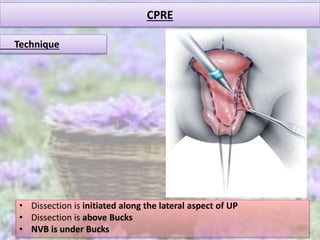
• Dissection is initiated along the lateral aspect of UP
• Dissection is above Bucks
• NVB is under Bucks
Technique
CPRE
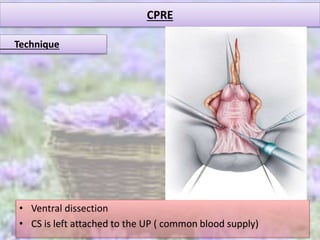
• Ventral dissection
• CS is left attached to the UP ( common blood supply)
Technique
CPRE
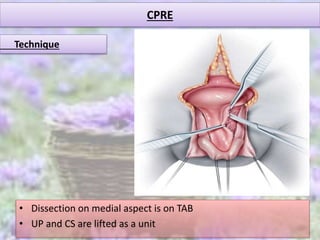
• Dissection on medial aspect is on TAB
• UP and CS are lifted as a unit
Technique
CPRE
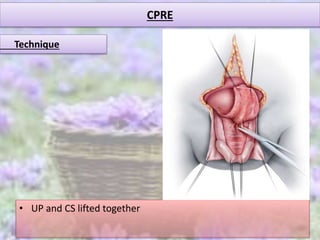
• UP and CS lifted together
Technique
CPRE
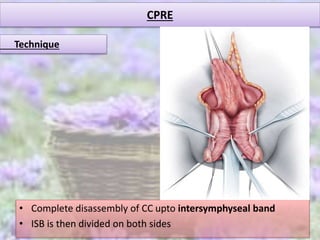
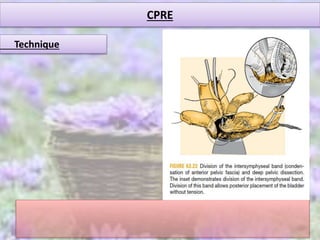
• Complete disassembly of CC upto intersymphyseal band
• ISB is then divided on both sides
Technique
CPRE
Technique
CPRE
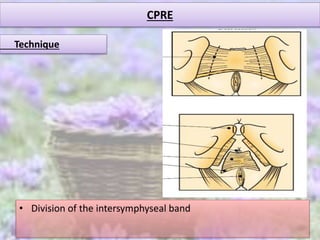
• Division of the intersymphyseal band
Technique
CPRE
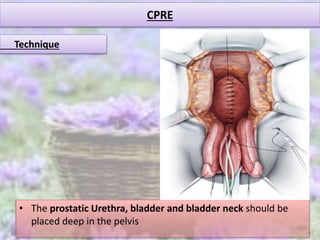
• The prostatic Urethra, bladder and bladder neck should be
placed deep in the pelvis
Technique
CPRE
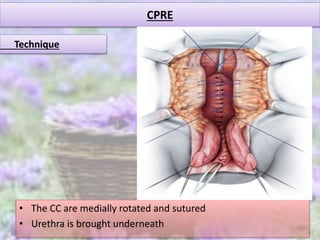
• The CC are medially rotated and sutured
• Urethra is brought underneath
Technique
CPRE
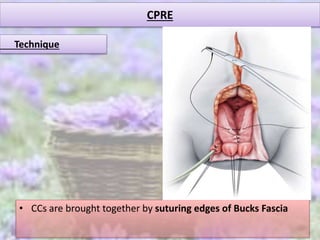
• CCs are brought together by suturing edges of Bucks Fascia
Technique
CPRE
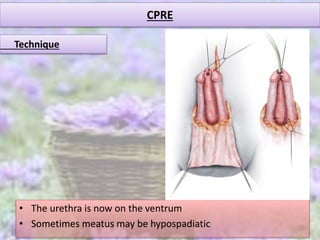
• The urethra is now on the ventrum
• Sometimes meatus may be hypospadiatic
Technique
CPRE
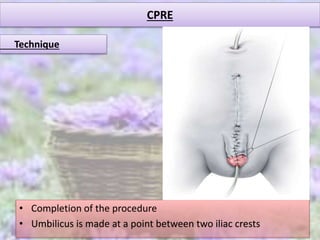
• Completion of the procedure
• Umbilicus is made at a point between two iliac crests
Technique
CPRE
• Patient is kept on oral antibiotics while the tubes are in place.
• If the patient had osteotomies, he is placed in a spika cast for 4 weeks.
• If no osteotomies are performed, no special restrictions of activity are
given.
• The ureteric/urethral stents are removed one at a time starting 5 days after
surgery.
• The suprapubic tube is not removed until the patient is voiding to
completion.
• If the patient cannot empty completely, clean intermittent catheterization
with a 6 F catheter is started
Post-Op care
CPRE
Results
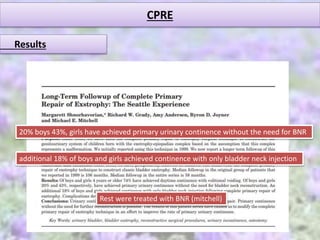
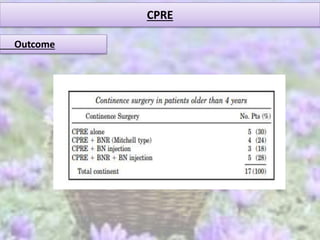
20% boys 43%, girls have achieved primary urinary continence without the need for BNR
additional 18% of boys and girls achieved continence with only bladder neck injection
Rest were treated with BNR (mitchell)
CPRE
Technique
CPRE
Outcome
CPRE
Outcome
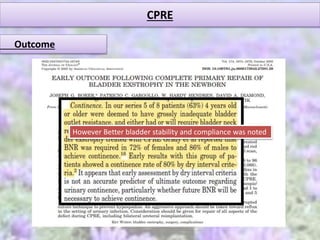
However Better bladder stability and compliance was noted
CPRE
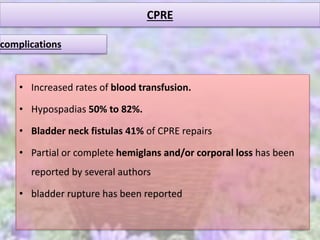
• Increased rates of blood transfusion.
• Hypospadias 50% to 82%.
• Bladder neck fistulas 41% of CPRE repairs
• Partial or complete hemiglans and/or corporal loss has been
reported by several authors
• bladder rupture has been reported
complications
CPRE
Technique
CPRE
Point & counterpoint
CPRE
Proponents argue
CPRE
Proponents argue
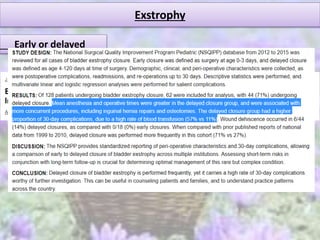
Exstrophy
Early or delayed
CPRE
Cosmetic Outcome
• Cosmetic outcome is not very encouraging
• significantly small phallus can lead to low self-esteem,
psychosocial and psychosexual dysfunction, and suicidal
ideation
• Thus, neophallic reconstruction has been performed,
although this procedure is done in a select few centers and
with significant risk for complications
CPRE
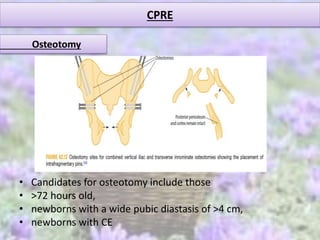
Osteotomy
• Candidates for osteotomy include those
• >72 hours old,
• newborns with a wide pubic diastasis of >4 cm,
• newborns with CE
Thank You
drfaheemandrabi@gmail.com

Exstrophy Epispadias Complex MSRE & CPRE

  • 1.
    MSRE and CPRE DrFaheem Ul Hassan Andrabi Fellow Pediatric Urology Prof. Narendrababu Prof. Pediatric Surgery and Pediatric Urology IGICH Banglore
  • 2.
    Modern Staged Repairof Exstrophy • Stage I: bladder and posterior urethral closure soon thereafter birth • Stage II: epispadias repair at 6–12 months of life • Stage III: BNR when the bladder capacity is adequate (usually at 4–5 years of life)
  • 3.
    Modern Staged Repairof Exstrophy • The umbilicus is ligated and trimmed • Incisions are made from the midline above the umbilicus, extending around the margins of the bladder, and forward onto the root of the penis upto the distal limit of the veru montanum.
  • 4.
    Modern Staged Repairof Exstrophy • Bladder Mobilisation • extraperitoneal
  • 5.
    Modern Staged Repairof Exstrophy • Completion of the dissection around the periphery of the bladder and the urethral plate.
  • 6.
    Modern Staged Repairof Exstrophy • Inversion of the bladder plate and approximation of the corpora . Also note the inferior paraexstrophy incisions.
  • 7.
    Modern Staged Repairof Exstrophy • Closure of the skin over the corpora and their partial freeing from the pubis
  • 8.
    Modern Staged Repairof Exstrophy • Placement of a suprapubic drainage tube.
  • 9.
    Modern Staged Repairof Exstrophy • Further closure of the skin inferiorly, • approximation to the UP • Creation of the paraexstrophy flaps
  • 10.
    Modern Staged Repairof Exstrophy • The urethral plate is prepared for tubularization over a catheter.
  • 11.
    Modern Staged Repairof Exstrophy • The urethral plate is now tubularized, • ureteral catheters are placed bilaterally • Bladder being closed
  • 12.
    Modern Staged Repairof Exstrophy • Completion of tubularization of the bladder and urethra, and location of the various drainage tubes
  • 13.
    Modern Staged Repairof Exstrophy • After two-layered closure of the bladder and urethral plate, the bladder is reduced into the pelvis and fixed with sutures.
  • 14.
    Modern Staged Repairof Exstrophy • Sutures are placed to for approximation of the pubic halves
  • 15.
    Modern Staged Repairof Exstrophy • Drainage tubes are brought out superiorly, • Approximation of the pubis helps in successful closure of bladder and abdominal wall
  • 16.
  • 17.
    Cantwell-Ransley epispadias repair. •The urethral plate is dissected from the corpora and is tubularized
  • 18.
    Cantwell-Ransley epispadias repair. •Corporotomies are created at the midphallus, and the urethra is transposed to the ventral surface.
  • 19.
    Cantwell-Ransley epispadias repair. •The corpora cavernosa are rotated medially and reapproximated at the corporotomy sites, pulling the corporal bodies inward and providing coverage of the neourethra.
  • 20.
    Modern Staged Repairof Exstrophy • The distal urethral plate at the tip of the glans is incised longitudinally and the incision is closed transversely with fine, absorbable sutures. This ‘IPGAM’ maneuver brings the urethral meatus more ventrally on the glans.
  • 21.
    Modern Staged Repairof Exstrophy • Following epispadias repair, the patient’s bladder capacity is measured annually with gravity cystogram under anesthesia.
  • 22.
    MSRE Stage 1+ 2: Combined Exstrophy and Epispadias Closures faied repair (30), and delayed repair (5) Results were comparable with conventional MSRE repair However Osteotomy in this approach is necessary
  • 23.
    Modern Staged Repairof Exstrophy • Cephalotrigonal ureteric reimplantation is done • a strip of bladder mucosa ~ 1.5–1.8 cm wide and 3–4 cm long is generated • A tube is formed over 8 French catheter Bladder Neck Reconstruction YDLB
  • 24.
    Modern Staged Repairof Exstrophy  (1) the urethra is stricture-free and capable of catheterization  (2) under anesthesia, the bladder capacity is 60–85 cc; and  (3) the child is mature enough to participate in the postoperative voiding program (4-5 years) Pre-requisites of BNR
  • 25.
    Modern Staged Repairof Exstrophy • Surgical success is defined as a dry interval of >2–3 hours and spontaneous voiding without catheterization. • YDL-BNR has a urinary continence rates of 30%–80+% for patients • Many factors influence the outcome of surgery. – initial failed bladder closure or – prior failed BNR – A preoperative bladder capacity of <85 ccs Results of BNR
  • 26.
    Modern Staged Repairof Exstrophy • Use of osteotomies and patient immobilization through spica casting or Bryant’s traction increases the success of bladder closure and subsequent continence. • Delayed bladder closure increases the likelihood of bladder augmentation due to inadequate bladder capacity that, in turn, reduces the chance for voluntary voiding. Results of BNR
  • 27.
    Modern Staged Repairof Exstrophy Results of BNR • Bryant’s traction after exstrophy closure without osteotomies.
  • 28.
    Modern Staged Repairof Exstrophy Results of BNR • Patient seen with an external fixator and in modified Buck’s traction.
  • 29.
    Modern Staged Repairof Exstrophy Results of BNR Approximately 80% of patients had compliant and stable bladders before BNR 19% maintained normal filling and voiding dynamics after reconstruction. less invasive alternatives to the Young-Dees Leadbetter BNR should be sought
  • 30.
    Modern Staged Repairof Exstrophy Results of BNR 8 of 13 patients with initially successful BNR required further surgery in second decade of life because of poor compliance and incontinence
  • 31.
    Modern Staged Repairof Exstrophy Artificial Urinary Sphincter – Plagued by multiple operative revisions – Used only in older children – AUS erosions into bladder and bowel may occur Bladder Neck Wraps and Slings – does not consistently maintain long-term urinary continence, especially in male patients Management of failed BNR
  • 32.
    Modern Staged Repairof Exstrophy • Bladder Neck Bulking Agents • Bulking agents can be used as an adjunctive procedure for those patients who demonstrate slight leakage due to stress incontinence after BNR • Bladder Neck Closure with CUD – BNC with Mitrofanoff is an option in those patients who have failed multiple attempts at BNR. – This option eliminates the chance to void per urethra Management of failed BNR
  • 33.
    Modern Staged Repairof Exstrophy • Jeffs and colleagues noted normal upper urinary tracts in 87% • series from Johns Hopkins also achieved low rates of renal damage (17%), • continence rates of 60%–88% are achieved with MSRE Results of MSRE early exstrophy closure in conjunction with pelvic ring approximation, results in a higher rate of continence
  • 34.
    Modern Staged Repairof Exstrophy Results of MSRE
  • 35.
    Modern Staged Repairof Exstrophy Failed Initial Closure – complete bladder dehiscence, – bladder prolapse with obstruction, and – stricture of the posterior urethra. Results of MSRE Failure of the initial closure significantly decreases the chance of continence
  • 36.
    Modern Staged Repairof Exstrophy Dehiscence • Can be prevented by – approximation of the pelvic ring, – adequate pelvic immobilization, – prevention of wound infection, – Prevention of abdominal distention, – Prventing urinary tube malfunction. Results of MSRE The child should be given a 6-month recovery period prior to a second attempt at closure.
  • 37.
    Modern Staged Repairof Exstrophy Bladder Prolapse – Prolapse represents dehiscence of the lower end of the closure. – Occurs due to incomplete pelvic ring closure Results of MSRE
  • 38.
    Modern Staged Repairof Exstrophy Bladder outlet obstruction • is characterized by incresed PVRU. • It can increases the risk of – renal damage by raising storage pressures to dangerous levels – urinary tract infection. Results of MSRE The bladder outlet may be assessed with sounds or bougies 4–6 weeks after closure USG of the bladder and upper tracts should be performed 3 months after closure Treatment is UD and CIC
  • 39.
    Modern Staged Repairof Exstrophy Neourethral stricture • it is due to – paraexstrophy skin flaps in the posterior urethra – suture reaction – urethral stents • RBUS shows features of BOO • Management options include – DU – DVIU – EPA – CUD Results of MSRE
  • 40.
  • 41.
    Complete Primary Repairof Exstrophy In the late 1980s, Mitchell initiated simultaneous bladder and abdominal wall closure with epispadias repair and bladder neck remodeling
  • 42.
    CPRE this technique may •decrease costs, • decrease the morbidity associated with multiple operations • stimulate early bladder cycling and growth. • Complete disassembly allows placement of PU and bladder necks in the pelvis • Fosters improved bonding between the parents and infant. Proponents argue
  • 43.
    CPRE • Mark theentire length of UP and bladder • Make a circumcoronal incision Technique
  • 44.
    CPRE • Dissection isinitiated along the lateral aspect of UP • Dissection is above Bucks • NVB is under Bucks Technique
  • 45.
    CPRE • Ventral dissection •CS is left attached to the UP ( common blood supply) Technique
  • 46.
    CPRE • Dissection onmedial aspect is on TAB • UP and CS are lifted as a unit Technique
  • 47.
    CPRE • UP andCS lifted together Technique
  • 48.
    CPRE • Complete disassemblyof CC upto intersymphyseal band • ISB is then divided on both sides Technique
  • 49.
  • 50.
    CPRE • Division ofthe intersymphyseal band Technique
  • 51.
    CPRE • The prostaticUrethra, bladder and bladder neck should be placed deep in the pelvis Technique
  • 52.
    CPRE • The CCare medially rotated and sutured • Urethra is brought underneath Technique
  • 53.
    CPRE • CCs arebrought together by suturing edges of Bucks Fascia Technique
  • 54.
    CPRE • The urethrais now on the ventrum • Sometimes meatus may be hypospadiatic Technique
  • 55.
    CPRE • Completion ofthe procedure • Umbilicus is made at a point between two iliac crests Technique
  • 56.
    CPRE • Patient iskept on oral antibiotics while the tubes are in place. • If the patient had osteotomies, he is placed in a spika cast for 4 weeks. • If no osteotomies are performed, no special restrictions of activity are given. • The ureteric/urethral stents are removed one at a time starting 5 days after surgery. • The suprapubic tube is not removed until the patient is voiding to completion. • If the patient cannot empty completely, clean intermittent catheterization with a 6 F catheter is started Post-Op care
  • 57.
    CPRE Results 20% boys 43%,girls have achieved primary urinary continence without the need for BNR additional 18% of boys and girls achieved continence with only bladder neck injection Rest were treated with BNR (mitchell)
  • 58.
  • 59.
  • 60.
    CPRE Outcome However Better bladderstability and compliance was noted
  • 61.
    CPRE • Increased ratesof blood transfusion. • Hypospadias 50% to 82%. • Bladder neck fistulas 41% of CPRE repairs • Partial or complete hemiglans and/or corporal loss has been reported by several authors • bladder rupture has been reported complications
  • 62.
  • 63.
  • 64.
  • 65.
  • 66.
  • 67.
    CPRE Cosmetic Outcome • Cosmeticoutcome is not very encouraging • significantly small phallus can lead to low self-esteem, psychosocial and psychosexual dysfunction, and suicidal ideation • Thus, neophallic reconstruction has been performed, although this procedure is done in a select few centers and with significant risk for complications
  • 68.
    CPRE Osteotomy • Candidates forosteotomy include those • >72 hours old, • newborns with a wide pubic diastasis of >4 cm, • newborns with CE
  • 69.