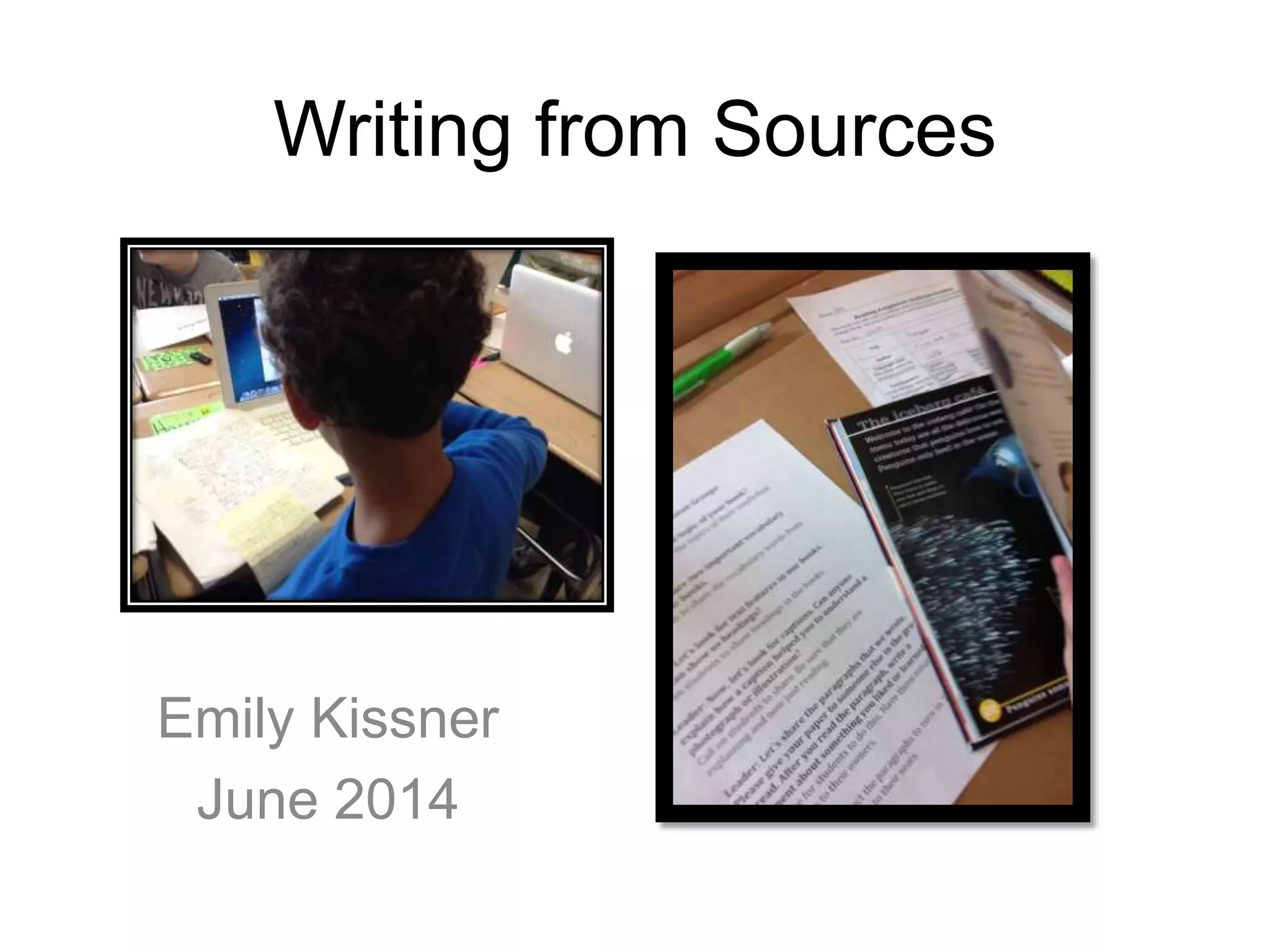
Writing from Sources
Emily Kissner
June 2014
Agenda
1. Why write from sources? (see Part 1)
2. Steps for synthesis (see Part 1)
3. Unpacking the process
4. Classroom activities
The good news
The process of integrating ideas and figuring
out how to say them helps students to
become stronger readers and writers.
Unpacking the process
The task of writing from sources becomes
easier if we unpack the process and look at
all of the low-stakes, high-impact classroom
activities that we can do to promote the
process.
Connecting
Exploring connections between ideas is
important for students who are writing from
sources.
Connecting
Two ideas can:
 Say the Same
 Go Against (Contradict)
 Explain and Elaborate
 Connect
Dive into some books!
Look at sets of texts on a similar topic. Can
you find examples of the different
relationships?
Dive into some books!
How might this activity be helpful for
students? What discussions might arise?
Moving to writing
These different idea relationships can be
expressed using different transition words.
Moving to writing
Teaching students how to connect transitions
to kinds of thinking could help them to make
clear connections in their writing.
Organizing
Not surprisingly, students in research studies
on synthesis writing did not do well with
organizing final products.
Organizing
“It is significant that students started to write
with hardly any planning…Our interpretation
is that, faced with the difficulty of
constructing their own text, the students
borrow the organization and structure of the
STs [source texts].”
-Sole et al, 2013
Organizing
Small classroom tasks that require students to
go across genres can force them to create
their own organizational patterns.
Organizing
Organizing
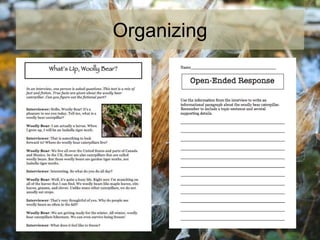
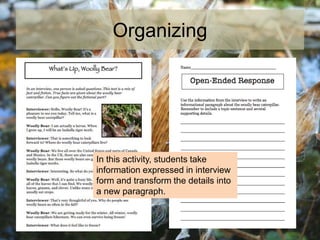
In this activity, students take
information expressed in interview
form and transform the details into
a new paragraph.
Organizing
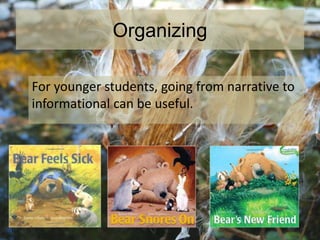
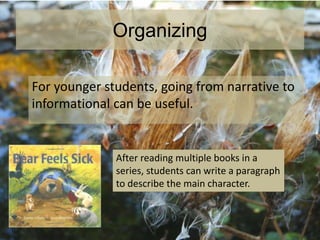
For younger students, going from narrative to
informational can be useful.
Organizing
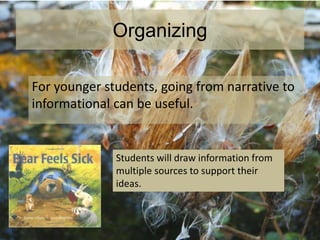
For younger students, going from narrative to
informational can be useful.
After reading multiple books in a
series, students can write a paragraph
to describe the main character.
Organizing
For younger students, going from narrative to
informational can be useful.
Students will draw information from
multiple sources to support their
ideas.
Organizing
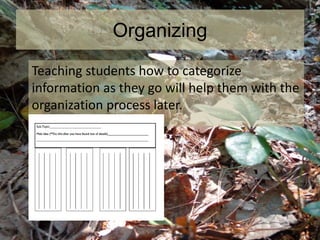
Teaching students how to categorize
information as they go will help them with the
organization process later.
Organizing
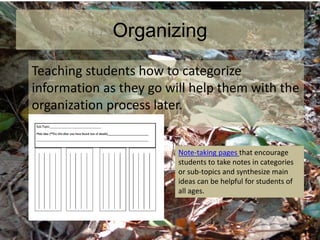
Teaching students how to categorize
information as they go will help them with the
organization process later.
Note-taking pages that encourage
students to take notes in categories
or sub-topics and synthesize main
ideas can be helpful for students of
all ages.
Organizing
No matter what activities you try, it’s
important to model rereading with students.
Going back to source material is linked to
better synthesis writing.
Selecting
Selecting appropriate sources becomes
an expectation in grade 3.
Selecting
Readers need to use the “text analyst” role
to figure out which sources are credible.
Digital think-alouds are an important way
to help students understand how to do
this.
Selecting
What classroom activities have you tried
to help students select information?
For more information on selecting and
using information, look at “Building Online
Reading Comprehension.”
Classroom Activities
Writing a full-scale synthesis is not something
that we can have students do in one week.
Synthesis—and the skills of selection, connection,
and organization--needs to permeate our
classroom culture. Here are some activities to
try!
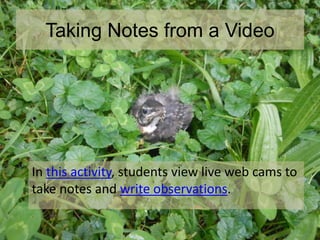
Taking Notes from a Video
In this activity, students view live web cams to
take notes and write observations.
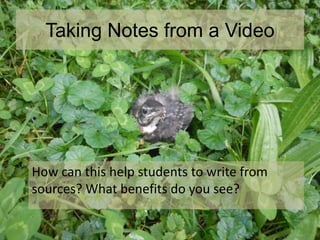
Taking Notes from a Video
How can this help students to write from
sources? What benefits do you see?
Topic Studies
In a topic study, students read many different
texts on a given topic.
Topic Studies
The teacher guides students into looking for
connections between ideas, building
awareness of idea relationships.
Topic Studies
In fact, resolving ideas that seem
contradictory helps students to build strong
understandings.
Topic Studies
What experiences have you had with topic
studies? How have students learned from
them?
Weather Explorations
“I heard that…”
“The news said…”
Students are always eager to discuss the
weather. Take advantage of this to work
together to write a paragraph from sources.
Weather Explorations
-What kinds of connections between ideas are
used in this task?
-How could this lead to a more formal writing
prompt?
Reading Firsthand Accounts
Highlighting firsthand accounts of information
helps students to realize that information can
come from various sources.
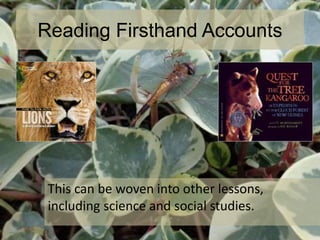
Reading Firsthand Accounts
This can be woven into other lessons,
including science and social studies.
Whole-Class Research Projects
Instead of diving into individual research
projects, try researching a topic as a class. This
can weave together online reading
comprehension and writing from sources.
Whole-Class Research Projects
This can also help you to see which processes
are difficult for students, and what kinds of
instruction students need.
Small-scale Lessons
Which of these ideas have you tried, or would
you like to try? How did they build synthesis
skills?
Formal Writing from Sources
Use RAFTS-style writing prompts
Provide some sources, especially sources at
students’ reading levels
Support students with organization
Suggest transitions to show connections
Support a recursive process
As you plan formal writing projects, keep these best
practices in mind:
Time to Work!
Create materials that will support writing from
sources in your classroom!
•Small scale activities
•Formal prompts
•Lists of links and materials
•Connected theme sets
References
Gil, Laura, Ivar Braten, Eduardo Vidal-Abarca, and Helge StromsoI. 2010. “Summary versus
Argument Tasks when Working with Multiple Documents: Which Is Better for Whom?”
Contemporary Educational Psychology, v35 n3 p157-173.
Mateos, Mar and Isabel Sole. 2009. “Synthesising Information from Various Texts: A Study of
Procedures and Products at Different Educational Levels.” European Journal of Psychology of
Education, v24 n4 p435-451.
Mateos, Mar, Elena Martin, Ruth Villalon, and Maria Luna. 2008. “Reading and Writing to
Learn in Secondary Education: Online Processing Activity and Written Products in
Summarizing and Synthesizing Tasks.” Reading and Writing: An Interdisciplinary Journal, v21
n7 p675-697.
Sole, Isabel, Mariana Miras, Nuria Castells, Sandra Espino, and Marta Minguela. 2013.
“Integrating Information: An Analysis of the Processes Involved and the Products Generated
in a Written Synthesis Task.” Written Communication, v30 n1 p63-90.
Spivey, N.N. 1997. “Transforming texts: Constructive processes in reading and writing.”
Written Communication, 7, 256–287.
Zhang, Cui. 2013. “Effect of Instruction on ESL Students' Synthesis Writing.” Journal of Second
Language Writing, v22 n1 p51-67.

Writing from Sources, Part 2

  • 1.
    Writing from Sources EmilyKissner June 2014
  • 2.
    Agenda 1. Why writefrom sources? (see Part 1) 2. Steps for synthesis (see Part 1) 3. Unpacking the process 4. Classroom activities
  • 3.
    The good news Theprocess of integrating ideas and figuring out how to say them helps students to become stronger readers and writers.
  • 4.
    Unpacking the process Thetask of writing from sources becomes easier if we unpack the process and look at all of the low-stakes, high-impact classroom activities that we can do to promote the process.
  • 5.
    Connecting Exploring connections betweenideas is important for students who are writing from sources.
  • 6.
    Connecting Two ideas can: Say the Same  Go Against (Contradict)  Explain and Elaborate  Connect
  • 7.
    Dive into somebooks! Look at sets of texts on a similar topic. Can you find examples of the different relationships?
  • 8.
    Dive into somebooks! How might this activity be helpful for students? What discussions might arise?
  • 9.
    Moving to writing Thesedifferent idea relationships can be expressed using different transition words.
  • 10.
    Moving to writing Teachingstudents how to connect transitions to kinds of thinking could help them to make clear connections in their writing.
  • 11.
    Organizing Not surprisingly, studentsin research studies on synthesis writing did not do well with organizing final products.
  • 12.
    Organizing “It is significantthat students started to write with hardly any planning…Our interpretation is that, faced with the difficulty of constructing their own text, the students borrow the organization and structure of the STs [source texts].” -Sole et al, 2013
  • 13.
    Organizing Small classroom tasksthat require students to go across genres can force them to create their own organizational patterns.
  • 14.
  • 15.
    Organizing In this activity,students take information expressed in interview form and transform the details into a new paragraph.
  • 16.
    Organizing For younger students,going from narrative to informational can be useful.
  • 17.
    Organizing For younger students,going from narrative to informational can be useful. After reading multiple books in a series, students can write a paragraph to describe the main character.
  • 18.
    Organizing For younger students,going from narrative to informational can be useful. Students will draw information from multiple sources to support their ideas.
  • 19.
    Organizing Teaching students howto categorize information as they go will help them with the organization process later.
  • 20.
    Organizing Teaching students howto categorize information as they go will help them with the organization process later. Note-taking pages that encourage students to take notes in categories or sub-topics and synthesize main ideas can be helpful for students of all ages.
  • 21.
    Organizing No matter whatactivities you try, it’s important to model rereading with students. Going back to source material is linked to better synthesis writing.
  • 22.
    Selecting Selecting appropriate sourcesbecomes an expectation in grade 3.
  • 23.
    Selecting Readers need touse the “text analyst” role to figure out which sources are credible. Digital think-alouds are an important way to help students understand how to do this.
  • 24.
    Selecting What classroom activitieshave you tried to help students select information? For more information on selecting and using information, look at “Building Online Reading Comprehension.”
  • 25.
    Classroom Activities Writing afull-scale synthesis is not something that we can have students do in one week. Synthesis—and the skills of selection, connection, and organization--needs to permeate our classroom culture. Here are some activities to try!
  • 26.
    Taking Notes froma Video In this activity, students view live web cams to take notes and write observations.
  • 27.
    Taking Notes froma Video How can this help students to write from sources? What benefits do you see?
  • 28.
    Topic Studies In atopic study, students read many different texts on a given topic.
  • 29.
    Topic Studies The teacherguides students into looking for connections between ideas, building awareness of idea relationships.
  • 30.
    Topic Studies In fact,resolving ideas that seem contradictory helps students to build strong understandings.
  • 31.
    Topic Studies What experienceshave you had with topic studies? How have students learned from them?
  • 32.
    Weather Explorations “I heardthat…” “The news said…” Students are always eager to discuss the weather. Take advantage of this to work together to write a paragraph from sources.
  • 33.
    Weather Explorations -What kindsof connections between ideas are used in this task? -How could this lead to a more formal writing prompt?
  • 34.
    Reading Firsthand Accounts Highlightingfirsthand accounts of information helps students to realize that information can come from various sources.
  • 35.
    Reading Firsthand Accounts Thiscan be woven into other lessons, including science and social studies.
  • 36.
    Whole-Class Research Projects Insteadof diving into individual research projects, try researching a topic as a class. This can weave together online reading comprehension and writing from sources.
  • 37.
    Whole-Class Research Projects Thiscan also help you to see which processes are difficult for students, and what kinds of instruction students need.
  • 38.
    Small-scale Lessons Which ofthese ideas have you tried, or would you like to try? How did they build synthesis skills?
  • 39.
    Formal Writing fromSources Use RAFTS-style writing prompts Provide some sources, especially sources at students’ reading levels Support students with organization Suggest transitions to show connections Support a recursive process As you plan formal writing projects, keep these best practices in mind:
  • 40.
    Time to Work! Creatematerials that will support writing from sources in your classroom! •Small scale activities •Formal prompts •Lists of links and materials •Connected theme sets
  • 41.
    References Gil, Laura, IvarBraten, Eduardo Vidal-Abarca, and Helge StromsoI. 2010. “Summary versus Argument Tasks when Working with Multiple Documents: Which Is Better for Whom?” Contemporary Educational Psychology, v35 n3 p157-173. Mateos, Mar and Isabel Sole. 2009. “Synthesising Information from Various Texts: A Study of Procedures and Products at Different Educational Levels.” European Journal of Psychology of Education, v24 n4 p435-451. Mateos, Mar, Elena Martin, Ruth Villalon, and Maria Luna. 2008. “Reading and Writing to Learn in Secondary Education: Online Processing Activity and Written Products in Summarizing and Synthesizing Tasks.” Reading and Writing: An Interdisciplinary Journal, v21 n7 p675-697. Sole, Isabel, Mariana Miras, Nuria Castells, Sandra Espino, and Marta Minguela. 2013. “Integrating Information: An Analysis of the Processes Involved and the Products Generated in a Written Synthesis Task.” Written Communication, v30 n1 p63-90. Spivey, N.N. 1997. “Transforming texts: Constructive processes in reading and writing.” Written Communication, 7, 256–287. Zhang, Cui. 2013. “Effect of Instruction on ESL Students' Synthesis Writing.” Journal of Second Language Writing, v22 n1 p51-67.

Editor's Notes

  • #4 Sole et al 2013
  • #10 Mateos and Sole, 2009
  • #11 Mateos and Sole, 2009
  • #12 Mateos et al, 2008
  • #13 Sole et al, 2013
  • #14 Sole et al, 2013
  • #15 Synthesis task from October Reading Homework, http://www.teacherspayteachers.com/Product/October-Reading-Homework-and-Test-Preparation-907062
  • #16 Synthesis task from October Reading Homework, http://www.teacherspayteachers.com/Product/October-Reading-Homework-and-Test-Preparation-907062
  • #20 Mateos et al, 2008
  • #21 Mateos et al, 2008
  • #22 Mateos et al, 2008
  • #23 Mateos et al, 2008
  • #24 Mateos et al, 2008
  • #26 Mateos et al, 2008
  • #31 Nuthall, 2000
  • #42 Emily Kissner 2014. Photos by Emily Kissner.