ASSESSMENT
IN CONTENT AREA
LITERACY
EDLL 4380
Definition
• What comes to your mind when you hear the term
‘assessment’?
• What types of assessments have you seen or used with
children?
• What is the difference between ASSESSMENT and
EVALUATION?
• In addition to your notes from the reading, it is important
to remember that assessment must not be a one-time
activity but an ongoing process, that informs instruction.
(Pike & Mumper, 2004)
As our world and the children we teach change so does our teaching. Education
is evolving and changing daily. Because of this, so is assessment. McLaughlin
(p. 232) states,
As 21st century content area teachers, we are striving to
move away from the teacher/text dominated classroom and
to transition to a time of student-generated ideas, self
selection, critical thinking, creativity, interaction and
personal construction of meaning.
As a result of this changing paradigm, assessment has
been undergoing a major reformation. Practices have
been shifting from the traditional “read the book and
answer the question” method to a more performance-
based “show what you can do with what you have
learned” approach.
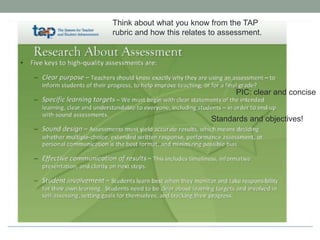
Think about what you know from the TAP
rubric and how this relates to assessment.
Standards and objectives!
PIC: clear and concise
What are some important
characteristics of assessment?
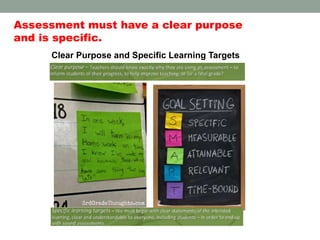
Clear Purpose and Specific Learning Targets
Assessment must have a clear purpose
and is specific.
Assessment is standards-based.
Frey and Fisher (p. 250) state, “Students will be tested;
teachers and schools will be evaluated according to
student performance on these tests.”
There is much controversy about this topic, but this will not be
changing any time soon.
“We must be careful not to allow the test practice
to become the curriculum. Rather, we believe in
teaching to the standards that are tested. When
students are well versed in standards-based
content, they are more likely to do well on the test.
School is still about creating citizens who can
participate in democracy.” (Frey and Fisher, p.
251)
Assessment is authentic.
Because we know that the assessment should guide the
teachers instruction, assessment is grounded in real world, real
classroom experiences. Rather than using only a standardized
or traditional test, teachers are looking at what children do
daily and using that as assessment.
For example, teachers are looking at writing samples, projects,
reading samples (running records); their students day to day
work versus only using a culminating project or test.
Assessment is reflective.
Reflection encourages students and teachers to take ownership over their learning. It also
helps affirm the learner and let the student know that their learning is valued and their
thoughts heard.
Teachers are also reflective after teaching because they consistently ask themselves questions
like: What worked today?
What can I do tomorrow?
What does this group of children or child need now?
McLaughlin (pg 235) shares, “Reflective activities in the classroom help make
thinking more visible, enabling students to learn from one another and to
gain greater insights into their own thinking and learning process.”
Assessment is dynamic
“No longer is it a valid notion that assessment is a one-time
activity; rather, assessment is an integral part of instruction
that helps guide teacher’ planning and delivery of
instruction.”
McLaughlin (pg. 234) shares, “Because assessment has a dynamic
nature, it is viewed not as an event but rather a natural,
ongoing, purposeful component of teaching and learning.”
Assessment has multiple response
formats.
In classrooms that integrate authentic assessment,
teachers are aware that his/her students have many
strengths. Therefore, this teacher offers a variety of
assessment to check on what has been learned. This
variety includes assessments that involve speaking,
writing, dramatizing, technology, film, music and art.
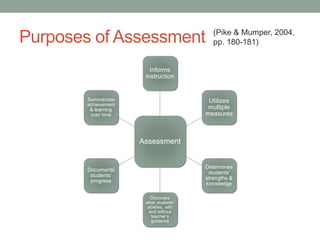
Purposes of Assessment
Assessment
Informs
instruction
Utilizes
multiple
measures
Determines
students’
strengths &
knowledge
Discovers
what students’
abilities, with
and without
teacher’s
guidance
Documents
students’
progress
Summarizes
achievement
& learning
over time
(Pike & Mumper, 2004,
pp. 180-181)
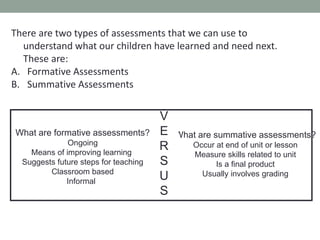
What are formative assessments?
Ongoing
Means of improving learning
Suggests future steps for teaching
Classroom based
Informal
There are two types of assessments that we can use to
understand what our children have learned and need next.
These are:
A. Formative Assessments
B. Summative Assessments
What are summative assessments?
Occur at end of unit or lesson
Measure skills related to unit
Is a final product
Usually involves grading
V
E
R
S
U
S
“We can monitor all students progress
through formative assessments, but this type
of assessment is especially valuable in the
case of the English learner. We often provide
these students with additional support and
observing their progress through formative
assessments provides us with ongoing insight
into their thinking and abilities. The resulting
information informs our future lesson
planning.” McLaughlin, pg 239
A. Formative Measures of Assessment
In literacy, the effective formative measures of assessment
are:
• Observation/ kidwatching
• Retellings
• Interviews, surveys, and inventories
• Student self-evaluation
• Think alouds
• Analysis of student products and projects (performance
assessment) and analysis of student performance on
state exams (grade level)
(Pike & Mumper, 2004, p. 181)
Observation/ Kidwatching
• the process of observing children as they engage in
authentic daily activities, or of looking at the results or
products of these activities (Pike & Mumper, 2004, p. 182)
• the process of students retell or talk about what they have read using
their own words, assessing the extent that students are able to
summarize, remember details, sequence events, and make meaning
of the text in general (Pike & Mumper, 2004, p.185)
Retellings
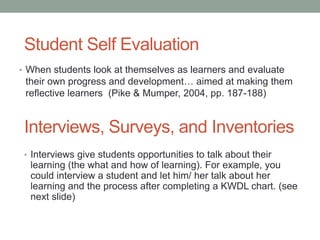
Interviews, Surveys, and Inventories
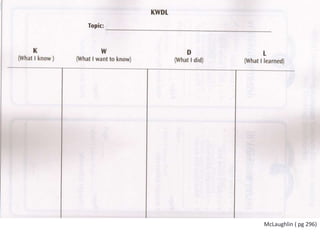
• Interviews give students opportunities to talk about their
learning (the what and how of learning). For example, you
could interview a student and let him/ her talk about her
learning and the process after completing a KWDL chart. (see
next slide)
• When students look at themselves as learners and evaluate
their own progress and development… aimed at making them
reflective learners (Pike & Mumper, 2004, pp. 187-188)
Student Self Evaluation
McLaughlin ( pg 296)
Student Products, projects, and other
work samples
• These artifacts show evidence of students’ work in class
and, if authentic, provide evidence of their performance
and learning.
Other examples: informal writing pieces (e.g. journal entries, exits
slips, quickwrites, etc.
• When students verbalize their thoughts as they read,
write, or make sense of text (Pike & Mumper, 2004, p.
188)
Think Alouds
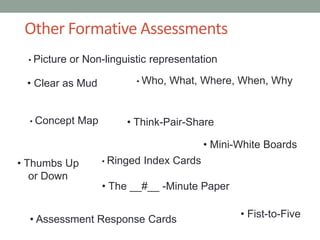
• Think-Pair-Share
• Clear as Mud
• Ringed Index Cards
• The __#__ -Minute Paper
• Picture or Non-linguistic representation
• Thumbs Up
or Down
• Fist-to-Five
• Assessment Response Cards
• Mini-White Boards
• Who, What, Where, When, Why
• Concept Map
Other Formative Assessments
B. Summative Measures of Assessment
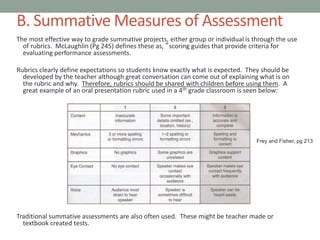
The most effective way to grade summative projects, either group or individual is through the use
of rubrics. McLaughlin (Pg 245) defines these as, “scoring guides that provide criteria for
evaluating performance assessments.
Rubrics clearly define expectations so students know exactly what is expected. They should be
developed by the teacher although great conversation can come out of explaining what is on
the rubric and why. Therefore, rubrics should be shared with children before using them. A
great example of an oral presentation rubric used in a 4th grade classroom is seen below:
Traditional summative assessments are also often used. These might be teacher made or
textbook created tests.
Frey and Fisher, pg 213
Whatcanauthenticassessmentlooklikeintheelementaryclassroom?
FINAL THOUGHTS
Mrs. Nash’s second grade class starts the day by getting into their Readers Theatre groups. They
practice their scripts with their groups for about 10 minutes and then Mrs. Nash asks them to
prepare to present to the class. Groups are chosen to begin reading their scripts with the focus
being on fluency and expression. Once the group completes their task, their classmates share
“glows and grows” telling what they think their peers did well and need to work on. Meanwhile,
Mrs. Nash is using a rubric to grade each group. Later that day, as the children work independently
at Reading Workshop, Mrs.Nash calls reading groups to her back table. She spends time introducing a
new chapter to the group, listens to them read, jots notes about what strategies she sees children using
as they read. As she dismisses the reading group, she asks one child to stay behind and asks this
particular child to read a page or two of the text. The teacher marks the reading (running record) and
takes notes on fluency and strategy use. After reading, the class moves to writing workshop. At this
point, the teacher grabs her clipboard and moves around the classroom. She stops at particular children
and asks them to share what they have worked on so far. She encourages, guides and teaches individual
children as they work on their independent stories. As she works with children, she takes notes on
her clipboard, which she will use later to guide her planning of minilessons. At math, Mrs. Nash reinforces
what has been learned previously about fractions. After playing games and completing problems together,
Mrs. Nash asks her students to take out their Learning Logs. Before closing the lesson, she asks the
second graders to write a story problem (using fractions) for their classmates to solve. The students turn
in their learning logs and the teacher guides children to solve some of the chosen word problems.

Assessment

  • 1.
  • 2.
    Definition • What comesto your mind when you hear the term ‘assessment’? • What types of assessments have you seen or used with children? • What is the difference between ASSESSMENT and EVALUATION? • In addition to your notes from the reading, it is important to remember that assessment must not be a one-time activity but an ongoing process, that informs instruction. (Pike & Mumper, 2004)
  • 3.
    As our worldand the children we teach change so does our teaching. Education is evolving and changing daily. Because of this, so is assessment. McLaughlin (p. 232) states, As 21st century content area teachers, we are striving to move away from the teacher/text dominated classroom and to transition to a time of student-generated ideas, self selection, critical thinking, creativity, interaction and personal construction of meaning. As a result of this changing paradigm, assessment has been undergoing a major reformation. Practices have been shifting from the traditional “read the book and answer the question” method to a more performance- based “show what you can do with what you have learned” approach.
  • 4.
    Think about whatyou know from the TAP rubric and how this relates to assessment. Standards and objectives! PIC: clear and concise
  • 5.
    What are someimportant characteristics of assessment?
  • 6.
    Clear Purpose andSpecific Learning Targets Assessment must have a clear purpose and is specific.
  • 7.
    Assessment is standards-based. Freyand Fisher (p. 250) state, “Students will be tested; teachers and schools will be evaluated according to student performance on these tests.” There is much controversy about this topic, but this will not be changing any time soon. “We must be careful not to allow the test practice to become the curriculum. Rather, we believe in teaching to the standards that are tested. When students are well versed in standards-based content, they are more likely to do well on the test. School is still about creating citizens who can participate in democracy.” (Frey and Fisher, p. 251)
  • 8.
    Assessment is authentic. Becausewe know that the assessment should guide the teachers instruction, assessment is grounded in real world, real classroom experiences. Rather than using only a standardized or traditional test, teachers are looking at what children do daily and using that as assessment. For example, teachers are looking at writing samples, projects, reading samples (running records); their students day to day work versus only using a culminating project or test.
  • 9.
    Assessment is reflective. Reflectionencourages students and teachers to take ownership over their learning. It also helps affirm the learner and let the student know that their learning is valued and their thoughts heard. Teachers are also reflective after teaching because they consistently ask themselves questions like: What worked today? What can I do tomorrow? What does this group of children or child need now? McLaughlin (pg 235) shares, “Reflective activities in the classroom help make thinking more visible, enabling students to learn from one another and to gain greater insights into their own thinking and learning process.”
  • 10.
    Assessment is dynamic “Nolonger is it a valid notion that assessment is a one-time activity; rather, assessment is an integral part of instruction that helps guide teacher’ planning and delivery of instruction.” McLaughlin (pg. 234) shares, “Because assessment has a dynamic nature, it is viewed not as an event but rather a natural, ongoing, purposeful component of teaching and learning.”
  • 11.
    Assessment has multipleresponse formats. In classrooms that integrate authentic assessment, teachers are aware that his/her students have many strengths. Therefore, this teacher offers a variety of assessment to check on what has been learned. This variety includes assessments that involve speaking, writing, dramatizing, technology, film, music and art.
  • 12.
    Purposes of Assessment Assessment Informs instruction Utilizes multiple measures Determines students’ strengths& knowledge Discovers what students’ abilities, with and without teacher’s guidance Documents students’ progress Summarizes achievement & learning over time (Pike & Mumper, 2004, pp. 180-181)
  • 13.
    What are formativeassessments? Ongoing Means of improving learning Suggests future steps for teaching Classroom based Informal There are two types of assessments that we can use to understand what our children have learned and need next. These are: A. Formative Assessments B. Summative Assessments What are summative assessments? Occur at end of unit or lesson Measure skills related to unit Is a final product Usually involves grading V E R S U S
  • 14.
    “We can monitorall students progress through formative assessments, but this type of assessment is especially valuable in the case of the English learner. We often provide these students with additional support and observing their progress through formative assessments provides us with ongoing insight into their thinking and abilities. The resulting information informs our future lesson planning.” McLaughlin, pg 239
  • 15.
    A. Formative Measuresof Assessment In literacy, the effective formative measures of assessment are: • Observation/ kidwatching • Retellings • Interviews, surveys, and inventories • Student self-evaluation • Think alouds • Analysis of student products and projects (performance assessment) and analysis of student performance on state exams (grade level) (Pike & Mumper, 2004, p. 181)
  • 16.
    Observation/ Kidwatching • theprocess of observing children as they engage in authentic daily activities, or of looking at the results or products of these activities (Pike & Mumper, 2004, p. 182) • the process of students retell or talk about what they have read using their own words, assessing the extent that students are able to summarize, remember details, sequence events, and make meaning of the text in general (Pike & Mumper, 2004, p.185) Retellings
  • 17.
    Interviews, Surveys, andInventories • Interviews give students opportunities to talk about their learning (the what and how of learning). For example, you could interview a student and let him/ her talk about her learning and the process after completing a KWDL chart. (see next slide) • When students look at themselves as learners and evaluate their own progress and development… aimed at making them reflective learners (Pike & Mumper, 2004, pp. 187-188) Student Self Evaluation
  • 18.
  • 19.
    Student Products, projects,and other work samples • These artifacts show evidence of students’ work in class and, if authentic, provide evidence of their performance and learning. Other examples: informal writing pieces (e.g. journal entries, exits slips, quickwrites, etc. • When students verbalize their thoughts as they read, write, or make sense of text (Pike & Mumper, 2004, p. 188) Think Alouds
  • 20.
    • Think-Pair-Share • Clearas Mud • Ringed Index Cards • The __#__ -Minute Paper • Picture or Non-linguistic representation • Thumbs Up or Down • Fist-to-Five • Assessment Response Cards • Mini-White Boards • Who, What, Where, When, Why • Concept Map Other Formative Assessments
  • 21.
    B. Summative Measuresof Assessment The most effective way to grade summative projects, either group or individual is through the use of rubrics. McLaughlin (Pg 245) defines these as, “scoring guides that provide criteria for evaluating performance assessments. Rubrics clearly define expectations so students know exactly what is expected. They should be developed by the teacher although great conversation can come out of explaining what is on the rubric and why. Therefore, rubrics should be shared with children before using them. A great example of an oral presentation rubric used in a 4th grade classroom is seen below: Traditional summative assessments are also often used. These might be teacher made or textbook created tests. Frey and Fisher, pg 213
  • 22.
    Whatcanauthenticassessmentlooklikeintheelementaryclassroom? FINAL THOUGHTS Mrs. Nash’ssecond grade class starts the day by getting into their Readers Theatre groups. They practice their scripts with their groups for about 10 minutes and then Mrs. Nash asks them to prepare to present to the class. Groups are chosen to begin reading their scripts with the focus being on fluency and expression. Once the group completes their task, their classmates share “glows and grows” telling what they think their peers did well and need to work on. Meanwhile, Mrs. Nash is using a rubric to grade each group. Later that day, as the children work independently at Reading Workshop, Mrs.Nash calls reading groups to her back table. She spends time introducing a new chapter to the group, listens to them read, jots notes about what strategies she sees children using as they read. As she dismisses the reading group, she asks one child to stay behind and asks this particular child to read a page or two of the text. The teacher marks the reading (running record) and takes notes on fluency and strategy use. After reading, the class moves to writing workshop. At this point, the teacher grabs her clipboard and moves around the classroom. She stops at particular children and asks them to share what they have worked on so far. She encourages, guides and teaches individual children as they work on their independent stories. As she works with children, she takes notes on her clipboard, which she will use later to guide her planning of minilessons. At math, Mrs. Nash reinforces what has been learned previously about fractions. After playing games and completing problems together, Mrs. Nash asks her students to take out their Learning Logs. Before closing the lesson, she asks the second graders to write a story problem (using fractions) for their classmates to solve. The students turn in their learning logs and the teacher guides children to solve some of the chosen word problems.