Writing from Sources: Part 1
Emily Kissner
June 2014
Agenda
1. Why write from sources?
2. Steps for synthesis
3. Unpacking the process (see Part 2)
4. Classroom activities (see Part 2)
Common Core Shift Video
As you view the video,
consider:
• What do these speakers
consider “writing from
sources” to be?
• Do you agree with their
claims that this hasn’t
been emphasized in
classrooms?
• How do you feel about
this video?
Your Turn!
Remember a time that you had to
write from sources.
-Create three verbs that show what
actions you took to create your piece
of writing.
-Write an adjective that shows how
you felt:
-at the beginning of the project
-during the project
-when you finished the project
We’ll create a Wordle to capture our feelings about writing from
sources.
Why write from sources?
Research the standards: Which standards
from your state and grade level explicitly
refer to writing from sources? Which
standards may imply a need to write from
sources?
Observing student synthesis
There is a strong line of research
investigating what students actually do when
posed with a synthesis task. As we go
forward, we need to consider the thinking
processes necessary for successful
synthesis—and the thinking processes that
students actually use.
Observing student synthesis
The idea is that we can teach many of the
underlying skills for synthesis before
students have to write the formal research
paper.
Selecting: Students
must select information
relevant to the writing
task
Connecting: Students
must make connections
among ideas.
Organizing: Students must
organize ideas into a new
piece of writing.
Think about it
Consider the three main processes for
synthesis: selection, connection,
organization. What have you done in your
classroom that supports these processes?
What do you wish you had done?
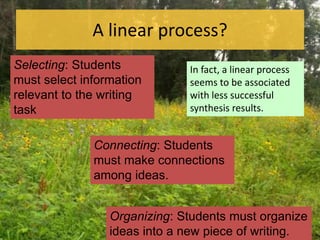
A linear process?
Selecting: Students
must select information
relevant to the writing
task
Connecting: Students
must make connections
among ideas.
Organizing: Students must organize
ideas into a new piece of writing.
A linear process?
Selecting: Students
must select information
relevant to the writing
task
Connecting: Students
must make connections
among ideas.
Organizing: Students must organize
ideas into a new piece of writing.
In fact, a linear process
seems to be associated
with less successful
synthesis results.
A recursive process
Selecting: Students
must select information
relevant to the writing
task
Connecting: Students
must make connections
among ideas.
Organizing: Students must organize
ideas into a new piece of writing.
Less successful strategies
In the least successful synthesis products,
students merely summarized or copied
sentences from various texts.
Less successful strategies
The resulting synthesis papers do not show
integration of ideas. Have you seen this in
your students’ writings?
“Just get it done!”
A focus on task completion may be
damaging to strong synthesis. Why might
being focused on a product interfere with a
strong recursive process?
Thinking about the classroom
The idea of a recursive process and a less
intense focus on task completion is at odds
with the work of most classrooms. What do
you think?
The good news
The process of integrating ideas and figuring
out how to say them helps students to
become stronger readers and writers.
In the next part…
Low stakes classroom activities to help
students build the skills of connecting,
organizing, and selecting information
References
Gil, Laura, Ivar Braten, Eduardo Vidal-Abarca, and Helge StromsoI. 2010. “Summary versus
Argument Tasks when Working with Multiple Documents: Which Is Better for Whom?”
Contemporary Educational Psychology, v35 n3 p157-173.
Mateos, Mar and Isabel Sole. 2009. “Synthesising Information from Various Texts: A Study of
Procedures and Products at Different Educational Levels.” European Journal of Psychology of
Education, v24 n4 p435-451.
Mateos, Mar, Elena Martin, Ruth Villalon, and Maria Luna. 2008. “Reading and Writing to
Learn in Secondary Education: Online Processing Activity and Written Products in
Summarizing and Synthesizing Tasks.” Reading and Writing: An Interdisciplinary Journal, v21
n7 p675-697.
Sole, Isabel, Mariana Miras, Nuria Castells, Sandra Espino, and Marta Minguela. 2013.
“Integrating Information: An Analysis of the Processes Involved and the Products Generated
in a Written Synthesis Task.” Written Communication, v30 n1 p63-90.
Spivey, N.N. 1997. “Transforming texts: Constructive processes in reading and writing.”
Written Communication, 7, 256–287.
Zhang, Cui. 2013. “Effect of Instruction on ESL Students' Synthesis Writing.” Journal of Second
Language Writing, v22 n1 p51-67.

Writing from Sources Part 1

  • 1.
    Writing from Sources:Part 1 Emily Kissner June 2014
  • 2.
    Agenda 1. Why writefrom sources? 2. Steps for synthesis 3. Unpacking the process (see Part 2) 4. Classroom activities (see Part 2)
  • 3.
    Common Core ShiftVideo As you view the video, consider: • What do these speakers consider “writing from sources” to be? • Do you agree with their claims that this hasn’t been emphasized in classrooms? • How do you feel about this video?
  • 4.
    Your Turn! Remember atime that you had to write from sources. -Create three verbs that show what actions you took to create your piece of writing. -Write an adjective that shows how you felt: -at the beginning of the project -during the project -when you finished the project We’ll create a Wordle to capture our feelings about writing from sources.
  • 5.
    Why write fromsources? Research the standards: Which standards from your state and grade level explicitly refer to writing from sources? Which standards may imply a need to write from sources?
  • 6.
    Observing student synthesis Thereis a strong line of research investigating what students actually do when posed with a synthesis task. As we go forward, we need to consider the thinking processes necessary for successful synthesis—and the thinking processes that students actually use.
  • 7.
    Observing student synthesis Theidea is that we can teach many of the underlying skills for synthesis before students have to write the formal research paper.
  • 8.
    Selecting: Students must selectinformation relevant to the writing task
  • 9.
    Connecting: Students must makeconnections among ideas.
  • 10.
    Organizing: Students must organizeideas into a new piece of writing.
  • 11.
    Think about it Considerthe three main processes for synthesis: selection, connection, organization. What have you done in your classroom that supports these processes? What do you wish you had done?
  • 12.
    A linear process? Selecting:Students must select information relevant to the writing task Connecting: Students must make connections among ideas. Organizing: Students must organize ideas into a new piece of writing.
  • 13.
    A linear process? Selecting:Students must select information relevant to the writing task Connecting: Students must make connections among ideas. Organizing: Students must organize ideas into a new piece of writing. In fact, a linear process seems to be associated with less successful synthesis results.
  • 14.
    A recursive process Selecting:Students must select information relevant to the writing task Connecting: Students must make connections among ideas. Organizing: Students must organize ideas into a new piece of writing.
  • 15.
    Less successful strategies Inthe least successful synthesis products, students merely summarized or copied sentences from various texts.
  • 16.
    Less successful strategies Theresulting synthesis papers do not show integration of ideas. Have you seen this in your students’ writings?
  • 17.
    “Just get itdone!” A focus on task completion may be damaging to strong synthesis. Why might being focused on a product interfere with a strong recursive process?
  • 18.
    Thinking about theclassroom The idea of a recursive process and a less intense focus on task completion is at odds with the work of most classrooms. What do you think?
  • 19.
    The good news Theprocess of integrating ideas and figuring out how to say them helps students to become stronger readers and writers.
  • 20.
    In the nextpart… Low stakes classroom activities to help students build the skills of connecting, organizing, and selecting information
  • 21.
    References Gil, Laura, IvarBraten, Eduardo Vidal-Abarca, and Helge StromsoI. 2010. “Summary versus Argument Tasks when Working with Multiple Documents: Which Is Better for Whom?” Contemporary Educational Psychology, v35 n3 p157-173. Mateos, Mar and Isabel Sole. 2009. “Synthesising Information from Various Texts: A Study of Procedures and Products at Different Educational Levels.” European Journal of Psychology of Education, v24 n4 p435-451. Mateos, Mar, Elena Martin, Ruth Villalon, and Maria Luna. 2008. “Reading and Writing to Learn in Secondary Education: Online Processing Activity and Written Products in Summarizing and Synthesizing Tasks.” Reading and Writing: An Interdisciplinary Journal, v21 n7 p675-697. Sole, Isabel, Mariana Miras, Nuria Castells, Sandra Espino, and Marta Minguela. 2013. “Integrating Information: An Analysis of the Processes Involved and the Products Generated in a Written Synthesis Task.” Written Communication, v30 n1 p63-90. Spivey, N.N. 1997. “Transforming texts: Constructive processes in reading and writing.” Written Communication, 7, 256–287. Zhang, Cui. 2013. “Effect of Instruction on ESL Students' Synthesis Writing.” Journal of Second Language Writing, v22 n1 p51-67.

Editor's Notes