Charcot-Marie-Tooth (CMT) High School Presentation Elizabeth Ouellette www.charcot-marie-tooth.org
Charcot-Marie-Tooth   Charcot-Marie-Tooth (CMT) disease is named after the 3 physicians who first identified it . Jean-Martin  Charcot 1825-1893 Pierre  Marie   1853-1940 Howard Henry  Tooth 1856-1925
Facts the most common inherited genetic disorder that involves the peripheral nerves, affecting an estimated 150,000 people in the United States. It occurs in all races and ethnic groups, affecting  about 1 in 2,500 people  or 2.6 million people worldwide. a progressive disorder, causing people to lose normal use of their hands. arms, feet/legs. not usually life-threatening and does not affect the brain or intelligence. not contagious, but is usually passed down from one generation to the next. currently not curable Charcot-Marie-Tooth (CMT) disease is:
CMT - Peripheral Nervous System CMT causes damage to the  peripheral nerves , which link the brain and spinal cord to muscles and sensory organs.  Peripheral Nerves  carry impulses from the spinal cord to muscles. Peripheral Nerves  convey sensation by carrying feelings like pain & temperature from the hands and feet to the spinal cord. Peripheral Nerves  help control balance, by carrying information about the position of the body in space.
A Nerve is Like a Wire Source: Carly Siskind, MS, CGC & Shawna Feely, MS
CMT Demyelinating (Type 1) Axonal (Type 2) Autosomal Dominant X-Linked Autosomal Recessive Demyelinating OR Axonal (Type 4) Intermediate (Type X) Many Types of CMT   Source: Carly Siskind, MS, CGC & Shawna Feely, MS
Subtypes of CMT Source: Carly Siskind, MS, CGC & Shawna Feely, MS CMT subtype Gene  HNPP PMP22  (deletion) CMT1A PMP22  (duplication) CMT1B MPZ CMT1C LITAF/SIMPLE CMT1D EGR2 CMT1E PMP22  (point mutation) CMT1X GJB1 (Cx32) CMT2A MFN2 CMT2B RAB7 CMT2D GARS CMT2E NFL CMT2F HSP27/HSPB1 CMT2L HSPB8  CMT4A GDAP1 CMT4B1 MTMR2  CMT4B2 SBF2  CMT4C SH3TC2  CMT4D NDRG1 CMT4E EGR2 CMT4F PRX CMT4J FIG4 dHMN V GARS  and  BSCL2 HSN SPTLC1
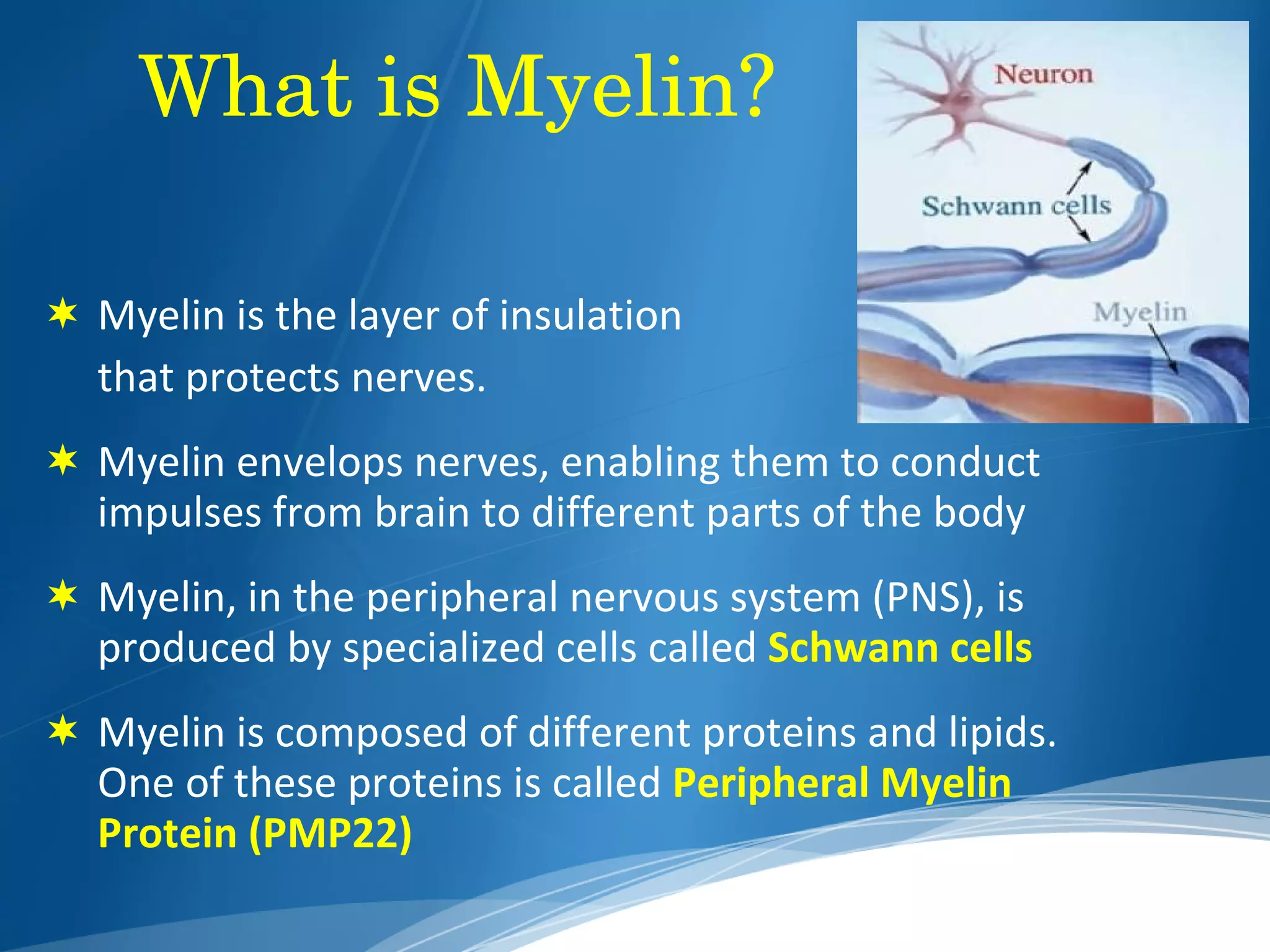
What is Myelin? Myelin is the layer of insulation  that protects nerves. Myelin envelops nerves, enabling them to conduct impulses from brain to different parts of the body Myelin, in the peripheral nervous system (PNS), is produced by specialized cells called  Schwann cells Myelin is composed of different proteins and lipids. One of these proteins is called  Peripheral Myelin Protein (PMP22)
Myelinated Peripheral Nerve
Characteristics and Symptoms High Arches Muscle weakness in lower legs: foot drop, poor  balance and sprained  ankles
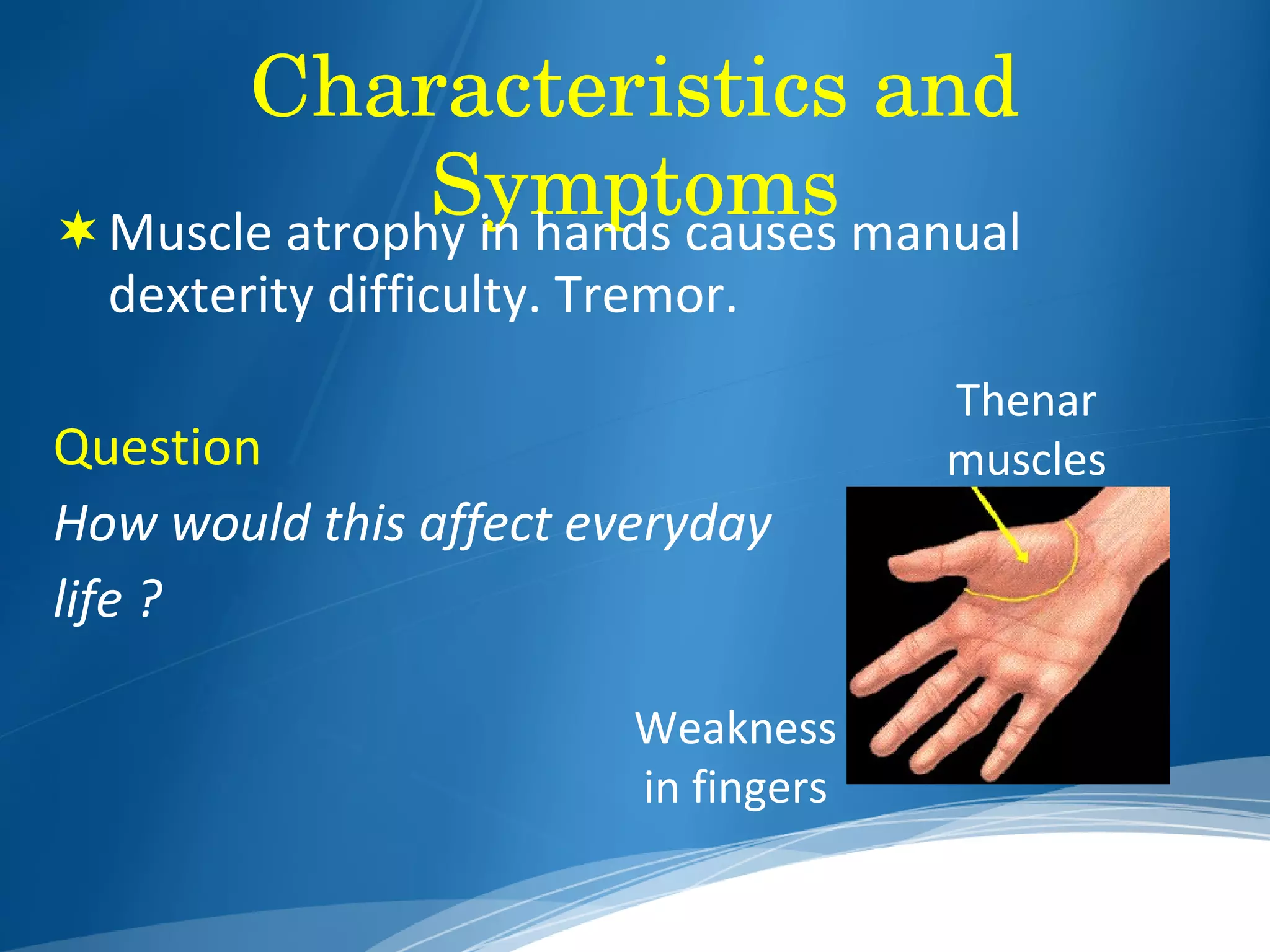
Characteristics and Symptoms Muscle atrophy in hands causes manual dexterity difficulty. Tremor. Question How would this affect everyday  life ? Thenar muscles Weakness in fingers
Characteristics and Symptoms   Loss of nerve function can lead to tingling, burning sensation in hands and feet (painful neuropathy) Additional Symptoms: fatigue, breathing problems, scoliosis, kyphosis…..
Treatments Physical Therapy Moderate Activity AFOs or leg braces Occupational Therapy Surgery Now, there is hope for a cure…  STAR
CMT: Back to Basics Charcot-Marie-Tooth disease is caused by inherited mutations in the genes involved with the structure and function of the peripheral nerves
Chromosomes
Chromosomes Chromosome  = bookcase Genes  = books on the bookcase DNA  = letters which give the book its meaning If there is a typo in the book or if there are missing or extra pages, the book’s message (code) might be changed  A  mutation  in the DNA of a gene = typo in a book Source: Carly Siskind, MS, CGC  & Shawna Feely, MS
CMT & Genetic Mutations Charcot-Marie-Tooth disease is caused by inherited mutations in the genes involved with the structure and function of the peripheral nerves Chromosome 17 PMP22 gene  duplication PMP22 gene  duplication
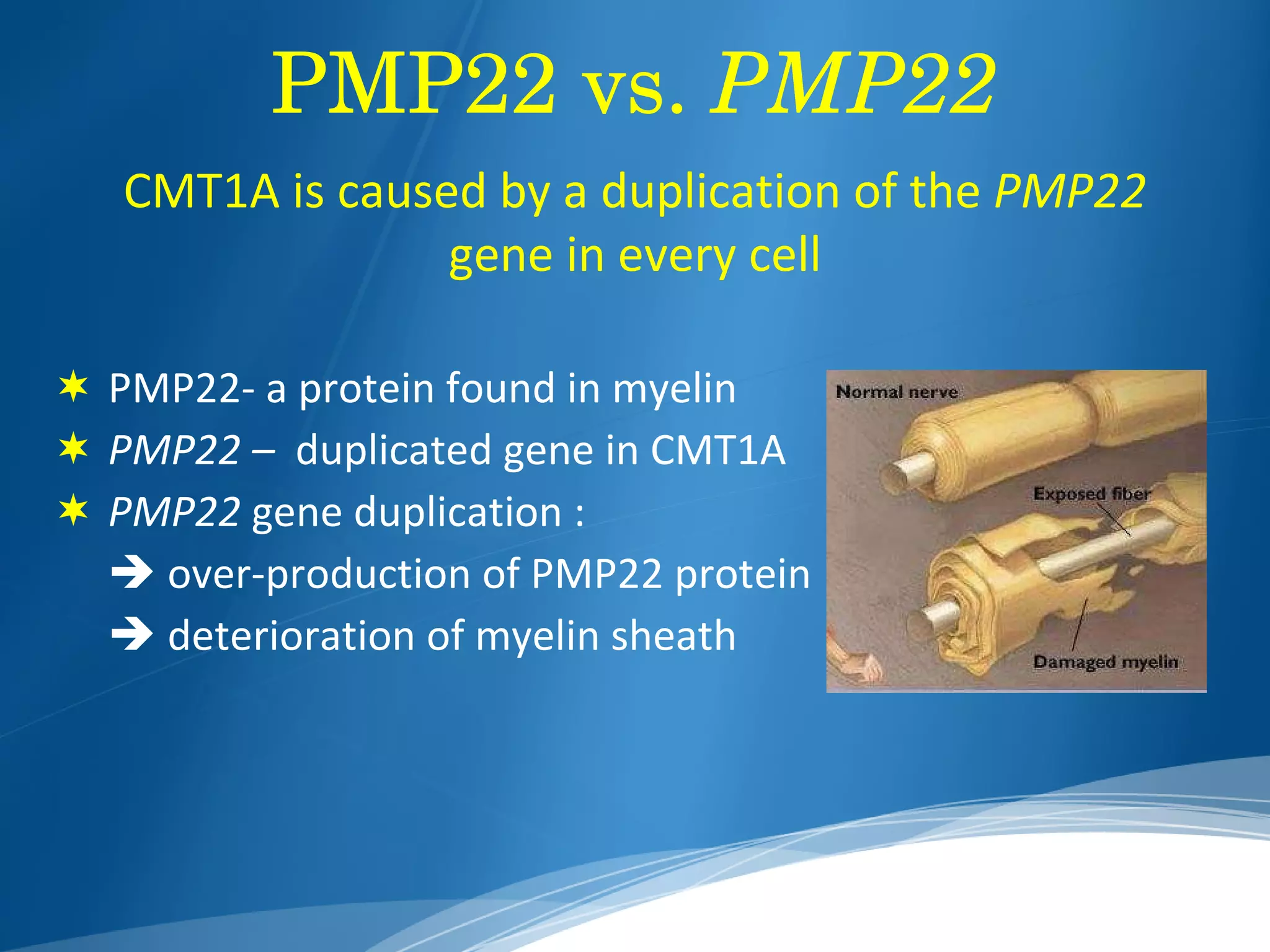
PMP22 vs.  PMP22 PMP22- a protein found in myelin PMP22   –  duplicated gene in CMT1A PMP22  gene duplication :    over-production of PMP22 protein     deterioration of myelin sheath CMT1A is caused by a duplication of the  PMP22  gene in every cell
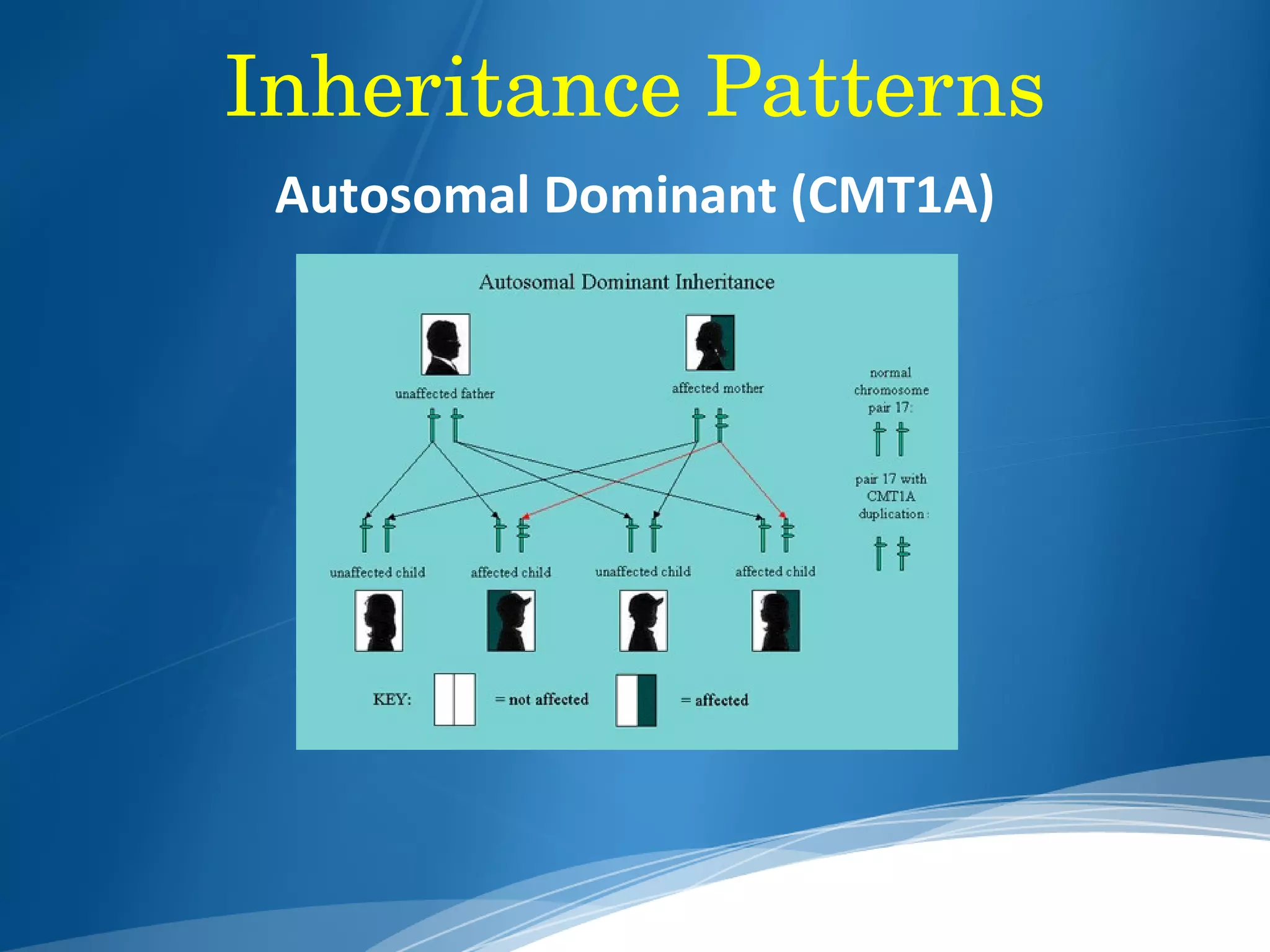
Inheritance Patterns Autosomal Dominant (CMT1A)
X-linked Inheritance   Unaffected Affected Unaffected Affected
Autosomal Recessive (Type 4)
Spontaneous Mutations Unaffected  Unaffected  Affected  Spontaneous Mutation
Activity …… .Put the initials of your father in the square and the initials of your mother in  the circle. …… ..Put your initials in either the circle or square,  depending if you are male or female. …… ..Roll the dice once to determine how many children you will have. Decide on the sex.  ………Take the coin and flip it. Heads-the child has CMT, and Tails-child does not have CMT.  ………Do this for every child. Mark your results.
Everyone Has Different Abilities Albert Einstein : Aspergers Tom Cruise: Dyslexia Jim Carrey: Depression Gerry Jewel: Cerebral Palsy Franklin D. Roosevelt: Polio  Erik Weihenmayer: Blind
Achieving our vision of a world without CMT…
Goals of STAR Grow CMT1A cell line Work in conjunction with the National Chemical Genomics Center (NCGC), where more than 300,000 compounds will be screened against the CMTA’s cell line using High Throughput Screening (HTS) The most promising candidate compounds will be further evaluated in CMT- specific animal models. Human trials Collaboration among some of the world’s best scientists to find a cure for CMT
Create a CMT1A Cell Line Cell lines are cells (in this case, CMT1A cells), taken from tissue and grown in culture dishes Researchers add a florescent marker or Luciferace to the cells to indicate luminescence every time the PMP22 protein is present
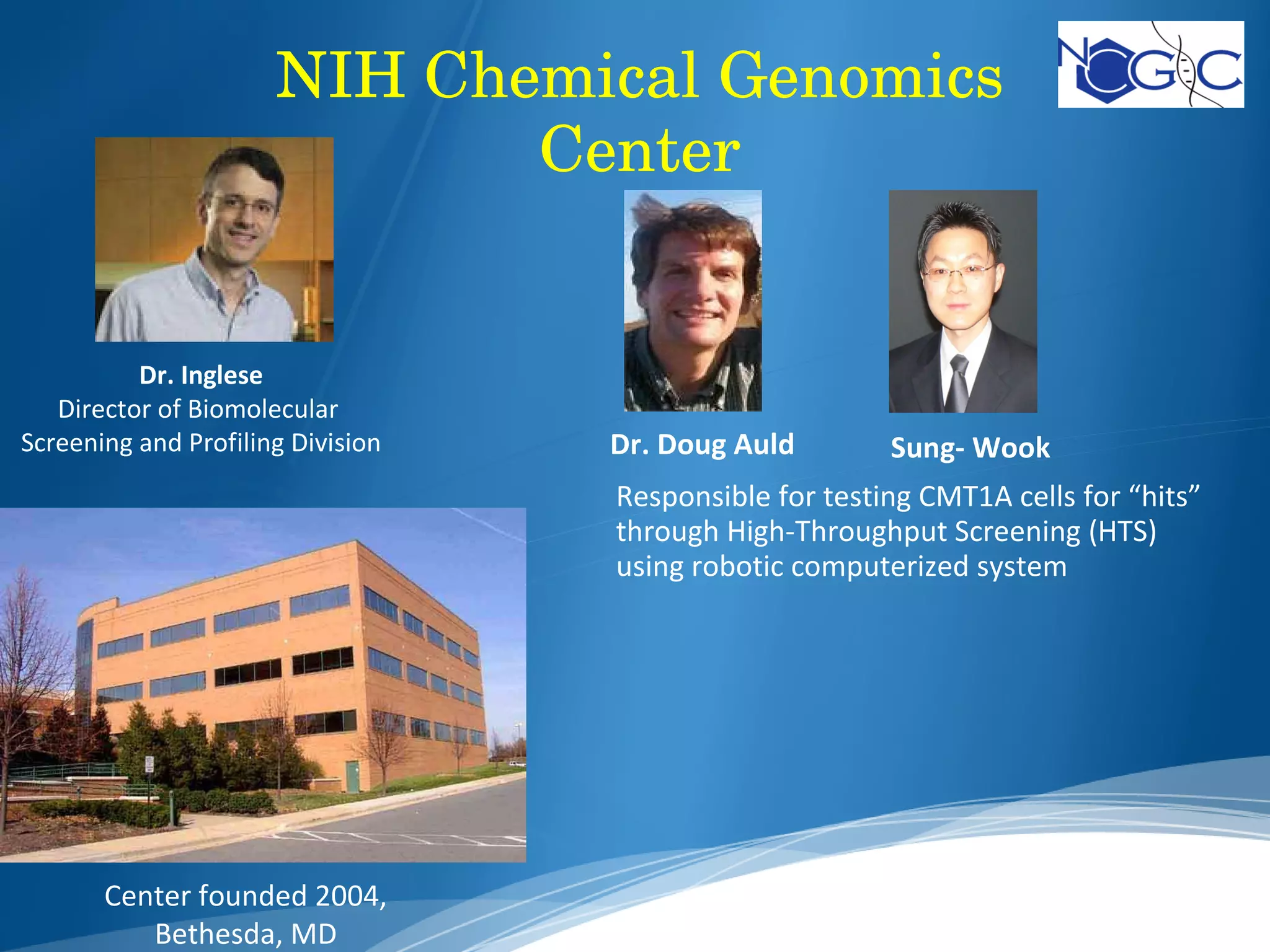
NIH Chemical Genomics Center Responsible for testing CMT1A cells for “hits” through High-Throughput Screening (HTS) using robotic computerized system Dr. Inglese Director of Biomolecular  Screening and Profiling Division Center founded 2004, Bethesda, MD Dr. Doug Auld   Sung- Wook
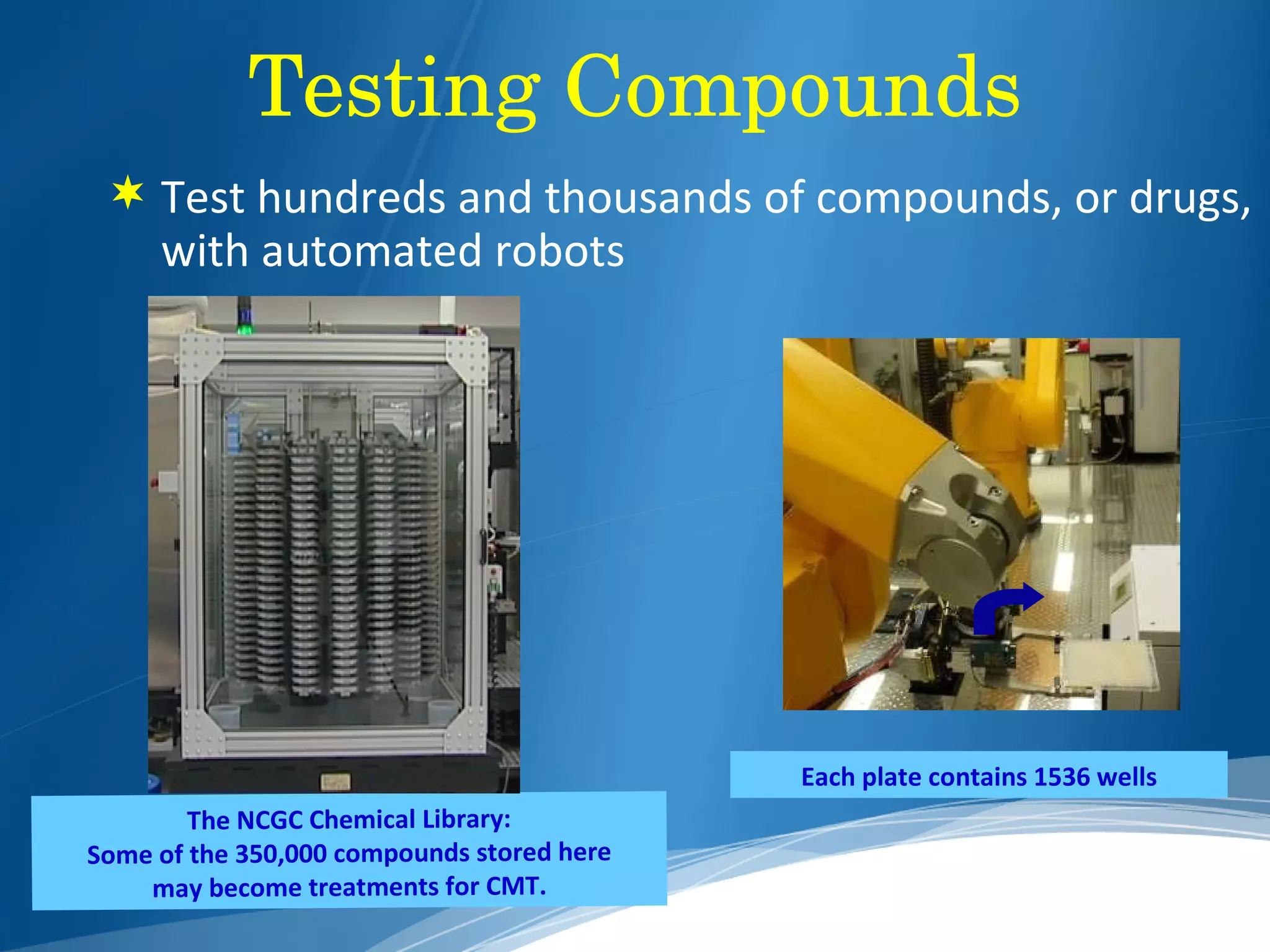
Testing Compounds The NCGC Chemical Library: Some of the 350,000 compounds stored here may become treatments for CMT. Each plate contains 1536 wells Test hundreds and thousands of compounds, or drugs, with automated robots
High-Throughput Screening Cells in cell line expresses Luciferace when PMP22 present: The more PMP22 in cells, the brighter they will glow Compounds (medications) that make cells dim    less PMP22 “ Hits” are considered as candidate medications  to treat CMT1A
Testing  Medications Create CMT1A laboratory animals (rats)  Take the most promising compounds found during HTS process and test them on CMT1A laboratory animals Confirm specific candidate medication successfully works on laboratory rats with CMT1A Klaus-Armin Nave – Director of Plank Institute for Experimental Medicine in Gottingen, Germany
Clinical Trials Centers of Excellence Wayne State University, (Detroit, Michigan) University of Pennsylvania (Philadelphia) University of Washington (Seattle) University of Texas, Southwestern (Dallas)  John Hopkins University (Baltimore, MD) University of Rochester (NY)

CMT slides: understand the disease.

  • 1.
    Charcot-Marie-Tooth (CMT) HighSchool Presentation Elizabeth Ouellette www.charcot-marie-tooth.org
  • 2.
    Charcot-Marie-Tooth Charcot-Marie-Tooth (CMT) disease is named after the 3 physicians who first identified it . Jean-Martin Charcot 1825-1893 Pierre Marie 1853-1940 Howard Henry Tooth 1856-1925
  • 3.
    Facts the mostcommon inherited genetic disorder that involves the peripheral nerves, affecting an estimated 150,000 people in the United States. It occurs in all races and ethnic groups, affecting about 1 in 2,500 people or 2.6 million people worldwide. a progressive disorder, causing people to lose normal use of their hands. arms, feet/legs. not usually life-threatening and does not affect the brain or intelligence. not contagious, but is usually passed down from one generation to the next. currently not curable Charcot-Marie-Tooth (CMT) disease is:
  • 4.
    CMT - PeripheralNervous System CMT causes damage to the peripheral nerves , which link the brain and spinal cord to muscles and sensory organs. Peripheral Nerves carry impulses from the spinal cord to muscles. Peripheral Nerves convey sensation by carrying feelings like pain & temperature from the hands and feet to the spinal cord. Peripheral Nerves help control balance, by carrying information about the position of the body in space.
  • 5.
    A Nerve isLike a Wire Source: Carly Siskind, MS, CGC & Shawna Feely, MS
  • 6.
    CMT Demyelinating (Type1) Axonal (Type 2) Autosomal Dominant X-Linked Autosomal Recessive Demyelinating OR Axonal (Type 4) Intermediate (Type X) Many Types of CMT Source: Carly Siskind, MS, CGC & Shawna Feely, MS
  • 7.
    Subtypes of CMTSource: Carly Siskind, MS, CGC & Shawna Feely, MS CMT subtype Gene HNPP PMP22 (deletion) CMT1A PMP22 (duplication) CMT1B MPZ CMT1C LITAF/SIMPLE CMT1D EGR2 CMT1E PMP22 (point mutation) CMT1X GJB1 (Cx32) CMT2A MFN2 CMT2B RAB7 CMT2D GARS CMT2E NFL CMT2F HSP27/HSPB1 CMT2L HSPB8 CMT4A GDAP1 CMT4B1 MTMR2 CMT4B2 SBF2 CMT4C SH3TC2 CMT4D NDRG1 CMT4E EGR2 CMT4F PRX CMT4J FIG4 dHMN V GARS and BSCL2 HSN SPTLC1
  • 8.
    What is Myelin?Myelin is the layer of insulation that protects nerves. Myelin envelops nerves, enabling them to conduct impulses from brain to different parts of the body Myelin, in the peripheral nervous system (PNS), is produced by specialized cells called Schwann cells Myelin is composed of different proteins and lipids. One of these proteins is called Peripheral Myelin Protein (PMP22)
  • 9.
  • 10.
    Characteristics and SymptomsHigh Arches Muscle weakness in lower legs: foot drop, poor balance and sprained ankles
  • 11.
    Characteristics and SymptomsMuscle atrophy in hands causes manual dexterity difficulty. Tremor. Question How would this affect everyday life ? Thenar muscles Weakness in fingers
  • 12.
    Characteristics and Symptoms Loss of nerve function can lead to tingling, burning sensation in hands and feet (painful neuropathy) Additional Symptoms: fatigue, breathing problems, scoliosis, kyphosis…..
  • 13.
    Treatments Physical TherapyModerate Activity AFOs or leg braces Occupational Therapy Surgery Now, there is hope for a cure… STAR
  • 14.
    CMT: Back toBasics Charcot-Marie-Tooth disease is caused by inherited mutations in the genes involved with the structure and function of the peripheral nerves
  • 15.
  • 16.
    Chromosomes Chromosome = bookcase Genes = books on the bookcase DNA = letters which give the book its meaning If there is a typo in the book or if there are missing or extra pages, the book’s message (code) might be changed A mutation in the DNA of a gene = typo in a book Source: Carly Siskind, MS, CGC & Shawna Feely, MS
  • 17.
    CMT & GeneticMutations Charcot-Marie-Tooth disease is caused by inherited mutations in the genes involved with the structure and function of the peripheral nerves Chromosome 17 PMP22 gene duplication PMP22 gene duplication
  • 18.
    PMP22 vs. PMP22 PMP22- a protein found in myelin PMP22 – duplicated gene in CMT1A PMP22 gene duplication :  over-production of PMP22 protein  deterioration of myelin sheath CMT1A is caused by a duplication of the PMP22 gene in every cell
  • 19.
  • 20.
    X-linked Inheritance Unaffected Affected Unaffected Affected
  • 21.
  • 22.
    Spontaneous Mutations Unaffected Unaffected Affected Spontaneous Mutation
  • 23.
    Activity …… .Putthe initials of your father in the square and the initials of your mother in the circle. …… ..Put your initials in either the circle or square, depending if you are male or female. …… ..Roll the dice once to determine how many children you will have. Decide on the sex. ………Take the coin and flip it. Heads-the child has CMT, and Tails-child does not have CMT. ………Do this for every child. Mark your results.
  • 24.
    Everyone Has DifferentAbilities Albert Einstein : Aspergers Tom Cruise: Dyslexia Jim Carrey: Depression Gerry Jewel: Cerebral Palsy Franklin D. Roosevelt: Polio Erik Weihenmayer: Blind
  • 25.
    Achieving our visionof a world without CMT…
  • 26.
    Goals of STARGrow CMT1A cell line Work in conjunction with the National Chemical Genomics Center (NCGC), where more than 300,000 compounds will be screened against the CMTA’s cell line using High Throughput Screening (HTS) The most promising candidate compounds will be further evaluated in CMT- specific animal models. Human trials Collaboration among some of the world’s best scientists to find a cure for CMT
  • 27.
    Create a CMT1ACell Line Cell lines are cells (in this case, CMT1A cells), taken from tissue and grown in culture dishes Researchers add a florescent marker or Luciferace to the cells to indicate luminescence every time the PMP22 protein is present
  • 28.
    NIH Chemical GenomicsCenter Responsible for testing CMT1A cells for “hits” through High-Throughput Screening (HTS) using robotic computerized system Dr. Inglese Director of Biomolecular Screening and Profiling Division Center founded 2004, Bethesda, MD Dr. Doug Auld Sung- Wook
  • 29.
    Testing Compounds TheNCGC Chemical Library: Some of the 350,000 compounds stored here may become treatments for CMT. Each plate contains 1536 wells Test hundreds and thousands of compounds, or drugs, with automated robots
  • 30.
    High-Throughput Screening Cellsin cell line expresses Luciferace when PMP22 present: The more PMP22 in cells, the brighter they will glow Compounds (medications) that make cells dim  less PMP22 “ Hits” are considered as candidate medications to treat CMT1A
  • 31.
    Testing MedicationsCreate CMT1A laboratory animals (rats) Take the most promising compounds found during HTS process and test them on CMT1A laboratory animals Confirm specific candidate medication successfully works on laboratory rats with CMT1A Klaus-Armin Nave – Director of Plank Institute for Experimental Medicine in Gottingen, Germany
  • 32.
    Clinical Trials Centersof Excellence Wayne State University, (Detroit, Michigan) University of Pennsylvania (Philadelphia) University of Washington (Seattle) University of Texas, Southwestern (Dallas) John Hopkins University (Baltimore, MD) University of Rochester (NY)

Editor's Notes

  • #3 In 1886 two French neurologists (Charcot and Marie) and one English neurologist (Tooth) described a set of characteristic physical symptoms to which was later given their names - Charcot-Marie-Tooth disease (CMT). Tooth realized that problem was in the nerves not the muscle.
  • #4 MS-250,000-300,000
  • #6 A nerve resembles a telephone wire. The outer coating protects the nerve and facilitates impulses moving strongly and quickly from the feet/hands to the brain and back. Some types of CMT affect the myelin and others affect primarily the nerve cells or axons.
  • #7 CMT is one term for many different types and subtypes of CMT.
  • #8 No Explanation-just to show all the different subtypes of CMT 40 genes found, 44 loci.
  • #10 A slide to show how what the nerve cells look like in the body.
  • #11 A high arched foot is usually one of the first signs of this disorder, although in some instances extremely flat feet are also typical of CMT. As the disease progresses, structural foot deformities take place. People may develop a pes cavus (high-arched) foot and hammertoes. The progressive muscle wasting of CMT also leads to problems with walking, running, and balance. Ankle weakness and sprains are common, and many patients develop foot drop. To avoid tripping, patients with foot drop raise their knees unusually high, resulting in the high “steppage” gait associated with CMT. In some patients, muscle weakness may also occur in the upper legs.
  • #12 Hand function may become affected. Progressive atrophy of the thenar muscles at the base of the thumb and other small muscles in the hand results in fine motor skill challenges. Tasks requiring manual dexterity become difficult. Patients have problems holding writing utensils, buttoning clothing, grasping zipper pulls and turning doorknobs.
  • #15 We all are made up of cells, which are the very smallest unit of living matter. Cells have a nucleus, which controls the cell’s activities and acts like the cell’s brain. Within the nucleus, there are chromosomes which are made up of DNA and the proteins that are attached to it.  DNA (Deoxyribonucleic acid) is the building block of the gene and is made up of 4 chemical bases A,T,C,G.   When certain proteins attach themselves to the DNA, it all coils ups into 'superhelixes' that we call chromosomes.  So, our DNA is located inside the chromosomes of every cell in the human body, except red blood cells. The sections of DNA that make each of us different are called genes. You inherit your genes from your parent. There are 100 trillion cells in the human body and 20,000-25,000 genes in the human body. 1200-1500 genes on Chromosome 17.
  • #16 We all have 23 pairs of chromosomes (1 of each pair is from your mom and 1 is from your dad): 22 autosomes (an autosome is a chromosome that is not a sex chromosome) & 2 sex chromosomes.. Males have an X and a Y chromosome and females have 2 XX chromosomes. (Karyotype is a complete set of chromosomes.)
  • #17 DNA is the building block of the genes and a gene is made up of 4 chemical bases represented by the letters C,T,G,A. A combination of three of these DNA “letters” when put together make one DNA “word” . Each of these words is the code for a specific amino acid. The amino acids are then strung together like beads on a string to make up a protein. Proteins are the building blocks for different tissues. Book shelf analogy: Chromosomes are the book shelf, genes are the books, DNA are the pages and the codes are the words.
  • #18 In the example of CMT1A, there is a gene duplication on Chromosome 17. 3 genes instead of 2.
  • #19 To differentiate between the PMP 22 gene and the PMP 22 protein, italics are used when speaking of the gene. PMP 22 (protein) is found in only 5% of the peripheral nervous system. Did you know that Schwann cells, (named after the German physiologist Theodor Schwann) are the cells that make the myelin insulation of the nerves in the peripheral nervous system (as opposed the central nervous system, which is composed of the brain and spinal cord)? In CMT1A, the Schwann cells make too much PMP22 protein. The extra PMP22 protein that the Schwann cells make in CMT1A patients disrupts the function of the myelin and causes peripheral neuropathy.
  • #20 In the case of autosomal dominant genes, a single abnormal gene on one of the autosomal chromosomes (one of the first 22 "non-sex" chromosomes) from either parent can cause the disease. Autosomal means the condition can equally affect males as well as females. If one parent has CMT there is a 50/50 chance of passing the gene on to the child.
  • #21 Regarding the X-linked form of inheritance, the gene that is mutated and causing the condition is on the X chromosome (not the female chromosome - both men and women have X chromosomes). The mutated CMT gene is carried on the X chromosome. Mothers have a 50/50 chance of passing the CMT gene on to her sons and daughters. A new mutation is also possible. A father cannot pass the condition on to his son. The father will pass it on to all of his daughters.
  • #22 The least common forms of CMT are inherited in an autosomal recessive manner. All Type 4 patients have inherited the autosomal recessive form of CMT. In autosomal recessive forms, both parents have to be “carriers” of the defective gene before a child can be affected. Neither parent shows signs of any symptoms of CMT, but the child who inherits autosomal recessive CMT gets a double dose of the affected gene, causing him or her to have the disease, usually in a more severe form. Two parents each with an autosomal recessive CMT gene have a 1 in 4 chance of passing it on to their children. It can affect both males and females
  • #23 Our Sphynx cat, Tortellini, is a hairless cat and is an example of a natural and spontaneous mutation, which resulted in her thinking she is a monkey. Yohan does not think he is a monkey, thank God, but he also had a spontaneous mutation, a de novo mutation making him the first in our family to have CMT.
  • #24 The square is your dad, and the circle your mom. You are either a circle or a square, depending if you are male or female.
  • #25 32 nd President of US. He contracted polio. Fitting his hips and legs with iron braces, he laboriously taught himself to walk a short distance by swiveling his torso while supporting himself with a cane. In private, he used a wheelchair. He usually appeared in public standing upright, supported on one side by an aide or one of his sons. FDR used a car with specially designed hand controls, which further gave him the illusion of mobility . Everyone has differing abilities. Focus on strength and what you CAN do, as opposed to what is not possible. achieve your heart’s desire.
  • #26 04/26/10 15:11 © 2007 Microsoft Corporation. All rights reserved. Microsoft, Windows, Windows Vista and other product names are or may be registered trademarks and/or trademarks in the U.S. and/or other countries. The information herein is for informational purposes only and represents the current view of Microsoft Corporation as of the date of this presentation. Because Microsoft must respond to changing market conditions, it should not be interpreted to be a commitment on the part of Microsoft, and Microsoft cannot guarantee the accuracy of any information provided after the date of this presentation. MICROSOFT MAKES NO WARRANTIES, EXPRESS, IMPLIED OR STATUTORY, AS TO THE INFORMATION IN THIS PRESENTATION.
  • #27 The first project of STAR was to create a CMT 1A cell line. This step has been completed. The cell line is now at the National Institute of Health where it awaits testing through High-Throughput Screening.
  • #28 Each cell in the CMT1A cell line contains a florescent marker (Luciferace) similar to the glow seen in fire flies. Since thousands of medicines can be placed and tested in the wells of tissue culture plates, researchers are able to observe which medicines dim the fluorescent glow, suggesting that a particular compound is lowering the amount of PMP22 being produced. Since CMT1A involves the overproduction of PMP22, this procedure should quickly produce “candidate” medicines to control that overproduction.
  • #29 Now that the CMT1A line has been generated, it will be used in the High-Throughput Screening (HTS) facility housed at the National Institute of Health’s Chemical Genomics Center under the direction of Dr. Jim Inglese. Using a robotic computerized system, Dr. Inglese and his colleagues will be able to rapidly test hundreds of thousands of candidate medications to determine if they reduce the amount of PMP22 protein in the CMT1A cells. Sung-Wook Jang has committed to a three-year term as a CMTA post-doctoral fellow at the NCGC. Sung-Wook, who has a Ph.D in Cellular and Molecular Biology from the University of Wisconsin in Madison, will work closely with scientists at the NCGC and be responsible for the development and performance of screening efforts using the NIH compound library to find therapies for Charcot-Marie-Tooth. Doug Auld, who received a Ph.D at the University of North Carolina at Chapel Hill, followed by a post-doc in the Department of Biology at MIT is supervising Sung Wook’s thesis work. Doug Auld is now Group Leader for Genomic Assay Technologies at the NIH Chemical Genomic center.
  • #30 There are 1,536 wells in each plate. Each compound is tested at different doses (7 levels of dosing), to determine the best dilution of compound needed to reduce PMP22. This allows our researchers to accelerate the testing of hundreds and thousands of compounds in very little time (2-3 weeks).
  • #31 Since there are surely many potential but undiscovered compounds currently available to lower PMP22 levels and treat CMT1A, our aim is to develop a screening methodology to identify as many compounds simultaneously, in the least amount of time possible. This is feasible with currently available technology through a process known as “high-throughput screening,” in which various compounds are tested using robots on a cell line to screen tens of thousands of candidate compounds to determine whether they can lower PMP22 levels.
  • #32 Klaus-Armin Nave is Director, Department of Neurogenetics, Max Planck Institute for Experimental Medicine Göttingen and Professor of Biology, University of Heidelberg. He is responsible for creating the CMT1A mouse model, a project done in parallel with the cell line preparation and testing. As soon as we have identified a few compounds to treat CMT1A, those compounds will be immediately tested on the rat models to prove efficacy.