Tips on using my ppt.
1. You can freely download, edit, modify and put your
name etc.
2. Don’t be concerned about number of slides. Half the
slides are blanks except for the title.
3. First show the blank slides (eg. Aetiology ) > Ask
students what they already know about ethology of
today's topic. > Then show next slide which enumerates
aetiologies.
4. At the end rerun the show – show blank> ask questions >
show next slide.
5. This will be an ACTIVE LEARNING SESSION x
three revisions.
6. Good for self study also.
7. See notes for bibliography.
Learning Objectives
Learning Objectives
1. Introduction & History
2. Relevant Anatomy, Physiology
3. Aetiology
4. Pathophysiology
5. Pathology
6. Classification
7. Clinical Features
8. Investigations
9. Management
10. Prevention
11. Guidelines
12. Take home messages
Introduction & History.
•
Introduction
• Gangrene refers to death of macroscopic
portions of tissue which turn black because
of the breakdown of haemoglobin and the
formation of iron sulphide.
• It usually affects the most distal part of a
limb because of arterial obstruction.
Aetiology
Aetiology
• Idiopathic
• Congenital/ Genetic
• Nutritional Deficiency/excess
• Traumatic
• Infections /Infestation
• Autoimmune
• Neoplastic (Benign/Malignant)
• Degenerative / lifestyle
• Iatrogenic
• Psychosomatic
• Poisoning/ Toxins/ Drug induced
Aetiology
• Idiopathic
• Congenital/Genetic
• Traumatic
• Infections /Infestation
• Autoimmune
• Neoplastic (Benign/Malignant)
• Degenerative Diabetes mellitus.
• Iatrogenic
Pathophysiology
Pathophysiology
• Acute or Chronic arterial occlussion leads
to death of distal tissue.
Pathophysiology
• A line of demarcation between viable and
the dead tissue.
• In dry gangrene, if the blood supply of the
proximal tissues is adequate, the final line
of demarcation appears quickly.
• If the arterial supply to the proximal living
tissue is poor, the line of final demarcation
is very slow to form or does not develop at
all.
• If bone is involved, complete separation
takes longer.
Pathophysiology
• Unless the arterial supply can be improved,
the gangrene will spread to adjacent tissues
or will suddenly appear as ‘skip’ areas
further up the limb.
• Infection may also cause gangrene to
spread proximally into areas of extensive
inflammation.
• To attempt local amputation in the presence
of poor circulation will fail and gangrene
will reappear in the wound or skin edges. .
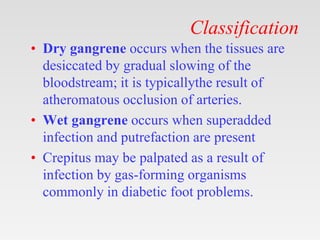
Classification
Classification
• Dry gangrene occurs when the tissues are
desiccated by gradual slowing of the
bloodstream; it is typicallythe result of
atheromatous occlusion of arteries.
• Wet gangrene occurs when superadded
infection and putrefaction are present
• Crepitus may be palpated as a result of
infection by gas-forming organisms
commonly in diabetic foot problems.
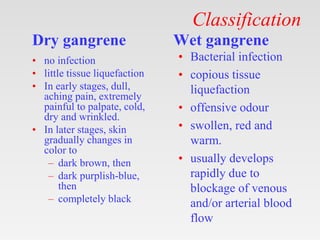
Classification
Dry gangrene
• no infection
• little tissue liquefaction
• In early stages, dull,
aching pain, extremely
painful to palpate, cold,
dry and wrinkled.
• In later stages, skin
gradually changes in
color to
– dark brown, then
– dark purplish-blue,
then
– completely black
Wet gangrene
• Bacterial infection
• copious tissue
liquefaction
• offensive odour
• swollen, red and
warm.
• usually develops
rapidly due to
blockage of venous
and/or arterial blood
flow
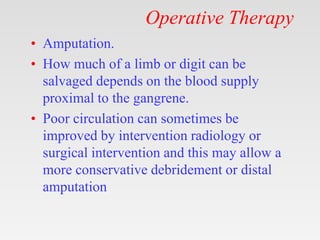
Operative Therapy
Operative Therapy
• Amputation.
• How much of a limb or digit can be
salvaged depends on the blood supply
proximal to the gangrene.
• Poor circulation can sometimes be
improved by intervention radiology or
surgical intervention and this may allow a
more conservative debridement or distal
amputation
Get this ppt in mobile
1. Download Microsoft
PowerPoint from play
store.
2. Open Google assistant
3. Open Google lens.
4. Scan qr code from
next slide.
Get this ppt in mobile
Get my ppt collection
• https://www.slideshare.net/drpradeeppande/
edit_my_uploads
• https://www.dropbox.com/sh/x600md3cvj8
5woy/AACVMHuQtvHvl_K8ehc3ltkEa?dl
=0
• https://www.facebook.com/doctorpradeeppa
nde/?ref=pages_you_manage

Gangrene.pptx

  • 1.
    Tips on usingmy ppt. 1. You can freely download, edit, modify and put your name etc. 2. Don’t be concerned about number of slides. Half the slides are blanks except for the title. 3. First show the blank slides (eg. Aetiology ) > Ask students what they already know about ethology of today's topic. > Then show next slide which enumerates aetiologies. 4. At the end rerun the show – show blank> ask questions > show next slide. 5. This will be an ACTIVE LEARNING SESSION x three revisions. 6. Good for self study also. 7. See notes for bibliography.
  • 2.
  • 3.
    Learning Objectives 1. Introduction& History 2. Relevant Anatomy, Physiology 3. Aetiology 4. Pathophysiology 5. Pathology 6. Classification 7. Clinical Features 8. Investigations 9. Management 10. Prevention 11. Guidelines 12. Take home messages
  • 4.
  • 5.
    Introduction • Gangrene refersto death of macroscopic portions of tissue which turn black because of the breakdown of haemoglobin and the formation of iron sulphide. • It usually affects the most distal part of a limb because of arterial obstruction.
  • 6.
  • 7.
    Aetiology • Idiopathic • Congenital/Genetic • Nutritional Deficiency/excess • Traumatic • Infections /Infestation • Autoimmune • Neoplastic (Benign/Malignant) • Degenerative / lifestyle • Iatrogenic • Psychosomatic • Poisoning/ Toxins/ Drug induced
  • 8.
    Aetiology • Idiopathic • Congenital/Genetic •Traumatic • Infections /Infestation • Autoimmune • Neoplastic (Benign/Malignant) • Degenerative Diabetes mellitus. • Iatrogenic
  • 9.
  • 10.
    Pathophysiology • Acute orChronic arterial occlussion leads to death of distal tissue.
  • 11.
    Pathophysiology • A lineof demarcation between viable and the dead tissue. • In dry gangrene, if the blood supply of the proximal tissues is adequate, the final line of demarcation appears quickly. • If the arterial supply to the proximal living tissue is poor, the line of final demarcation is very slow to form or does not develop at all. • If bone is involved, complete separation takes longer.
  • 12.
    Pathophysiology • Unless thearterial supply can be improved, the gangrene will spread to adjacent tissues or will suddenly appear as ‘skip’ areas further up the limb. • Infection may also cause gangrene to spread proximally into areas of extensive inflammation. • To attempt local amputation in the presence of poor circulation will fail and gangrene will reappear in the wound or skin edges. .
  • 13.
  • 14.
    Classification • Dry gangreneoccurs when the tissues are desiccated by gradual slowing of the bloodstream; it is typicallythe result of atheromatous occlusion of arteries. • Wet gangrene occurs when superadded infection and putrefaction are present • Crepitus may be palpated as a result of infection by gas-forming organisms commonly in diabetic foot problems.
  • 15.
    Classification Dry gangrene • noinfection • little tissue liquefaction • In early stages, dull, aching pain, extremely painful to palpate, cold, dry and wrinkled. • In later stages, skin gradually changes in color to – dark brown, then – dark purplish-blue, then – completely black Wet gangrene • Bacterial infection • copious tissue liquefaction • offensive odour • swollen, red and warm. • usually develops rapidly due to blockage of venous and/or arterial blood flow
  • 16.
  • 17.
    Operative Therapy • Amputation. •How much of a limb or digit can be salvaged depends on the blood supply proximal to the gangrene. • Poor circulation can sometimes be improved by intervention radiology or surgical intervention and this may allow a more conservative debridement or distal amputation
  • 18.
    Get this pptin mobile 1. Download Microsoft PowerPoint from play store. 2. Open Google assistant 3. Open Google lens. 4. Scan qr code from next slide.
  • 19.
    Get this pptin mobile
  • 20.
    Get my pptcollection • https://www.slideshare.net/drpradeeppande/ edit_my_uploads • https://www.dropbox.com/sh/x600md3cvj8 5woy/AACVMHuQtvHvl_K8ehc3ltkEa?dl =0 • https://www.facebook.com/doctorpradeeppa nde/?ref=pages_you_manage

Editor's Notes

  • #2 drpradeeppande@gmail.com 7697305442