ASSESSMENT
DR. JAYESH PATIDAR
NURSING PATH
INTRODUCTION
Assessment is part of the everyday
activities of nursing professionals.
Assessment is the only way by which
a teacher can know how successful
his teaching was and what areas in
teaching need improvement.
Similarly, a student can know his
learning difficulties & also at what
position he stands in the crowd of
students.
10/11/2019
www.nursingpath.in
2
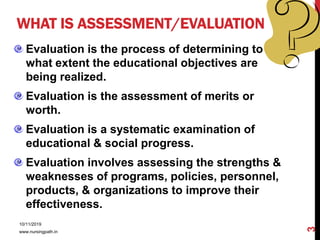
WHAT IS ASSESSMENT/EVALUATION
Evaluation is the process of determining to
what extent the educational objectives are
being realized.
Evaluation is the assessment of merits or
worth.
Evaluation is a systematic examination of
educational & social progress.
Evaluation involves assessing the strengths &
weaknesses of programs, policies, personnel,
products, & organizations to improve their
effectiveness.
10/11/2019
www.nursingpath.in
3
PURPOSES OF
ASSESSMENT/EVALUATION
To provide short-term goals to the students.
To clarify the intended learning outcome.
To determine the level of knowledge &
understanding in students.
To diagnose the strengths & weakness of students.
10/11/2019
www.nursingpath.in
4
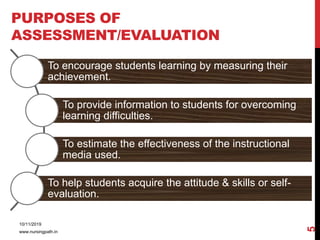
PURPOSES OF
ASSESSMENT/EVALUATION
To encourage students learning by measuring their
achievement.
To provide information to students for overcoming
learning difficulties.
To estimate the effectiveness of the instructional
media used.
To help students acquire the attitude & skills or self-
evaluation.
10/11/2019
www.nursingpath.in
5
PURPOSES OF
ASSESSMENT/EVALUATION
To assess the nonscholastic domains of the
student’s personality.
To assess the student’s progress throughout the
year.
To ascertain if the teaching strategies are
effective or not.
To improve curriculum in light of recent advances.
10/11/2019
www.nursingpath.in
6
PURPOSES OF
ASSESSMENT/EVALUATION
To satisfy the university requirements for a
curriculum.
To report the student’s progress to parents.
Evaluation is carried out for general &
educational research.
10/11/2019
www.nursingpath.in
7
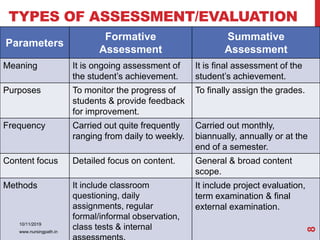
TYPES OF ASSESSMENT/EVALUATION
Parameters
Formative
Assessment
Summative
Assessment
Meaning It is ongoing assessment of
the student’s achievement.
It is final assessment of the
student’s achievement.
Purposes To monitor the progress of
students & provide feedback
for improvement.
To finally assign the grades.
Frequency Carried out quite frequently
ranging from daily to weekly.
Carried out monthly,
biannually, annually or at the
end of a semester.
Content focus Detailed focus on content. General & broad content
scope.
Methods It include classroom
questioning, daily
assignments, regular
formal/informal observation,
class tests & internal
It include project evaluation,
term examination & final
external examination.
10/11/2019
www.nursingpath.in
8
SCOPE OF
ASSESSMENT/
EVALUATION
Selection
of students
Feedback
of
students
Feedback
to teacher
Incentive
to
learning
Motivation
of learning
activities
Certification
of
competency
Decision
for
successor
10/11/2019
www.nursingpath.in
9
CRITERIA FOR SELECTION OF
ASSESSMENT TECHNIQUE/METHOD
1. Congruent with educational
objectives
2. Objectivity
3. Practicability
4. Constructed on wide
curricular content
10/11/2019
www.nursingpath.in
10
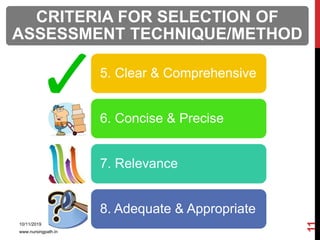
CRITERIA FOR SELECTION OF
ASSESSMENT TECHNIQUE/METHOD
5. Clear & Comprehensive
6. Concise & Precise
7. Relevance
8. Adequate & Appropriate
10/11/2019
www.nursingpath.in
11
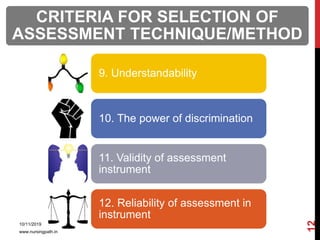
CRITERIA FOR SELECTION OF
ASSESSMENT TECHNIQUE/METHOD
9. Understandability
10. The power of discrimination
11. Validity of assessment
instrument
12. Reliability of assessment in
instrument
10/11/2019
www.nursingpath.in
12
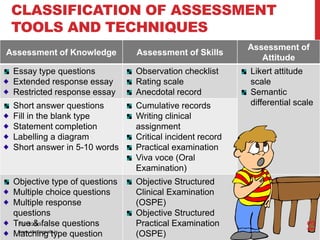
CLASSIFICATION OF ASSESSMENT
TOOLS AND TECHNIQUES
Assessment of Knowledge Assessment of Skills
Assessment of
Attitude
Essay type questions
Extended response essay
Restricted response essay
Observation checklist
Rating scale
Anecdotal record
Likert attitude
scale
Semantic
differential scaleShort answer questions
Fill in the blank type
Statement completion
Labelling a diagram
Short answer in 5-10 words
Cumulative records
Writing clinical
assignment
Critical incident record
Practical examination
Viva voce (Oral
Examination)
Objective type of questions
Multiple choice questions
Multiple response
questions
True & false questions
Matching type question
Objective Structured
Clinical Examination
(OSPE)
Objective Structured
Practical Examination
(OSPE)
10/11/2019
www.nursingpath.in
13
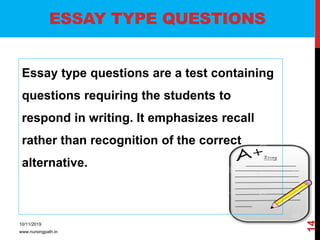
ESSAY TYPE QUESTIONS
Essay type questions are a test containing
questions requiring the students to
respond in writing. It emphasizes recall
rather than recognition of the correct
alternative.
10/11/2019
www.nursingpath.in
14
ESSAY TYPE QUESTIONS
Features of essay type questions:
 Questions are used both as formative &
summative assessments.
 They require a great deal of thought & planning.
 Students prepare their own answers.
 They evaluate knowledge areas alone.
 No single answer can be considered through or
correct.
 The examinee is permitted freedom of response
10/11/2019
www.nursingpath.in
15
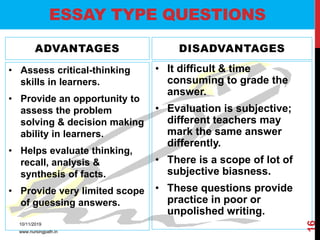
ADVANTAGES
‱ Assess critical-thinking
skills in learners.
‱ Provide an opportunity to
assess the problem
solving & decision making
ability in learners.
‱ Helps evaluate thinking,
recall, analysis &
synthesis of facts.
‱ Provide very limited scope
of guessing answers.
DISADVANTAGES
‱ It difficult & time
consuming to grade the
answer.
‱ Evaluation is subjective;
different teachers may
mark the same answer
differently.
‱ There is a scope of lot of
subjective biasness.
‱ These questions provide
practice in poor or
unpolished writing.
ESSAY TYPE QUESTIONS
10/11/2019
www.nursingpath.in
16
SHORT ANSWER QUESTIONS
SAQ the answer has to be generated and
supplied by the learner rather than chosen
from a number of options provided.
10/11/2019
www.nursingpath.in
17
SHORT ANSWER QUESTIONS
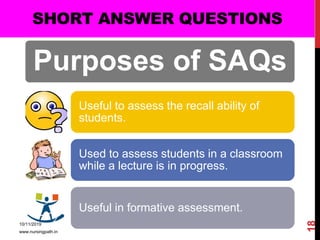
Purposes of SAQs
Useful to assess the recall ability of
students.
Used to assess students in a classroom
while a lecture is in progress.
Useful in formative assessment.
10/11/2019
www.nursingpath.in
18
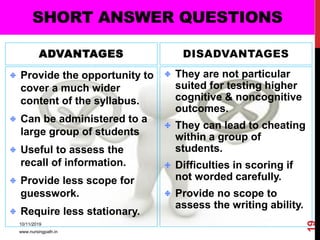
ADVANTAGES
Provide the opportunity to
cover a much wider
content of the syllabus.
Can be administered to a
large group of students
Useful to assess the
recall of information.
Provide less scope for
guesswork.
Require less stationary.
DISADVANTAGES
They are not particular
suited for testing higher
cognitive & noncognitive
outcomes.
They can lead to cheating
within a group of
students.
Difficulties in scoring if
not worded carefully.
Provide no scope to
assess the writing ability.
SHORT ANSWER QUESTIONS
10/11/2019
www.nursingpath.in
19
MULTIPLE CHOICE QUESTIONS
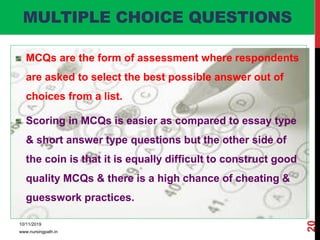
MCQs are the form of assessment where respondents
are asked to select the best possible answer out of
choices from a list.
Scoring in MCQs is easier as compared to essay type
& short answer type questions but the other side of
the coin is that it is equally difficult to construct good
quality MCQs & there is a high chance of cheating &
guesswork practices.
10/11/2019
www.nursingpath.in
20
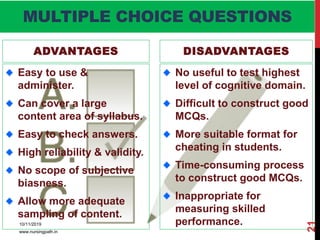
ADVANTAGES
Easy to use &
administer.
Can cover a large
content area of syllabus.
Easy to check answers.
High reliability & validity.
No scope of subjective
biasness.
Allow more adequate
sampling of content.
DISADVANTAGES
No useful to test highest
level of cognitive domain.
Difficult to construct good
MCQs.
More suitable format for
cheating in students.
Time-consuming process
to construct good MCQs.
Inappropriate for
measuring skilled
performance.
MULTIPLE CHOICE QUESTIONS
10/11/2019
www.nursingpath.in
21
OBSERVATION CHECKLIST
A checklist is a simple instrument
consisting prepared list of expected
items of performance or attributes, which
are checked by a evaluator for their
presence or absence.
10/11/2019
www.nursingpath.in
22
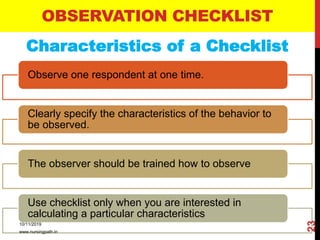
Characteristics of a Checklist
OBSERVATION CHECKLIST
Observe one respondent at one time.
Clearly specify the characteristics of the behavior to
be observed.
The observer should be trained how to observe
Use checklist only when you are interested in
calculating a particular characteristics
10/11/2019
www.nursingpath.in
23
OBSERVATION CHECKLIST
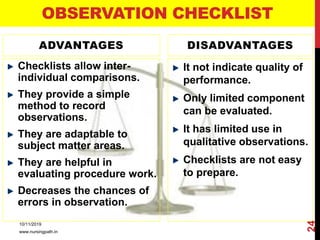
ADVANTAGES
Checklists allow inter-
individual comparisons.
They provide a simple
method to record
observations.
They are adaptable to
subject matter areas.
They are helpful in
evaluating procedure work.
Decreases the chances of
errors in observation.
DISADVANTAGES
It not indicate quality of
performance.
Only limited component
can be evaluated.
It has limited use in
qualitative observations.
Checklists are not easy
to prepare.
10/11/2019
www.nursingpath.in
24
RATING SCALE
Rating is the term used to express opinion or
judgment regarding some performance of a person,
object, situation & character.
Rating scale refers to a scale with a set of opinion,
which describes varying degree of the dimensions
of an attitude or a phenomenon being observed.
It could be a 3-point, a 5-point or a 7-point rating
scale
10/11/2019
www.nursingpath.in
25
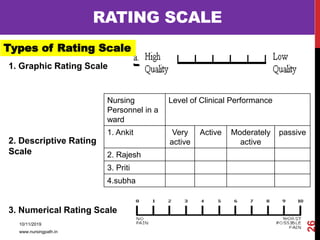
1. Graphic Rating Scale
RATING SCALE
2. Descriptive Rating
Scale
3. Numerical Rating Scale
Nursing
Personnel in a
ward
Level of Clinical Performance
1. Ankit Very
active
Active Moderately
active
passive
2. Rajesh
3. Priti
4.subha
Types of Rating Scale
10/11/2019
www.nursingpath.in
26
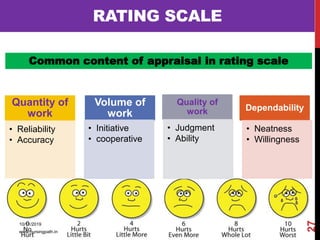
Quantity of
work
‱ Reliability
‱ Accuracy
Volume of
work
‱ Initiative
‱ cooperative
Quality of
work
‱ Judgment
‱ Ability
Dependability
‱ Neatness
‱ Willingness
RATING SCALE
Common content of appraisal in rating scale
10/11/2019
www.nursingpath.in
27
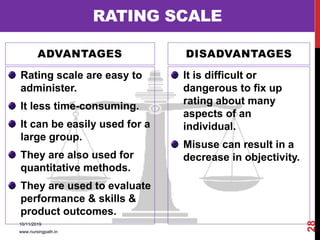
ADVANTAGES
Rating scale are easy to
administer.
It less time-consuming.
It can be easily used for a
large group.
They are also used for
quantitative methods.
They are used to evaluate
performance & skills &
product outcomes.
DISADVANTAGES
It is difficult or
dangerous to fix up
rating about many
aspects of an
individual.
Misuse can result in a
decrease in objectivity.
RATING SCALE
10/11/2019
www.nursingpath.in
28
PRACTICAL EXAMINATION
Practical examination is concerned with
the assessment of practical performance
skills & practice competency acquired by a
student during the course of a particular
programme.
10/11/2019
www.nursingpath.in
29
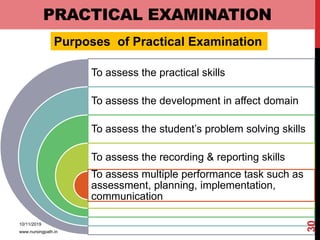
To assess the practical skills
To assess the development in affect domain
To assess the student’s problem solving skills
To assess the recording & reporting skills
To assess multiple performance task such as
assessment, planning, implementation,
communication
PRACTICAL EXAMINATION
Purposes of Practical Examination
10/11/2019
www.nursingpath.in
30
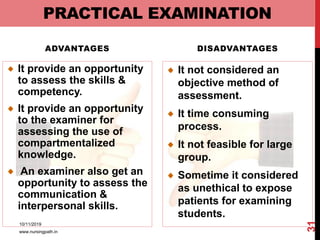
ADVANTAGES
It provide an opportunity
to assess the skills &
competency.
It provide an opportunity
to the examiner for
assessing the use of
compartmentalized
knowledge.
An examiner also get an
opportunity to assess the
communication &
interpersonal skills.
DISADVANTAGES
It not considered an
objective method of
assessment.
It time consuming
process.
It not feasible for large
group.
Sometime it considered
as unethical to expose
patients for examining
students.
PRACTICAL EXAMINATION
10/11/2019
www.nursingpath.in
31
OBJECTIVE STRUCTURED CLINICAL
EXAMINATION
OSCE is a modern type of examination to
assess clinical skill performance &
competence in skills such as communication,
clinical examination, medical & nursing
procedure/prescription, exercise prescription,
joint mobilization techniques & interpretation
of results.
10/11/2019
www.nursingpath.in
32
DEFINITION OF OSCE
OSCE is an assessment tool in which the components of
clinical competence such as history taking, physical
examination, simple procedures, interpretation of lab
results, patient management problems, communication,
attitude etc. are tested using agreed check lists &
rotating the student round a number of stations some of
which have observers with checklists.
OBJECTIVE STRUCTURED CLINICAL
EXAMINATION
10/11/2019
www.nursingpath.in
33
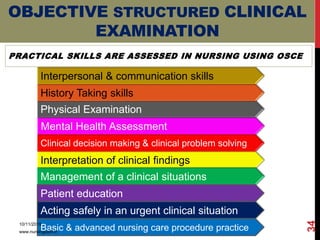
PRACTICAL SKILLS ARE ASSESSED IN NURSING USING OSCE
OBJECTIVE STRUCTURED CLINICAL
EXAMINATION
Interpretation of clinical findings
Mental Health Assessment
Physical Examination
History Taking skills
Interpersonal & communication skills
Clinical decision making & clinical problem solving
Management of a clinical situations
Patient education
Acting safely in an urgent clinical situation
Basic & advanced nursing care procedure practice
10/11/2019
www.nursingpath.in
34
OBJECTIVE STRUCTURED CLINICAL
EXAMINATION
Organizing the OSCE
The OSCE examination consists of about 10-15
stations, each of which requires about 4-5 minutes. The
number of stations & time spent on each station may
vary based on needs of evaluation.
All stations should be capable of being completed in
the same time.
The students are rotated through all stations & have to
move to the next station at the signal.
As the stations are generally independent, students can
start at any procedure stations & complete the cycle.
Using 15 stations of 4 minutes each, 15 students can
complete the examination within 1 hour.
10/11/2019
www.nursingpath.in
35
OBJECTIVE STRUCTURED CLINICAL
EXAMINATION
Organizing the OSCE
Each station is designed to test a component of clinical
competence.
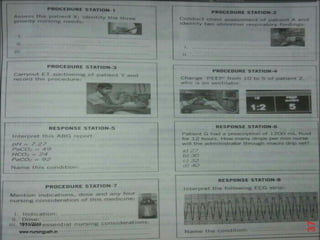
At some stations, called the procedure stations,
students are given tasks to perform on patients or
simulators. At all such stations there are observers with
agreed upon checklist or rating scales to score the
student’s performance.
At other stations called response stations, students
respond to questions of the objective type or interpret
data or record their findings of the previous procedure
stations.
10/11/2019
www.nursingpath.in
36
10/11/2019
www.nursingpath.in
37
ADVANTAGES
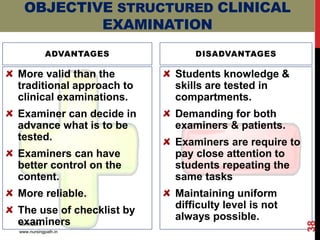
More valid than the
traditional approach to
clinical examinations.
Examiner can decide in
advance what is to be
tested.
Examiners can have
better control on the
content.
More reliable.
The use of checklist by
examiners
DISADVANTAGES
Students knowledge &
skills are tested in
compartments.
Demanding for both
examiners & patients.
Examiners are require to
pay close attention to
students repeating the
same tasks
Maintaining uniform
difficulty level is not
always possible.
OBJECTIVE STRUCTURED CLINICAL
EXAMINATION
10/11/2019
www.nursingpath.in
38
LIKERT SCALE
The Likert Scale was named after a psychologist Rensis
Likert, who developed it in 1932 as a psychological
concept measurement scale.
Likert Scale is a composite measurement scale used to
measure attitude, values & feelings of the people that
involve summation of scores on the set of positive &
negative declarative statements regarding measuring
variables to which respondents are asked to indicate
their degree of agreement or disagreement.
10/11/2019
www.nursingpath.in
39
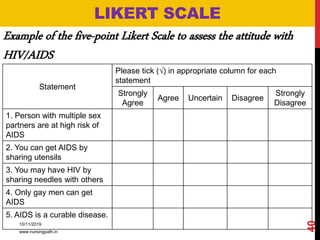
Example of the five-point Likert Scale to assess the attitude with
HIV/AIDS
LIKERT SCALE
Statement
Please tick (√) in appropriate column for each
statement
Strongly
Agree
Agree Uncertain Disagree
Strongly
Disagree
1. Person with multiple sex
partners are at high risk of
AIDS
2. You can get AIDS by
sharing utensils
3. You may have HIV by
sharing needles with others
4. Only gay men can get
AIDS
5. AIDS is a curable disease.
10/11/2019
www.nursingpath.in
40
LIKERT SCALE
Uses of a Likert Scale
It is basically used to measure the
attitudes, values & feelings of the
people about specific concept such
as a situation, people, place, object,
programme, practice, policy & so on.
This scale is used to have quantified
measurement of the qualitative
attributes of people such as feelings,
values & attitude.
It may also be used to assess the
opinion of the people about a
particular abstract concept.
10/11/2019
www.nursingpath.in
41
LIKERT SCALE
Characteristics of a Likert Scale
Psychological
Measurement
tool
Illustrative in
nature
Neutral
statementsBipolar scaling
method
Measurement of
the specific number
of scaling
categories
10/11/2019
www.nursingpath.in
42
LIKERT SCALE
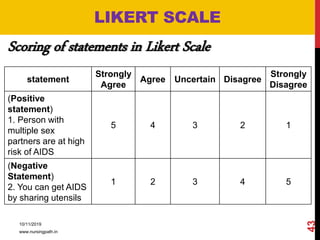
Scoring of statements in Likert Scale
statement
Strongly
Agree
Agree Uncertain Disagree
Strongly
Disagree
(Positive
statement)
1. Person with
multiple sex
partners are at high
risk of AIDS
5 4 3 2 1
(Negative
Statement)
2. You can get AIDS
by sharing utensils
1 2 3 4 5
10/11/2019
www.nursingpath.in
43
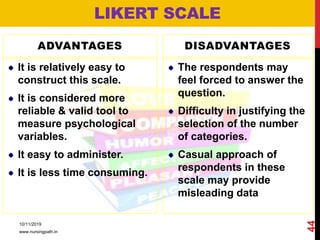
ADVANTAGES
It is relatively easy to
construct this scale.
It is considered more
reliable & valid tool to
measure psychological
variables.
It easy to administer.
It is less time consuming.
DISADVANTAGES
The respondents may
feel forced to answer the
question.
Difficulty in justifying the
selection of the number
of categories.
Casual approach of
respondents in these
scale may provide
misleading data
LIKERT SCALE
10/11/2019
www.nursingpath.in
44
SEMANTIC DIFFERENTIAL SCALE
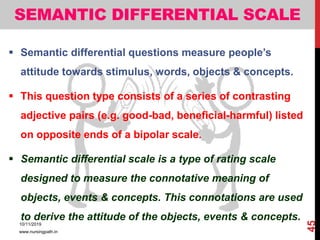
 Semantic differential questions measure people’s
attitude towards stimulus, words, objects & concepts.
 This question type consists of a series of contrasting
adjective pairs (e.g. good-bad, beneficial-harmful) listed
on opposite ends of a bipolar scale.
 Semantic differential scale is a type of rating scale
designed to measure the connotative meaning of
objects, events & concepts. This connotations are used
to derive the attitude of the objects, events & concepts.
10/11/2019
www.nursingpath.in
45
SEMANTIC DIFFERENTIAL SCALE
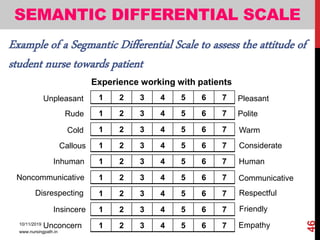
Example of a Segmantic Differential Scale to assess the attitude of
student nurse towards patient
1 2 3 4 5 6 7
1 2 3 4 5 6 7
1 2 3 4 5 6 7
1 2 3 4 5 6 7
1 2 3 4 5 6 7
1 2 3 4 5 6 7
1 2 3 4 5 6 7
1 2 3 4 5 6 7
1 2 3 4 5 6 7
Experience working with patients
Pleasant
Polite
Warm
Unconcern
Insincere
Disrespecting
Noncommunicative
Inhuman
Callous
Cold
Rude
Unpleasant
Respectful
Communicative
Human
Considerate
Empathy
Friendly
10/11/2019
www.nursingpath.in
46
SEMANTIC DIFFERENTIAL SCALE
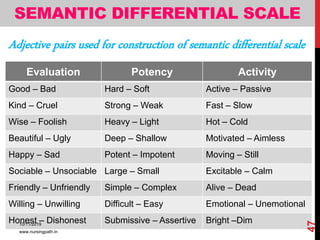
Adjective pairs used for construction of semantic differential scale
Evaluation Potency Activity
Good – Bad Hard – Soft Active – Passive
Kind – Cruel Strong – Weak Fast – Slow
Wise – Foolish Heavy – Light Hot – Cold
Beautiful – Ugly Deep – Shallow Motivated – Aimless
Happy – Sad Potent – Impotent Moving – Still
Sociable – Unsociable Large – Small Excitable – Calm
Friendly – Unfriendly Simple – Complex Alive – Dead
Willing – Unwilling Difficult – Easy Emotional – Unemotional
Honest – Dishonest Submissive – Assertive Bright –Dim10/11/2019
www.nursingpath.in
47
SEMANTIC DIFFERENTIAL SCALE
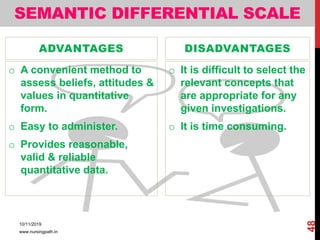
ADVANTAGES
o A convenient method to
assess beliefs, attitudes &
values in quantitative
form.
o Easy to administer.
o Provides reasonable,
valid & reliable
quantitative data.
DISADVANTAGES
o It is difficult to select the
relevant concepts that
are appropriate for any
given investigations.
o It is time consuming.
10/11/2019
www.nursingpath.in
48
10/11/2019
www.nursingpath.in
49
10/11/2019
www.nursingpath.in
50

Assessment

  • 1.
  • 2.
    INTRODUCTION Assessment is partof the everyday activities of nursing professionals. Assessment is the only way by which a teacher can know how successful his teaching was and what areas in teaching need improvement. Similarly, a student can know his learning difficulties & also at what position he stands in the crowd of students. 10/11/2019 www.nursingpath.in 2
  • 3.
    WHAT IS ASSESSMENT/EVALUATION Evaluationis the process of determining to what extent the educational objectives are being realized. Evaluation is the assessment of merits or worth. Evaluation is a systematic examination of educational & social progress. Evaluation involves assessing the strengths & weaknesses of programs, policies, personnel, products, & organizations to improve their effectiveness. 10/11/2019 www.nursingpath.in 3
  • 4.
    PURPOSES OF ASSESSMENT/EVALUATION To provideshort-term goals to the students. To clarify the intended learning outcome. To determine the level of knowledge & understanding in students. To diagnose the strengths & weakness of students. 10/11/2019 www.nursingpath.in 4
  • 5.
    PURPOSES OF ASSESSMENT/EVALUATION To encouragestudents learning by measuring their achievement. To provide information to students for overcoming learning difficulties. To estimate the effectiveness of the instructional media used. To help students acquire the attitude & skills or self- evaluation. 10/11/2019 www.nursingpath.in 5
  • 6.
    PURPOSES OF ASSESSMENT/EVALUATION To assessthe nonscholastic domains of the student’s personality. To assess the student’s progress throughout the year. To ascertain if the teaching strategies are effective or not. To improve curriculum in light of recent advances. 10/11/2019 www.nursingpath.in 6
  • 7.
    PURPOSES OF ASSESSMENT/EVALUATION To satisfythe university requirements for a curriculum. To report the student’s progress to parents. Evaluation is carried out for general & educational research. 10/11/2019 www.nursingpath.in 7
  • 8.
    TYPES OF ASSESSMENT/EVALUATION Parameters Formative Assessment Summative Assessment MeaningIt is ongoing assessment of the student’s achievement. It is final assessment of the student’s achievement. Purposes To monitor the progress of students & provide feedback for improvement. To finally assign the grades. Frequency Carried out quite frequently ranging from daily to weekly. Carried out monthly, biannually, annually or at the end of a semester. Content focus Detailed focus on content. General & broad content scope. Methods It include classroom questioning, daily assignments, regular formal/informal observation, class tests & internal It include project evaluation, term examination & final external examination. 10/11/2019 www.nursingpath.in 8
  • 9.
    SCOPE OF ASSESSMENT/ EVALUATION Selection of students Feedback of students Feedback toteacher Incentive to learning Motivation of learning activities Certification of competency Decision for successor 10/11/2019 www.nursingpath.in 9
  • 10.
    CRITERIA FOR SELECTIONOF ASSESSMENT TECHNIQUE/METHOD 1. Congruent with educational objectives 2. Objectivity 3. Practicability 4. Constructed on wide curricular content 10/11/2019 www.nursingpath.in 10
  • 11.
    CRITERIA FOR SELECTIONOF ASSESSMENT TECHNIQUE/METHOD 5. Clear & Comprehensive 6. Concise & Precise 7. Relevance 8. Adequate & Appropriate 10/11/2019 www.nursingpath.in 11
  • 12.
    CRITERIA FOR SELECTIONOF ASSESSMENT TECHNIQUE/METHOD 9. Understandability 10. The power of discrimination 11. Validity of assessment instrument 12. Reliability of assessment in instrument 10/11/2019 www.nursingpath.in 12
  • 13.
    CLASSIFICATION OF ASSESSMENT TOOLSAND TECHNIQUES Assessment of Knowledge Assessment of Skills Assessment of Attitude Essay type questions Extended response essay Restricted response essay Observation checklist Rating scale Anecdotal record Likert attitude scale Semantic differential scaleShort answer questions Fill in the blank type Statement completion Labelling a diagram Short answer in 5-10 words Cumulative records Writing clinical assignment Critical incident record Practical examination Viva voce (Oral Examination) Objective type of questions Multiple choice questions Multiple response questions True & false questions Matching type question Objective Structured Clinical Examination (OSPE) Objective Structured Practical Examination (OSPE) 10/11/2019 www.nursingpath.in 13
  • 14.
    ESSAY TYPE QUESTIONS Essaytype questions are a test containing questions requiring the students to respond in writing. It emphasizes recall rather than recognition of the correct alternative. 10/11/2019 www.nursingpath.in 14
  • 15.
    ESSAY TYPE QUESTIONS Featuresof essay type questions:  Questions are used both as formative & summative assessments.  They require a great deal of thought & planning.  Students prepare their own answers.  They evaluate knowledge areas alone.  No single answer can be considered through or correct.  The examinee is permitted freedom of response 10/11/2019 www.nursingpath.in 15
  • 16.
    ADVANTAGES ‱ Assess critical-thinking skillsin learners. ‱ Provide an opportunity to assess the problem solving & decision making ability in learners. ‱ Helps evaluate thinking, recall, analysis & synthesis of facts. ‱ Provide very limited scope of guessing answers. DISADVANTAGES ‱ It difficult & time consuming to grade the answer. ‱ Evaluation is subjective; different teachers may mark the same answer differently. ‱ There is a scope of lot of subjective biasness. ‱ These questions provide practice in poor or unpolished writing. ESSAY TYPE QUESTIONS 10/11/2019 www.nursingpath.in 16
  • 17.
    SHORT ANSWER QUESTIONS SAQthe answer has to be generated and supplied by the learner rather than chosen from a number of options provided. 10/11/2019 www.nursingpath.in 17
  • 18.
    SHORT ANSWER QUESTIONS Purposesof SAQs Useful to assess the recall ability of students. Used to assess students in a classroom while a lecture is in progress. Useful in formative assessment. 10/11/2019 www.nursingpath.in 18
  • 19.
    ADVANTAGES Provide the opportunityto cover a much wider content of the syllabus. Can be administered to a large group of students Useful to assess the recall of information. Provide less scope for guesswork. Require less stationary. DISADVANTAGES They are not particular suited for testing higher cognitive & noncognitive outcomes. They can lead to cheating within a group of students. Difficulties in scoring if not worded carefully. Provide no scope to assess the writing ability. SHORT ANSWER QUESTIONS 10/11/2019 www.nursingpath.in 19
  • 20.
    MULTIPLE CHOICE QUESTIONS MCQsare the form of assessment where respondents are asked to select the best possible answer out of choices from a list. Scoring in MCQs is easier as compared to essay type & short answer type questions but the other side of the coin is that it is equally difficult to construct good quality MCQs & there is a high chance of cheating & guesswork practices. 10/11/2019 www.nursingpath.in 20
  • 21.
    ADVANTAGES Easy to use& administer. Can cover a large content area of syllabus. Easy to check answers. High reliability & validity. No scope of subjective biasness. Allow more adequate sampling of content. DISADVANTAGES No useful to test highest level of cognitive domain. Difficult to construct good MCQs. More suitable format for cheating in students. Time-consuming process to construct good MCQs. Inappropriate for measuring skilled performance. MULTIPLE CHOICE QUESTIONS 10/11/2019 www.nursingpath.in 21
  • 22.
    OBSERVATION CHECKLIST A checklistis a simple instrument consisting prepared list of expected items of performance or attributes, which are checked by a evaluator for their presence or absence. 10/11/2019 www.nursingpath.in 22
  • 23.
    Characteristics of aChecklist OBSERVATION CHECKLIST Observe one respondent at one time. Clearly specify the characteristics of the behavior to be observed. The observer should be trained how to observe Use checklist only when you are interested in calculating a particular characteristics 10/11/2019 www.nursingpath.in 23
  • 24.
    OBSERVATION CHECKLIST ADVANTAGES Checklists allowinter- individual comparisons. They provide a simple method to record observations. They are adaptable to subject matter areas. They are helpful in evaluating procedure work. Decreases the chances of errors in observation. DISADVANTAGES It not indicate quality of performance. Only limited component can be evaluated. It has limited use in qualitative observations. Checklists are not easy to prepare. 10/11/2019 www.nursingpath.in 24
  • 25.
    RATING SCALE Rating isthe term used to express opinion or judgment regarding some performance of a person, object, situation & character. Rating scale refers to a scale with a set of opinion, which describes varying degree of the dimensions of an attitude or a phenomenon being observed. It could be a 3-point, a 5-point or a 7-point rating scale 10/11/2019 www.nursingpath.in 25
  • 26.
    1. Graphic RatingScale RATING SCALE 2. Descriptive Rating Scale 3. Numerical Rating Scale Nursing Personnel in a ward Level of Clinical Performance 1. Ankit Very active Active Moderately active passive 2. Rajesh 3. Priti 4.subha Types of Rating Scale 10/11/2019 www.nursingpath.in 26
  • 27.
    Quantity of work ‱ Reliability ‱Accuracy Volume of work ‱ Initiative ‱ cooperative Quality of work ‱ Judgment ‱ Ability Dependability ‱ Neatness ‱ Willingness RATING SCALE Common content of appraisal in rating scale 10/11/2019 www.nursingpath.in 27
  • 28.
    ADVANTAGES Rating scale areeasy to administer. It less time-consuming. It can be easily used for a large group. They are also used for quantitative methods. They are used to evaluate performance & skills & product outcomes. DISADVANTAGES It is difficult or dangerous to fix up rating about many aspects of an individual. Misuse can result in a decrease in objectivity. RATING SCALE 10/11/2019 www.nursingpath.in 28
  • 29.
    PRACTICAL EXAMINATION Practical examinationis concerned with the assessment of practical performance skills & practice competency acquired by a student during the course of a particular programme. 10/11/2019 www.nursingpath.in 29
  • 30.
    To assess thepractical skills To assess the development in affect domain To assess the student’s problem solving skills To assess the recording & reporting skills To assess multiple performance task such as assessment, planning, implementation, communication PRACTICAL EXAMINATION Purposes of Practical Examination 10/11/2019 www.nursingpath.in 30
  • 31.
    ADVANTAGES It provide anopportunity to assess the skills & competency. It provide an opportunity to the examiner for assessing the use of compartmentalized knowledge. An examiner also get an opportunity to assess the communication & interpersonal skills. DISADVANTAGES It not considered an objective method of assessment. It time consuming process. It not feasible for large group. Sometime it considered as unethical to expose patients for examining students. PRACTICAL EXAMINATION 10/11/2019 www.nursingpath.in 31
  • 32.
    OBJECTIVE STRUCTURED CLINICAL EXAMINATION OSCEis a modern type of examination to assess clinical skill performance & competence in skills such as communication, clinical examination, medical & nursing procedure/prescription, exercise prescription, joint mobilization techniques & interpretation of results. 10/11/2019 www.nursingpath.in 32
  • 33.
    DEFINITION OF OSCE OSCEis an assessment tool in which the components of clinical competence such as history taking, physical examination, simple procedures, interpretation of lab results, patient management problems, communication, attitude etc. are tested using agreed check lists & rotating the student round a number of stations some of which have observers with checklists. OBJECTIVE STRUCTURED CLINICAL EXAMINATION 10/11/2019 www.nursingpath.in 33
  • 34.
    PRACTICAL SKILLS AREASSESSED IN NURSING USING OSCE OBJECTIVE STRUCTURED CLINICAL EXAMINATION Interpretation of clinical findings Mental Health Assessment Physical Examination History Taking skills Interpersonal & communication skills Clinical decision making & clinical problem solving Management of a clinical situations Patient education Acting safely in an urgent clinical situation Basic & advanced nursing care procedure practice 10/11/2019 www.nursingpath.in 34
  • 35.
    OBJECTIVE STRUCTURED CLINICAL EXAMINATION Organizingthe OSCE The OSCE examination consists of about 10-15 stations, each of which requires about 4-5 minutes. The number of stations & time spent on each station may vary based on needs of evaluation. All stations should be capable of being completed in the same time. The students are rotated through all stations & have to move to the next station at the signal. As the stations are generally independent, students can start at any procedure stations & complete the cycle. Using 15 stations of 4 minutes each, 15 students can complete the examination within 1 hour. 10/11/2019 www.nursingpath.in 35
  • 36.
    OBJECTIVE STRUCTURED CLINICAL EXAMINATION Organizingthe OSCE Each station is designed to test a component of clinical competence. At some stations, called the procedure stations, students are given tasks to perform on patients or simulators. At all such stations there are observers with agreed upon checklist or rating scales to score the student’s performance. At other stations called response stations, students respond to questions of the objective type or interpret data or record their findings of the previous procedure stations. 10/11/2019 www.nursingpath.in 36
  • 37.
  • 38.
    ADVANTAGES More valid thanthe traditional approach to clinical examinations. Examiner can decide in advance what is to be tested. Examiners can have better control on the content. More reliable. The use of checklist by examiners DISADVANTAGES Students knowledge & skills are tested in compartments. Demanding for both examiners & patients. Examiners are require to pay close attention to students repeating the same tasks Maintaining uniform difficulty level is not always possible. OBJECTIVE STRUCTURED CLINICAL EXAMINATION 10/11/2019 www.nursingpath.in 38
  • 39.
    LIKERT SCALE The LikertScale was named after a psychologist Rensis Likert, who developed it in 1932 as a psychological concept measurement scale. Likert Scale is a composite measurement scale used to measure attitude, values & feelings of the people that involve summation of scores on the set of positive & negative declarative statements regarding measuring variables to which respondents are asked to indicate their degree of agreement or disagreement. 10/11/2019 www.nursingpath.in 39
  • 40.
    Example of thefive-point Likert Scale to assess the attitude with HIV/AIDS LIKERT SCALE Statement Please tick (√) in appropriate column for each statement Strongly Agree Agree Uncertain Disagree Strongly Disagree 1. Person with multiple sex partners are at high risk of AIDS 2. You can get AIDS by sharing utensils 3. You may have HIV by sharing needles with others 4. Only gay men can get AIDS 5. AIDS is a curable disease. 10/11/2019 www.nursingpath.in 40
  • 41.
    LIKERT SCALE Uses ofa Likert Scale It is basically used to measure the attitudes, values & feelings of the people about specific concept such as a situation, people, place, object, programme, practice, policy & so on. This scale is used to have quantified measurement of the qualitative attributes of people such as feelings, values & attitude. It may also be used to assess the opinion of the people about a particular abstract concept. 10/11/2019 www.nursingpath.in 41
  • 42.
    LIKERT SCALE Characteristics ofa Likert Scale Psychological Measurement tool Illustrative in nature Neutral statementsBipolar scaling method Measurement of the specific number of scaling categories 10/11/2019 www.nursingpath.in 42
  • 43.
    LIKERT SCALE Scoring ofstatements in Likert Scale statement Strongly Agree Agree Uncertain Disagree Strongly Disagree (Positive statement) 1. Person with multiple sex partners are at high risk of AIDS 5 4 3 2 1 (Negative Statement) 2. You can get AIDS by sharing utensils 1 2 3 4 5 10/11/2019 www.nursingpath.in 43
  • 44.
    ADVANTAGES It is relativelyeasy to construct this scale. It is considered more reliable & valid tool to measure psychological variables. It easy to administer. It is less time consuming. DISADVANTAGES The respondents may feel forced to answer the question. Difficulty in justifying the selection of the number of categories. Casual approach of respondents in these scale may provide misleading data LIKERT SCALE 10/11/2019 www.nursingpath.in 44
  • 45.
    SEMANTIC DIFFERENTIAL SCALE Semantic differential questions measure people’s attitude towards stimulus, words, objects & concepts.  This question type consists of a series of contrasting adjective pairs (e.g. good-bad, beneficial-harmful) listed on opposite ends of a bipolar scale.  Semantic differential scale is a type of rating scale designed to measure the connotative meaning of objects, events & concepts. This connotations are used to derive the attitude of the objects, events & concepts. 10/11/2019 www.nursingpath.in 45
  • 46.
    SEMANTIC DIFFERENTIAL SCALE Exampleof a Segmantic Differential Scale to assess the attitude of student nurse towards patient 1 2 3 4 5 6 7 1 2 3 4 5 6 7 1 2 3 4 5 6 7 1 2 3 4 5 6 7 1 2 3 4 5 6 7 1 2 3 4 5 6 7 1 2 3 4 5 6 7 1 2 3 4 5 6 7 1 2 3 4 5 6 7 Experience working with patients Pleasant Polite Warm Unconcern Insincere Disrespecting Noncommunicative Inhuman Callous Cold Rude Unpleasant Respectful Communicative Human Considerate Empathy Friendly 10/11/2019 www.nursingpath.in 46
  • 47.
    SEMANTIC DIFFERENTIAL SCALE Adjectivepairs used for construction of semantic differential scale Evaluation Potency Activity Good – Bad Hard – Soft Active – Passive Kind – Cruel Strong – Weak Fast – Slow Wise – Foolish Heavy – Light Hot – Cold Beautiful – Ugly Deep – Shallow Motivated – Aimless Happy – Sad Potent – Impotent Moving – Still Sociable – Unsociable Large – Small Excitable – Calm Friendly – Unfriendly Simple – Complex Alive – Dead Willing – Unwilling Difficult – Easy Emotional – Unemotional Honest – Dishonest Submissive – Assertive Bright –Dim10/11/2019 www.nursingpath.in 47
  • 48.
    SEMANTIC DIFFERENTIAL SCALE ADVANTAGES oA convenient method to assess beliefs, attitudes & values in quantitative form. o Easy to administer. o Provides reasonable, valid & reliable quantitative data. DISADVANTAGES o It is difficult to select the relevant concepts that are appropriate for any given investigations. o It is time consuming. 10/11/2019 www.nursingpath.in 48
  • 49.
  • 50.