WELCOME
Sepsis Screening Tool
Capt Shams
Trainee Officer (1st Term)
Dept of Surgery
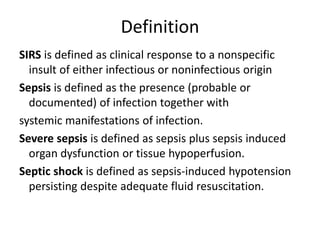
Definition
SIRS is defined as clinical response to a nonspecific
insult of either infectious or noninfectious origin
Sepsis is defined as the presence (probable or
documented) of infection together with
systemic manifestations of infection.
Severe sepsis is defined as sepsis plus sepsis induced
organ dysfunction or tissue hypoperfusion.
Septic shock is defined as sepsis-induced hypotension
persisting despite adequate fluid resuscitation.
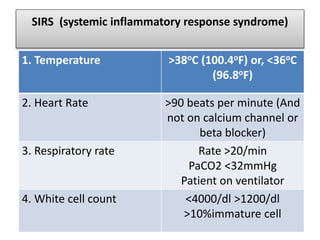
SIRS (systemic inflammatory response syndrome)
1. Temperature >38oC (100.4oF) or, <36oC
(96.8oF)
2. Heart Rate >90 beats per minute (And
not on calcium channel or
beta blocker)
3. Respiratory rate Rate >20/min
PaCO2 <32mmHg
Patient on ventilator
4. White cell count <4000/dl >1200/dl
>10%immature cell
Any 2 or more of the above criteria
+
known/suspected focus of
infection
Is it associated with
1. Hypotension (Mean BP<65mmHg / systolic
BP 40mmHg less than baseline)
2. Organ hypoperfusion (failure)
a) Oliguria
Decrease urine output (Urine output < 0.5 mL/kg/hr for at
least 2 hrs despite adequate fluid resuscitation)
Increase Creatinine (>50% from the baseline or >2.0mgdl)
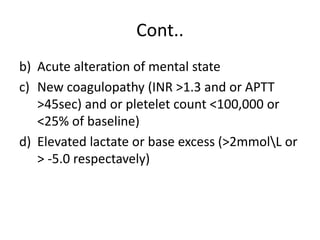
Cont..
b) Acute alteration of mental state
c) New coagulopathy (INR >1.3 and or APTT
>45sec) and or pletelet count <100,000 or
<25% of baseline)
d) Elevated lactate or base excess (>2mmolL or
> -5.0 respectavely)
SEPSIS
+
Any of the above criteria
In hypotension administer 20ml/kg of 0.9%
Saline (or 7ml/kg of colloid as appropritae)
over 30 min. If necessary administer a second
similar bolus. After fluid bolus if mean BP
<65mmHg-
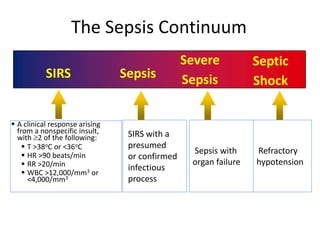
The Sepsis Continuum
 A clinical response arising
from a nonspecific insult,
with 2 of the following:
 T >38oC or <36oC
 HR >90 beats/min
 RR >20/min
 WBC >12,000/mm3 or
<4,000/mm3
SIRS with a
presumed
or confirmed
infectious
process
SepsisSIRS
Severe
Sepsis
Septic
Shock
Sepsis with
organ failure
Refractory
hypotension
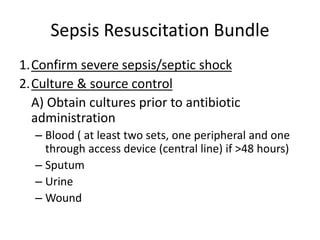
Sepsis Resuscitation Bundle
1.Confirm severe sepsis/septic shock
2.Culture & source control
A) Obtain cultures prior to antibiotic
administration
– Blood ( at least two sets, one peripheral and one
through access device (central line) if >48 hours)
– Sputum
– Urine
– Wound
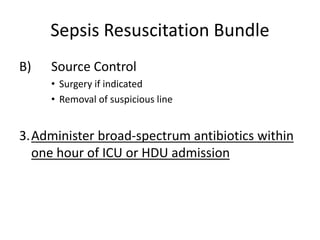
Sepsis Resuscitation Bundle
B) Source Control
• Surgery if indicated
• Removal of suspicious line
3.Administer broad-spectrum antibiotics within
one hour of ICU or HDU admission
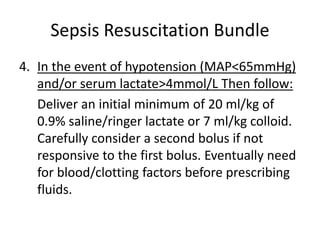
Sepsis Resuscitation Bundle
4. In the event of hypotension (MAP<65mmHg)
and/or serum lactate>4mmol/L Then follow:
Deliver an initial minimum of 20 ml/kg of
0.9% saline/ringer lactate or 7 ml/kg colloid.
Carefully consider a second bolus if not
responsive to the first bolus. Eventually need
for blood/clotting factors before prescribing
fluids.
Sepsis Resuscitation Bundle
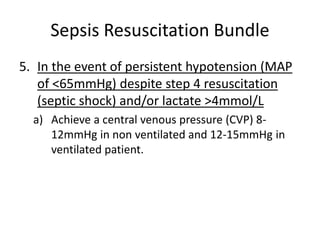
5. In the event of persistent hypotension (MAP
of <65mmHg) despite step 4 resuscitation
(septic shock) and/or lactate >4mmol/L
a) Achieve a central venous pressure (CVP) 8-
12mmHg in non ventilated and 12-15mmHg in
ventilated patient.
Sepsis Resuscitation Bundle
b) Introduce nor-adrenaline for hypotension no
responding to initial fluid resuscitation to
maintain mean arterial pressure MAP>65mmHg.
if hypotension is refractory to above therapy
1)Hydrocortisone 50mg 6hourly
2)PICCO based inotropic/vasoconstrictor therapy.
3)Look for other cause of hypotension
4)Re-evaluate ventilator settings –tidal volume etc.
Sepsis Resuscitation Bundle
C. Achieve a central venous oxygen saturation
(ScvO2)>70%
if ScvO2<70% then-
1) Administer fluid if CVP goal not has been
met
2)Transfuse blood if Hematocrit <30% and
ScvO2<70% or mixed venous O2<65% despite
fluid resuscitation
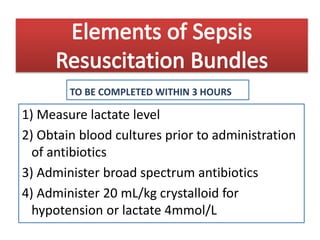
TO BE COMPLETED WITHIN 3 HOURS
1) Measure lactate level
2) Obtain blood cultures prior to administration
of antibiotics
3) Administer broad spectrum antibiotics
4) Administer 20 mL/kg crystalloid for
hypotension or lactate 4mmol/L
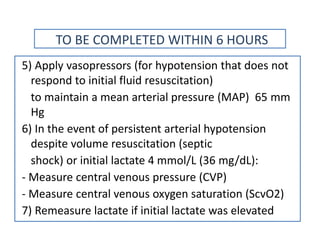
TO BE COMPLETED WITHIN 6 HOURS
5) Apply vasopressors (for hypotension that does not
respond to initial fluid resuscitation)
to maintain a mean arterial pressure (MAP) 65 mm
Hg
6) In the event of persistent arterial hypotension
despite volume resuscitation (septic
shock) or initial lactate 4 mmol/L (36 mg/dL):
- Measure central venous pressure (CVP)
- Measure central venous oxygen saturation (ScvO2)
7) Remeasure lactate if initial lactate was elevated
Sepsis screening tool

Sepsis screening tool

  • 1.
  • 2.
    Sepsis Screening Tool CaptShams Trainee Officer (1st Term) Dept of Surgery
  • 3.
    Definition SIRS is definedas clinical response to a nonspecific insult of either infectious or noninfectious origin Sepsis is defined as the presence (probable or documented) of infection together with systemic manifestations of infection. Severe sepsis is defined as sepsis plus sepsis induced organ dysfunction or tissue hypoperfusion. Septic shock is defined as sepsis-induced hypotension persisting despite adequate fluid resuscitation.
  • 4.
    SIRS (systemic inflammatoryresponse syndrome) 1. Temperature >38oC (100.4oF) or, <36oC (96.8oF) 2. Heart Rate >90 beats per minute (And not on calcium channel or beta blocker) 3. Respiratory rate Rate >20/min PaCO2 <32mmHg Patient on ventilator 4. White cell count <4000/dl >1200/dl >10%immature cell
  • 5.
    Any 2 ormore of the above criteria + known/suspected focus of infection
  • 6.
    Is it associatedwith 1. Hypotension (Mean BP<65mmHg / systolic BP 40mmHg less than baseline) 2. Organ hypoperfusion (failure) a) Oliguria Decrease urine output (Urine output < 0.5 mL/kg/hr for at least 2 hrs despite adequate fluid resuscitation) Increase Creatinine (>50% from the baseline or >2.0mgdl)
  • 7.
    Cont.. b) Acute alterationof mental state c) New coagulopathy (INR >1.3 and or APTT >45sec) and or pletelet count <100,000 or <25% of baseline) d) Elevated lactate or base excess (>2mmolL or > -5.0 respectavely)
  • 8.
    SEPSIS + Any of theabove criteria
  • 9.
    In hypotension administer20ml/kg of 0.9% Saline (or 7ml/kg of colloid as appropritae) over 30 min. If necessary administer a second similar bolus. After fluid bolus if mean BP <65mmHg-
  • 10.
    The Sepsis Continuum A clinical response arising from a nonspecific insult, with 2 of the following:  T >38oC or <36oC  HR >90 beats/min  RR >20/min  WBC >12,000/mm3 or <4,000/mm3 SIRS with a presumed or confirmed infectious process SepsisSIRS Severe Sepsis Septic Shock Sepsis with organ failure Refractory hypotension
  • 11.
    Sepsis Resuscitation Bundle 1.Confirmsevere sepsis/septic shock 2.Culture & source control A) Obtain cultures prior to antibiotic administration – Blood ( at least two sets, one peripheral and one through access device (central line) if >48 hours) – Sputum – Urine – Wound
  • 12.
    Sepsis Resuscitation Bundle B)Source Control • Surgery if indicated • Removal of suspicious line 3.Administer broad-spectrum antibiotics within one hour of ICU or HDU admission
  • 13.
    Sepsis Resuscitation Bundle 4.In the event of hypotension (MAP<65mmHg) and/or serum lactate>4mmol/L Then follow: Deliver an initial minimum of 20 ml/kg of 0.9% saline/ringer lactate or 7 ml/kg colloid. Carefully consider a second bolus if not responsive to the first bolus. Eventually need for blood/clotting factors before prescribing fluids.
  • 14.
    Sepsis Resuscitation Bundle 5.In the event of persistent hypotension (MAP of <65mmHg) despite step 4 resuscitation (septic shock) and/or lactate >4mmol/L a) Achieve a central venous pressure (CVP) 8- 12mmHg in non ventilated and 12-15mmHg in ventilated patient.
  • 15.
    Sepsis Resuscitation Bundle b)Introduce nor-adrenaline for hypotension no responding to initial fluid resuscitation to maintain mean arterial pressure MAP>65mmHg. if hypotension is refractory to above therapy 1)Hydrocortisone 50mg 6hourly 2)PICCO based inotropic/vasoconstrictor therapy. 3)Look for other cause of hypotension 4)Re-evaluate ventilator settings –tidal volume etc.
  • 16.
    Sepsis Resuscitation Bundle C.Achieve a central venous oxygen saturation (ScvO2)>70% if ScvO2<70% then- 1) Administer fluid if CVP goal not has been met 2)Transfuse blood if Hematocrit <30% and ScvO2<70% or mixed venous O2<65% despite fluid resuscitation
  • 17.
    TO BE COMPLETEDWITHIN 3 HOURS 1) Measure lactate level 2) Obtain blood cultures prior to administration of antibiotics 3) Administer broad spectrum antibiotics 4) Administer 20 mL/kg crystalloid for hypotension or lactate 4mmol/L
  • 18.
    TO BE COMPLETEDWITHIN 6 HOURS 5) Apply vasopressors (for hypotension that does not respond to initial fluid resuscitation) to maintain a mean arterial pressure (MAP) 65 mm Hg 6) In the event of persistent arterial hypotension despite volume resuscitation (septic shock) or initial lactate 4 mmol/L (36 mg/dL): - Measure central venous pressure (CVP) - Measure central venous oxygen saturation (ScvO2) 7) Remeasure lactate if initial lactate was elevated