SEPSIS-SIRS
Aldwin Tanuwijaya
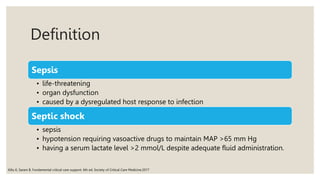
Definition
Sepsis
• life-threatening
• organ dysfunction
• caused by a dysregulated host response to infection
Septic shock
• sepsis
• hypotension requiring vasoactive drugs to maintain MAP >65 mm Hg
• having a serum lactate level >2 mmol/L despite adequate fluid administration.
Killu K, Sarani B. Fundamental critical care support. 6th ed. Society of Critical Care Medicine.2017
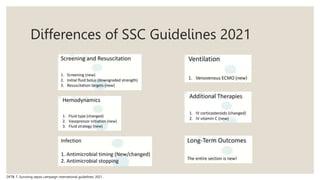
Differences of SSC Guidelines 2021
DFTB, T. Surviving sepsis campaign international guidelines. 2021.
qSOFA
Access in Dec, 1st 2021 on https://www.sccm.org/SurvivingSepsisCampaign/Guidelines/Adult-Patients
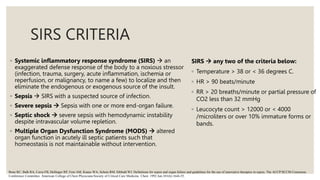
SIRS CRITERIA
◦ Systemic inflammatory response syndrome (SIRS)  an
exaggerated defense response of the body to a noxious stressor
(infection, trauma, surgery, acute inflammation, ischemia or
reperfusion, or malignancy, to name a few) to localize and then
eliminate the endogenous or exogenous source of the insult.
◦ Sepsis  SIRS with a suspected source of infection.
◦ Severe sepsis  Sepsis with one or more end-organ failure.
◦ Septic shock  severe sepsis with hemodynamic instability
despite intravascular volume repletion.
◦ Multiple Organ Dysfunction Syndrome (MODS)  altered
organ function in acutely ill septic patients such that
homeostasis is not maintainable without intervention.
Bone RC, Balk RA, Cerra FB, Dellinger RP, Fein AM, Knaus WA, Schein RM, Sibbald WJ. Definitions for sepsis and organ failure and guidelines for the use of innovative therapies in sepsis. The ACCP/SCCM Consensus
Conference Committee. American College of Chest Physicians/Society of Critical Care Medicine. Chest. 1992 Jun;101(6):1644-55.
SIRS  any two of the criteria below:
◦ Temperature > 38 or < 36 degrees C.
◦ HR > 90 beats/minute
◦ RR > 20 breaths/minute or partial pressure of
CO2 less than 32 mmHg
◦ Leucocyte count > 12000 or < 4000
/microliters or over 10% immature forms or
bands.
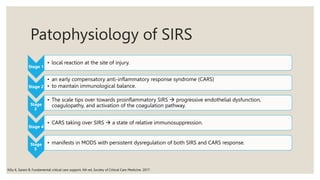
Patophysiology of SIRS
Stage 1
• local reaction at the site of injury.
Stage 2
• an early compensatory anti-inflammatory response syndrome (CARS)
• to maintain immunological balance.
Stage
3
• The scale tips over towards proinflammatory SIRS  progressive endothelial dysfunction,
coagulopathy, and activation of the coagulation pathway.
Stage 4
• CARS taking over SIRS  a state of relative immunosuppression.
Stage
5
• manifests in MODS with persistent dysregulation of both SIRS and CARS response.
Killu K, Sarani B. Fundamental critical care support. 6th ed. Society of Critical Care Medicine. 2017
Screening
◦ Clinical variables and tools are used for sepsis screening, such as :
1. systemic inflammatory response syndrome (SIRS) criteria,
2. vital signs,
3. signs of infection,
4. quick Sequential Organ Failure Score (qSOFA),
5. Sequential Organ Failure Assessment (SOFA) criteria,
6. National Early Warning Score (NEWS), or
7. Modified Early Warning Score (MEWS) (26, 32)
◦ Recommend against using qSOFA compared with SIRS, NEWS, or MEWS as a single screening
tool for sepsis or septic shock.
DFTB, T. Surviving sepsis campaign international guidelines. 2021.
Laboratory
Isolated
thrombocytopenia
Hyperglycemia
Arterial blood gas 
metabolic acidosis
Elevated serum lactate
Elevated bilirubin and
mild elevation of
transaminases.
Renal insufficiency
Nonspecific markers of
inflammation/infection
 procalcitonin
Killu K, Sarani B. Fundamental critical care support. 6th ed. Society of Critical Care Medicine.2017
Mean Arterial Pressure
Septic shock on
vasopressors
•an initial target MAP of 65mmHg
over higher MAP targets.
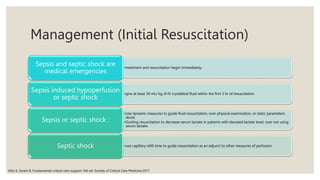
Management (Initial Resuscitation)
•treatment and resuscitation begin immediately.
Sepsis and septic shock are
medical emergencies
•give at least 30 mL/ kg of IV crystalloid fluid within the first 3 hr of resuscitation.
Sepsis induced hypoperfusion
or septic shock
•Use dynamic measures to guide fluid resuscitation, over physical examination, or static parameters
alone.
•Guiding resuscitation to decrease serum lactate in patients with elevated lactate level, over not using
serum lactate.
Sepsis or septic shock :
•use capillary refill time to guide resuscitation as an adjunct to other measures of perfusion.
Septic shock
Killu K, Sarani B. Fundamental critical care support. 6th ed. Society of Critical Care Medicine.2017
Management (Hemodynamic)
sepsis or septic shock
• who require ICU admission 
admitting the patients to the ICU
within 6 hr.
• using crystalloids as first-line fluid
for resuscitation.
• using balanced crystalloids instead of
normal saline for resuscitation.
• using albumin in patients who
received large volumes of crystalloids.
• against using starches for
resuscitation.
sepsis and septic shock
• using norepinephrine as the first-line
agent over other vasopressors.
• on norepinephrine with inadequate
MAP levels  adding vasopressin
instead of escalating the dose of
norepinephrine  if still inadequate
even using norepinephrine and
vasopressin  adding epinephrine.
septic shock
• against using terlipressin.
• and cardiac dysfunction with
persistent hypoperfusion despite
adequate volume status and arterial
blood pressure  either adding
dobutamine to norepinephrine or
using epinephrine alone, against
using levosimendan, invasive
monitoring of arterial blood pressure
over noninvasive monitoring, as soon
as practical and if resources are
available, starting vasopressors
peripherally to restore mean arterial
pressure rather than delaying
initiation until a central venous access
is secured.
Killu K, Sarani B. Fundamental critical care support. 6th ed. Society of Critical Care Medicine.2017
Management
(Hemodynamic)...2
Killu K, Sarani B. Fundamental critical care support. 6th ed. Society of Critical Care Medicine.2017
Management (Antibiotic)
Access in Dec, 1st 2021 on https://www.sccm.org/SurvivingSepsisCampaign/Guidelines/Adult-Patients
Management (Antibiotic) ... 2
Killu K, Sarani B. Fundamental critical care support. 6th ed. Society of Critical Care Medicine.2017
Management (Ventilation)
sepsis-induced
hypoxemic
respiratory failure
•use of high flow
nasal oxygen over
noninvasive
ventilation.
sepsis-induced
ARDS
•using a low tidal
volume ventilation
strategy (6 mL/kg),
over a high tidal
volume strategy (>
10 mL/kg).
•using an upper limit
goal for plateau
pressures of 30 cm
H2O, over higher
plateau pressures.
sepsis-induced
moderate-severe
ARDS
•using traditional
recruitment
maneuvers.
•using prone
ventilation for
greater than 12 hr
daily.
•using intermittent
NMBA boluses, over
NMBA continuous
infusion.
moderate to severe
sepsis- induced
ARDS
•using higher PEEP
over lower PEEP.
sepsis-induced
respiratory failure
(without ARDS)
•using low tidal
volume as compared
with high tidal
volume ventilation.
Using recruitment
maneuvers
•against using
incremental PEEP
titration/strategy.
Killu K, Sarani B. Fundamental critical care support. 6th ed. Society of Critical Care Medicine.2017
Management (Additional)
Adults with septic shock and an ongoing
requirement for vasopressor therapy
• use IV corticosteroids.
adults with sepsis or septic shock
• against using polymyxin B hemoperfusion
• using a restrictive (over liberal) transfusion
strategy
• against using IV immunoglobulins
• and who have risk factors for gastrointestinal
(GI) bleeding  using stress ulcer prophylaxis
• using pharmacologic venous
thromboembolism (VTE) prophylaxis unless a
contraindication to such therapy exists
• using low molecular weight heparin over
unfractionated heparin for VTE prophylaxis
• against using mechanical VTE prophylaxis, in
addition to pharmacological prophylaxis, over
pharmacologic prophylaxis alone.
• and AKI  use either continuous or intermit-
tent renal replacement therapy.
• and AKI, with no definitive indications for renal
replace- ment therapy, we suggest against
using renal replacement therapy.
• initiating insulin therapy at a glucose level of ≥
180mg/dL (10 mmol/L).
• against using IV vitamin C.
• who can be fed enterally  early (within 72 hr)
initiation of enteral nutrition.
septic shock and hypoperfusion-induced
lactic acidemia
• against using sodium bicarbonate therapy to
improve hemodynamics or to reduce
vasopressor requirements.
septic shock and severe metabolic acidemia
(pH ≤ 7.2) and acute kidney injury (AKIN score
2 or 3)
• using sodium bicarbonate therapy
Killu K, Sarani B. Fundamental critical care support. 6th ed. Society of Critical Care Medicine.2017
References :
1. Killu K, Sarani B. Fundamental critical care support. 6th ed. Society of Critical Care Medicine.2017
2. DFTB, T. Surviving sepsis campaign international guidelines. 2021.
3. Bone RC, Balk RA, Cerra FB, Dellinger RP, Fein AM, Knaus WA, Schein RM, Sibbald WJ. Definitions for sepsis and organ failure and guidelines for
the use of innovative therapies in sepsis. The ACCP/SCCM Consensus Conference Committee. American College of Chest Physicians/Society of
Critical Care Medicine. Chest. 1992 Jun;101(6):1644-55.
4. Levy MM, Fink MP, Marshall JC, Abraham E, Angus D, Cook D, Cohen J, Opal SM, Vincent JL, Ramsay G., SCCM/ESICM/ACCP/ATS/SIS. 2001
SCCM/ESICM/ACCP/ATS/SIS International Sepsis Definitions Conference. Crit Care Med. 2003 Apr;31(4):1250-6.
5. Fernando SM, Rochwerg B, Seely AJE. Clinical implications of the Third International Consensus Definitions for Sepsis and Septic Shock (Sepsis-
3). CMAJ. 2018 Sep 10;190(36):E1058-E1059.
6. Access in Dec, 1st 2021 on https://www.sccm.org/SurvivingSepsisCampaign/Guidelines/Adult-Patients
7. Jimenez MF, Marshall JC; International Sepsis Forum: Source control in the management of sepsis. Intensive Care Med 2001; 27 Suppl 1:S49–S62
8. Lalisang T, Usman N, Hendrawidjaya I, Handaya A, Nasution S, Saunar R et al. Clinical Practice Guidelines in Complicated Intra-Abdominal Infection 2018: An Indonesian
Perspective. Surgical Infections. 2019;20(1):83-90.

Sepsis dan SIRS

  • 1.
  • 2.
    Definition Sepsis • life-threatening • organdysfunction • caused by a dysregulated host response to infection Septic shock • sepsis • hypotension requiring vasoactive drugs to maintain MAP >65 mm Hg • having a serum lactate level >2 mmol/L despite adequate fluid administration. Killu K, Sarani B. Fundamental critical care support. 6th ed. Society of Critical Care Medicine.2017
  • 3.
    Differences of SSCGuidelines 2021 DFTB, T. Surviving sepsis campaign international guidelines. 2021.
  • 4.
    qSOFA Access in Dec,1st 2021 on https://www.sccm.org/SurvivingSepsisCampaign/Guidelines/Adult-Patients
  • 5.
    SIRS CRITERIA ◦ Systemicinflammatory response syndrome (SIRS)  an exaggerated defense response of the body to a noxious stressor (infection, trauma, surgery, acute inflammation, ischemia or reperfusion, or malignancy, to name a few) to localize and then eliminate the endogenous or exogenous source of the insult. ◦ Sepsis  SIRS with a suspected source of infection. ◦ Severe sepsis  Sepsis with one or more end-organ failure. ◦ Septic shock  severe sepsis with hemodynamic instability despite intravascular volume repletion. ◦ Multiple Organ Dysfunction Syndrome (MODS)  altered organ function in acutely ill septic patients such that homeostasis is not maintainable without intervention. Bone RC, Balk RA, Cerra FB, Dellinger RP, Fein AM, Knaus WA, Schein RM, Sibbald WJ. Definitions for sepsis and organ failure and guidelines for the use of innovative therapies in sepsis. The ACCP/SCCM Consensus Conference Committee. American College of Chest Physicians/Society of Critical Care Medicine. Chest. 1992 Jun;101(6):1644-55. SIRS  any two of the criteria below: ◦ Temperature > 38 or < 36 degrees C. ◦ HR > 90 beats/minute ◦ RR > 20 breaths/minute or partial pressure of CO2 less than 32 mmHg ◦ Leucocyte count > 12000 or < 4000 /microliters or over 10% immature forms or bands.
  • 6.
    Patophysiology of SIRS Stage1 • local reaction at the site of injury. Stage 2 • an early compensatory anti-inflammatory response syndrome (CARS) • to maintain immunological balance. Stage 3 • The scale tips over towards proinflammatory SIRS  progressive endothelial dysfunction, coagulopathy, and activation of the coagulation pathway. Stage 4 • CARS taking over SIRS  a state of relative immunosuppression. Stage 5 • manifests in MODS with persistent dysregulation of both SIRS and CARS response. Killu K, Sarani B. Fundamental critical care support. 6th ed. Society of Critical Care Medicine. 2017
  • 7.
    Screening ◦ Clinical variablesand tools are used for sepsis screening, such as : 1. systemic inflammatory response syndrome (SIRS) criteria, 2. vital signs, 3. signs of infection, 4. quick Sequential Organ Failure Score (qSOFA), 5. Sequential Organ Failure Assessment (SOFA) criteria, 6. National Early Warning Score (NEWS), or 7. Modified Early Warning Score (MEWS) (26, 32) ◦ Recommend against using qSOFA compared with SIRS, NEWS, or MEWS as a single screening tool for sepsis or septic shock. DFTB, T. Surviving sepsis campaign international guidelines. 2021.
  • 8.
    Laboratory Isolated thrombocytopenia Hyperglycemia Arterial blood gas metabolic acidosis Elevated serum lactate Elevated bilirubin and mild elevation of transaminases. Renal insufficiency Nonspecific markers of inflammation/infection  procalcitonin Killu K, Sarani B. Fundamental critical care support. 6th ed. Society of Critical Care Medicine.2017
  • 9.
    Mean Arterial Pressure Septicshock on vasopressors •an initial target MAP of 65mmHg over higher MAP targets.
  • 10.
    Management (Initial Resuscitation) •treatmentand resuscitation begin immediately. Sepsis and septic shock are medical emergencies •give at least 30 mL/ kg of IV crystalloid fluid within the first 3 hr of resuscitation. Sepsis induced hypoperfusion or septic shock •Use dynamic measures to guide fluid resuscitation, over physical examination, or static parameters alone. •Guiding resuscitation to decrease serum lactate in patients with elevated lactate level, over not using serum lactate. Sepsis or septic shock : •use capillary refill time to guide resuscitation as an adjunct to other measures of perfusion. Septic shock Killu K, Sarani B. Fundamental critical care support. 6th ed. Society of Critical Care Medicine.2017
  • 11.
    Management (Hemodynamic) sepsis orseptic shock • who require ICU admission  admitting the patients to the ICU within 6 hr. • using crystalloids as first-line fluid for resuscitation. • using balanced crystalloids instead of normal saline for resuscitation. • using albumin in patients who received large volumes of crystalloids. • against using starches for resuscitation. sepsis and septic shock • using norepinephrine as the first-line agent over other vasopressors. • on norepinephrine with inadequate MAP levels  adding vasopressin instead of escalating the dose of norepinephrine  if still inadequate even using norepinephrine and vasopressin  adding epinephrine. septic shock • against using terlipressin. • and cardiac dysfunction with persistent hypoperfusion despite adequate volume status and arterial blood pressure  either adding dobutamine to norepinephrine or using epinephrine alone, against using levosimendan, invasive monitoring of arterial blood pressure over noninvasive monitoring, as soon as practical and if resources are available, starting vasopressors peripherally to restore mean arterial pressure rather than delaying initiation until a central venous access is secured. Killu K, Sarani B. Fundamental critical care support. 6th ed. Society of Critical Care Medicine.2017
  • 12.
    Management (Hemodynamic)...2 Killu K, SaraniB. Fundamental critical care support. 6th ed. Society of Critical Care Medicine.2017
  • 13.
    Management (Antibiotic) Access inDec, 1st 2021 on https://www.sccm.org/SurvivingSepsisCampaign/Guidelines/Adult-Patients
  • 14.
    Management (Antibiotic) ...2 Killu K, Sarani B. Fundamental critical care support. 6th ed. Society of Critical Care Medicine.2017
  • 15.
    Management (Ventilation) sepsis-induced hypoxemic respiratory failure •useof high flow nasal oxygen over noninvasive ventilation. sepsis-induced ARDS •using a low tidal volume ventilation strategy (6 mL/kg), over a high tidal volume strategy (> 10 mL/kg). •using an upper limit goal for plateau pressures of 30 cm H2O, over higher plateau pressures. sepsis-induced moderate-severe ARDS •using traditional recruitment maneuvers. •using prone ventilation for greater than 12 hr daily. •using intermittent NMBA boluses, over NMBA continuous infusion. moderate to severe sepsis- induced ARDS •using higher PEEP over lower PEEP. sepsis-induced respiratory failure (without ARDS) •using low tidal volume as compared with high tidal volume ventilation. Using recruitment maneuvers •against using incremental PEEP titration/strategy. Killu K, Sarani B. Fundamental critical care support. 6th ed. Society of Critical Care Medicine.2017
  • 16.
    Management (Additional) Adults withseptic shock and an ongoing requirement for vasopressor therapy • use IV corticosteroids. adults with sepsis or septic shock • against using polymyxin B hemoperfusion • using a restrictive (over liberal) transfusion strategy • against using IV immunoglobulins • and who have risk factors for gastrointestinal (GI) bleeding  using stress ulcer prophylaxis • using pharmacologic venous thromboembolism (VTE) prophylaxis unless a contraindication to such therapy exists • using low molecular weight heparin over unfractionated heparin for VTE prophylaxis • against using mechanical VTE prophylaxis, in addition to pharmacological prophylaxis, over pharmacologic prophylaxis alone. • and AKI  use either continuous or intermit- tent renal replacement therapy. • and AKI, with no definitive indications for renal replace- ment therapy, we suggest against using renal replacement therapy. • initiating insulin therapy at a glucose level of ≥ 180mg/dL (10 mmol/L). • against using IV vitamin C. • who can be fed enterally  early (within 72 hr) initiation of enteral nutrition. septic shock and hypoperfusion-induced lactic acidemia • against using sodium bicarbonate therapy to improve hemodynamics or to reduce vasopressor requirements. septic shock and severe metabolic acidemia (pH ≤ 7.2) and acute kidney injury (AKIN score 2 or 3) • using sodium bicarbonate therapy Killu K, Sarani B. Fundamental critical care support. 6th ed. Society of Critical Care Medicine.2017
  • 17.
    References : 1. KilluK, Sarani B. Fundamental critical care support. 6th ed. Society of Critical Care Medicine.2017 2. DFTB, T. Surviving sepsis campaign international guidelines. 2021. 3. Bone RC, Balk RA, Cerra FB, Dellinger RP, Fein AM, Knaus WA, Schein RM, Sibbald WJ. Definitions for sepsis and organ failure and guidelines for the use of innovative therapies in sepsis. The ACCP/SCCM Consensus Conference Committee. American College of Chest Physicians/Society of Critical Care Medicine. Chest. 1992 Jun;101(6):1644-55. 4. Levy MM, Fink MP, Marshall JC, Abraham E, Angus D, Cook D, Cohen J, Opal SM, Vincent JL, Ramsay G., SCCM/ESICM/ACCP/ATS/SIS. 2001 SCCM/ESICM/ACCP/ATS/SIS International Sepsis Definitions Conference. Crit Care Med. 2003 Apr;31(4):1250-6. 5. Fernando SM, Rochwerg B, Seely AJE. Clinical implications of the Third International Consensus Definitions for Sepsis and Septic Shock (Sepsis- 3). CMAJ. 2018 Sep 10;190(36):E1058-E1059. 6. Access in Dec, 1st 2021 on https://www.sccm.org/SurvivingSepsisCampaign/Guidelines/Adult-Patients 7. Jimenez MF, Marshall JC; International Sepsis Forum: Source control in the management of sepsis. Intensive Care Med 2001; 27 Suppl 1:S49–S62 8. Lalisang T, Usman N, Hendrawidjaya I, Handaya A, Nasution S, Saunar R et al. Clinical Practice Guidelines in Complicated Intra-Abdominal Infection 2018: An Indonesian Perspective. Surgical Infections. 2019;20(1):83-90.

Editor's Notes

  • #3 Sepsis  life-threatening organ dysfunction caused by host response to infection. Abnormalities that suggest organ dysfunction may include, but are not limited to, lactic acidosis, oliguria, coagulation disorders, and an acute alteration in mental status. These abnormalities are not specific for sepsis and may be present in other conditions. Septic shock  sepsis with hypotension requiring vasoactive drugs to maintain mean arterial pressure >65 mm Hg and having a serum lactate level >2 mmol/L despite adequate fluid administration. Patients with suspected infection who are likely to have a prolonged ICU stay or die in the hospital can be identified at the bedside by alteration in mental status, systolic blood pressure <100 mm Hg, or a respiratory rate of >22 breaths/min. (FCCS 6E)
  • #7 Stage 1 is a local reaction at the site of injury that aims at containing the injury and limit spread. Stage 2 is an early compensatory anti-inflammatory response syndrome (CARS) in an attempt to maintain immunological balance. There is a stimulation of growth factors and recruitment of macrophages and platelets as the level of pro-inflammatory mediators decreases to maintain homeostasis. Stage 3 is when the scale tips over towards proinflammatory SIRS resulting in progressive endothelial dysfunction, coagulopathy, and activation of the coagulation pathway. It results in end-organ micro thrombosis, and a progressive increase in capillary permeability, eventually resulting in loss of circulatory integrity. Stage 4 is characterized by CARS taking over SIRS, resulting in a state of relative immunosuppression. The individual, therefore, becomes susceptible to secondary or nosocomial infections, thus perpetuating the sepsis cascade. Stage 5 manifests in MODS with persistent dysregulation of both SIRS and CARS response.
  • #9 The most common coagulation abnormality in sepsis is isolated thrombocytopenia. A decline in platelet count may be a subtle, early clue to the presence of infection. Sepsis causes relative insulin resistance, usually resulting in hyperglycemia, whereas hypoglycemia is less frequent and often reflects low hepatic glycogen stores. Arterial blood gas measurements usually reflect metabolic acidosis, a low PaCO2 due to respiratory compensation and often hypoxemia. An elevated serum lactate level is a significant sign of compromised peripheral perfusion and oxygen balance due to severe sepsis or septic shock. Hepatic dysfunction is usually not severe but presents as a cholestatic picture with elevated bilirubin and mild elevation of transaminases. Renal insufficiency often occurs due to multiple factors, such as hypotension and hypovolemia. Other possible nonspecific markers of inflammation/infection include procalcitonin and among the studies with quickly available results is Gram stain of body fluids.