Dr.A.P. Kulkarni
Professor & Head
Department of Community Medicine
Rural Medical College, LONI
OVERVIEW OF STUDY DESIGNS
Lesson objectives
At the end of the lesson, the participants will be
able to
Enlist the common study designs
Choose study design suitable for their RQ
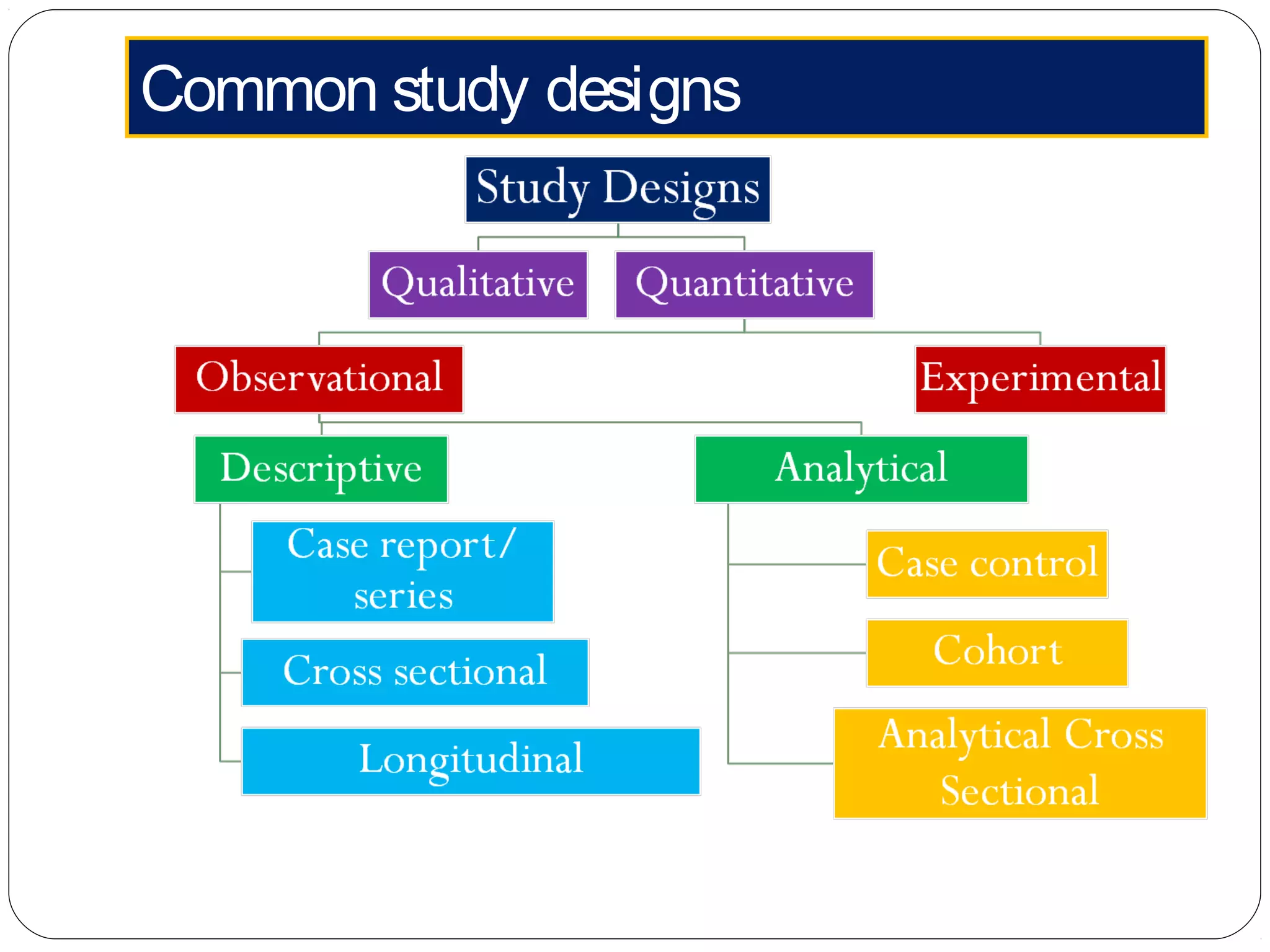
Common study designs
Qualitativestudy
Finds out how and why an event/phenomenon occurred
and when did it occur
Does not answer questions like in how many families it
occurred, how many families/communities were
involved etc.)
Helps to do a rapid assessment of the situation
Helps understand human behaviour, culture, practices
Helps understand the anomie (anarchy, normlessness)
and conflict situation in human society
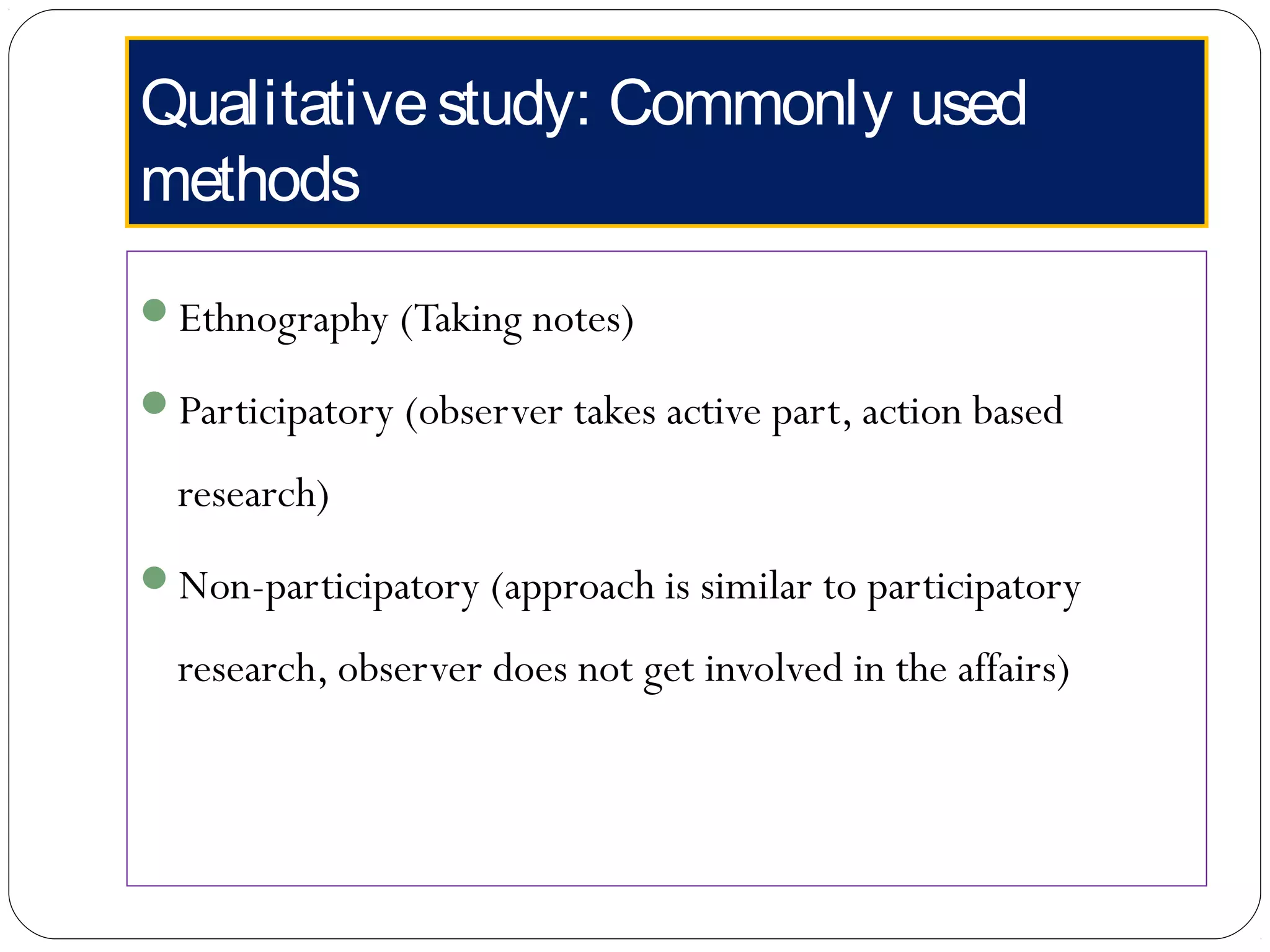
Qualitativestudy: Commonly used
methods
Ethnography (Taking notes)
Participatory (observer takes active part, action based
research)
Non-participatory (approach is similar to participatory
research, observer does not get involved in the affairs)
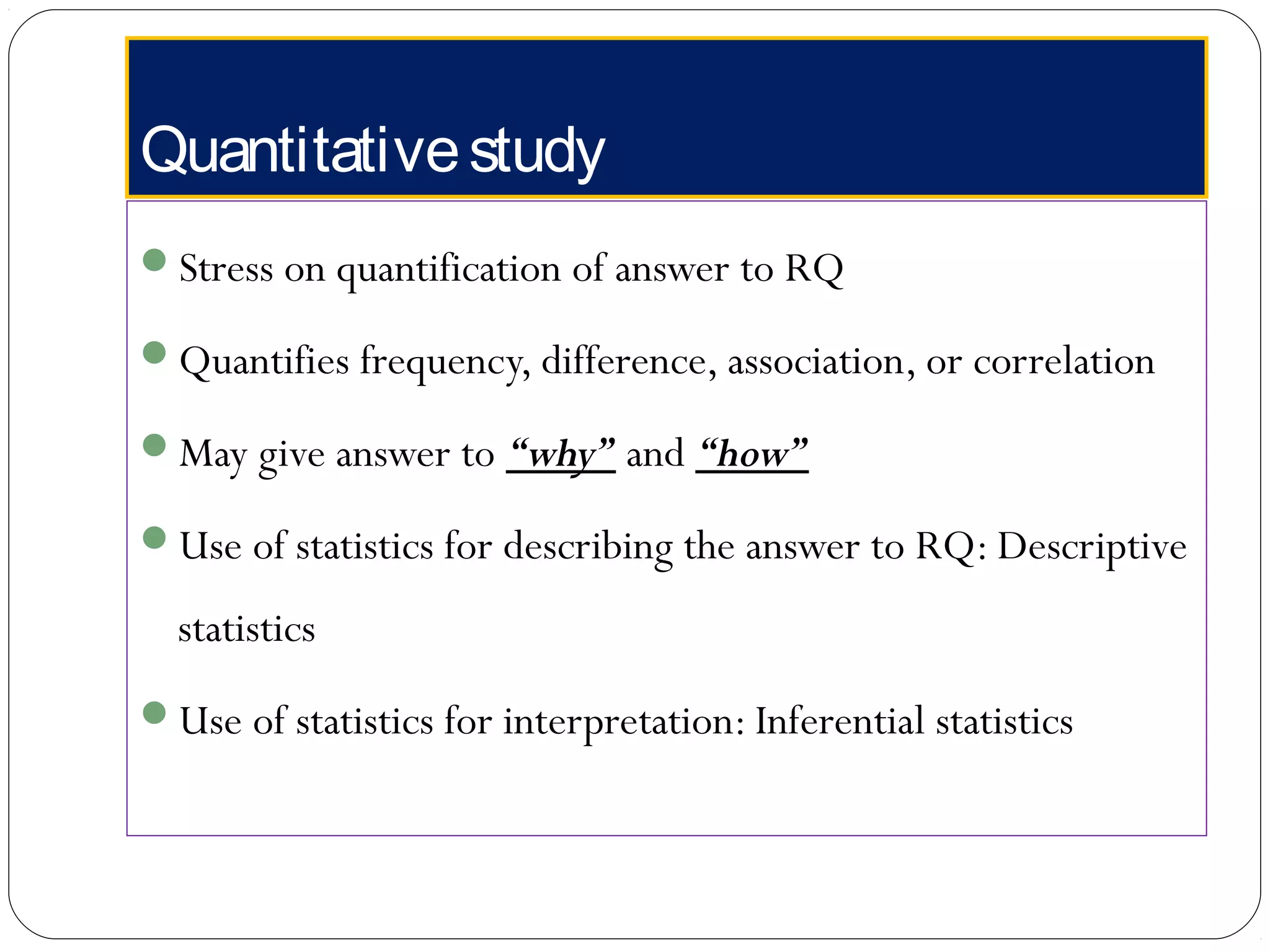
Quantitativestudy
Stress on quantification of answer to RQ
Quantifies frequency, difference, association, or correlation
May give answer to “why” and “how”
Use of statistics for describing the answer to RQ: Descriptive
statistics
Use of statistics for interpretation: Inferential statistics
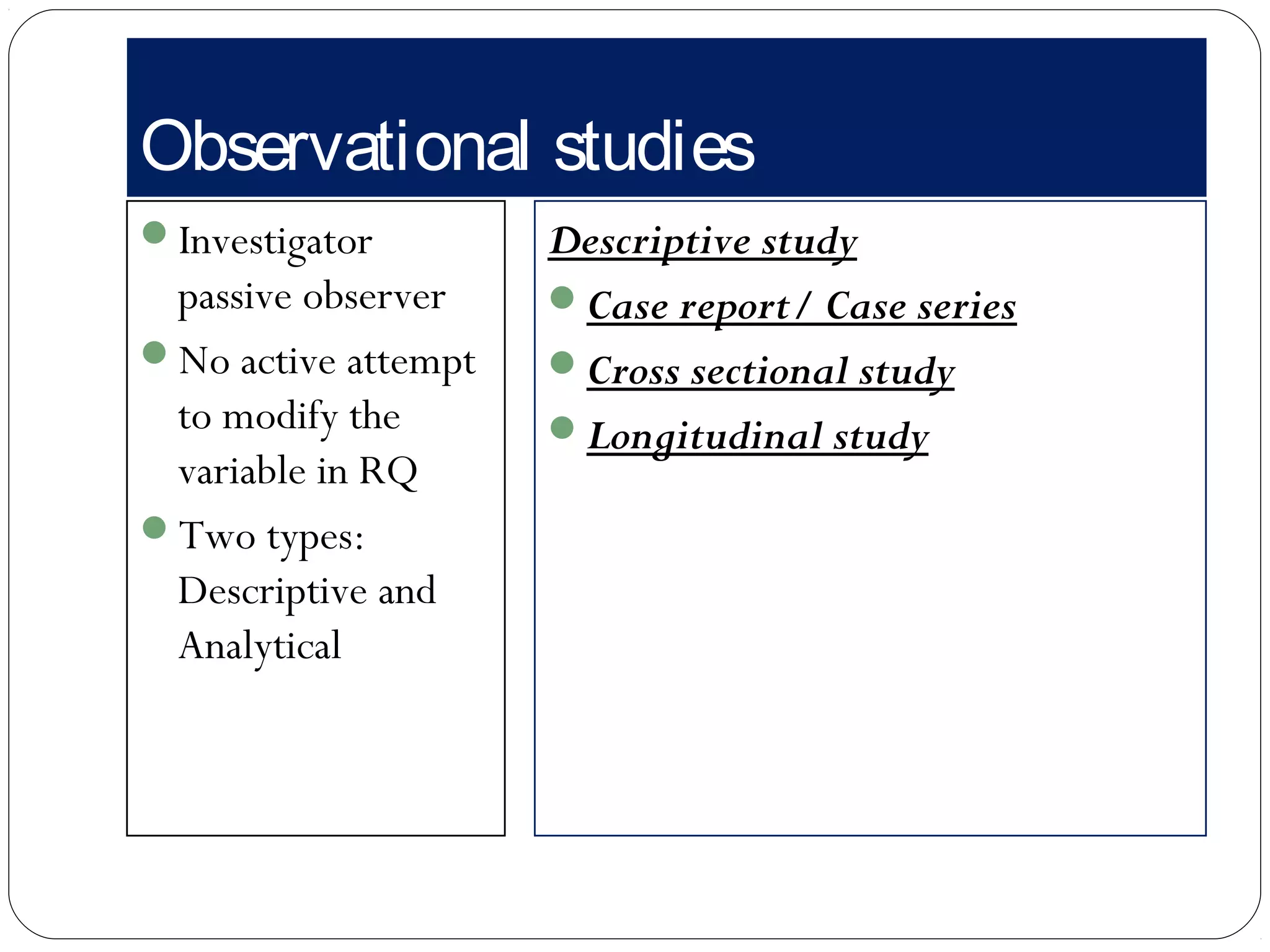
Observational studies
Investigator
passive observer
No active attempt
to modify the
variable in RQ
Two types:
Descriptive and
Analytical
Descriptive study
Case report/ Case series
Cross sectional study
Longitudinal study
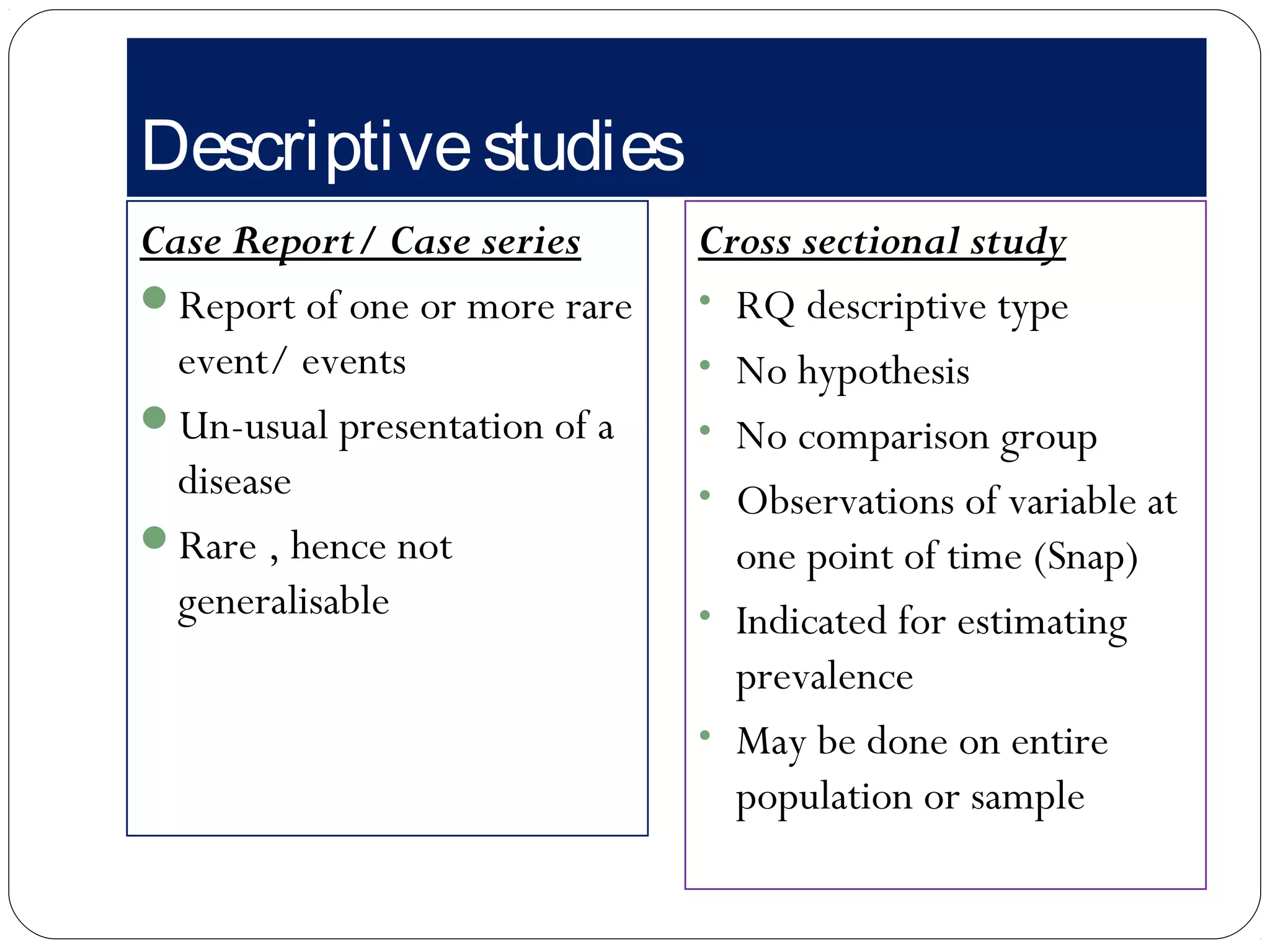
Descriptivestudies
Case Report/ Case series
Report of one or more rare
event/ events
Un-usual presentation of a
disease
Rare , hence not
generalisable
Cross sectional study
• RQ descriptive type
• No hypothesis
• No comparison group
• Observations of variable at
one point of time (Snap)
• Indicated for estimating
prevalence
• May be done on entire
population or sample
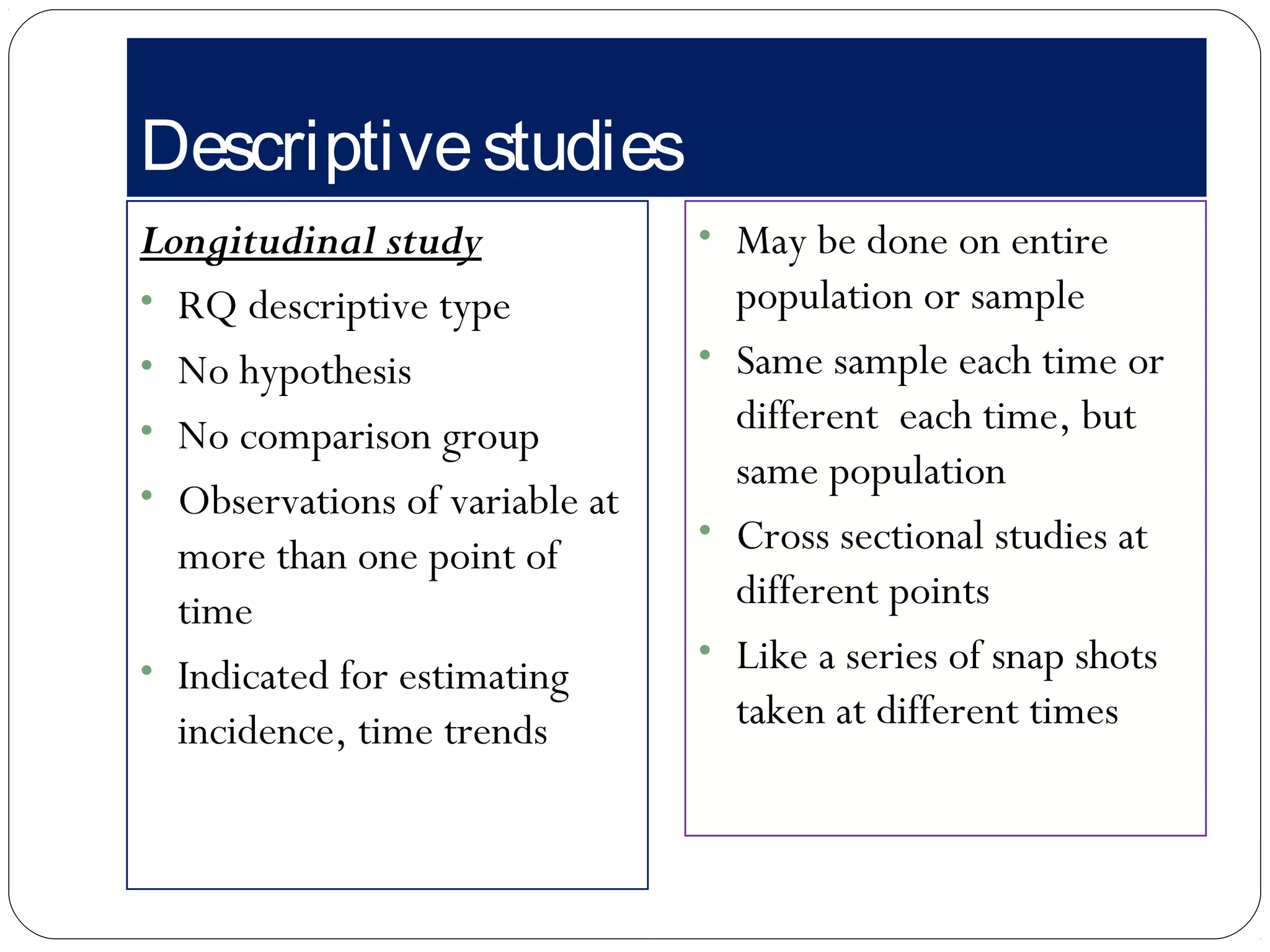
Descriptivestudies
Longitudinal study
• RQ descriptive type
• No hypothesis
• No comparison group
• Observations of variable at
more than one point of
time
• Indicated for estimating
incidence, time trends
• May be done on entire
population or sample
• Same sample each time or
different each time, but
same population
• Cross sectional studies at
different points
• Like a series of snap shots
taken at different times
Analytical studies
Case control study
• RQ difference type or
association type
• Hypothesis derived from
previous descriptive studies
• Two groups:
1. Those with outcome
[Dependent variable]
2. Those without outcome
Objective: To study
difference or association of
dependent variable with
one or more independent
[Predictor] variables
Outcome and independent
variable present before
study starts
Backward looking or
retrospective
Analytical studies
Cohort study
• RQ difference type or
association type
• Hypothesis derived from
previous descriptive studies
• Two groups:
1. Those with Independent
[Predictor] variable
2. Those without
Independent [Predictor]
variable
Objective: To study
difference or association of
independent variable with
one or more dependent
[outcome] variables
Independent variable
present before study starts
Dependent variable NOT
present at time of study
Forward looking or
prospective
Experimental studies
• RQ difference type or
association type
• Hypothesis derived from
previous studies
• Active attempt by
investigator to modify study
variable by way of
“Intervention
• Two or more groups
1. Given intervention
2. Not given intervention
under study [Control
group]
 Intervention: Giving /
Withdrawing
 Objectives:
1. To study association of
outcome with
intervention
2. To study difference in in
outcomes two groups
Evaluation of diagnostic test
• Variant of observational
study
• Objective to evaluate utility
of new test
• New test compared with
gold standard
• Hypothesis present
Variantsof Experimental studies
• Clinical trial: Placebo
controlled, No placebo
• Clinical trial: Parallel
groups, Cross over type
• Before- after trial
• Field trial
• Vaccine trial
Choice of Study Design
Type of RQ
Hypothesis
Objective
15
Thank You !

2. overview of study designs

  • 1.
    Dr.A.P. Kulkarni Professor &Head Department of Community Medicine Rural Medical College, LONI OVERVIEW OF STUDY DESIGNS
  • 2.
    Lesson objectives At theend of the lesson, the participants will be able to Enlist the common study designs Choose study design suitable for their RQ
  • 3.
  • 4.
    Qualitativestudy Finds out howand why an event/phenomenon occurred and when did it occur Does not answer questions like in how many families it occurred, how many families/communities were involved etc.) Helps to do a rapid assessment of the situation Helps understand human behaviour, culture, practices Helps understand the anomie (anarchy, normlessness) and conflict situation in human society
  • 5.
    Qualitativestudy: Commonly used methods Ethnography(Taking notes) Participatory (observer takes active part, action based research) Non-participatory (approach is similar to participatory research, observer does not get involved in the affairs)
  • 6.
    Quantitativestudy Stress on quantificationof answer to RQ Quantifies frequency, difference, association, or correlation May give answer to “why” and “how” Use of statistics for describing the answer to RQ: Descriptive statistics Use of statistics for interpretation: Inferential statistics
  • 7.
    Observational studies Investigator passive observer Noactive attempt to modify the variable in RQ Two types: Descriptive and Analytical Descriptive study Case report/ Case series Cross sectional study Longitudinal study
  • 8.
    Descriptivestudies Case Report/ Caseseries Report of one or more rare event/ events Un-usual presentation of a disease Rare , hence not generalisable Cross sectional study • RQ descriptive type • No hypothesis • No comparison group • Observations of variable at one point of time (Snap) • Indicated for estimating prevalence • May be done on entire population or sample
  • 9.
    Descriptivestudies Longitudinal study • RQdescriptive type • No hypothesis • No comparison group • Observations of variable at more than one point of time • Indicated for estimating incidence, time trends • May be done on entire population or sample • Same sample each time or different each time, but same population • Cross sectional studies at different points • Like a series of snap shots taken at different times
  • 10.
    Analytical studies Case controlstudy • RQ difference type or association type • Hypothesis derived from previous descriptive studies • Two groups: 1. Those with outcome [Dependent variable] 2. Those without outcome Objective: To study difference or association of dependent variable with one or more independent [Predictor] variables Outcome and independent variable present before study starts Backward looking or retrospective
  • 11.
    Analytical studies Cohort study •RQ difference type or association type • Hypothesis derived from previous descriptive studies • Two groups: 1. Those with Independent [Predictor] variable 2. Those without Independent [Predictor] variable Objective: To study difference or association of independent variable with one or more dependent [outcome] variables Independent variable present before study starts Dependent variable NOT present at time of study Forward looking or prospective
  • 12.
    Experimental studies • RQdifference type or association type • Hypothesis derived from previous studies • Active attempt by investigator to modify study variable by way of “Intervention • Two or more groups 1. Given intervention 2. Not given intervention under study [Control group]  Intervention: Giving / Withdrawing  Objectives: 1. To study association of outcome with intervention 2. To study difference in in outcomes two groups
  • 13.
    Evaluation of diagnostictest • Variant of observational study • Objective to evaluate utility of new test • New test compared with gold standard • Hypothesis present
  • 14.
    Variantsof Experimental studies •Clinical trial: Placebo controlled, No placebo • Clinical trial: Parallel groups, Cross over type • Before- after trial • Field trial • Vaccine trial Choice of Study Design Type of RQ Hypothesis Objective
  • 15.