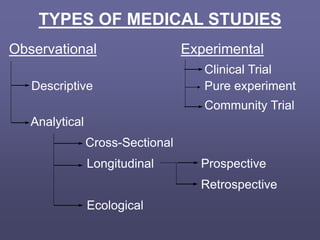
TYPES OF MEDICAL STUDIES
Observational Experimental
Clinical Trial
Descriptive Pure experiment
Community Trial
Analytical
Cross-Sectional
Longitudinal Prospective
Retrospective
Ecological
• Investigator exercises control over
allocation of exposure
• More powerful than observational studies
for testing etiological hypotheses
• For ethical reasons the possibilities of
conducting experiments in humans is
limited
Experimental Studies
SAMPLE
nonparticipants
RANDOMIZATION TO GROUPS (2….n)
INTERVENTION CONTROL
GROUP GROUP
lost to
follow-up
MEASURE MEASURE
OUTCOME OUTCOME
DESIGN OF A CLINICAL/COMMUNITY TRIAL
Clinical trial
- Gold standard in medicine – provides the
greatest justification for concluding causality
and is subject to the least number of problems or
biases
- Involves people
- Controlled trials are studies in which the
experimental dug or procedure is compared with
another drug or procedure, sometimes a placebo
and sometimes the previously accepted
treatment
- Uncontrolled trials – no comparison group
Controls
- Independent concurrent controls
- Double-blind trials
- Trials with self-controls
- Trials with external (historical) controls
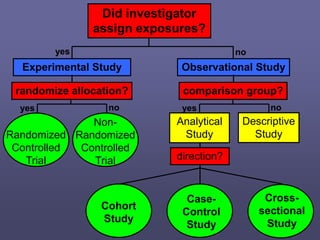
Did investigator
assign exposures?
Observational Study
Experimental Study
comparison group?
randomize allocation?
Randomized
Controlled
Trial
Non-
Randomized
Controlled
Trial
Analytical
Study
Descriptive
Study
direction?
Cross-
sectional
Study
Case-
Control
Study
Cohort
Study
no
yes
yes no yes no
Observational Studies
• Investigator observes occurrence of
condition/s in “self”-assigned groups of
people
• Often most practical and feasible
• Carried out in more natural settings
• Less control over study situation
results more susceptible to distorting
influence
Descriptive Survey
• Sets out to describe a situation
ex. Distribution of depression in a
population in relation to sex, age and other
characteristics
Analytical Survey
• Sets out to test hypotheses or detect
associations
ex. Identify factors that explain higher rates
of depression among women
OBJECTIVES OF DESCRIPTIVE
EPIDEMIOLOGiC STUDIES
• To permit evaluation of trends in health and
disease and comparisons among countries and
subgroups within countries; this objective
includes monitoring of known diseases as well
as the identification of emerging problems
• To provide a basis for planning, provision, and
evaluation of health services
• To identify problems to be studied by analytic
methods and suggest areas that may be fruitful
for investigation
(Friis & Seelers, 1999)
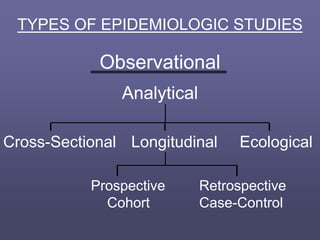
TYPES OF EPIDEMIOLOGIC STUDIES
Observational
Analytical
Cross-Sectional Longitudinal Ecological
Prospective Retrospective
Cohort Case-Control
Directionality of study design
retrospective
outcome
exposure
prospective
Prospective Study
• The first step in a prospective study
design is to identify the relevant group/s
of people and collect information about
their exposure history.
• We then follow these people over time
and measure the incidence of the
outcome/s of interest.
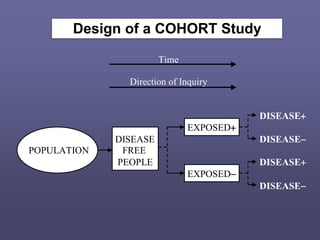
Time
Direction of Inquiry
DISEASE
EXPOSED
DISEASE DISEASE
POPULATION FREE
PEOPLE DISEASE
EXPOSED
DISEASE
Design of a COHORT Study
Cohort Study
D1 D2
E1 n1
E2 n2
Cohort study of British Doctors
Current smoker Non smoker
(1951) (1951)
Yes a b
Death of lung cancer 4180 224
No c d
45820 39776
# at beginning of study 50000 40000 90000
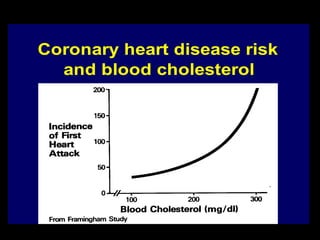
Coronary heart disease risk
and blood cholesterol
The main limitation of the
prospective design is the time and
cost involved especially when
studying chronic diseases that
may only become apparent years
after the exposure/s of interest
or may require years of exposure
to “cause” the outcome.
Example:
To investigate the risk of bowel cancer
(annual incidence = 100-300/100,000
persons) would require a cohort of
thousands of individuals to be followed for
10-15 years in order to identify a
sufficient number of outcomes for a
reliable estimation of the association.
Historical Prospective Design
• An alternative strategy for the concurrent
prospective study design in order to reduce
time and costs.
• This design requires identifying a defined
cohort from some time in the past. The follow-
up period is the time that elapsed since
exposure status was determined until the
present.
• Incidence and risk measures can be estimated
in the same manner as in a concurrent
prospective study.
Historical Prospective Design
Particularly useful when the exposure under
investigation is “unique” in some way. e.g.,
occurred only in the past, occurred in specific
group of people. Therefore this design is
often applied to the study of acute
environmental exposures.
Example: thyroid cancer risk among people
exposed to the Chernobyl nuclear-reactor
accident
Historical Prospective Design
Possible sources of information about
exposure status:
• industrial worker records
• military records
• insurance companies or health care
provider companies
• registries of persons receiving specific
medical treatment
Historical Prospective Design
• Often difficult to obtain information
about other exposures in the cohort.
• Sometime difficult to obtain
comprehensive list of those who
experienced the outcome (less
problematic in a mortality study)
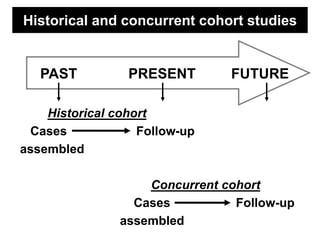
Historical and concurrent cohort studies
PAST PRESENT FUTURE
Historical cohort
Cases Follow-up
assembled
Concurrent cohort
Cases Follow-up
assembled
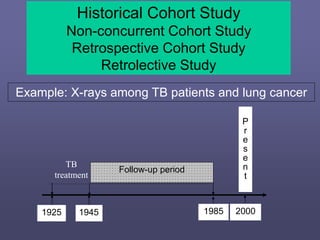
Historical Cohort Study
Non-concurrent Cohort Study
Retrospective Cohort Study
Retrolective Study
Example: X-rays among TB patients and lung cancer
2000
1985
1945
1925
TB
treatment
Follow-up period
P
r
e
s
e
n
t
Time
Direction of Inquiry
Start with:
EXPOSED
CASES
(people with
EXPOSED disease)
POPULATION
EXPOSED
CONTROLS
(people without
EXPOSED disease)
Design of a CASE-CONTROL Study
Case-Control Study
D1 D2
E1
E1
m1 m2
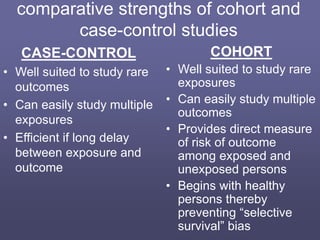
comparative strengths of cohort and
case-control studies
CASE-CONTROL
• Well suited to study rare
outcomes
• Can easily study multiple
exposures
• Efficient if long delay
between exposure and
outcome
COHORT
• Well suited to study rare
exposures
• Can easily study multiple
outcomes
• Provides direct measure
of risk of outcome
among exposed and
unexposed persons
• Begins with healthy
persons thereby
preventing “selective
survival” bias
comparative limitations of cohort
and case-control studies
CASE-CONTROL
• Inefficient for rare
exposures
• Not well suited to study
multiple outcomes
• Unable to provide data
on absolute risk
• Time sequence of
exposure and outcome
can be unclear
COHORT
• Inefficient for rare
outcomes
• Not well suited to study
multiple exposures
• Difficult if long delay
between exposure and
outcome*
• Lost-to-follow-up
problem
• Can be costly*
comparative limitations of cohort
and case-control studies
CASE-CONTROL
• Relies on information
about past exposures
that may be prone to
bias
COHORT
• Assessment of exposure
status may influence
participant’s behavior
• Changing diagnostic
criteria may introduce
bias
Design of a CROSS-SECTIONAL Study
Begin with:
DEFINED
POPULATION
gather data on exposure and disease
Exposed Exposed Exposed Exposed
Disease Disease Disease Disease
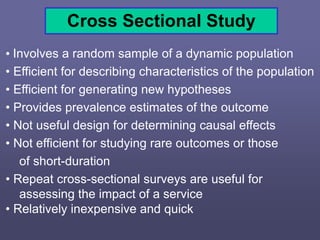
Cross Sectional Study
• Involves a random sample of a dynamic population
• Efficient for describing characteristics of the population
• Efficient for generating new hypotheses
• Provides prevalence estimates of the outcome
• Not useful design for determining causal effects
• Not efficient for studying rare outcomes or those
of short-duration
• Repeat cross-sectional surveys are useful for
assessing the impact of a service
• Relatively inexpensive and quick
• Cannot provide direct estimates of risk
• Difficult to interpret temporality between
exposure and outcome
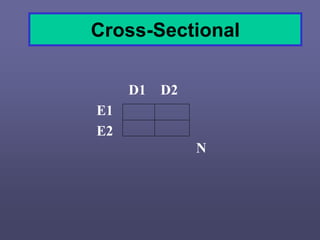
Cross Sectional Study
Cross-Sectional
D1 D2
E1
E2
N
repeated cross-sectional survey
ECOLOGICAL STUDY
BEWARE!!!
Ecological
Fallacy
of

study designs.ppt

  • 1.
    TYPES OF MEDICALSTUDIES Observational Experimental Clinical Trial Descriptive Pure experiment Community Trial Analytical Cross-Sectional Longitudinal Prospective Retrospective Ecological
  • 2.
    • Investigator exercisescontrol over allocation of exposure • More powerful than observational studies for testing etiological hypotheses • For ethical reasons the possibilities of conducting experiments in humans is limited Experimental Studies
  • 3.
    SAMPLE nonparticipants RANDOMIZATION TO GROUPS(2….n) INTERVENTION CONTROL GROUP GROUP lost to follow-up MEASURE MEASURE OUTCOME OUTCOME DESIGN OF A CLINICAL/COMMUNITY TRIAL
  • 4.
    Clinical trial - Goldstandard in medicine – provides the greatest justification for concluding causality and is subject to the least number of problems or biases - Involves people - Controlled trials are studies in which the experimental dug or procedure is compared with another drug or procedure, sometimes a placebo and sometimes the previously accepted treatment - Uncontrolled trials – no comparison group
  • 5.
    Controls - Independent concurrentcontrols - Double-blind trials - Trials with self-controls - Trials with external (historical) controls
  • 6.
    Did investigator assign exposures? ObservationalStudy Experimental Study comparison group? randomize allocation? Randomized Controlled Trial Non- Randomized Controlled Trial Analytical Study Descriptive Study direction? Cross- sectional Study Case- Control Study Cohort Study no yes yes no yes no
  • 7.
    Observational Studies • Investigatorobserves occurrence of condition/s in “self”-assigned groups of people • Often most practical and feasible • Carried out in more natural settings • Less control over study situation results more susceptible to distorting influence
  • 8.
    Descriptive Survey • Setsout to describe a situation ex. Distribution of depression in a population in relation to sex, age and other characteristics Analytical Survey • Sets out to test hypotheses or detect associations ex. Identify factors that explain higher rates of depression among women
  • 9.
    OBJECTIVES OF DESCRIPTIVE EPIDEMIOLOGiCSTUDIES • To permit evaluation of trends in health and disease and comparisons among countries and subgroups within countries; this objective includes monitoring of known diseases as well as the identification of emerging problems • To provide a basis for planning, provision, and evaluation of health services • To identify problems to be studied by analytic methods and suggest areas that may be fruitful for investigation (Friis & Seelers, 1999)
  • 10.
    TYPES OF EPIDEMIOLOGICSTUDIES Observational Analytical Cross-Sectional Longitudinal Ecological Prospective Retrospective Cohort Case-Control
  • 11.
    Directionality of studydesign retrospective outcome exposure prospective
  • 12.
    Prospective Study • Thefirst step in a prospective study design is to identify the relevant group/s of people and collect information about their exposure history. • We then follow these people over time and measure the incidence of the outcome/s of interest.
  • 13.
    Time Direction of Inquiry DISEASE EXPOSED DISEASEDISEASE POPULATION FREE PEOPLE DISEASE EXPOSED DISEASE Design of a COHORT Study
  • 14.
  • 15.
    Cohort study ofBritish Doctors Current smoker Non smoker (1951) (1951) Yes a b Death of lung cancer 4180 224 No c d 45820 39776 # at beginning of study 50000 40000 90000
  • 16.
    Coronary heart diseaserisk and blood cholesterol
  • 17.
    The main limitationof the prospective design is the time and cost involved especially when studying chronic diseases that may only become apparent years after the exposure/s of interest or may require years of exposure to “cause” the outcome.
  • 18.
    Example: To investigate therisk of bowel cancer (annual incidence = 100-300/100,000 persons) would require a cohort of thousands of individuals to be followed for 10-15 years in order to identify a sufficient number of outcomes for a reliable estimation of the association.
  • 19.
    Historical Prospective Design •An alternative strategy for the concurrent prospective study design in order to reduce time and costs. • This design requires identifying a defined cohort from some time in the past. The follow- up period is the time that elapsed since exposure status was determined until the present. • Incidence and risk measures can be estimated in the same manner as in a concurrent prospective study.
  • 20.
    Historical Prospective Design Particularlyuseful when the exposure under investigation is “unique” in some way. e.g., occurred only in the past, occurred in specific group of people. Therefore this design is often applied to the study of acute environmental exposures. Example: thyroid cancer risk among people exposed to the Chernobyl nuclear-reactor accident
  • 21.
    Historical Prospective Design Possiblesources of information about exposure status: • industrial worker records • military records • insurance companies or health care provider companies • registries of persons receiving specific medical treatment
  • 22.
    Historical Prospective Design •Often difficult to obtain information about other exposures in the cohort. • Sometime difficult to obtain comprehensive list of those who experienced the outcome (less problematic in a mortality study)
  • 23.
    Historical and concurrentcohort studies PAST PRESENT FUTURE Historical cohort Cases Follow-up assembled Concurrent cohort Cases Follow-up assembled
  • 24.
    Historical Cohort Study Non-concurrentCohort Study Retrospective Cohort Study Retrolective Study Example: X-rays among TB patients and lung cancer 2000 1985 1945 1925 TB treatment Follow-up period P r e s e n t
  • 25.
    Time Direction of Inquiry Startwith: EXPOSED CASES (people with EXPOSED disease) POPULATION EXPOSED CONTROLS (people without EXPOSED disease) Design of a CASE-CONTROL Study
  • 26.
  • 27.
    comparative strengths ofcohort and case-control studies CASE-CONTROL • Well suited to study rare outcomes • Can easily study multiple exposures • Efficient if long delay between exposure and outcome COHORT • Well suited to study rare exposures • Can easily study multiple outcomes • Provides direct measure of risk of outcome among exposed and unexposed persons • Begins with healthy persons thereby preventing “selective survival” bias
  • 28.
    comparative limitations ofcohort and case-control studies CASE-CONTROL • Inefficient for rare exposures • Not well suited to study multiple outcomes • Unable to provide data on absolute risk • Time sequence of exposure and outcome can be unclear COHORT • Inefficient for rare outcomes • Not well suited to study multiple exposures • Difficult if long delay between exposure and outcome* • Lost-to-follow-up problem • Can be costly*
  • 29.
    comparative limitations ofcohort and case-control studies CASE-CONTROL • Relies on information about past exposures that may be prone to bias COHORT • Assessment of exposure status may influence participant’s behavior • Changing diagnostic criteria may introduce bias
  • 30.
    Design of aCROSS-SECTIONAL Study Begin with: DEFINED POPULATION gather data on exposure and disease Exposed Exposed Exposed Exposed Disease Disease Disease Disease
  • 31.
    Cross Sectional Study •Involves a random sample of a dynamic population • Efficient for describing characteristics of the population • Efficient for generating new hypotheses • Provides prevalence estimates of the outcome • Not useful design for determining causal effects • Not efficient for studying rare outcomes or those of short-duration • Repeat cross-sectional surveys are useful for assessing the impact of a service • Relatively inexpensive and quick
  • 32.
    • Cannot providedirect estimates of risk • Difficult to interpret temporality between exposure and outcome Cross Sectional Study
  • 33.
  • 34.
  • 35.
  • 36.