Reading and Writing Skills
Grade 11/12
PARAGRAPH RHETORIC MODELS
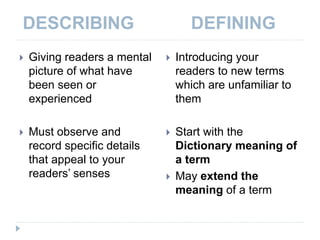
DESCRIBING DEFINING
 Giving readers a mental
picture of what have
been seen or
experienced
 Must observe and
record specific details
that appeal to your
readers’ senses
 Introducing your
readers to new terms
which are unfamiliar to
them
 Start with the
Dictionary meaning of
a term
 May extend the
meaning of a term
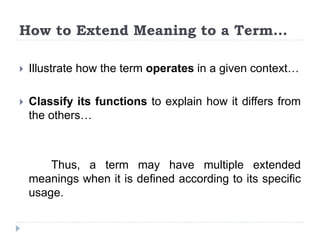
How to Extend Meaning to a Term…
 Illustrate how the term operates in a given context…
 Classify its functions to explain how it differs from
the others…
Thus, a term may have multiple extended
meanings when it is defined according to its specific
usage.
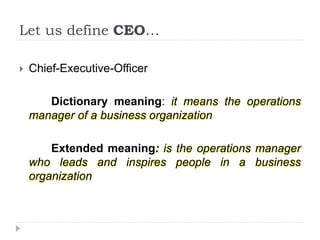
Let us define CEO…
 Chief-Executive-Officer
Dictionary meaning: it means the operations
manager of a business organization
Extended meaning: is the operations manager
who leads and inspires people in a business
organization
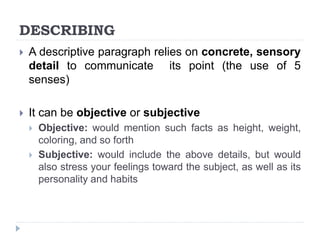
DESCRIBING
 A descriptive paragraph relies on concrete, sensory
detail to communicate its point (the use of 5
senses)
 It can be objective or subjective
 Objective: would mention such facts as height, weight,
coloring, and so forth
 Subjective: would include the above details, but would
also stress your feelings toward the subject, as well as its
personality and habits
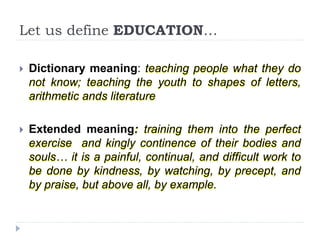
Let us define EDUCATION…
 Dictionary meaning: teaching people what they do
not know; teaching the youth to shapes of letters,
arithmetic ands literature
 Extended meaning: training them into the perfect
exercise and kingly continence of their bodies and
souls… it is a painful, continual, and difficult work to
be done by kindness, by watching, by precept, and
by praise, but above all, by example.
DESCRIBING
1. Avoid being static or flat.
2. Think of what pieces readers need, in what order,
to construct a scene.
3. Description is not what you saw, but what
readers need to see in order to imagine the
scene, a person, or an object.
4. Record a series of detailed observations.
5. Use sensory details. Do not rely much on
adjectives and adverbs.
6. Give your description away as generously as the
world gives away sights.
DESCRIBING
7. Use an approach that show decay, change or
improvement.
8. Use the description to substantiate or elaborate your
point, or move your story along.
THINK: Readers first read this, now
this, now this; what do they need
next?
CLASSIFICATION COMPARE/CONTRAST
 Elaborates on the
meaning by explaini8ng
the parts of a term
relate to its whole and
vice-versa
 Ascertain the parts or
categories that make up
a term
 Writing about 2 or more
subjects: focus mainly
on their similarities and
differences
 Understand each of the
two subjects more
clearly and make sound
judgments
CLASSIFICATION
 Example:
 Medicine as a Profession
1. Pediatrician – a doctor specializing on children
2. Dermatologist – a doctor specializing on skin
and skin allergies
3. Cardiologist – a doctor specializing on heart-
related diseases
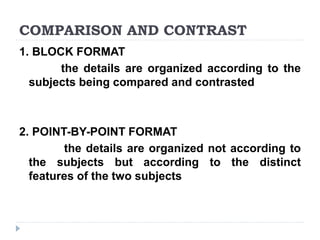
COMPARISON AND CONTRAST
1. BLOCK FORMAT
the details are organized according to the
subjects being compared and contrasted
2. POINT-BY-POINT FORMAT
the details are organized not according to
the subjects but according to the distinct
features of the two subjects
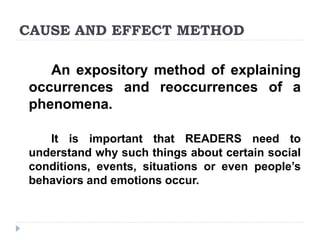
CAUSE AND EFFECT METHOD
An expository method of explaining
occurrences and reoccurrences of a
phenomena.
It is important that READERS need to
understand why such things about certain social
conditions, events, situations or even people’s
behaviors and emotions occur.
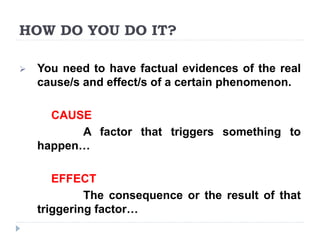
HOW DO YOU DO IT?
 You need to have factual evidences of the real
cause/s and effect/s of a certain phenomenon.
CAUSE
A factor that triggers something to
happen…
EFFECT
The consequence or the result of that
triggering factor…
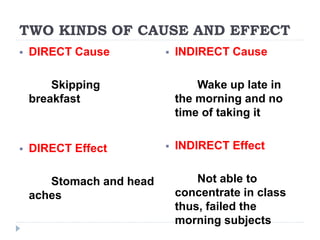
TWO KINDS OF CAUSE AND EFFECT
 DIRECT Cause
Skipping
breakfast
 DIRECT Effect
Stomach and head
aches
 INDIRECT Cause
Wake up late in
the morning and no
time of taking it
 INDIRECT Effect
Not able to
concentrate in class
thus, failed the
morning subjects
HOW DO YOU DO IT?
 Begin your paragraph by stating the direct
cause (in the topic sentence) first.
 Support it with an indirect cause/related cause
when necessary, followed by the direct and
indirect effect/s or coincidence.
 Alternatively, you may do it the other way
around starting with the effects (direct and
indirect) followed by the causes (direct and
indirect)
Reading and Thinking Strategies Across Text Types:
PATTERNS OF DEVELOPMENT
 Content Standard:
The learner realizes that information in a
written text may be selected and organized to
achieve a particular purpose
 Performance Standard:
The learner critiques a chosen sample of each
pattern of development focusing on information
selection, organization, development
Reading and Thinking Strategies Across Text Types:
PATTERNS OF DEVELOPMENT
 Learning Competencies:
Distinguishes between and among patterns of
development in writing across disciplines:
a. narration
b. description
c. definition
d. exemplification/classification
e. comparison and contrast
d. cause-effect
f. problem-solution
g. persuasion
LESSON RECAP
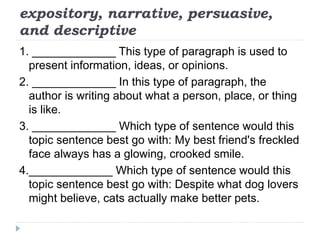
expository, narrative, persuasive,
and descriptive
1. _____________ This type of paragraph is used to
present information, ideas, or opinions.
2. _____________ In this type of paragraph, the
author is writing about what a person, place, or thing
is like.
3. _____________ Which type of sentence would this
topic sentence best go with: My best friend's freckled
face always has a glowing, crooked smile.
4._____________ Which type of sentence would this
topic sentence best go with: Despite what dog lovers
might believe, cats actually make better pets.
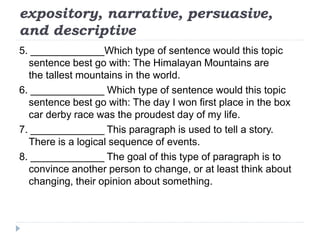
expository, narrative, persuasive,
and descriptive
5. _____________Which type of sentence would this topic
sentence best go with: The Himalayan Mountains are
the tallest mountains in the world.
6. _____________ Which type of sentence would this topic
sentence best go with: The day I won first place in the box
car derby race was the proudest day of my life.
7. _____________ This paragraph is used to tell a story.
There is a logical sequence of events.
8. _____________ The goal of this type of paragraph is to
convince another person to change, or at least think about
changing, their opinion about something.

Lesson on patterns of development

  • 1.
    Reading and WritingSkills Grade 11/12
  • 2.
  • 3.
    DESCRIBING DEFINING  Givingreaders a mental picture of what have been seen or experienced  Must observe and record specific details that appeal to your readers’ senses  Introducing your readers to new terms which are unfamiliar to them  Start with the Dictionary meaning of a term  May extend the meaning of a term
  • 4.
    How to ExtendMeaning to a Term…  Illustrate how the term operates in a given context…  Classify its functions to explain how it differs from the others… Thus, a term may have multiple extended meanings when it is defined according to its specific usage.
  • 5.
    Let us defineCEO…  Chief-Executive-Officer Dictionary meaning: it means the operations manager of a business organization Extended meaning: is the operations manager who leads and inspires people in a business organization
  • 6.
    DESCRIBING  A descriptiveparagraph relies on concrete, sensory detail to communicate its point (the use of 5 senses)  It can be objective or subjective  Objective: would mention such facts as height, weight, coloring, and so forth  Subjective: would include the above details, but would also stress your feelings toward the subject, as well as its personality and habits
  • 7.
    Let us defineEDUCATION…  Dictionary meaning: teaching people what they do not know; teaching the youth to shapes of letters, arithmetic ands literature  Extended meaning: training them into the perfect exercise and kingly continence of their bodies and souls… it is a painful, continual, and difficult work to be done by kindness, by watching, by precept, and by praise, but above all, by example.
  • 8.
    DESCRIBING 1. Avoid beingstatic or flat. 2. Think of what pieces readers need, in what order, to construct a scene. 3. Description is not what you saw, but what readers need to see in order to imagine the scene, a person, or an object. 4. Record a series of detailed observations. 5. Use sensory details. Do not rely much on adjectives and adverbs. 6. Give your description away as generously as the world gives away sights.
  • 9.
    DESCRIBING 7. Use anapproach that show decay, change or improvement. 8. Use the description to substantiate or elaborate your point, or move your story along. THINK: Readers first read this, now this, now this; what do they need next?
  • 10.
    CLASSIFICATION COMPARE/CONTRAST  Elaborateson the meaning by explaini8ng the parts of a term relate to its whole and vice-versa  Ascertain the parts or categories that make up a term  Writing about 2 or more subjects: focus mainly on their similarities and differences  Understand each of the two subjects more clearly and make sound judgments
  • 11.
    CLASSIFICATION  Example:  Medicineas a Profession 1. Pediatrician – a doctor specializing on children 2. Dermatologist – a doctor specializing on skin and skin allergies 3. Cardiologist – a doctor specializing on heart- related diseases
  • 12.
    COMPARISON AND CONTRAST 1.BLOCK FORMAT the details are organized according to the subjects being compared and contrasted 2. POINT-BY-POINT FORMAT the details are organized not according to the subjects but according to the distinct features of the two subjects
  • 13.
    CAUSE AND EFFECTMETHOD An expository method of explaining occurrences and reoccurrences of a phenomena. It is important that READERS need to understand why such things about certain social conditions, events, situations or even people’s behaviors and emotions occur.
  • 14.
    HOW DO YOUDO IT?  You need to have factual evidences of the real cause/s and effect/s of a certain phenomenon. CAUSE A factor that triggers something to happen… EFFECT The consequence or the result of that triggering factor…
  • 15.
    TWO KINDS OFCAUSE AND EFFECT  DIRECT Cause Skipping breakfast  DIRECT Effect Stomach and head aches  INDIRECT Cause Wake up late in the morning and no time of taking it  INDIRECT Effect Not able to concentrate in class thus, failed the morning subjects
  • 16.
    HOW DO YOUDO IT?  Begin your paragraph by stating the direct cause (in the topic sentence) first.  Support it with an indirect cause/related cause when necessary, followed by the direct and indirect effect/s or coincidence.  Alternatively, you may do it the other way around starting with the effects (direct and indirect) followed by the causes (direct and indirect)
  • 17.
    Reading and ThinkingStrategies Across Text Types: PATTERNS OF DEVELOPMENT  Content Standard: The learner realizes that information in a written text may be selected and organized to achieve a particular purpose  Performance Standard: The learner critiques a chosen sample of each pattern of development focusing on information selection, organization, development
  • 18.
    Reading and ThinkingStrategies Across Text Types: PATTERNS OF DEVELOPMENT  Learning Competencies: Distinguishes between and among patterns of development in writing across disciplines: a. narration b. description c. definition d. exemplification/classification e. comparison and contrast d. cause-effect f. problem-solution g. persuasion
  • 19.
  • 20.
    expository, narrative, persuasive, anddescriptive 1. _____________ This type of paragraph is used to present information, ideas, or opinions. 2. _____________ In this type of paragraph, the author is writing about what a person, place, or thing is like. 3. _____________ Which type of sentence would this topic sentence best go with: My best friend's freckled face always has a glowing, crooked smile. 4._____________ Which type of sentence would this topic sentence best go with: Despite what dog lovers might believe, cats actually make better pets.
  • 21.
    expository, narrative, persuasive, anddescriptive 5. _____________Which type of sentence would this topic sentence best go with: The Himalayan Mountains are the tallest mountains in the world. 6. _____________ Which type of sentence would this topic sentence best go with: The day I won first place in the box car derby race was the proudest day of my life. 7. _____________ This paragraph is used to tell a story. There is a logical sequence of events. 8. _____________ The goal of this type of paragraph is to convince another person to change, or at least think about changing, their opinion about something.