From error springs insight.
Erring [is] vital to any process of
invention and creation.
How can we trust when perception is
accurate and when it is not?
We cannot.
Katherine Schultz, Being Wrong
The Illusion of Naïve Realism

Katherine Schultz, Being Wrong
The Illusion of Naïve Realism

Katherine Schultz, Being Wrong
•  Our brains are not rational or logical:
we protect ourselves from being wrong
–  Confirmation bias
–  The Illusion of Asymmetric Insight
–  The Backfire Effect
–  Sunk Cost Fallacy
–  The Anchoring Effect

David McRaney, You Are Not So Smart
•  You can see learning
•  Increasing pupils’ performance is a
good thing
•  Outstanding lessons are a good thing
•  Feedback is always good (AfL)
•  We can only infer learning from
performance
•  Performance is a very poor indicator
of learning
•  Reducing performance might actually
increase learning
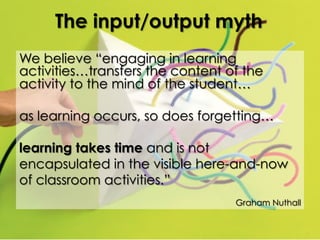
The input/output myth
We believe “engaging in learning
activities…transfers the content of the
activity to the mind of the student…
as learning occurs, so does forgetting…
learning takes time and is not
encapsulated in the visible here-and-now
of classroom activities.”
Graham Nuthall
Rob Coe
Introducing difficulties at the point of
acquisition increases long term retention
and transfer.
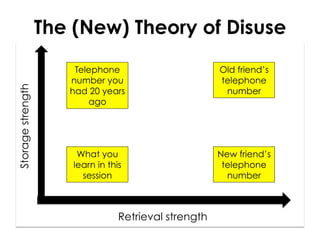
Storage strength

The (New) Theory of Disuse	
  
Telephone
number you
had 20 years
ago

Old friend’s
telephone
number

What you
learn in this
session

New friend’s
telephone
number

Retrieval strength
•  Increasing retrieval strength only
improves performance
•  Increasing storage strength depends
on the power of forgetting:
–  Spacing
–  Interleaving
–  Variability
–  Testing
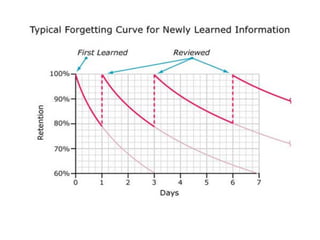
Hermann Ebbinghaus, 1885
Topic
2
Topic
3
Topic
4

Topic 5
Topic 6
Topic 3
Topic 1
Topic 4
Topic 2

Topic
1

Topic 2
Topic 4
Topic 3
Topic 5
Topic 1
Topic 6

Topic 1
Topic 3
Topic 4
Topic 6
Topic 2
Topic 5

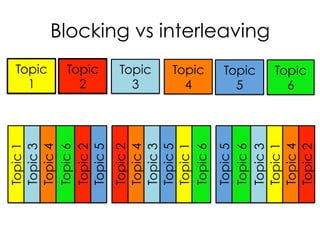
Blocking vs interleaving
Topic
5
Topic
6
Which study pattern will result in the best
test results?
1.  STUDY STUDY STUDY STUDY – TEST
2.  STUDY STUDY STUDY TEST – TEST
3.  STUDY STUDY TEST TEST – TEST
4.  STUDY TEST TEST TEST - TEST
• 
• 
• 
• 
• 
• 
• 
• 
• 
• 

Sustained & rapid progress ✗
Consistently high expectations ✓
Excellent subject knowledge ✓
Systematic, accurate assessment ?

Well judged, imaginative teaching strategies ?

Sharply focused & timely support ?

Enthusiasm, participation & commitment ?

Resilience, confidence & independence ?

Frequent & consistently high quality feedback ✗
Engagement, courtesy, collaboration & ?

cooperation
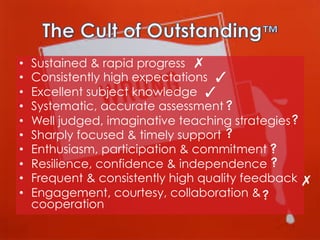
•  ‘Outstanding’ lessons focus on
performance at the expense of
learning
•  There is no such thing as an
outstanding lesson
•  Don’t get me started on lesson grades!
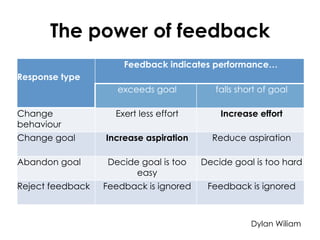
The power of feedback
Feedback indicates performance…
Response type
exceeds goal

falls short of goal

Exert less effort

Increase effort

Change goal

Increase aspiration

Reduce aspiration

Abandon goal

Decide goal is too
easy

Decide goal is too hard

Feedback is ignored

Feedback is ignored

Change
behaviour

Reject feedback

Dylan Wiliam
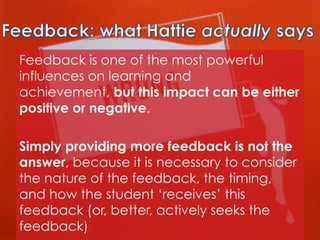
Feedback is one of the most powerful
influences on learning and
achievement, but this impact can be either
positive or negative.
Simply providing more feedback is not the
answer, because it is necessary to consider
the nature of the feedback, the timing,
and how the student ‘receives’ this
feedback (or, better, actively seeks the
feedback)
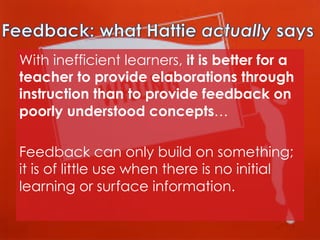
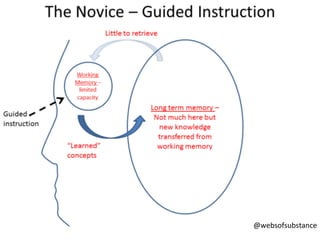
With inefficient learners, it is better for a
teacher to provide elaborations through
instruction than to provide feedback on
poorly understood concepts… 
Feedback can only build on something;
it is of little use when there is no initial
learning or surface information.
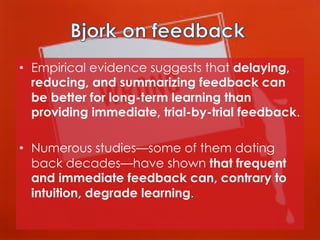
•  Empirical evidence suggests that delaying,
reducing, and summarizing feedback can
be better for long-term learning than
providing immediate, trial-by-trial feedback.
•  Numerous studies—some of them dating
back decades—have shown that frequent
and immediate feedback can, contrary to
intuition, degrade learning.
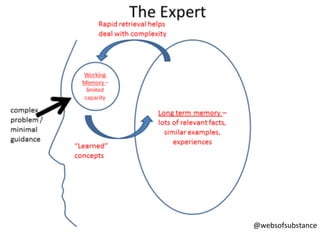
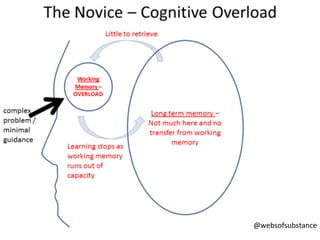
•  Working memory is severely limited
•  Experts think differently to novices
•  Our brains are not designed for
thinking.
@websofsubstance	
  
@websofsubstance	
  
@websofsubstance	
  
•  Abandon the Cult of Outstanding
•  Be careful about how we give feedback
•  Introduce ‘desirable difficulties’
•  Question all your assumptions – be
prepared to ‘murder your darlings’
David Didau
@LearningSpy
www.learningspy.co.uk
ddidau@gmail.com

Pedagoo London 2014

  • 2.
    From error springsinsight. Erring [is] vital to any process of invention and creation. How can we trust when perception is accurate and when it is not? We cannot. Katherine Schultz, Being Wrong
  • 3.
    The Illusion ofNaïve Realism Katherine Schultz, Being Wrong
  • 4.
    The Illusion ofNaïve Realism Katherine Schultz, Being Wrong
  • 6.
    •  Our brainsare not rational or logical: we protect ourselves from being wrong –  Confirmation bias –  The Illusion of Asymmetric Insight –  The Backfire Effect –  Sunk Cost Fallacy –  The Anchoring Effect David McRaney, You Are Not So Smart
  • 7.
    •  You cansee learning •  Increasing pupils’ performance is a good thing •  Outstanding lessons are a good thing •  Feedback is always good (AfL)
  • 8.
    •  We canonly infer learning from performance •  Performance is a very poor indicator of learning •  Reducing performance might actually increase learning
  • 9.
    The input/output myth Webelieve “engaging in learning activities…transfers the content of the activity to the mind of the student… as learning occurs, so does forgetting… learning takes time and is not encapsulated in the visible here-and-now of classroom activities.” Graham Nuthall
  • 10.
  • 11.
    Introducing difficulties atthe point of acquisition increases long term retention and transfer.
  • 12.
    Storage strength The (New)Theory of Disuse   Telephone number you had 20 years ago Old friend’s telephone number What you learn in this session New friend’s telephone number Retrieval strength
  • 13.
    •  Increasing retrievalstrength only improves performance •  Increasing storage strength depends on the power of forgetting: –  Spacing –  Interleaving –  Variability –  Testing
  • 14.
  • 15.
    Topic 2 Topic 3 Topic 4 Topic 5 Topic 6 Topic3 Topic 1 Topic 4 Topic 2 Topic 1 Topic 2 Topic 4 Topic 3 Topic 5 Topic 1 Topic 6 Topic 1 Topic 3 Topic 4 Topic 6 Topic 2 Topic 5 Blocking vs interleaving Topic 5 Topic 6
  • 17.
    Which study patternwill result in the best test results? 1.  STUDY STUDY STUDY STUDY – TEST 2.  STUDY STUDY STUDY TEST – TEST 3.  STUDY STUDY TEST TEST – TEST 4.  STUDY TEST TEST TEST - TEST
  • 18.
    •  •  •  •  •  •  •  •  •  •  Sustained & rapidprogress ✗ Consistently high expectations ✓ Excellent subject knowledge ✓ Systematic, accurate assessment ? Well judged, imaginative teaching strategies ? Sharply focused & timely support ? Enthusiasm, participation & commitment ? Resilience, confidence & independence ? Frequent & consistently high quality feedback ✗ Engagement, courtesy, collaboration & ? cooperation
  • 19.
    •  ‘Outstanding’ lessonsfocus on performance at the expense of learning •  There is no such thing as an outstanding lesson •  Don’t get me started on lesson grades!
  • 20.
    The power offeedback Feedback indicates performance… Response type exceeds goal falls short of goal Exert less effort Increase effort Change goal Increase aspiration Reduce aspiration Abandon goal Decide goal is too easy Decide goal is too hard Feedback is ignored Feedback is ignored Change behaviour Reject feedback Dylan Wiliam
  • 21.
    Feedback is oneof the most powerful influences on learning and achievement, but this impact can be either positive or negative. Simply providing more feedback is not the answer, because it is necessary to consider the nature of the feedback, the timing, and how the student ‘receives’ this feedback (or, better, actively seeks the feedback)
  • 22.
    With inefficient learners,it is better for a teacher to provide elaborations through instruction than to provide feedback on poorly understood concepts…  Feedback can only build on something; it is of little use when there is no initial learning or surface information.
  • 23.
    •  Empirical evidencesuggests that delaying, reducing, and summarizing feedback can be better for long-term learning than providing immediate, trial-by-trial feedback. •  Numerous studies—some of them dating back decades—have shown that frequent and immediate feedback can, contrary to intuition, degrade learning.
  • 24.
    •  Working memoryis severely limited •  Experts think differently to novices •  Our brains are not designed for thinking.
  • 25.
  • 26.
  • 27.
  • 28.
    •  Abandon theCult of Outstanding •  Be careful about how we give feedback •  Introduce ‘desirable difficulties’ •  Question all your assumptions – be prepared to ‘murder your darlings’
  • 29.