
What makes an effective
 Mathematics teacher
Effective Teachers
• Create a mathematical environment
• Pose worthwhile mathematical tasks
• Use cooperative learning groups
• Encourage the use of activities, models and
  calculators as thinking tools
• Require students to justify their responses
• Encourage conversation and writing
• Listen actively – actively question
• Include all students
The Teaching Principle

Effective mathematics teaching requires
understanding what learners know
and what they need to learn
and then challenging and supporting them
to learn it well.
Three ingredients that will contribute
        to successful lessons


 – Creative climate and conjecturing atmosphere
 – Valuing mathematical thinking
 – Purposeful activity and discussion
Creative climate and
conjecturing atmosphere
 Encouraging discussion and
  learning from mistakes
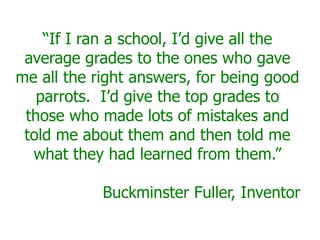
“If I ran a school, I’d give all the
 average grades to the ones who gave
me all the right answers, for being good
   parrots. I’d give the top grades to
 those who made lots of mistakes and
 told me about them and then told me
  what they had learned from them.”

            Buckminster Fuller, Inventor
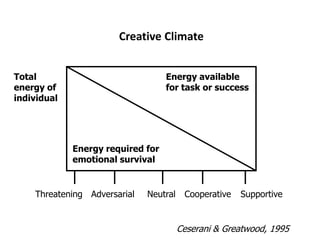
Creative Climate


Total                              Energy available
energy of                          for task or success
individual


             Energy required for
             emotional survival


    Threatening Adversarial   Neutral    Cooperative   Supportive


                                        Ceserani & Greatwood, 1995
Valuing mathematical thinking
 What behaviours do we value in
  mathematics and how can we
encourage them in our classrooms?
Are you excited by a challenge?


The most exciting phrase to hear in
science, the one that heralds new
discoveries, is not Eureka!, but rather,
“hmmm… that’s funny…”

                  Isaac Asimov
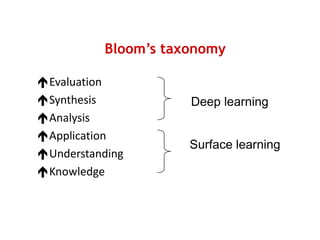
Bloom’s taxonomy

Evaluation
Synthesis           Deep learning
Analysis
Application
                     Surface learning
Understanding
Knowledge
Purposeful activity and discussion

Give the learners something to do,
      not something to learn;
and if the doing is of such a nature
      as to demand thinking;
    learning naturally results.
                         John Dewey
Learning styles

   Visual
  Auditory
Kinaesthetic
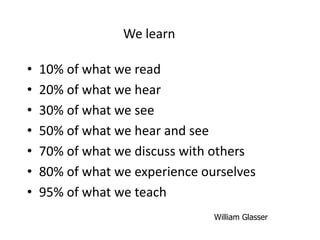
We learn

•   10% of what we read
•   20% of what we hear
•   30% of what we see
•   50% of what we hear and see
•   70% of what we discuss with others
•   80% of what we experience ourselves
•   95% of what we teach
                                William Glasser

What makes an effective Maths Teacher

  • 1.
    What makes aneffective Mathematics teacher
  • 2.
    Effective Teachers • Createa mathematical environment • Pose worthwhile mathematical tasks • Use cooperative learning groups • Encourage the use of activities, models and calculators as thinking tools • Require students to justify their responses • Encourage conversation and writing • Listen actively – actively question • Include all students
  • 3.
    The Teaching Principle Effectivemathematics teaching requires understanding what learners know and what they need to learn and then challenging and supporting them to learn it well.
  • 4.
    Three ingredients thatwill contribute to successful lessons – Creative climate and conjecturing atmosphere – Valuing mathematical thinking – Purposeful activity and discussion
  • 5.
    Creative climate and conjecturingatmosphere Encouraging discussion and learning from mistakes
  • 6.
    “If I rana school, I’d give all the average grades to the ones who gave me all the right answers, for being good parrots. I’d give the top grades to those who made lots of mistakes and told me about them and then told me what they had learned from them.” Buckminster Fuller, Inventor
  • 7.
    Creative Climate Total Energy available energy of for task or success individual Energy required for emotional survival Threatening Adversarial Neutral Cooperative Supportive Ceserani & Greatwood, 1995
  • 8.
    Valuing mathematical thinking What behaviours do we value in mathematics and how can we encourage them in our classrooms?
  • 9.
    Are you excitedby a challenge? The most exciting phrase to hear in science, the one that heralds new discoveries, is not Eureka!, but rather, “hmmm… that’s funny…” Isaac Asimov
  • 10.
    Bloom’s taxonomy Evaluation Synthesis Deep learning Analysis Application Surface learning Understanding Knowledge
  • 11.
    Purposeful activity anddiscussion Give the learners something to do, not something to learn; and if the doing is of such a nature as to demand thinking; learning naturally results. John Dewey
  • 12.
    Learning styles Visual Auditory Kinaesthetic
  • 13.
    We learn • 10% of what we read • 20% of what we hear • 30% of what we see • 50% of what we hear and see • 70% of what we discuss with others • 80% of what we experience ourselves • 95% of what we teach William Glasser