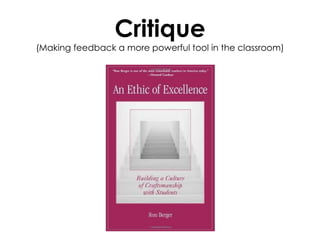
Critique
(Making feedback a more powerful tool in the classroom)
Why I looked at it:
• I wanted students to develop actual pride in the
  quality of their work

• I wanted to develop the use of feedback in my
  classroom (and for it to become a culture/norm)

• I wanted to have feedback acted upon instantly
  so every student made progress (specific
  feedback is surely one of the best forms of
  differentiation?)
Process
      Dedicate whole lessons to this
• Model a piece of work you are asking students
  to create (pull out key vocabulary)

• Create a success criteria with students

• Draft 1

• Formal class critique

• Draft 2 (redraft)

• Student critique….
Critique Rules:
• Be kind: All feedback is there to help. No
  personal comments. No sarcasm.

• Be specific: No comments like ‘It’s good’ or ‘I
  like it’. These just waste our time. Ban them. Use
  vocab pulled out from model.

• Be helpful: Aim is to help an individual or the
  whole class with their learning. Comments
  should focus on this. Anything else wastes time.

• Hard on content, soft on people
In-Depth Critique
Gallery Critique
Please click this link to see the work that High Tech High in San Diego does on critique
                              and promoting excellent work:
http://www.jamieportman.com/blog/teaching-learning/reflections-on-hightechhigh-visit-exhibiting-
                                        learning/
Why? Impact?
• Standard of work went through the roof
• Feedback given was more specific and became like
  a set of instructions (vocab improved)
• The progress that students made was extremely high
• Content was learnt and reinforced over and over
  again through process of critique
• Underlying development of literacy skills and other
  key processes used in the project
• Students looking for work to be critiqued without my
  direction
• Students skilled enough to critique their own work
  with rigor
• Culture of creating work to be proud of was
  achieved in the project (due to critique)
Essential resources
‘An Ethic of Excellence’
by Ron Berger

Excellent ‘must read’ for all
teachers.

http://www.amazon.co.uk/A
n-Ethic-Excellence-Building-
Craftsmanship/dp/032500596
6
Essential resources
Ron Berger basic explanation of critique
Part 1 - http://www.youtube.com/watch?v=1znB1ox0_EI
Part 2 - http://www.youtube.com/watch?v=J2K75WO7a70
Austin’s Butterfly - http://www.youtube.com/watch?v=JFHf7jAfJlg

Tait Coles Critique presentation from TMClevedon
Part 1 - http://www.youtube.com/watch?v=v_qdNNs3m6g
Part 2 - http://www.youtube.com/watch?v=M-yXX1En3fc

High Tech High guide - P27 of the book explaining critique
http://www.innovationunit.org/sites/default/files/Teacher's%20Guide%20to%20Pr
oject-based%20Learning.pdf

Darren Mead blog posts on critique
http://pedagogicalpurposes.blogspot.co.uk/search/label/critiques

Tait Coles blog posts on critique
http://taitcoles.wordpress.com/2012/06/07/public-critique/

David Didau (Learning Spy)
http://learningspy.co.uk/2013/01/26/work-scrutiny-whats-the-point-of-marking-
books/

Critique presentation

  • 1.
    Critique (Making feedback amore powerful tool in the classroom)
  • 2.
    Why I lookedat it: • I wanted students to develop actual pride in the quality of their work • I wanted to develop the use of feedback in my classroom (and for it to become a culture/norm) • I wanted to have feedback acted upon instantly so every student made progress (specific feedback is surely one of the best forms of differentiation?)
  • 3.
    Process Dedicate whole lessons to this • Model a piece of work you are asking students to create (pull out key vocabulary) • Create a success criteria with students • Draft 1 • Formal class critique • Draft 2 (redraft) • Student critique….
  • 4.
    Critique Rules: • Bekind: All feedback is there to help. No personal comments. No sarcasm. • Be specific: No comments like ‘It’s good’ or ‘I like it’. These just waste our time. Ban them. Use vocab pulled out from model. • Be helpful: Aim is to help an individual or the whole class with their learning. Comments should focus on this. Anything else wastes time. • Hard on content, soft on people
  • 5.
  • 6.
    Gallery Critique Please clickthis link to see the work that High Tech High in San Diego does on critique and promoting excellent work: http://www.jamieportman.com/blog/teaching-learning/reflections-on-hightechhigh-visit-exhibiting- learning/
  • 7.
    Why? Impact? • Standardof work went through the roof • Feedback given was more specific and became like a set of instructions (vocab improved) • The progress that students made was extremely high • Content was learnt and reinforced over and over again through process of critique • Underlying development of literacy skills and other key processes used in the project • Students looking for work to be critiqued without my direction • Students skilled enough to critique their own work with rigor • Culture of creating work to be proud of was achieved in the project (due to critique)
  • 8.
    Essential resources ‘An Ethicof Excellence’ by Ron Berger Excellent ‘must read’ for all teachers. http://www.amazon.co.uk/A n-Ethic-Excellence-Building- Craftsmanship/dp/032500596 6
  • 9.
    Essential resources Ron Bergerbasic explanation of critique Part 1 - http://www.youtube.com/watch?v=1znB1ox0_EI Part 2 - http://www.youtube.com/watch?v=J2K75WO7a70 Austin’s Butterfly - http://www.youtube.com/watch?v=JFHf7jAfJlg Tait Coles Critique presentation from TMClevedon Part 1 - http://www.youtube.com/watch?v=v_qdNNs3m6g Part 2 - http://www.youtube.com/watch?v=M-yXX1En3fc High Tech High guide - P27 of the book explaining critique http://www.innovationunit.org/sites/default/files/Teacher's%20Guide%20to%20Pr oject-based%20Learning.pdf Darren Mead blog posts on critique http://pedagogicalpurposes.blogspot.co.uk/search/label/critiques Tait Coles blog posts on critique http://taitcoles.wordpress.com/2012/06/07/public-critique/ David Didau (Learning Spy) http://learningspy.co.uk/2013/01/26/work-scrutiny-whats-the-point-of-marking- books/