How
the
Brain
Processes
Information:


Memory,
attention
and
learning

Tracey Tokuhama-Espinosa, Ph.D.
IDEA, Universidad San Francisco de Quito
UDLA, Quito
Mayo 2010
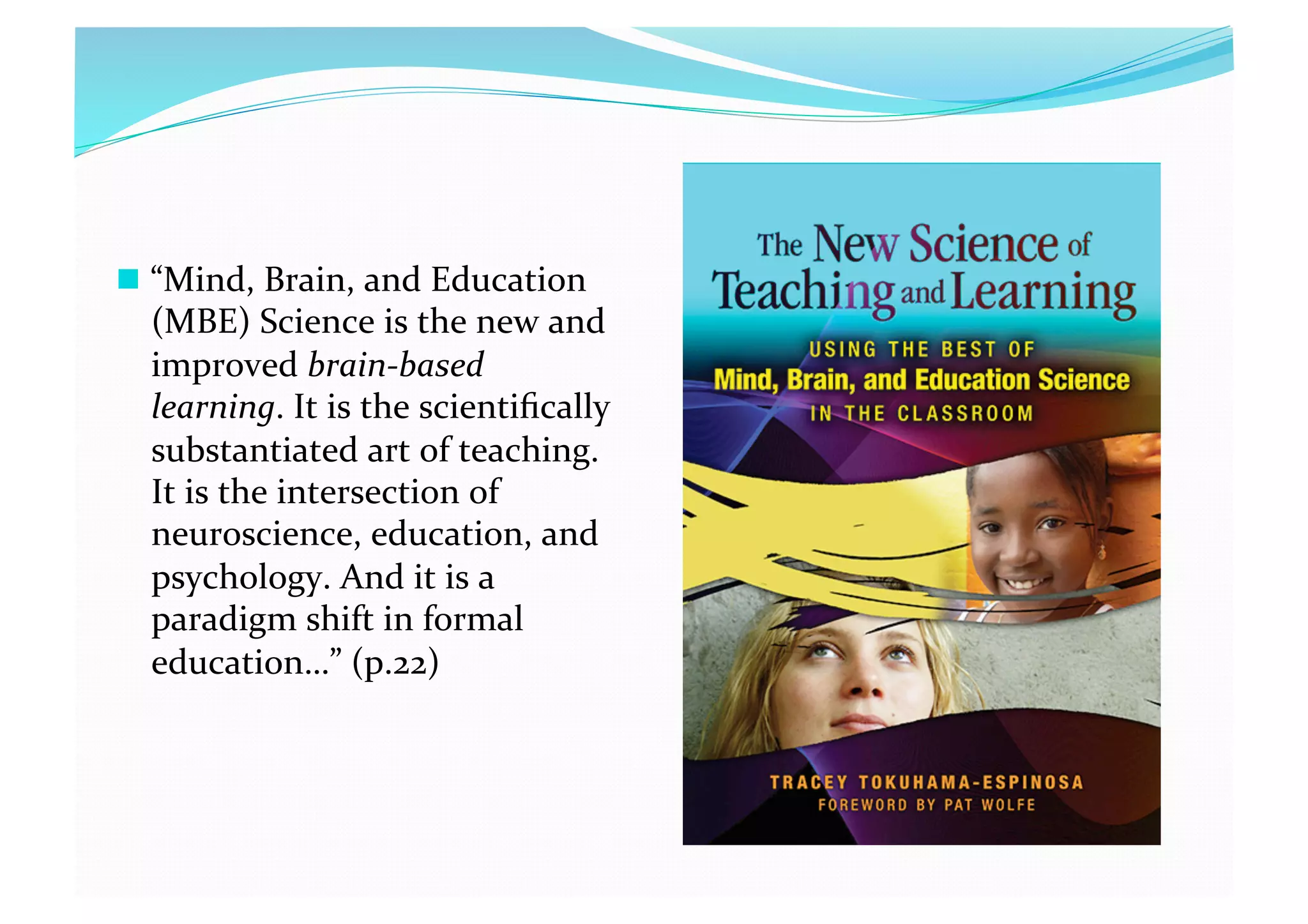
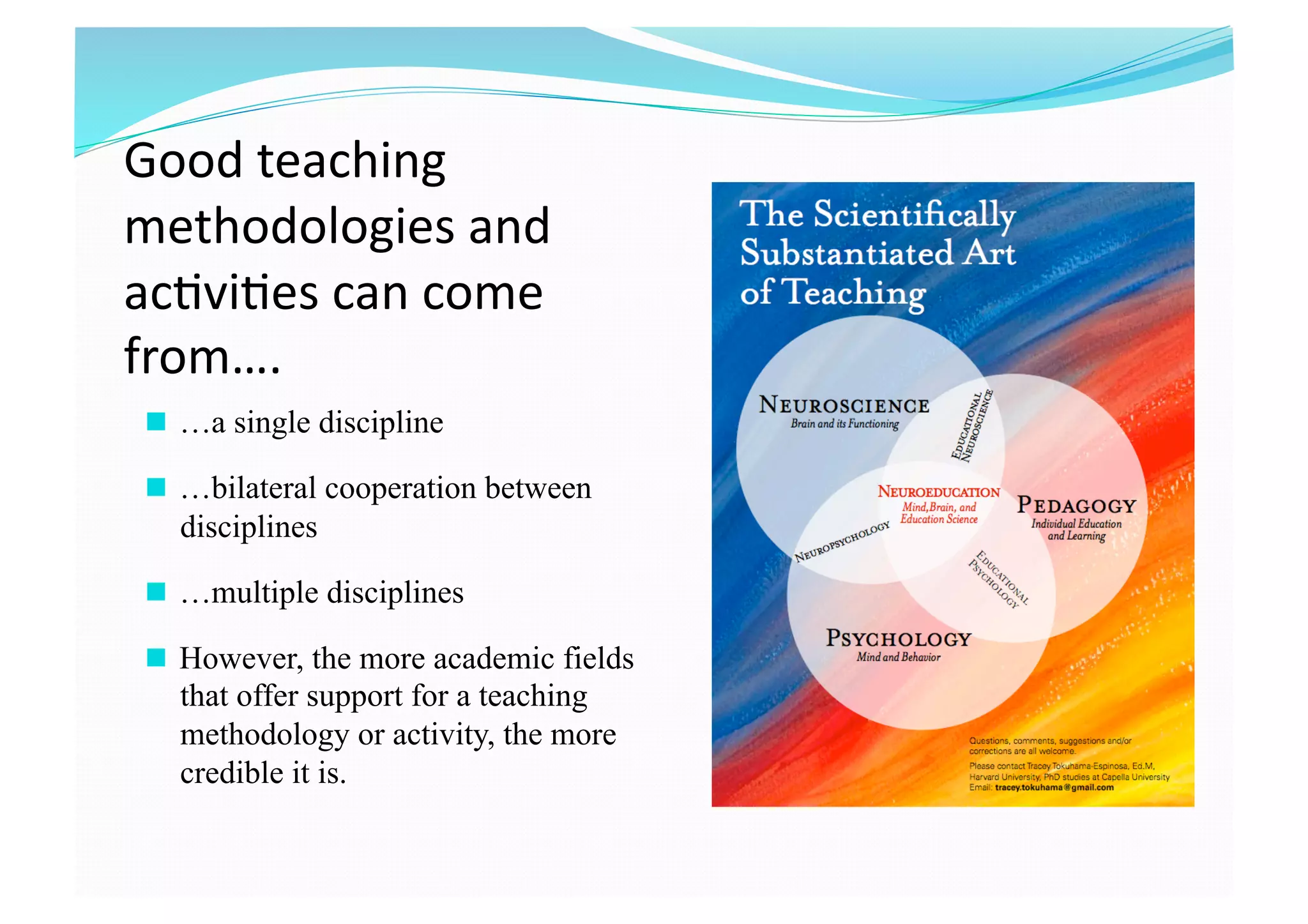
 “Mind,
Brain,
and
Education

(MBE)
Science
is
the
new
and

improved
brain‐based

learning.
It
is
the
scientifically

substantiated
art
of
teaching.

It
is
the
intersection
of

neuroscience,
education,
and

psychology.
And
it
is
a

paradigm
shift
in
formal

education…”
(p.22)

"Tracey
Tokuhama‐Espinosa’s
book
is
not
only
an
excellent
guide
for
teachers,
a
most

needed
review
of
the
cutting
edge
research
on
neuroeducation,
but
also
a
model
of

pedagogy.
The
author
has
done
a
generous
effort
to
guide
the
readers
step
by
step
in
the

fascinating
exploration
of
the
new
transdisciplinary
field
called
MBE,
Mind,
Brain
and

Education.
I
recommend
this
book
to
every
teacher.
It
will
clarify
many
issues
and
promote

many
educational
initiatives."


‐Antonio
M.
Battro,
MD,
PhD

President
of
IMBES,
International
Mind,
Brain
and
Education
Society


“Tracey
Tokuhama‐Espinosa
has
written
a
highly
accessible,
extraordinarily
well‐
documented
compilation
of
essential
information
for
all
educators.
She
firmly
establishes

the
links
between
neuroscience
and
psychology
provides
the
background
knowledge

needed
to
evaluate
research
for
validity.
In
doing
so,
Tracey
Tokuhama‐Espinosa
offers
the

important
principles
teachers
can
follow
to
be
critical
consumers.
The
exposures
of
the

neuromyths,
that
have
plagued
optimal
progress
in
the
incorporation
of
appropriately

supported
research
into
our
textbooks,
teacher
education,
and
classroom
strategies,
is

accompanied
with
tools
for
differentiating
between
valid
research
interpretations
and

future
neuromyths.
Readers
will
be
vital
resources
for
students,
colleagues,
and
the
future

of
our
educational
system.
This
breakthrough
book
guides
informed
decision
making
using

the
best
science
has
to
offer
to
return
joy
and
authentic
learning
to
our
classrooms.”

‐Judy
Willis,
M.D.,
M.Ed,
neurologist,
middle
school
teacher,
author
and
renowned
speaker

on
brain‐based
education


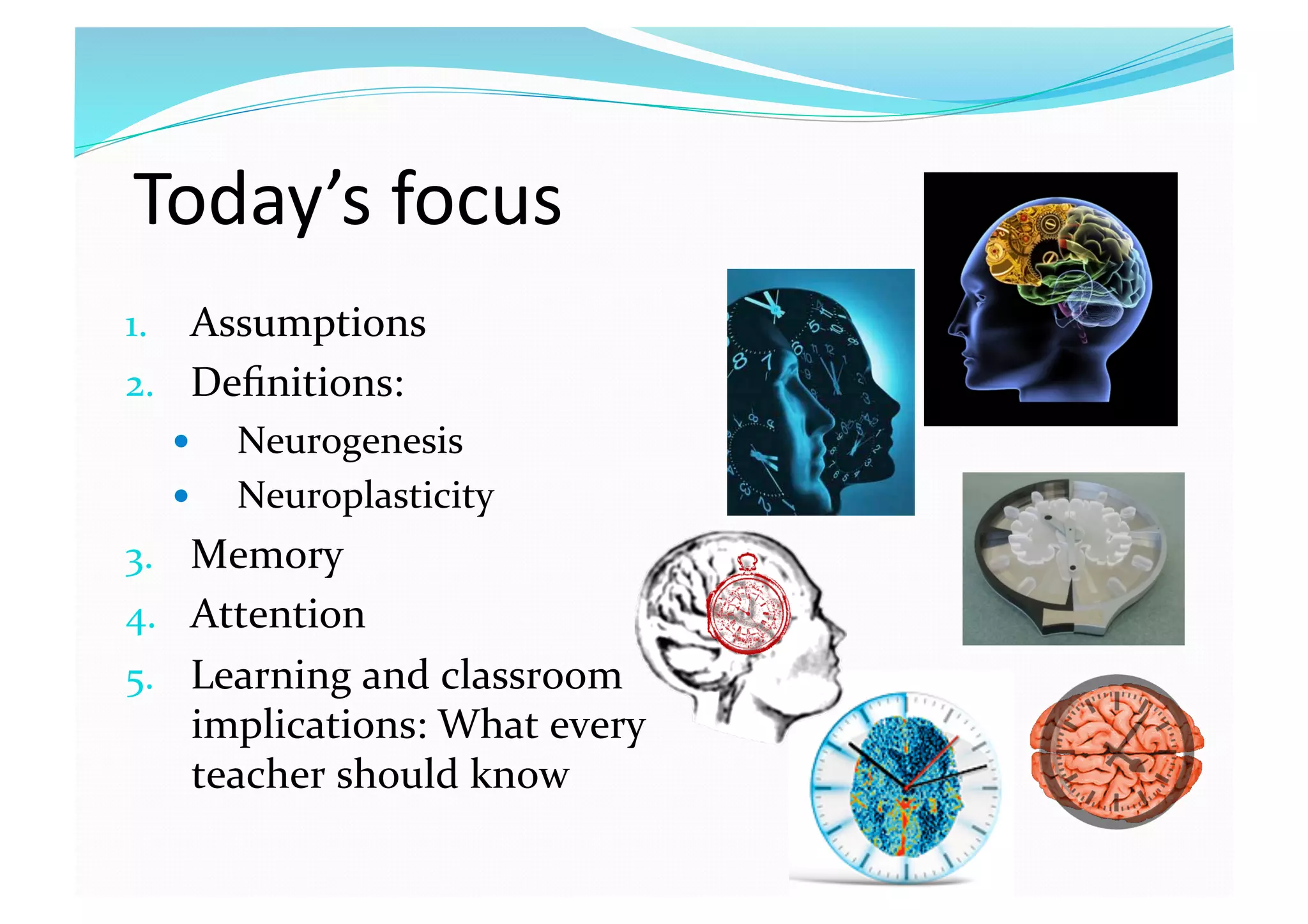
Today’s
focus

1.  Assumptions

2.  Definitions:


  Neurogenesis

  Neuroplasticity

3.  Memory

4.  Attention

5.  Learning
and
classroom

implications:
What
every

teacher
should
know

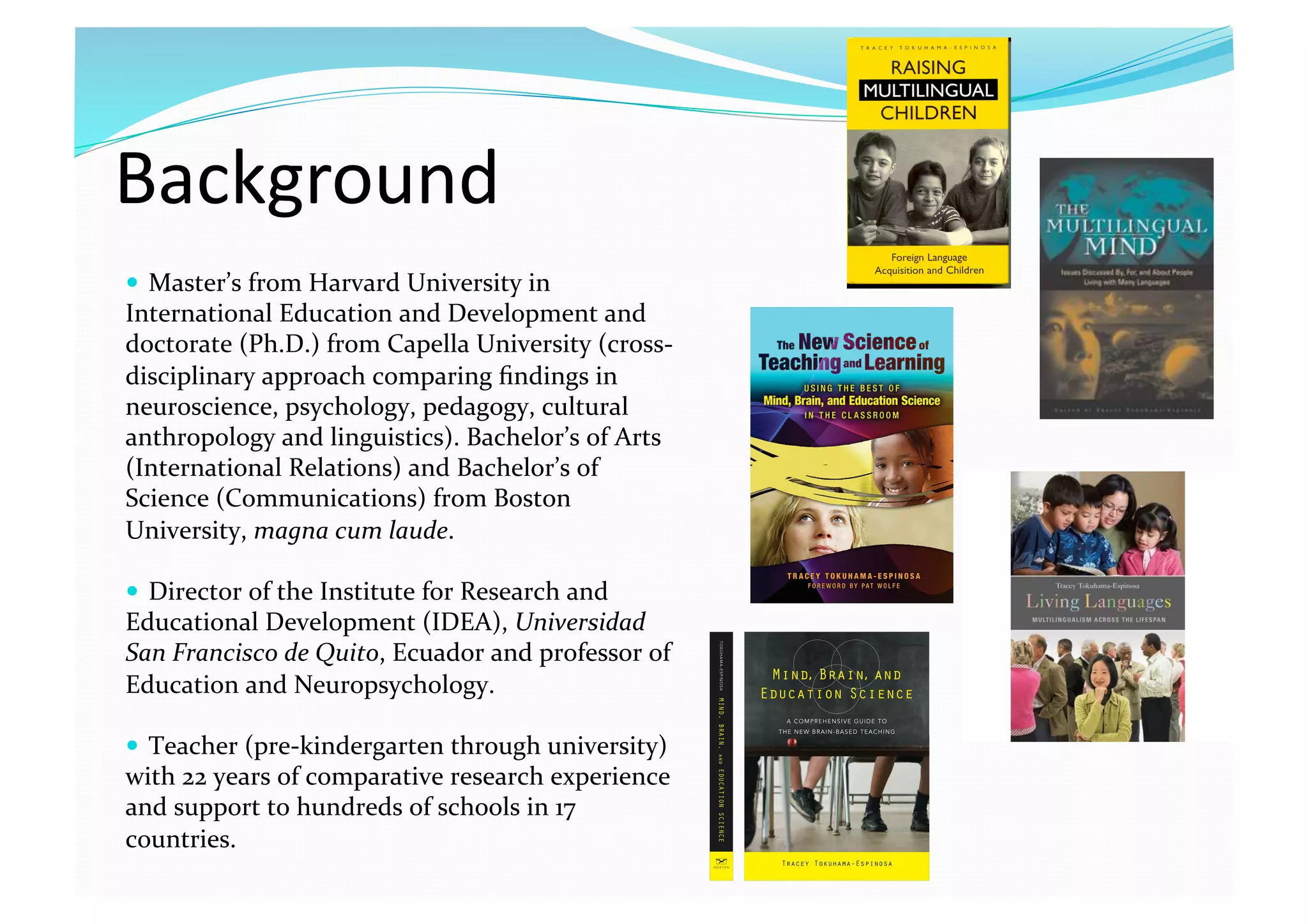
Background

  Master’s
from
Harvard
University
in

International
Education
and
Development
and

doctorate
(Ph.D.)
from
Capella
University
(cross‐
disciplinary
approach
comparing
findings
in

neuroscience,
psychology,
pedagogy,
cultural

anthropology
and
linguistics).
Bachelor’s
of
Arts

(International
Relations)
and
Bachelor’s
of

Science
(Communications)
from
Boston

University,
magna
cum
laude.

  Director
of
the
Institute
for
Research
and

Educational
Development
(IDEA),
Universidad

San
Francisco
de
Quito,
Ecuador
and
professor
of

Education
and
Neuropsychology.

  Teacher
(pre‐kindergarten
through
university)

with
22
years
of
comparative
research
experience

and
support
to
hundreds
of
schools
in
17

countries.


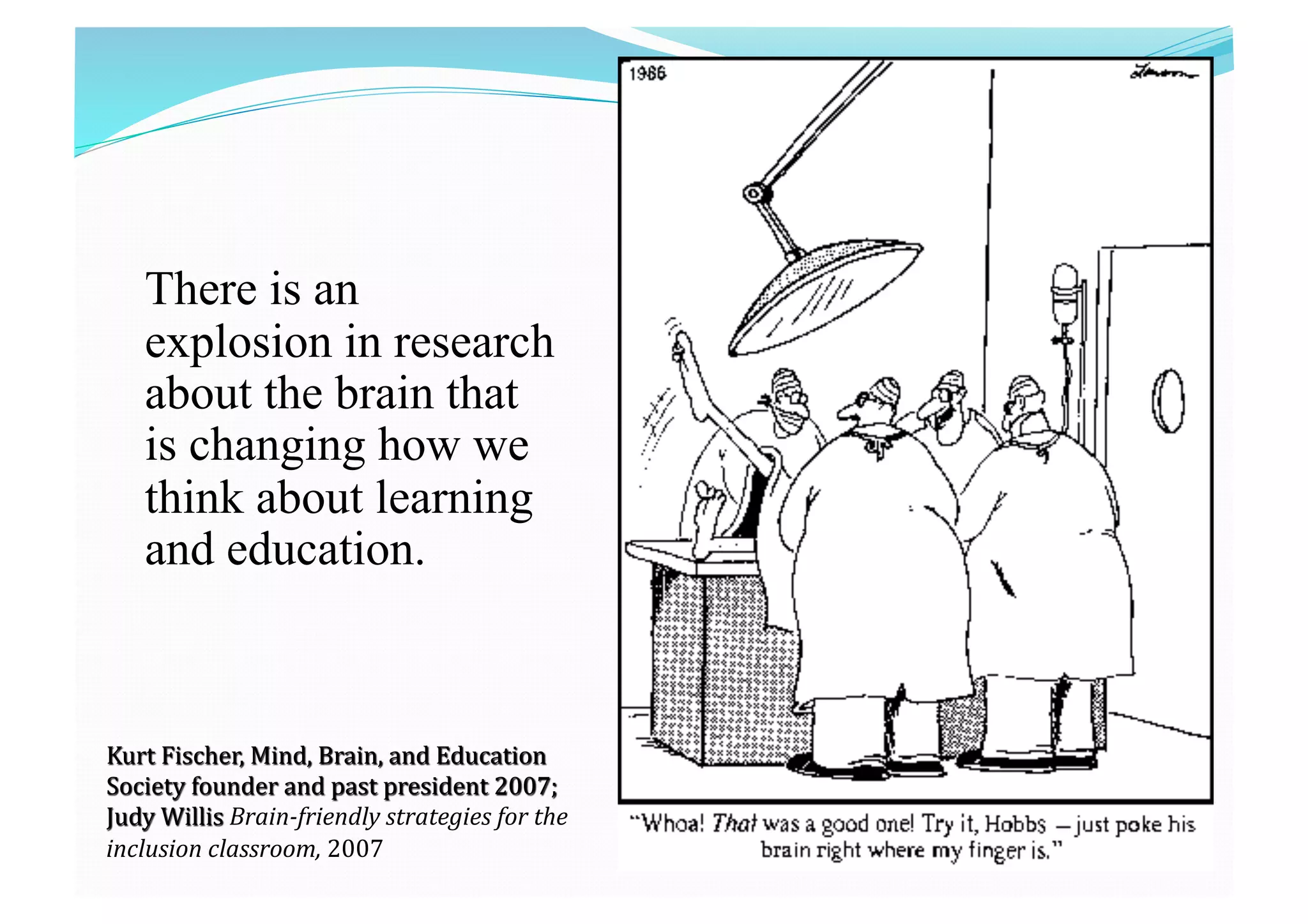
There is an
explosion in research
about the brain that
is changing how we
think about learning
and education.
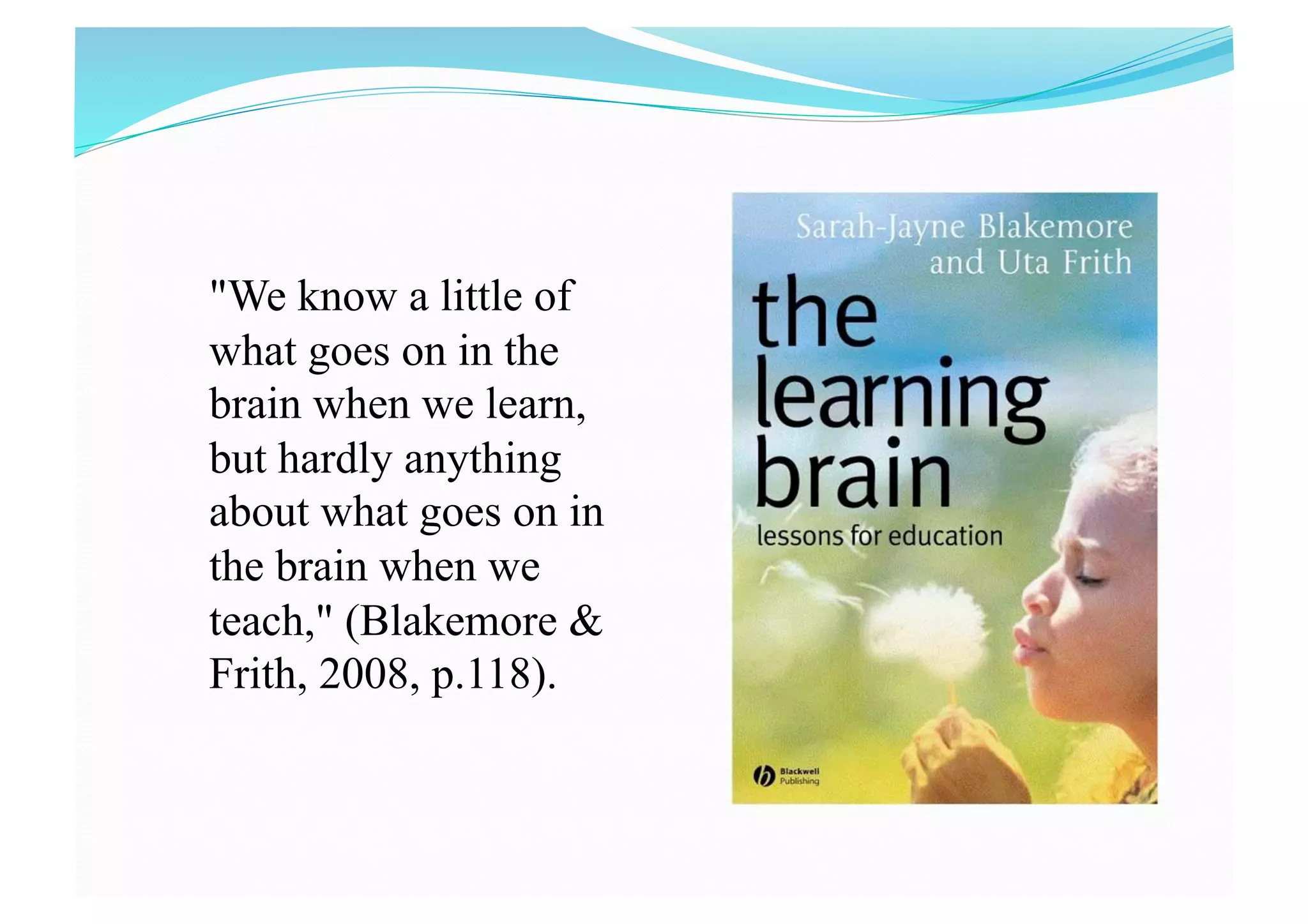
"We know a little of
what goes on in the
brain when we learn,
but hardly anything
about what goes on in
the brain when we
teach," (Blakemore &
Frith, 2008, p.118).
In
brief

 Concepts from Mind, Brain, and Education science,
commonly referred in the popular press as “brain-based
learning,” have been applied indiscreetly and
inconsistently to classroom teaching practices for many
years.
 While standards exist in neuroscience, psychology and
pedagogy, until recently there were no agreed upon
standards in their intersection, Mind, Brain, and
Education science. Some of these standards will be
discussed today.

Assump8ons

1.  The new academic discipline in discussion is the
intersection of neuroscience, education and
psychology.
2.  The focus is equally balanced between knowledge
of how humans learn and how best to teach.
3.  Education is not a “one-size-fits-all” practice
(recipe approach).
4.  The first rule of Education is the same as that of
Medicine: “Do no harm.”
Good
teaching

methodologies
and

ac8vi8es
can
come

from….
  …a single discipline
  …bilateral cooperation between
disciplines
  …multiple disciplines
  However, the more academic fields
that offer support for a teaching
methodology or activity, the more
credible it is.
Where
does
this
informa8on
come
from?


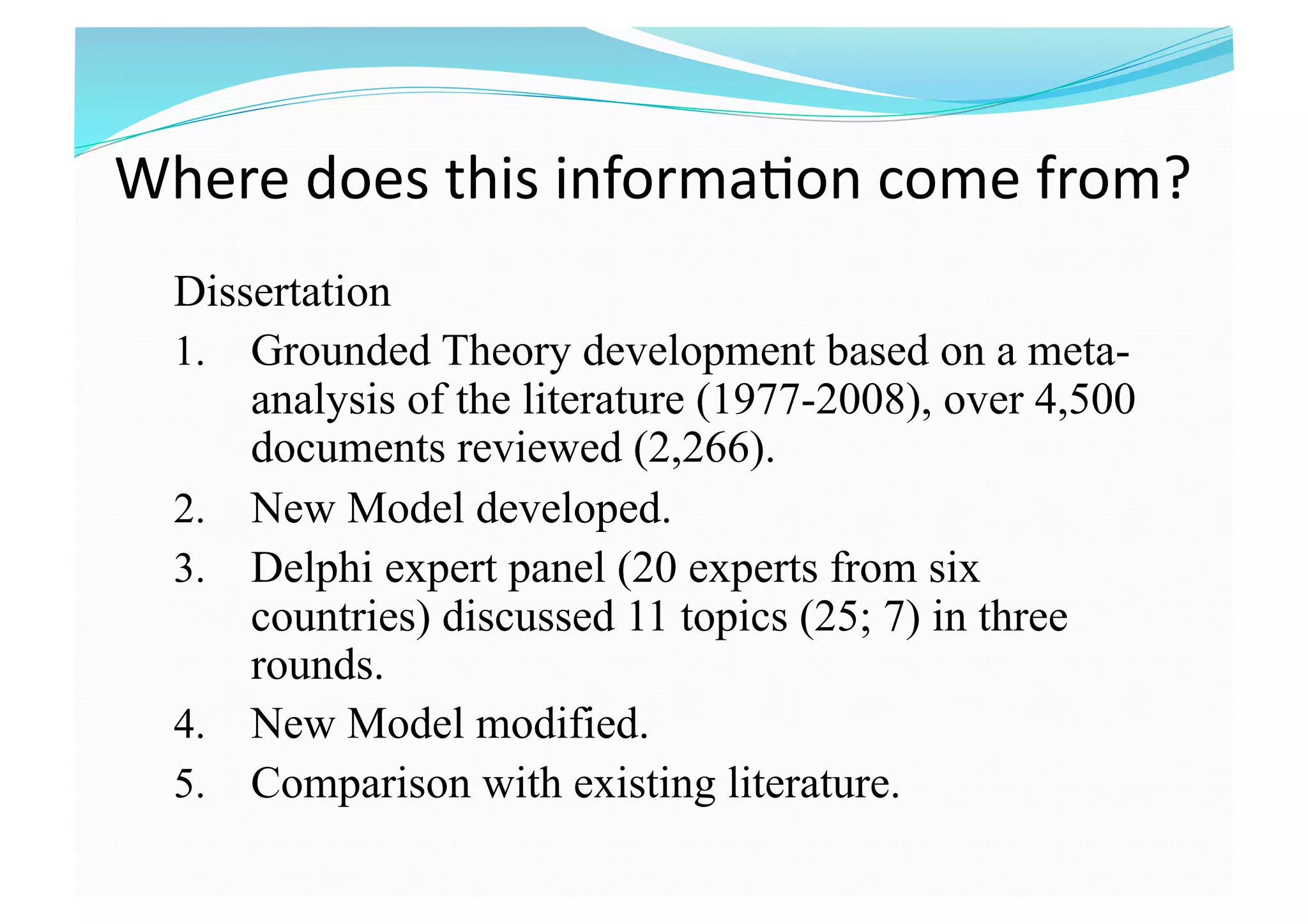
Dissertation
1.  Grounded Theory development based on a meta-
analysis of the literature (1977-2008), over 4,500
documents reviewed (2,266).
2.  New Model developed.
3.  Delphi expert panel (20 experts from six
countries) discussed 11 topics (25; 7) in three
rounds.
4.  New Model modified.
5.  Comparison with existing literature.
Delphi
Par8cipants

  Daniel Ansari
  Michael Atherton
  Jane Bernstein
  Sarah Jayne Blakemore
  Renate Nummela-
Caine
  Donna Coch
  David Daniel
  Stanislas Dehaene
  Marian Diamond
  Kurt Fischer
  John Geake
  Usha Goswami
  Christina Hinton
  Mary Helen
Immordino-Yang
  Eric Jensen
  Jelle Jolles
  Michael Posner
  Marc Schwartz
  Rita Smilkstein
  David Sousa
  Judy Willis
 Virginia Berninger
 John T. Bruer
 Howard Gardner
 Paul Howard-Jones
 Hideaki Koizumi
Neuroscientists
Psychologists
Educators
Topics
Researched
in
Mind,
Brain,
and

Science
Educa8on


1.  Neuroimaging
2.  Neurotransmitters and Chemicals
3.  Neurogenesis and Plasticity
4.  Theories of Consciousness
5.  Beliefs about Intelligence
6.  New Learning Theories
7.  Neuroethics
8.  Learning Differences
9.  Mind-Body Connection
a.  Sleep
b.  Physical Exercise
c.  Nutrition

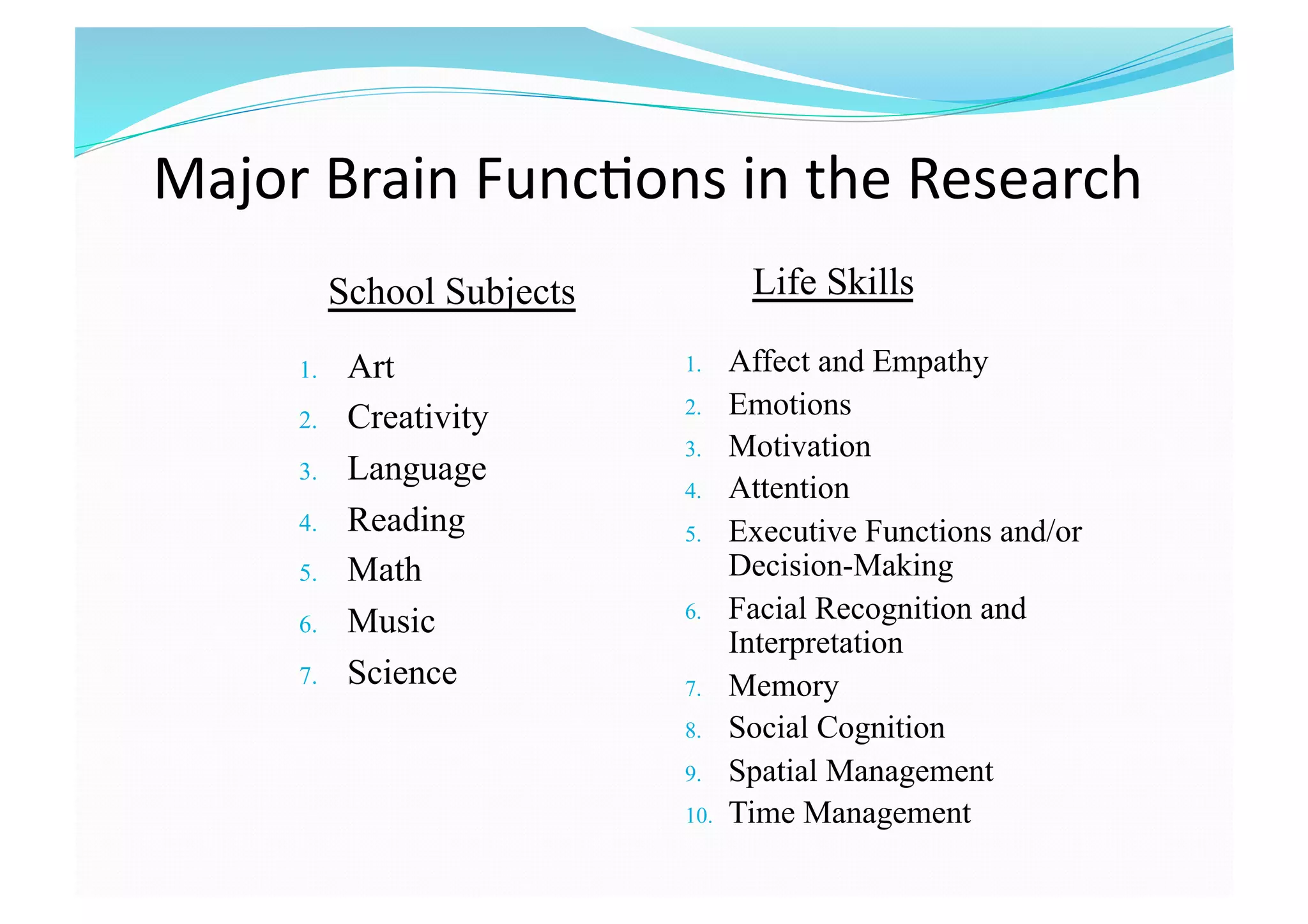
Major
Brain
Func8ons
in
the
Research

1.  Art
2.  Creativity
3.  Language
4.  Reading
5.  Math
6.  Music
7.  Science

1.  Affect and Empathy
2.  Emotions
3.  Motivation
4.  Attention
5.  Executive Functions and/or
Decision-Making
6.  Facial Recognition and
Interpretation
7.  Memory
8.  Social Cognition
9.  Spatial Management
10.  Time Management
School Subjects Life Skills
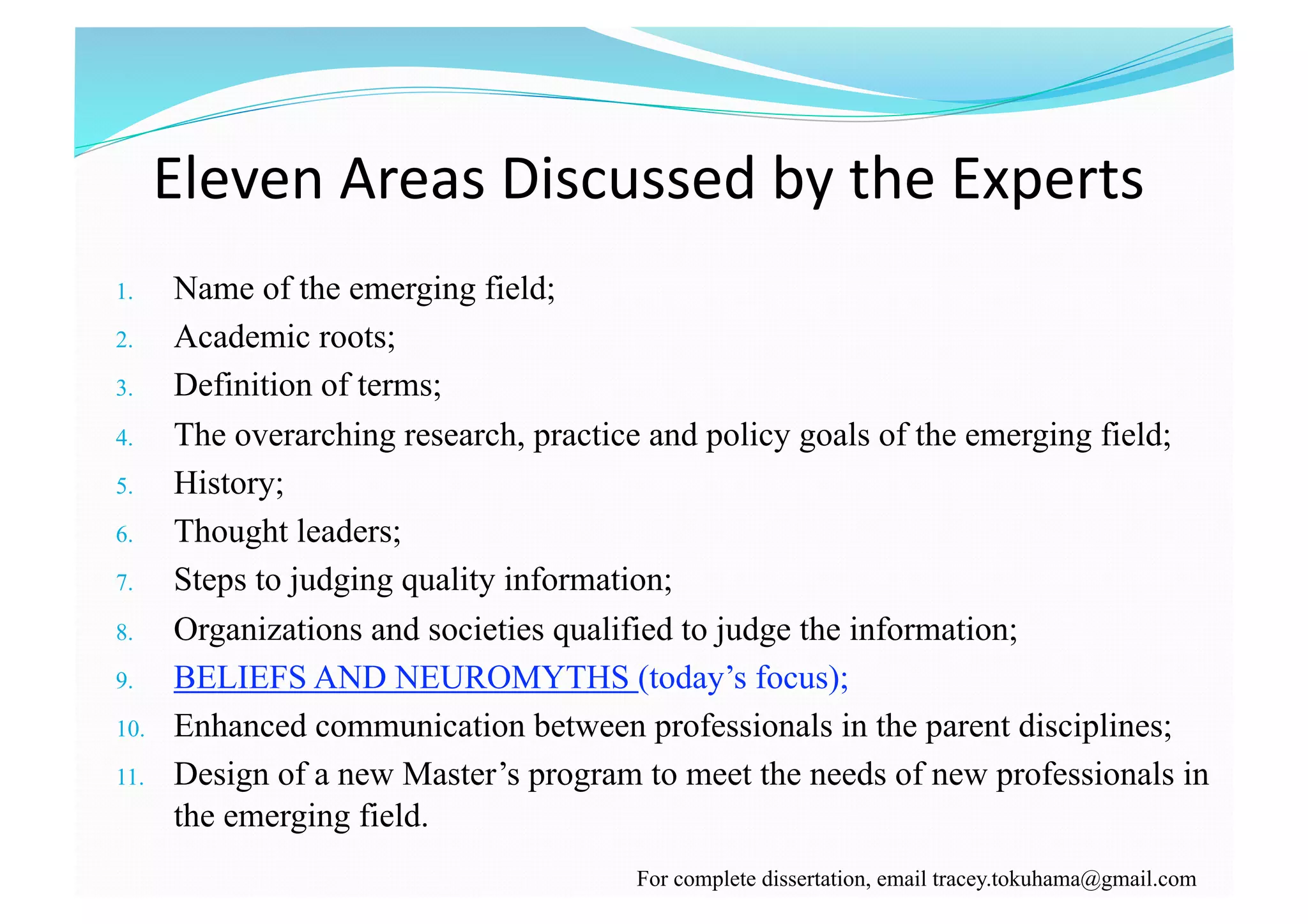
Eleven
Areas
Discussed
by
the
Experts


1.  Name of the emerging field;
2.  Academic roots;
3.  Definition of terms;
4.  The overarching research, practice and policy goals of the emerging field;
5.  History;
6.  Thought leaders;
7.  Steps to judging quality information;
8.  Organizations and societies qualified to judge the information;
9.  BELIEFS AND NEUROMYTHS (today’s focus);
10.  Enhanced communication between professionals in the parent disciplines;
11.  Design of a new Master’s program to meet the needs of new professionals in
the emerging field.
For complete dissertation, email tracey.tokuhama@gmail.com
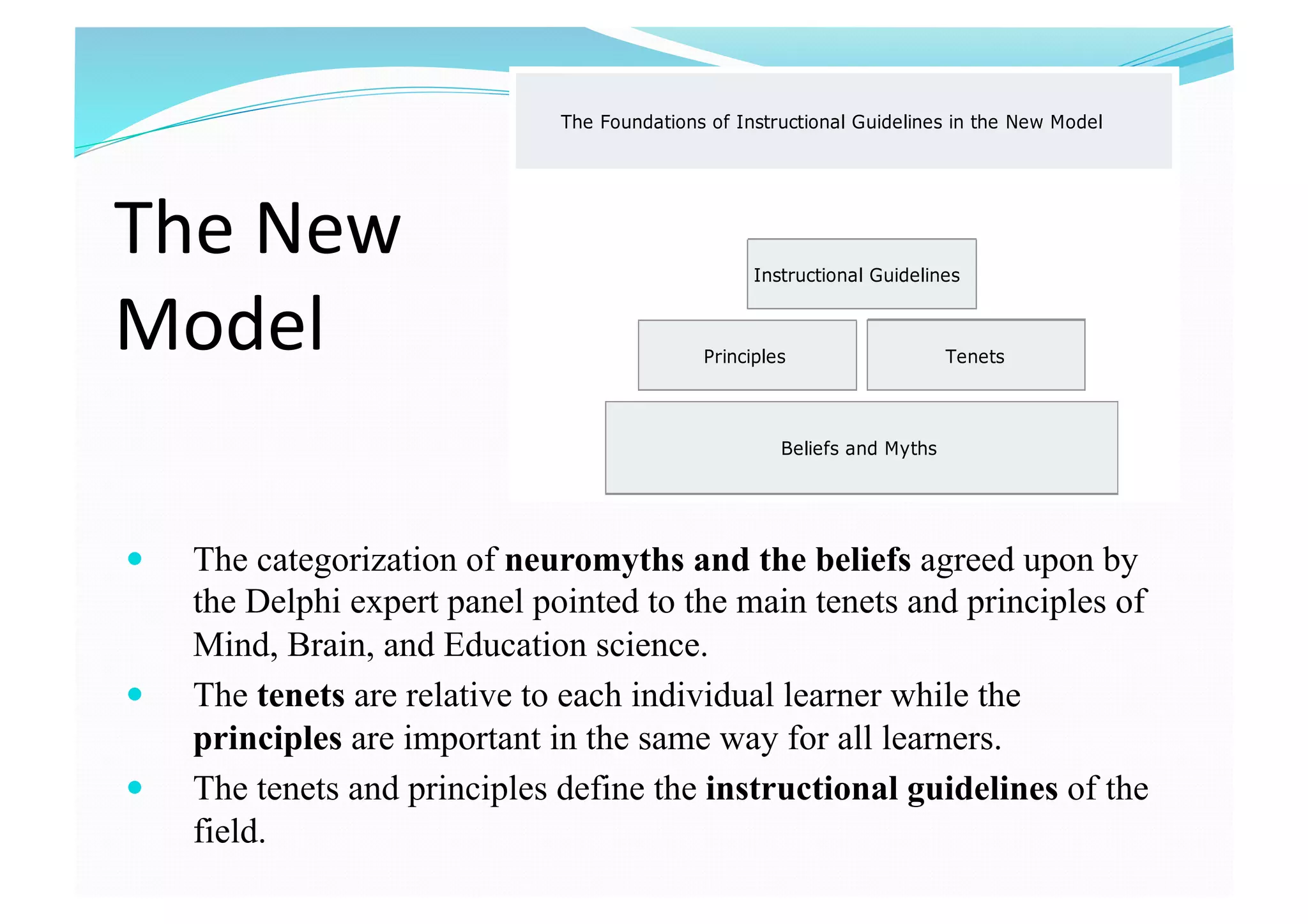
The
New

Model

  The categorization of neuromyths and the beliefs agreed upon by
the Delphi expert panel pointed to the main tenets and principles of
Mind, Brain, and Education science.
  The tenets are relative to each individual learner while the
principles are important in the same way for all learners.
  The tenets and principles define the instructional guidelines of the
field.
Beliefs and Myths
Principles Tenets
Instructional Guidelines
The Foundations of Instructional Guidelines in the New Model
Categoriza8on
criteria

In Understanding the brain:
The birth of a learning
science, (OECD, 2002)* the
authors propose a continuum
of four categories of
information quality.
*OECD= 30 countries (Australia, Austria, Belgium, Canada, Czech Republic, Denmark, Finland, France,
Germany, Greece, Hungary, Iceland, Ireland, Italy, Japan, Korea, Luxemburg, Mexico, the Netherlands, New
Zealand, Norway, Poland, Portugal, Slovenia, Spain, Sweden, Switzerland, Turkey, United Kingdom, United
States.
Criteria
used
to
categorize
concepts

Categories:
A.  What is well-established (i.e. plasticity, which now has
hundreds of credible human studies behind it);
B.  What is probably so (i.e., sensitive periods, which has
hundreds of studies behind it, though not all conducted on
humans);
C.  What is intelligent speculation (i.e., gender differences,
which has thousands of studies behind it, albeit of mixed
quality and sometimes with contradictory findings); and
D.  What is popular misconception or a neuromyth (i.e., "right
brain" and "left brain" discussion, which has been the target
of thousands of books and articles, some of which promote
the term, but most of which criticize the lack of factual
accuracy of the claim).
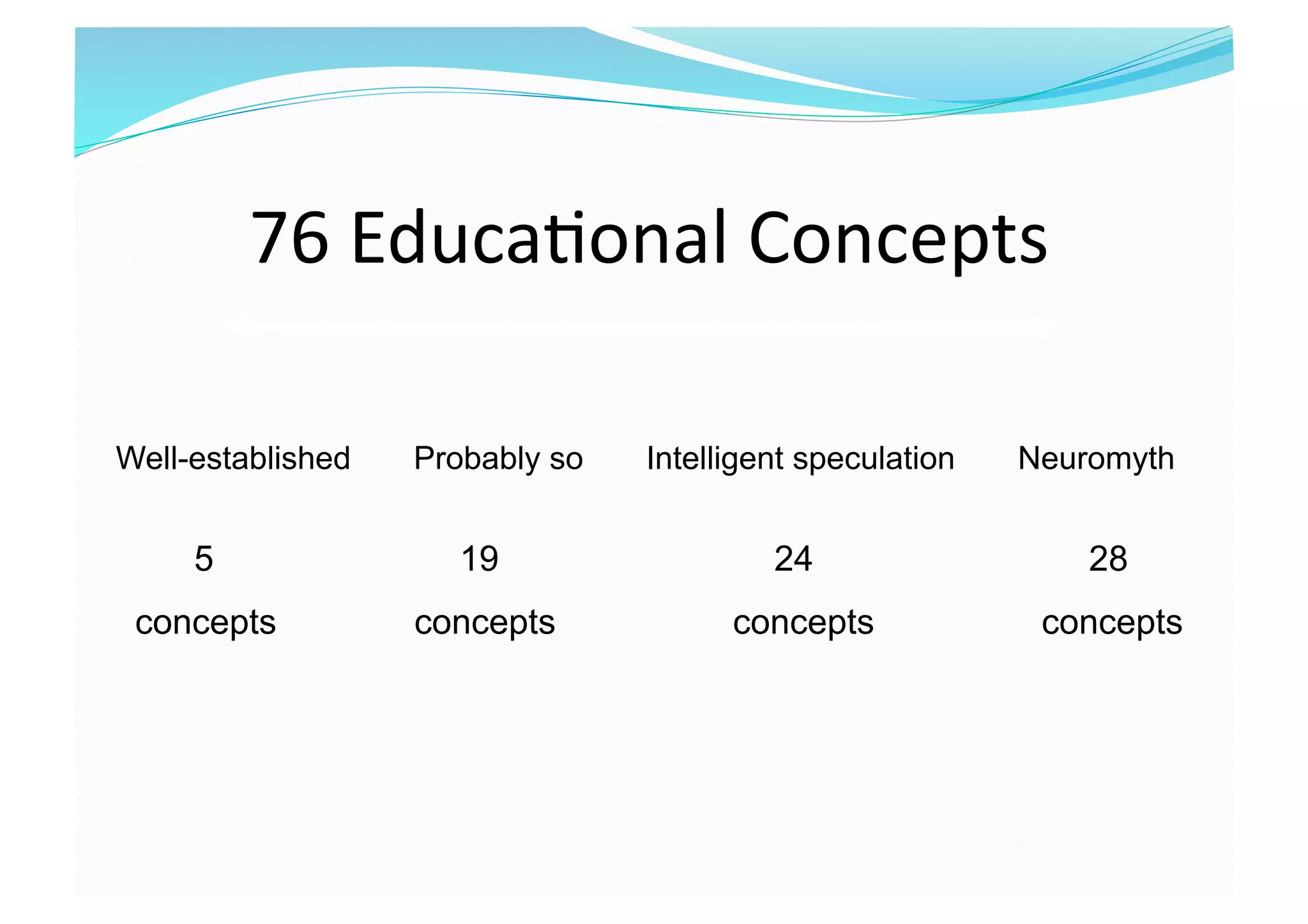
76
Educa8onal
Concepts

5 19 24 28
concepts concepts concepts concepts
Well-established Probably so Intelligent speculation Neuromyth
Conceptual
Assump8ons

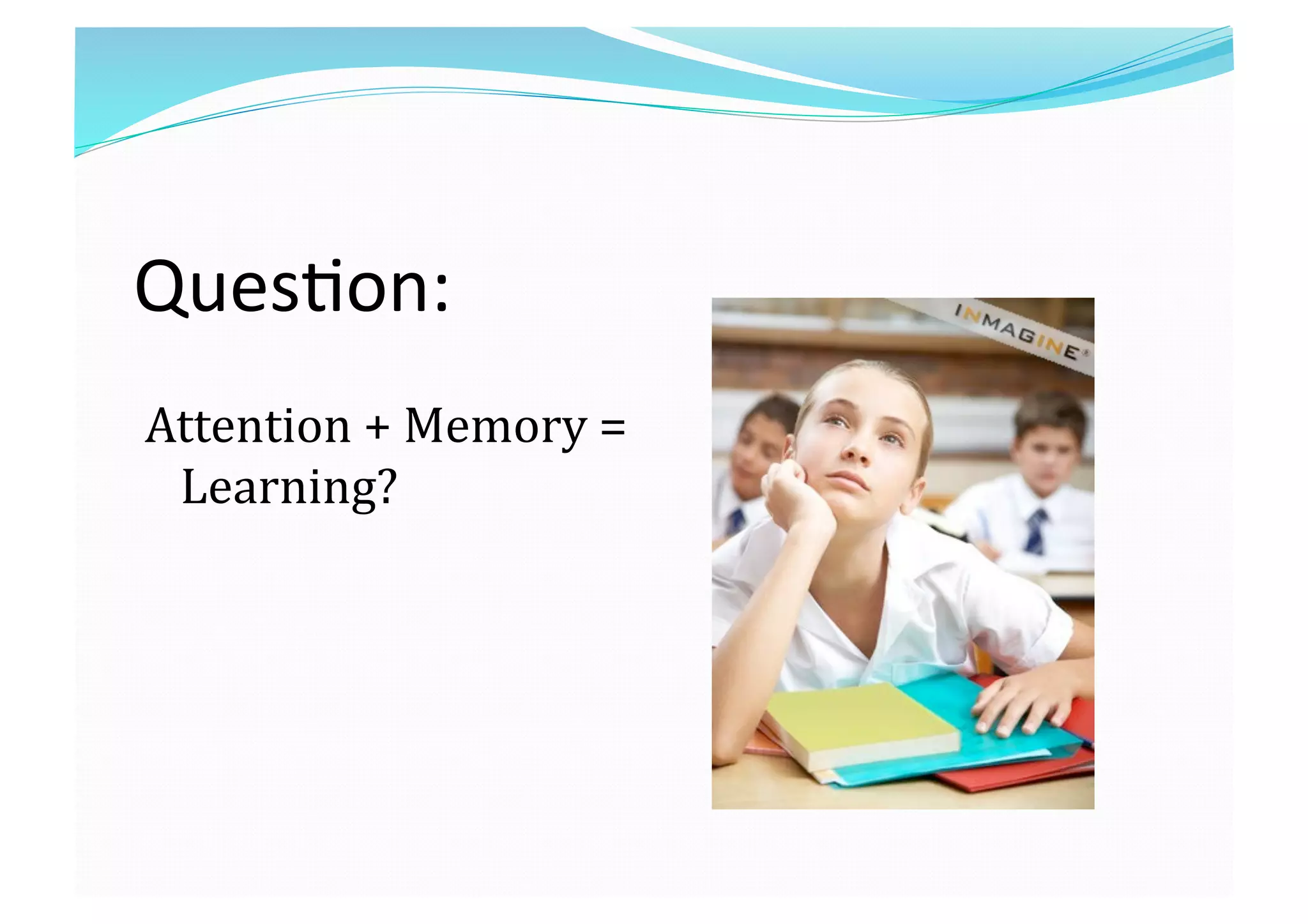
Ques8on:

Attention
+
Memory
=

Learning?

Probably
so:

ATen8on
+
Memory
=
Learning

  To
learn
something
new
means

you
have
to
pay
attention
to
it,

and
to
remember
it.


  Declarative
memory
depends
on

being
able
to
pay
attention.

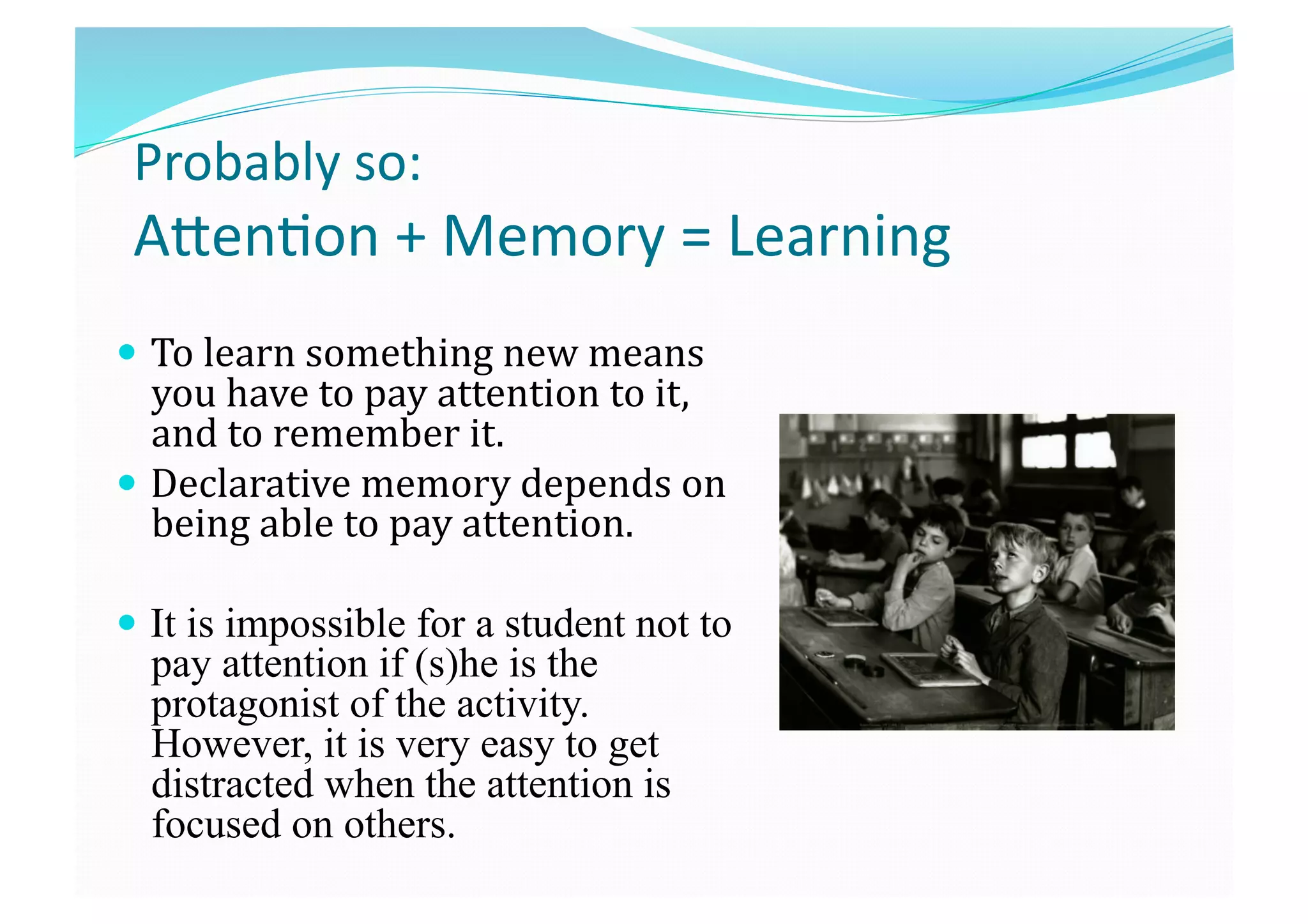
  It is impossible for a student not to
pay attention if (s)he is the
protagonist of the activity.
However, it is very easy to get
distracted when the attention is
focused on others.
Defini8ons

Neurogenesis


(“new
birth”)

  Neurogenesis
is
the
production
of
cells
in
the
nervous

system
in
the
brain
(neurons)
and
glial
cells.
Most

notable
in
neo‐natal
stages,
but
occurs
throughout

the
lifespan.


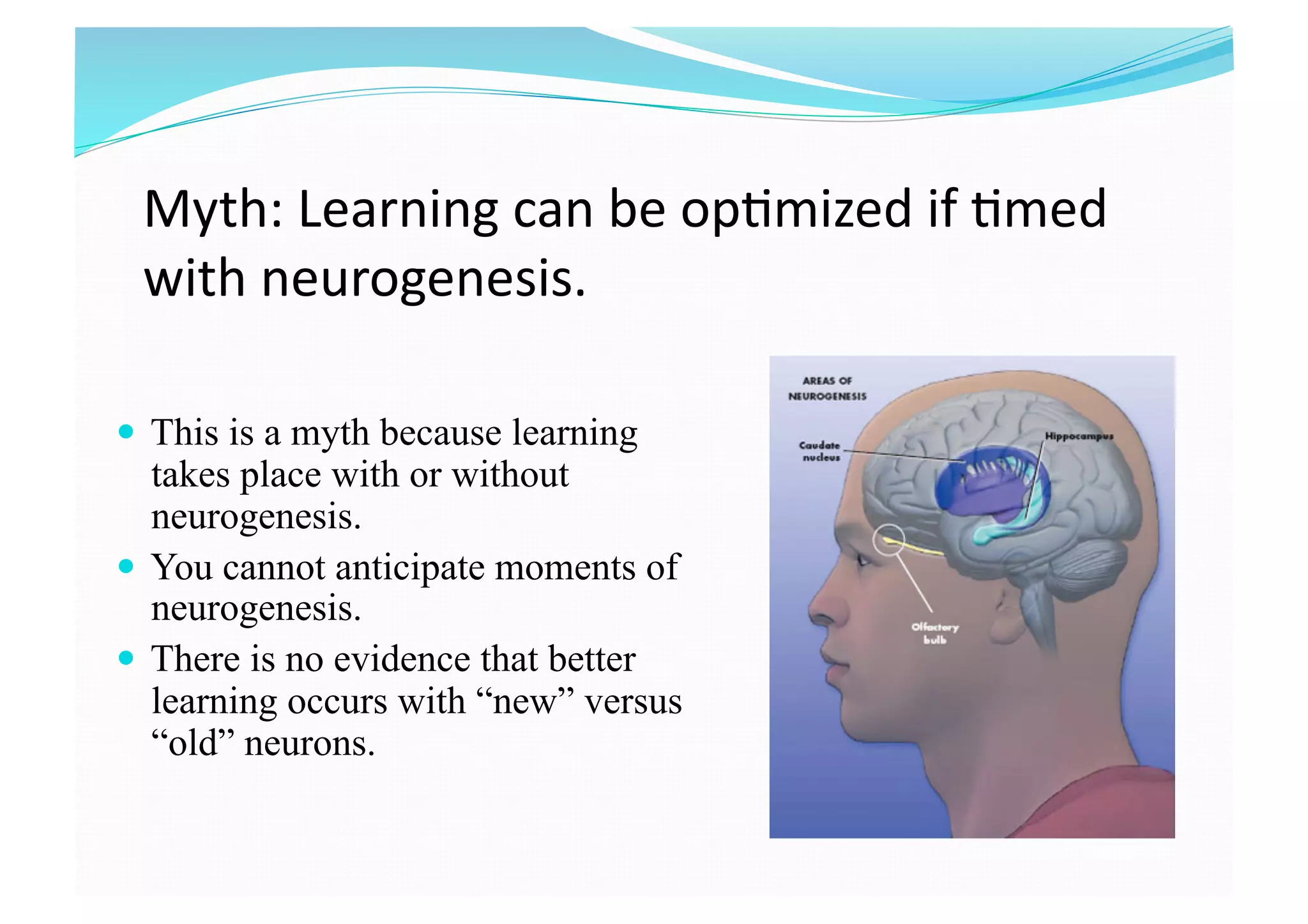
  In
humans,
neurogenesis
has
been
documented
most

notably
in
the
olfactory
bulb
and
hippocampus.

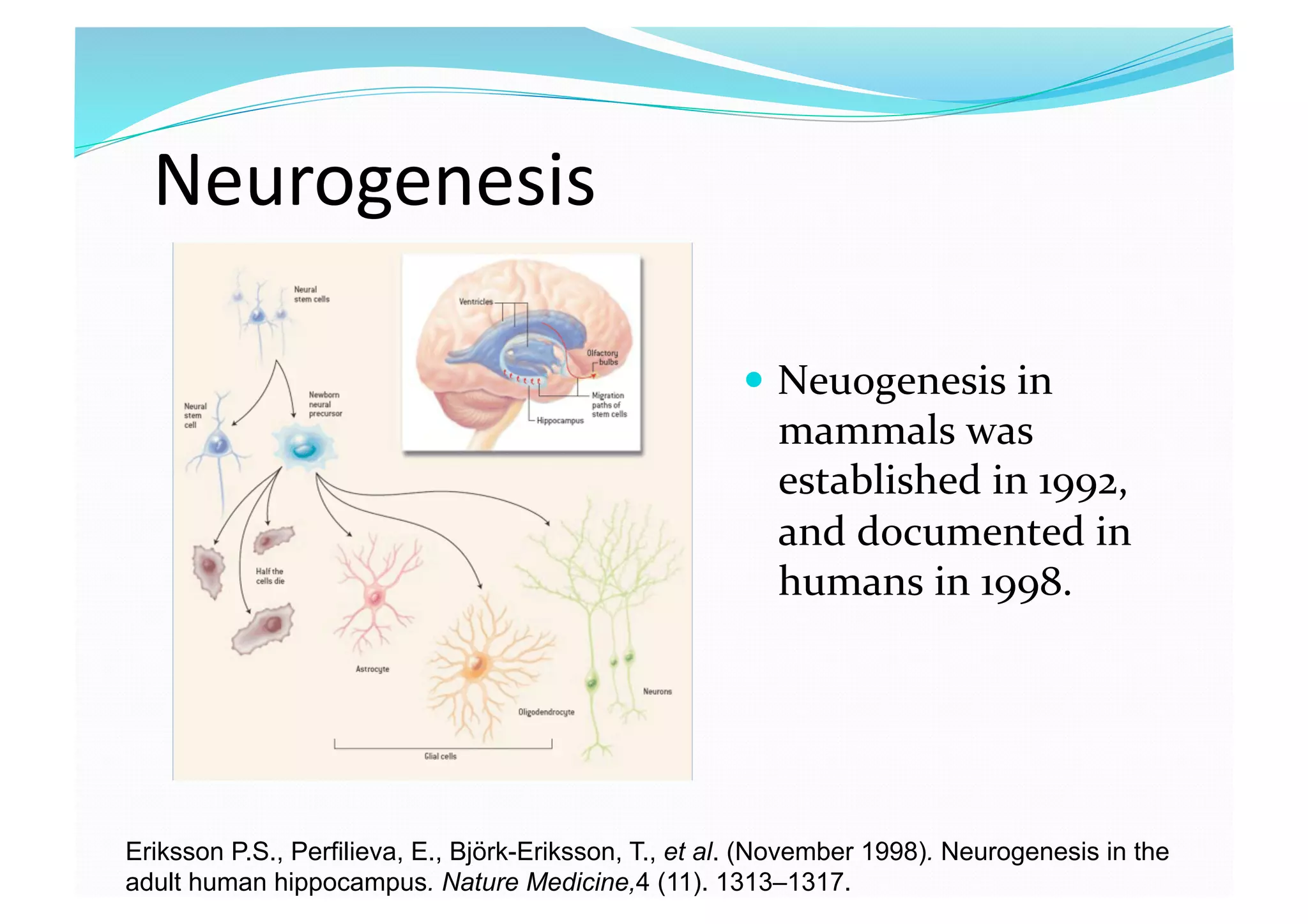
Neurogenesis

  Neuogenesis
in

mammals
was

established
in
1992,

and
documented
in

humans
in
1998.


Eriksson P.S., Perfilieva, E., Björk-Eriksson, T., et al. (November 1998). Neurogenesis in the
adult human hippocampus. Nature Medicine,4 (11). 1313–1317.
Myth:
Neurons
are
never
replaced

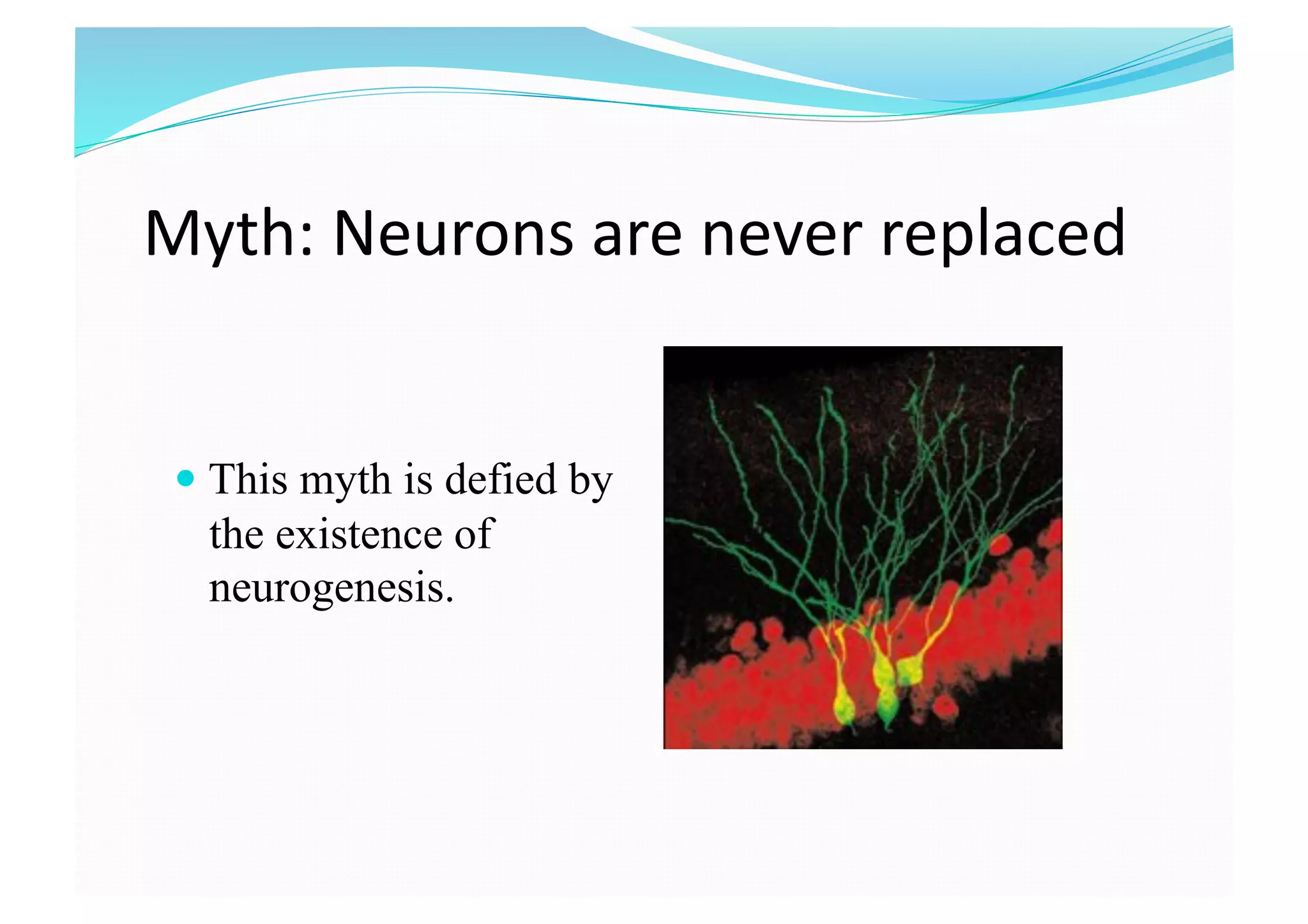
 This myth is defied by
the existence of
neurogenesis.
Myth:
Learning
can
be
op8mized
if
8med

with
neurogenesis.

  This is a myth because learning
takes place with or without
neurogenesis.
  You cannot anticipate moments of
neurogenesis.
  There is no evidence that better
learning occurs with “new” versus
“old” neurons.
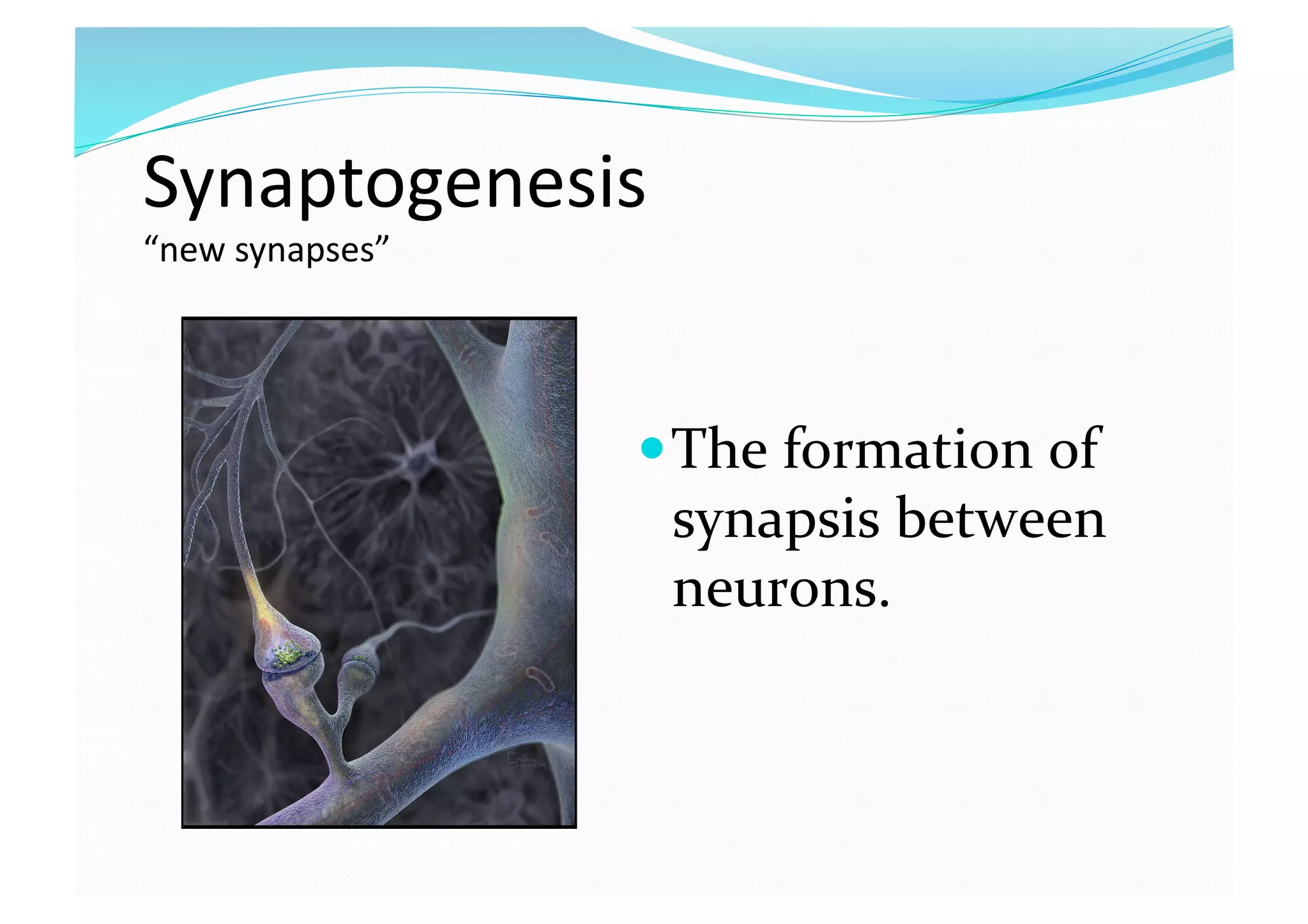
Synaptogenesis

“new
synapses”

 The
formation
of

synapsis
between

neurons.

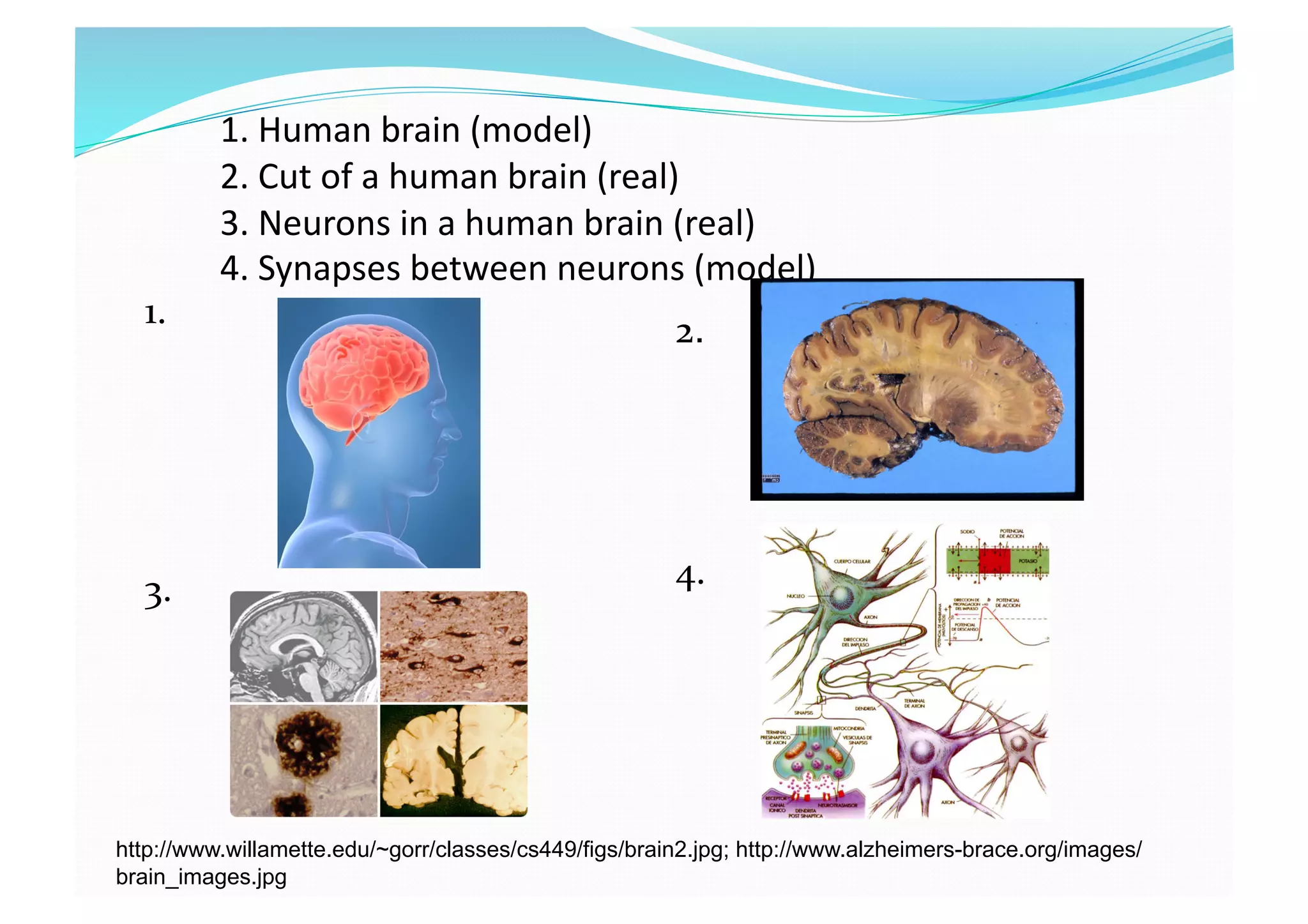
1.
Human
brain
(model)

2.
Cut
of
a
human
brain
(real)


3.
Neurons
in
a
human
brain
(real)

4.
Synapses
between
neurons
(model)

1.

3.

http://www.willamette.edu/~gorr/classes/cs449/figs/brain2.jpg; http://www.alzheimers-brace.org/images/
brain_images.jpg
2.
4.

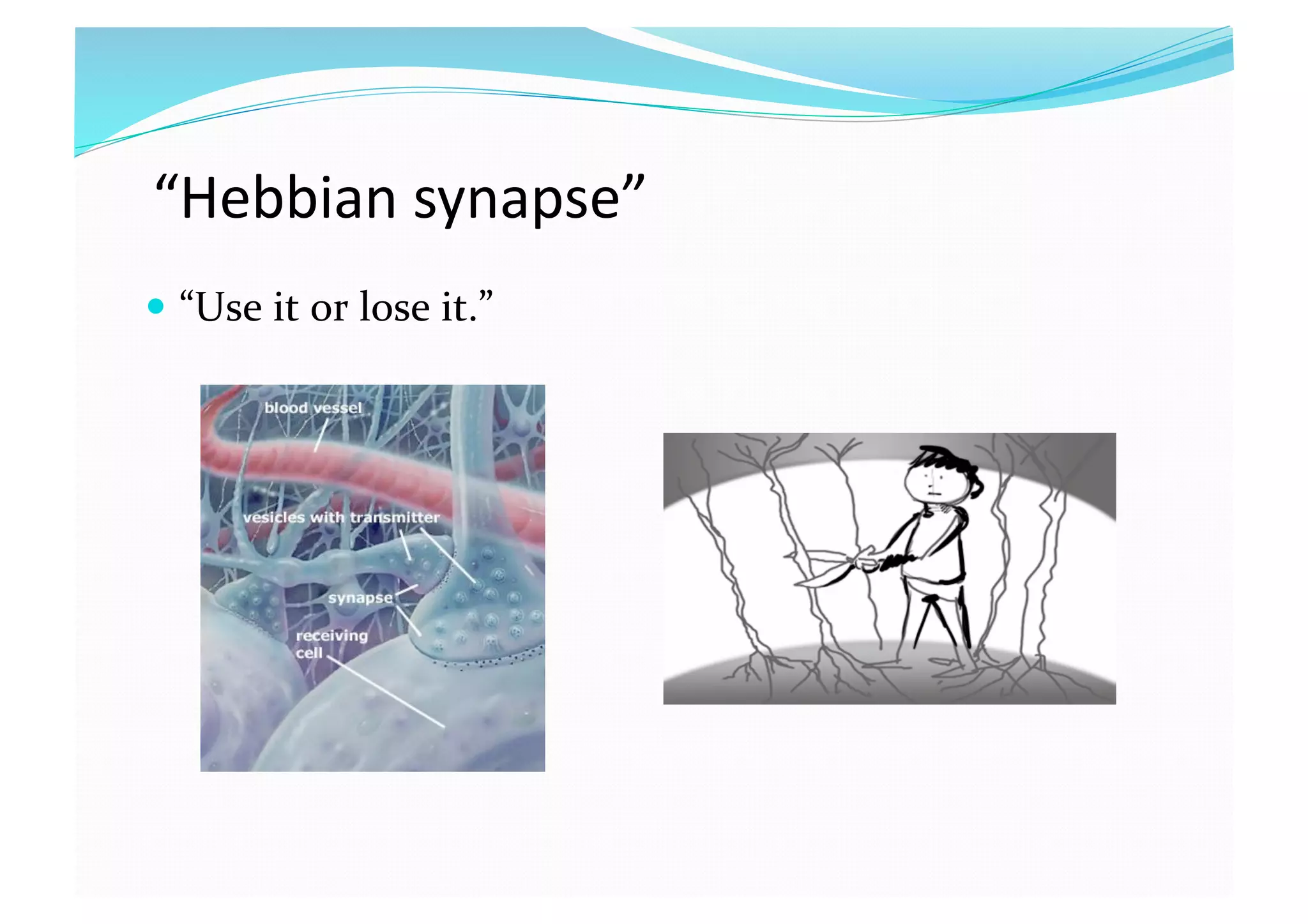
“Hebbian
synapse”

  “Use
it
or
lose
it.”

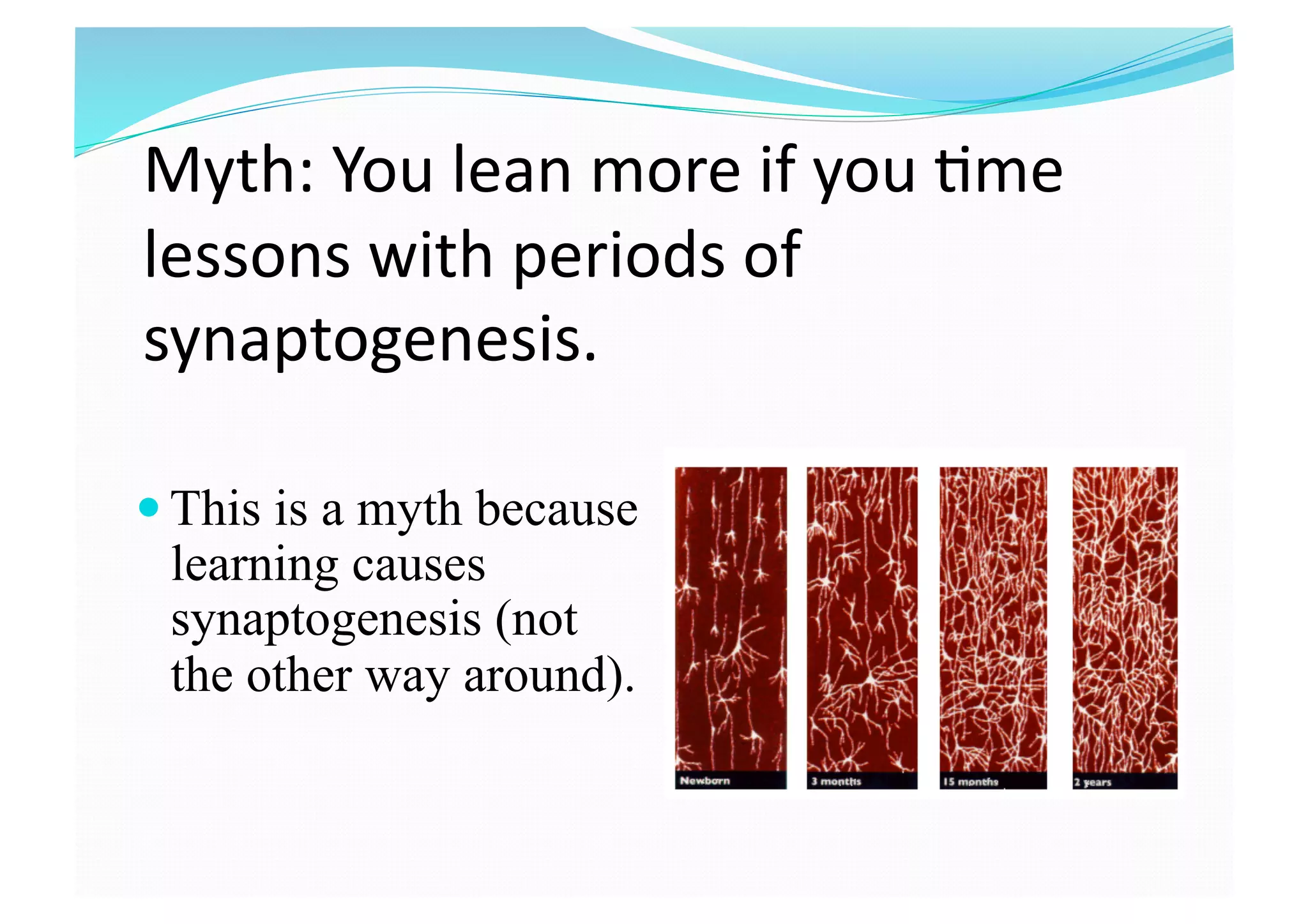
Myth:
You
lean
more
if
you
8me

lessons
with
periods
of

synaptogenesis.


 This is a myth because
learning causes
synaptogenesis (not
the other way around).
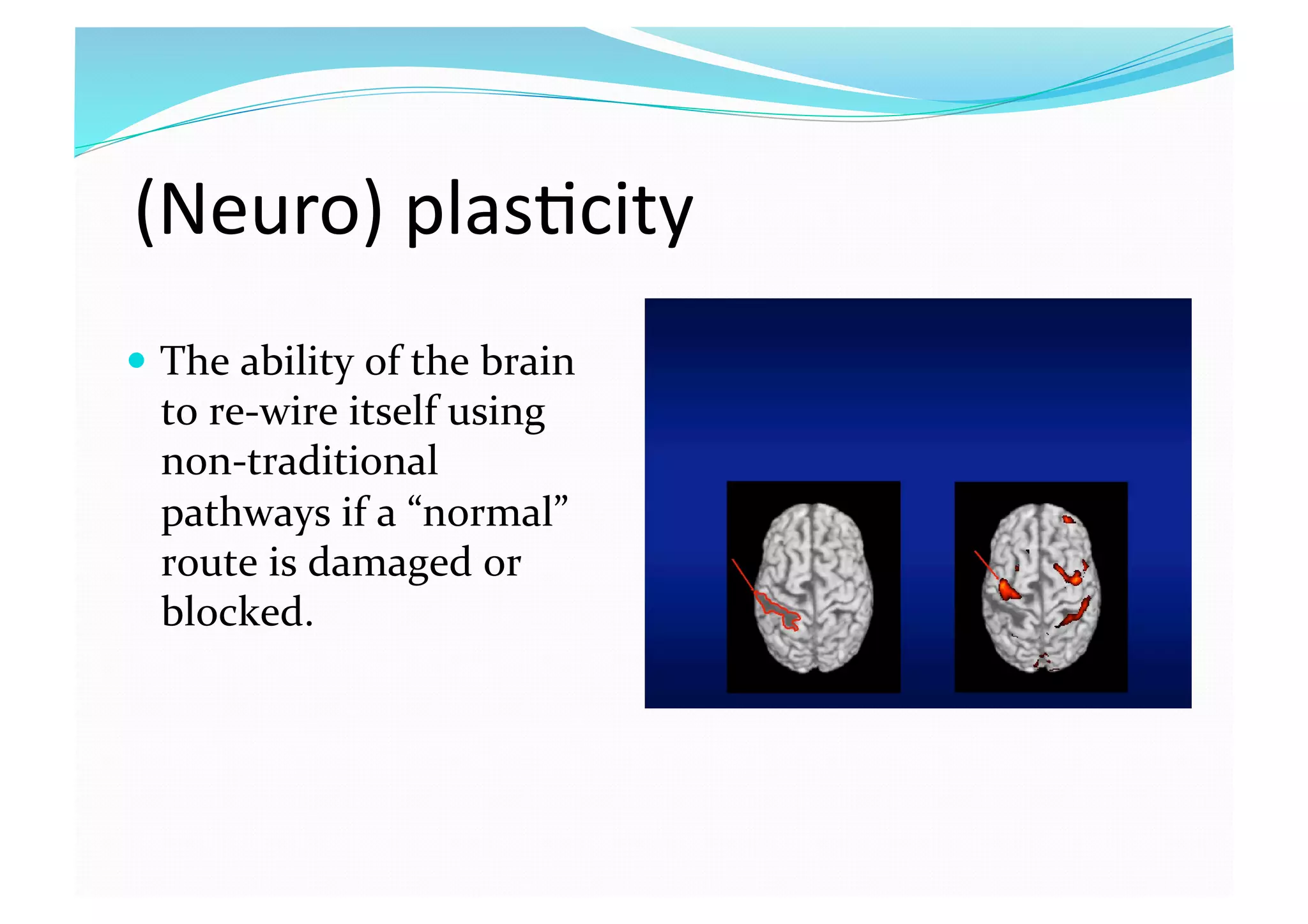
(Neuro)
plas8city

  The
ability
of
the
brain

to
re‐wire
itself
using

non‐traditional

pathways
if
a
“normal”

route
is
damaged
or

blocked.


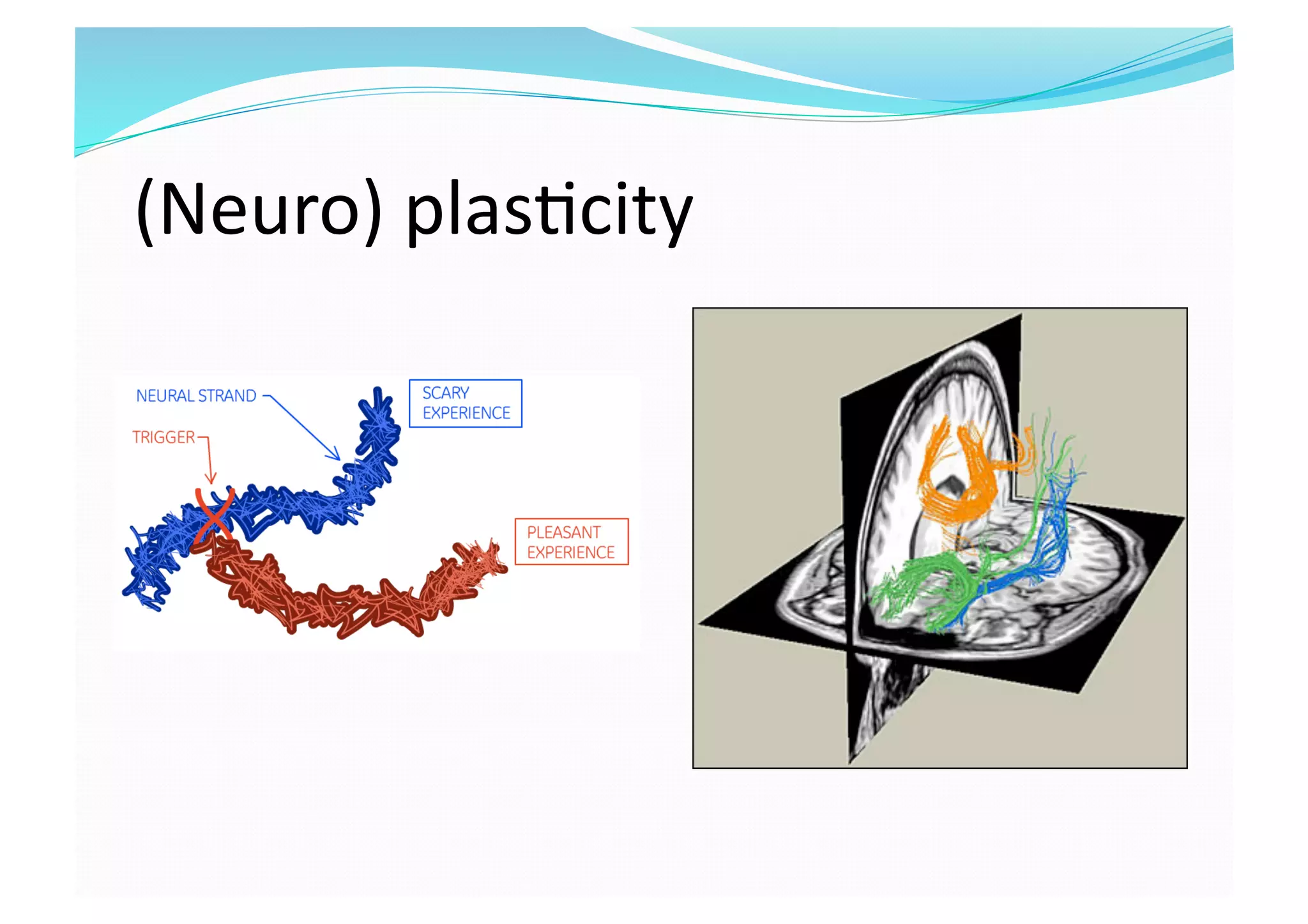
(Neuro)
plas8city

Plas8city:
A
paradigm
shic
in
how
we

look
at
the
brain

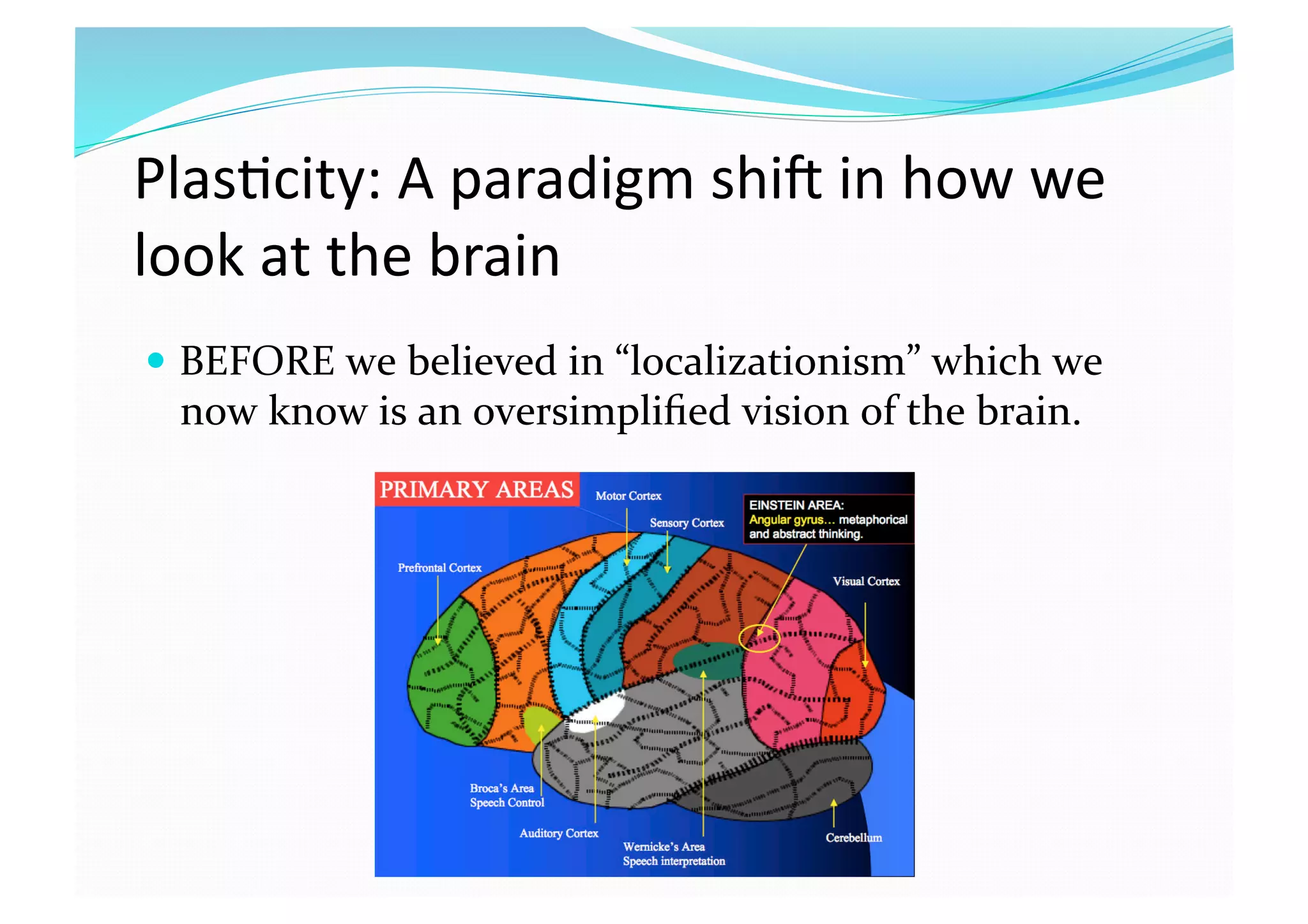
  BEFORE
we
believed
in
“localizationism”
which
we

now
know
is
an
oversimplified
vision
of
the
brain.


Plas8city

We
now
know
that….

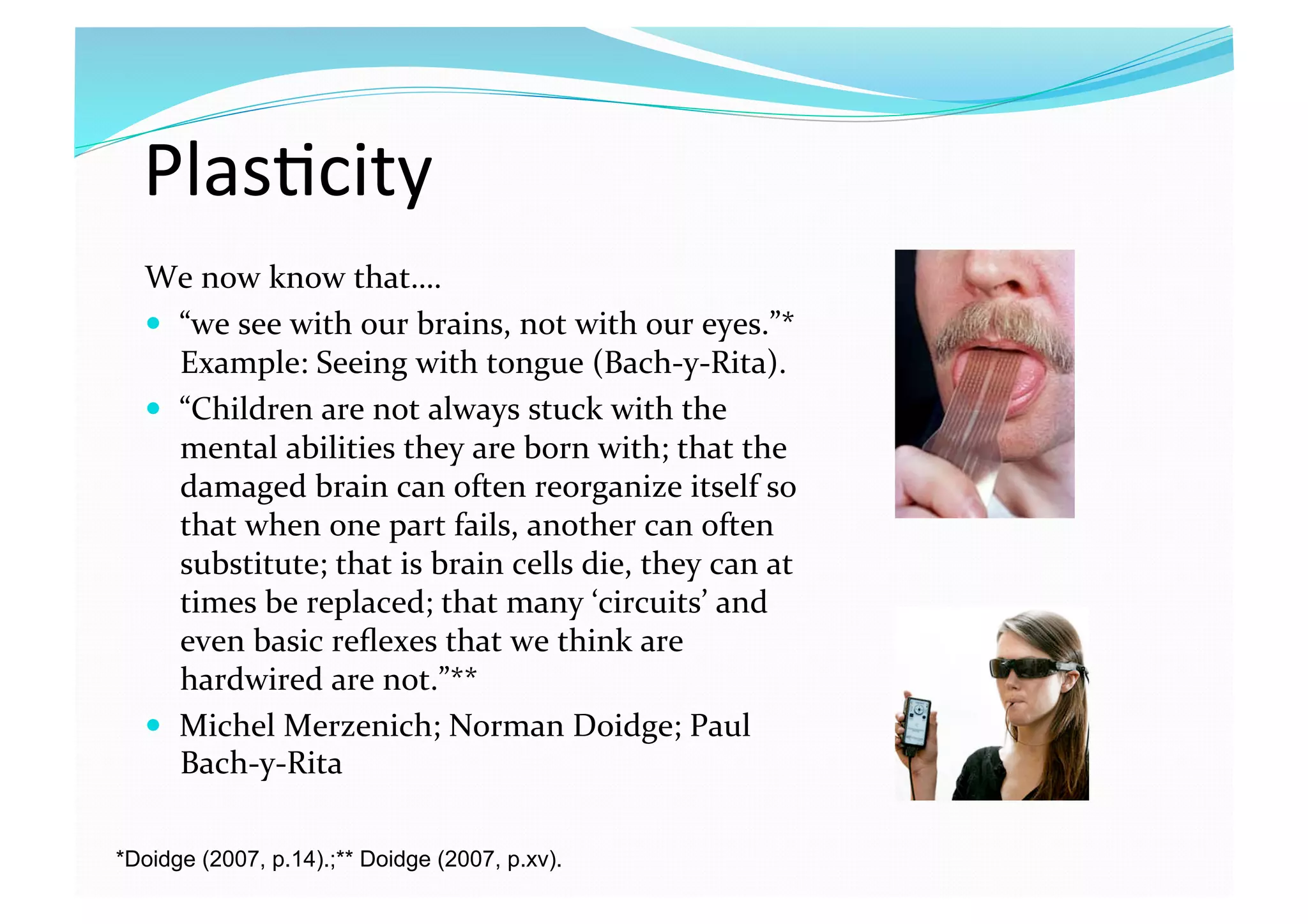
  “we
see
with
our
brains,
not
with
our
eyes.”*

Example:
Seeing
with
tongue
(Bach‐y‐Rita).

  “Children
are
not
always
stuck
with
the

mental
abilities
they
are
born
with;
that
the

damaged
brain
can
often
reorganize
itself
so

that
when
one
part
fails,
another
can
often

substitute;
that
is
brain
cells
die,
they
can
at

times
be
replaced;
that
many
‘circuits’
and

even
basic
reflexes
that
we
think
are

hardwired
are
not.”**

  Michel
Merzenich;
Norman
Doidge;
Paul

Bach‐y‐Rita

*Doidge (2007, p.14).;** Doidge (2007, p.xv).
Myth:
Plas8city
is
due
to
good
pedagogy

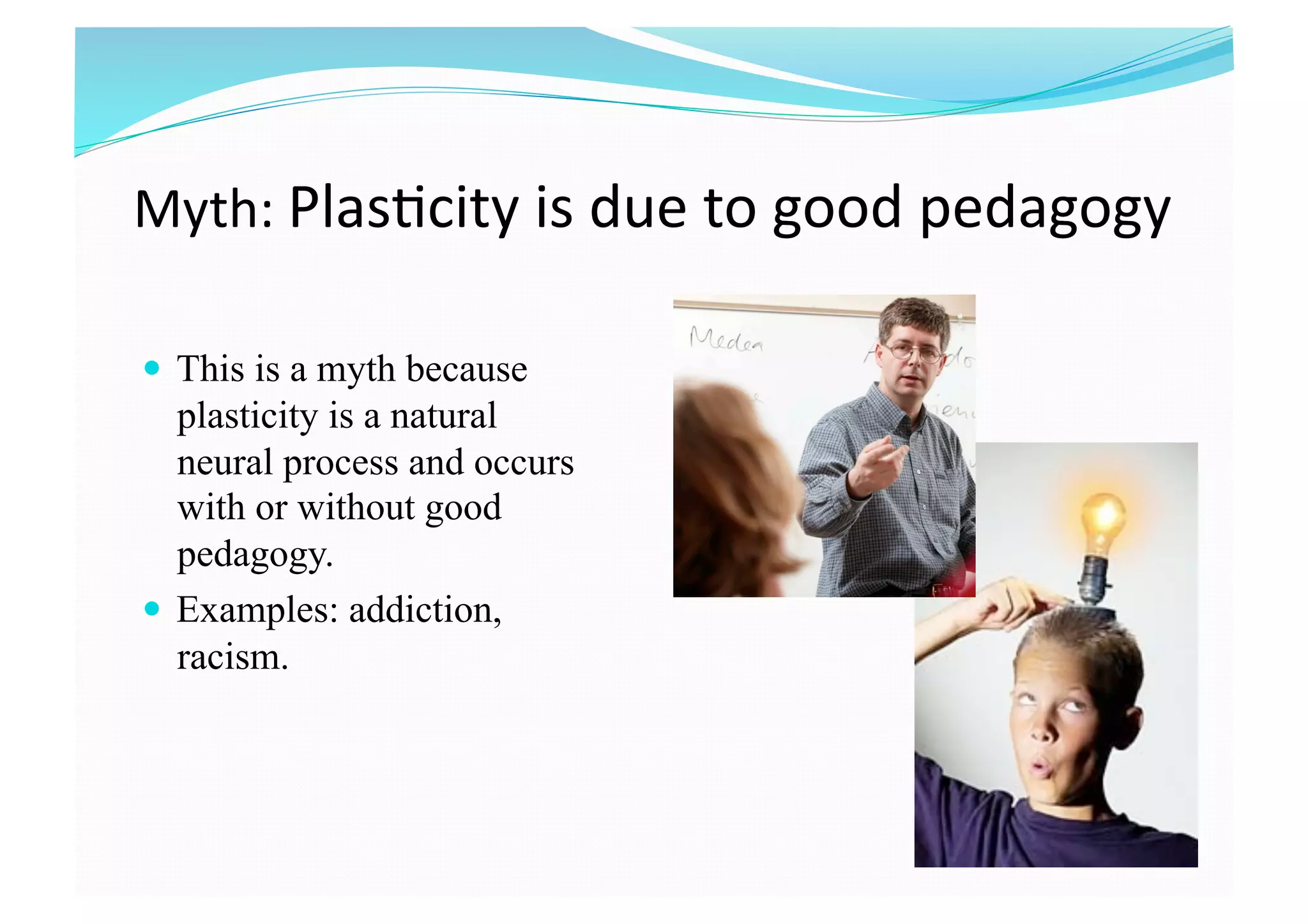
  This is a myth because
plasticity is a natural
neural process and occurs
with or without good
pedagogy.
  Examples: addiction,
racism.
Memory

Ques8on:

True
or
false?


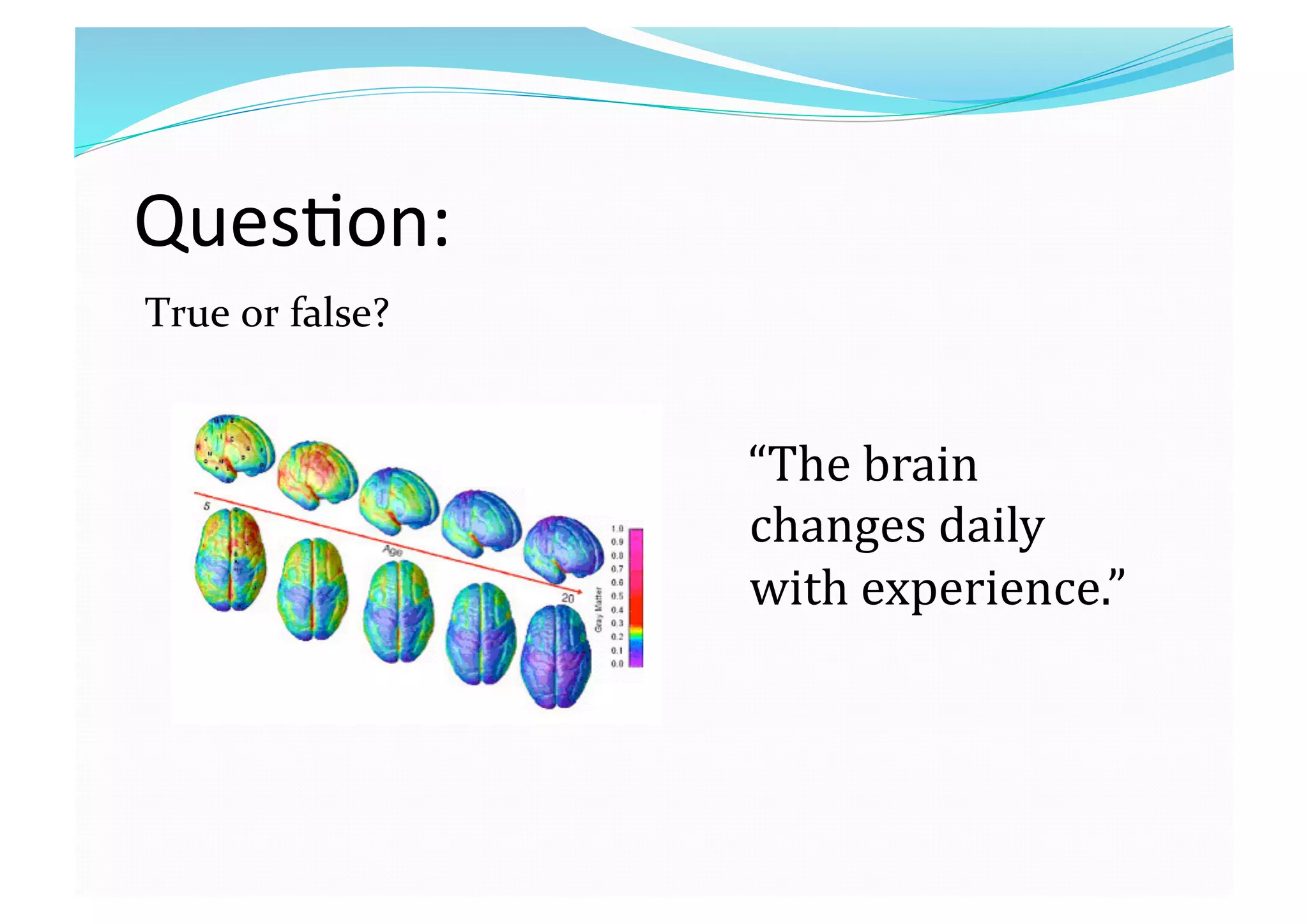
“The
brain

changes
daily

with
experience.”

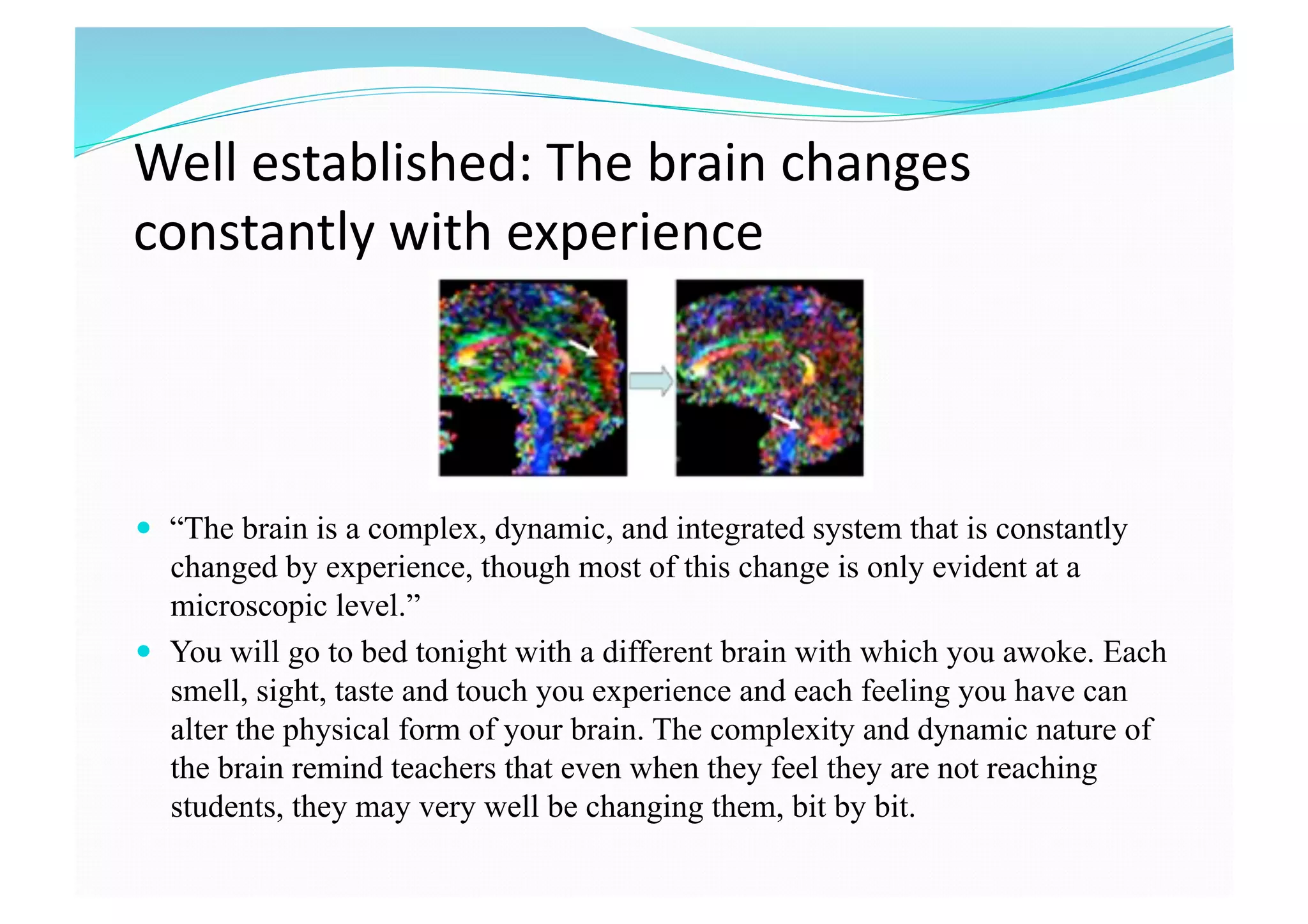
Well
established:
The
brain
changes

constantly
with
experience

  “The brain is a complex, dynamic, and integrated system that is constantly
changed by experience, though most of this change is only evident at a
microscopic level.”
  You will go to bed tonight with a different brain with which you awoke. Each
smell, sight, taste and touch you experience and each feeling you have can
alter the physical form of your brain. The complexity and dynamic nature of
the brain remind teachers that even when they feel they are not reaching
students, they may very well be changing them, bit by bit.
Ques8on:


True
or
False?


“Past
information

inEluences
how
we

learn
something
new.”

Well‐established:


Influence
of
past
knowledge

  “Connecting new
information to prior
knowledge facilitates
learning.”
  We learn better and faster
when we relate new
information to things that
we already know.
Intelligent
specula8on:
Memory


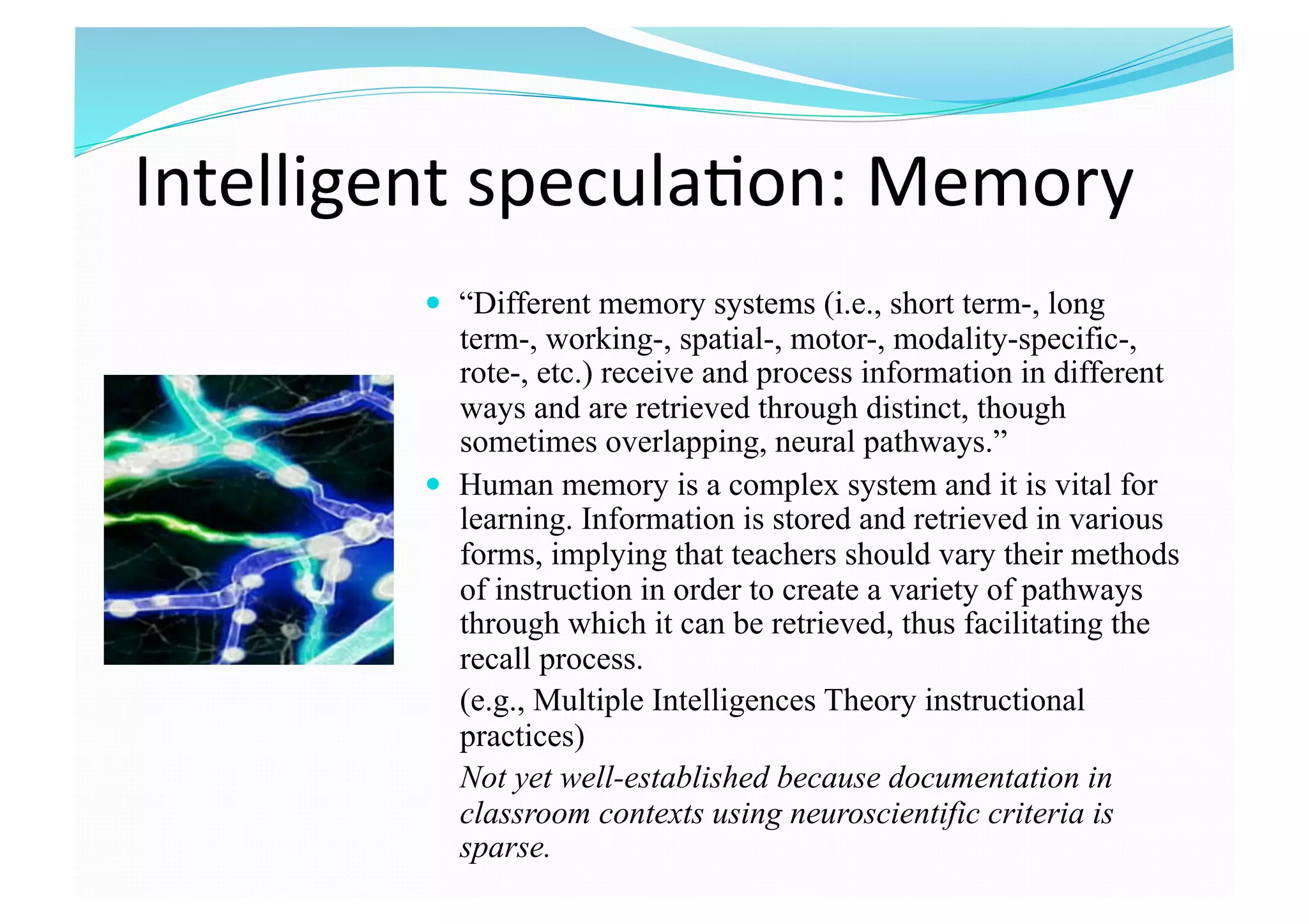
  “Different memory systems (i.e., short term-, long
term-, working-, spatial-, motor-, modality-specific-,
rote-, etc.) receive and process information in different
ways and are retrieved through distinct, though
sometimes overlapping, neural pathways.”
  Human memory is a complex system and it is vital for
learning. Information is stored and retrieved in various
forms, implying that teachers should vary their methods
of instruction in order to create a variety of pathways
through which it can be retrieved, thus facilitating the
recall process.
(e.g., Multiple Intelligences Theory instructional
practices)
Not yet well-established because documentation in
classroom contexts using neuroscientific criteria is
sparse.
Intelligent
specula8on:


Exis8ng
knowledge

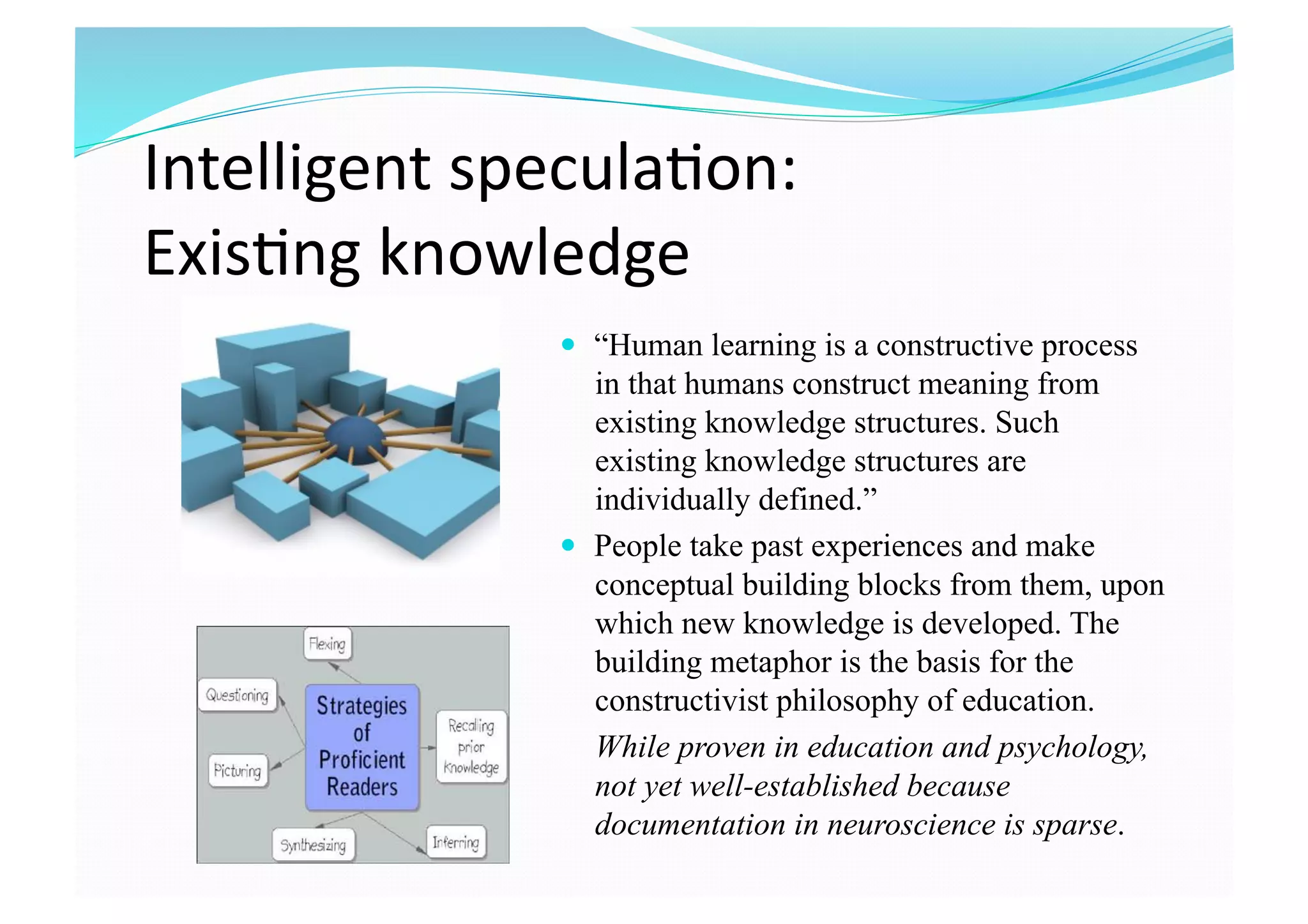
  “Human learning is a constructive process
in that humans construct meaning from
existing knowledge structures. Such
existing knowledge structures are
individually defined.”
  People take past experiences and make
conceptual building blocks from them, upon
which new knowledge is developed. The
building metaphor is the basis for the
constructivist philosophy of education.
While proven in education and psychology,
not yet well-established because
documentation in neuroscience is sparse.
Neuromyth:
“Memory
is
like
an
objec8ve

recording
of
a
situa8on,
and
reality
exists

in
an
abstract
form
for
all
to
perceive.”
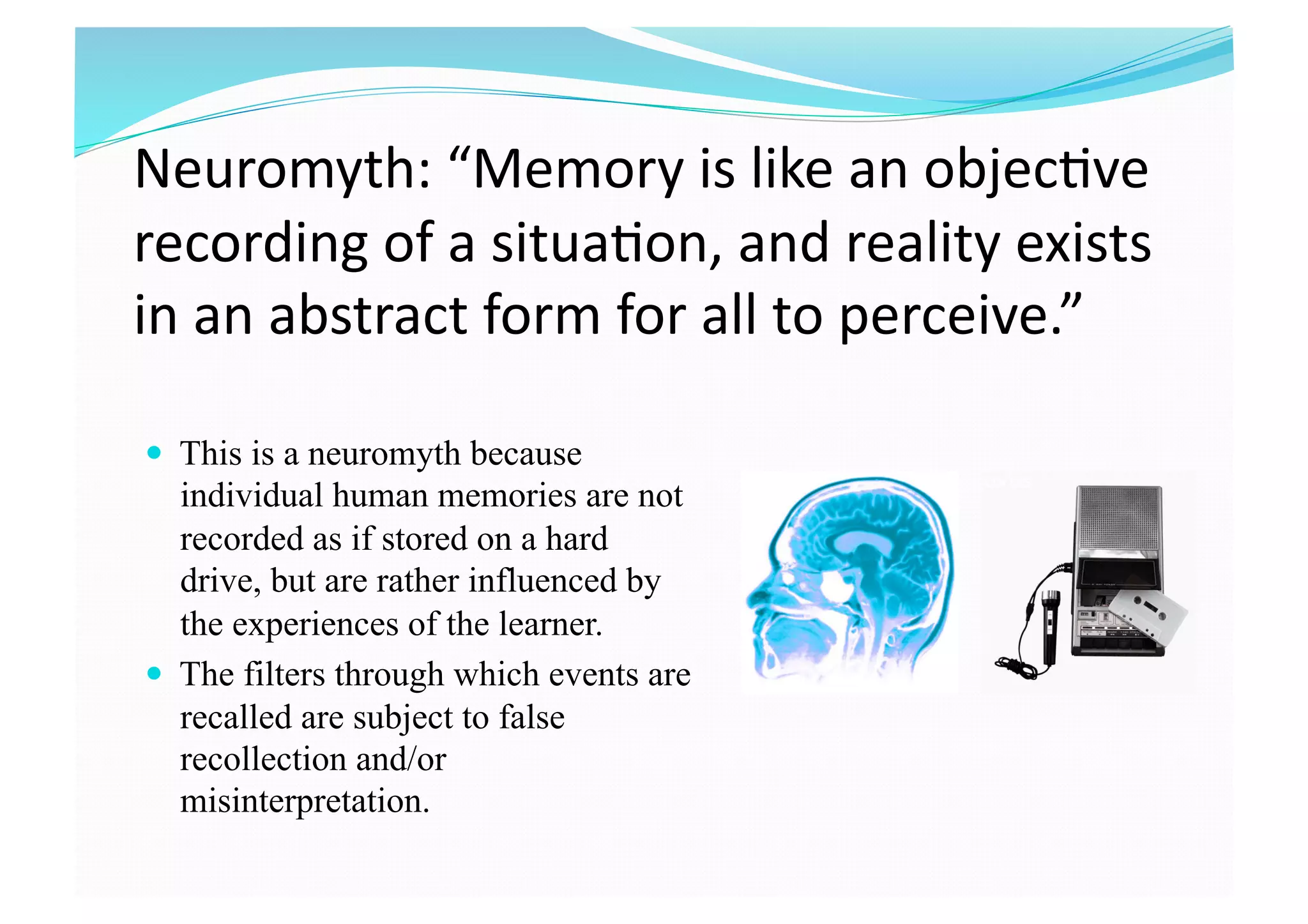
  This is a neuromyth because
individual human memories are not
recorded as if stored on a hard
drive, but are rather influenced by
the experiences of the learner.
  The filters through which events are
recalled are subject to false
recollection and/or
misinterpretation.
Neuromyth:
“The
brain
remembers

everything
it
has
ever
experienced;
forgegng

is
simply
an
absence
of
recall
ability.”
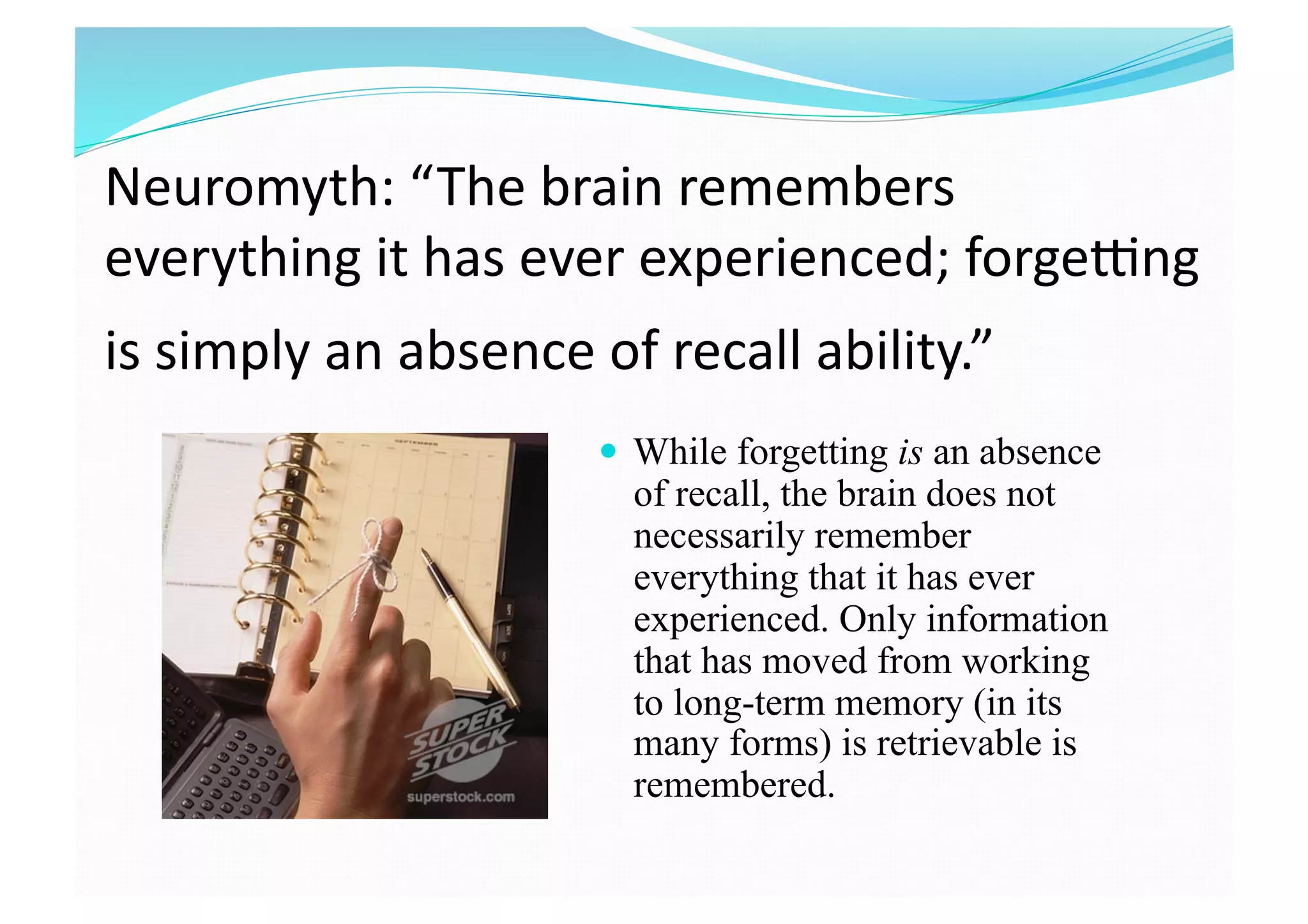
  While forgetting is an absence
of recall, the brain does not
necessarily remember
everything that it has ever
experienced. Only information
that has moved from working
to long-term memory (in its
many forms) is retrievable is
remembered.
Memory

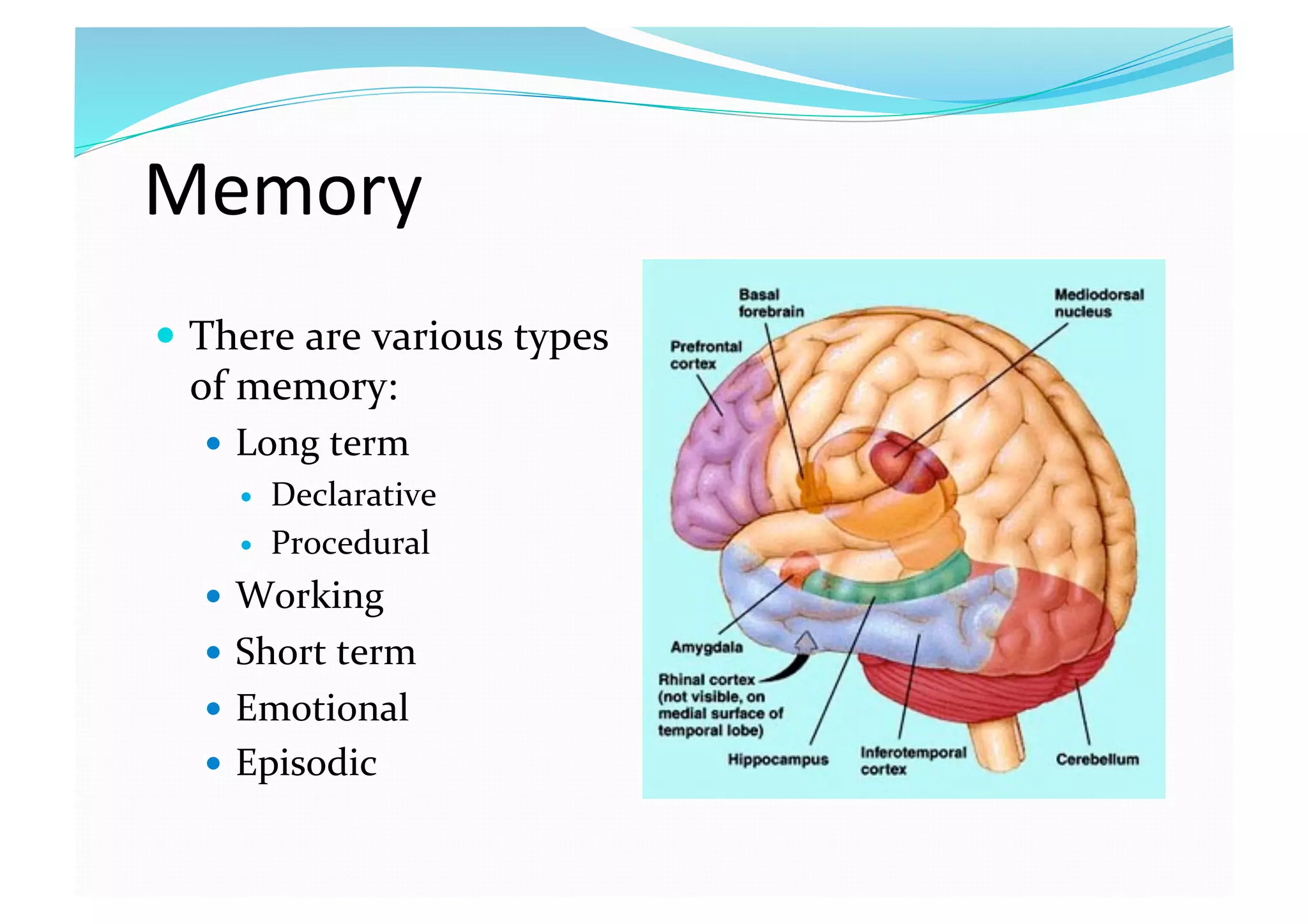
  There
are
various
types

of
memory:

  Long
term

  Declarative

  Procedural

  Working

  Short
term

  Emotional

  Episodic

Requirements
for
long‐term
memory

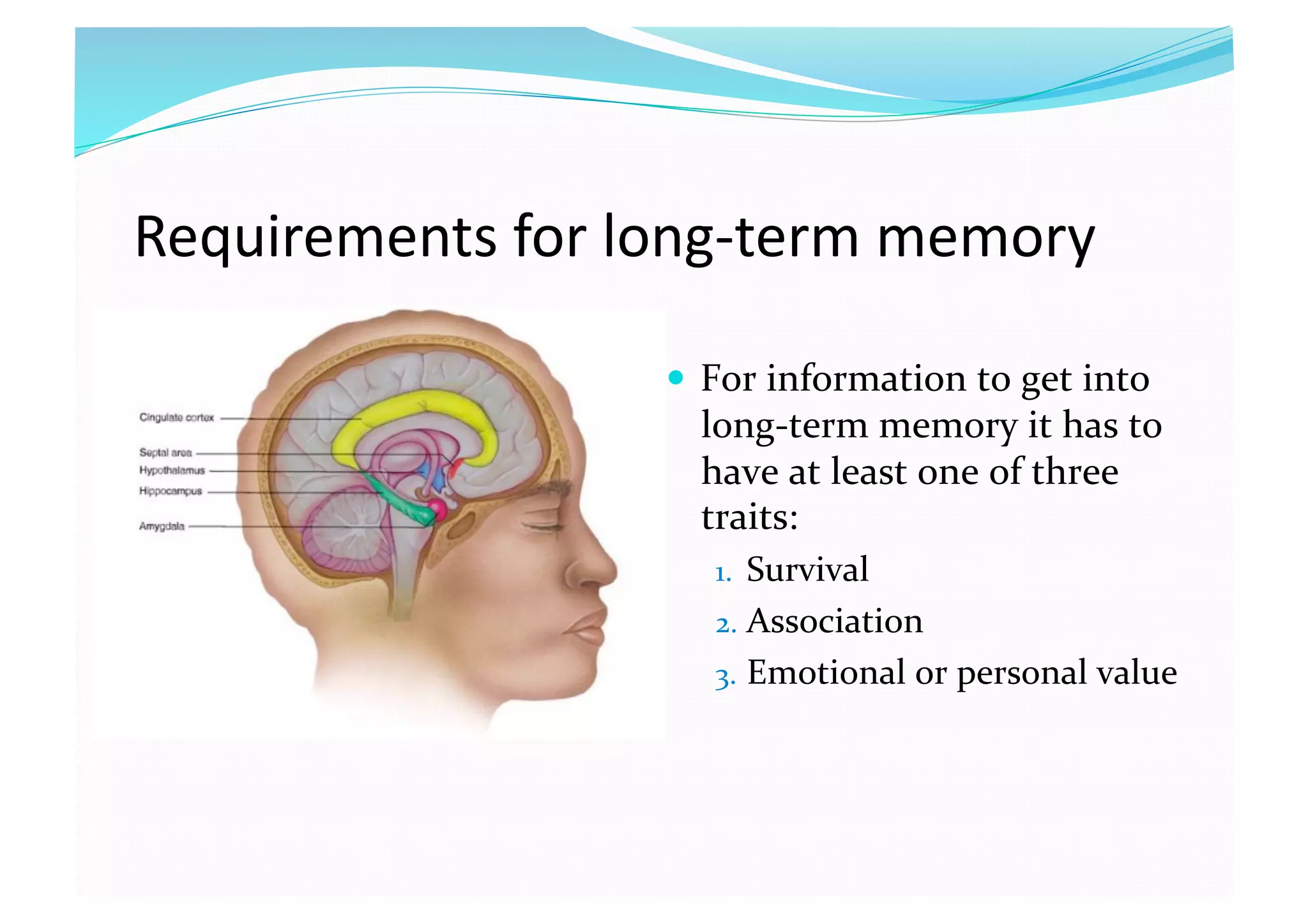
  For
information
to
get
into

long‐term
memory
it
has
to

have
at
least
one
of
three

traits:

1.  Survival

2.  Association

3.  Emotional
or
personal
value

Three things that are easy to remember.
Three things that are hard to remember.
Think
about…

Probably
so:
Sleep

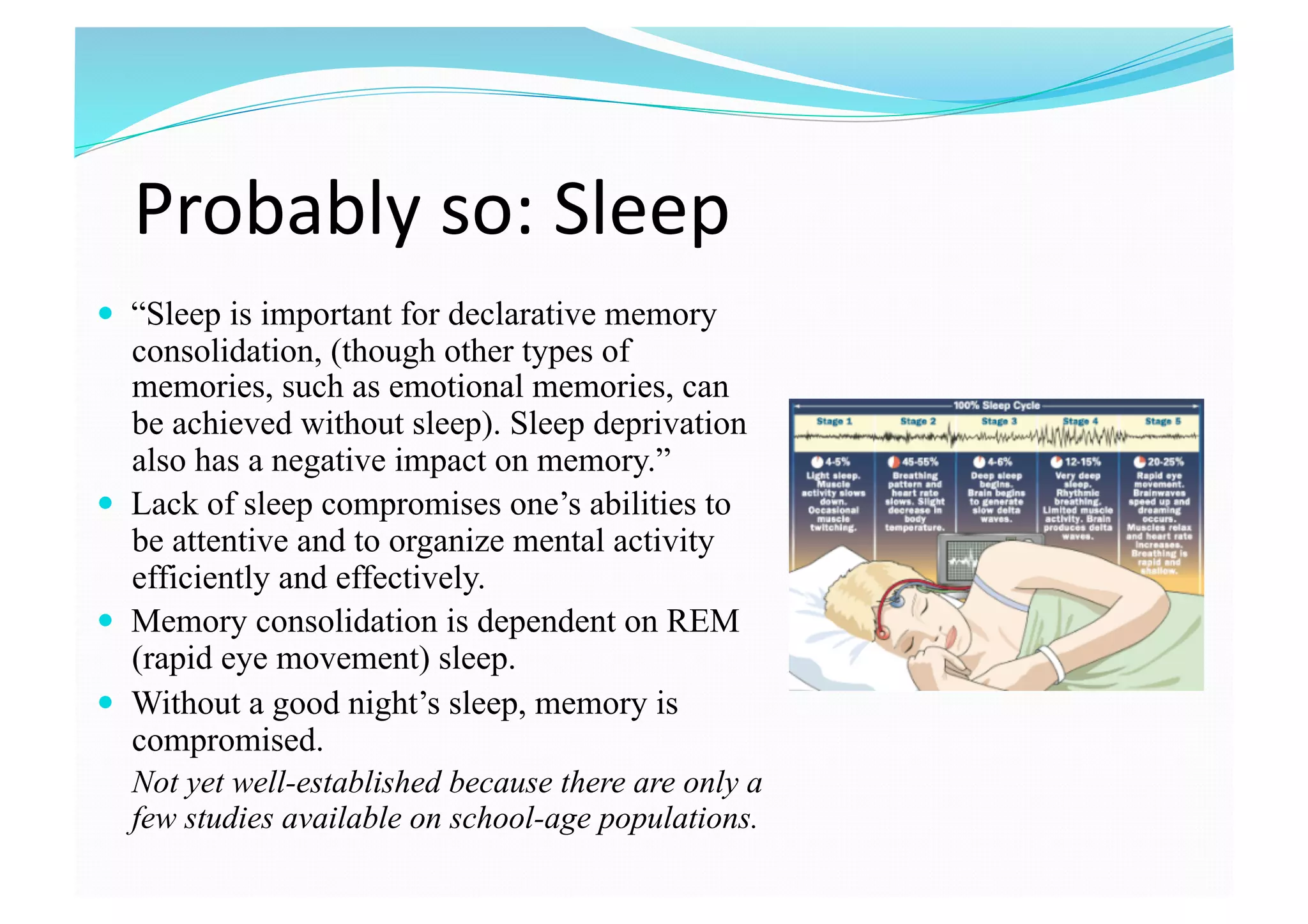
  “Sleep is important for declarative memory
consolidation, (though other types of
memories, such as emotional memories, can
be achieved without sleep). Sleep deprivation
also has a negative impact on memory.”
  Lack of sleep compromises one’s abilities to
be attentive and to organize mental activity
efficiently and effectively.
  Memory consolidation is dependent on REM
(rapid eye movement) sleep.
  Without a good night’s sleep, memory is
compromised.
Not yet well-established because there are only a
few studies available on school-age populations.
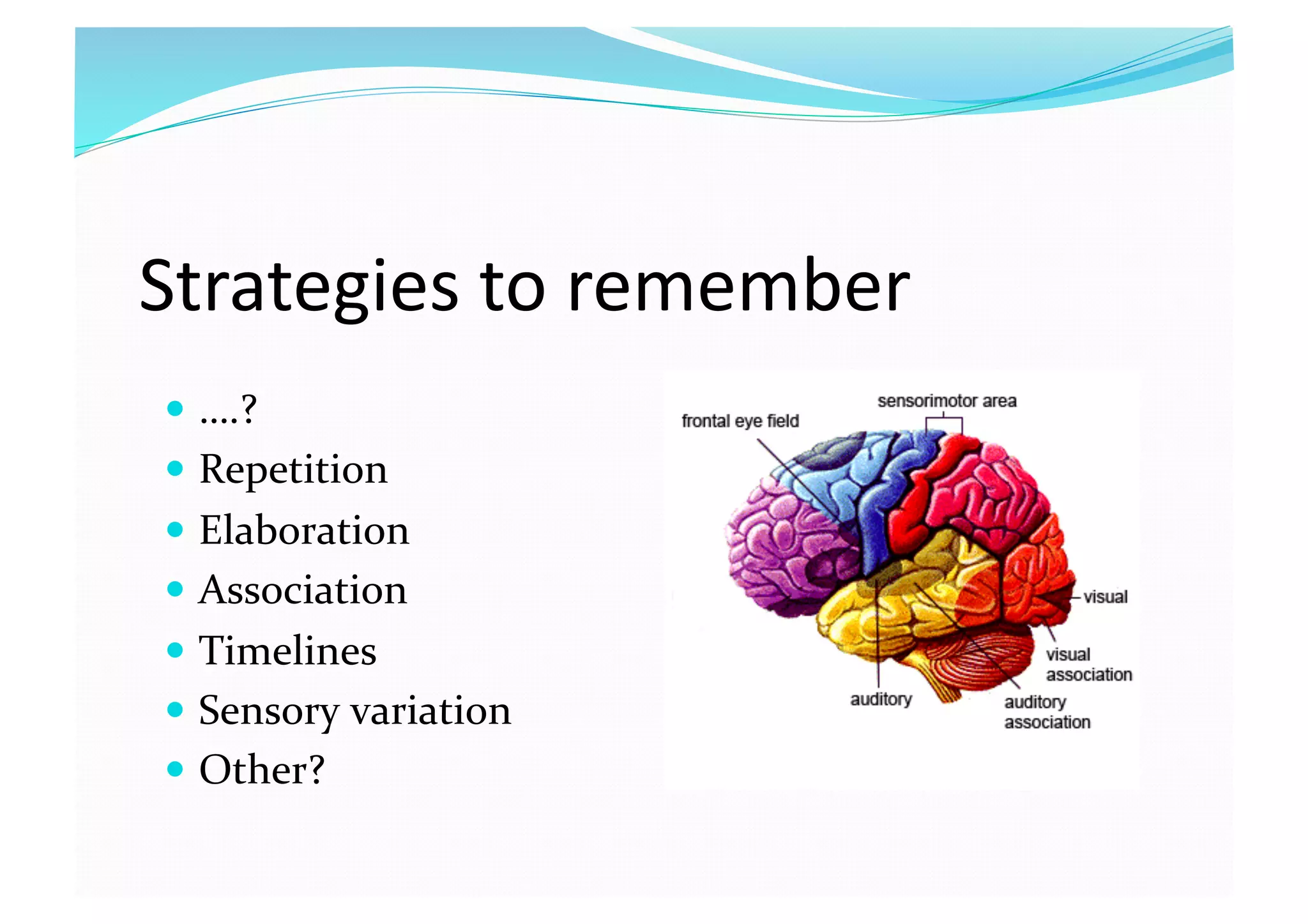
Strategies
to
remember

  ….?

  Repetition

  Elaboration

  Association

  Timelines

  Sensory
variation

  Other?

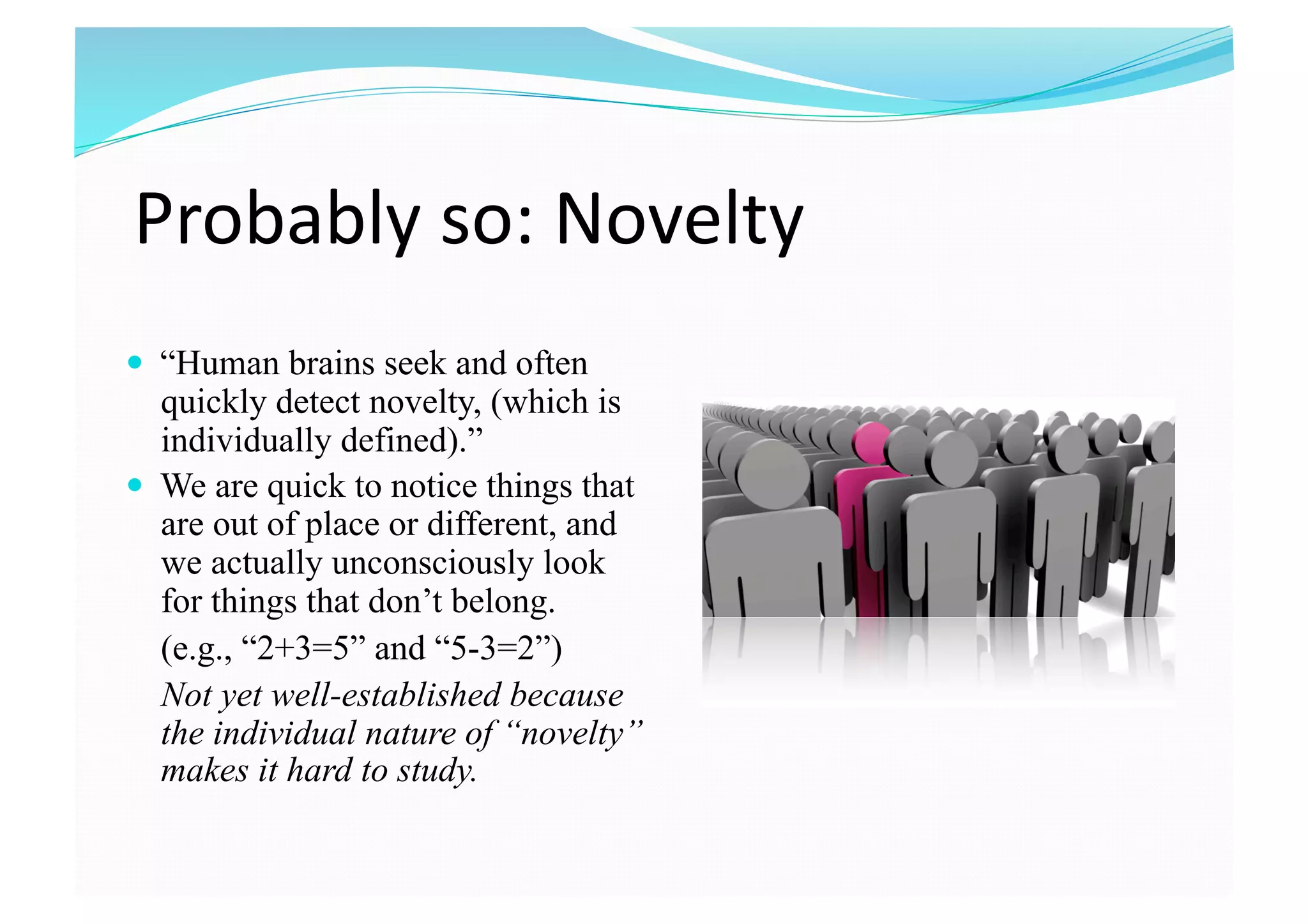
Probably
so:
Novelty

  “Human brains seek and often
quickly detect novelty, (which is
individually defined).”
  We are quick to notice things that
are out of place or different, and
we actually unconsciously look
for things that don’t belong.
(e.g., “2+3=5” and “5-3=2”)
Not yet well-established because
the individual nature of “novelty”
makes it hard to study.
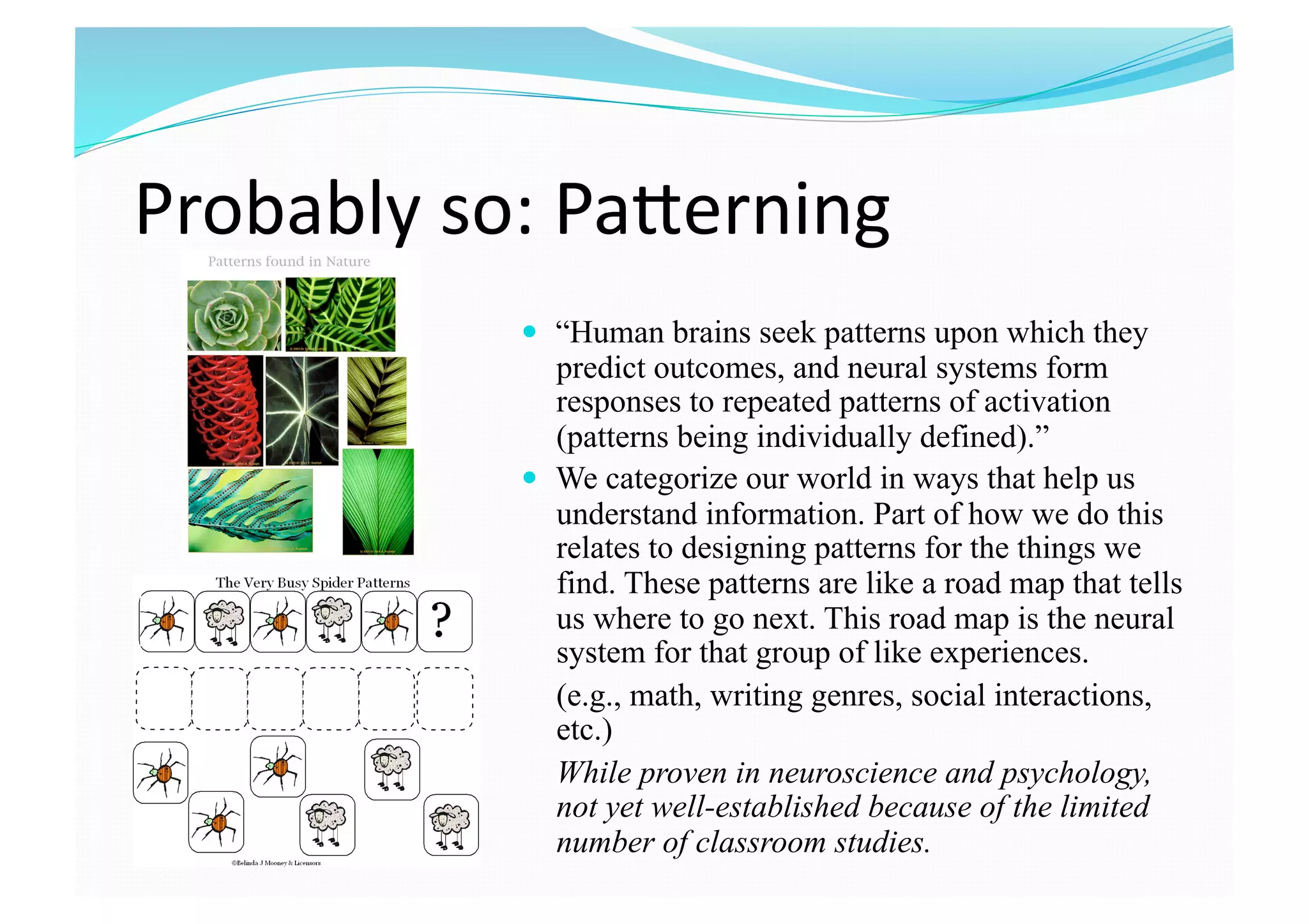
Probably
so:
PaTerning

  “Human brains seek patterns upon which they
predict outcomes, and neural systems form
responses to repeated patterns of activation
(patterns being individually defined).”
  We categorize our world in ways that help us
understand information. Part of how we do this
relates to designing patterns for the things we
find. These patterns are like a road map that tells
us where to go next. This road map is the neural
system for that group of like experiences.
(e.g., math, writing genres, social interactions,
etc.)
While proven in neuroscience and psychology,
not yet well-established because of the limited
number of classroom studies.
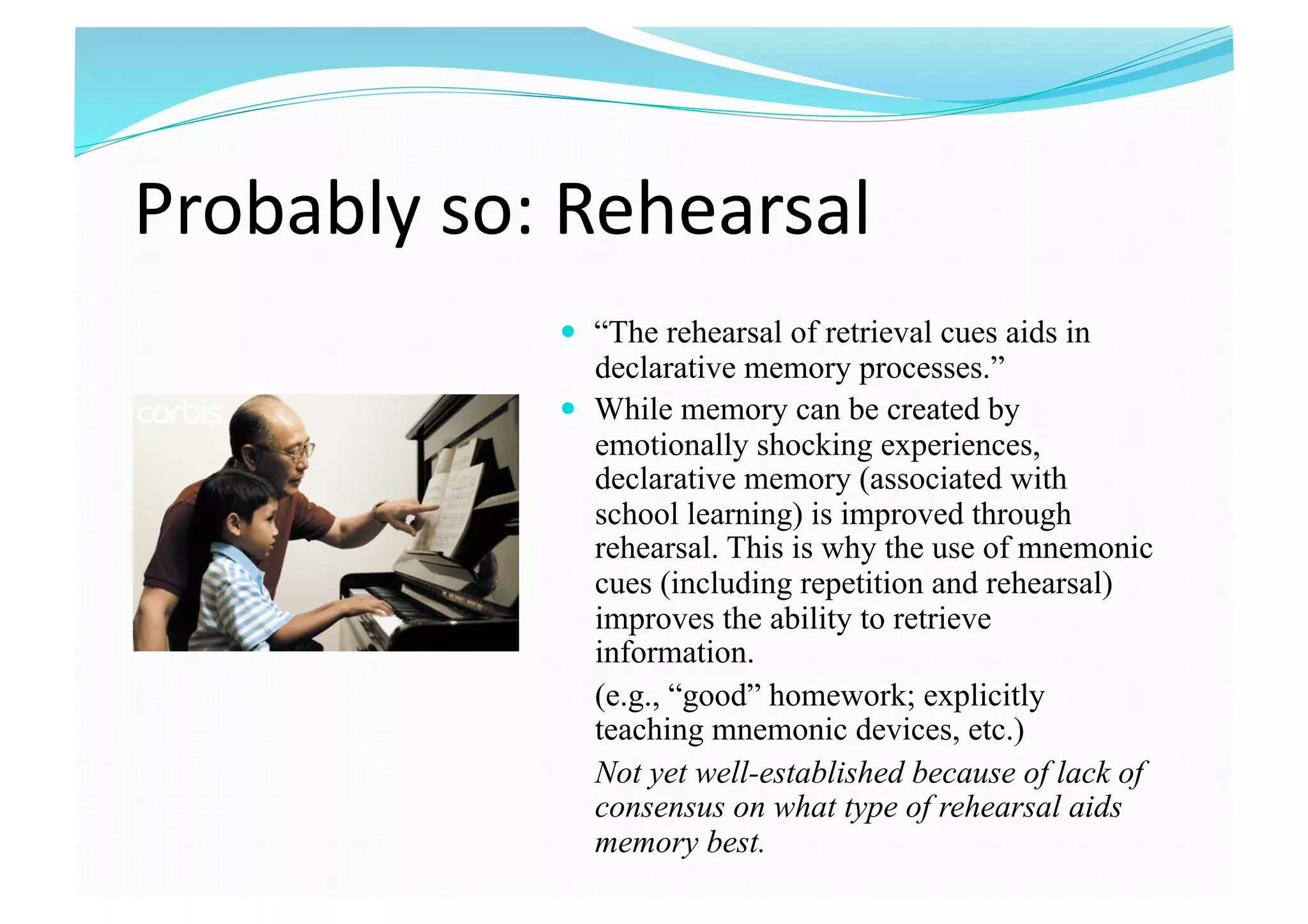
Probably
so:
Rehearsal

  “The rehearsal of retrieval cues aids in
declarative memory processes.”
  While memory can be created by
emotionally shocking experiences,
declarative memory (associated with
school learning) is improved through
rehearsal. This is why the use of mnemonic
cues (including repetition and rehearsal)
improves the ability to retrieve
information.
(e.g., “good” homework; explicitly
teaching mnemonic devices, etc.)
Not yet well-established because of lack of
consensus on what type of rehearsal aids
memory best.
Probably
so:
Elabora8on

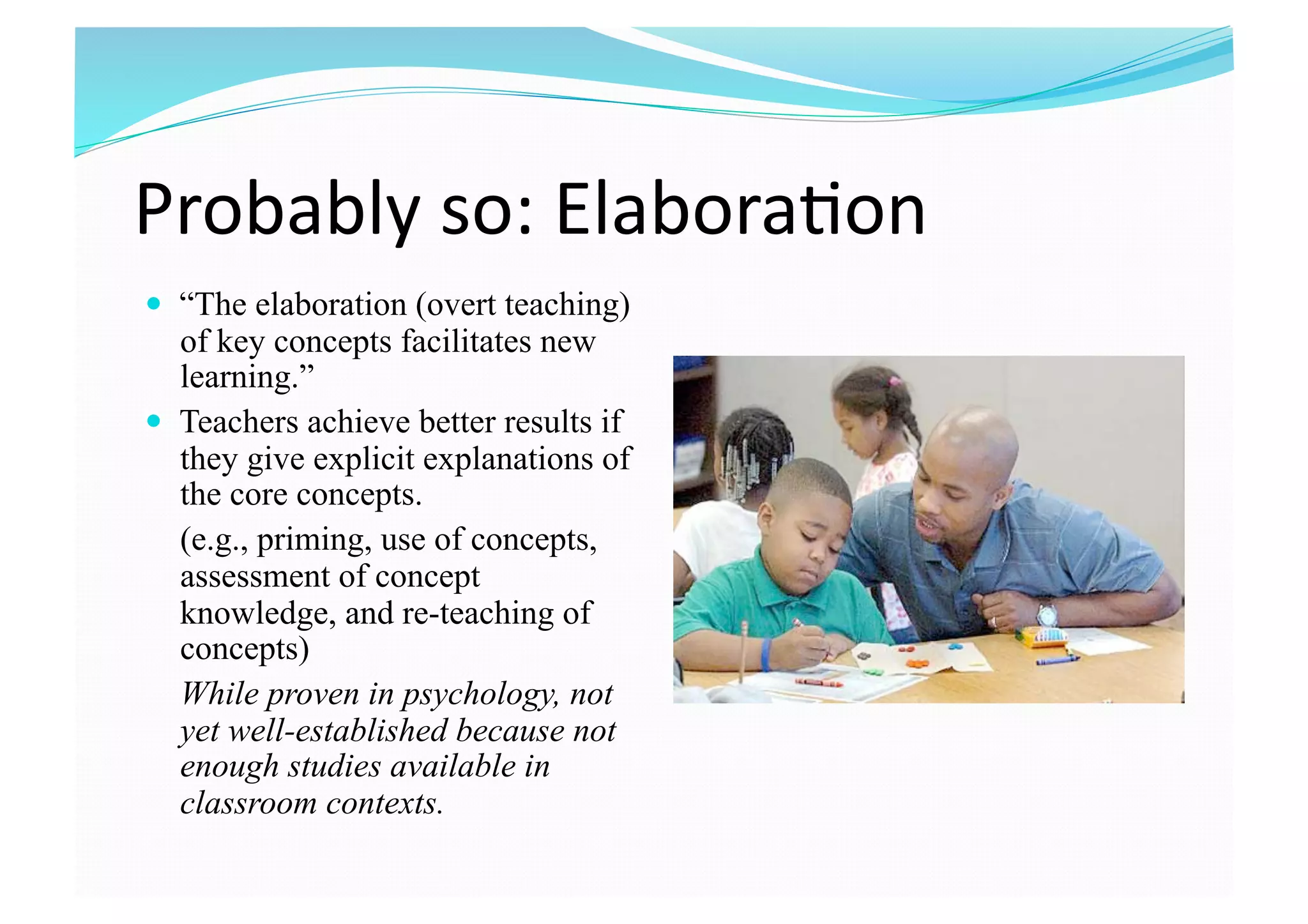
  “The elaboration (overt teaching)
of key concepts facilitates new
learning.”
  Teachers achieve better results if
they give explicit explanations of
the core concepts.
(e.g., priming, use of concepts,
assessment of concept
knowledge, and re-teaching of
concepts)
While proven in psychology, not
yet well-established because not
enough studies available in
classroom contexts.
ATen8on

ATen8on

  How
long
is
the
average
attention
span?

ATen8on

Attention
spans

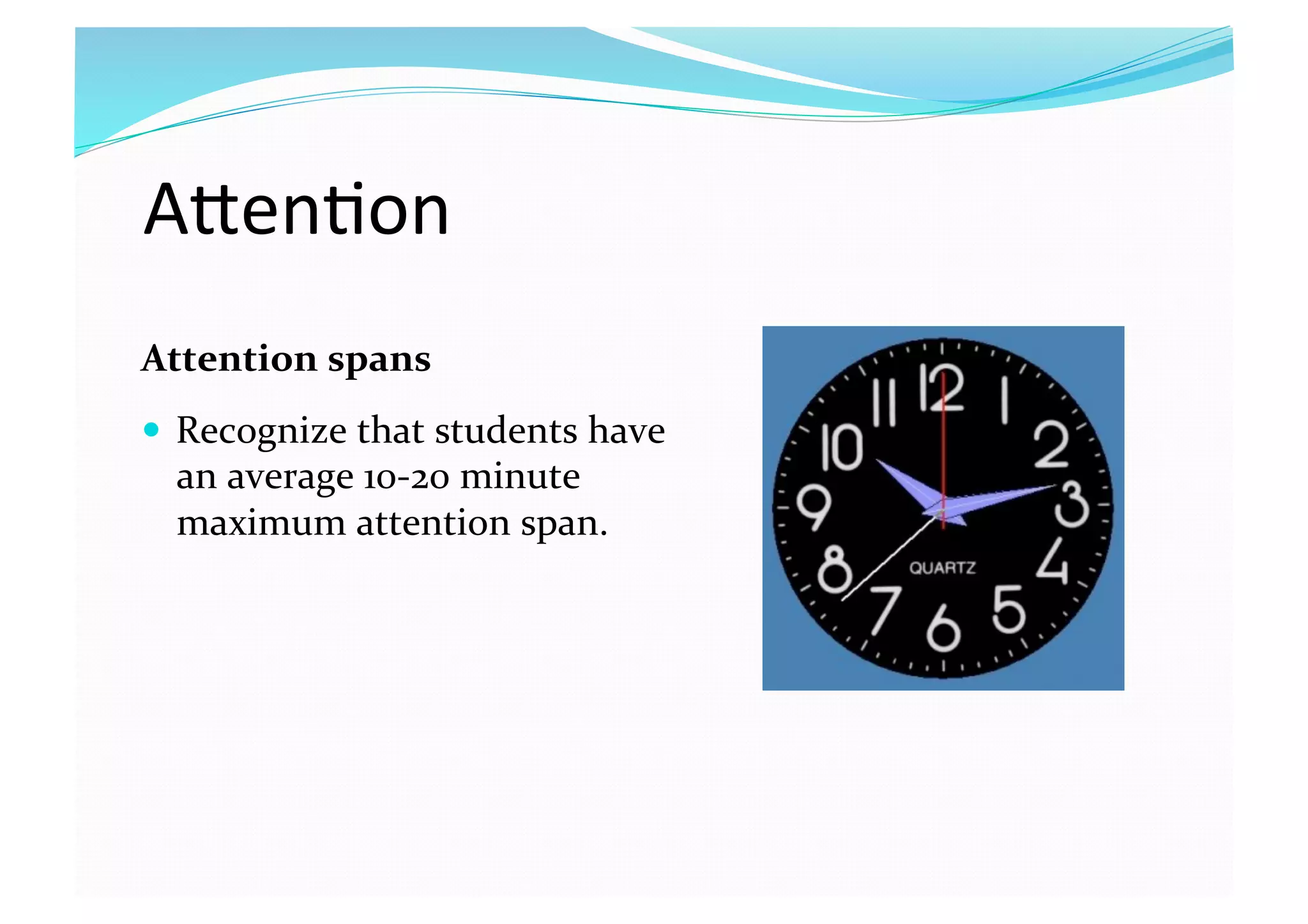
  Recognize
that
students
have

an
average
10‐20
minute

maximum
attention
span.

In
prac(ce:

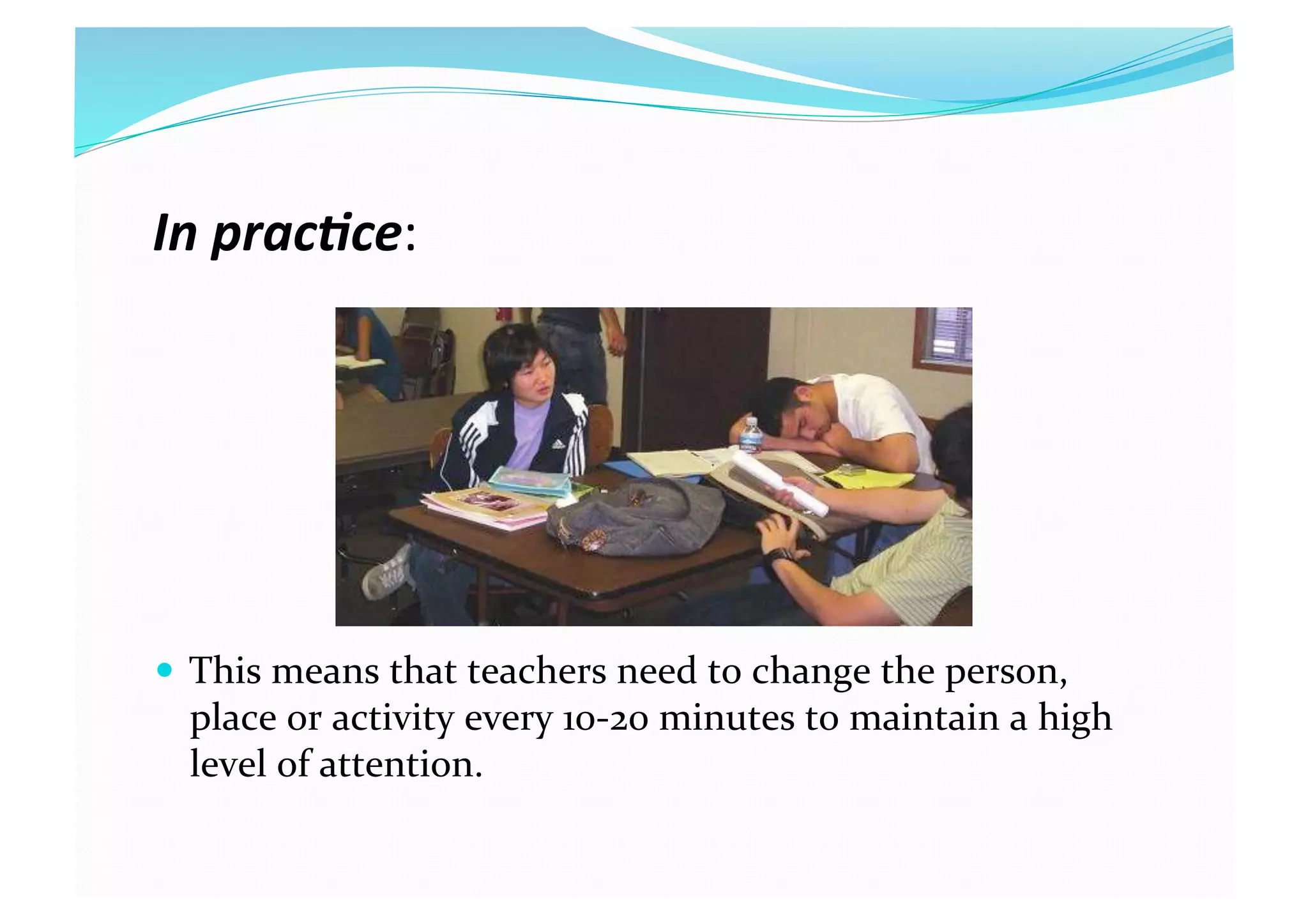
  This
means
that
teachers
need
to
change
the
person,

place
or
activity
every
10‐20
minutes
to
maintain
a
high

level
of
attention.

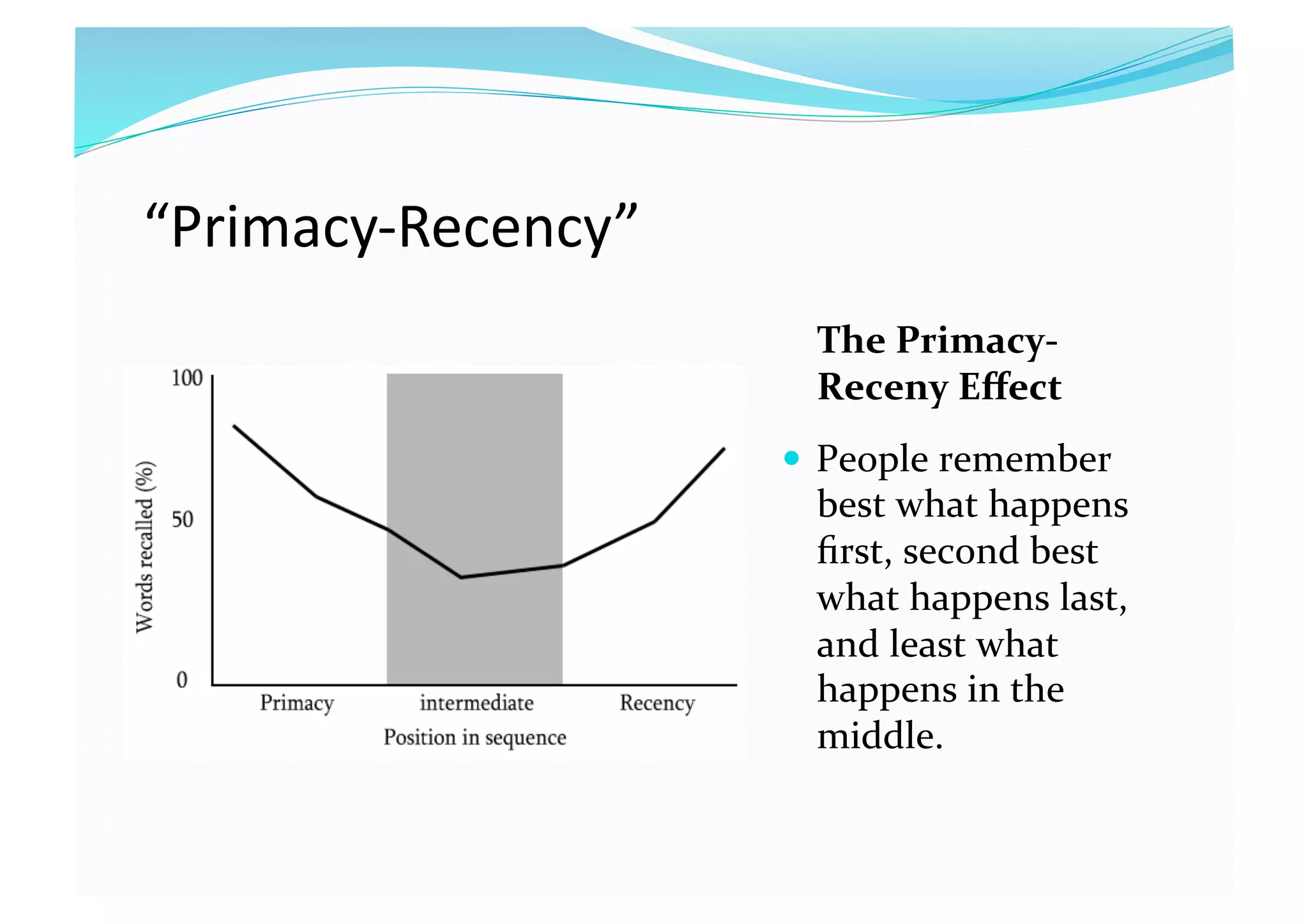
“Primacy‐Recency”

The
Primacy‐
Receny
Effect

  People
remember

best
what
happens

first,
second
best

what
happens
last,

and
least
what

happens
in
the

middle.

In
prac(ce:

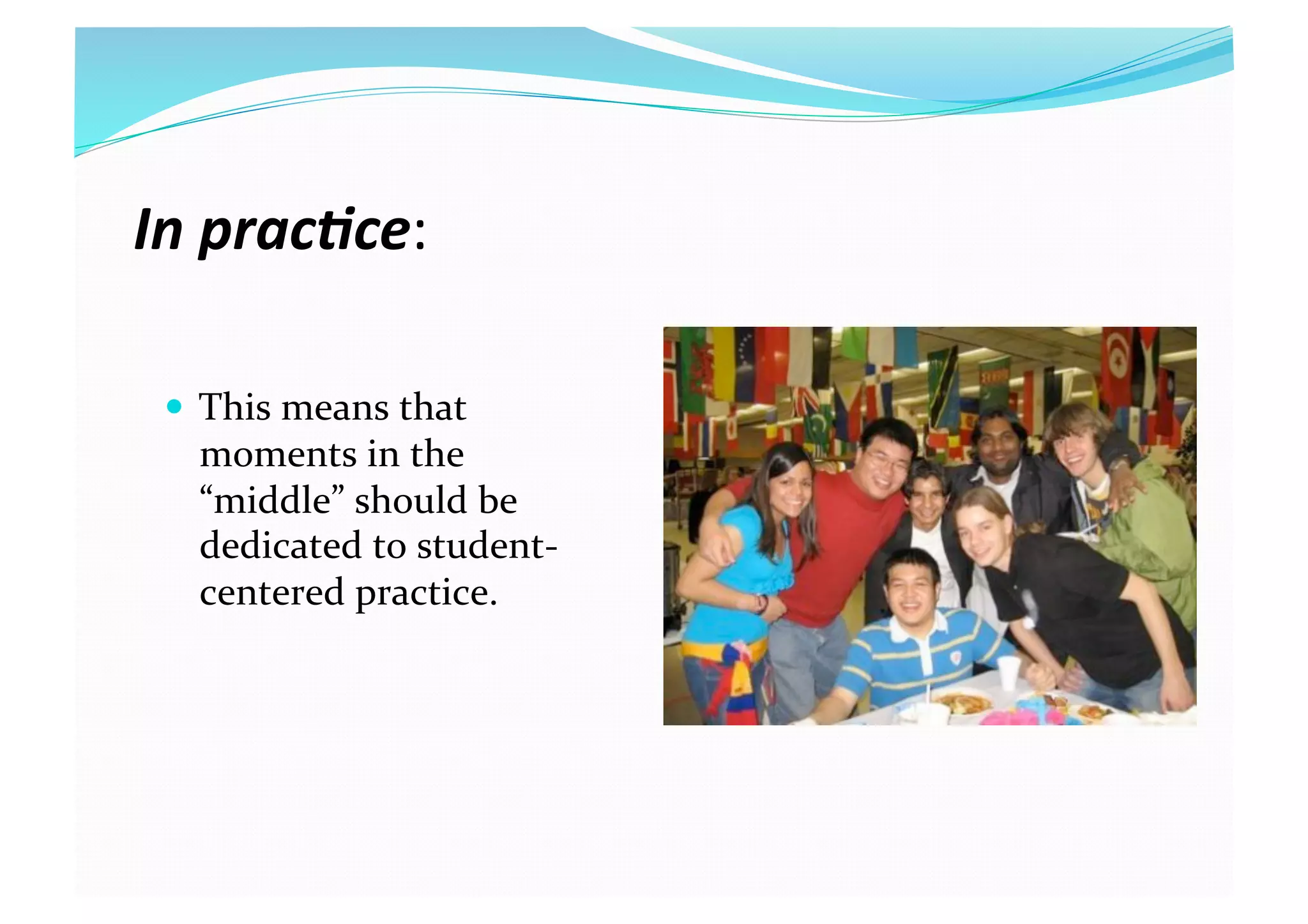
  This
means
that

moments
in
the

“middle”
should
be

dedicated
to
student‐
centered
practice.

In
prac(ce:

  The
last
part
of
the
class

should
be
dedicated
to

summarizing
important

concepts
and
bridging
to

next
class.


Classroom
implica8ons:


What
every
teacher
needs
to
know…

The
reten8on
of
new
informa8on


  Depending
on
the
chosen
methodology,
students
have
varying

attention
levels.


  The
best
way
to
learn
anything
is….


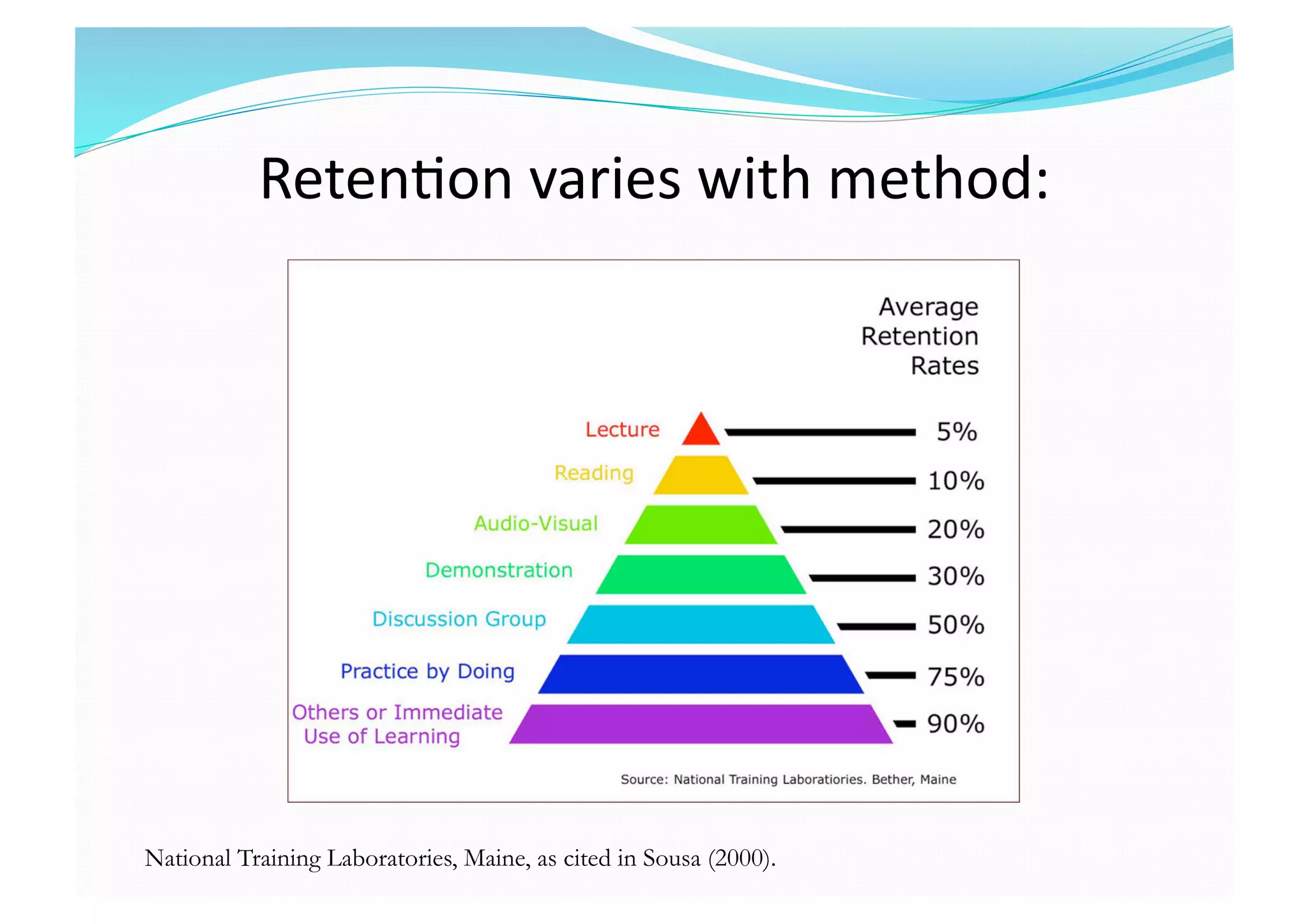
Reten8on
varies
with
method:

National Training Laboratories, Maine, as cited in Sousa (2000).
Reten8on
varies
with
method:

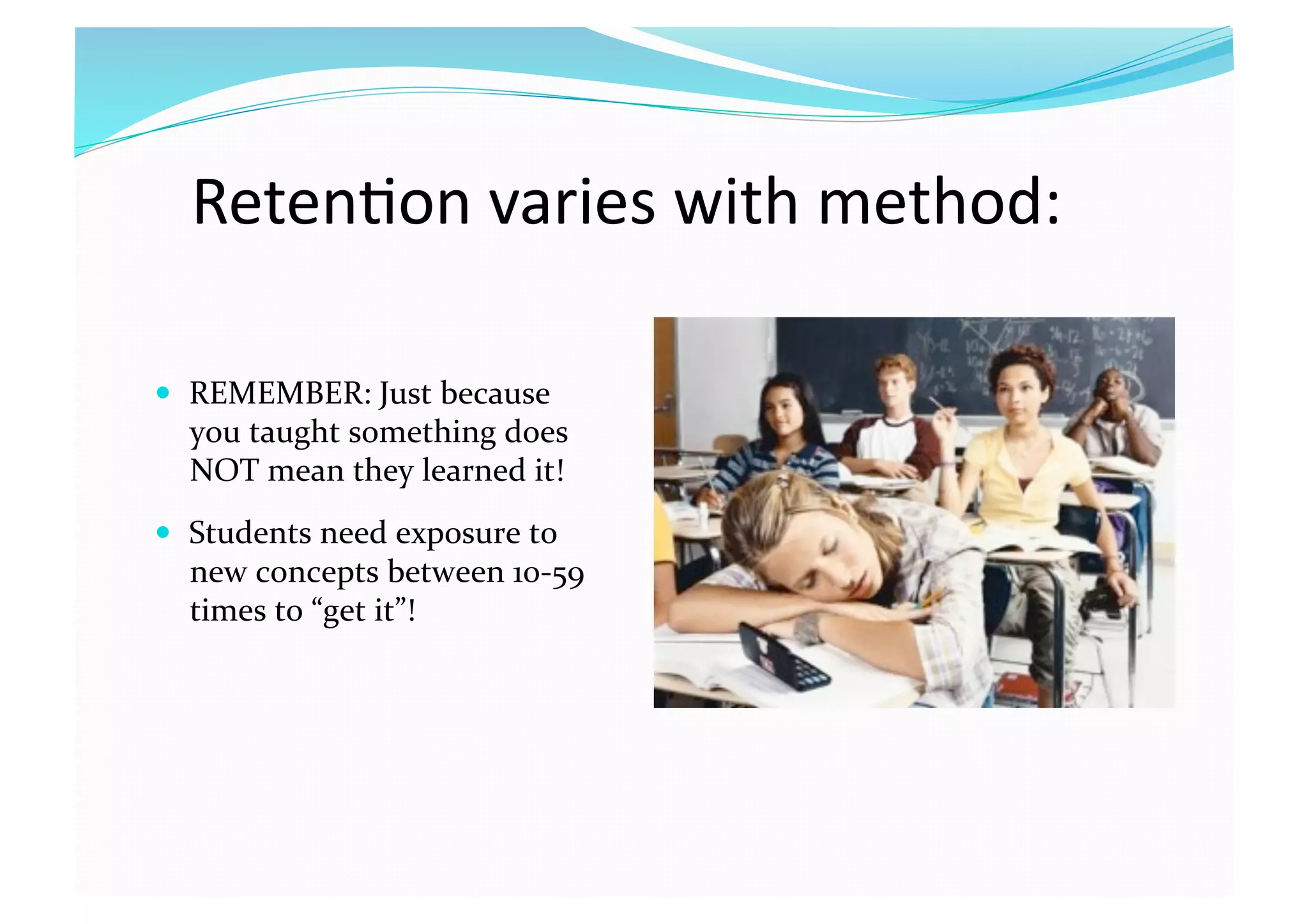
  REMEMBER:
Just
because

you
taught
something
does

NOT
mean
they
learned
it!


  Students
need
exposure
to

new
concepts
between
10‐59

times
to
“get
it”!

In
prac(ce:

The
Law
of
10:

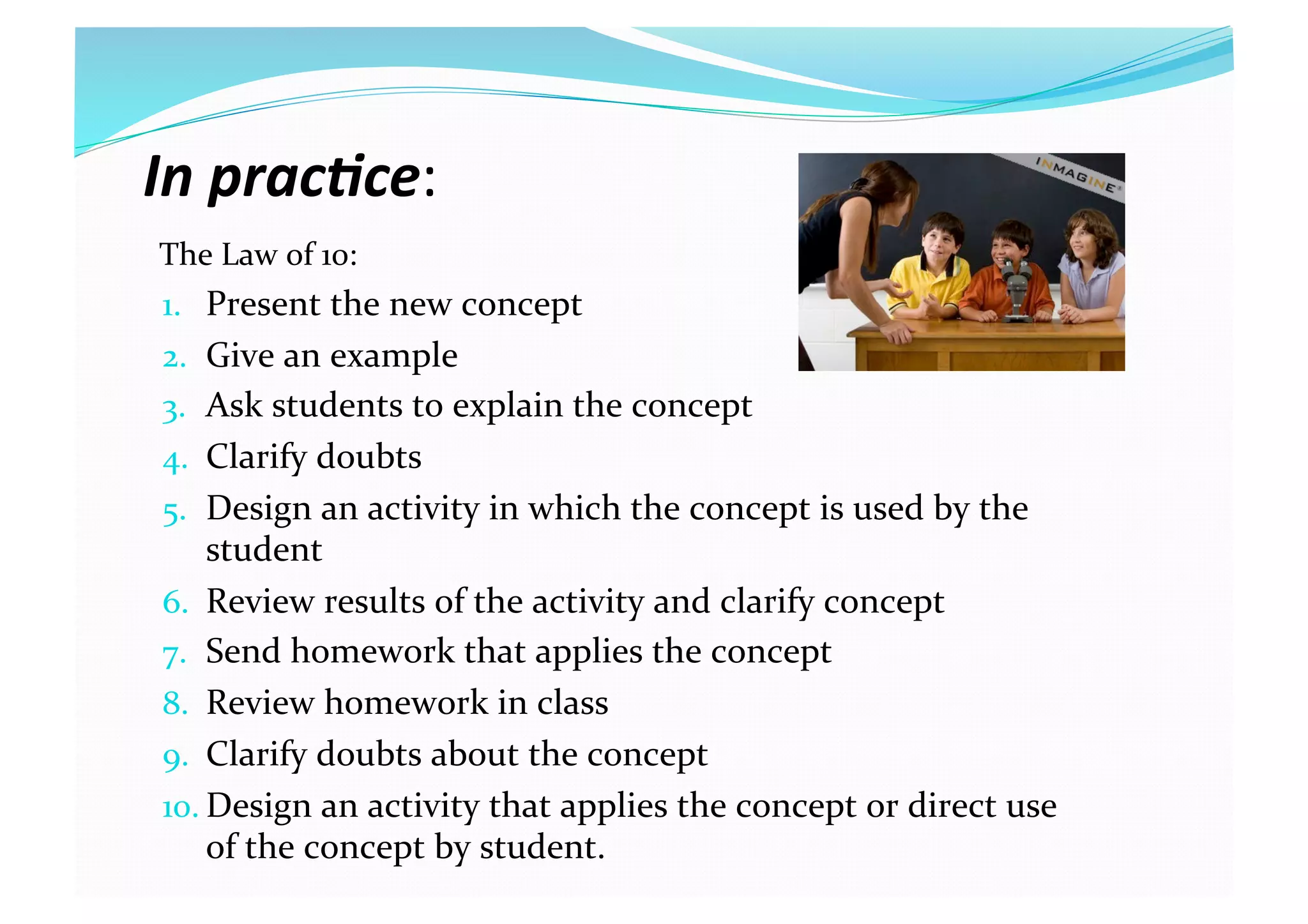
1.  Present
the
new
concept

2.  Give
an
example

3.  Ask
students
to
explain
the
concept

4.  Clarify
doubts

5.  Design
an
activity
in
which
the
concept
is
used
by
the

student

6.  Review
results
of
the
activity
and
clarify
concept

7.  Send
homework
that
applies
the
concept

8.  Review
homework
in
class

9.  Clarify
doubts
about
the
concept

10. Design
an
activity
that
applies
the
concept
or
direct
use

of
the
concept
by
student.

In
prac(ce:

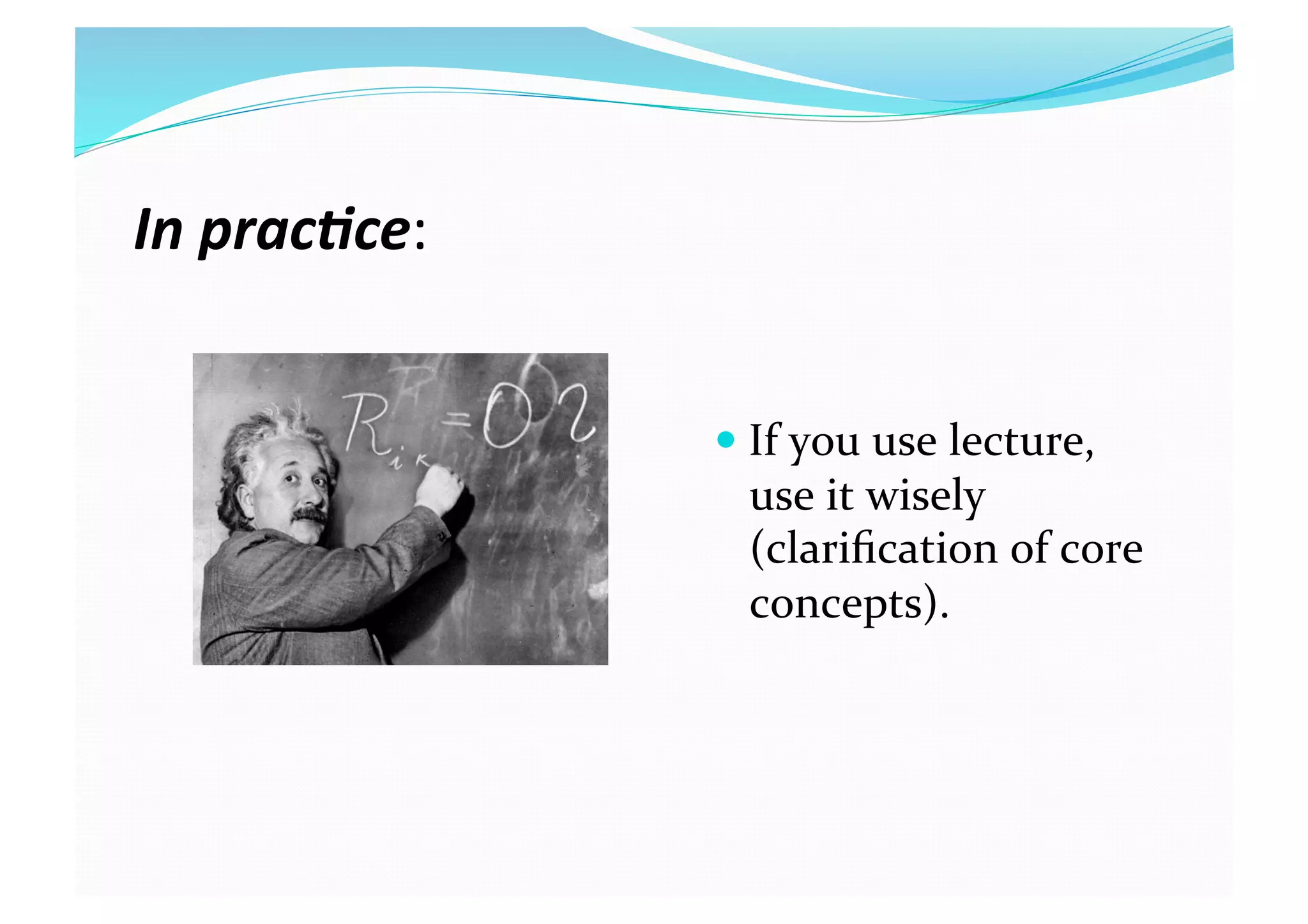
 If
you
use
lecture,

use
it
wisely

(clarification
of
core

concepts).

In
prac(ce:

 Homework
should
be

used
to
reinforce
the

new
ideas
and


concepts.

Best
prac8ce…

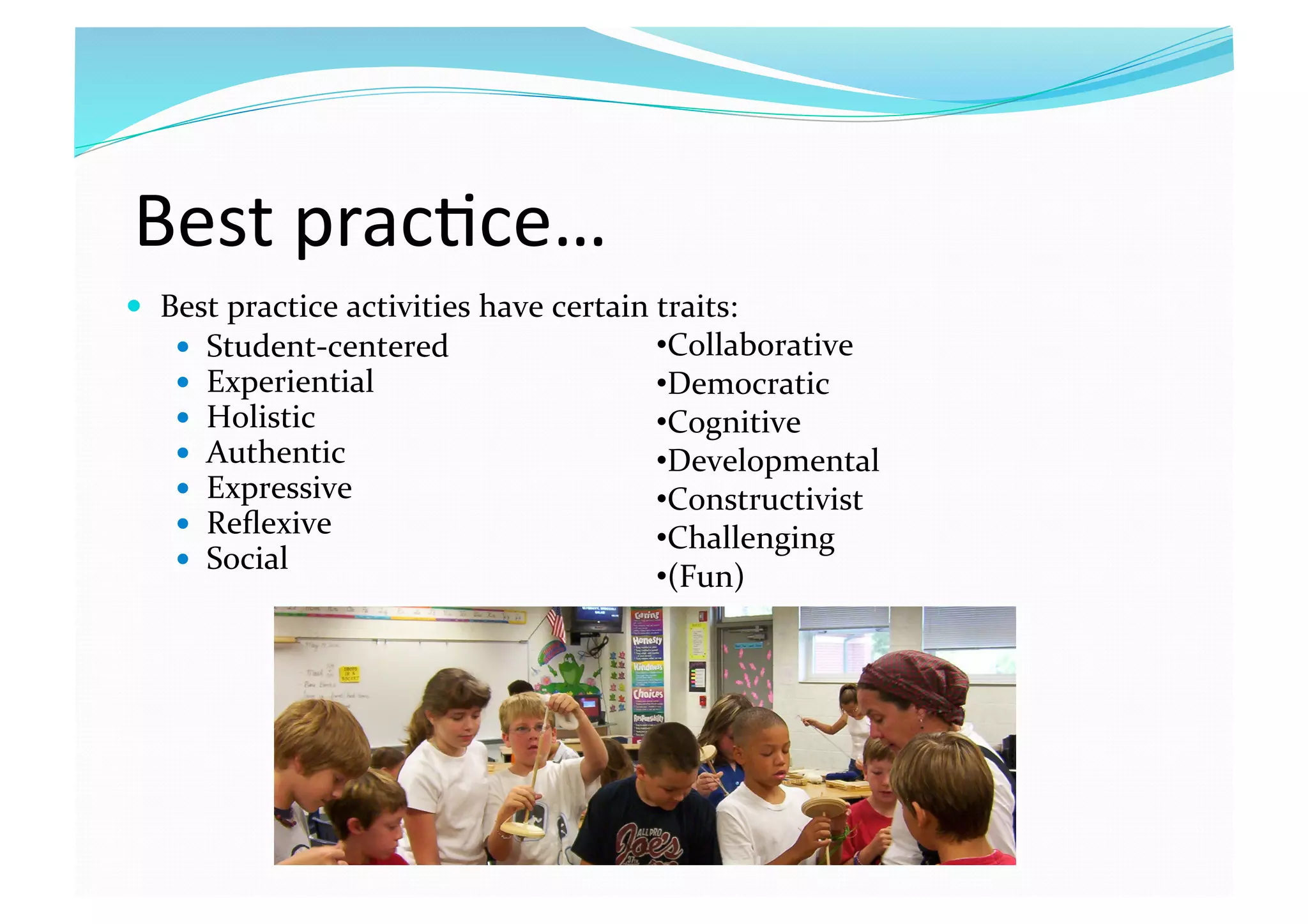
  Best
practice
activities
have
certain
traits:


  Student‐centered

  Experiential

  Holistic

  Authentic

  Expressive

  Reflexive

  Social


• Collaborative

• Democratic

• Cognitive

• Developmental

• Constructivist

• Challenging


• (Fun)

In
prac(ce:

  Activities
that
have
one
or
more

of
the
aforementioned

characteristics
are
more
likely

to
have
an
impact
and
create

significant
learning
experiences.

Examples
of
best
prac8ce

ac8vi8es….?

10
Guides
for
BeTer

Teaching

Guide
1:


Learning
environments

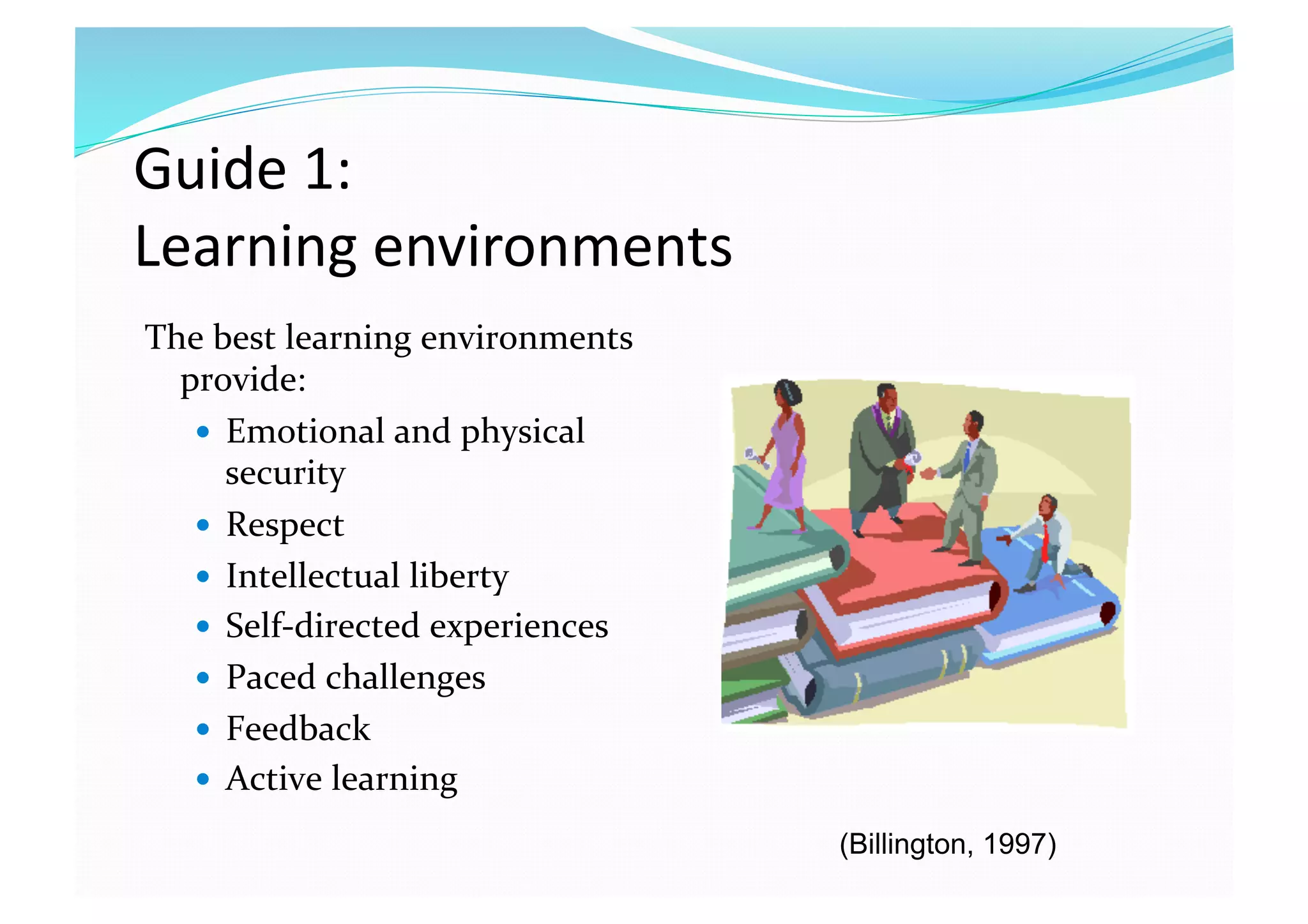
The
best
learning
environments

provide:

  Emotional
and
physical

security

  Respect

  Intellectual
liberty

  Self‐directed
experiences

  Paced
challenges

  Feedback

  Active
learning

(Billington, 1997)
Guide
2:


Sense,
Meaning
and
Transfer

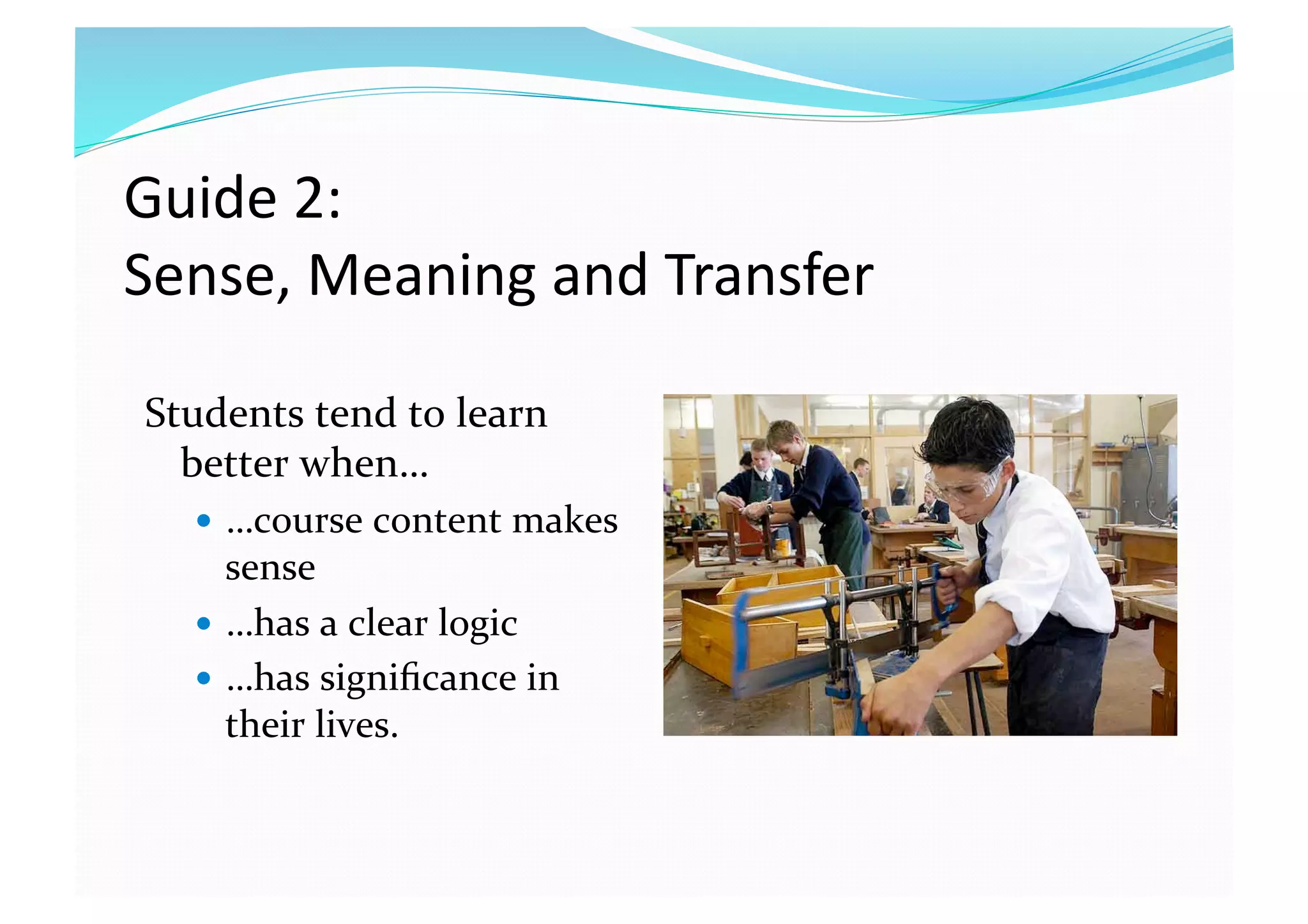
Students
tend
to
learn

better
when…

  …course
content
makes

sense

  …has
a
clear
logic

  …has
significance
in

their
lives.

Guide
3:


Different
memory
pathways

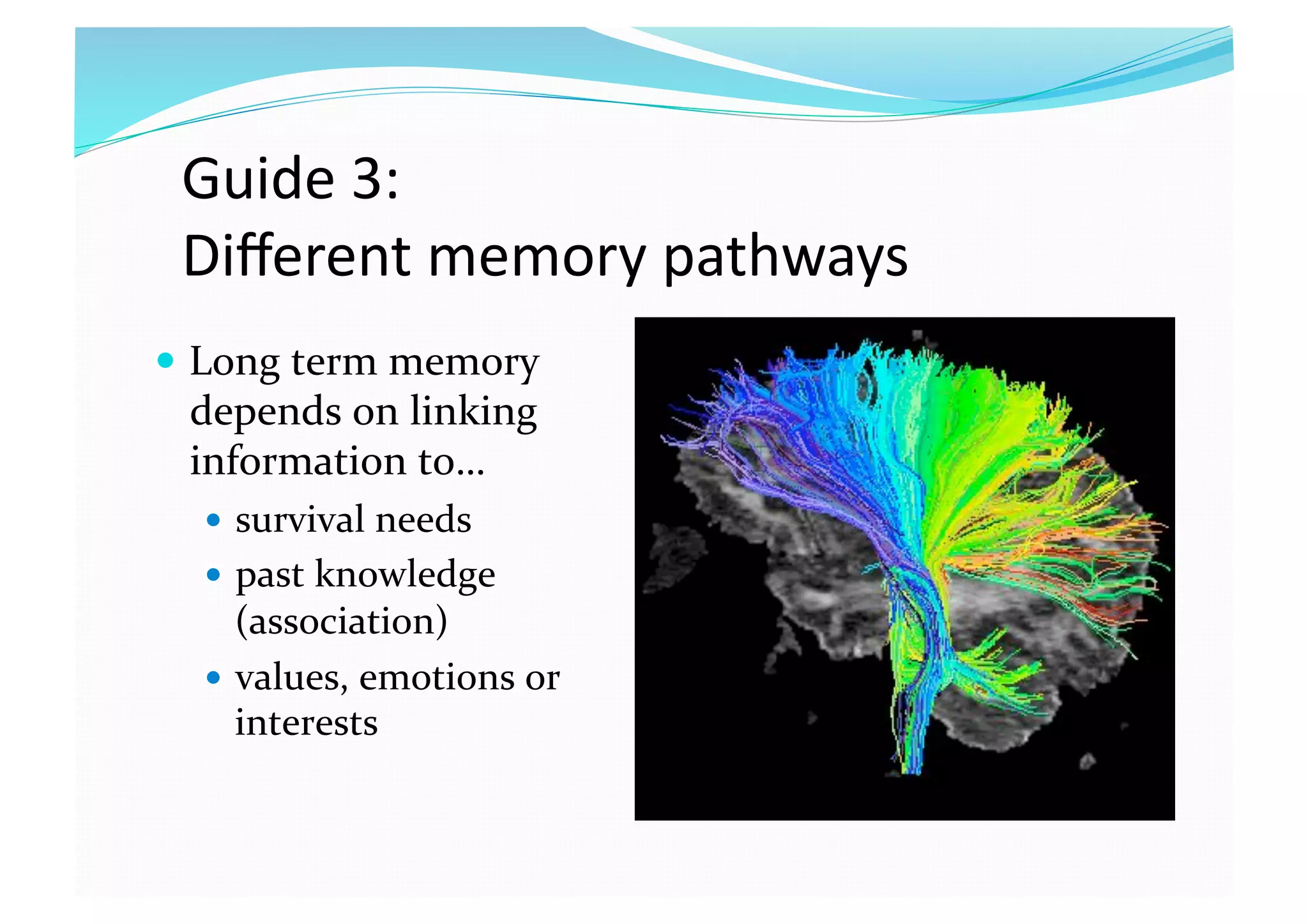
  Long
term
memory

depends
on
linking

information
to…

  survival
needs

  past
knowledge

(association)

  values,
emotions
or

interests

Guide 4:
Attention limits

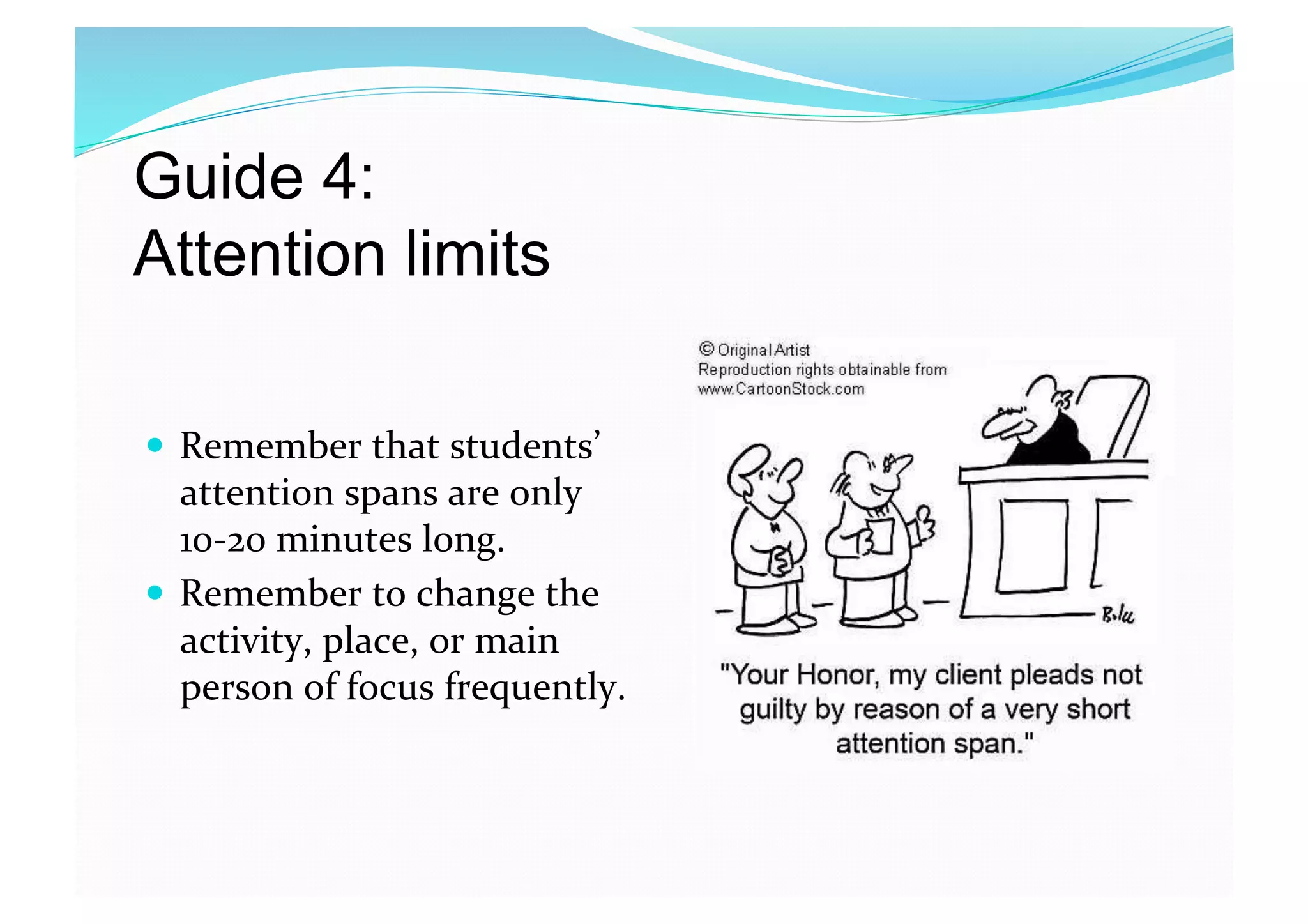
  Remember
that
students’

attention
spans
are
only

10‐20
minutes
long.

  Remember
to
change
the

activity,
place,
or
main

person
of
focus
frequently.


Guide 5:
Social learning

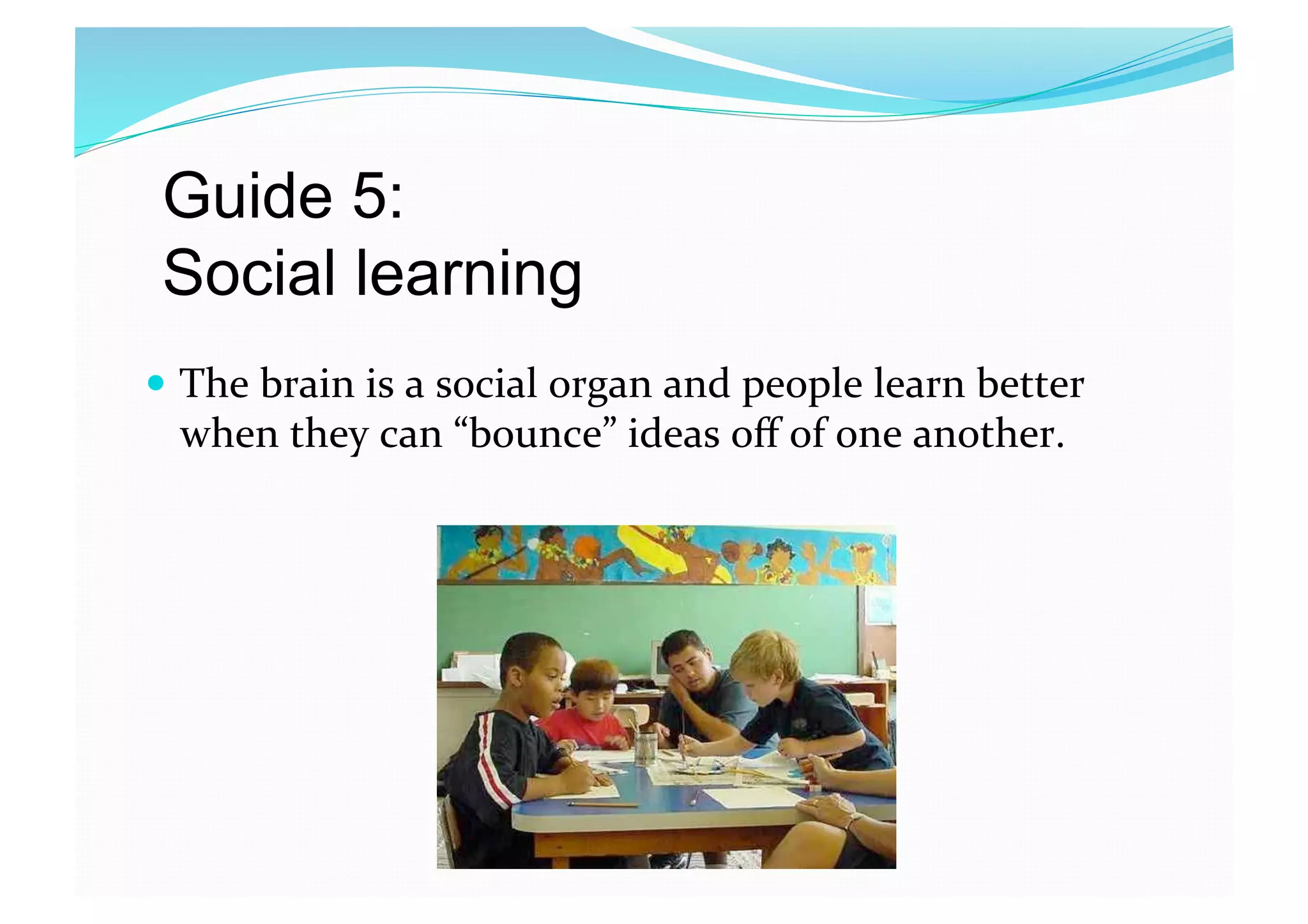
  The
brain
is
a
social
organ
and
people
learn
better

when
they
can
“bounce”
ideas
off
of
one
another.


Guide
6:


Mind‐Body
Concepts

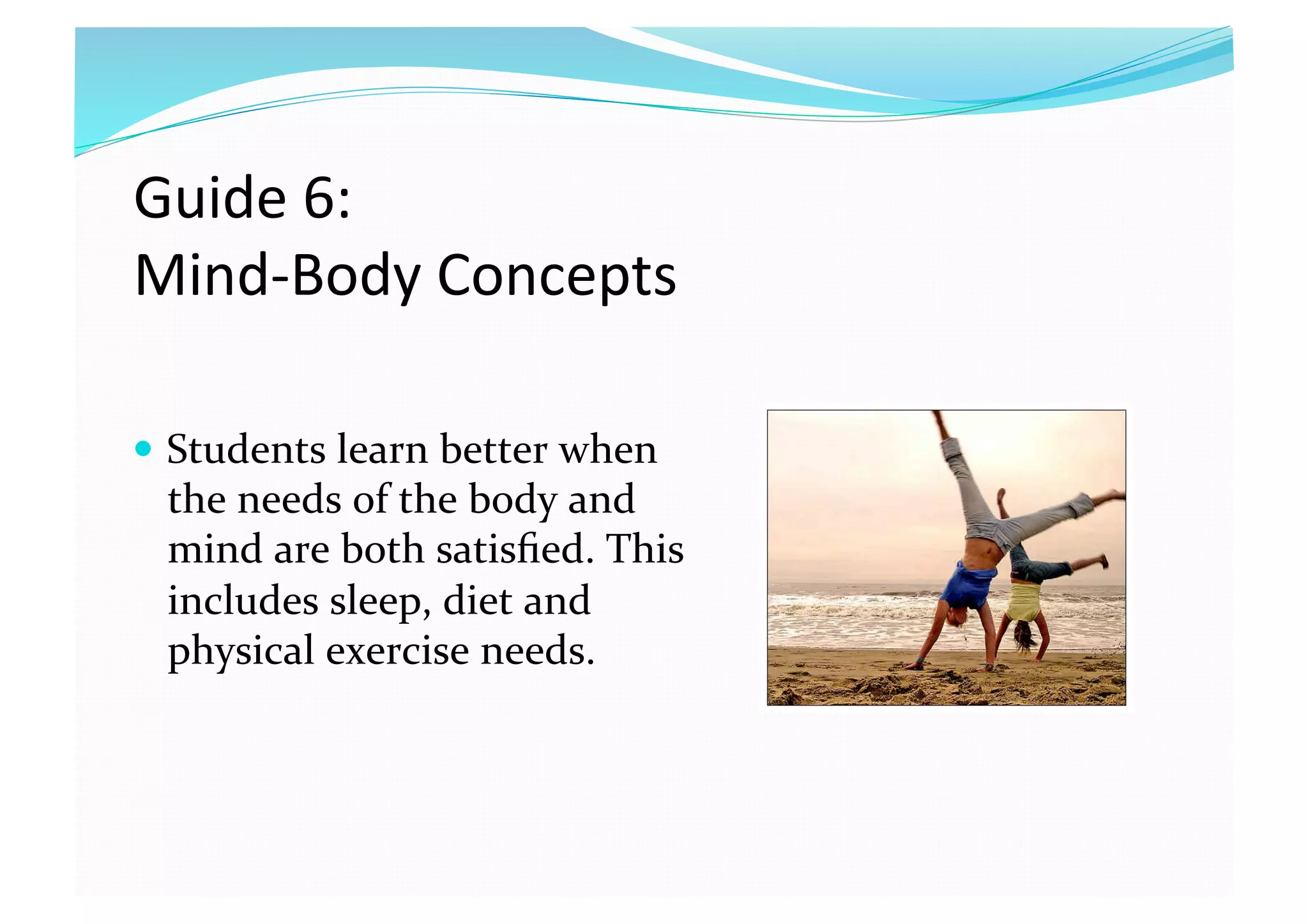
  Students
learn
better
when

the
needs
of
the
body
and

mind
are
both
satisfied.
This

includes
sleep,
diet
and

physical
exercise
needs.


Guide
7:


Teacher
metaphor:
Orquestra
director

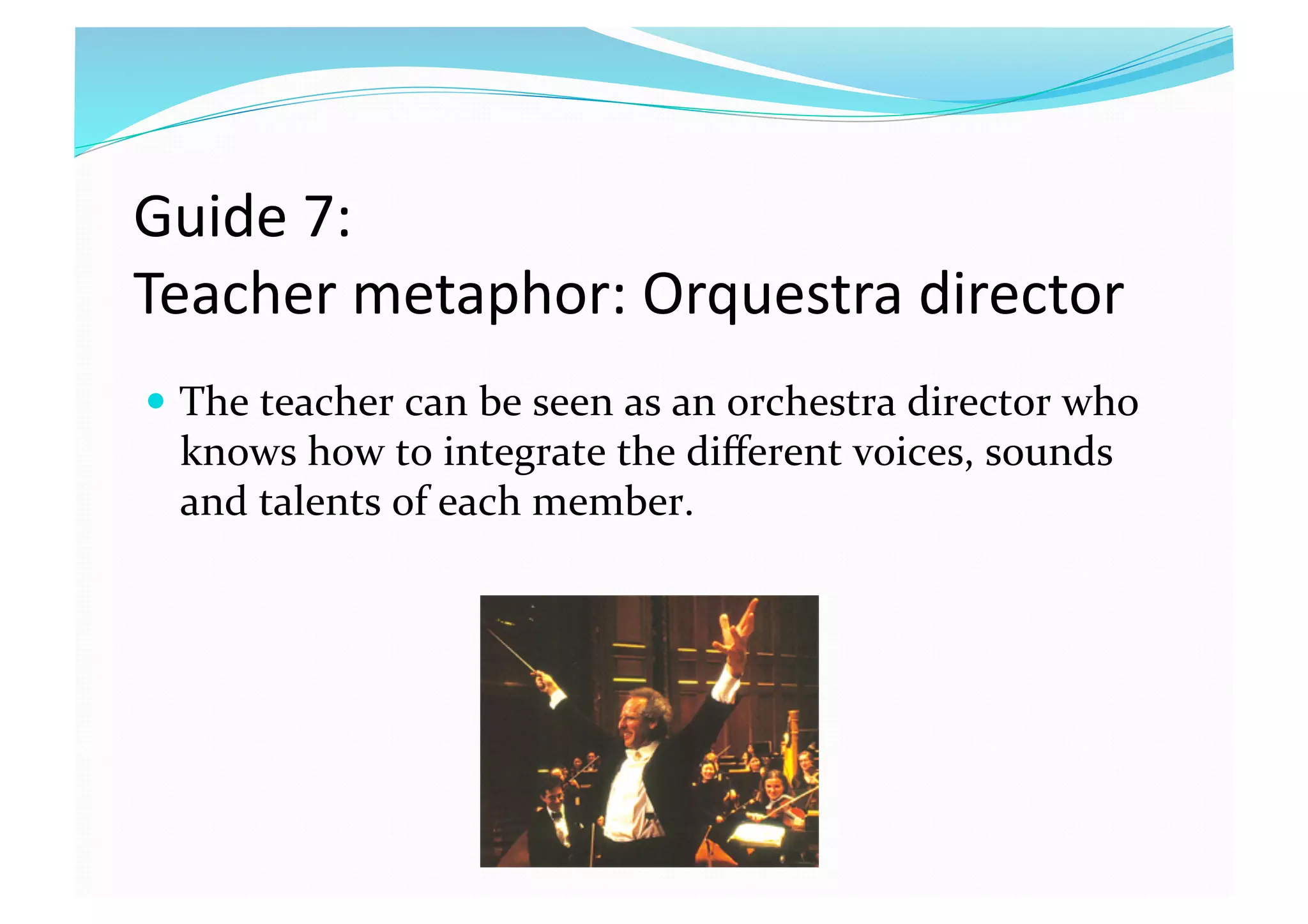
  The
teacher
can
be
seen
as
an
orchestra
director
who

knows
how
to
integrate
the
different
voices,
sounds

and
talents
of
each
member.


Guide
8:


Ac8ve
proceses

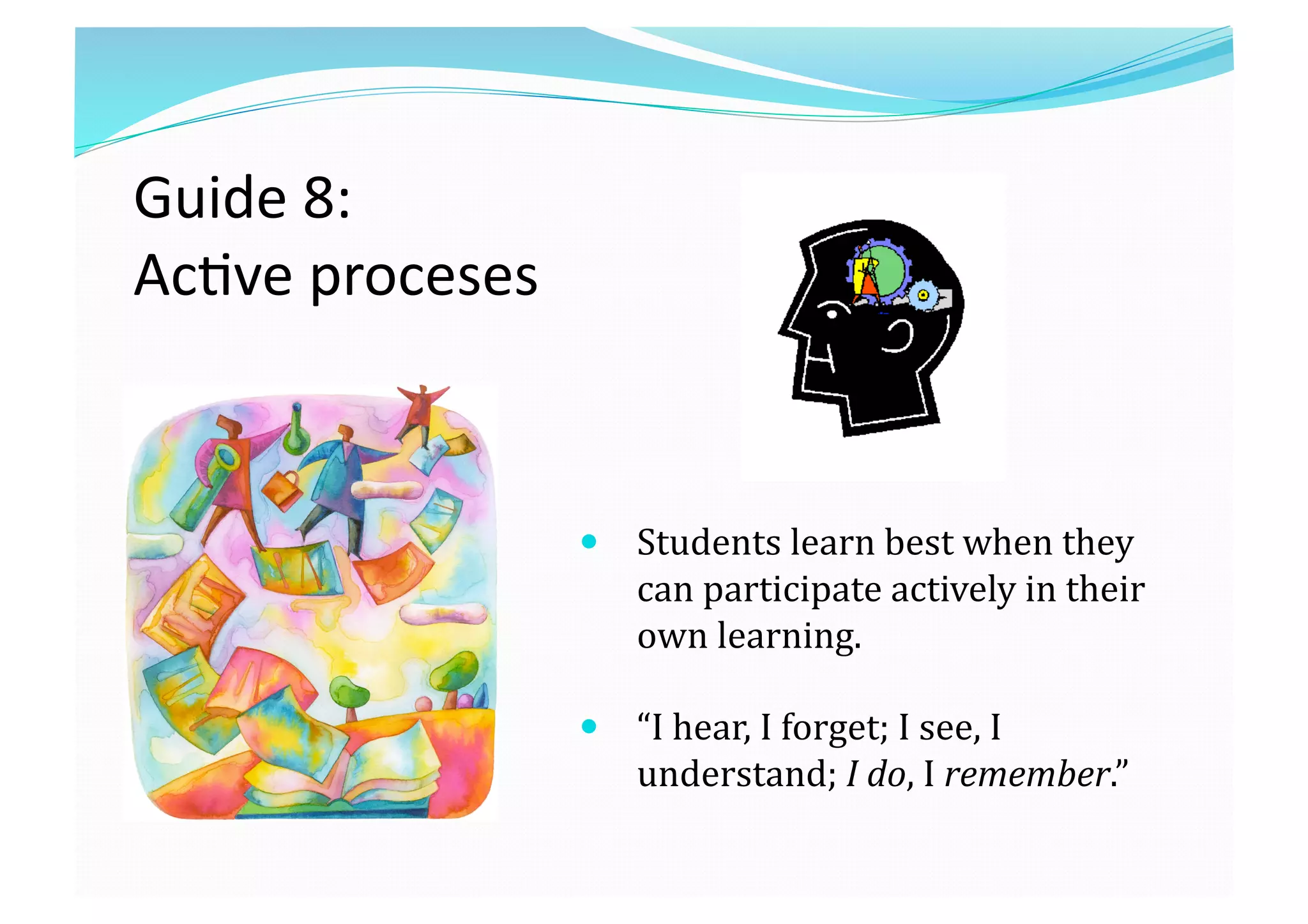
  Students
learn
best
when
they

can
participate
actively
in
their

own
learning.


  “I
hear,
I
forget;
I
see,
I

understand;
I
do,
I
remember.”

Guide
9:


Meta‐cogni8on
y


Self‐reflec8on

  To
remember
best,
it
is
necessary
to
reflect
upon
our

experiences.


  Given
the
vast
amount
of
information
that
students
are

bombarded
with
daily,
it
is
important
to
give
them
“down

time”
to
process.


Guide
10:


Learning
across
the
lifespan

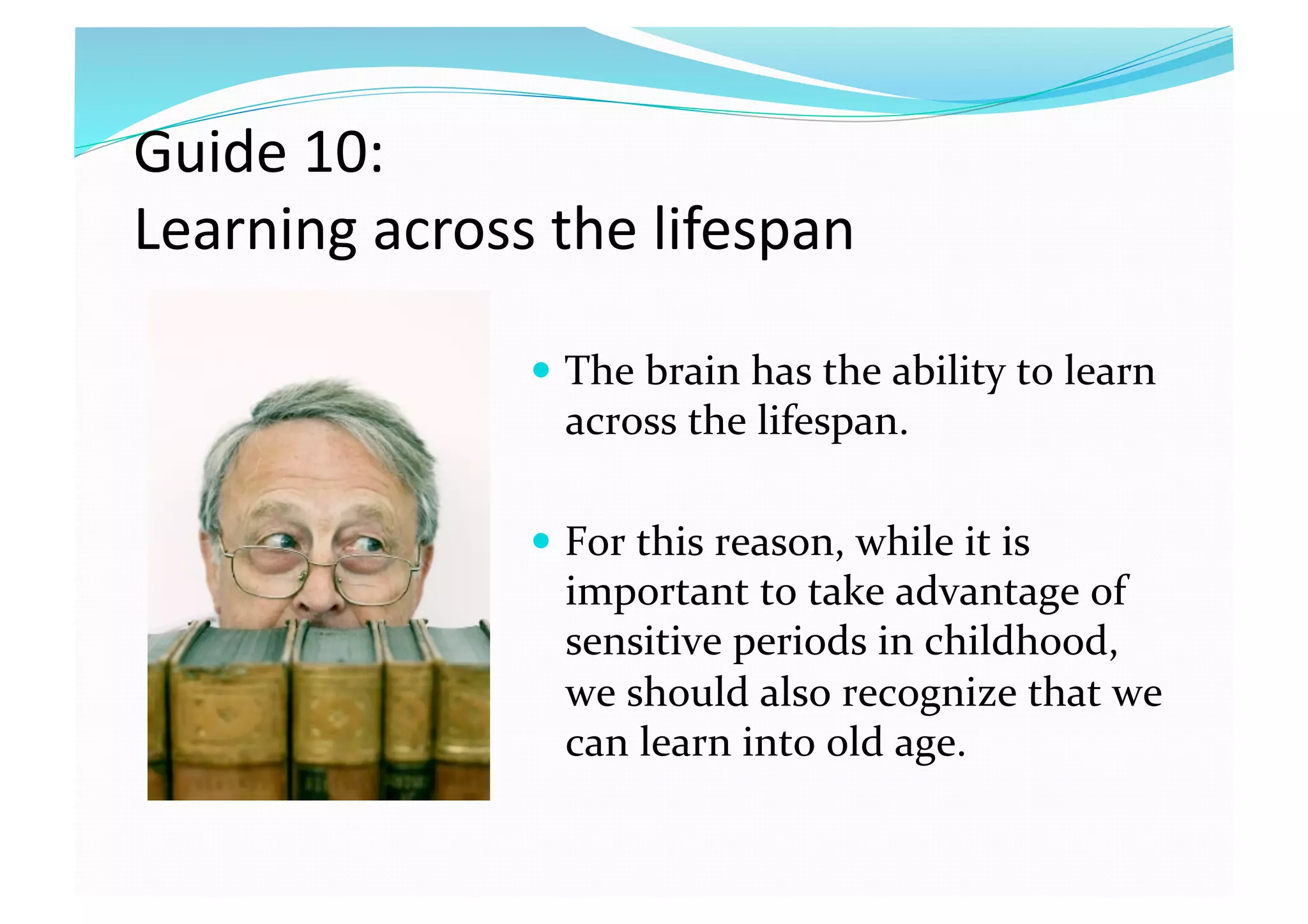
  The
brain
has
the
ability
to
learn

across
the
lifespan.

  For
this
reason,
while
it
is

important
to
take
advantage
of

sensitive
periods
in
childhood,

we
should
also
recognize
that
we

can
learn
into
old
age.


Ques8ons?

For
more
informa8on:

Tracey Tokuhama-Espinosa, Ph.D.
Universidad San Francisco de Quito
Casa Corona
Telf: 297-1700 x1338
desarrolloprofesional@usfq.edu.ec
Bibliography

  For a list of more than 2000 book related to this study see:
http://www.proquest.com/en-US/products/dissertations/
pqdt.shtml y el nombre “Tokuhama-Espinosa” (gratis).
  You can find this presentation on:
www.educacionparatodos.com

how the brain processes information memory retention and learning tracey-tokuhama-espinosa