ylioppilastutkinto.fi digabi.fi
THE FINNISH
MATRICULATION
EXAMINATION
History
● The Matriculation Examination was first arranged in
Finland in 1852:
● Entrance exam to university: skills in Latin and Christian doctrine
● Number of students:
● 1850s: about 70
● 1920: 1000
● 1950: 4000
● 2000s: 35 000 (about half of the age group)
● The purpose is to discover:
● whether the students have assimilated the skills required in the
curriculum for the upper secondary school and
● whether they have reached the adequate level of maturity.
10.3.2015
Virpi Britschgi
2
The Matriculation Examination today
● The Matriculation Examination is arranged biannually
(spring/autumn), in all Finnish upper secondary schools at the
same time.
● A candidate must complete the examination during not more
than three consecutive examination periods.
● All the tests are assessed first by the upper secondary school
teachers and then by censors, who are members or associate
members of the Matriculation Examination Board.
10.3.2015
Virpi Britschgi
3
The role of the Matriculation Examination in the
Finnish education system
● The examination is arranged in upper
secondary schools as a final examination.
● Passing the Matriculation Examination
entitles the candidate to continue his or
her studies at university.
● Admission to Finnish universities is also
possible without passing the
Matriculation Examination.These
candidates are eligible to apply in a
separate quota.
● Every year, about 35 000 candidates take
the exam:
● altogether 200 000 tests
● 6% of the candidates fail the exam
● The exams are arranged in Finnish and
Swedish
10.3.2015
Virpi Britschgi
4
The compulsory and optional tests
● The examination consists of at least four compulsory tests:
● candidate’s mother tongue (Finnish, Swedish, Sami):
compulsory for all candidates
● three other compulsory tests from the following group:
- second national language (advanced/intermediate level),
- a foreign language (advanced/basic level),
- mathematics (advanced/basic level),
- one test in the general studies battery of tests (sciences and humanities)
- The general studies test can have questions that cross the boundaries of differents
subjects
● Additional (optional) test(s) may be included in the examination
10.3.2015
Virpi Britschgi
5
National Matriculation Examination board
● Selected for three years (The Ministry of Culture and
Education)
● Issues guidelines and instructions for the examination
● The Board has an office working with all the
arrangements
● In charge of all arrangements
for the tests
● Develops the examination
10.3.2015
Virpi Britschgi
6
Digabi
- the digitalization project of the matriculation
examination
● From paper format to electronic exam
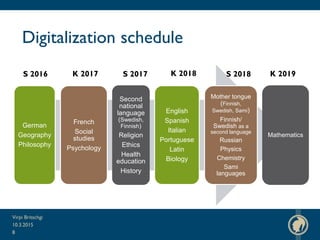
● first tests autumn 2016, all tests 2019
● Digitalization of the whole process
10.3.2015
Virpi Britschgi
7
Digitalization schedule
10.3.2015
Virpi Britschgi
German
Geography
Philosophy
French
Social
studies
Psychology
Second
national
language
(Swedish,
Finnish)
Religion
Ethics
Health
education
History
English
Spanish
Italian
Portuguese
Latin
Biology
Mother tongue
(Finnish,
Swedish, Sami)
Finnish/
Swedish as a
second language
Russian
Physics
Chemistry
Sami
languages
Mathematics
S 2016 K 2017 S 2017 K 2018 S 2018 K 2019
8
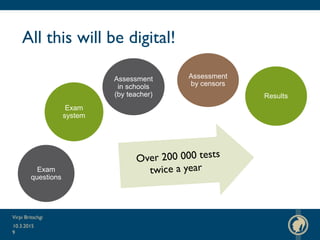
All this will be digital!
Virpi Britschgi
Exam
questions
Exam
system
Assessment
in schools
(by teacher)
Assessment
by censors
Results
10.3.2015
9
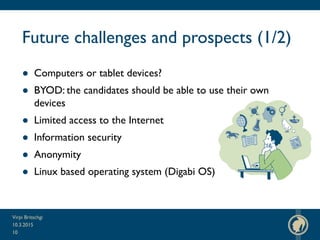
Future challenges and prospects (1/2)
● Computers or tablet devices?
● BYOD: the candidates should be able to use their own
devices
● Limited access to the Internet
● Information security
● Anonymity
● Linux based operating system (Digabi OS)
10.3.2015
Virpi Britschgi
10
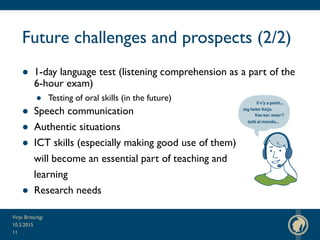
Future challenges and prospects (2/2)
● 1-day language test (listening comprehension as a part of the
6-hour exam)
● Testing of oral skills (in the future)
● Speech communication
● Authentic situations
● ICT skills (especially making good use of them)
will become an essential part of teaching and
learning
● Research needs
10.3.2015
Virpi Britschgi
11
Abitti
- the electronic exam system
● www.abitti.fi (in Finnish and Swedish)
● Launched 30.1.2015
● Developed by the Matriculation Examination Board for
Finnish upper secondary schools
● free registration: teachers, students, administration,
researchers…
10.3.2015
Virpi Britschgi
12
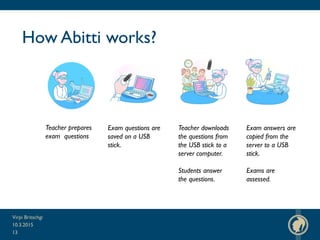
How Abitti works?
10.3.2015
Virpi Britschgi
13
Teacher prepares
exam questions
Exam questions are
saved on a USB
stick.
Teacher downloads
the questions from
the USB stick to a
server computer.
Students answer
the questions.
Exam answers are
copied from the
server to a USB
stick.
Exams are
assessed.
Other ongoing changes
● The core curriculum of the upper secondary schools is being
reformed and will be implemented in the schools in 2016.
● A Common European Framework of Reference for languages
● Structural changes in the exams
● mathematics, mother tongue
● A new method for defining the grades: based on the average
of standardized scores (calculated for each candidate)
10.3.2015
Virpi Britschgi
14
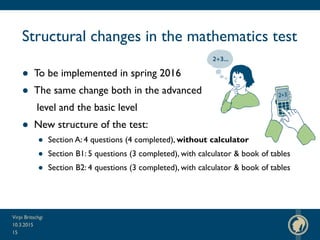
Structural changes in the mathematics test
● To be implemented in spring 2016
● The same change both in the advanced
level and the basic level
● New structure of the test:
● Section A: 4 questions (4 completed), without calculator
● Section B1: 5 questions (3 completed), with calculator & book of tables
● Section B2: 4 questions (3 completed), with calculator & book of tables
10.3.2015
Virpi Britschgi
15
A new method for defining the grades
● The Finnish matriculation exam was restructured in two big
reforms in 2005 and 2006:
• Exam in mother tongue – the only compulsory test for all
candidates
• Separate tests for all general studies (science and
humanities) instead of a combined test
-> the candidate populations for each test are different
10.3.2015
Virpi Britschgi
16
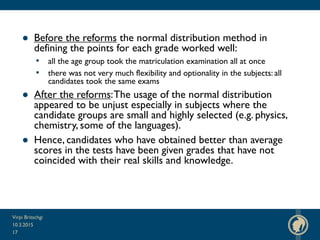
● Before the reforms the normal distribution method in
defining the points for each grade worked well:
• all the age group took the matriculation examination all at once
• there was not very much flexibility and optionality in the subjects: all
candidates took the same exams
● After the reforms:The usage of the normal distribution
appeared to be unjust especially in subjects where the
candidate groups are small and highly selected (e.g. physics,
chemistry, some of the languages).
● Hence, candidates who have obtained better than average
scores in the tests have been given grades that have not
coincided with their real skills and knowledge.
10.3.2015
Virpi Britschgi
17
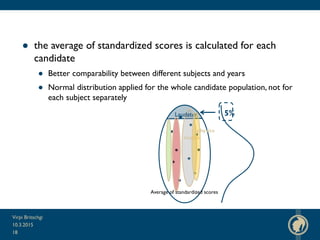
● the average of standardized scores is calculated for each
candidate
● Better comparability between different subjects and years
● Normal distribution applied for the whole candidate population, not for
each subject separately
10.3.2015
Virpi Britschgi
18
maths
Laudatur 5%
Average of standardized scores
physics
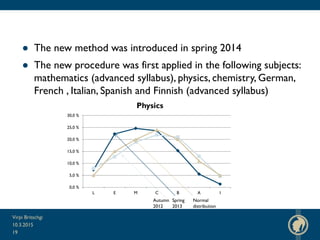
● The new method was introduced in spring 2014
● The new procedure was first applied in the following subjects:
mathematics (advanced syllabus), physics, chemistry, German,
French , Italian, Spanish and Finnish (advanced syllabus)
10.3.2015
Virpi Britschgi
19
0,0 %
5,0 %
10,0 %
15,0 %
20,0 %
25,0 %
30,0 %
L E M C B A I
Physics
Autumn
2012
Spring
2013
Normal
distribution

Reválida en Finlandia

  • 1.
  • 2.
    History ● The MatriculationExamination was first arranged in Finland in 1852: ● Entrance exam to university: skills in Latin and Christian doctrine ● Number of students: ● 1850s: about 70 ● 1920: 1000 ● 1950: 4000 ● 2000s: 35 000 (about half of the age group) ● The purpose is to discover: ● whether the students have assimilated the skills required in the curriculum for the upper secondary school and ● whether they have reached the adequate level of maturity. 10.3.2015 Virpi Britschgi 2
  • 3.
    The Matriculation Examinationtoday ● The Matriculation Examination is arranged biannually (spring/autumn), in all Finnish upper secondary schools at the same time. ● A candidate must complete the examination during not more than three consecutive examination periods. ● All the tests are assessed first by the upper secondary school teachers and then by censors, who are members or associate members of the Matriculation Examination Board. 10.3.2015 Virpi Britschgi 3
  • 4.
    The role ofthe Matriculation Examination in the Finnish education system ● The examination is arranged in upper secondary schools as a final examination. ● Passing the Matriculation Examination entitles the candidate to continue his or her studies at university. ● Admission to Finnish universities is also possible without passing the Matriculation Examination.These candidates are eligible to apply in a separate quota. ● Every year, about 35 000 candidates take the exam: ● altogether 200 000 tests ● 6% of the candidates fail the exam ● The exams are arranged in Finnish and Swedish 10.3.2015 Virpi Britschgi 4
  • 5.
    The compulsory andoptional tests ● The examination consists of at least four compulsory tests: ● candidate’s mother tongue (Finnish, Swedish, Sami): compulsory for all candidates ● three other compulsory tests from the following group: - second national language (advanced/intermediate level), - a foreign language (advanced/basic level), - mathematics (advanced/basic level), - one test in the general studies battery of tests (sciences and humanities) - The general studies test can have questions that cross the boundaries of differents subjects ● Additional (optional) test(s) may be included in the examination 10.3.2015 Virpi Britschgi 5
  • 6.
    National Matriculation Examinationboard ● Selected for three years (The Ministry of Culture and Education) ● Issues guidelines and instructions for the examination ● The Board has an office working with all the arrangements ● In charge of all arrangements for the tests ● Develops the examination 10.3.2015 Virpi Britschgi 6
  • 7.
    Digabi - the digitalizationproject of the matriculation examination ● From paper format to electronic exam ● first tests autumn 2016, all tests 2019 ● Digitalization of the whole process 10.3.2015 Virpi Britschgi 7
  • 8.
  • 9.
    All this willbe digital! Virpi Britschgi Exam questions Exam system Assessment in schools (by teacher) Assessment by censors Results 10.3.2015 9
  • 10.
    Future challenges andprospects (1/2) ● Computers or tablet devices? ● BYOD: the candidates should be able to use their own devices ● Limited access to the Internet ● Information security ● Anonymity ● Linux based operating system (Digabi OS) 10.3.2015 Virpi Britschgi 10
  • 11.
    Future challenges andprospects (2/2) ● 1-day language test (listening comprehension as a part of the 6-hour exam) ● Testing of oral skills (in the future) ● Speech communication ● Authentic situations ● ICT skills (especially making good use of them) will become an essential part of teaching and learning ● Research needs 10.3.2015 Virpi Britschgi 11
  • 12.
    Abitti - the electronicexam system ● www.abitti.fi (in Finnish and Swedish) ● Launched 30.1.2015 ● Developed by the Matriculation Examination Board for Finnish upper secondary schools ● free registration: teachers, students, administration, researchers… 10.3.2015 Virpi Britschgi 12
  • 13.
    How Abitti works? 10.3.2015 VirpiBritschgi 13 Teacher prepares exam questions Exam questions are saved on a USB stick. Teacher downloads the questions from the USB stick to a server computer. Students answer the questions. Exam answers are copied from the server to a USB stick. Exams are assessed.
  • 14.
    Other ongoing changes ●The core curriculum of the upper secondary schools is being reformed and will be implemented in the schools in 2016. ● A Common European Framework of Reference for languages ● Structural changes in the exams ● mathematics, mother tongue ● A new method for defining the grades: based on the average of standardized scores (calculated for each candidate) 10.3.2015 Virpi Britschgi 14
  • 15.
    Structural changes inthe mathematics test ● To be implemented in spring 2016 ● The same change both in the advanced level and the basic level ● New structure of the test: ● Section A: 4 questions (4 completed), without calculator ● Section B1: 5 questions (3 completed), with calculator & book of tables ● Section B2: 4 questions (3 completed), with calculator & book of tables 10.3.2015 Virpi Britschgi 15
  • 16.
    A new methodfor defining the grades ● The Finnish matriculation exam was restructured in two big reforms in 2005 and 2006: • Exam in mother tongue – the only compulsory test for all candidates • Separate tests for all general studies (science and humanities) instead of a combined test -> the candidate populations for each test are different 10.3.2015 Virpi Britschgi 16
  • 17.
    ● Before thereforms the normal distribution method in defining the points for each grade worked well: • all the age group took the matriculation examination all at once • there was not very much flexibility and optionality in the subjects: all candidates took the same exams ● After the reforms:The usage of the normal distribution appeared to be unjust especially in subjects where the candidate groups are small and highly selected (e.g. physics, chemistry, some of the languages). ● Hence, candidates who have obtained better than average scores in the tests have been given grades that have not coincided with their real skills and knowledge. 10.3.2015 Virpi Britschgi 17
  • 18.
    ● the averageof standardized scores is calculated for each candidate ● Better comparability between different subjects and years ● Normal distribution applied for the whole candidate population, not for each subject separately 10.3.2015 Virpi Britschgi 18 maths Laudatur 5% Average of standardized scores physics
  • 19.
    ● The newmethod was introduced in spring 2014 ● The new procedure was first applied in the following subjects: mathematics (advanced syllabus), physics, chemistry, German, French , Italian, Spanish and Finnish (advanced syllabus) 10.3.2015 Virpi Britschgi 19 0,0 % 5,0 % 10,0 % 15,0 % 20,0 % 25,0 % 30,0 % L E M C B A I Physics Autumn 2012 Spring 2013 Normal distribution