Unit 1- Stress and Strain
Topics Covered
  Lecture -1 - Introduction, state of plane stress

  Lecture -2 - Principle Stresses and Strains

  Lecture -3 - Mohr's Stress Circle and Theory of
   Failure

  Lecture -4- 3-D stress and strain, Equilibrium
   equations and impact loading

  Lecture -5 - Generalized Hook's law and Castigliono's
3-D Stress and Strain
          stress vector σ that represents the force per
          unit area acting at a given location on the
          body's surface.
          In other words, a stress vector cannot be fully
            €
          described unless both the force and the
          surface where the force acts on has been
          specified.
                              ΔF dF
                   σ = lim       =
                        Δs−>0 Δs   ds


         €
3-D Stress and Strain

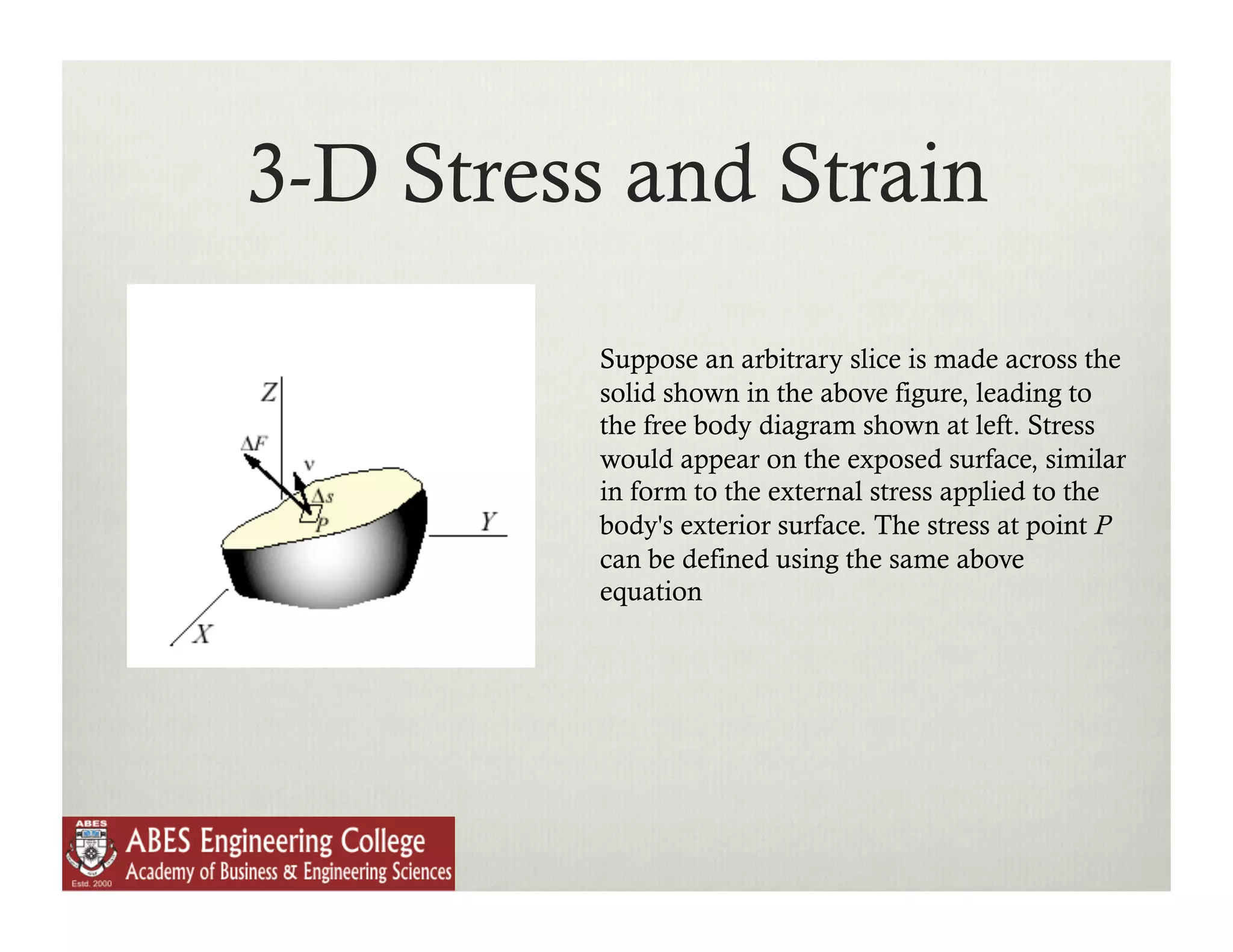
          Suppose an arbitrary slice is made across the
          solid shown in the above figure, leading to
          the free body diagram shown at left. Stress
          would appear on the exposed surface, similar
          in form to the external stress applied to the
          body's exterior surface. The stress at point P
          can be defined using the same above
          equation
3-D Stress and Strain
          Stresses acting on an plane, are typically
          decomposed into three mutually orthogonal
          components. One component is normal to
          the surface and represents direct stress. The
          other two components are tangential to the
          surface and represent shear stresses.


          Normal component = σxx ,σyy ,σzz


          Tangential component = xy ,σyx ,σxz ,σzx ,σyz ,σzy
                                σ
                       €


                      €
3-D Stress and Strain
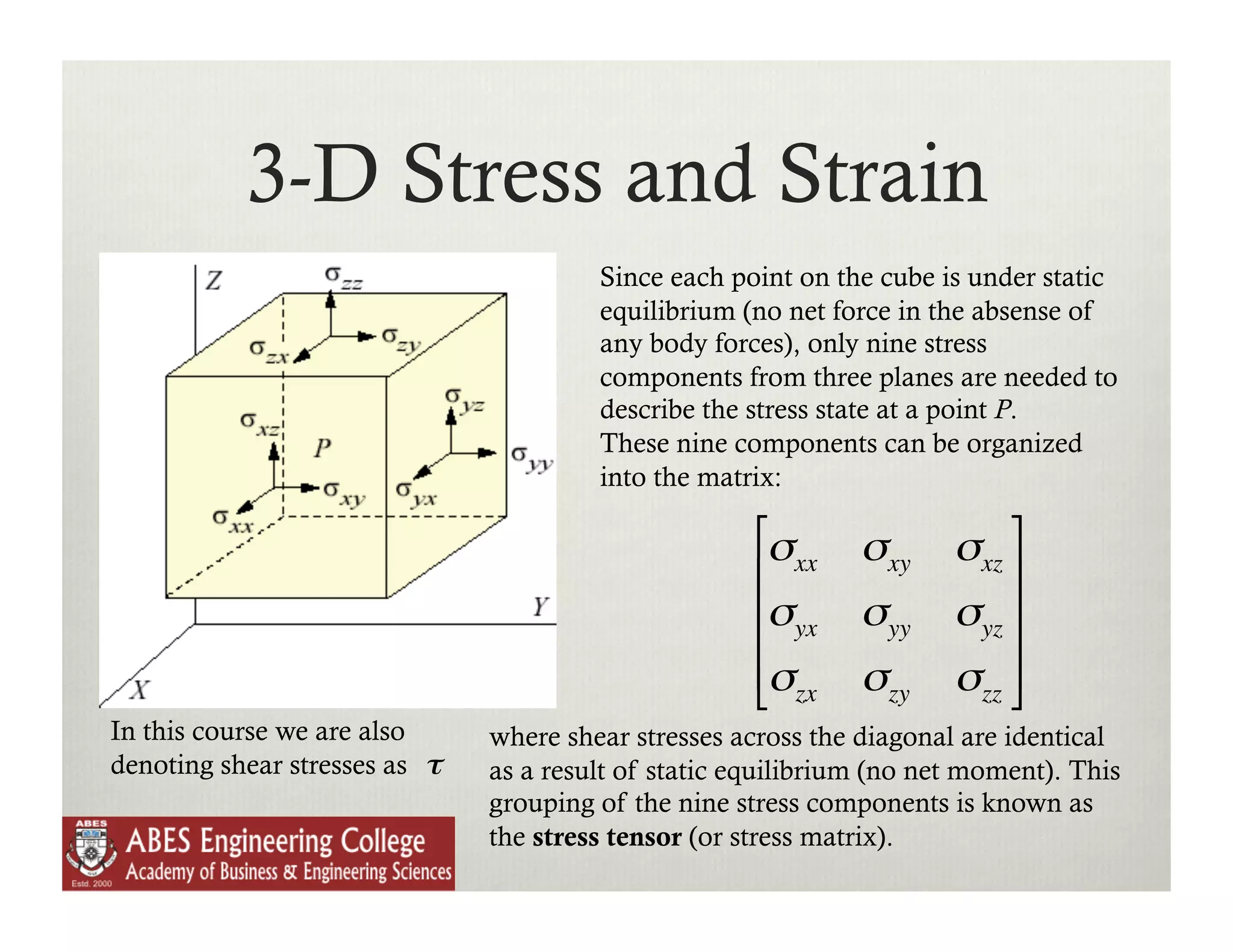
                                        Since each point on the cube is under static
                                        equilibrium (no net force in the absense of
                                        any body forces), only nine stress
                                        components from three planes are needed to
                                        describe the stress state at a point P.
                                        These nine components can be organized
                                        into the matrix:

                                                     ⎡σ       σxy σxz ⎤
                                                         xx
                                                     ⎢                ⎥
                                                     ⎢σyx     σyy σyz ⎥
                                                     ⎢σ
                                                     ⎣ zx     σzy σzz ⎥
                                                                       ⎦
In this course we are also     where shear stresses across the diagonal are identical
denoting shear stresses as τ   as a result of static equilibrium (no net moment). This
                               grouping of the nine stress components is known as
                               the stress tensor (or stress matrix).

             €                        €
3-D Stress and Strain
           Shear stresses across the diagonal are
           identical as a result of static equilibrium (no
           net moment). The six shear stresses reduces
           to 3 shear stresses.
           This grouping of the six stress components is
           known as the stress tensor (or stress matrix).

        The off diagonal elements are equal i.e   σxy = σyx
                        ⎡σ       σxy σxz ⎤
                            xx
                        ⎢                ⎥
                        ⎢σxy     σyy σyz ⎥
                                    €
                        ⎢σ
                        ⎣ xz     σyz σzz ⎥
                                          ⎦


         €
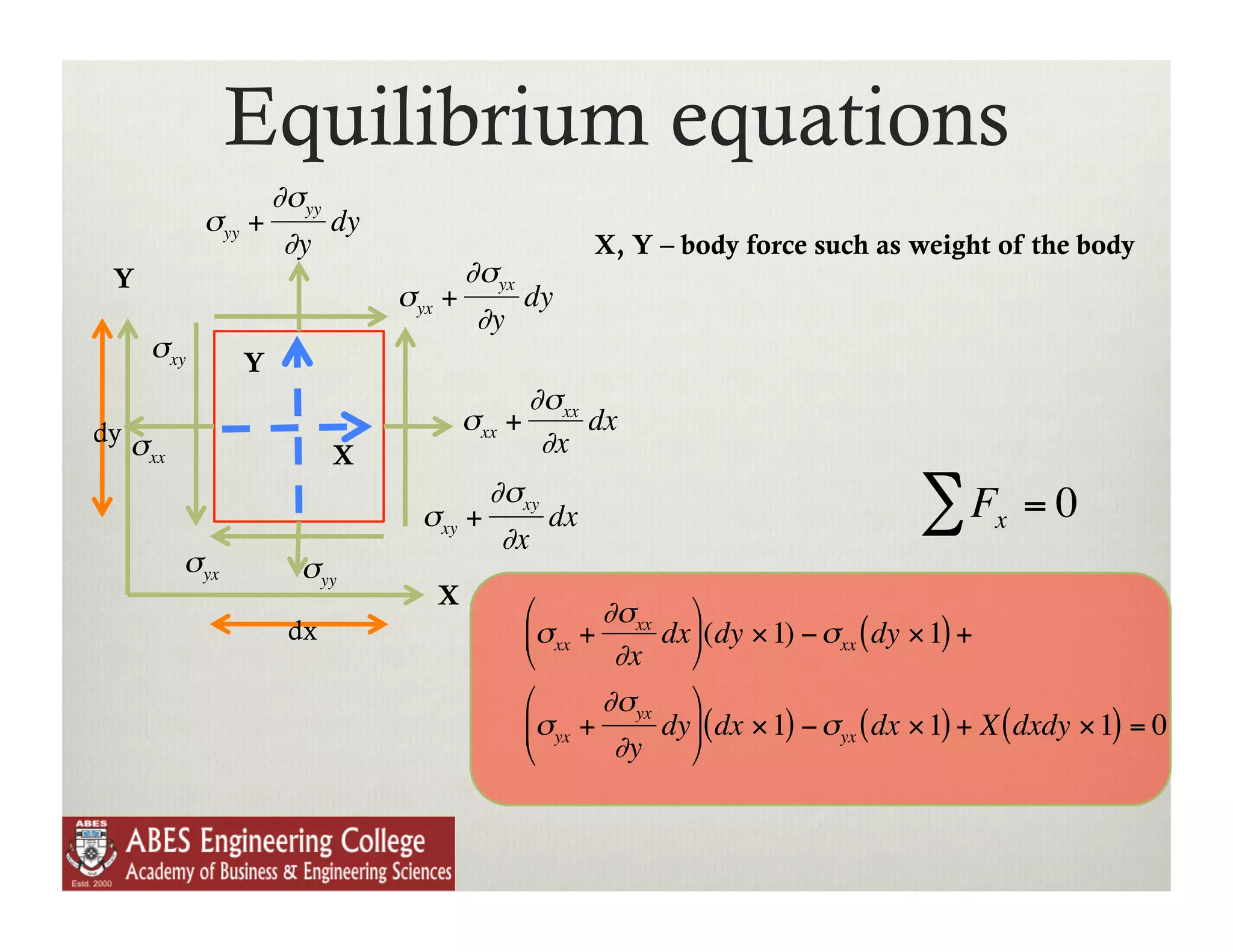
Equilibrium equations
                            ∂σyy
                      σyy +      dy
                             ∂y                              X, Y – body force such as weight of the body
         Y                                     ∂σyx
                                         σyx +      dy
                                                ∂y
             σxy         Y
    €
                                                        ∂σxx
        dy σ                                      σxx +      dx
             xx              €       X                   ∂x
€
                                             σxy +
                                                   ∂σxy
                                                    ∂x
                                                        dx                                   ∑F     x   =0
                  σyx            σyy€
€                                             X
                                                       ⎛      ∂σxx ⎞
                             dx                        ⎜σxx +     dx ⎟(dy × 1) − σxx ( dy × 1) +
                                 €                     ⎝       ∂x    ⎠
    €             €                                    ⎛      ∂σyx ⎞ €
                                                       ⎜σyx +     dy ⎟( dx × 1) − σyx ( dx × 1) + X ( dxdy × 1) = 0
                                                       ⎝       ∂y    ⎠


                                         €
Equilibrium equations
                            ∂σyy
                      σyy +      dy
                             ∂y
                                               ∂σyx             For 2 dimension
          y                              σyx +      dy
                                                ∂y
              σxy
    €
                         Y
                                                                   ∂σ xx ∂σ xy
        dy σ                                    σxx +
                                                      ∂σxx
                                                           dx           +      +X =0
             xx              €       X                 ∂x           ∂x    ∂y
€                                                ∂σxy
                                           σxy +
                                                  ∂x
                                                      dx           ∂σ yx ∂σ yy
                  σyx            σyy€                                   +      +Y = 0
€                                           x                       ∂x    ∂y
                             dx
                                 €
    €             €
                                                X, Y – body force such as weight of the body
                                                  €
Equilibrium equations
     For 3 dimension

   ∂σ xx ∂σ xy ∂σ xz
        +     +      +X =0
    ∂x    ∂y    ∂z
   ∂σ yx ∂σ yy ∂σ yz
        +     +      +Y = 0
    ∂x    ∂y    ∂z
   ∂σ zx ∂σ zy ∂σ zz
        +     +      +Z =0
    ∂x    ∂y    ∂z
Impact Load
  Definitions
     Resilience – Total strain energy stored in the system.
     Proof resilience – Maximum strain energy stored in a
      body is known as proof resilience. Strain energy in the
      body will be maximum when the body is stressed upto
      elastic limit
     Modulus of resilience- Proof resilience of a material
      per unit volume.
                                  Pr oof _ resilience
      Modulus of resilience =
                                Volume _ of _ the _ body


                   €
Impact Load
  Strain energy when load is applied gradually.

                                                              M
                             2
  Energy stored in a body=
                             σV
                                   Load
                             2E           P

                          σ 2 AL                              N
                        =
                           2E                 O   Extension
             €                                      x


         €
Impact Load
              Strain energy when load is applied suddenly.

                                                                             M
                                            2
                Energy stored in a body=
                                           σ AL
                                                  Load
                                            2E           P

                σ 2 AL           σ
                       =P×x=P× ×L                                            N
                 2E              E                           O   Extension
                       €       P                                   x
                         σ =2×
                               A
    derivation in book - R.K Bansal
€
Impact Load
  PROBLEM- A steel rod is 2m long and 50mm in
   diameter. An axial pull of 100 kN is suddenly
   applied to the rod. Calculate the instantaneous stress
   induced and also the instantaneous elongation
   produced in the rod. Take E=200GN/mm2
Impact Load
      Strain energy when load is applied with impact.
       Energy of impact = Potential energy of the falling load
                              σ 2 AL
       Energy of impact =
                               2E
      Potential energy of the falling load = P   ( h + δL )

              €
              P ⎛    €2AEh ⎞
           σ = ⎜1+ 1+      ⎟
              A ⎝      PL ⎠


€
Impact Load
                             PROBLEM- A vertical compound tie
                                 member fixed rigidly at its upper end
            20 mm                consists of a steel rod 2.5 m long and
2.5 m                   P=10kN   30mm external diameter. The rod and
        1           2
                                 the tube are fixed together at the ends.
                         3 mm    The compound member is then
                                 suddenly loaded in tension by a weight
            21 mm                of 10 kN falling through a height of 3
                                 mm on to a flange fixed to its lower
            30 mm
                                 end. Calculate the maximum stresses
                                 in steel and brass. Assume Es=2x10⁵
                                 N/mm2 and Eb=1.0x10⁵ N/mm2
Impact Load
  Strain energy in shear loading.

                          τ 2 AL
   Strain energy stored =
                           2C                                     P
                                             D       D1       C       C1


            €

                                         h

                                                 φ                φ
                                             A            l   B


                                     €                €
Impact Load
  PROBLEM- The shear stress in a material at a price
   is given as 50N/mm2. Determine the local strain
   energy per unit volume stored in the material due to
   shear stress. Take C=8x10⁴ N/mm2

Lecture 4 3 d stress tensor and equilibrium equations

  • 2.
    Unit 1- Stressand Strain Topics Covered   Lecture -1 - Introduction, state of plane stress   Lecture -2 - Principle Stresses and Strains   Lecture -3 - Mohr's Stress Circle and Theory of Failure   Lecture -4- 3-D stress and strain, Equilibrium equations and impact loading   Lecture -5 - Generalized Hook's law and Castigliono's
  • 3.
    3-D Stress andStrain stress vector σ that represents the force per unit area acting at a given location on the body's surface. In other words, a stress vector cannot be fully € described unless both the force and the surface where the force acts on has been specified. ΔF dF σ = lim = Δs−>0 Δs ds €
  • 4.
    3-D Stress andStrain Suppose an arbitrary slice is made across the solid shown in the above figure, leading to the free body diagram shown at left. Stress would appear on the exposed surface, similar in form to the external stress applied to the body's exterior surface. The stress at point P can be defined using the same above equation
  • 5.
    3-D Stress andStrain Stresses acting on an plane, are typically decomposed into three mutually orthogonal components. One component is normal to the surface and represents direct stress. The other two components are tangential to the surface and represent shear stresses. Normal component = σxx ,σyy ,σzz Tangential component = xy ,σyx ,σxz ,σzx ,σyz ,σzy σ € €
  • 6.
    3-D Stress andStrain Since each point on the cube is under static equilibrium (no net force in the absense of any body forces), only nine stress components from three planes are needed to describe the stress state at a point P. These nine components can be organized into the matrix: ⎡σ σxy σxz ⎤ xx ⎢ ⎥ ⎢σyx σyy σyz ⎥ ⎢σ ⎣ zx σzy σzz ⎥ ⎦ In this course we are also where shear stresses across the diagonal are identical denoting shear stresses as τ as a result of static equilibrium (no net moment). This grouping of the nine stress components is known as the stress tensor (or stress matrix). € €
  • 7.
    3-D Stress andStrain Shear stresses across the diagonal are identical as a result of static equilibrium (no net moment). The six shear stresses reduces to 3 shear stresses. This grouping of the six stress components is known as the stress tensor (or stress matrix). The off diagonal elements are equal i.e σxy = σyx ⎡σ σxy σxz ⎤ xx ⎢ ⎥ ⎢σxy σyy σyz ⎥ € ⎢σ ⎣ xz σyz σzz ⎥ ⎦ €
  • 8.
    Equilibrium equations ∂σyy σyy + dy ∂y X, Y – body force such as weight of the body Y ∂σyx σyx + dy ∂y σxy Y € ∂σxx dy σ σxx + dx xx € X ∂x € σxy + ∂σxy ∂x dx ∑F x =0 σyx σyy€ € X ⎛ ∂σxx ⎞ dx ⎜σxx + dx ⎟(dy × 1) − σxx ( dy × 1) + € ⎝ ∂x ⎠ € € ⎛ ∂σyx ⎞ € ⎜σyx + dy ⎟( dx × 1) − σyx ( dx × 1) + X ( dxdy × 1) = 0 ⎝ ∂y ⎠ €
  • 9.
    Equilibrium equations ∂σyy σyy + dy ∂y ∂σyx For 2 dimension y σyx + dy ∂y σxy € Y ∂σ xx ∂σ xy dy σ σxx + ∂σxx dx + +X =0 xx € X ∂x ∂x ∂y € ∂σxy σxy + ∂x dx ∂σ yx ∂σ yy σyx σyy€ + +Y = 0 € x ∂x ∂y dx € € € X, Y – body force such as weight of the body €
  • 10.
    Equilibrium equations For 3 dimension ∂σ xx ∂σ xy ∂σ xz + + +X =0 ∂x ∂y ∂z ∂σ yx ∂σ yy ∂σ yz + + +Y = 0 ∂x ∂y ∂z ∂σ zx ∂σ zy ∂σ zz + + +Z =0 ∂x ∂y ∂z
  • 11.
    Impact Load   Definitions   Resilience – Total strain energy stored in the system.   Proof resilience – Maximum strain energy stored in a body is known as proof resilience. Strain energy in the body will be maximum when the body is stressed upto elastic limit   Modulus of resilience- Proof resilience of a material per unit volume. Pr oof _ resilience Modulus of resilience = Volume _ of _ the _ body €
  • 12.
    Impact Load   Strainenergy when load is applied gradually. M 2 Energy stored in a body= σV Load 2E P σ 2 AL N = 2E O Extension € x €
  • 13.
    Impact Load   Strain energy when load is applied suddenly. M 2 Energy stored in a body= σ AL Load 2E P σ 2 AL σ =P×x=P× ×L N 2E E O Extension € P x σ =2× A derivation in book - R.K Bansal €
  • 14.
    Impact Load   PROBLEM-A steel rod is 2m long and 50mm in diameter. An axial pull of 100 kN is suddenly applied to the rod. Calculate the instantaneous stress induced and also the instantaneous elongation produced in the rod. Take E=200GN/mm2
  • 15.
    Impact Load   Strain energy when load is applied with impact. Energy of impact = Potential energy of the falling load σ 2 AL Energy of impact = 2E Potential energy of the falling load = P ( h + δL ) € P ⎛ €2AEh ⎞ σ = ⎜1+ 1+ ⎟ A ⎝ PL ⎠ €
  • 16.
    Impact Load   PROBLEM- A vertical compound tie member fixed rigidly at its upper end 20 mm consists of a steel rod 2.5 m long and 2.5 m P=10kN 30mm external diameter. The rod and 1 2 the tube are fixed together at the ends. 3 mm The compound member is then suddenly loaded in tension by a weight 21 mm of 10 kN falling through a height of 3 mm on to a flange fixed to its lower 30 mm end. Calculate the maximum stresses in steel and brass. Assume Es=2x10⁵ N/mm2 and Eb=1.0x10⁵ N/mm2
  • 17.
    Impact Load   Strainenergy in shear loading. τ 2 AL Strain energy stored = 2C P D D1 C C1 € h φ φ A l B € €
  • 18.
    Impact Load   PROBLEM-The shear stress in a material at a price is given as 50N/mm2. Determine the local strain energy per unit volume stored in the material due to shear stress. Take C=8x10⁴ N/mm2