

WELCOME
Dean (@deanmalmgren)
Mike (@mstringer)
Laurie (@laurieskelly)
WHY DESIGN?
INTERVIEW
EXPLORE
SYNTHESIZE
SKETCH
OBSERVE
PROTOTYPE
FORM GROUPS
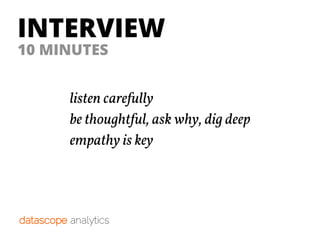
INTERVIEW
INTERVIEW
listen carefully
be thoughtful, ask why, dig deep
empathy is key
10 MINUTES
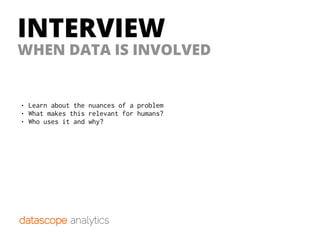
INTERVIEW
WHEN DATA IS INVOLVED
• Learn about the nuances of a problem
• What makes this relevant for humans?
• Who uses it and why?
EXPLORE
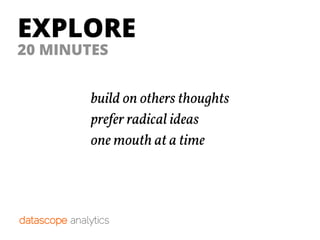
EXPLORE
build on others thoughts
prefer radical ideas
one mouth at a time
20 MINUTES
EXPLORE
WHEN DATA IS INVOLVED
• Have the attitude that “anything is possible (eventually)”
• Don’t focus too much on the details of the data or analysis
• Speak the language of the problem, not the solution
SYNTHESIZE
SYNTHESIZE
clump post-its in groups
stars will force a decision
mistakes are OK
15 MINUTES
SYNTHESIZE
WHEN DATA IS INVOLVED
• Tweak or discard clearly infeasible ideas
• But still focus on usefulness, not feasibility
SKETCH
SKETCH
sketch out your concepts
ignore distracting details
ugly is just !ine
20 MINUTES
SKETCH
WHEN DATA IS INVOLVED
• Usually sketch many times before writing any code
• Make sure concept addresses one use case well
• Use finer tipped markers, pens, and pencils for more detail
• Build even more refined wireframes with inkscape/photoshop
• Keep using the language of the problem owners, not nerd speak.
OBSERVE
OBSERVE
observe carefully
don’t defend, they’re helping you
empathy is key
10 MINUTES
OBSERVE
• Understand which parts of concept are useful or not (and why!)
• Ask for suggestions and questions
WHEN DATA IS INVOLVED
PROTOTYPE
PROTOTYPE
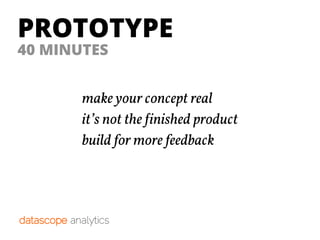
make your concept real
it’s not the !inished product
build for more feedback
40 MINUTES
PROTOTYPE
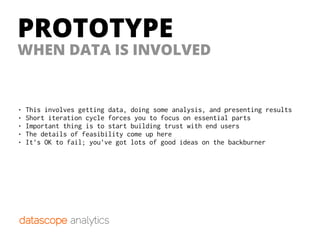
WHEN DATA IS INVOLVED
• This involves getting data, doing some analysis, and presenting results
• Short iteration cycle forces you to focus on essential parts
• Important thing is to start building trust with end users
• The details of feasibility come up here
• It’s OK to fail; you’ve got lots of good ideas on the backburner
THANKS
Dean (@deanmalmgren)
Mike (@mstringer)
Laurie (@laurieskelly)

Design thinking for dummies (data scientists)